348 Volume-4, Issue-4, August-2014,ISSN No.: 2250-0758 International Journal of Engineering and Management Research
Available at:
Page Number: 348-358
An Over-View of Coffee Production and Productivity in Karnataka
H.S. Sunanda1, Dr. N.Nagaraja2 1
Research Scholar, Department of Studies in Commerce, University of Mysore, Mysore, INDIA 2
Associate Professor, Department of Studies in Commerce, University of Mysore, Mysore, INDIA
ABSTRACT
The coffee industry of India is t
I.
INTRODUCTION
Coffee is one of the most widely traded agricultural commodities in the world. Coffee occupies a place of pride among plantation crops grown in India. In the present study researcher found the coffee production and productivity in the state of Karnataka, along with this objective study is also focused on production in India, to achieve the aforesaid objectives data gathered from primary and secondary sources. To support the objective hypothesis is also tested by using Analysis of Variance tool. From the present study is found that that the production and productivity of coffee in the state of Karnataka is showing an up-ward momentum i.e. production of coffee in Karnataka with that of total planted area in the state has shown a marginal increase of 03% and a rate of shift from Arabica to Robusta is similar. For the last six decades the area of production is multiplied by almost four and half times and the productivity by a significant sixteen times. From the present study it also found that Karnataka contributed 2, 30,225 metritonnes (72.35%) followed by Kerala with 64,200 metric tonnes (20.15%) and Tamil Nadu with 17,370 metric tonnes (5.40%). The Non Traditional Areas comprising Andhra Pradesh & Odisha and North Eastern Region made up the remaining 6,720 metric tonnes (2.10%).
Keywords--- Coffee Production, Productivity,
Coffee is one of the most widely traded agricultural commodities in the world. It is farmed in 80 countries and exported by over 50 in Central and South America, Africa and Asia. The 25 million coffee farmers in the developing countries are mostly small‐ scale producers. More than a 100 million people are engaged in
producing and processing coffee. Clearly, the production of coffee has a significant impact on the economic development of the producing areas and their environment. Coffee bean prices often below low cost of production unleaded a series of adverse consequences among rural workers and small scale farmers. As handful of transnational corporations control the market. There are more than 50 major coffee producing countries in the world. Brazil is one of leading producers of coffee in the world. It produces all most 1/3 of the world’s coffee production. India’s share to the global output is just around 4%.
Coffee occupies a place of pride among plantation crops grown in India. Indian coffee is grown in one of the most sensitive hotspots in the world, called the Western Ghats, which is a treasure house for flora and fauna. Cultivation of this stimulating beverage crop is mainly confined to the southern states of Karnataka, Kerala, Tamilnadu and Andhra Pradesh. It is also grown to a small extent in all most every states of North Eastern belt and some parts of West Bengal considered as non-traditional belt.
India is the only country that grows all of its coffee under shade. Indian coffee is making dent in worldwide as quality coffee and eco-friendly coffee. Coffee cultivation is instrumental in preserving the precious forest eco-system in traditional areas while in non-traditional areas coffee was introduced to check the production or shift cultivation and thus to control denudation of forest and also soil-erosion. Every plantation acts as a wild life sanctuary. Rare species of birds nest inside the coffee plantation. Water holes for the purpose of irrigation act as water source for wildlife such as wild boar, deer, rabbits etc.
Production of Coffee in Major States/Districts of India (in MTs)
State Post blossom estimation 2014-15 Final estimate 2013-14
Arabica Robusta Total Arabica Robusta Total
Karnataka
Chikmagalur 41,170 40,000 81,170 38,250 30,640 68,890
Kodagu 20,150 113,000 133,150 21,040 90,820 111,860
349
Sub total 80,700 167,600 248,300 78,440 132,660 211,100
Kerala
Wayanad 0 57,900 57,900 0 56,425 56,425
Travancore 900 7,300 8,200 900 6,700 7,600
Nelliampathies 1,175 1,600 2,775 1,100 1,550 2,650
Sub total 2,075 66,800 68,875 2,000 64,675 66,675
Tamil Nadu
Pulneys 7,575 375 7,950 6,975 325 7,300
Nilgiris 1,600 3,775 5,375 1,800 3,950 5,750
Shevroys (Salem) 2,700 50 2,750 3,875 50 3,925
Anamalais (Coimbatore) 1,300 500 1,800 1,300 500 1,800
Sub total 13,175 4,700 17,875 13,950 4,825 18,775
Non-Traditional areas
Andhra Pradesh 8,790 70 8,860 7,250 70 7,320
Orissa 620 0 620 440 0 440
Sub Total 9,410 70 9,480 7,690 70 7,760
North Eastern Region 140 80 220 120 70 190
Grand Total (India) 105,500 239,250 344,750 102,200 202,300 304,500
Source: Coffee Board, Ministry of Commerce and Trade, Government of India
II.
STATEMENT OF THE
PROBLEM
Surplus of research works were carried out generally and specifically on coffee industry and its constituents such as, genus of coffee, species of coffee, cultivated species of coffee in general and particularly on popularity of Arabica, Robusta, coffee species, growth behavior of coffee, flowers and flowering, pollination, fertilization and fruit, beans and seeds, variability studies, quality of breeding, environmental and physiological factors affecting coffee quality, output, revenue and cost of coffee produce. At the mean while there was no good research works had been carried out particularly production and productivity of coffee. So that, researcher has found that there is significant scope for research on coffee production and productivity in Karnataka, hence study chosen.
III.
OBJECTIVES OF THE STUDY
1. To understand the importance of coffee industry. 2. To study the Production of coffee in India. 3. To know the incentive packages offered by the Government.
4. To study the Coffee Production and Productivity in Karnataka.
5. To offer suitable suggestion based on findings of the study.
IV.
TESTING OF HYPOTHESIS:
H0: Various incentive packages offered by the government impact on the production
H1
V.
SCOPE OF THE STUDY
: Various incentive packages offered by the government do not impact on the production
The present study is confined to three districts of Karnataka which includes Coorg, Chikmagalur and Hassan. out of three districts three hundred coffee growers 150, 100, and 50 coffee growers were selected respectively, which consist of Very Small, Small, Medium and large scale growers of coffee and the growers those who are following traditional and modern methods of plantation of coffee.
VI.
RESEARCH METHODOLOGY
To achieve the aforesaid objectives data is gathered from primary and secondary sources of data. Primary data gathered from a structured questionnaire. Secondary data gathered from various published reports, research articles, and other official circulars.
VII.
TOOLS USED FOR ANALYSIS
To test the hypothesis, Analysis of Variance
350
VIII.
DATA ANALYSIS AND DISCUSSION
Table No. 1
Table Showing Production of coffee in India since 1950-51[In MT]
Base Year - 1950-51=100
Year Arabica % Changes
in Producti
on (In %)
Robusta % Changes
in Producti
on (In %)
Total Changes
in Productio
n (in %)
1950-51 15511 82 100 3383 18 100 18893 100
1960-61 39526 58 255 28643 42 847 68169 361
1970-71 58348 53 376 51883 47 1534 110231 583
1980-81 61262 52 395 57384 48 1696 118646 628
1990-91 78311 46 505 91415 54 2702 169726 898
2000-01 104400 35 673 196800 65 5817 301200 1594
2010-11 94140 31 607 207860 69 6144 302000 1598
Sources: Coffee Board
Interpretation:
The total production of coffee in the country in 1950-51 was just 18,893 MT, of which 15,511 MT Arabica and 3,382 MT Robusta in the ratio of 82:18. Average production of coffee of our country for the last 1 decade is 2, 79,898 MT. From the table given above, we can arrive at a conclusion that the contribution of Robusta coffee to the total production has been increased year after year and Arabica has been declined.
Compared to the production of Arabica in the decade1950-51, from the decade 1960-61 to the decade 2000-01 there is a slow rate of increase in production. But in the decade 2010-11 there is a little decline in the production when compared to immediate previous decade. In case of Robusta there is a recognizable increase in the production during all the 6 decades when compared to the decade 1950-51.
Table No. 2
Planted Area of Coffee in India since 1950-51[In hectares]
Base Period195051=100
Year Arabica % Changes
In %
Robusta % Changes In %
Total Changes In %
1950-51 67613 73 100 24910 27 100 92523 100
1960-61 70650 59 104 49670 41 199 120320 130
1970-71 80433 59 119 55030 41 221 135463 146
1980-81 109454 53 162 98815 47 397 208269 225
1990-91 127934 47 189 142887 53 574 270821 293
2000-01 167679 48 248 179037 52 719 346716 375
2010-11 197930 49 293 206715 51 830 404645 437
Sources: Coffee Board
Interpretation:
Planted area of coffee in India since 1950-51 is increased considerably. It was 92,523 hectares in 1950-51 of which 73% Arabica and 27% Robusta. In 2010-11 the
351 increased by 4.37 times. Increase in production is much
higher than the increase in the area of plantation during all periods. During 2010-11 increase in total production is
3.66 times of increase in the area of plantation - Arabica 2.07 times and Robusta 7.4 times.
Table No. 3
Table Showing Productivity of Coffee in India since 1950-51(Kg\ha)
Year Arabica Changes in
% Robusta
Changes in
% Overall Changes in %
1950-51 229 100 136 100 204 100
1960-61 559 244 577 424 567 278
1970-71 725 317 943 693 814 399
1980-81 625 272 623 458 624 306
1990-91 722 315 795 585 759 372
2000-01 713 311 1175 864 959 470
2010-11 575 251 1056 776 838 411
Source: Coffee Statistics, Coffee Board *Base Year: 1950=100
Interpretation:
Above table reveals that compared to Robusta, productivity of Arabica was 1.7 times higher in 1950-51, but in 2010-11 it is reversed, i.e., productivity of Robusta is around 1.8 times higher than the productivity of Arabica. During 1960-61 and 1980-81 productivity of both are almost same, but in the remaining periods productivity of Robusta is higher.
There are more than 50 major coffee producing countries in the world. Brazil is on of leading producers of
coffee in the world. It produces all most 1\3 of the world’s coffee production. India’s share to the global output is just around 4%.
Global coffee production averaged around 6 million tons a year during the 1990s. Increased output from Brazil and Vietnam saw production grow to an average of 7.6 million tons a year between 2007 and 2011,peaking at a record 8.05 million tons in 2010.
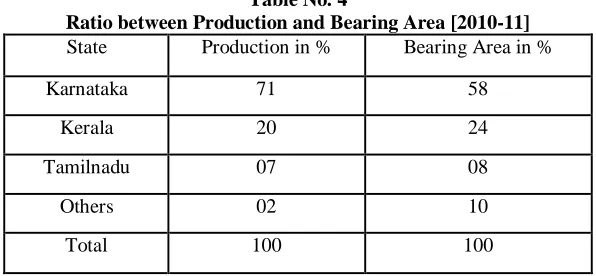
Table No. 4
Ratio between Production and Bearing Area [2010-11]
State Production in % Bearing Area in %
Karnataka 71 58
Kerala 20 24
Tamilnadu 07 08
Others 02 10
Total 100 100
Sources: Survey data
Interpretation:
Share of coffee production of Karnataka to the total coffee production of India is much higher than the share of bearing area of coffee of Karnataka to the total bearing area of coffee of India. Share of bearing area and share production is little less in case of Kerala and Tamilnadu.
But in case of others share of production is much lesser than the share of bearing area as shown in the table below:
352 Table No. 5
Table Showing Planted Area of Coffee in Karnataka in Hectares from 2006-07 to 2011-12
Year
Arabica % Robusta % Total Change in %
(2006-07=100)
2006-07
1,09,274 49 1,13,913 51 2,23,187 100
2007-08 1,09,895 49 1,15,563 51 2,25,458 101
2008-09
1,10298 49 1,16,602 51 2,26,900 102
2009-10
1,10,023 48 1,17,317 52 2,27,340 102
2010-11
1,09,773 48 1,17,977 52 2,27,750 102
2011-12
1,09,128 48 1,20,530 52 2,29,658 103
Source: Coffee Statistics, Coffee Board
Interpretation:
The above table depicts the area of coffee planted in Karnataka exhibits the spread of the plantation for the period 2006-07 to 2011-12. Taking 2006-07 as base year percentage of increase\decrease of two important varieties viz., Arabica and Robusta is evaluated and found, only a
marginal 01% increase in Arabica and Robusta respectively. It also depicts that there is a clear 01% shift from Arabica to Robusta in the planted area for a six year period. However, when we look into the overall planted area for the same period, there is a marginal 03% increase
is noticed.
District-wise Plantation of Coffee in Karnataka
Table No. 6
Table Showing Plantation of Coffee in Chikmagalur District of Karnataka State from 2006-07 to 2012-13(in hectares)
Year
Arabica % Robusta % Total
Changes in % (2006-07=100)
2006-07 56,590 65 31,078 35 87,668 100
2007-08 56,590 65 31,078 35 87,668 100
2008-09 56,995 64 31,565 36 88,560 101
2009-10 56,995 64 31,650 36 88,645 101
2010-11 56,995 64 31,650 36 88,645 101
2011-12 57,000 64 31,853 36 88,853 101
Source: Coffee Statistics, Coffee Board
Interpretation:
When we look into the planted area of coffee pertaining to the district Chikmagalur, for a six years period 2006-07 to 2011-12, taking 2006-07 as base year only 01% decline in Arabica and 01% increase in Robusta
353 Table No. 7
Table Showing Plantation of Coffee in Coorg District of Karnataka State from 2006-07 to 2012-13(in hectares)
Year Arabica % Robusta % Total Changes in %
(2006-07=100)
2006-07 27,434 27 73,795 73 1,01,229 100
2007-08 28,830 28 74,495 72 1,03,325 102
2008-09 28,828 28 74,497 72 1,03,325 102
2009-10 28,803 28 74,777 72 1,03,580 102
2010-11 28,803 28 74,777 72 1,03,580 102
2011-12 28,053 27 76,727 73 1,04,780 103
Source: Coffee Statistics, Coffee Board
Interpretation:
The planted area of Coorg district for the period 2006-06 to 2011-12, taking 2006-07 as base year shows not much of a difference between Arabica and Robusta, . From the base year for the next four years, only 01%
increase in Arabica and 01% decrease in Robusta is noticed in the planted area. But in 2011-12 again planted area of both Arabica and Robusta are retained the base year status. However, there is a 03% increase in the total planted area of the district for the same period.
Table No. 8
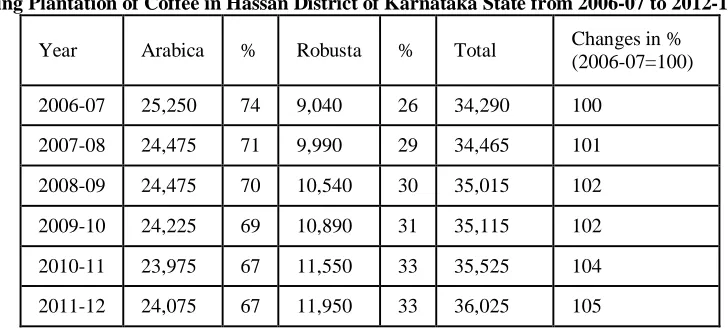
Table Showing Plantation of Coffee in Hassan District of Karnataka State from 2006-07 to 2012-13(in hectares)
Year Arabica % Robusta % Total Changes in %
(2006-07=100)
2006-07 25,250 74 9,040 26 34,290 100
2007-08 24,475 71 9,990 29 34,465 101
2008-09 24,475 70 10,540 30 35,015 102
2009-10 24,225 69 10,890 31 35,115 102
2010-11 23,975 67 11,550 33 35,525 104
2011-12 24,075 67 11,950 33 36,025 105
Source: Coffee Statistics, Coffee Board
Interpretation:
The planted area of Hassan district shows a different picture altogether as compared to other two districts. Taking 2006-07 as base year, we notice a 07% decline in the planted area of Arabica and a 07% increase in the planted area of Robusta variety. Overall increase of 05% in the total planted area is noticed. The table clearly depicts that there is 07% shift in the area of cultivation
354
Production of Coffee in Karnataka
Table No .9
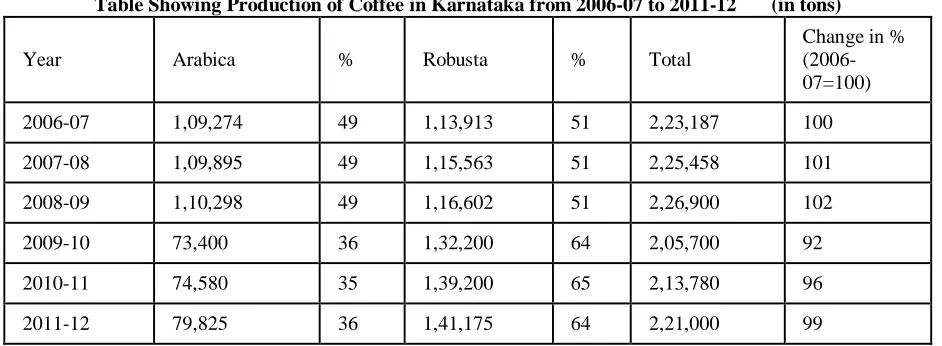
Table Showing Production of Coffee in Karnataka from 2006-07 to 2011-12 (in tons)
Year Arabica % Robusta % Total
Change in % (2006-07=100)
2006-07 1,09,274 49 1,13,913 51 2,23,187 100
2007-08 1,09,895 49 1,15,563 51 2,25,458 101
2008-09 1,10,298 49 1,16,602 51 2,26,900 102
2009-10 73,400 36 1,32,200 64 2,05,700 92
2010-11 74,580 35 1,39,200 65 2,13,780 96
2011-12 79,825 36 1,41,175 64 2,21,000 99
Source: Coffee Statistics, Coffee Board
Interpretation:
Production of coffee in Karnataka for a six years period from 2006-07 to 2011-12 is depicted in the table mentioned above. By taking 2006-07 as base year, two varieties - Arabica and Robusta viewed. Both the varieties have not shown any change for the first three years. But for the next three years, the production of Arabica has declined almost 14% and the same is gained by Robusta.
But when we look into the total production, there is not much of a difference from that of base year, except in the year 2009-10.
If we compare the production of coffee in Karnataka with that of total planted area in the state, has shown a marginal increase of 03% and a rate of shift from Arabica to Robusta is similar.
District-wise Production of Coffee in Karnataka
Table No. 10
Table Showing Production of Coffee in Chikmagalur District of Karnataka State from 2006-07 to 2011-12(in tons)
Year Arabica % Robusta % Total Changes in%
(2006-07=100)
2006-07 56,590 65 31,078 35 87,668 100
2007-08 56,590 65 31,078 35 87,668 100
2008-09 38,850 54 32,900 46 71,750 82
2009-10 37,450 53 32,700 47 70,150 80
2010-11 36,975 50 36800 50 73,775 84
2011-12 39,775 52 36,150 48 75,925 87
Source: Coffee Statistics, Coffee Board
Table No.11
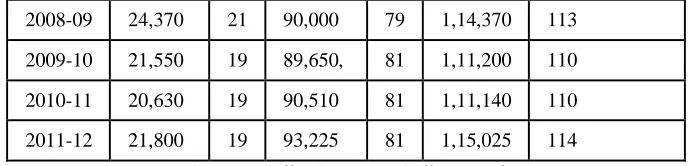
Table Showing Production of Coffee in Coorg District of Karnataka State from 2006-07 to 2011-12(in tons)
Year Arabica % Robusta % Total
Changes in % (2006-07=100)
2006-07 27,434 27 73,795 73 1,01,229 100
355
2008-09 24,370 21 90,000 79 1,14,370 113
2009-10 21,550 19 89,650, 81 1,11,200 110
2010-11 20,630 19 90,510 81 1,11,140 110
2011-12 21,800 19 93,225 81 1,15,025 114
Source: Coffee Statistics, Coffee Board
Table No.12
Table Showing Production of Coffee in Hassan District of Karnataka State from 2006-07 to 2011-12(in tons)
Year Arabica % Robusta % Total
Changes in % (2006-07=100)
2006-07 25,250 74 9,040 26 34,290 100
2007-08 24,475 71 9,990 29 34,465 101
2008-09 14,650 65 7,725 35 22,375 65
2009-10 14,400 59 9,950 41 24,350 71
2010-11 16,975 59 11,890 41 28,865 84
2011-12 18,250 61 11,800 39 30,050 88
Source: Coffee Statistics, Coffee Board
Interpretation:
If look into district-wise production spread for a six years period from 2006-07 to 2011-12 for Arabica and Robusta the following inferences are drawn: Taking 2006-07 as the base year, in Chikmagalur district there is a gradual decline in the production of Arabica by around 15%, but the production of Robusta has increased by the same rate. However, the total production has shown a gradual decline of 13%. In Coorg district production of Arabica has declined by 08% and the same 08% is gained by Robusta for the six years period from 2006-07 to 2011-12. But, if we look into the total production for the above said period, it shows 14% increase. In Hassan district, production of Arabica has shown a decline of about 14%
and the same rate is gained by Robusta. But in case of total production, the district Hassan has followed the neighboring Chikmagalur district. However, in the years 2008-09 and 2009-10 the decline in the total production is as high as 35% and 29% respectively.
Among the 3 districts, the production trend for a six years period from 2006-07 to 2011-12, Coorg district shows a gradual increase up to 14%. But vice-versa the case in Chikmagalur and Hassan districts. It means the productivity rate is greater in Coorg district than Chikmagalur and Hassan districts. It implies that productivity of Robusta is higher than Arabica, because in Coorg district the area of plantation has a higher share of Robusta coffee.
Table No.13
Table Showing District-wise Average Coffee Planted Area of Karnataka for Six Years from 2006-07 to 2011-12
Districts Arabica % Robusta % Total %
Chikmagalur 56,861 52 31,479 27 88,340 39
Coorg 28,459 26 74,845 64 1,03,304 46
Hassan 24,413 22 10,660 09 35,073 15
Total 1,09,633 100 1,16,984 100 2,26,713 100
356 Table No.14
Table Showing District-wise Average Coffee Production of Karnataka for Six Years from 2006-07 to 2011-12
Districts Arabica % Robusta % Total %
Chikmagalur 44,372 51 33,451 26 77,823 36
Coorg 24,102 28 85,279 66 1,09,381 51
Hassan 19,000 21 10,066 08 29,066 13
Total 87,474 100 1,28,796 100 2,16,270 100
Source: Coffee Statistics, Coffee Board
Interpretation:
In order to know the share of contribution regarding planted area and production by three major districts of Karnataka viz., Chikmagalur, Coorg and Hassan, a six years averages, from 2006-07 to 2011-12 have been mentioned in the tables shown above. Coffee growing areas in Karnataka are Chickmagalur, Coorg and Hassan districts. Major contributor to the total production of coffee of Karnataka is Coorg, around 51% in the rate of around 22 and 78 Arabica and Robusta fallowed by Chickmagalur around 36% in the rate of 57 and 43 Arabica and Robusta, Hassan about 13% in the rate of around 65 and 35 Arabica and Robusta respectively.
Percentage of coffee planted area of Chikmaglur district to total coffee planted area of Karnataka is around 39%. But the percentage of coffee production of the
district to total coffee production of Karnataka state is around 36%. Percentage of coffee planted area of Coorg district to total coffee planted area of Karnataka is around 46%. But the percentage of coffee production of Coorg district to total coffee production of Karnataka state is around 51%. Whereas percentage of coffee planted area of Hassan district to total coffee planted area of Karnataka is around 15%. But the percentage of coffee production of Hassan district to total coffee production of Karnataka state is around 13%. Hence, among these 3 districts overall productivity is more in Coorg district. This is because, major portion of coffee plantation in Coorg district is Robusta variety, which proves that, the productivity of Robusta is comparatively higher than Arabica, whether the production is considered annually or on an average basis.
IX.
TESTING OF HYPOTHESIS
H0: Various incentive packages offered by the government impact on the production H1: Various incentive packages offered by the government do not impact on the production
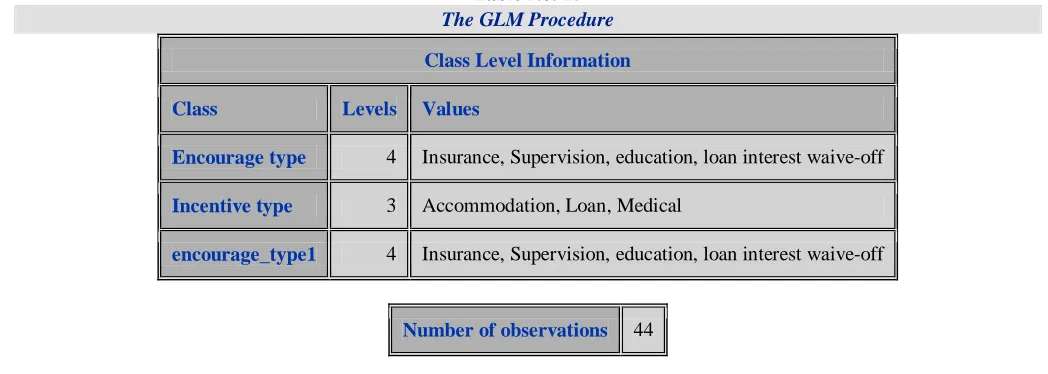
Table No: 15
The GLM Procedure
Class Level Information
Class Levels Values
Encourage type 4 Insurance, Supervision, education, loan interest waive-off
Incentive type 3 Accommodation, Loan, Medical
encourage_type1 4 Insurance, Supervision, education, loan interest waive-off
357 Table No: 16
The GLM Procedure
Dependent Variable: parchment
Source DF Sum of Squares Mean Square F Value Pr > F
Model 3 10.8395056 3.6131685 0.56 0.6418
Error 40 256.1377671 6.4034442
Corrected Total 43 266.9772727
R-Square Coeff Var Root MSE parchment Mean
0.040601 33.63810 2.530503 7.522727
Table No: 17
Source DF Type III SS Mean Square F Value Pr > F
encour_code 1 4.01964032 4.01964032 0.63 0.4329
help_type_code 1 3.45686987 3.45686987 0.54 0.4668
incent_code 1 0.19946062 0.19946062 0.03 0.8608
Analysis
From table No. 17, it is found that various incentive packages offered by the government impact on the production, (when Pr > F value is less than 0.05 null Hypothesis is rejected and Pr > F value greater than 0.05 null hypothesis is accepted). From the above table tested values is greater than 0.05, so null hypothesis is accepted. Hence null hypothesis is accepted and alternative hypothesis is rejected.
X.
CONCLUSION
Agriculture has been a major contributor to the national economy in India throughout the post independence period. No doubt its share in the national income has, of late, come down. Even the share of population dependent on agriculture has fallen according to the census of 2011.
The suggestions given in this treatise will have to be taken up not in isolation but as a package. It has to be an attempt to address the problems simultaneously from all directions. All this can happen only if the policy makers and the farmers themselves believe that they can rework on the set agenda. Confidence in their own potential and correct means to realize this potential is the order of success of agriculture anywhere in the world. Liberalized
markets give us enough opportunity for technology transfer. This aspect also is to be learnt by learning from world’s leading coffee producers. Reduction of cost of cultivation, increase of yield and tapping new markets will have to be the ‘mantra’ if the coffee economy is to be strengthened.
To conclude, that the production and productivity of coffee in the state of Karnataka is showing an up-ward momentum. For the last six decades the area of production is multiplied by almost four and half times and the productivity by a significant sixteen times. However, there is a churn in the variety of coffee bean. Arabica has taken a back seat compared to Robusta. In all it is evident that the Coffee Industry in Karnataka is flourishing both in terms of production and productivity.
REFERENCES
[1] De Sola, Herbert (2000). “Selecting and Diminishing: Indian Coffee”, a Paper presented in ICO World Coffee conference (May 2001).
[2] Chengappa and Muralidharan (1981). ‘Journal of Coffee Research’, 11(3), pp.81-88.
358 [4] Jamsheed Ahmed and Sreenivasan (1990).
‘Indian Coffee’, LIV (6), pp.9-12.
[5] International Coffee Organisation. (2014). World coffee trade (1963 – 2013): A review of the markets, challenges and opportunities facing the sector. London: International Coffee Organisation.
[6] Sharma, Subhash and A.Damodaran, (1997). “Coffee Export Strategy for 9th Five Year Plan, in: ‘Indian Coffee’
[7] Shivram Dass, et al. (1985). “Quantum, Unit Value and Export Value of Coffee Exports”, Agricultural Situation in India. (pp.751-755)
[8] Srivasthava, H.C. B.Vatsya, K.K.G.Menon. Plantation Crops, Opportunities and Constraints, Vol I and II, New Delhi: Oxford and IBH Publishing Co-Pvt.,Ltd
[9] St.Joseph’s College of Commerce, Bangalore (2001). “Coffee Marketing in India - A Study with special reference to the State of Karnataka”.
[10] The Fair Trade Foundation (1997). “Problems facing the Coffee Growers”.
[11] Thimma Reddy, et al. (1991). ‘Journal of Coffee Research’, 21 (2), pp.127-134.
[12] Thimmaiah, T.M. (2000-01). “An Analysis of the Attitude towards Coffee Future Trading”.
[13] Vaswani, L.K. (1996). “Integration of Indian Coffee Trade with Global Trends - Issues and Challenges”.
![Table Showing Production of coffee in India since 1950-51[In MT] Table No. 1 Base Year - 1950-51=100](https://thumb-us.123doks.com/thumbv2/123dok_us/9784312.1963887/3.612.48.576.118.320/table-showing-production-coffee-india-table-base-year.webp)