Volume 2, Issue 2, February 2013
Page 150
A
BSTRACTThe popularity of Wireless Sensor Networks (WSN) has increased tremendously in recent time due to growth in Micro-Electro-Mechanical Systems (MEMS) technology. WSN has the potentiality to connect the physical world with the virtual world by forming a network of sensor nodes. Here, sensor nodes are usually battery-operated devices, and hence energy saving of sensor nodes is a major design issue. To prolong the network‘s lifetime, minimization of energy consumption should be implemented at all layers of the network protocol stack starting from the physical to the application layer including cross-layer optimization. In Mobile ADHOC Networks (MANET) or Wireless Sensor Networks (WSN), the sensors or the mobile transceivers are randomly deployed in the sensor field which brings the problem of coverage for all or some of the nodes. As the coverage problem can increase overall effective distance of all nodes from the sensor which further affects overall throughput & power required by the system. It is a unique problem and in maximizing coverage, the sensors need to be placed in a position such that the sensing capability of the network is fully utilized to ensure high quality of service. The main objective of the paper is to find optimum route distance between nodes and sensors. And power should be less consummated between locations points and sensors an maximum utilization of bandwidth.
Keywords: Wireless Sensor Networks; Home Area Network; BFO; MATLAB
1.
I
NTRODUCTIONWireless Sensor Networks (WSN) have gained world-wide attention in recent years due to the advances made in wireless communication, information technologies and electronics field [6,9].The concept of wireless sensor networks is based on a simple equation: Sensing + CPU + Radio = Thousands of potential applications [6] . It is an ―In situ‖ sensing technology where tiny, autonomous and compact devices called sensor nodes or motes deployed in a remote area to detect phenomena, collect and process data and transmit sensed information to users. The development of low-cost, low-power, a multifunctional sensor has received increasing attention from various industries. Sensor nodes or motes in WSNs are small sized and are capable of sensing, gathering and processing data while communicating with other connected nodes in the network, via radio frequency (RF) channel.
WSN term can be broadly sensed as devices range from laptops, PDAs or mobile phones to very tiny and simple sensing devices. At present, most available wireless sensor devices are considerably constrained in terms of computational power, memory, efficiency and communication capabilities due to economic and technology reasons. That‘s why most of the research on WSNs has concentrated on the design of energy and computationally efficient algorithms and protocols, and the application domain has been confined to simple data-oriented monitoring and reporting applications. WSNs nodes are battery powered which are deployed to perform a specific task for a long period of time, even years. If WSNs nodes are more powerful or mains-powered devices in the vicinity, it is beneficial to utilize their computation and communication resources for complex algorithms and as gateways to other networks.
2.
W
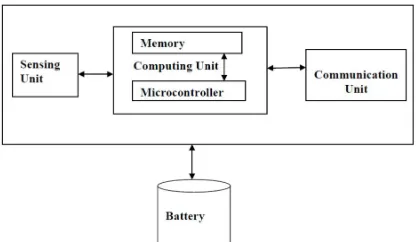
IRELESS SENSOR NODE ARCHITECTUREThe basic block diagram of a wireless sensor node is presented in Figure 1.1. It is made up four basic components: a sensing unit, a processing unit, a transceiver unit and a power unit. There can be application dependent additional componentssuch as a location finding system, a power generator and a 150obilize.
Optimization using Bacteria Foraging
Optimization Algorithm: A Review
Er. Navjot Sharma1, Er. Sunny Behal2
1
Lecturer of Computer Engg. Department of Baba Heera Singh Bhattal College of Engg. & Tech., India
2
Volume 2, Issue 2, February 2013
Page 151
Figure 1.1: Architecture of a Wireless Sensor Node3.
A
PPLICATIONS OFW
IRELESSS
ENSORN
ETWORKSAccording to a new report from research firm ON World ―The home market for Wireless Sensor Networks (WSN) will reach US$6 billion a year by 2012‖. The prediction includes both products and services centred on in-home energy management and health monitoring. Meanwhile, ON World predicts the market for "Home Area Network" (HAN) energy management solutions to reach 20 million homes worldwide by 2013.
Wireless Sensor Networks may consist of many different types of sensors such as seismic, low sampling rate magnetic, thermal, visual, infrared, acoustic and radar. They are able to monitor a wide variety of ambient conditions that include temperature, humidity, vehicular movement, lightning condition, pressure, soil makeup, noise levels, the presence or absence of certain kinds of objects, mechanical stress levels on attached objects, and the current characteristics such as speed, direction and size of an object. WSN applications can beclassified into two categories [3] as shown in Figure 1.2:
Monitoring
Tracking
In monitoring we have:
Military security Detection.
Habitat Animal Monitoring.
Business Inventory Monitoring.
Health Patient Monitoring.
Environmental Monitoring.
In Tracking we have:
Military Enemy Tracking.
Habitat Animal Tracking.
Business Human Tracking.
4.
B
ACKGROUNDW
ORKWireless sensor networks have their own unique characteristics which create new challenges for the design of routing protocols for these networks. First, sensors are very limited in transmission power, computational capacities, storage capacity and most of all, in energy. Thus, the operating and networking protocol must be kept much simpler as compared to other ad hoc networks. Second, due to the large number of application scenarios for WSN, it is unlikely that there will be a one-thing-fits-all solution for these potentially very different possibilities.
In 2002, Passino [1] proposed Bacterial Foraging Optimization Algorithm (BFOA) for distributed optimization and control. BFA is based on the foraging behavior of Escherichia Coli (E. Coli) bacteria present in the human intestine and already been in use to many engineering problems including multiple robot co-ordination. According to paper, BFA is better than Particle Swarm Optimization in terms of convergence, robustness and precision.
Volume 2, Issue 2, February 2013
Page 152
5.
O
BJECTIVE OF THEW
ORK1) Optimum route distance between nodes and sensors
2) Optimum or least power consumption between location points and sensors. 3) Maximum Bandwidth utilization.
4) Increase in Sensor Coverage.
5) Optimization of Mean location points of wireless sensors.
6.
P
ROPOSED STEPS TO ACHIEVE THEO
BJECTIVE With minimum number of sensor nodes having maximum coverage in the network and the nodes are within the communication range.
By making optimized wireless clusters using the Euclidean distance from all the location nodes to the Sensor Nodes.
By making the Clusters of the sensor nodes with a corresponding central transceiver point which will be further chosen from a group of sensors.
By Optimizing the Sensors position within each individual cluster, using BFO.
7.
B
ACTERIALF
ORAGINGO
PTIMIZATION FOR CLUSTER HEAD SELECTIONBacterial Foraging Optimization (BFO) [2] is a population-based numerical optimization algorithm. In recent years, bacterial foraging behaviour has provided rich source of solution in many engineering applications and computational model. It has been applied for solving practical engineering problems like optimal control [2], harmonic estimation channel equalization [10] etc. In this thesis, BFO has been used for cluster head selection to provide improved energy efficiency in routing.
7.1 Bacteria Foraging Optimization
The process of natural selection tends to eliminate animals with poor foraging strategies and favour the propagation of genes of those animals that have successful foraging strategies, since they are more likely to enjoy reproductive success. After many generations, poor foraging strategies are either eliminated or shaped into good ones. This activity of foraging led the researchers to use it as optimization process. The Escherichia Coli or E. coli bacteria that are present in our intestines also undergo a foraging strategy. The control system of these bacteria that dictates how foraging should proceed can be subdivided into four sections, namely, chemotaxis, swarming, reproduction, and elimination and dispersal.
7.2Bacterial Foraging Optimization Algorithm:
The algorithm that models bacterial population chemotaxis, swarming, reproduction, elimination, and dispersal is given here (initially j=k=l=0). For the algorithm, updates to the θi automatically result in updates to P number of sensor nodes. The flowchart of the BFO is shown in Figure 4.2.The procedure of BFO is as follows.
1) First of all, get sample no of sensor nodes to be optimized
2) Initialize, the value of p,S,Nc,N,s,Nre, Ned, Ped and the c(i), i=1,2… S . The initial values for the θi, i = 12…. S
must be chosen.
3) Elimination-dispersal loop: l = l +1 4) Reproduction loop: k=k+1
5) Chemotaxis loop: j=j+1
a) For i =1, 2….S, take a chemotactic step for bacterium i as follows.
b) Compute cost function J(I,j,k,l) . The cost function of the BFO is calculated in the following way: First sum the distance squares from each node to the CH for an one cluster. Then this value for all the clusters should be summed over. )
c) Let J last)=J(I,j,k,l) to save this value since we may find a better value via a run.
Volume 2, Issue 2, February 2013
Page 153
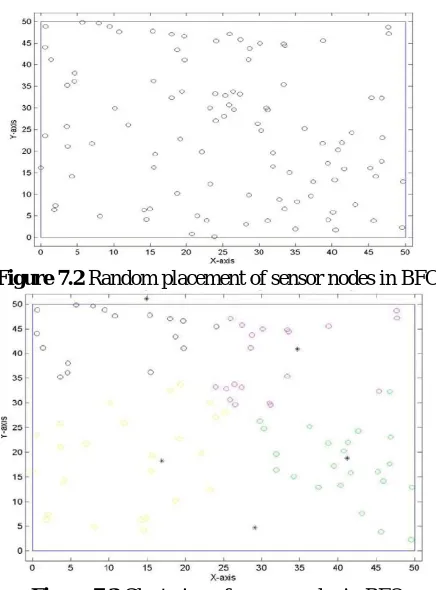
Figure 7.1 Initial positions of sensor nodes during simulationFigure 7.2 Random placement of sensor nodes in BFO
Figure 7.3 Clustering of sensor nodes in BFO
8.
C
ONCLUSIONIt is seen that BFO provides better performance than other popular techniques. However, the computational complexity of BFO for applicability to WSNs still remains a challenge. The use of Bacteria foraging algorithm firstly for WSNs for enhancing network lifetime of sensor nodes. To validate the algorithm, simulations had been carried out using MATLAB. Simulation results showed better performance of BFO as compared to other clustering protocols
.
9.
F
UTURED
IRECTIONSTo conclude the paper, the following are some suggestions for the future work which can be done. In this paper, bio-inspired clustering algorithm Bacteria Foraging has been used. Other bio-bio-inspired algorithms like Ant colony optimization, artificial Immune system, Genetic algorithm (significant time and power consuming) can also be compared to BFO; but the challenge of reducing computational complexity still remains. Comparable study of computational complexity of different algorithm need to be analyzed.
R
EFERENCES[1] K. M. Passino, "Biomimicry of bacterial foraging for distributed optimization and control," Control System Magazine,IEEE, vol. 22, pp. 52-67, June 2002.
[2] Babita Majhi and G. Panda and A. Choubey, "On the Development of a Newe Adaptive Channel Equalizer using Bacterial Foraging Optimization Technique," in Annual IEEE india conference, 2006, pp. 1-6.
Volume 2, Issue 2, February 2013
Page 154
[7] A.W. Krings Z. (Sam) Ma, "Bio-Inspired Computing and Communication in Wireless Ad Hoc and Sensor Networks," Ad Hoc Networks,Elsevier, vol. 7, no. 4, pp. 742-755 , June 2009.
[8] S. Selvakennedy, S. Sinnappan, Yi Shang, "A biologically-inspired clustering protocol for wireless sensor networks," Computer Communications,Elsevier, vol. 30, pp. 2786-2801, 2007
[9] I. F. Akyildiz, W. Su, Y. Sankarasubramaniam, and E. Cayirci, "A survey on sensor networks," Communications Magazine,IEEE, vol. 40, pp. 102-114, 2002.