Meenakshi et al. World Journal of Pharmaceutical and Life Sciences
EFFECT OF OIL PULLING AS AN ADJUNCT TO SCALING AND ROOT PLANING ON
PLAQUE INDUCED GINGIVITIS
Dr. Meenakshi Mohan* and Dr. Sankari M.
Department of Periodontics, Saveetha Dental College, India.
Article Received on 06/04/2017 Article Revised on 25/04/2017 Article Accepted on 16/05/2017
INTRODUCTION
Oil pulling also known as oil swishing is an age old home remedy process mentioned in CharakSamhita and Sushrutha’sArthashastra and its use was a widely recommended detoxification technique in Ayurvedic therapy, called as KavalaGandoosha and KavalGraha in Ayurveda.[1] It is a traditional method used for oral and systemic health benefits. It was reported that it cured about 30 systemic illness including migraine, asthma and diabetes.[2,3] For many decades, it is being used as an alternative medicine in prevention of tooth decay, oral malodor, bleeding gums and throat infections.[4,5] Thus oil pulling is an effective preventive as well as curative therapy.[6] Various oils that can be used for oil pulling are coconut oil, cone oil, sesame oil, rice bran oil, sunflower oil and soya bean oil.[7]
The commonly used oil for oil pulling therapy, sesame oil is reported for its effectiveness in reducing bacterial growth and adhesion.[8] It was believed that the viscosity
Gingivitis, an inflamed condition of gingiva, considered to be one of the most common and highly prevalent periodontal disease. Gingivitis occurs due to the long term effect of microorganisms present in the form of biofilms in plaque. Antimicrobialmouth rinses like chlorhexidine are considered to be the “gold standard” which acts as an adjunct to mechanical plaque control.[11] Studies have reported that the long term use of hexidine alters taste sensation and stains the teeth, there is a requirement of home remedy which is economical as well as effective as chlorohexidine.[12] Hence this study aims to compare the efficiency of oil pulling in reducing the colony forming unit (CFU) with chlorhexidine as an adjunct to scaling and root planing (SRP).
MATERIALS AND METHODS
Study location
The study was conducted among the patients reported to the outpatient clinics of Saveetha Dental College and Hospitals, Chennai, Tamilnadu, India.
World Journal of Pharmaceutical and Life Sciences
WJPLSwww.wjpls.org SJIF Impact Factor: 4.223
*Corresponding Author: Dr. Meenakshi Mohan
Department of Periodontics, Saveetha Dental College, India.
ABSTRACT
Background: Oil pulling has been used extensively as a traditional Indian folk remedy for strengthening the teeth, gums and the jaw and to prevent decay, oral malodor, bleeding gums, dryness of the throat, and cracked lips. It is a widely recommended procedure in Ayurveda. Although chlorhexidine serves as a gold standard in mechanical plaque control, due to its chemical adverse effects, the study stresses on assessing the efficiency of oil pulling as an alternate to chlorhexidine. Aim: To compare the efficiency of oil pulling in reducing the colony forming unit (CFU) with chlorhexidine as an adjunct to scaling and root planing (SRP). Objective: The objective of the study is to find out whether oil pulling with sesame oil serves effective in controlling plaque accumulation. To assess its efficacy in maintaining gingival health and to compare the effectiveness of oil pulling in reduction of colon y forming microorganisms with chlorhexidine vas an adjunct to SRP.
Group A- Study group comprising of 10 patients, were instructed to use sesame oil for oil pulling everyday for the next 30 days after SRP was done.
Group B- Control group comprising of 10 patients, were instructed to use chlorhexidine mouth rinse for the next 30 days after SRP was done.
The study was approved by SRB andPatients included in the study were informed about the study and an informed consent was obtained.
Inclusion criteria
Subjects willing to participate
Subjects with moderate to severe plaque induced gingivitis
Subjects having atleast 20 permanent natural teeth
Subjects who hasn't used any mouthwash for the past 3 months
Subjects with no history of systemic illness
Exclusion criteria
Subjects with chronic or aggressive periodontitis
Subjects with a history of antibiotic usage in the past one month
Subjects allergic to the oil used
Subjects with systemic illness
Subjects using mouthwash regularly
Subjects under orthodontic treatment and those having intra oral prosthesis
Subjects who Smoke
Parameters assessed
Parameters assessed in this study are,
Gingival index [Silness & Loe, 1963]
Plaque index [Loe & Silness, 1967]
OHI-s index [Greene & Vermillon, 1963]
Total colony forming units [CFU]
The study group was instructed to use one table spoon of sesame oil for oil pulling in empty stomach. Swishing
should be done for atleast 15 to 20 mins until the oil turns thin and white after which the oral cavity should be rinsed off completely. The control group was instructed to use 0.02% chlorhexidine mouthwash for rinsing about half an hour after brushing.
Sample collection and study methodology
The baseline values of gingival index, plaque index and OHI-s index were recorded and the saliva samples of both the control and study group was collected in a sterile disposable container prior to Scaling and Root Planing (SRP). SRP was done to all the subjects with ultrasonic scaler unit and appropriate oral hygiene instructions were given. The study group was taut to perform oil pulling with sesame oil and was instructed to continue for the next 30 days in empty stomach and the control group was instructed to rinse with 0.2% CHX mouthwash for 30secs everyday. Patients from both the group were instructed to report to the clinic for follow-up on the 15th and 30th day from the day SRP was done. On the 15th and 30th day the gingival index, plaque index and OHI-s index were recorded to compare the difference with the baseline values, and saliva samples was also collected for microbiological analysis of total CFUs.
The samples were stored in 8 degree C until inoculation. The saliva samples were serially diluted and inoculated on Muller Hinton agar plates with proper labels to differentiate the sample group. The plates were then incubated for 24 hours at 37 degree C. The total number of colony forming units were counted and tabulated.
RESULTS
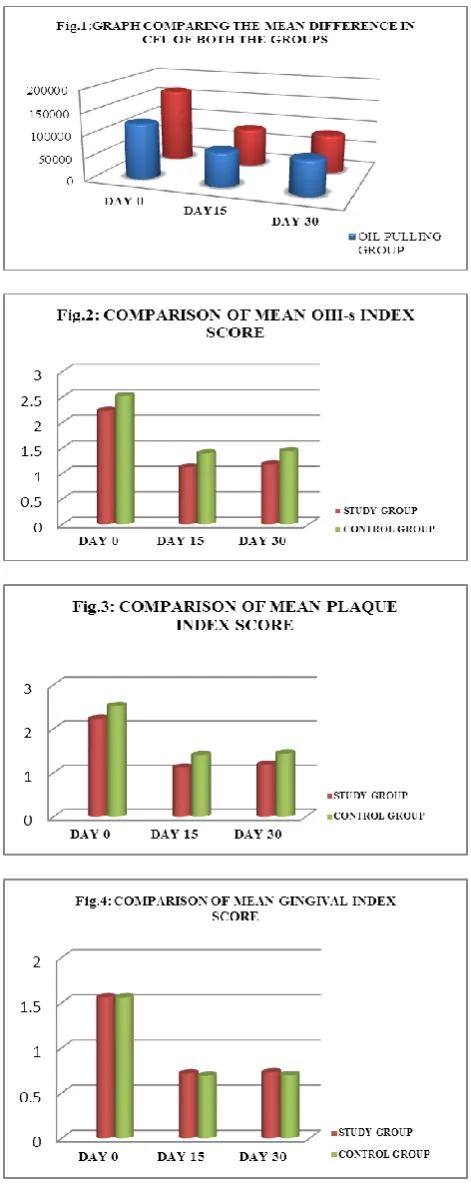
The plaque index, OHI-s index and gingival index of all the 20 patients was recorded and a mean scores of each was calculated. The total no. of CFU of both the groups was obtained and a mean score of it was calculated. The percentage reduction in all the four parameters that were assessed was derived for both the groups. The results thus obtained is tabulated below.
Table 1: Mean scores of plaque index, OHI-s index and gingival index.
Study Group (Oil Pulling) Control Group (CHX Mouthwash)
Parameters Day 0 Day 15 Day 30 Day 0 Day 15 Day 30
Ohi Index 2.23 1.12 1.18 2.52 1.40 1.44
Plaque Index 1.82 0.96 0.98 1.68 0.84 0.88
Gingival Index 1.56 0.72 0.73 1.56 0.69 0.70
Fig 5: Pre and post procedural percentage difference.
Statistical significance of each parameter assessed in both the groups is calculated using pairedStudent t- test with p value < 0.05 and the results are tabulated below (Table 3.)
Table 3: Table showing the statistical significance of all the four parameters.
Parameters P value
(p<0.05) Statistical Significance
Plaque index 0.1051 Not significant Gingival index 0.5000 Not significant
OHI-s 0.0347 Significant
CFU 0.3565 Not significant
DISCUSSION
Plaque induced gingivitis is the most common gingival disease and occurs as a result of an interaction between the microbial colonies in dental plaque biofilm and the tissue inflammatory cells of the host. Chlorhexidine has long been recognized as the “gold standard” chemical agent in plaque control. Chlorhexidine acts on the
negativity charged bacterial cell. The
maintaining a good oral hygiene status and control the oral microbial flora. sesame oil is used in this study forperforming oil pulling, the oil acts as a cleansing agent. It works around the teeth and gums and pulls out the bacteria and deposits. Oil pulling is done until the viscous oil turns thin and milky white.Oil pulling therapy should be followed by tooth brushing and rinsing of the mouth.Swishing process makes the oil mix thoroughly with saliva and activates the enzymes which in turn extracts the toxins out of blood. This idea is contrary as the oral mucosa is not a semi permeable membrane to allow toxins to pass through.[17] Another proposed mechanism states that viscosity of oil and possible saponification and emulsification process prevents bacterial adhesion and promotes mechanical cleansing action.[3]
The study includes both clinical and microbiological assessment. Clinical assessments was done by recording the plaque index by silness andLoe, gingival index by Loe and Silness and OHI-s index by Greene and Vermillon. Microbial assessment was done by recording the total CFU in pre-procedural and post-procedural samples of both the control and study group.
In this study oil pulling therapy is as effective as chlorhexidine against plaque induced gingivitis. Table 1 depicts the mean values of OHI-s index, plaque index, gingival index and the number of CFU’s. Fig. 1,2,3 & 4 shows the graphical representation of the same. Table 2 depicts the percentage difference in plaque score which showed 61.87% reduction in study group and 66.66% reduction in control group and gingival score which showed 73.68% reduction in study group and 77.33% reduction in control group. Similar study done by Dr. Nitin Dani et al.[1] showed a reduction of 51.6% & 47.61% in plaque score of study and confer ok group respectively and 53.37 & 44.58% in gingival index score of study and control group respectively. Table 2 shows a 66.27% reduction in OHI-s score of study group and 57.14% reduction of the control group. There is no study till date to to assess the status of oral hygiene scores to study the benefits of oil pulling. Both the groups were followed up for 30 days at an interval of 14 days which gives a beneficial result in assessing the efficiency of oil pulling in maintaining oral health. The total number of CFU has reduced by 63.45% in study group and 47.23% in control group. This shows that oil pulling therapy is more effective than chlorhexidine therapy in reducing the microbial population adhering to oral cavity. Fig.5 shows the percentage difference between the pre and post procedural values of both the groups.As the usage of oil therapy or chlorhexidine regularly by the subjects is questionable and cannot be monitored there may be slight variations in proportional decrease in the values.
Sesame oil is advantageous as it overcomes the demerits of chlorhexidine. It does not stain the tooth, alters taste sensation or cause any allergy. It is also more cost effective when compared to chlorhexidine and is easily
available in households. Though it cannot be used as a preventive therapy it works well as an adjunct to mechanical plaque removal. Extended studies with larger sample size and long time follow up should be carried out to establish a strong proof for assessing the effect of oil pulling therapy on plaque induced gingivitis.
CONCLUSION
Gingivitis when left untreated progresses to severe form of periodontitis. Hence the gingivitis must be treated in the early stages by removing the local factors. Some form of adjunct therapy is also necessary to maintain the oral hygiene status after mechanical plaque removal. With the results obtained from the study it can be concluded that oil pulling with sesame oil has a significant effect on plaque,gingivitis and oral hygiene maintenance. Thus it is advantageous to promote awareness among people to practice oil pulling for maintaining oral hygiene.
REFERANCES
1. Ram K S. Agnivesa’s Charakasamhita Vol I (Sutra Sthana). Varanasi: Chowkhamba Sanskrit Series office, 2002; 123: 99-100.
2. Asokan S. Oil pulling therapy. Indian J Dent Res, 2008; 19: 169.
3. John Novak M. Classification of diseases and conditions affecting the periodontium. In: Newman, Takei, Klokkevold, Caranza, editors.Clinical periodontology. 10 ed. Saunders –An imprint of Elsevier, 2006; 100-9.
4. Amith HV, Ankola AV, Nagesh L. Effect of oil pulling on plaque and gingivitis. J Oral Health Comm Dent, 2007; 1: 12-8.
5. SharathAsokan, Pamela Emmadi,
RaghuramanChamundeswari. Effect of oil pulling on plaque induced gingivitis: A randomized, controlled, triple-blind study. Indian J Dent Res, 2009; 20(1).
6. Namiki M. The chemistry and physiological functions of sesame. Food Rev Int 2002; 11: 281-329.
7. Asokan S, Kumar RS, Emmadi P, Raghuraman R, Sivakumar N. Effect of oil pulling on halitosis and microorganisms causing halitosis: A randomized controlled pilot trial. J Indian SocPedodPrev Dent, 2011; 29: 90-4.
8. Durai TA, Pothiraj C, Gopinath RM, Kayalvizhi B. Effect of oil-pulling on dental caries causing bacteria. Afr J Microbiol Res, 2008; 2: 063-06. 9. Asokan S, Rathan J, Muthu MS, Rathna PV,
Emmadi P, Raghuraman R, et al. Effect of oil pulling on Streptococcus mutanscount in plaque and saliva using Dentocult SM Strip mutans test: A randomized, controlled, triple-blind study. J Indian SocPedodPrev Dent, 2008; 26: 12-7.
11. Dr.Nitin Dani, Dr.Triveni Kale, Dr.AmolBeldar, Dr.MerekhnaRaghavan, Dr.PriyaThakkar. Oil pulling as an adjunct to scaling and root planing: A Clinico-Microbial study. International Journal of Pharmaceutical Science Invention ISSN (Online):
2319 – 6718, ISSN (Print): 2319 –
670X.www.ijpsi.org, June 2015; 4(6): 38-44. 12. DeepshikaSaravanan, ShubashiniRamkumar, K
Vineetha. Effect of oil pulling with sesame oil on plaque-induced gingivitis: A microbiological study. JOFR. 10.5005/jp-journals-10026-1091.
13. Denton GW. Chlorhexidine. In: block SS, ed. Disinfection, sterilization and preservation. 4th edition Philadelphia: Lea and febiger, 1991; 274-289.
14. Axelsson P, Lindhe J. Efficacy of mouthrinses in inhibiting dental plaque and gingivitis in man. J ClinPeriodontol, 1987; 14: 205-12.
15. Menendez A. Comparative analysis of the antibacterial effects of combined mouthrinses on Streptococcus mutans. Oral MicrobiolImmunol, 2005; 20: 31.
16. Santos A. Evidence-based control of plaque and gingivitis. J EsthetRestor Dent, 2003; 15: 25-30. 17. Sankar D,Sanbandam G,Rao R, Pugalendi KV.