Sharif University of Technology
Scientia IranicaTransactions A: Civil Engineering www.scientiairanica.com
Gene-expression programming to predict the local
scour depth at downstream of stilling basins
M. Mesbahi
a;, N. Talebbeydokhti
b, S.-A. Hosseini
aand S.-H. Afzali
b a. Department of Civil Engineering, Science and Research Branch, Islamic Azad University, Tehran, Iran. b. Department of Civil and Environmental Engineering, Shiraz University, Shiraz, Iran.Received 26 July 2014; received in revised form 10 January 2015; accepted 3 May 2015
KEYWORDS Articial intelligence; GEP;
Scour depth; Stilling basin; Spillways.
Abstract.This research introduces an approach to predict maximum scour depth, scour hole length, and the length of the deepest point of the scour hole at equilibrium conditions at downstream of stilling basins by using the GEP. Five non-dimensional parameters in terms of physical properties of bed sediments, stilling basin length, tail water depth, and discharge of spillway were considered as input variables to evaluate the scour hole geometry. The GEP model was developed using experimental datasets collected from literature. Results of the GEP models were compared with those obtained using ANFIS and non-linear regression analysis. Performances indicated that the proposed GEP models to characterize scour hole geometry produced more accurate results than the other methods. In addition, results of sensitivity analysis to dene the most eective independent parameters on scour hole geometry were reported. Finally, proper application of the proposed model has been conrmed as the GEP-based best formulation, which is a useful soft computing tool for prediction of scour hole geometry at downstream of a stilling basin.
© 2016 Sharif University of Technology. All rights reserved.
1. Introduction
Scouring process at downstream of hydraulic structures is issued as one of the most signicant features in river engineering which jeopardize the stability and safety of structures. Occasionally, hydraulic jump at the down-stream of stilling basin with high velocity causes high local shear stress which basically exceeds the threshold shear stresses of bed materials. Within the scour phenomenon, deposition of sediments downstream from reservoir can lead to increase in the tail water depth. Hence, decreasing the total available head for power production is met. To obtain the optimum design of stilling basins as an energy dissipater for decreasing the *. Corresponding author. Tel.: +98 714 3523911
E-mail addresses: [email protected] (M. Mesbahi); [email protected] (N. Talebbeydokhti);
abbas [email protected] (S.-A. Hosseini); [email protected] (S.-H. Afzali)
destructive inuences of scour process, hydraulic engi-neers should take into account an accurate prediction of maximum scour depth due to hydraulic jump with regard to the economic problems. Evaluating the local scour at downstream of hydraulic structures is one of the most attractive issues in water sciences [1,2].
Experimental studies on the scouring phe-nomenon at downstream of a ski-jump bucket, grade-control structures, sluice gates, and stilling basins have been conducted comprehensively. From previ-ous investigations, it was established that the exiting traditional equations based on laboratory as well as prototype observations in hydraulic structures were met and also it was the most remarkable to obtain an accurate prediction of the maximum scour depth at downstream of hydraulic structures. Laboratory and eld investigations indicated which eects of dierent variables on the scour process could not be character-ized comprehensively. In case of experimental and eld studies, lack of facilities for conducting the experiments
and the range of observed variables were two chief shortcomings causing over- (or under-) prediction of the scour depth [1,3,4-8].
Within a non-linear system with high degree of complexity, generalization of fundamentally functional relationships between input-output variables with the mathematical approaches is in lack of validation to obtain accurately ecient performance. Empirical equations based linear and non-linear regression meth-ods are limited to the range of experimental data and eld input-output data collections. In this way, it should be said that deriving equations have not high generalization capacity to be applied for presenting an accurate prediction of the scour depth at hydraulic structures [9,10].
In the recent decade, in case of scouring at down-stream of hydraulic structures, dierent Articial Intel-ligence (AI) models such as Articial Neural Networks (ANNs), Articial Neuro-Fuzzy Inference System (AN-FIS), Genetic Programming (GP), Gene-Expression Programming (GEP), and Group Method of Data Han-dling (GMDH) have been applied to predict the scour depth. From these applications, predictive methods based on iterative and evolutionary algorithms were established, and promisingly good validations were yielded for the measured dataset in comparison with empirical equations based regression [11-22].
The main object of this study is GEP approach that has been developed to predict the geometry of scour hole at downstream of a stilling basin due to hydraulic jump. In fact, gene-expression programming can be utilized to nd optimum estimation models with the least error and the best t. Also, GEP model characterizes problems with high degree of complexity in form of simply explicit equations. Results of training and testing stages are investigated to evaluate scour hole for three dierent ow conditions. Also, the performance of GEP models is compared with those of the ANFIS and traditional equations based non-linear regression analysis [23,24].
The advantages of a system like GEP are clear by nature, but the most important ones should be emphasized. First, the chromosomes are simple en-tities: linear, compact, relatively small, and easy to manipulate genetically (replicate, mutate, recombine, transpose, etc.). Second, the ETs are exclusively the expression of their respective chromosomes; they are the entities upon which selection acts and, according to tness, they are selected to be reproduced with modication. During reproduction, there are the chromosomes of the individuals, not the ETs, which are reproduced with modication and transmitted to the next generation [25].
On account of these characteristics, GEP is ex-tremely versatile and it greatly surpasses the existing evolutionary techniques. Indeed, in the most complex
problem presented in previous work, GEP surpasses GP by more than four orders of magnitude [25]. 2. AI approaches for the scour modeling at
downstream of hydraulic structures
Prior to applications of the AI models for prediction of the scour at downstream of a hydraulic structure, Aza-mathulla et al. (2005) investigated geometry of scour hole downstream of ski-jump bucket using dierent articial neural networks [12]. They found that Feed Forward Back Propagation Neural Network (FFBP-NN) had performed relatively well, compared to the Radial Basis Function Neural Network (RBF-NN) and equations based non-linear regression. Neural networks models are \black boxes" and have limited ability to explicitly identify possible causal relationships, so, it may be more dicult to use them in the eld; they require greater computational resources; they are prone to over-tting; their development is empirical; and there remain many methodological issues to be resolved [11,12,15].
Azamathulla et al. (2007) predicted local scour at downstream of ip bucket using ANFIS model [26]. They developed the ANFIS models using experimen-tal input-output datasets. Results of performances indicated that the ANFIS model characterized the best model in comparison with the empirical equa-tions based non-linear regression models. In addition, Several researchers represented ANNs, ANFIS, and GP approaches based eld datasets for predicting the maximum scour depth at downstream of ski-jump bucket [11,27,28]. Their proposed models were in compromisingly good agreement with the observed scour depth values. Other researchers predicted scour downstream of grade-control structures using the GP and ANNs methods. GP algorithm operates with populations of individuals that can encode simple computer programs, functions, and solutions to our problem. Similarly, as in the case of genetic algorithms, the eciency of the evaluation function greatly impacts the eciency of the whole algorithm and therefore, as well, the application of genetic programming. For that reason, it is important to implement fast evaluation of individuals. From their studies, it was found that AI models produced more ecient results than those obtained using empirical methods [16,18,21].
Goel and Pal (2009) represented ANNs and Sup-port Vector Machines (SVM) for evaluation of scour depth downstream of grade-control structures. They found that equations, based on SVM, work better for large-scale. Also, as other research results from the SVM based modeling show a better performance in comparison to the back propagation ANN and empirical Equation. Performances for training and testing stages indicated that the SVM model gave
better prediction of the scour depth than both exiting equations and FFBP-NN models [13].
Farhoudi et al. (2010) applied adaptive ANFIS to predict the maximum scour depth and its location in downstream of stilling basins due to hydraulic jump. They found that ANFIS predicts the characteristics of scour hole with more ecient results [29]. The overall performance of ANFIS model is superior to that of the ANN model when compared to error based criteria. Further, it is required to collect eld data of scour to train the GP approach and validate its usefulness [17]. Also, Guven (2011) used a multi-output Descrip-tive Neural Network (DNN) model to predict scour hole geometry downstream of hydraulic structures [15]. The suggested method shows that the explicit formulation, extracted from DNN, can replace the conventional regression equations with high accuracy. Luacelli and Goistolisti (2011) applied Evolutionary Polynomial Re-gression (EPR) based eld and experimental datasets for prediction of maximum scour depth downstream of grade-control structures [19].
Samadi et al. (2012) have predicted the scour process below free overfall spillways by assessment of M5' model tree and Classication And Regression Trees (CART). Statistical error parameters used for qualitative and quantitative representation of results indicated that model trees were more accurate than the CART model for evaluating the scour depth. The research results of soft computing approaches were compared with those of empirical equations and showed that the soft computing methods are more accurate and have better performance than the empirical equa-tions [22].
Multi-Objective Evolutionary Polynomial Regres-sion (MO-EPR) is a new modeling technique that combines numerical regression and evolutionary com-puting to local scouring downstream of GCS (Growing Cell Structures) modeling. MO-EPR performs an evolutionary-based multi-objective optimization in the space of solutions, using three conicting objective functions describing accuracy of the candidate models. MO-EPR performs a set of optimal data models of dierent accuracy and complexity [19].
Sreeja (2012) evaluated empirical equations for predicting scour at downstream of ski-jump spillway us-ing laboratory and eld datasets. Finally, he proposed a generalized equation with more eciency using exper-imental and eld data reported in the literature [30].
Meantime, Azamathulla (2013 & 2014) studied local scour depth at downstream of the ski-jump bucket spillways. He gave some comments on the previous investigations and suggested constructive cor-rections [31,32].
Najafzadeh et al. (2014b) have applied the GMDH networks based laboratory datasets for prediction of scour hole geometry at downstream of a ski-jump
bucket [33]. Their studies have shown that GMDH networks give relatively good results in comparison with the ANNs, ANFIS, GP, and empirical mod-els. Meantime, Najafzadeh and Lim (2014) improved Neuro-Fuzzy GMDH network using Particle Swarm Optimization (PSO) algorithm to predict the local scour depth downstream of sluice gates. Performances of the Neuro-Fuzzy Group Method of Data Handling Particle Swarm Optimization (NF-GMDH-PSO) net-work produced more accurate results than those of the other empirical equations [20].
2.1. Analysis of eective parameters on the scouring downstream of stilling basins In the previous investigations about scouring prediction at hydraulic structures, eective parameters on the scour hole geometry have been considered, including those of tail water condition, physical properties of bed material, hydraulic conditions of hydraulic jump, and geometry of hydraulic structures [1,12,16,19,29,33,34]. In this way, for scour modeling at downstream of stilling basins, the functional relationship between input-output parameters can be expressed as follows:
f (q; g; d50; g; d2; hd; L; s; w; ds; ls; lh) = 0; (1) in which q, g, d50, g, dw, hd, L, s, w, ds, ls, lh and ls are the unit discharge of spillway, acceleration due to gravity, median sediment size, geometric standard deviation of sediment size distribution, tail water depth, spillway height, length of stilling basin, density of sediment, density of water, maximum scour depth, length of the scour hole, and length of the deepest point of the scour hole, respectively [1,33,34].
Previous investigations for prediction of the scour hole geometry downstream of hydraulic structures in-dicated that grouped non-dimensional variables pro-duced good results in comparison with those of dimen-sional variables [12,15,23,24,33,35]. Therefore, using the Buckingham theorem, non-dimensional equations in functional forms were used to develop the model as follows:
ds dw = f
q p
gd3 w
;dhd w; g;
d50 dw;
L dw;
s w
!
; (2)
ds dw = f
q p
gd3 w
;dhd w; g;
d50 dw;
L dw;
s w
!
; (3)
lh dw = f
q p
gd3 w
;dhd w; g;
d50 dw;
L dw;
s w
!
; (4)
in which q=pgd3
wis the Froude number (Fr) due to tail water. The ratio of sediment density to water density, s=w, would be constant and can be eliminated from the analysis. In this way, Eqs. (2)-(4) are applied to
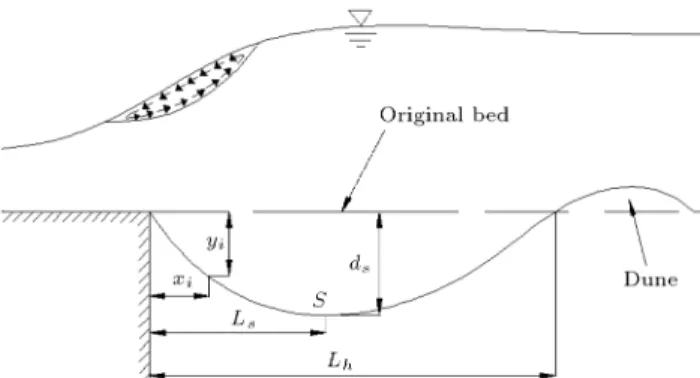
Figure 1. Denition sketch for characterizations of scour hole geometry downstream of a stilling basin.
develop the gene-expression programming for predict-ing the scour hole geometry at downstream of stillpredict-ing basin [24,33,35]. To perceive the eective parameters on the scour depth, the process of scour phenomenon downstream of a spillway due to hydraulic jump is illustrated in Figure 1 [36].
Datasets were reported from dierent conditions of ow, bed sediments, and scales of experimental models. Farhoudi (1979) conducted laboratory works with three types of bed sediments including sand, coarse bakelite, and ne Bakelite [36]. Also, median sediment sizes were between 0.15 and 0.85 mm. In his tests program, three sizes of physical models catego-rized as small, medium, and large were built to which the lengths of stilling basins were xed at 41.5, 83, and 166 cm. Heights of spillways were 0.1, 0.2, and 0.4 m. Local scour experiments due to the hydraulic jump have been carried out in three various conditions downstream of stilling basin, i.e. free (balanced tail water), repelled (low-tail water), and drowned (high-tail water) hydraulic jump. In the free jump status, the tail water depth is ecient to produce hydraulic jump on the apron [36].
In this status, hydraulic jump occurs over the movable bed sediments in downstream of stilling basin, leading in an intense sediment transport process due to development of the large eddies in the scour hole and washing the sediments back towards the apron and pile adjacent to its end. Whenever the piled sediment reaches enough height to interrupt the passage of ow laments leavings the apron, re-entertainment of the piled sediment particles is observed. This mechanism of the scour phenomenon is dominant at initiation of each experiment that has been performed by an oscillation action in the scour hole location. In low tail water conditions, the scour hole depth increases and water level raises tended to move the front of the jump towards of the apron. In addition, it is seen that ow separation mechanism is developed further along the downstream face of the scour hole [36].
Through the drowned hydraulic jump with high tail water conditions, the tail water depth is such that
it forces the jump back toward the spillway and forms the jump adjacent to the spillway toe. As tail water depth increases, the hydraulic jump inclines to be more submerged and occurs closer to the drop toe [36].
In this study, eects of dierent scales on per-forming the predictive data-exiting approaches and regression based techniques are neglected. There may exist the expectation that the capacity generalization of models reduces. Meantime, this feature was issued in previous studies [2,12,16].
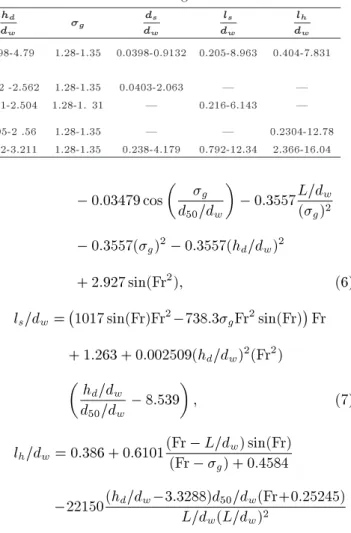
Datasets used for scour modelling are represented in three groups based on tail water conditions. The rst group of datasets is the maximum of scour hole depth related to the high tail water condition (ratio of tail water depth, dw, to the conjugate depth of hydraulic jump, d2, is 1.25 (dw=d2 = 1:25)). In this condition, 442, 156, and 221 series datasets are devoted to pre-diction of ds=dw, ls=dw, and lh=dw, respectively. The second group of datasets is the maximum of scour hole length pertained to the balanced tail water conditions (dw=d2 = 1). For the balanced condition, 418, 156, and 262 series datasets are devoted to prediction of ds=dw, ls=dw, and lh=dw, respectively. Finally, the third one is the distance between the end of stilling basin and the maximum of scour hole depth in low tail water status (dw=d2 = 0:78). For this condition, 356, 150, and 206 series datasets are related to prediction of ds=dw, ls=dw, and lh=dw, respectively. Generally, 1216, 462, and 689 datasets are collected for prediction of the maximum scour depth, length of the deepest point of the scour hole, and scour hole length downstream of stilling basins, respectively. Each of datasets is divided into two parts for training and testing stages. It is clear that the selected models are inherently very sensitive to the number of datasets used for training. In this way, for each condition, 75% of datasets are selected by trial and error for the training stage, and the remaining of them (25%) are devoted to test the model. Also, Table 1 presents the ranges of input-output parameters to evaluate scour hole geometry downstream of stilling basins [31,32,36].
2.2. Development of the gene-expression programming
Most recently, a new technique, called GEP, was developed which was an extension of the GP approach. The GEP is a search model that evolves computer programs in forms of mathematical expressions, deci-sion trees, and logical expresdeci-sions. In addition, the GEP model has attracted the attention of investigators in prediction of characteristics in hydraulic problems. This research represents GEP models for evaluation of scour hole geometry at downstream of stilling basins. The GEP approach is coded in form of linear chromo-somes which are then expressed into Expression Trees (ETs) [37-40].
Table 1. Range of input-output parameters for scour hole modeling.
Tail water
conditions Fr
d50
dw
L dw
hd
dw g
ds
dw
ls
dw
lh
dw
High
(dw=d2= 1:25) 0.1507-3.46 0.000706-0.0119 3.73-19.88 0.898-4.79 1.28-1.35 0.0398-0.9132 0.205-8.963 0.404-7.831
Balance (dw=d2= 1)
0.3407-0.3413 0.00154-0.0132 5.073-10.633 1.222 -2.562 1.28-1.35 0.0403-2.063 | | 0.225-0.329 0.00117-0.0129 3.905-10.395 0.941-2.504 1.28-1. 31 | 0.216-6.143 | Low
(dw=d2= 0:78)
0.329-0.341 0.0015-0.0132 4.96-10.63 1.195-2 .56 1.28-1.35 | | 0.2304-12.78 0.4781-0.4788 0.00192-0.0166 6.357-13.32 1.532-3.211 1.28-1.35 0.238-4.179 0.792-12.34 2.366-16.04
In fact, the ETs are sophisticated computer pro-gramming which are usually evolved to solve a practical problem, and are selected according to their tness at solving that problem. The corresponding empirical expressions can be obtained from these trees structures. A population of the ETs will discover traits, and therefore will adapt to the particular problem it is employed to solve [37-40].
Development of the GEP approach includes ve steps. The rst step is to select the tness function, fi, of an individual program (i). This item is evaluated as follows:
fi= Ct
X j=1
M jC(i;j) Tjj
; (5)
in which M, C(i;j), and Tj are the selection range, the value returned by the individual chromosome i for tness case j, and the largest value for tness case j, respectively [37-40].
In the second stage, the set of terminals, T , and the set of functions, F , are selected to gen-erate the chromosomes. In this study, the termi-nal includes ve independent parameters in form of Tds
dw; ls dw; and
lh dw
= F r, hd dw, g,
d50 dw, and
L dw
[37-40].
To nd the appropriate function set, it is nec-essary to peer review previous investigations of scour problems in this area. In this way, four basic op-erators (+; ; ; =) and basic mathematical functions (p, Power, Sin, Cos, Exp) are applied to scour hole geometry modeling. The third step is to congure the chromosomal architecture. The fourth step is selection of liking function. Finally, for the fth stage, the sets of genetic operators that cause variation and their rates was chosen. The other details related to the architecture of GEP modeling are expressed in the literature. In this study, characterizations of scour hole geometry in forms of ds=dw, ls=dw, and lh=dw are predicted using the GEP model for dierent tail water conditions (High, Balance, and Low) [37].
The best explicit form of the GEP approach for scour hole geometry in high tail water condition is given as follows:
ds=dw= 1:502 + 0:03479(L=dw)2+0:03479 sin(L=dw)
0:03479 cos
g d50=dw
0:3557L=d( w g)2 0:3557(g)2 0:3557(hd=dw)2
+ 2:927 sin(Fr2); (6)
ls=dw= 1017 sin(Fr)Fr2 738:3gFr2sin(Fr)Fr + 1:263 + 0:002509(hd=dw)2(Fr2)
hd=dw
d50=dw 8:539
; (7)
lh=dw= 0:386 + 0:6101(Fr L=d(Fr w) sin(Fr) g) + 0:4584
22150(hd=dw 3:3288)dL=d 50=dw(Fr+0:25245) w(L=dw)2
0:01972 cos (L=dw)2:(L=dw)2: sin(Fr): (8) Furthermore, the functional set and the operational parameters applied in the proposed GEP models are presented in Table 2.
2.3. Adaptive neuro-fuzzy inference system The ANFIS, rst introduced by Jang (1993), is an approximator which is capable of approximating any real continuous function on a compact set to any degree of accuracy [17]. The basic structure of fuzzy modeling, commonly known as Fuzzy Inference System (FIS), is based on the knowledge that can be inferred from
Table 2. Functional set and the operational parameters used in the proposed GEP models.
Parameter Value
Population size 100
Number of generations 500
Tournament size 5
Max. gene 4
Max. tree depth 4
Operators and functions ( p
; +; ; ; =; Power, Sin, Cos, Exp)
Table 3. Fuzzy rules used to predict the scour hole geometry by the ANFIS model. Fuzzy rule (youtput= ds=dw, ls=dw, and lh=dw)
1. If (Fr is Fr mf1) and (d
50=dw is d50=dw mf1) and (L=dw is L=dw mf1) and (g
is g mf1) and (hd=dw is hd=dw mf1) then (youtputis youtputmf1)
2. If (Fr is Fr mf2) and (d
50=dw is d50=dw mf2) and (L=dw is L=dw mf2) and (g
is g mf2) and (hd=dw is hd=dw mf2) then (youtputis youtputmf2)
3. If (Fr is Fr mf3) and (d
50=dw is d50=dw mf3) and (L=dw is L=dw mf3) and (g
is g mf3) and (hd=dw is hd=dw mf3) then (youtputis youtputmf3) : mf1, mf2, and mf3 are membership functions.
available data or verbal information. In this study, three FISs were applied to evaluate characterizations of scour hole geometry. Each of the ANFIS models has ve inputs and one output. The ANFIS models were trained using a hybrid algorithm which was a combination of the gradient descent and least square method. In this way, the best value of the learning rate in back propagation, , was adjusted 0.01 for the ANFIS models. Also, each of these proposed models were generated using 3 rules for the scour hole prediction (Table 3) [41,42].
2.4. Multiple non-linear regressions
Non-linear relationships based regression models be-tween the dependent variables of ds=dw, ls=dw, and lh=dw and independent parameters were utilized to nd the least squares t to those observations. In triple conditions of tail water, non-linear regressions were conducted to predict scour hole geometry. In this way, equations given by non-linear regression were presented to evaluate ds=dw, ls=dw, and lh=dw in dierent conditions of tail water as follows:
ds=dw=Fr1:081: d50 dw 0:234 : L dw 0:387 : hd dw 0:869 : 1:954
g ; (9)
ls=dw=Fr0:9497: d50 dw 0:146 : L dw 0:128 : hd dw 0:476 :2:2056
g ; (10)
lh=dw=Fr1:0419: d50 dw 0:0605 : L dw 1:0192 : hd dw 0:311 :0:6501
g : (11)
3. Results and discussion
The results of the proposed GEP, ANFIS models, and traditional equations based regression technique are expressed in this section. The statistical parameters
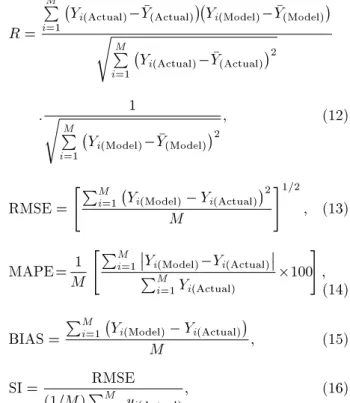
are correlation coecient (R), Root Mean Square Error (RMSE), Scatter Index (SI), BIAS, and Mean Absolute Percentage of Error (MAPE) and can be dened to evaluate error indicators in the training and testing stages:
R = M P
i=1 Yi(Actual)
Y(Actual)Yi(Model) Y(Model) s
M P
i=1 Yi(Actual)
Y(Actual)2
:s 1
M P
i=1 Yi(Model)
Y(Model)2
; (12)
RMSE = "PM
i=1 Yi(Model) Yi(Actual)2 M #1=2 ; (13) MAPE= 1 M "PM
i=1Yi(Model) Yi(Actual) PM
i=1Yi(Actual)
100 # ; (14) BIAS = PM
i=1 Yi(Model) Yi(Actual)
M ; (15)
SI = RMSE
(1=M)PMi=1yi(Actual)
; (16)
where Yi(Model) is the predicted values (network out-put), Yi(Actual)is the observed values (target), Y is the mean values, and M is the total of events.
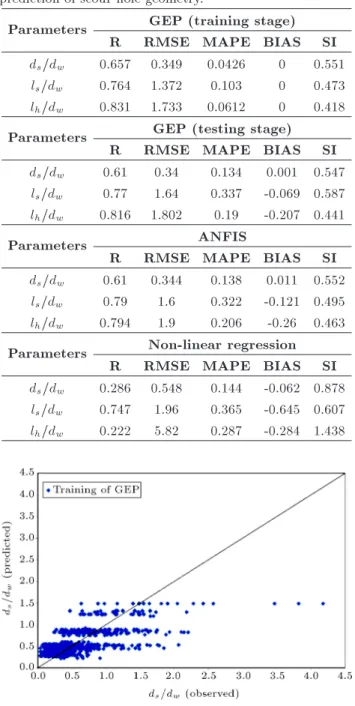
Results of the performances of GEP, ANFIS models, and traditional equations based non-linear regression to predict the scour hole geometry are presented in Table 4.
From Table 4, statistical error parameters for training stage indicate that the GEP approach pro-duces the maximum scour depth with relatively good performances in forms of RMSE = 0.35, MAPE = 0.0426, and SI = 0.551. For prediction of ls=dw, the best formulation included four eective parameters of
Table 4. Performances of the proposed models for prediction of scour hole geometry.
Parameters GEP (training stage)
R RMSE MAPE BIAS SI
ds=dw 0.657 0.349 0.0426 0 0.551
ls=dw 0.764 1.372 0.103 0 0.473
lh=dw 0.831 1.733 0.0612 0 0.418
Parameters GEP (testing stage)
R RMSE MAPE BIAS SI
ds=dw 0.61 0.34 0.134 0.001 0.547
ls=dw 0.77 1.64 0.337 -0.069 0.587
lh=dw 0.816 1.802 0.19 -0.207 0.441
Parameters ANFIS
R RMSE MAPE BIAS SI
ds=dw 0.61 0.344 0.138 0.011 0.552
ls=dw 0.79 1.6 0.322 -0.121 0.495
lh=dw 0.794 1.9 0.206 -0.26 0.463
Parameters Non-linear regression
R RMSE MAPE BIAS SI
ds=dw 0.286 0.548 0.144 -0.062 0.878
ls=dw 0.747 1.96 0.365 -0.645 0.607
lh=dw 0.222 5.82 0.287 -0.284 1.438
Figure 2. Performance of the training stage of GEP model for prediction of ds=dw.
d50=dw, hd=dw, g, and Fr. Also, high accuracy of the GEP model (R = 0:76) was met in comparison with that obtained for ds=dw (R = 0:65). The proposed GEP model for evaluating lh=dw has given R = 0.831, RMSE = 1.733, and MAPE = 0.0612. Qualitative training results for the proposed GEP model in pre-dicting the ds=dw, ls=dw, and lh=dw parameters are illustrated in Figures 2 to 4, respectively.
For prediction of ds=dw, performing the test-ing results indicated that the GEP model provided relatively acceptable accuracy in terms of BIAS = 0.001, compared to the ANFIS model (BIAS = 0.011).
Figure 3. Performance of the training stage of GEP model for prediction of ls=dw.
Figure 4. Performance of the training stage of GEP model for prediction of lh=dw
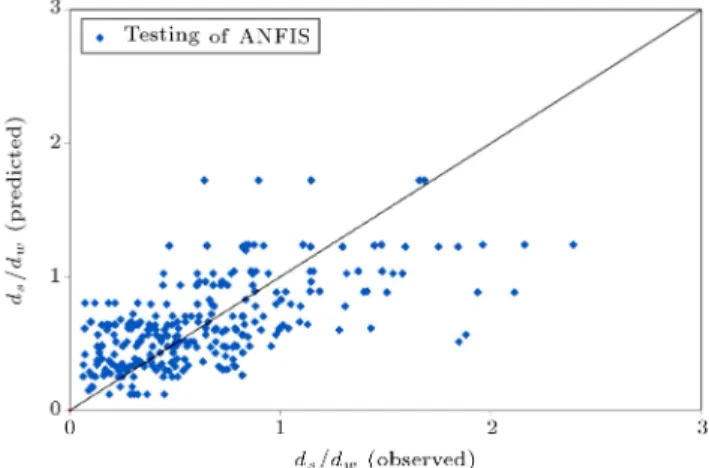
Also, according to the statistical error parameters of R, RMSE, MAPE, and SI, the proposed GEP (R = 0.61, RMSE = 0.35, MAPE = 0.134, and SI = 0.547) produced approximately the same performance in comparison with that obtained using the ANFIS model (R = 0.61, RMSE = 0.344, MAPE = 0.138, and SI = 0.552). Furthermore, the ANFIS model presented prediction of ls=dw with relatively higher accuracy (R = 0.79, RMSE = 1.6, and SI = 0.495) than that yielded using the GEP model (R = 0.77, RMSE = 1.64, and SI = 0.587), whereas the BIAS given by the GEP model (BIAS = -0.069) is lower than that obtained by the ANFIS model (BIAS = -0.121). For predicting the lh=dw parameter, the proposed GEP approach indicated remarkably higher accuracy in terms of R = 0.816, RMSE = 1.802, and BIAS = -0.207, compared to that given by the ANFIS model (R = 0.794, RMSE = 1.9, and BIAS = -0.26). Performances of testing results for the proposed GEP models in predicting the ds=dw, ls=dw, and lh=dwparameters are given in Figures 5 to 7, respectively.
In addition, performances of the ANFIS models in predicting the non-dimensional parameters of ds=dw,
Figure 5. Performance of the GEP model for prediction of ds=dw.
Figure 6. Performance of the GEP model for prediction of ls=dw.
Figure 7. Performance of the GEP model for prediction of lh=dw.
ls=dw, and lh=dw are illustrated in Figures 8 to 10, respectively. Eqs. (9) and (11) based non-linear regres-sion were applied to predict the scour hole geometry downstream of stilling basin.
Statistical results of these equations are given in Table 4. Eq. (9) provided the maximum scour
Figure 8. Performance of the ANFIS model for prediction of ds=dw.
Figure 9. Performance of the ANFIS model for prediction of ls=dw.
Figure 10. Performance of the ANFIS model for prediction of lh=dw.
depth with signicantly lower accuracy in terms of R = 0.286, RMSE = 0.548 and scatter index = 0.878 than those of the ANFIS and GEP models. However, Eq. (9) based approach failed to yield more accurate prediction of the scour depth downstream of stilling basin. For the length of scour hole, Eq. (10) provided
the higher dierence between the predicted and the observed values by parameter BIAS = -0.645 than those given by the ANFIS (BIAS = -0.121) and GEP models (BIAS = -0.069).
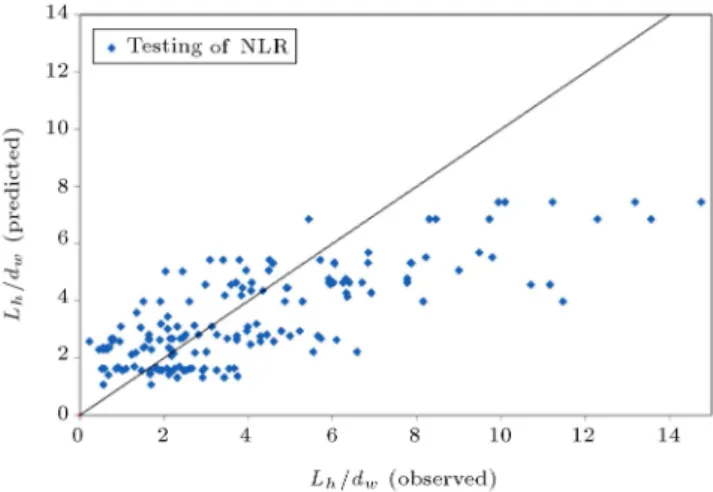
From Table 4, it should be said that Eq. (11) provided remarkably low accuracy (R = 0.222) and high error of prediction (RMSE = 5.82 and SI = 1.432) compared to the GEP (RMSE = 1.802 and SI = 0.441) and ANFIS (RMSE = 1.96 and SI = 0.463) models. The lack of validation for Eqs. (9) to (11) corresponds to their limitation in eective parameters, which commonly causes them to fail to present the accurate feature for physical meaning of scour hole geometry. Results of performances for the non-linear regression equations are given in Figures 11 to 13. 4. Sensitivity analysis
To determine the relative signicance of each indepen-dent parameter (input variables) on scour hole geome-try downstream of stilling basin, sensitivity analyses were conducted. The proposed GEP models were selected for this purpose. In order to perform the
sensi-Figure 11. Performance of the non-linear regression model for prediction of ds=dw.
Figure 12. Performance of the non-linear regression model for prediction of ls=dw.
Figure 13. Performance of the non-linear regression model for prediction of lh=dw.
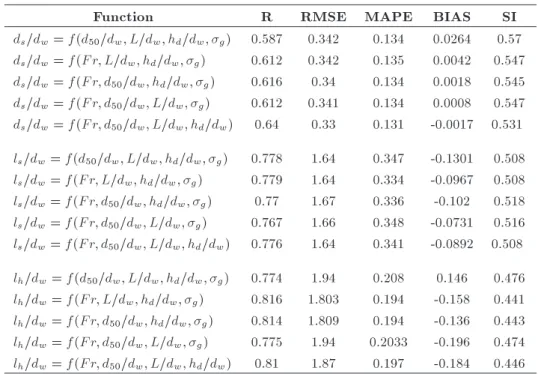
tivity analyses, each time, one parameter of Eqs. (2) to (4) was eliminated to evaluate the eect of that input parameter. In this way, statistical error parameters of R, RMSE, MAPE, BIAS, and SI were considered to evaluate performance of sensitivity analysis. Results of performances are given in Table 5.
For prediction of ds=dw, elimination of Fr from the list of input variables, compared to the other parameters, leads to relatively high error in evaluation (R = 0.587, RMSE = 0.342, and SI = 0.57). From Table 5, it is found that the parameter related to the bed sediment size, d50=dw, is the second important input in the form of BIAS = 0.0042 and also, other statistical errors have provided approximately the same values for sensitivity analysis of the l=dw and hd=dw parameters. In addition, the parameter gis dened as the least important parameter in the maximum scour depth with R = 0.64, RMSE = 0.33, and SI = 0.531.
For prediction of ls=dw downstream of stilling basin, L=dw is dened as the most important input variable (RMSE = 1.67, BIAS = -0.102, and SI = 0.518), compared to the other parameters. Meantime, performance of sensitivity analysis indicates that the d50=dwparameter has the least inuence on the ls=dw with R = 0.779, MAPE = 0.334, and SI = 0.5083. From Table 5, it is found that the parameter related to the bed sediment size, d50=dw, is the second im-portant input in form of BIAS = 0.0042 and also, other statistical errors provide approximately the same values for sensitivity analysis of the L=dw and hd=dw parameters. The hd=dw parameter related to the geometry of spillway in terms of R = 0.767, RMSE = 1.66, and MAPE = 0.348 is dened as the second important parameter in the scour hole length.
Sensitivity analysis was carried out for lh=dw, which demonstrated that the parameter was assigned as the most signicant input variable (R = 0.774, RMSE = 1.94, MAPE = 0.208, and SI = 0.476) in comparison with the other non-dimensional
parame-Table 5. Results of sensitivity analysis.
Function R RMSE MAPE BIAS SI
ds=dw= f(d50=dw; L=dw; hd=dw; g) 0.587 0.342 0.134 0.0264 0.57
ds=dw= f(F r; L=dw; hd=dw; g) 0.612 0.342 0.135 0.0042 0.547
ds=dw= f(F r; d50=dw; hd=dw; g) 0.616 0.34 0.134 0.0018 0.545
ds=dw= f(F r; d50=dw; L=dw; g) 0.612 0.341 0.134 0.0008 0.547
ds=dw= f(F r; d50=dw; L=dw; hd=dw) 0.64 0.33 0.131 -0.0017 0.531
ls=dw= f(d50=dw; L=dw; hd=dw; g) 0.778 1.64 0.347 -0.1301 0.508
ls=dw= f(F r; L=dw; hd=dw; g) 0.779 1.64 0.334 -0.0967 0.508
ls=dw= f(F r; d50=dw; hd=dw; g) 0.77 1.67 0.336 -0.102 0.518
ls=dw= f(F r; d50=dw; L=dw; g) 0.767 1.66 0.348 -0.0731 0.516
ls=dw= f(F r; d50=dw; L=dw; hd=dw) 0.776 1.64 0.341 -0.0892 0.508
lh=dw= f(d50=dw; L=dw; hd=dw; g) 0.774 1.94 0.208 0.146 0.476
lh=dw= f(F r; L=dw; hd=dw; g) 0.816 1.803 0.194 -0.158 0.441
lh=dw= f(F r; d50=dw; hd=dw; g) 0.814 1.809 0.194 -0.136 0.443
lh=dw= f(F r; d50=dw; L=dw; g) 0.775 1.94 0.2033 -0.196 0.474
lh=dw= f(F r; d50=dw; L=dw; hd=dw) 0.81 1.87 0.197 -0.184 0.446
ters. Furthermore, the hd=dw parameter is the second important variable on the lh=dwwith R = 0.779, RMSE = 1.94, MAPE = 0.203, and SI = 0.474. From Table 5, statistical errors parameters in terms of R = 0.816, RMSE = 1.803, MAPE = 0.19, and SI = 0.441 indicate that d50=dwhas the least eect on the d50=dw parameters.
5. Conclusion
In this research, eciency of the GEP model based relationship to predict the scour hole geometry in terms of the maximum scour depth, scour hole length, and the length of the deepest point of the scour hole at downstream of stilling basin has been studied. The GEP approach was designed using ve non-dimensional parameters and three output variables.
Results of performances for the proposed GEP models indicated more accurate prediction of scour hole characterizations than those for the ANFIS and non-linear regression models. According to the quantita-tive comparisons, statistical error parameters indicated that the GEP approach predicted the maximum scour depth with lower errors of BIAS = 0.001, RMSE = 0.35, MAPE = 0.134 and higher correlation coecient of R = 0.97, compared to the ANNs, ANFIS (MAPE = 0.138, BIAS = 0.011, and SI = 0.552) and non-linear regression techniques (R = 0.286, RMSE = 0.548, MAPE = 0.134). From the sensitivity analysis, carried out by the GEP model, it can be concluded that Fr, L=dw, and hd=dwwere the most important parameters in prediction of ds=dw, ls=dw, and lh=dw, respectively. Finally, it is proven that the GEP model based on
the best relationship is a powerful technique to solve scour problems at downstream of stilling basins as well as the other AI models.
Nomenclature
AI Articial Intelligence
ANNs Articial Neural Networks
ANFIS Adaptive Neuro-Fuzzy Inference
System
GP Genetic Programming
GEP Gene-Expression Programming
GMDH Group Method of Data Handling
FFBP-NN Feed Forward Back Propagation
Neural Network
RBF-NN Radial Basis Function Neural Network
SVM Support Vector Machines
DNN Descriptive Neural Network
EPR Evolutionary Polynomial Regression
CARTs Classication And Regression Trees
PSO Particle Swarm Optimization
NF-GMDH-PSONeuro-Fuzzy Group Method of Data Handling Particle Swarm Optimization
ETs Expression Trees
References
1. Farhoudi, J. and Khalili Shayan, H. \Investigation on local scour downstream of adverse stilling basins", Ain Shams Engineering Journal, 5, pp. 361-375 (2014).
2. Najafzadeh, M. and Azamathulla, H.Md. \Neuro-fuzzy GMDH systems to predict the scour pile groups due to waves", Journal of Computing in Civil Engineering (ASCE), pp. 1943-5487 (2014).
3. Bormann, N.E. and Julien, P.Y. \Scour downstream of grade-control structures", Journal of Hydraulic En-gineering, 117(5), pp. 579-594 (1991).
4. Chee, S.P. and Padiyar, P.V. \Erosion at the base of ip buckets", Canadian Engineering Journal, 52(11), pp. 22-24 (1969).
5. D'Agostino, V. and Ferro, V. \Scour on alluvial bed downstream of grade-control structures", Journal of Hydraulic Engineering, 130(1), pp. 24-36 (2004). 6. Incyth, L.H.A. \Estudio sobre modelo del aliviadero de
la Presa Casa de Piedra", Informe Final, Argentina, DOH-044-03-82, Ezeiza (1982).
7. Lenzi, M.A. and Comiti, F. \Local scouring and mor-phological adjustments in steep channels with check-dam sequences", Geomorphology, 55(1-4), pp. 97-109 (2003).
8. Martin, R.B.F. \Scouring of rocky river beds by free jet spillways", International Water Power Dam Construction, 27(4), pp. 152-153 (1975).
9. Termini, D. \Bed scouring downstream of hydraulic structures under steady ow conditions", Experimental Analysis of Space and Time Scales and Implications for Mathematical Modeling, Catena, 84, pp. 125-135 (2011).
10. Veronese, A. \Erosion de Fondoa Valle diuno Scarico", Annali dei Lavori Publicci, 759, pp. 717-726 (1937). 11. Azamathulla, H.Md., Deo, M.C. and Deolalikar, P.B.
\Alternative neural networks to estimate the scour below spillways", Advances in Engineering Software, 38(8), pp. 689-698 (2008a).
12. Azamathulla, H.Md., Deo, M.C. and Deolalikar, P.B. \Neural networks for estimation of scour downstream of a ski-jump bucket", Journal of Hydraulic Engineer-ing (ASCE), 131(10), pp. 898-908 (2005).
13. Goel, A. and Pal, M. \Application of support vector machines in scour prediction on grade-control struc-tures", Engineering Applications of Articial Intelli-gence, 22, pp. 216-223 (2009).
14. Guven, A. and Azamathulla, H.Md. \Gene-expression programming for ip-bucket spillway scour", Water Science & Technology, 65(11), pp. 1982-1987 (2012b). 15. Guven, A. \A multi-output descriptive neural network for estimation of scour geometry downstream from hy-draulic structures", Advances in Engineering Software, 42, pp. 85-93 (2011).
16. Guven, A. and Gunal, M. \Genetic programming approach for prediction of local scour downstream hy-draulic structures", Journal of Irrigation and Drainage Engineering, 134(2), pp. 241-249 (2008a).
17. Jang, J.S.R. \ANFIS: adaptive-network-based fuzzy inference system", IEEE. Trans. Syst., Man Cyber, 23(3), pp. 665-685 (1993).
18. Koza, J.R., Genetic Programming: On the Program-ming of Computers by Means of Natural Selection, Cambridge, MA: The MIT Press (1992).
19. Laucelli, D. and Giustolisi, O. \Scour depth modelling by a multi-objective evolutionary paradigm", Environ-mental Modelling & Software, 26, pp. 498-509 (2011). 20. Najafzadeh, M. and Lim, S.Y. \Application of im-proved neuro-fuzzy GMDH to predict scour down-stream of sluice gates", Earth Science Informatics, DOI: 10.1007/s12145-014-0144-8 (2014).
21. Najafzadeh, M. and Barani, Gh.A. \Discussion of genetic programming to predict river pipeline scour by H. Md. Azamathulla and A. Ab. Ghani", Journal of Pipeline Systems Engineering and Practice (ASCE), 4(4), pp. 1949-1204 (2013).
22. Samadi, M., Jabbari, E. and Azamathulla, H.Md. \Assessment of M50 model tree and classication and
regression trees for prediction of scour depth below free overfall spillways", Neural Computing and Appli-cations, DOI 10.1007/s00521-012-1230-9 (2012). 23. Sattar, A.M.A. \Gene expression models for the
pre-diction of longitudinal dispersion coecients in transi-tional and turbulent pipe ow", J. Pipeline Syst. Eng. Pract., 5(1), 04013011 (2014a).
24. Sattar, A.M.A. \Gene expression models for prediction of dam breach parameters", Journal of Hydroinformat-ics, 16(3), pp. 550-571 (2014b).
25. Candida, F. \Gene expression programming: A new adaptive algorithm for solving problems", Complex Systems, 13(2), pp. 87-129 (2001).
26. Azamathulla, H.Md., Ghani, A.A. and Zakaria, N.A. \An ANFIS based approach for predicting the scour below ip-bucket spillway", Riverside Kuching, Sarawak, Malaysia, June 6-8 (2007).
27. Azamathulla, H.Md., Guven, A. and Demir, Y.K. \Linear genetic programming to scour below sub-merged pipeline", Ocean Engineering, 38(8-9), pp. 995-1000 (2011).
28. Azamathulla, H.Md., Ghani, A.A., Zakaria, N.A. and Guven, A. \Genetic programming to predict bridge pier scour", Journal of Hydraulic Engineering (ASCE), 136(3), pp. 165-169 (2010).
29. Farhoudi, J., Hosseini, S.M. and Sedghi-Asl, M. \Application of neuro-fuzzy model to estimate the characteristics of local scour downstream of stilling basins", Journal of Hydroinformatics, 12(2), pp. 201-211 (2010).
30. Sreeja, C.K.P. \Evaluation of selected equations for predicting scour at downstream of ski-jump spillway using laboratory and eld data", Engineering Geology, 129-130, pp. 98-103 (2012).
31. Azamathulla, H.Md. \Comment on `Evaluation of selected equations for predicting scour at downstream of ski-jump spillway using laboratory and eld data' by C. Kumar and P. Sreeja.", Engineering Geology, 152(1), pp. 210-211 (2014).
32. Azamathulla, H.Md. \Comment on `Evaluation of selected equations for predicting scour at downstream of ski-jump spillway using laboratory and eld data' by C. Kumar and P. Sreeja", Engineering Geology, 152(1), pp. 210-211 (2013).
33. Najafzadeh, M., Barani, Gh.A. and Hessami-Kermani, M.R. \Group method of data handling to predict scour at downstream of a ski-jump bucket spillway", Earth Science Informatics, 7, pp. 231-248 (2014).
34. Oliveto, G. and Coumniello, V. \Local scour down-stream of positive-step stilling basins", Journal of Hydraulic Engineering (ASCE), 135(10), pp. 846-851 (2009).
35. Najafzadeh, M., Barani, Gh.A. and Hessami Kermani, M. \Estimation of pipeline scour due to waves by GMDH", Journal of Pipeline System Engineering and Practice (ASCE), 5(3), pp. 1949-1204 (2014c). 36. Farhoudi, J. \Scaling relationship for local scour
downstream of stilling basins", Thesis presented to Southampton University at Southampton, England, in partial fulllment of the requirements for the degree of Doctor of Philosophy (1979).
37. Azamathulla, H.Md. and Haque, A.A.M. \Prediction of scour depth at culvert outlets using gene-expression programming", International Journal of Innovative Computing, Information and Control, 8(7B), pp. 5045-5054 (2012).
38. Ferreria, C., Gene-Expression Programming: Mathe-matical Modeling by an Articial Intelligence, GEP Book, 2nd Ed., Spriner, Heidelberg (2006).
39. Ferreria, C. \Gene-expression programming in prob-lem solving", The 6th Online Word Conference on Soft Computing in Industrial Applications (Invited tutorials) (2001a).
40. Ferreria, C. \Gene-expression programming: A new adaptive algorithm for solving problems", Complex Systems, 13(2), pp. 87-129 (2001b).
41. Jang, J.S.R., Sun, C.T. and Mizutani, E., Neuro-Fuzzy and Soft Computing, Englewood Clis, NJ: Prentice-Hall, 640 pages (1997).
42. Jang, J.S.R. and Sun, C.T. \Neuro-fuzzy modelling and control", Proc. IEEE, 83(3), pp. 378-406 (1995).
Biographies
Masoud Mesbahi received his BS degree in Civil Engineering from Islamic Azad University in 1996, and
his MS degree in Civil Engineering from Islamic Azad University of South-Tehran in 2002. He is currently a PhD degree student at Science and Research Branch of Tehran-Islamic Azad University. His research interests include scouring at downstream of stilling basin and articial intelligence approaches. He has presented and published several papers in various national and international conferences.
Nasser Talebbeydokhti is Professor of Civil and Environmental Engineering in the School of Engineer-ing at Shiraz University. He is an active member of the Academy of Sciences and the Editor-in-Chief of Iranian Journal of Science and Technology, Transaction of Civil Engineering, which is an ISI journal. He is also Editor-in-Chief of Journal of Water Engineering and Associate Editor of Hydraulic Engineering Journal. Professor Talebbeydokhti has published more than 100 journal papers and more than 200 conference papers. He has been recognized as prominent hydraulic engineer. His book entitled Analysis and Design of Gabion Structure was awarded as the best engineering book. Professor Talebbeydokhti is member of pro-motion committee in the School of Engineering and member of research committee in several water, waste water, and environmental engineering companies in Iran.
Seyed Abbas Hosseini obtained his BS in Civil Engineering, MS in Hydraulic Structure and PhD degree in Water Engineering from Sharif University of Technology. He is currently Assistant Professor of Technical & Engineering Department at Islamic Azad University, Science and Research Branch, Tehran, Iran. His research interests are experimental and numerical modeling of incompressible ow, sediment transport, and scouring in hydraulic structures.
Seied Hosein Afzali received his BS degree in Civil Engineering from Shiraz University, Shiraz, Iran, and MS degree from Amir Kabir University of Technology, Tehran, Iran, in Hydraulic Structures and PhD degree in the same eld from Shiraz University, Shiraz, Iran. He is currently Assistant Professor of Civil Engineering at Shiraz University, Iran. His main research interests are computational uid dynamics, hydraulic, optimiza-tion, river mechanics, and groundwater.