Competition within Random Growth
Models
Department of Mathematics and Statistics
Shane Turnbull
Abstract
This thesis is concerned with introducing competition into random models. It can be
observed that there are two natural mechanisms for the evolution of a random model;
either by growth or by self interactions. What we do is look at two types of models and
introduce competition within them. The first model, the voter model, is an example
of a self interacting model and we introduce growth into it. The second model, the
Hasting-Levitov model, is a random growth model and we introduce competition
within the model.
In both cases we construct diffusion approximations to model these systems when
the initial population is large for the first case and when the addition of incoming
par-ticles is small in the second. Once these diffusion processes have been constructed we
then analyse the long term behaviour of them and find their asymptotic distribution,
Dedication
Throughout my time at university there have been many people who have made here
such a fantastic experience. I have spent 8 years here at Lancaster and I am proud
to say Lancaster is my home. I shall keep the list short so apologies for not naming
many people!
Firstly, my thanks must go to my supervisor Amanda, her wisdom and guidance
has helped me throughout my time here. Apologies for all the times I turned up
unannounced at your door with a random query. I must also thank her for her
optimism for when I clearly did not have any, she always knew what to say whenever
I needed support.
I would also like to thank Tom, throughout my 8 years at university you have been
someone who I knew would be there for me, through the highs and lows your support
has always been appreciated. I know I have wasted much of your time discussing
probability theory but I hope you enjoyed some of our conversations and am glad you
have managed to retain some of it! I look forward to remaining friends even after
Lancaster, I am sure we shall.
I also extend my thanks to my family and all my friends who offered their thoughts
and encouragements while undertaking my PhD but for also offering me the distraction
during the weekends and evenings when I much needed them.
Finally, I am very grateful for the Faculty of Science and Technology for supporting
has provided me I would not have been able to do this. Thank you.
July 2018
I would also like to thank my examiners, Dmitry Korshunov and Tim Rogers, for
both their time in reading my thesis and for their invaluable comments which helped
me improve it further.
Declaration
I declare that the work in this thesis has been done by myself and has not been
submitted elsewhere for the award of any other degree.
Contents
1 Introduction 1
2 Random Models 3
2.1 Random Growth Models . . . 3
2.1.1 Lattice Models . . . 4
2.1.2 Off Lattice Models . . . 9
2.1.3 P´olya Urn Model . . . 13
2.2 Model with Internal Behaviour . . . 14
2.2.1 Voter Model . . . 14
2.2.2 Moran Model . . . 15
2.2.3 Wright-Fisher Diffusion . . . 16
2.3 Random Growth Models with Competition . . . 17
2.3.1 Lotka-Volterra System . . . 17
2.3.2 Introducing randomness . . . 19
3 Diffusion Theory 22 3.1 Motivation . . . 22
3.2 Limit Theorem . . . 26
3.3 Analysis of Diffusion Processes . . . 33
4.1 Introduction . . . 43
4.1.1 The fully connected voter model with the addition of growth . 44 4.1.2 Overview . . . 46
4.2 Diffusion Estimates . . . 47
4.3 Limit Distributions . . . 55
4.3.1 Deterministic . . . 56
4.3.2 Martingales and Diffusion Processes . . . 56
4.3.3 Limit Distribution for fixed N . . . 58
4.4 Applications . . . 61
5 Introducing Competition within HL(0) 66 5.1 Introduction . . . 66
5.1.1 The Hastings-Levitov Model . . . 67
5.1.2 Harmonic Measure Flow . . . 68
5.1.3 Introducing Competition . . . 71
5.1.4 Outline . . . 73
5.2 Diffusion Estimates . . . 73
5.3 Limit Distributions . . . 78
Chapter 1
Introduction
This thesis is split into four parts, each dealing with its own specific material. Chapters
2 and 3 serve as a literature review with Chapter 2 providing a grounding in where this
area of research lies. We give a rough overview of two types of models; random growth
models and self-interacting models. As the name suggests, random growth models are
those that consist of a set which increases over time, given some probabilistic rule. We
consider the P´olya urn model since it is simple to describe and also has an asymptotic
distribution, something we are interested in with the models we consider. We also
look at the Eden model and its continuous analogue, the Hastings-Levitov model,
since part of our research focuses on this model.
Self interacting models are those that have states which change over time. We
consider the voter model, which is a simplistic model for representing the votes of
people. Again, this is another model which our research focuses on. We also include
the Moran model and that of Wright-Fisher diffusion. This is because they are both
used in population genetics where Wright-Fisher diffusion could be thought of as the
continuous limit of the Moran model. We include these here as some of our stochastic
differential equations that appear are similar to that of Wright-Fisher diffusion. We
types of behaviour.
Chapter 3 focuses on the tools required for us to construct and then analyse our
models. We start by introducing the kernel of a pure jump process. This is a very
useful object since it contains all the information of the process. With the kernel
defined we then look at what a scaling limit is and state a theorem which ensures we
have weak convergence of a sequence of stochastic processes to a diffusion process.
Once we have done this, we then analyse the obtained diffusion process. We look at
the speed measure and scale function, which are required for us to analyse our systems,
along with how to classify the boundary behaviour. This is enough information to
then find the asymptotic distribution.
The next two chapters, Chapter 4 and 5, contain our original work. We use the
tools introduced in Chapter 3 to analyse the models and work out their long term
behaviour.
Chapter 4 consists of the voter model, a self-interacting model, and we study the
behaviour after the introduction of growth. This was originally studied in [Morris
and Rogers, 2014], but we extend these results and reconfirm their results using the
kernel of a process and Kurtz’s theorem. We also give a full characterisation of the
model. We show how the addition of growth has the ability to turn absorbing states
into reflecting ones and then analyse the limiting behaviour.
In Chapter 5 we do the opposite. We consider a random growth model where the
growth is constructed via a sequence of conformal maps, in this case the
Hastings-Levitov model and introduce competition into it. We introduce a form of competition
where we allow the growth to vary depending on the harmonic measure of the regions.
We show it is necessary to allow the size and rate of the added particles to change to
Chapter 2
Random Models
The aim of this section is to give an overview of where our area of research lies. To
do this we consider two types of random models. As the name suggests, a random
model is intended to model something with a random element and is often influenced
by the world around us. There are two natural mechanisms to think of when we
consider this; growth and self-interactions. The first type of models that we consider
are those that grow, such as the Eden model. The second type of models that we
consider are those which evolve dynamically so that the states of them change over
time; an examples of this would be the voter model. After we consider these two
types of models, we consider a model that lies in the intersection of these areas; one
which grows but also evolves dynamically. This is the area that we perform research
in.
2.1
Random Growth Models
We shall consider two types of models in this section, those which grow on a lattice,
called lattice models, and those which do not, called off lattice models. Lattice models
are useful since the structure of the lattice allows us to grow clusters in an easy to
examples. Off lattice models are a better representation for real world growth, but
can be harder to model mathematically.
2.1.1
Lattice Models
In this section we look at three types of lattice models. In all cases, we are looking
at the square latticeZ2 but these can be expanded to others.
Eden Model
A contender as a model for cell growth, the Eden model is named after Murray Eden
who studied it in [Eden, 1961] and is used to model the growth of a cluster where
the growth is motivated by the splitting of cells. Consider the square lattice with a
particle located at the origin. This has four unoccupied neighbours; we uniformly pick
one of these neighbours at random and the cell divides to occupy this cell too. This
cluster now has six neighbours and we repeat the process, letting the cluster grow,
[image:11.612.113.540.456.571.2]see Figure 2.1.
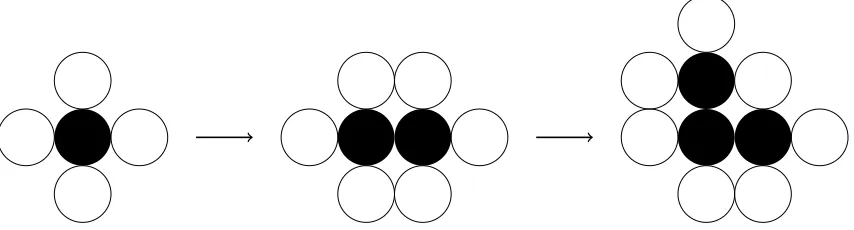
Figure 2.1: Possible first steps of the Eden model. The black cells indicate occupied sites and the white ones are the possible growth sites, which are picked with equal probability among them.
An interesting question to ask is, when we let the cluster grow for a long time, does
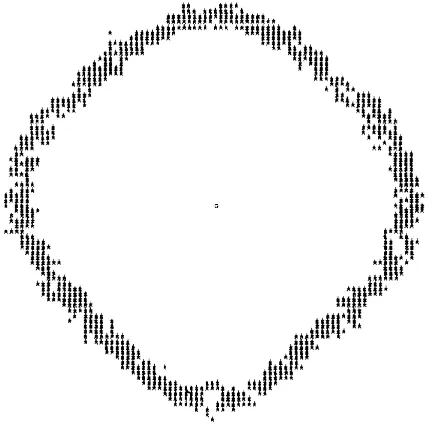
t→ ∞we obtain a limit object? From computer simulations [Freche et al., 1985] the
authors claim that the model does seem to exhibit anisotropic behaviour, and so is
[image:12.612.219.437.151.363.2]not isotropic, with large clusters forming a diamond shape, see Figure 2.2.
Figure 2.2: Simulation showing the anisotrophy from the growing clusters. The middle has been removed to make the boundary clearer. This is Figure 2 from [Freche et al., 1985].
Though a simple question, it was very hard to prove and very little was known
about the actual shape obtained in the limit for the first 10 years. Various attempts
have been done and some results have been gained. One of the first rigorous results
is listed below
Theorem 2.1.1. Let A be the unit circle and At the Eden cluster at time t, then
there exists aλ >0 such that for allε >0 we have, with probability 1, a large enough
t0 such that for all t > t0,
(1−ε)λA ⊂A¯t/t⊂(1 +ε)λA,
where A¯t is known as the continuum versions of At formed by replacing each point in
This result was first shown to hold in probability in [Richardson, 1973] and then
subsequently strengthened to the almost sure statement above in [Kesten, 1993]. The
main approach to showing these results is to show that the Eden model can be linked to
another model known as First-Passage percolation which we discuss in the next section
and to then show that first passage percolation satisfies a property known as
”sub-additivity”. This was generalised by Kingmann to produce the subadditive ergodic
Theorem [Kingman, 1973]. For further details see Theorem 2.1 and the surrounding
text in [Deijfen and H¨aggstr¨om, 2007].
Of course, this model can be generalised onto any graph. Consider a graph G =
(V, E) comprising a setV of vertices and E of edges. Set C0 =v0, where v0 ∈ V, to
be the initial cluster. The model grows following the iteration
Cn=Cn−1∪ {vn−1}
wherevn−1 is a vertex which neighbours the cluster Cn, which is picked uniformly at
random from all possible options.
Percolation
As the name suggests, the following model is used to represent the idea of water
seeping through a porous material. We shall restrict our study to the 2d case but this
can be extended. Imagine ann×n grid composed of 1×1 squares, with probability
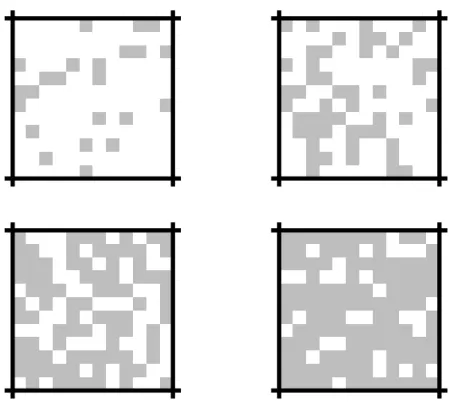
pwe let each square either be occupied or not. Some simulations for p= 0.2,0.4,0.6
and 0.8 are shown in Figure 2.3.
This model is known as site percolation since it is the sites that are being occupied,
a slight variant known as bond percolation exists where the edges of the lattice are
considered closed or open. Site percolation can be viewed as a sub-model of the
bond percolation since every bond model can be expressed in terms of a site model
Figure 2.3: Simulations of the percolation model for p = 0.2,0.4,0.6 and 0.8 listed from top left to bottom right. Filled in cells are coloured grey with empty ones in white.
[Grimmett, 1989]. A half way house model has been proposed called bridge percolation
which links the two, see [Chayes and Schonmann, 2000].
The first question of interest is: is it possible for the water to seep through? That
is, is there a path such that we can go from the top to the bottom? This question has
been considered in the case where the lattice in infinite in which case the question is
slightly reworded to; does there exist an infinitely large open cluster containing the
origin? This can be shown to be a probability 0 or 1 event. This in-turn raises an
observation; there must exist a critical probability, denoted bypc such that forp < pc
we will find a an infinitely large set and forp > pc we can not. In our simulations we
can see that in the case when p = 0.2 and 0.4 we can find a path but in the other
two cases there does not exist a path. This is something that has been well studied,
it was shown in 1960 by Harris that for p= 1/2 we can not find a path, see [Harris,
1960] but took another 20 years before Kesten was able to show that percolation does
not occur forp >1/2 thus showing that pc= 1/2, see [Kesten, 1980]. An overview of
As mentioned in the previous section, another model stemming from the
percola-tion model exists and is called, first passage percolation, this was first introduced by
Hammersley and Welsh [Hammersley and Welsh, 1965]. The idea is to introduce on
each site a random variable which represents the amount of time it takes for the liquid
to travel through the site, this is known as the passage time. If we denote the passage
time on site si as t(si) then the passage time of a path r which travels through the
site s1, s2, . . . , sn is just given by the sum of the passage times, that is
T(r) =
n
X
i=1
t(si).
The first passage time between two points, say uand v, is denoted byT(u, v) and is
defined to be the shortest time to travel between the two points, that is
T(u, v) = inf{T(r) :r is a path from u tov.}.
The main object of study here is following
B(t) = {v ∈Zd:T(0, v)≤t}
the set of points which can be reached in time t from the origin. For further details
concerning this and percolation in general please see [Kesten, 1987].
Diffusion Limited Aggregation
We now consider another model that is similar to the Eden model, which was first
studied by Witten and Sanders in [Witten and Sander, 1983]. Once again, consider
the square lattice with an initial seed at (0,0). We start a random walk “at infinity”
and once the random walk reaches an adjacent point to the cluster it sticks. We
instead of the addition sites being chosen uniformly over all boundary points, it is now
selected with the harmonic measure of the boundary point, which is the probability
of the point being hit by the random walk. This is different from the Eden model as
in this model there is a possibility of holes being formed as they have no chance of
being filled in, whereas in the Eden model this could not happen. This model is very
hard to study and very little is known about it, a similar case holds for its continuous
variant, off lattice diffusion limited aggregation.
2.1.2
Off Lattice Models
We now look at a type of growing model that takes place in continuous space. In
the previous section, we mentioned a growth model where the growth site was picked
based on the arrival of a simple random walk. The continuous analogue to this is called
off site diffusion limited aggregation. Consider the unit disc and allow particles to
perform a Brownian path until they hit the disc, at which point they join and increase
the size of the cluster. This is very similar to the on site model, in the sense that we
have an initial site and the cluster grows randomly but with the continuous analogue
of the random walk. The probability of hitting a point is given by the harmonic
measure; this is just the probability of a Brownian particle hitting the region. In the
case of a circle, the harmonic measure is the uniform measure on the boundary. If
the shape is a simply connected object, then we can find a conformal map between
it and the circle. Since Brownian motion is invariant under conformal maps, we can
then find the hitting probabilities from the circle. This fact will be of use later.
The problem with this model is that it is very hard to say anything about it, as it
is not mathematically tractable. This is where the model proposed by Hastings and
Hastings-Levitov HL(α) Model
The model proposed is known as the Hastings-Levitov model and is one that we extend
in Chapter 5. As such, we shall dedicate this section to giving a basic understanding
of the original model. In Chapter 5, we go into more detail concerning the case when
α= 0 as this is the one we shall work with. For a more thorough introduction, please
see [Rohde and Zinsmeister, 2005].
Let K0 be the closed unit disc centered at the origin on the complex plane. We
construct a sequence of compact sets (Kn)n∈N, which represents the cluster after the
addition ofn particles. The cluster after the addition of the first particle is given by
K1 =K0 ∪P0 where P0 is the attachment of a particle at angle θ = 0. In our case,
the particle,P0, will be a slit with lengthd0, i.e. P0 = (1,1 +d0].
After the addition of the first particle, we allow particles to arrive with lengthsdn
and at angleθn. Though we talk about the slits being of lengthdn we work with what
is known as the capacity, cn, of the particles. This can be expressed as a function of
the diameter via
ecn = 1 + d
2
n
4(1 +dn)
. (2.1)
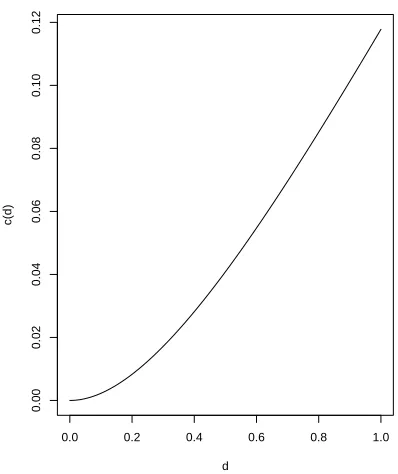
Figure 2.4 shows the relation between the values cand d, note that asc→0, d
c1/2. The addition of the first particle is given by the conformal map f :D
1 −→D0.
This can be constructed from a composition of conformal maps
f(z) = (m−1 ◦r◦h◦m)(z)
where
• m maps the unit circle to the real line
m(z) = iz−i
0.0 0.2 0.4 0.6 0.8 1.0
0.00
0.02
0.04
0.06
0.08
0.10
0.12
d
[image:18.612.219.418.93.330.2]c(d)
Figure 2.4: A plot comparingc and d with relation given in Equation 2.1.
• r is a linear scaling
r(z) = q z 1− c2
2+c2
;
• and h maps the upper half plane, minus a line
z =si:s∈
0,142+c2c2
2
to the upper half plane
h(z) =
c2
2 +c2
2
+z2.
Combining this, it is possible to obtain a closed form expression for the function f
[Turner, 2006].
The function f maps the exterior of the cluster unioned with a point attached at
angle θ = 0 back to the exterior of the initial cluster. This can be extended to map
the attachment of any particle at angleθ byeiθf(e−iθz).
exists a unique conformal map Φn :D0 →Dn. The map Φnis formed from a sequence
of the maps fn. This in turn will construct our sequence of growing clusters, (Kn).
Withθn representing the addition of a particle at that angle andcn being a sequence
of non-negative numbers we can generate a sequence of mapsfn and Φn
fn(z) = eiθnfcn(e
−iθnz) and Φ
n =f1◦. . .◦fn.
In our case, the angles θn are distributed uniformly and cn = c a constant. The
Hastings-Levitov model differs from DLA since the conformal maps cause the slits to
become deformed.
The model HL(α) has the parameter α∈[0,2) which is related to the size of the
attached particle dn. The role of α is given by
dn=d
Φn−1(eiθn)
−α/2
.
Recall that cn and dn are linked by Equation (2.1) and when α = 0 we obtain the
constant case as mentioned.
Remark 2.1.1. When α = 0 the sequence of maps are independently identically
dis-tributed. This means that before we apply the conformal maps the added particles
are the same size but they become deformed after we apply the maps. Whenα = 2,
the addition of particles is changed such that, after applying the conformal maps, the
size of the particles being added is constant. The caseα= 2 is of interest since is was
thought that this could be a good model to represent DLA since in DLA the size of
the added particles are all the same, after the application of the conformal maps.
From this set up, it is now possible to analyse the system. It is shown in [Norris
and Turner, 2012] that the limiting shape is a circle. Question such as the boundary
behaviour and the anisotropic case have also been considered, see [Johansson Viklund
2.1.3
P´
olya Urn Model
There are many different types of urn models and the rules that govern them vary,
but they all follow the same set up. Suppose we start with an urn which contains
r red balls and b black balls. We operate in discrete time and at each time step
we pick a ball out of the urn, we then return that ball into the urn but also place
an additional ball into the urn of the same colour. The first question of interest is,
does such a system stabilise? That is, if we continue picking and adding balls a large
number of times, will the proportion of black and red balls converge? The answer to
this question is yes; this is easy to see as the proportion of balls is a martingale and
since the proportion of balls is bounded between 0 and 1, we can conclude that it will
converge as all bounded martingales do.
Once we know that the process converges, the next question of interest is, what
does the process converge to? If we were to repeat the process again would we
expect the process to converge to the same point or something else? In this case the
proportion of balls will converge to a distribution.
We state a more general result, intuition may suggest that if we start with an equal
number of black and red balls so that b =r then we would expect the proportion of
balls to remain 50-50. However, this is not the case, in fact, the limit is given by the
following theorem.
Theorem 2.1.2. Suppose we have a P´olya urn model withr red balls andb black balls
and at each time step we pick a ball from the urn at random. We then return the ball
and add k balls of the same colour. Let Rn and Bn represent the number of red and
black balls at timen and let Pn = RnR+nBn be the proportion of red balls at time n, then
Pn⇒P∞ (in distribution) where P∞∼ Beta kr,kb
Proof. See [Mahmoud, 2009], Theorem 3.2 for further details.
the model we study in Chapter 4; the fully connected voter model when there are
no internal mechanics and growth is governed by replication. The main differences is
that the voter model is a continuous process whereas the P´olya urn model is a discrete
time model. This still enables the study of the long term behaviour via the P´olya urn
model as we shall discuss later.
As mentioned, there are many variants on the P´olya urn model. We have listed a
well known result for a generalised case when there are two balls. This model could
be extended to the case where there are a different number of colours or when balls
are returned by following a distribution.
2.2
Model with Internal Behaviour
So far we have only considered models that over time grew, we now consider another
type of model known as self-interacting models. As the name suggests, these are
models which change states over time based on the current configuration of the system.
We start this section by looking at the voter model and then consider two models
well known in the field of population genetics, the Moran model and Wright-Fisher
diffusion.
2.2.1
Voter Model
The voter model was first studied in [Clifford and Sudbury, 1973] and is a model for
the way people vote. This model allows people to vote one of two ways and allows
people to update their vote in continuous time based on the way their neighbours are
planning on voting. We describe the standard voter model, which is a generalisation
of the model we shall be working with.
Consider a connected graph G = (V, E). At each vertex there is a person who
vote with σv ∈ {−1,1}. The set of edges, e∈E, represents connections between two
people. If there is an edge linking them then they shall notify each other of how they
plan on voting and this in turn influences their vote and whether or not they will
change their vote.
In the standard model, each person changes their decision at rate 1. This can be
simulated by selecting a person at random with the time given by an exponential 1
random variable. The probability of them changing their vote is proportional to the
number of people who have the opposite view to them divided by the total number
of neighbours. In Figure 2.5 we can see that the selected cell has three neighbours,
all of which share the opposite view to it and so the probability of switching is 1.
−1 +1 −1
−1
−1 +1 −1
−1
−1 −1 −1
[image:22.612.108.541.326.400.2]−1
Figure 2.5: A person is picked at random, highlighted in dashed red and changes their vote with probability based on the proportion of votes it has from its neighbours. In this case, since all are opposite to it, they will change with probability 1.
It is clear that, given the rules of evolution, there are two invariant distributions,
when all voters agree with each other, either ±1. It can be shown that these are in
fact asymptotic distributions and, regardless of the initial configuration, will always
converge to one of these.
2.2.2
Moran Model
The Moran model, which is named after Patrick Moran, is a model for the
reproduc-tion of genes. Suppose that initially we have N genes not necessarily all distinct. At
and the other of which dies. This ensure the population remains constant and can be
thought of as two parent cells generating an offspring which inherits one of the parents
genes. In the long term it can be seen that one gene will eventually dominate and
is an absorbing state, meaning once reached we remain there. If we label the genes
1,2, . . . , N and set XN
n to be the number of type k ∈ {1,2, . . . , N} genes at time n,
then it can be seen that this is simply a Markov process with jumps ±1 or 0, as at
each time step only one cell reproduces and one cell dies. The transition probabilities
forXnNare given by
P(XnN+1 =i+ 1|X
N
n =i) =
i(N −i)
N2
P(XnN+1 =i−1|X
N
n =i) =
i(N −i)
N2
P(XnN+1 =i|XnN =i) =
(N −i)2+i2 N2 .
This clearly shows that there are two absorbing states forXN, when XN is equal to
N or 0. WhenXN =N this represents dominance among the other genes which must
all be equal to 0 which represents extinction. This model has been studied further
by considering whether or not the specific genes dominate. This can be studied using
knowledge of hitting times and is discussed in further detail in [Etheridge, 2011].
2.2.3
Wright-Fisher Diffusion
In the previous section we looked at the Moran model and looked at the processXN n ,
which represented the number of genes of typeN and timen. If we scale this process
by 1/N we then obtain the proportion of total genes that are of type N. If we send
N to infinity we obtain a continuous time Markov process known as Wright-Fisher
Diffusion. Such a process satisfies the following stochastic differential equation
dXt=
p
Observe that when Xt = 0 or Xt = 1 the derivative is zero, which shows they are
stationary states. It can further be shown that the process will always converge to
0 or 1. By symmetry, if the process starts at 12, then it must reach each point with
probability 12 thus making it an asymptotic distribution, see Chapter 3 and the scale
measure for further details.
What is useful about Wright-Fisher diffusion, is that it carries many of the
prop-erties of the finite Moran model but allows us to use a different set of tools to study it.
This is an example of a scaling limit, where we have changed the scale of the original
process and looked at the limiting behaviour, which is a continuous time process.
This method is useful since continuous time processes are very well understood
and have a large number of tools from Itˆo calculus to analyse them.
2.3
Random Growth Models with Competition
In this section we consider a model that lies at the intersection of the two previous
areas. That is, a model that has some form of interaction but also where the
pop-ulation size changes. We shall look at the Lotka-Volterra model which is a simple
deterministic model representing the population of two competing species.
2.3.1
Lotka-Volterra System
Consider the populations of two species of animals, one a predator, the other the prey.
As time evolves the population of these two species will evolve but will depend on
each other. As the number of predators increase the number of prey will decrease.
However, once the population of prey has decreased sufficiently, there will not be
enough food for the predator and this will cause a decrease in their population. This
will then have a knock on effect and cause the population of the prey to increase. The
Vito Volterra, who were both looking at these types of interactions. For Lotka, he
was concerned with a chemical reaction and Volterra was interested in applications in
Biology, see [Goel et al., 1971] for more details.
The System
Let x(t) and y(t) represent the number of prey and predators respectively, then the
Lotka-Volterra equations are
dxt
dt =axt−bxtyt and
dyt
dt =dxtyt−cyt
wherea, b, c, d are non-negative constants.
It can easily be seen thatxt = 0 andyt= 0 are fixed points of the above equation,
this would represent extension of both parties. There is also another fixed point to the
above pair of equations, this is given by xt = c/d and yt = a/b and would represent
steady co-existence between the two species, the rate at which they die would be equal
to the rate of birth and so we would see no change in the population.
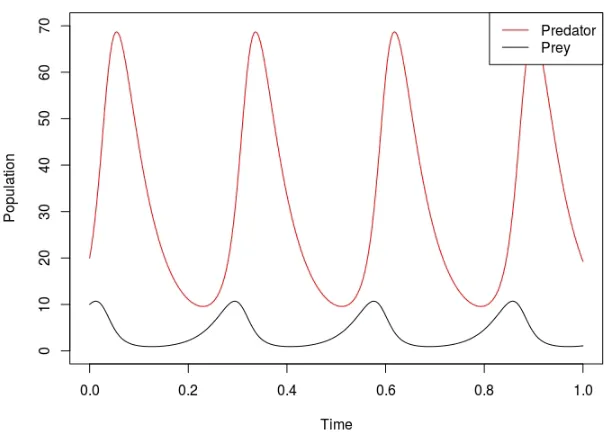
Figure 2.6 shows a numerical solution to the differential system with certain
pa-rameters. As you can see, the system appears to be periodically fluctuating up and
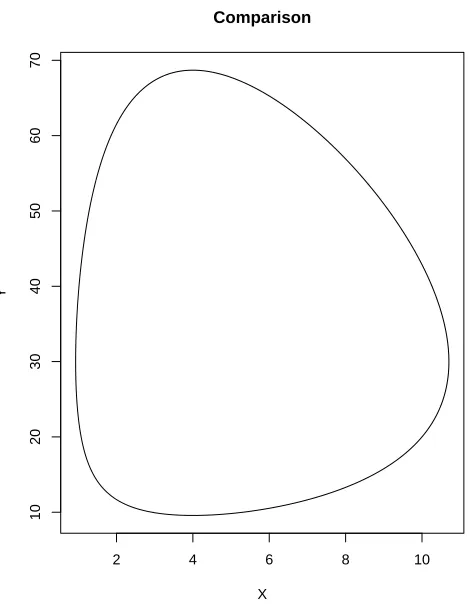
down as the other species does. Figure 2.7 highlights this periodic nature by plotting
the two populations against each other. We can see that it does indeed look periodic
and this fact is true for any values of a, b, cand d and any choice of starting points.
If we multiply and rearrange the two equations to separate the variables and then
integrate, we obtain the following
−clog(xt) +dxt=alog(yt)−byt+D,
whereD is the constant of integration. This is the equation plotted in Figure 2.7.
Figure 2.6: Plot of solution for a= 30, b = 1, c = 20 and d= 5.
random fluctuations, which would be expected in real life. Another shortfall of this
model is that for low values the behaviour seems unrealistic. For certain choices of the
parameters, it is possible to have the population size incredibly small, for example,
less than one. This is unrealistic since we know that a population size cannot be this
small but also, even after reaching this small size, the population still recovers and
can become large again.
Even though the model is simple, it still highlights the interest in trying to model
population size and how competition can affect this.
2.3.2
Introducing randomness
The model we have described so far is a model with growth and competition which
is something we are interested in but it does not contain any random elements. This
means we know for certain how the model will evolve over time and does not take
2 4 6 8 10
10
20
30
40
50
60
70
Comparison
X
[image:27.612.202.437.233.535.2]Y
etc. This is one reason why this model is not a good fit to the real world. One way to
try and make the model more realistic is to allow randomness to occur, this is done
by making the process a pure jump process with the rates being motivated by the
differential equations above which describes the evolution of the system. Consider the
following system comprising of predatorsXt and preyYt which evolves like so
(x, y)→
(x+ 1, y) at rate ax
(x−1, y) at rate bxy
(x, y+ 1) at rate dxy
(x, y−1) at rate cy
The first two lines relate the the number of prey in the system and are related to
the birth and death of one respectively. The last two are the same for the predator.
Again, this system can be seen that when both are zero we have a fixed point but
now, because of the randomness we have, there cannot be any other fixed point. An
issue with the system described above is that it does allow the prey to become extinct
to which the predator will only evolve by growing, similar to the deterministic model.
Other attempts to introduce randomness into the Lotka-Volterra system have been
considered and for further reading please see [Dimentberg, 2002] and [Cai and Lin,
Chapter 3
Diffusion Theory
In the previous section we had a look at a few models; some of which were discrete
others of which were continuous. In this section, we shall look at how, from a
contin-uous time Markov chain, we can scale the process to generate a sequence of stochastic
processes such that they converge to a continuous time Markov process. The obtained
continuous Markov process will be defined via a stochastic differential equation and
we shall look at the tools required to understand such a process. We look at the
speed measure and scale function along with the Feller boundary conditions. Once
we have classified the boundary behaviour of our process we show how that is enough
to understand the long term behaviour of the process.
3.1
Motivation
Let us have a look at a simple random process which takes jumps ±1 both with rate
1 and starts at 0. Some simulations of this process are given after a different number
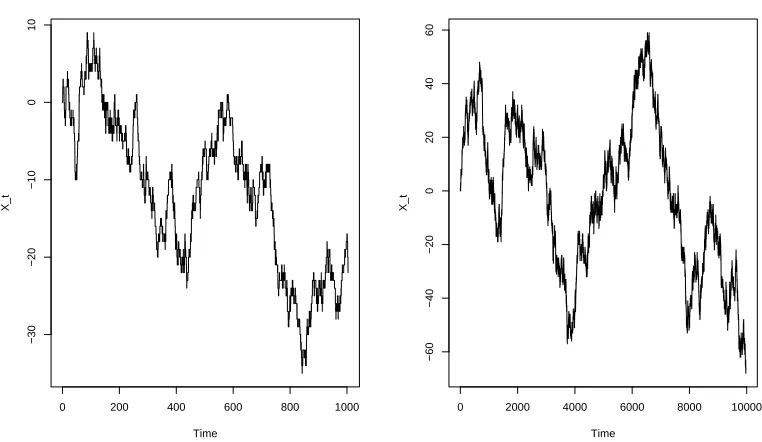
of steps, shown in Figures 3.1 and 3.2. As you can see, the process after 1000 steps
looks like a continuous process. This is because we have constrained the plot to fit
inside the box. A question arises though, is it possible to scale the process such that
this is yes, and there exists many theorems depending on the type of process you are
considering and the limit process you wish to obtain. In this section, we shall look at
a few that have been of use to us along with a few examples to help illustrate things.
We shall restrict our study to that of pure jump Markov processes. A pure jump
process is one whose movements are given purely by jumps and a Markov process is
one whose movement is only dependant on its current position and does not require
knowledge of the past. Though this may sound restrictive, this still incorporates a
large class of processes such as Poisson processes which are used in queueing theory
and the study of birth-death processes.
Definition 3.1.1. We say that a process Xt is a pure jump process if we can express
the evolution of the process in terms of jumps and its current location only. That is,
we can write
X→
X+J1(X) at rate R1(X)
X+J2(X) at rate R2(X)
.. .
X+Jn(X) at rate Rn(X)
where n is finite, Ji are the jumps of the process and Ri are the rates for the jumps
Ji respectively.
Before we consider these limit theorems though, we need to introduce one thing
that is central in the study of all these processes and this is known as thekernel. This
gives us another identical way of describing a pure jump process.
Definition 3.1.2. We say that the process Xn is a pure jump Markov process with
kernel,K, if it is a pure jump process and for all n∈N,
P Jn ∈dt,∆XJn ∈dy|Jn> t, XJn−1 =x
0 2 4 6 8 10 12
−1.0
−0.5
0.0
0.5
1.0
1.5
2.0
Time
X_t
0 20 40 60 80 100
−10
−5
0
Time
[image:31.612.133.505.122.332.2]X_t
Figure 3.1: Sample paths of a birth death process after 10 and 100 steps.
0 200 400 600 800 1000
−30
−20
−10
0
10
Time
X_t
0 2000 4000 6000 8000 10000
−60
−40
−20
0
20
40
60
Time
X_t
[image:31.612.129.510.444.665.2]whereJ1, J2, . . . are the jump times of the process.
The kernel is useful since it contains all the information we require about the
behaviour of the process. It informs us of the probability of jumping and the direction
of the jumps.
We say that the two definitions are identical in the sense that we can derive one
from the other since they both inform us of the jumps and the rates of the process
which is all we need. We end this section with a couple of illustrative examples.
Example 3.1.1. Consider the process Xt discussed so far with jumps given by the
following,
x−→
x+ 1 at rate 1
x−1 at rate 1.
Such a process would have the following kernel associated with it,
K(x, dy) = δ1+δ−1
whereδx represents the Dirac point measure which is defined such that for a subset
A⊂R,δx(A) = 1 if x∈A and 0 otherwise.
We can also extend the process such that it takes jumps of ±1 but this time with
rates given by λ and µ respectively. This process is known as a birth-death process.
If µ = 0, then the process is known as a pure birth process. Such a process would
have kernel given by
K(x, dy) =λδ1+µδ−1.
We now turn our attention into how we can use the kernel to show that the process,
3.2
Limit Theorem
In this section, we look at a theorem which states sufficient conditions to ensure that
the processes introduced in the previous section converges to a continuous process.
The result that we give is found in [Ethier and Kurtz, 1986] Chapter 7, though we
have altered it such that it includes the kernel directly. Similar results exist for other
types of diffusion processes, though we do not discuss them in much detail here. A
similar result for Markov chains which converge to a non-deterministic process is given
in [Gikhman and Skorokhod, 1996].
Inhomogeneous Markov Processes
The result we use is concerned with space inhomogeneous Markov processes, that is,
those processes whose movements are determined only by its current location. The
first theorem in this section will state what are the required conditions such that a
process converges weakly but before we state the theorem we need to introduce a few
concepts.
We firstly define the Skorokhod metric, this is a metric on the spaceD[0,∞). Let
Λ be the space of strictly increasing continuous functions mapping [0,∞) to itself and
let||f|| be the supremum norm, that is
||f||= sup
x>0
|f(x)|,
then the Skorokhod metric,σ(f, g), forf, g ∈D[0,∞) is given by
σ(f, g) = inf
λ∈Λmax{λ−I, f−g◦λ}
whereI is the identity function on [0,∞).
Let (XN
(respectively µ) corresponding to XN (respectively X) to be the measure defined to be
µ(A) = P(Xt∈A) (respectively µN(A) =P XtN ∈A
)
whereA is an element of the σ−Algebra of Borel subsets of D[0,∞).
Definition 3.2.1. We say that a sequence of measures (µN)
N∈N converges weakly to
µif for all continuous bounded functionals f on D[0,∞) with the Skorokhod metric
we have
lim
N→∞ Z
f(x)µN(dx) = Z
f(x)µ(dx).
If this is the case, we shall write µN ⇒µ (or XN ⇒ X). Further details concerning the notion of weak convergence and the Skorokhod metric can be found in [Billingsley,
1968], Chapter 1 Section 5 and Chapter 3 Section 14 respectively.
Also the notion of Brownian motion will be of use throughout the rest of this thesis
and so we include it here.
Definition 3.2.2. A stochastic processBtwhich has the following properties is known
as Brownian motion:
• For any s < t < u < v the incrementBt−Bs is independent of Bv−Bu.
• For any s, t >0,Bs+t−Bs is normally distribution with mean 0 and variancet.
• The process Bt has almost surely continuous sample paths.
When B0 = 0 then we shall refer to it as the Standard Brownian Motion.
The following theorem is what shall be key in our study of Markov processes to
obtain a scaling limit. We shall firstly state it in the way it shall be used but this is
not how it is stated in [Ethier and Kurtz, 1986]. After stating the theorem we shall
Theorem 3.2.1. Let a = (ai,j) be a Lipschitz continuous, symmetric, non-negative
definite d×d matrix valued function onRd and let b:Rd−→Rd be Lipschitz
contin-uous. Let KN(x, dy) be the kernel associated with the process XN, which takes values on some subset I ⊆Rd and define
bN(x) = Z
Rd
yKN(x, dy) and aN(x) = Z
Rd
yyTKN(x, dy).
Suppose that,
sup
x∈I
|aN(x)−a(x)|→0 and sup x∈I
|bN(x)−b(x)|→0
and that
sup
t>0
|XN t −X
N t−|→0 as N → ∞. If XN
0 = X0, then, setting σ2(x) = a(x), XtN → Xt weakly in D[0,∞)
where Xt is a solution to the stochastic differential equation given by
dXt=b(Xt)dt+σ(Xt)dBt.
where Bt is the standard one dimensional Brownian motion.
We now state the original Theorem and Corollary as stated in their book. Though
their terminology and notation is slightly different we will explain how it relates to
the theorem we use above.
Theorem 3.2.2 (Theorem 4.1 [Ethier and Kurtz, 1986]). Let a = (ai,j) be a
con-tinuous, symmetric, nonnegative definite, d×d matrix valued function on Rd and let
b:Rd−→
Rd be continuous. Let
where
Gf = 1 2
X
aij∂i∂jf+
X
bi∂if
and suppose that the CRd[0,∞) martingale problem for A is well-posed. For n =
1,2, . . ., let Xn and Bn be processes with sample paths in D
Rd[0,∞), and let An =
(An
i,j) be a symmetric d ×d matrix-valued process such that Ani,j has sample paths
in DR[0,∞) and An(t)− An(s) is nonnegative definite for 0 ≤ s < t. Set Fn t =
σ(Xn(s), Bn(s), An(s) :s≤t).
Let τn
r = inf{t:|Xn(t)|≥r or Xn(t−)≥t} and suppose that
Mn ≡Xn−Bn
and
MinMjn−Ani,j, i, j = 1,2, . . . , d,
areFn
t -local martingales, and that for each r >0, T >0, and i, j = 1,2, . . . , d
lim
n→∞E "
sup
t≤T∧tn r
|Xn(t)−Xn(t−)|2
#
= 0 (3.1)
lim
n→∞E "
sup
t≤T∧tn r
|Bn(t)−Bn(t−)|2
#
= 0 (3.2)
lim
n→∞E "
sup
t≤T∧tn r
Ani,j(t)−Ani,j(t−)
2
#
= 0 (3.3)
sup
t≤T∧τn r
Bin(t)−
Z t
0
bi(Xn(s))ds
→0 in probability (3.4)
and
sup
t≤T∧τn r
Ani,j(t)−
Z t
0
ai,j(Xn(s))ds
→0 in probability. (3.5)
Suppose that P Xn(0)−1 ⇒ ν ∈ P(Rd). Then (Xn) converges in distribution to the
In essence the above theorem states that if for a given sequence of processes (Xn) you can find functions a and b such that they satisfy the above conditions, then
the sequence (Xn) converges weakly to the process X which satisfies the stochastic differential equation given by
dXt=b(Xt)dt+σ(Xt)dBt.
This is precisely what is means to be a solution to the martingale problem. The
problem arises with how to find the functions a and b. This is where the corollary is
of use.
Corollary 3.2.1 (Corollary 4.2 [Ethier and Kurtz, 1986]). Let a, bandA be as in the
previous theorem and suppose the martingale problem for(A, ν)has a unique solution
for each ν ∈ P(Rd). Let µn(x,Γ), n = 1,2, . . . , be the transition function on Rd, and set
bn(x) = n
Z
|y−x|≤1
(y−x)µn(x, dy) and
an(x) = n
Z
|y−x|≤1
(y−x)(y−x)Tµn(x, dy).
Suppose for each r >0 and ε >0.
sup
|x|≤r
|an(x)−a(x)|→0,
sup
|x|≤r
|bn(x)−b(x)|→0
and
sup
|x|≤r
nµn(x,{y:|y−x|≥ε})→0. (3.6)
Let Yn be a Markov chain with transition function µn(x,Γ) and define Xn(t) =
the martingale problem for (A, ν).
The above corollary states that from the kernel we can construct functions anand
bnand if these function converges toaandb then subject to some other conditions we
have weak convergence. The reason we do not go into much further detail concerning
the other conditions is because they are automatically satisfied for us in all our cases.
The condition given by equation (3.6) is a requirement that the jump sizes of the
process Xn decrease as we increase n. The other condition given by P Y
n(0)−1 ⇒ ν
is stating that the initial distributions must converge which in our case holds since
they are all equal. The only other difference between this corollary and our theorem
is that we useKn=nµn
Proof of Theorem 3.2.1. See Theorem 7.4.1 and Corollary 7.4.2 in [Ethier and Kurtz,
1986].
In the previous theorem, the functions b(x) and a(x) can be thought of as the
infinitesimal drift and diffusivity of the processXtrespectively. This is why we require
the functions bN(x) and aN(x) to converge. We also require the jump sizes to tend to zero which is clearly necessary. Our final requirement is that the starting points
of all the processes coincide, this can be relaxed such that the starting points follow
a distribution and that this sequence of distributions must converge to the starting
distribution of Xt. We do not include it here since it will not be of need to us. We
shall now give a few examples where we can use the above theorem.
Example 3.2.1. Consider the birth death process given in Example 3.1.1. If we
construct the processXtN := √1
N XN t then this would have kernel
KN(x, dy) = N δ√−1 N
which yield the functions
bN(x) = 0 =b(x) and aN(x) = 1 =a(x)
hence, by tending N → ∞ we see that the jump sizes tend to zero. Assuming that
X0N =X0, we can conclude, by Theorem 3.2.1, that the process XtN converges to the
process Xt which satisfies the stochastic differential equation
dXt = 0dt+ 1dBt,
which in other words means that the process Xt =Bt, a Brownian path.
Example 3.2.2. Consider again the birth-death process given in Example 3.1.1 but
with λ(x) = x and µ = 0. Such a process is known as a pure birth process; since
µ= 0, the process can only increase. This is an example of an inhomogeneous space
process since the λ depends on the location of the process Xt. The process is still
a Markov chain as we only require knowledge of its current position. Consider the
process XtN = N1XN t, this has the kernel
KN(x, dy) = N xδ1 N
which yields the equations
aN(x) =x=a(x) and bN(x) = 0 =b(x).
Again, the jump sizes decrease to zero as we increaseN and we make the assumption
that X0 =X0N for all N. Combining this, by Theorem 3.2.1, we obtain the ordinary
differential equation given by
which can be solved to giveXt=X0et.
One question that the above theorem does not answer is: though we know that
we have convergence of the process, what is the speed at which it converges? This
can be useful at times since this helps us obtain the error when approximating for
finiteN or when running simulations. In the case where the limit is deterministic, as
in Example 3.2.2 we can apply what is known as the fluid limit which shows we have
exponential convergence to the deterministic process, for further details see [Darling
and Norris, 2008].
3.3
Analysis of Diffusion Processes
In this section, we analyse the behaviour of the stochastic differential equations that
we can obtain by applying the theorem in the previous section. The main question
that we are interested in is: what is the long term behaviour of the process ast → ∞?
The process may settle down and converge to a point, it may converge to a set of points
with certain probabilities or it may not settle down at all. If the process does not
settle down, is it possible to find a distribution for X∞? To answer these questions,
it turns out that it is sufficient to know about the boundary behaviour along with
something called the speed measure. We shall look at the speed measure and see how
this is of use to us along with the scale function, this is a function which converts
suitable diffusion processes into martingales, which reduces the complexity. Once this
is done we shall use the speed measure to classify the boundary behaviour into one
of three types, either absorbing, reflecting, or inaccessible and we will then combine
Scale function
Firstly, suppose we have a stochastic processXtwhich satisfies the following stochastic
differential equation,
dXt=µ(Xt)dt+σ(Xt)dBt. (3.7)
Such a process is known as a diffusion process and the functions µand σ are known
as the drift and diffusivity respectively. As mentioned earlier, if we could reduce the
problem such that the above process, or some invertible function of the above process,
was a martingale, then we could analyse the martingales behaviour and that in turn
would tell us the behaviour of our original process.
To do this, we use Itˆo’s formula which allows us to calculate functions of stochastic
processes given in the form above. We state the theorem below
Theorem 3.3.1(Itˆo’s Formula). Let Xt be given in (3.7) and let f be a twice
differ-entiable continuous function, then
df(Xt) =
µ(Xt)f0(Xt) +
1 2σ
2(X
t)f00(Xt)
dt+σ(Xt)f0(Xt)dBt.
Proof. See Theorem 15.19 in [Kallenberg, 2002].
This is of use since if we have a process of the form (3.7) and we suppose that
we have a function f which satisfies the assumed conditions, we can apply f to the
process and determine it’s stochastic differential equation by applying Itˆo’s theorem
to see what the resulting process would be. If we now suppose thatf satisfies
µ(x)f0(x) + 1 2σ
2(x)f00
(x) = 0
then after Itˆo’s formula we would obtain a process which only has a diffusive part and
it by ρ. It can be shown that ρ must satisfy
ρ(x) =
Z x
0
exp
−2
Z y
m
µ(u)
σ2(u)du
dy
wherem is a point in the interior of the interval the process takes, provided thatµ/σ2
is integrable. This is an assumption we shall need to make throughout since if this
does not hold we would not be able to transform the process.
After applying the scale function ρ we obtain the process Yt = ρ(Xt) which is of
the form
dYt= ˜σ(Yt)dBt
and so is a martingale.
Definition 3.3.1. Any process whose scale function is linear is said to be in natural
scale.
If the process is not in natural scale, then after applying ρ it will be. This can be
seen since any martingale is in natural scale asµ(x) ≡0. This reduces the study of
the diffusion process into that of a martingale. We now turn our attention to them.
For us to analyse martingales, we need to look at something called the speed measure.
Speed Measure
As we have shown with the use of the scale function, we can reduce any suitable
diffusion process into that of a martingale. This is useful since all martingales are
time changes of Brownian motion. This time change is given by the speed measure,
m. Combining this we obtain that
For a process of the form
dXt=σ(Xt)dBt
the speed measure is given by
m(dx) = 1
σ2(x)dx.
In general, for a process of the form (3.7), the speed measure is given by
m(dx) = 1
σ2(x)exp
2
Z x
0
µ(y)
σ2(y)dy
dx.
The speed measure is of use since for any martingale, knowledge of the boundary
behaviour is given explicitly in terms of the speed measure. This in turn will allow
us to classify the long term behaviour of the process.
Boundary Behaviour
We now turn our attention to the boundary points of a process. Suppose we have a
process Xt which takes values on the interval [θ, λ], which may be infinite. We wish
to understand what these boundary points are. There are three types of boundary
points;inaccessible, absorbing and reflecting.
Definition 3.3.2. For a stochastic processXtwe say that an endpointθisinaccessible
if the probability of hitting it from any internal point is 0.
Remark 3.3.1. If the boundary point is ±∞ then it is inaccessible.
Definition 3.3.3. For a stochastic processXtwe say that an endpoint θ isabsorbing
if the event{Xs=θ} ⇒ {Xu =θ} for all u≥s.
Remark 3.3.2. Though we do not consider it, ifZθ has positive Lebesgue measure but
If the processes is sticky, it spends some positive amount of time at the end points
before leaving. See [Feller, 1952] for his original work.
Definition 3.3.4. For a stochastic process Xtwe say that an endpoint θ isreflecting
if the setZθ ={t≥0 :Xt =θ} is such that int(Zb) = ∅.
Informally, an end point is inaccessible if we can not reach it, an end point is
accessible and reflecting if once reached the particle is ejected out immediately and
the endpoint is absorbing if the process remains in the end point indefinitely.
If the endpoint is accessible then it must be either absorbing or reflecting, if it is
not accessible then it must be inaccessible. The following theorem helps us classify
the end points.
Theorem 3.3.2(Boundary behaviour, Feller).Letmbe the speed measure of a regular
diffusion on a natural scale in some interval I = [θ, λ], and fix any u∈int(I). Then,
(i) λ is accessible iff it is finite with Ruλ(λ−x)m(dx)<∞
(ii) λ is accessible and reflecting iff it is finite with m(u, λ]<∞.
Proof. See Theorem 20.12 of [Kallenberg, 2002].
Let us look at some examples to see how this can be of use.
Example 3.3.1. Consider the process Xt such thatX0 = 0 and the process satisfies
the stochastic differential equation given by
dXt=
p
1−X2
t dBt.
Clearly such a process must take values on the interval [−1,1] and so we wish to
understand the boundary points ±1. Firstly we calculate the speed measure, in this
case we have
It can be seen that
Z 1
u
(1−x)m(dx) =
Z 1
u
dx
1 +x <∞
but
m(u,1] =
Z 1
u
dx
1−x2 =∞
and so, from Theorem 3.3.2 the boundary point 1 is accessible but not reflecting and
so must be an absorbing boundary point. Similar calculations can be done on−1 to
show that it too is an absorbing point.
Example 3.3.2. Now consider a slight variant on the one above, consider the process
Xt which satisfies the equation
dXt= (1−Xt2)dBt.
Again, ±1 are boundary points but this time we have
Z 1
u
(1−x)m(dx) =
Z 1
u
dx
(1−x)(1 +x)2
≥
Z 1
u
dx
4(1−x) =∞
and so in this case the boundary point 1 is not accessible, similarly for -1. This is
because, as the process approaches the boundary points, the rate of change decreases
faster than the process can move and so does not reach the boundary point.
This raises the question of how quickly does the diffusive term need to go to zero
to ensure the end point in the above cases are accessible.
Proposition 3.3.1. Consider the stochastic process Xt which satisfies the stochastic
differential equation
dXt= (1−Xt2) αdB
for α >0. Then the boundary points are accessible for α ≤1/2 and inaccessible for
α >1/2.
Proof. Since the process is in natural scale it is clear to see that the speed measure is
m(dx) = (1−x2)−2αdx. Applying Theorem 3.3.2 (i) we see that theR01(1−x)m(dx) is finite whenα ≤1/2 and infinite otherwise. A similar argument holds for the lower
boundary point.
Example 3.3.3. Consider another variant which takes values on [−1,1]. Suppose we
have a process Xt which satisfies
dXt =−
1
2Xtdt+ p
1−X2
t dBt.
This is not in natural scale and so we cannot classify the end points directly. We must
first calculate the scale function which in this case is
ρ(x) = sin−1(x).
Considering the process Yt= sin−1(Xt) and applying Itˆo’s formula yields,
dYt=dBt⇒Yt=Bt.
Observe that this shows that the processXt= sin(Bt). Since the original process Xt
takes value on the interval [−1,1] and we are now considering the processYt, this must
takes values on [−π, π]. We firstly classify these boundary points and then this in
turn will classify those ofXt. SinceYt=Bt it can easily be verified that m(dx) = dx
the standard Lebesgue measure. This means that for the boundary pointπ we have
and so the point π is an accessible reflecting point. A similar argument shows that
−π is an accessible reflecting point. Since both these points are reflecting, when we
look atXt we can conclude that they too must be reflecting points.
We now know how to classify the end points for a wide variety of processes, but how
can we use this knowledge to work out the long time behaviour of such processes? The
next theorem is what shall be of use. Beforehand, we need the following definitions.
Definition 3.3.5. A stochastic process Xt taking values on an interval A is said to
berecurrent if for any x, y ∈A
Px(Ty <∞) = 1
wherePx is the measure associated with the processXtwithX0 =xandTy = inf{t >
0 :Xt=y}.
A recurrent process can be further split into being null recurrent or positive
re-current.
Definition 3.3.6. A stochastic process Xt taking values in A which is recurrent is
called positive recurrent if for allx, y ∈A,
Ex(Ty)<∞.
If this is not the case then the process is called null recurrent.
Definition 3.3.7. A diffusion Xt with speed measure m(dx) on an interval I shall
be called m-ergodic if it is recurrent and the limit distribution of Xt has density
proportional tom for all X0 ∈I.
We now let (,[ and [[ denote the boundary point being inaccessible, absorbing or
reflecting respectively (e.g. [[0,1] means that the point 0 is a reflecting point and 1 is
Theorem 3.3.3(Feller, Maruyama and Tanaka, Theorem 20.15 [Kallenberg, 2002]).
For any regular diffusion on a natural scale and with speed measure m, the ergodic
behaviour is the following, depending on the initial position x and the nature of the
boundaries,
1. (−∞,∞): m-ergodic if m is bounded, otherwise null-recurrent;
2. (0,∞): converges to 0 a.s.;
3. [0,∞): absorbed at 0 a.s.;
4. [[0,∞): m-ergodic if m is bounded, otherwise null-recurrent;
5. (0,1): converges to 0 or 1 with probabilities x and 1−x , respectively;
6. [0,1): absorbed at 0 or converges to 1 with probabilitiesxand1−x, respectively;
7. [0,1]: absorbed at 0 or 1 with probabilities x and 1−x , respectively;
8. [[0,1): converges to 1 a.s.;
9. [[0,1]: absorbed at 1 a.s.;
10. [[0,1]]: m-ergodic.
As such, for us to understand the long term behaviour of the process, we first
use the function ρ to transform the process into a martingale so that it is in natural
scale. We then calculate the speed measure of the process, this will allow us to
work out the behaviour of the boundary points. Once we have done that we can use
the above theorem, after applying an affine transformation, to work out what the
limiting behaviour of the transformed process is and then, using the fact that ρ is
strictly increasing (and so invertible), we can work out the limiting distribution of the
Example 3.3.4 (Example 3.3.1 Cont.). In Example 3.3.1 we showed that ±1 are
both absorbing points for the processXtsatisfying dXt=
p
1−X2
t dBt. As such, we
are in case 7 of Theorem 3.3.3, and so the probabilities are directly proportional to
the distance to the boundaries. Since our process takes values on [−1,1] we need a
linear map to map it to the interval [0,1]. In this case we have f(x) = 12(1 +x) and
so if our process starts atx0 ∈[−1,1] we obtain that the distributionX∞ is given by
X∞ =
+1 with probabilty 12(1 +x0)
−1 with probabilty 12(1−x0).
Example 3.3.5 (Example 3.3.2 Cont.). Example 3.3.2 showed that ±1 are
inacces-sible for the process Xt satisfying dXt = (1−Xt2)dBt. As such, we are in case 5 of
Theorem 3.3.3, and so the probabilities are directly proportional to the distance to
the boundaries. Though they are not absorbed at the endpoints, they still converge
to these points and so we obtain the same distribution as the previous example.
Example 3.3.6 (Example 3.3.3 Cont.). For the process given as a solution to the
stochastic differential equation
dXt=−
1
2Xtdt+ p
1−X2
t dBt
we know that we have reflecting boundary points at±1, this puts us in case 10 of the
theorem. This means our process is ergodic and the distribution at infinity is given
by the arcsine distribution. This can be seen since the process, Xt above has scale
function ρ(x) = sin−1(x) giving Yt = ρ(Xt) = Bt with the boundary points for the
process Yt being reflecting. The distribution is given by the uniform distribution on
Chapter 4
Addition of Growth to the Fully
Connected Voter Model
4.1
Introduction
Discrete random dynamical systems typically evolve according to one of two
mecha-nisms: growth, in which the addition of individuals or particles are governed by some
rule; or internal dynamics, in which particles within the system interact with each
other. Examples of pure growth dynamical systems include the Eden model, 2d
per-colation and the P´olya urn model. See [Lindgren, 1963] for the original work by Eden
concerning his model, [Grimmett, 1989] for details on percolation and [Johnson and
Kotz, 1977] concerning the P´olya urn model. Examples of models with purely internal
dynamics include the voter model, which is studied in [Clifford and Sudbury, 1973] or
the Metropolis-Hastings algorithm for sampling from the Ising model (originally
pub-lished in [Ising, 1925]). In this chapter, we consider a model that incorporates both
of these mechanisms; a model that has growth and internal dynamics. The model we
look at is the fully-connected voter model with growth, which was first introduced in
consider one type of internal behaviour and two different types of growth. We extend
these results in a rigorous manner. We show how to approximate the proportion of
votes for a large initial population with a diffusion process. We also calculate the limit
distributions and show how the behaviour of states can change by increasing the rate
from constant growth to exponential growth. The case where the initial population
size is small is also discussed and we comment on how our limit distribution results
still hold for all except two cases. In the cases where it does not, we show how in
one case we obtain a system that is similar to the P´olya urn model and so the limit
distribution can be explicitly calculated.
4.1.1
The fully connected voter model with the addition of
growth
Following the set up given by [Morris and Rogers, 2014], we firstly introduce the basics
of the voter model. Consider a graph G= (V, E) comprising a set V of vertices and
E of edges. On each vertexv ∈ V there exists a discrete random variable, which we
denote as σv where σv ∈ {−1,1}. The point v represents a voter and σv is the vote
of a person on the site. The way that each person may vote is influenced by their
neighbours. We shall consider the mean-field case where everyone is connected to one
another. Since we are not concerned with the individual behaviour of each person,
but the average of them, we shall look at the proportion of votes, which we denote by
x. This is a function based upon the configurations of the votes and is defined to be
x(σ) = 1
|V|
X
v∈V
σv.
This meansx∈[−1,1] with the boundary points being achieved only when the voters
all align with the same party, either −1 or +1, respectively. We denote N = |V| to