EXTRACTION OF Ni(II) IONS INTO CHCl
3SOLUTION OF
N,N’-
ETHYLENEBIS(4-BUTANOYL-2,4-DIHYDRO-5-METHYL-2-PHENYL-3H-PYRAZOL-3-ONE IMINE) SCHIFF BASE
J. Godwin
[a], F. C. Nwadire
[b]and B. A. Uzoukwu
[c]Keywords: Extraction, Nickel(II), N,N’-Ethylenebis(4-butanoyl-2,4-dihydro-5-methyl-2-phenyl-3H-pyrazol-3-one imine), Effect of pH and anions
The extraction of Ni(II) ions in aqueous media was studied using chloroform solution of N,N ’-ethylenebis(dihydro-5-methyl-2-phenyl-3H-pyrazol-3-oneimine) (H2BuEtP) Schiff base as the organic extractant. The synergistic effect of 4-butanoyl-2,4-dihydro-5-methyl-2-phenyl-3H-pyrazol-3-one (HBuP) in these extractions were also investigated. The pH½ of extraction of Ni(II) was significantly lowered from a near neutral pH 7.14 ± 0.10 to an acidic region of 5.51 ± 0.10 when a mixture of the ligands was used. The partition coefficient (log KDNi1) 1.89 ± 0.05 (H2BuEtP) was same as (log KDNi2) 1.89 ± 0.02 (H2BuEtP-HBuP) while the extraction constant (log KexNi1) -12.39 ± 0.64 (H2BuEtP) was slightly less than (log KexNi2) -10.57 ± 0.10 (H2BuEtP-HBuP). Data analysis indicated that Ni(II) distributed slightly better into chloroform solution of H2BuEtP/HBuP as Ni(HBuEtP)(BuP)(o) than into a solution of H2BuEtP as Ni(HBuEtP)2(o) . Mineral acids show a masking effect in the extractions in both ligand alone and mixed ligands systems while mixed ligands system was shown to be a better extractant system for Ni(II) ions in the presence of anions and auxiliary complexing agents studied. Acetate, fluoride, and phosphate ions gave the best percentage extractions and the extraction of Ni(II) ions with the ligand is more efficient at near neutral to basic pH
Corresponding author
Email [email protected] Tel.: +2348033401456
[a] Department of Chemical Sciences, Niger Delta University, Wilberforce Island, PMB 71 Bayelsa State. Nigeria. [b] Department of Pure and Industrial Chemistry, University
of Port Harcourt, Choba, Port Harcourt, Rivers State. Nigeria, Email: [email protected]
[c] Department of Pure and Industrial Chemistry, University of Port Harcourt, Choba, Port Harcourt, Rivers State, Email: [email protected]
Introduction
Schiff bases are compounds that contain the carbon-nitrogen double bond traditionally connected to an aryl or alkyl group. Earlier studies on isolation and characterization of metal complexes of schiff bases have shown that they are capable of forming stable metal complexes with Cu(II) and Ni(II) and unstable metal complexes with Mo(VI), Co(II) and Cd(II).1,2 Derivatives of 1-Phenyl-3-methyl-4-acyl-pyrazolone-5 are known for their complexation reactions with transition metals forming metal complexes with interesting coordination chemistry. 3,4,5,6 Most of the current systems used for extracting metals work best mostly at acidic pH. However, natural waters are at near neutral to basic pH, and much of the currently stored wastes are at very caustic conditions. Thus, there is high demand for ligands that can extract over a wide range of pH.
In continuation of our earlier work on the synthesis, characterization7 of 1-phenyl-3-methyl-4-acylpyrazolone-5 derivatives and extraction of metal ions with N,N ’- ethylenebis(4-butanoyl-2,4-dihydro-5-methyl-2-phenyl-3H-pyrazol-3-oneimine) Schiff base, which has been successfully applied in the extraction of Lead(II)8 and U(VI) ions9, we report the application of the present Schiff base derivative of 4-butanoylpyrazolone as a potential extractant for Nickel(II) ions. The synthesis provided an opportunity
for a N=C-C-OH bonding moiety and extended the scope of coordination to involve tetradentate ligands from the initial bidentate 4-acylpyrazolone.
In this study the solvent extraction of nickel(II) ions from aqueous media using N,N ’-ethylenebis(4-butanoyl-2,4-dihydro-5-methyl-2-phenyl-3H-pyrazol-3-oneimine) was investigated. Extraction of metal ions with the Schiff base N,N’ - ethylenebis(4 - butanoyl - 2, 4-dihydro - 5 - methyl–2-phenyl-3H-pyrazol-3-one imine) has attracted little attention in the literature. Thus, the synergistic effect of 4-butanoyl-2,4-dihydro-5-methyl-2-phenyl-3H-pyrazol-3-one with O=C-C=C-OH moiety on the distribution behaviour of Ni(II) into a solution of predominantly N=C-C-OH bonding species and the effect of pH, acids, anions and auxiliary complexing agents on the extraction of Ni(II) from aqueous solutions was investigated. The aim of the study was to evaluate the potentials of the Schiff baseN,N ’-ethylenebis(4-butanoyl-2,4-dihydro-5-methyl-2-phenyl- 3H-pyrazol-3-oneimine) in the recovery of Ni(II) ions in aqueous media.
Materials and Methods
Reagents and Apparatus
N,N’ - Ethylenebis(4 - butanoyl - 2,4 – dihydro - 5 - methyl-2-phenyl-3H-pyrazol-3-oneimine) (H2BuEtP) was synthesized by methods reported earlier.7 The ligand’s purity after recrystallization from aqueous ethanol was established by elemental analysis for C, H and N; analysis of IR and NMR spectral data at the Institute for Inorganic Chemistry Technology, University of Dresden, Germany.
dissolving appropriate amount of the ligand in CHCl3. Stock solutions of 1.704 x 10⁻² M (1,000 mg/L) of Ni(II) were prepared by dissolving appropriate amount of ammonium nickel(II) tetraoxosulphate(VI) hydrate (2:1:2:6), (NiSO4.(NH4)2SO4.6H2O) in 0.1 mL of 10 M HNO3 and making up to mark in a 50 ml volumetric flask with deionized water. Buffer solutions were prepared with 0.1M HCl/0.1 M NaCl (pH 1.0-2.9), 0.1 M acetic acid/0.1 M NaCl (pH 3.0-3.5), 0.1 M acetic acid/0.1 M Na-acetate (pH 3.6-5.6), and 0.1 M KH2PO4/0.1 M NaOH (pH 5.7-10.0). pH of the buffered solutions were determined with a Labtech Digital pH meter. Solutions of 0.001-3.0M mineral acid, 0.001 - 1.0M anions or 0.0005M – 0.5M auxiliary complexing agent concentrations were prepared by diluting appropriate volumes of stock solutions of mineral acids or sodium salts of anions or auxiliary complexing agent. All experiments were performed at ionic strength of 0.1 M (NaClO4).
Extraction Procedure
2 mL aliquot of a buffer solution containing 8.52×10⁻⁴ M (50 mg/L) of Ni(II) ions and the desired pH of solution was prepared in a 10 ml extraction container. For extraction studies involving mineral acid or complexing agents, 2 ml aliquot of solution containing 8.52×10⁻⁴ M of Ni(II) ions and the desired mineral acid or complexing agent concentration was prepared in a 10 ml extraction container. An equal volume (2 mL) of chloroform solution of 0.05 M concentration of H2BuEtP or 0.05M H2BuEtP : 0.05 M HBuP (9:1 ratio by volume) was added and the mixture shaken mechanically for 30 minutes at room temperature of about 30 oC. A shaking time of 30 minutes was found suitable enough for attaining the equilibration. The phases were allowed to settle and separated. Concentration of Ni(II) ion in aqueous phase was determined with a Buck Scientific Atomic Absorption Spectrophotometer (AAS) 205 at wavelength of 232.0nm. Ni(II) ion concentration extracted into the organic phase was determined by the difference between the concentration of Ni(II) ion in aqueous phase before and after the extraction. Distribution ratio D was calculated as the ratio of metal ion concentration in the organic phase (Co) to that in the aqueous phase (C). Thus D = Co/C.
Results and Discussion
Effect of buffer solutions
Extraction of Ni(II) from aqueous phase into an organic phase ‘(o)’ containing the ligand H2BuEtP can be represented by equation
Ni2+ + H2BuEtP(o) Ni(BuEtP)(o) + 2H+ (1)
where H2BuEtP is a tetradentate ligand. It shows that the reaction should take place in the metal:ligand mole ratio of 1:1. Thus the extraction constant Kex can be represented by,
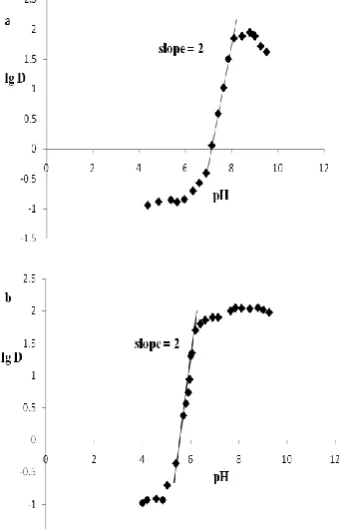
Figure 1. Plot of extraction of 8.52 x 10⁻⁴ M Ni(II) from buffer solutions into (a) chloroform solution of 0.05 M H2BuEtP and (b) chloroform solution of 0.05 M H2BuEtP-0.05 M HBuP in the 9:1 ratio by volume
The distribution ratio D = [Ni(BuEtP)(o)]/[Ni2+]). Substitution into equation (2) gives,
lgD = lgKex+lg[H2BuEtP]+2pH (3)
Extraction plots presented in Figure 1 show the effect of pH of solution on the distribution nature of Ni(II) into chloroform solutions of H2BuEtP and H2BuEtP-HBuP respectively. A slope of 2 was recorded in each of the graphs indicating that 2 moles of hydrogen ion was displaced during extraction in each of the different extraction systems. Slope analysis of extraction results presented in Figures 2a and 5a shows that one mole of the metal interacted with two moles of H2BuEtP. The probable reaction during the extraction process may therefore be represented as shown.
Ni2+ + 2H2BuEtP(o) Ni(HBuEtP)2(o) + 2H+ (4)
The distribution ratio D=[Ni(HBuEtP)2(o)]/[Ni2+]. Substitution into equation (5) gives,
lgDNi1=lgKNiex1+2log[H2BuEtP]+2pH (6)
2 ( )
2
2 ( )
( )
(2)
o ex
o
Ni BuEtP H
K
Ni H BuEtP
2
2( )
1 2 2
2 ( )
( )
(5) o
Niex
o
Ni HBuEtP H
K
Ni H BuEtP
Figure 2. kgD-lg [H2BuEtP] plot of extraction of 8.52 x 10⁻⁴ M of Ni(II) from buffer solutions at constant pH of 6.7, 7.3, and 7.8 in the absence of synergist
Figure 3. kgD-lg[H2BUEtP] plot of extraction of 8.52 x 10⁻⁴ M of Ni(II) from buffer solutions into chloroform solutions of ligands with [HBuP] kept constant (5 x 10⁻³ M)
In this study, it was observed that the extraction of Ni(II) ion increased with an increase in pH and reached a maximum at pH of 8.78 after that further increase in pH resulted in a decrease in the percentage extraction of Ni2+. Quantitative percentage extraction of 98.87% was obtained at pH of 8.78. The partition coefficient KNiD1 is given by KNiD1 = [Ni(HBuEtP)2(o)]/[Ni(HBuEtP)2] for which a value of 1.89 ± 0.05 was determined for logKNiD1 from the graph. The pH½ was also found to be 7.14 ± 0.01. Data of all the extraction processes are recorded in Table 1.
Figure 4. lgD-lg[HBuP] plot of extraction of 8.52 x 10⁻⁴ M of Ni(II) from buffer solutions into chloroform solution of ligands with [H2BuEtP] was kept constant (2.5 x 10⁻² M)
Effect of addition of HBuP on the distribution of Ni(II)
Quantitative percentage extraction of 99.11% at pH of 7.85
more acidic region indicating that extraction of Ni2+ ions at lower pH values was more effective in chloroform solutions containing HBuP as a synergist. Uzoukwu et al10 obtained a similar result from their studies on the effect of chloride ion (Cl-) concentration on Cu(II) and Ni(II) ions using 1-phenyl-3-methyl-4-trichloroacetylpyrazol-5-one. The partition coefficient KNiD2 is given by the equation of KNiD2= [Ni(HBuEtP)(BuP)(o)]/[Ni(HBuEtP)(BuP)], for which a value of 1.89 ± 0.02 that was statistically same with lgKNiD1 was determined from the graph in Fig. 1b.
Plots of log D against pH in the mixed ligands system in figure 1b gave a slope of 2 indicating that 2 moles of hydrogen were displaced during the extraction process. Interaction between Ni(II) and H2BuEtP in the presence of HBuP at constant pH 6.0, 6.5 and 7.0 in fig 3 and fig 4 all gave a slope of 1 confirming 1 mole of both ligands were involved in the interactions. Combining these results with metal variation plots in the presence of synergist in figure 5b, the probable reaction during the extraction process can therefore be represented as;
Ni2++H2BuEtP(o)+HBuP(o)↔Ni(HBuEtP)(BuP)(o)+2H+ (7)
where [HBuP] is constant and incorporated in KNiex2. The distribution ratio DNi2=[(Ni(HBuEtP).BuP(o))]/[Ni2+], on substitution into Eqn. (8) gives,
lgDNi2=lgKNiex2 + log[H2BuEtP] + 2pH (9)
Figure 5. lg D-log [Ni(II)] plot of extraction of Ni(NI) from buffer solutions into chloroform solutions of ligand 0.05 M H2BuEtP (b)
2
( )
2 2
( )
( ).
(8) 2
o Niex
o
Ni HBuEtP BuP H
K
Ni H BuEtP
Table 1. Extraction data of the influence of pH of aqueous phase on the extraction of 8.52 x 10⁻⁴ M of Ni(II) into organic solutions of 0.05 M H2BuEtP and mixture of 0.05 M H2BuEtP-0.05 M HBuP (9:1) ratio at room temprature of 30 oC (ionic strength of 0.1 M NaClO4)
Effect of mineral acids, anions and auxiliary complexing agents on the distribution of Ni(II)
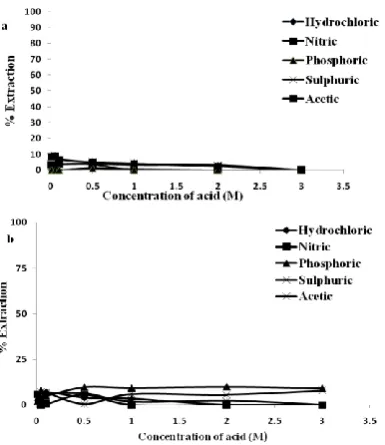
Results presented in fig 6 show that extraction of nickel is masked in the presence of mineral acids as percentage extraction was less than 10% even in the presence of the HBuP at all concentrations of the various mineral acids used in this study as was observed in the extraction of Pb(II) with most mineral acids with same ligand system.8 This can be attributed to the formation of unextractable hydrophilic ion pair nickel anionic species in acidic media even in the presence of H2SO4 which could be responsible for poor percentage extractions in the acidic regions in plots of extraction of Ni(II) ions in buffered media shown in Fig 1.
Figure 6.Plot of % extraction of 8.52 x 10⁻⁴ M Ni(II) from mineral acid solutions into (a) 0.05 M H2BuEtP solution (b) 0.05 M H2BuEtP-0.05 M HBuP (9:1) solution
The effect of anions on the distribution of Ni(II) ions in Fig. 7 indicate that chloride ion show the least enhancing effect (with an highest % extraction of 30) in the extraction of Nickel with the ligand H2BuEtP while phosphate ion gave the highest percentage extraction (99.43%) of Ni(II). In most cases, at anion concentrations above 0.01M the percentage extraction starts to decrease. This trend was also observed in the mixed ligands organic phase. The results in fig 7b clearly show that a mixture of H2BuEtP- HBuP/CHCl3 was a better extractant than H2BuEtP/CHCl3 for Ni(II) ions, as the following increases in percentage extraction was
Figure 7. Plot of % extraction of 8.52 x 10⁻⁴ M Ni(II) from
solutions of anions into (a) 0.05 M H2BuEtP solution (b) 0.05 M H2BuEtP-0.05 M HBuP (9:1) solution
observed; Cl- (29.18% to 58.71%), I-(56.8% to 97.5%), PO4 2-(95% to 99.9%), SO42- (41.83% to 67.05%), NO3- (47.68% to 95.2%) and CH3COO- (85% to 90.59%) at 0.01M concentration of ions. Most of the results on the effect of these anions follow trends observed in the distribution of Pb(II) using the same ligand system.8
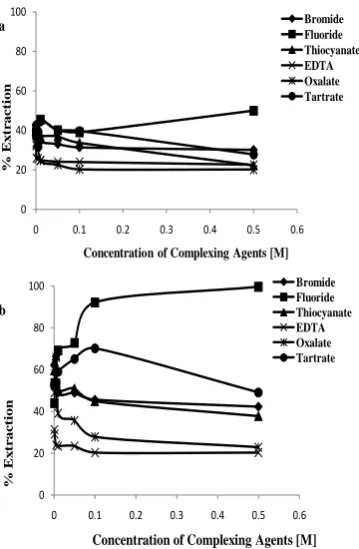
From the results presented in Fig 7, the influence of auxilliary complexing agents on the extraction of Ni(II) ions was not appreciable as all percentage of extraction was less than 50% at all concentrations of complexing agents used for the study except for F- ion at 0.5M when H2BuEtP only was used. There was an increase in % extraction when a mixed ligand H2BuEtP/HBuP organic phase was used as > 50% extraction of Ni(II) was obtained in all complexing agents except EDTA. The % extraction decreases at concentrations above 0.005M of complexing agents in both type of ligand system, except for fluoride and tartrate ions. For fuoride ion, the % extraction increases steadily from 44.1% at 0.0005M to 99.6% at 0.5M whilst, for tartrate, from 52.5% at 0.0005M to 70.3% at 0.1M.
Organic Phase lg Kex pH½ lg KD Species extracted
0.05 M H2BuEtP -12.39 ± 0.64 7.14 ± 0.10 1.89 ± 0.05 Ni(HBuEtP)2(o)
Figure 8: Plot of % extraction of 8.52 x 10⁻⁴ M Ni(II) from solutions of auxiliary complexing agents into (a) 0.05 M H2BuEtP solution (b) 0.05 M H2BuEtP-0.05 M HBuP (9:1) solution
H2BuEtP solution (b) 0.05 M H2BuEtP-0.05 M HBuP (9:1) solution
Conclusion
The study on the distribution of Ni(II) in buffered medium with chloroform solution of H2BuEtP alone and H2BuEtP/HBuP mixture show that the pH1/2 shifted from 7.14 ± 0.10 in H2BuEtP alone to an acidic region of 5.51 ± 0.10 in a mixture of the ligands system. The partition coefficients were; H2BuEtP alone KNiD1 1.89 ± 0.05 and H2BuEtP/HBuP mixture KNiD2 1.89 ± 0.02, indicating that in buffered media there was no noticeable difference in the distribution of Ni(II) ions into H2BuEtP alone as Ni(HBuEtP)2(o) and into H2BuEtP/HBuP mixture as Ni(HBuEtP)(BuP)(o). The extraction constant log KexNi1 -12.39 ± 0.64 < log KexNi2 -10.57 ± 0.52 indicates that H2BuEtP/HBuP mixture was slightly a better extractant in buffered media than H2BuEtP alone.
All mineral acids used for the study show less than 10% extraction of Ni(II) in both H2BuEtP alone and mixture of ligands H2BuEtP/HBuP organic phases as against the above 50% in almost all the anions except chloride ion in H2BuEtP alone. Combining this observation with % extraction of Ni(II) ions with the ligand in buffered media,
we conclude that extraction of Ni(II) ions with the ligand alone or its mixture with HBuP is better in alkaline medium.
From results of the effect of anions and auxilliary complexing agents on the extraction of Ni(II) ions, we may confirm that the mixture of ligands H2BuEtP/HBuP was a better extractant for Ni(II) ion than H2BuEtP alone collaborating the calculated physicochemical parameter values from distributionion of Ni(II) ions in buffered media.
Though extraction of Ni(II) ions can be obtained in acidic pH between 4 – 6 with a mixture of the ligands, the optimal conditions for the extraction of Ni(II) ions was in the mixture of ligands H2BuEtP/HBuP organic phase in the presence of phophate ion at ≤ 0.01M, acetate ion at ≤ 0.1M and fluorude ion at ≤ 0.5M in near neutral to alkaline condition were ≥ 99% extraction of Ni(II) ions was obtained.
Acknowledgement
The authors wish to thank the University of Port Harcourt, Alexander von Humboldt Stiftung, Germany and Prof. Karsten Gloe for research assistance to BAU.
References
1Uzoukwu, B. A.; Gloe, K., Duddeck, H.‘Synth. React. Inorg. Met.,
1998, 2(5), 819.
2Amarasekara, A. S.; Owereh, O. S.; Lyssenko, K. A.; Timofeeva. T. V. ‘J. Struct. Chem.,2009, 50(6), 1159.
3Maurya, R. C., Mishra, D. D, and Trivedi,P. K. Synth. React.
Inorg. Met., 1994, 24, 17.
4Uzoukwu, B. A.; Gloe, K.; Menzel, M., Rademacher, O. Z. Anorg. Allg. Chem, 2001, 627, 103.
5Xiao-yuan, C.; Shu-zhong, Z.; Qing-jin M. Transit. Met. Chem.,
1996, 21, 345.
6Uzoukwu, B. A.; Al-Juaid, S.S.; Hitchcock, P. B.; Smith, J. D. Polyhedron, 1993, 12(22), 2719.
7Uzoukwu, B. A.; Gloe, K.; Duddeck, H. Indian J. Chem. A,, 1998, 37B, 1180.
8Godwin, J and Uzoukwu, B. A. IOSR-JAC, 2012. 1(3,) 14 9Godwin, J and Uzoukwu, B. A. Int. J. Chem. (Toronto, ON, Can.),
2012. 4(4), 105
10Uzoukwu, B. A., and Mbonu J. I. Solvent. Extr. Ion Exch.2005, 23, 750
Received: 01.10.2012.
Accepted: 15.10.2012.
0 20 40 60 80 100
0 0.1 0.2 0.3 0.4 0.5 0.6
Bromide Fluoride Thiocyanate EDTA Oxalate Tartrate
%
E
x
tr
ac
tion
Concentration of Complexing Agents [M]
a
0 20 40 60 80 100
0 0.1 0.2 0.3 0.4 0.5 0.6
Bromide Fluoride Thiocyanate EDTA Oxalate Tartrate
%
E
x
tr
ac
tion
![Figure 2. kgD-lg [H2BuEtP] plot of extraction of 8.52 x 10⁻⁴ M of Ni(II) from buffer solutions at constant pH of 6.7, 7.3, and 7.8 in the absence of synergist](https://thumb-us.123doks.com/thumbv2/123dok_us/7838553.2090662/3.595.51.287.63.190/figure-buetp-extraction-buffer-solutions-constant-absence-synergist.webp)