European Journal of Physical Education and Sport Science
ISSN: 2501 - 1235 ISSN-L: 2501 - 1235 Available on-line at: www.oapub.org/edu
DOI: 10.46827/ejpe.v6i5.3191 Volume 6 │ Issue 5 │ 2020
PERCEPTIONAL EVALUATION OF THE OBESE CHILDREN
IN TERMS OF BODY, NUTRITION AND EXERCISE
Halime Pulat Demır1,
Mustafa Zahit Serarslan2i 1Dr., İstanbul Gelişim University,
School of Health Sciences,
İstanbul, Turkey
2Doç. Dr., Mardin Artuklu University, School of Physical Education and Sports, Mardin, Turkey
Abstract:
In this study, it was aimed to evaluate the perception of body, nutrition and exercise of obese children and their situations causing obesity. This study was carried out on 14 children aged 10 years old living in Avcılar district of Istanbul, who were classified as obese according to the World Health Organization (WHO) percentiles. Since the research was aimed at evaluating the perspectives of the participants who experienced obesity in detail, the case, which is one of the qualitative research models, was planned in the science (phenomenology) pattern. Phenomenological research has been specifically chosen to emphasize participants' perspectives and to understand them better . Body image scale consisting of 14 figures has been used for body perception in the age group of 10.A semi-structured interview form consisting of 20 questions was used to evaluate the perception of nutrition and exercise. Face to face interviews were made with the participants and voice recordings were obtained with their permission. After the sound recordings were transferred to the text and listened to, they were categorized with the content analysis method. Fourteen obese children, nine boys, and five girls participated in the study. Three topics were determined by the content analysis method. These are the participants' body image, perception of nutrition, and perception of exercise. As a result of the study, it was found that obese participants were not satisfied with their appearance and wanted to appear slim. They expressed some of the reasons why they wanted to be slimmer as being able to run and move faster. Most of the participants stated that they were mocked by their friends because of their appearance. It was determined that they define healthy and unhealthy nutrition in the right way and interpret them as "sports activities for getting slim rather than health" in their perceptions about exercise.
Keywords: obesity, child, body perception, nutrition, exercise
1. Introduction
More energy intake than the spent energy is the main cause of obesity. This type of obesity is called 'exogenous obesity' and the majority of obese people fall into this group. There are many factors that cause exogenous obesity such as environmental factors, socioeconomic status, psychological effects, nutritional habits, and physical activity deficiency (Neyzi Olcay, 2009) (Peker et al., 2000) (Balthazar and Oliveira, 2011a) (Clarke et al., 2015).
The lack of proper nutrition program for preschool and school-aged children, excessive calorie intake, environmental factors that encourage empty calorie foods, nutritional habits of the family, time to start complementary foods during infancy, portion amounts, physical activity deficiency are the most important causes of obesity in childhood (Peker et al, 2000) (Katz, Friedman, and Lucan, 2018) (Balthazar and Oliveira, 2011b) (Gupta et al., 2012). Childhood obesity has become one of the most important public health problems of the 21st Century (Clarke et al., 2015;
http://www.who.int/en/news-room/fact-sheets/detail/obesity-and-overweight 2018; Øen et al., 2018a). According to the report of the Global Burden of Disease: GBD Obesity Cooperation Group of 2015, there are 107.7 million obese children in the world.WHO estimates that 39% of adults are overweight and 13% are obese worldwide in 2016. Increasing prevalence in childhood obesity is also reported in the United States and European countries (Cad and Bey, 2018).
Similarly, in our country, with the change of life and diet, an increase in childhood obesity is observed. According to Turkey Childhood Obesity Research (CO-ENG 2016) data, 14,6% of children in the 7-8 age group in Turkey are overweight and 9.9% obese.Compared to the COSI-TUR 2013 study results, it is observed that the rate of overweight and obesity has increased (General Directorate of Public Health of the Ministry of Health of the Republic of Turkey, 2017).
Obesity in childhood and adolescence brings physical and physiological results. If children who are obese during this period switch to adulthood without losing weight, the risk of developing diabetes mellitus and cardiovascular diseases increases. (Bradbury et al., 2018; Øen et al., 2018b). Obesity is also associated with decreased self-confidence and quality of life, low physical activity, and sedentary life. It is known that childhood obesity is also associated with parental education status and weight of the parents (Bradbury et al., 2018; Øen et al., 2018b; Thorstensson et al., 2018).
It has been shown in studies that school programs developed to increase physical activity and to develop healthy eating habits can be effective in obese children. However, in such interventions, individual factors may be overlooked and desired results may not be obtained (Clarke et al., 2015).
There are many quantitative studies on the causes and complications of obesity, but qualitative studies in this area are limited (Doner et al., 2013).Qualitative studies can be helpful in understanding obese children better, as they provide insight into participants' perceptions, attitudes, concerns, and opinions (Clarke et al., 2015). This study is a qualitative research planned and conducted in order to understand how they perceive their bodies better, nutrition and exercise through the eyes of obese children and to develop suggestions for the solution of obesity.
2. Method
The universe of this research consists of individuals in the Avcılar district of Istanbul who are classified as obese by evaluating the height and weight of the World Health Organization (WHO) according to the obesity screening. In other words, the universe is made up of obese children whose WHO score is greater than + 2 for the children 5-19 years old. In obesity screening, the height measurement of the participants was measured with a stadiometer, and the body weight and fat ratio were measured with the Inbody 120 body analysis device.
Since it is not possible to reach all children in all age groups who are obese, 14 obese children who are 10 years old and study and reside in the district of Avcılar in Istanbul, consisted of the sample of the study with the consent of their families. The reason for the inclusion of the 10 age group in the study is that the most obesity rate is observed in this age group as a result of the obesity screening in Avcılar district and the body image scale was created for children aged 10 years. In this context, easily accessible case sampling, which is one of the purposeful sampling methods, was used in the study. All of the children participating in the study study at public school.
This study is a qualitative study planned to obtain some tips for how obese children perceive their body, nutrition and exercise, and to develop suggestions for the solution of obesity in children.Since the research aimed to evaluate the perspectives of the participants who experienced obesity in detail, the case, which is one of the qualitative research models, was planned in the science (phenomenology) pattern. Phenomenological research is particularly suitable for emphasizing the participants' perspectives and understanding them better.
2.1. Data Collection Tools
In this study, a semi-structured interview form consisting of 20 questions prepared by the researchers and “Body Image Scale of Children” was used as information and data collection tool.
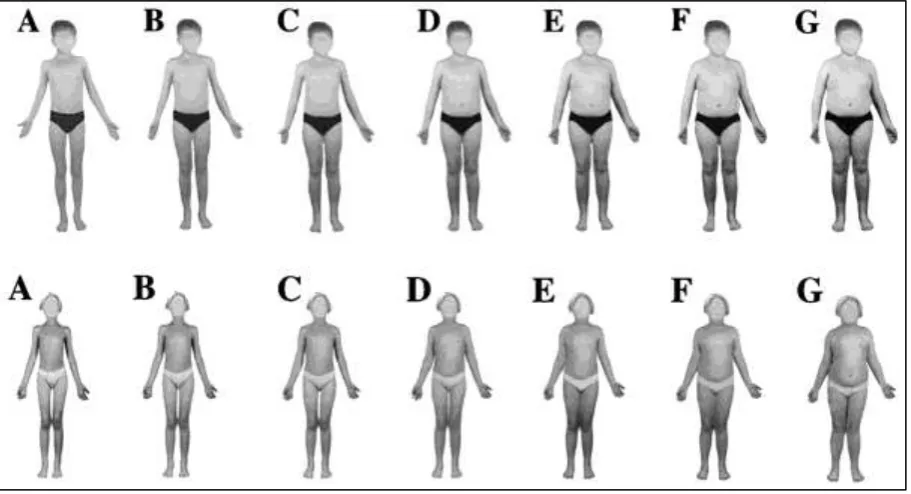
healthy children aged 7-12, ranging from the thinnest to the fattest, with separate male and female versions. The child was asked to describe the figure (perceived figure) he perceived most. They were then asked to show the figure (ideal figure) they wanted to be. The difference between perceived and ideal category numbers was used as a measure of dissatisfaction with body size. In this case, a positive score was obtained for a child who wants to be thinner, and a negative score for a child who wants to be fatter.The bigger the difference is, the child is dissatisfied with his/her image.(Truby and Paxton 2002). In Figure 1, “Body Image Scale of Children” is given.
Figure 1: The Children's Body İmage Scale
The semi-structured interview form applied in this study consists of 20 questions. Through the interview, it was tried to determine the perceptions, thoughts, and comments of obese participants regarding their bodies, nutrition, and exercise. While creating the semi-structured questionnaire, the questions were finalized by taking the suggestions of two academicians from the School of Physical Education and Sports and three academicians from the School of Health Sciences, Department of Nutrition and Dietetics in order to ensure the relevance and content validity of the questions.
Interviews were held in October 2018 after the approval of the ethics committee dated 29/09/2018 and numbered 77366270-199-E.9089 from Istanbul Gelişim University for the study.
main data source of this research. What is said in the interviews is marked as code and placed under the topic headings. Thus, the main topics were put forward and the results were evaluated. Since it was thought that it would not be appropriate to mention the name in the research, it was defined by giving a code to each participant.In the order of interview, child participants were given codes such as first participant (K1), second participant (K2)… fourteenth participant (K14). These codes were used while making analysis.
2.2. Analysis of Data
While analyzing the study data; “Continuous Comparative Analysis Method” was used. In this method, it is essential to encode the data in categories and at the same time to compare them continuously with other data. When there are no similar data when comparing, a new category is created and continued. If the first created categories are not considered to reflect the data completely, the categories can be changed at this stage. In this way, the available data were examined in detail, and classified according to similarities and differences. After classification, the data were coded and made into a table by finding repetitions. Since the aim of the study is to learn how these participants perceive their bodies, nutrition and exercise, the answers given are tried to be conveyed exactly as the participants' own expressions. The results of the analysis were interpreted with the help of the relevant literature.
2.3. Limitations of the Study
Since it is not possible to reach all participants in all age groups who are obese, this research is limited to data obtained from 14 obese children who are 10 years old and classified as obese by evaluating their height and weight according to WHO growth curves, as a result of obesity screening in Avcılar district of Istanbul. These data consist of a systematic group of questions designed semi-structured.
The data is limited to the observations and opinions of the participants only. It is based on data obtained within the framework of questions asked to children.In the study, it was assumed that the participants perceived the questions correctly and answered with sincerity and honesty.
3. Fındıngs
A total of 14 obese children, including nine boys and five girls, were included in the study. As stated above, three topics were identified based on the information and data obtained as a result of face-to-face interviews with these children. These can be listed as follows:
3.1. Body Image and the Look They Want to Be
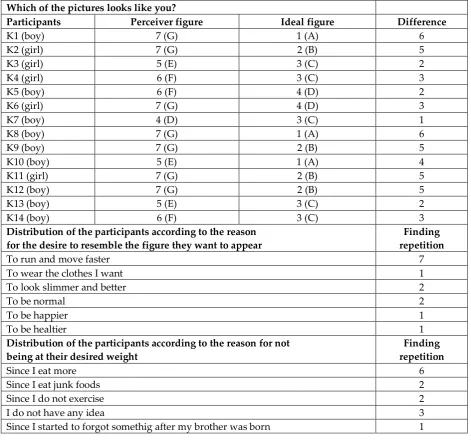
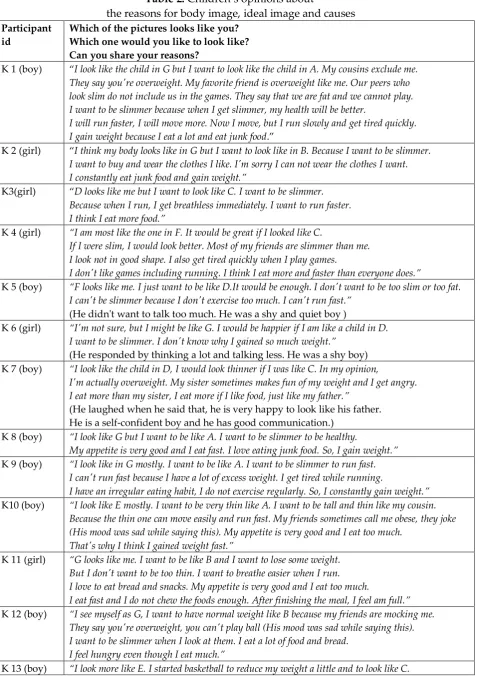
Being shown the Body Perception Scale, the participants were asked to show in which picture they see themselves and in which picture they want to be like and share their reasons. According to this situation, seven of the participants see themselves as the fattest, and all three want to look like the thinnest child. The difference between the "perceived figure" and "ideal figure" of all participants is positive. These difference scores and answers to the questions for each participant are summarized in Table 1.
Table 1: Data on Body Image and Causes
Which of the pictures looks like you?
Participants Perceiver figure Ideal figure Difference
K1 (boy) 7 (G) 1 (A) 6
K2 (girl) 7 (G) 2 (B) 5
K3 (girl) 5 (E) 3 (C) 2
K4 (girl) 6 (F) 3 (C) 3
K5 (boy) 6 (F) 4 (D) 2
K6 (girl) 7 (G) 4 (D) 3
K7 (boy) 4 (D) 3 (C) 1
K8 (boy) 7 (G) 1 (A) 6
K9 (boy) 7 (G) 2 (B) 5
K10 (boy) 5 (E) 1 (A) 4
K11 (girl) 7 (G) 2 (B) 5
K12 (boy) 7 (G) 2 (B) 5
K13 (boy) 5 (E) 3 (C) 2
K14 (boy) 6 (F) 3 (C) 3
Distribution of the participants according to the reason for the desire to resemble the figure they want to appear
Finding repetition
To run and move faster 7
To wear the clothes I want 1
To look slimmer and better 2
To be normal 2
To be happier 1
To be healtier 1
Distribution of the participants according to the reason for not being at their desired weight
Finding repetition
Since I eat more 6
Since I eat junk foods 2
Since I do not exercise 2
I do not have any idea 3
Since I started to forgot somethig after my brother was born 1
Table 2: Children’s opinions about
the reasons for body image, ideal image and causes
Participant id
Which of the pictures looks like you? Which one would you like to look like? Can you share your reasons?
K 1 (boy) “I look like the child in G but I want to look like the child in A. My cousins exclude me. They say you're overweight. My favorite friend is overweight like me. Our peers who look slim do not include us in the games. They say that we are fat and we cannot play. I want to be slimmer because when I get slimmer, my health will be better.
I will run faster, I will move more. Now I move, but I run slowly and get tired quickly. I gain weight because I eat a lot and eat junk food.”
K 2 (girl) “I think my body looks like in G but I want to look like in B. Because I want to be slimmer. I want to buy and wear the clothes I like. I'm sorry I can not wear the clothes I want. I constantly eat junk food and gain weight.”
K3(girl) “D looks like me but I want to look like C. I want to be slimmer. Because when I run, I get breathless immediately. I want to run faster. I think I eat more food.”
K 4 (girl) “I am most like the one in F. It would be great if I looked like C.
If I were slim, I would look better. Most of my friends are slimmer than me. I look not in good shape. I also get tired quickly when I play games.
I don't like games including running. I think I eat more and faster than everyone does.”
K 5 (boy) “F looks like me. I just want to be like D.It would be enough. I don't want to be too slim or too fat. I can't be slimmer because I don't exercise too much. I can't run fast.”
(He didn't want to talk too much. He was a shy and quiet boy )
K 6 (girl) “I'm not sure, but I might be like G. I would be happier if I am like a child in D. I want to be slimmer. I don't know why I gained so much weight.”
(He responded by thinking a lot and talking less. He was a shy boy) K 7 (boy) “I look like the child in D, I would look thinner if I was like C. In my opinion,
I'm actually overweight. My sister sometimes makes fun of my weight and I get angry. I eat more than my sister, I eat more if I like food, just like my father.”
(He laughed when he said that, he is very happy to look like his father. He is a self-confident boy and he has good communication.)
K 8 (boy) “I look like G but I want to be like A. I want to be slimmer to be healthy.
My appetite is very good and I eat fast. I love eating junk food. So, I gain weight.”
K 9 (boy) “I look like in G mostly. I want to be like A. I want to be slimmer to run fast. I can't run fast because I have a lot of excess weight. I get tired while running.
I have an irregular eating habit, I do not exercise regularly. So, I constantly gain weight.”
K10 (boy) “I look like E mostly. I want to be very thin like A. I want to be tall and thin like my cousin. Because the thin one can move easily and run fast. My friends sometimes call me obese, they joke (His mood was sad while saying this). My appetite is very good and I eat too much.
That's why I think I gained weight fast.”
K 11 (girl) “G looks like me. I want to be like B and I want to lose some weight. But I don't want to be too thin. I want to breathe easier when I run. I love to eat bread and snacks. My appetite is very good and I eat too much.
I eat fast and I do not chew the foods enough. After finishing the meal, I feel am full.”
K 12 (boy) “I see myself as G, I want to have normal weight like B because my friends are mocking me. They say you're overweight, you can't play ball (His mood was sad while saying this). I want to be slimmer when I look at them. I eat a lot of food and bread.
I feel hungry even though I eat much.”
3.2. Nutrition Perceptions and Comments
The children were asked the following questions about their perception of nutrition: • What is nutrition for you?
• What is a healthy diet for you?
• What do you think about your nutrition?
The data regarding the perception and comments of the participants are given in Table 3. According to this situation, 6 of the participants stated that the diet was ‘eating and drinking’ 2 of them stated that the diet was ‘eating the food we need’ and 2 of them stated that the diet was ‘feeding my stomach when I got hungry, eating too much’.
6 people defined healthy eating as ‘eating vegetables’and 3 people as ‘regular eating’ For the unhealthy diet, 9 used the expressions as 'eating junk' and 5 saying 'eating foods including fats'.
When asked to evaluate their own nutrition; Eight of them evaluated as normal and balanced.
Table 3: Participants' Discourses About Nutrition Perceptions and Comments Based on Data
What is nutrition for you? (Some gave multiple answers)
Finding repetition
It is eating and drinking 6
It is the eating the food we need 2
It is eating properly 1
It is eating for health 1
It is feeding my stomach when I feel hungry and eating too much 2
It is happiness 1
I do not know 1
What is a healthy diet for you? (Some gave multiple answers)
It is eating vegetables 6
It is feeding with milk and drinking milk before going to bed 2
It is eating lean foods and avoiding fried foods 2
It is not to drink acidic drinks 1
It is leaving eating junk food 3
It is eating healthy foods (such as eggs, honey, molasses) 3 It is not eating foods bad for health (such as potato chips, coke, pasta) 1
It is eating properly 3
It is eating healthy foods like fruit 2
What is unhealthy nutrition? (Some gave multiple answers)
It is eating junk-food (such as chocolate, potato chips, corn) 9
It is eating ice cream and dessert every day 2
I must be slimmer to be able to play basketball better. I think I gained weight because I ate too much and fast.”
K 14 (boy) “I see myself as F. I want to be like C. Because I want to run faster and move faster. Some of my friends annoy me by calling me tomato and potato.
I eat a lot of junk, I eat a lot of food, that's why I look like this.
It is eating hamburgers, cola, french fries, pizza 4
It is eating foods including fats 5
It is eating irregularly and untimely 1
It is eating pastry 2
It is eating bread too much 1
Participants evaluate their own nutrition
Very unhealthy 0
Unhealthy than normal 2
Normal, balanced 8
Healthier than normal 2
Very healthy 2
3.3. Exercise Perceptions and Comments
The participants were asked the following questions about exercise: • What is exercise for you?
• How to exercise according to you?
• Do you think that exercise should be done? Should everyone exercise? • Why should you exercise?
• Are you exercising? Can you share your reasons with me?
The answer to the question "What is exercise? The three participants, who are male, replied "building the body and muscles". Eight of the participants stated that exercise could be done by running, walking, jumping, and twelve of them stated that it was necessary to exercise, and two of them might be needed.
The answers are given by the participants to the question "Should everyone exercise?": Two of them stated that ‘slim ones do not need to do exercise’, Three of them stated that ‘Everyone should do it for health ’,Seven of them stated that ‘Exercise should be done to be healthy’ and six of them stated that‘Exercise should be done to lose weight’. Data on exercise are given in Table 4.
Table 4: Generated Data Based on the discourses of participants about exercise perceptions
What is exercise for you? (Some gave multiple answers)
Finding repetition
It is doing sport 11
It is body building 3
It is running on the treadmill 1
It is warming up 1
It is sweating 1
I do not know 1
It is imporving resistance 1
It is lifting heavy 1
How to exercise?
(Some gave multiple answers)
By making certain movements 4
Running, walking, jumping 8
On the treadmill with tools, riding a bicycle 5
Skipping rope 3 Playing games like hide and seek, racing, football, basketball 3
Swimming 1
I do not know 1
Do you think it is necessary to exercise?
Yes.It is necessary 12
It might be necessary 2
Do you think everyone should exercise?
(It is a question asked to some children, but not all of them, according to the answers given by the participants)
Slim ones don't need to do 2
Fat ones should do it constantly, if you are slim, you can do it from time to time 2 Yes, everyone should do it for health. Slim ones must do, as well 3 Why is it necessary?
(There have been more than one answer)
To be healthy 7
In order not to gain weight, to lose weight 6
To be stronger 4
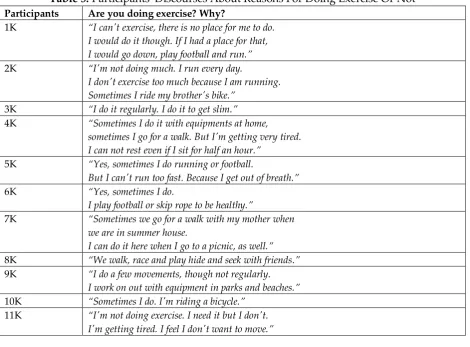
The reasons for the participants not exercising are: "lack of suitable space", "they get tired very quickly", and "they do not need regular exercise because they play games". The opinions of the participants about the reasons for doing or not doing exercises are cited without categorizing and given in Table 5 for each participant.
Table 5: Participants' Discourses About Reasons For Doing Exercise Or Not
Participants Are you doing exercise? Why?
1K “I can't exercise, there is no place for me to do. I would do it though. If I had a place for that, I would go down, play football and run.”
2K “I'm not doing much. I run every day.
I don't exercise too much because I am running. Sometimes I ride my brother's bike.”
3K “I do it regularly. I do it to get slim.”
4K “Sometimes I do it with equipments at home, sometimes I go for a walk. But I'm getting very tired. I can not rest even if I sit for half an hour.”
5K “Yes, sometimes I do running or football.
But I can't run too fast. Because I get out of breath.”
6K “Yes, sometimes I do.
I play football or skip rope to be healthy.”
7K “Sometimes we go for a walk with my mother when we are in summer house.
I can do it here when I go to a picnic, as well.”
8K “We walk, race and play hide and seek with friends.”
9K “I do a few movements, though not regularly. I work on out with equipment in parks and beaches.”
10K “Sometimes I do. I'm riding a bicycle.”
4. Results and Dıscussıons
According to the body perception scale assessment, the difference between the perceptions of the participants, and the figures they deemed ideal was positive in all of them. This result showed that they wanted to be slimmer in all participants who participated in the study. The discourse of the participants also supported these results. Similar to our study, in another study conducted on children using the same scale, 'looking thinner, normal desire to be overweight' was emphasized (Veldhuis et al. 2017). In a study related to body perception in high school students, 8% of students were found to be overweight than normal, 40.8% of them stated that they considered themselves overweight and wanted to be slimmer (Uskun and Sabapli 2013). In our study, the statements of the participants as "I would like to be slimmer, I would like to be normal" attracted attention. It can be interpreted that it is very important for obese participants to lose weight or at least not to gain weight before adolescence, when body perception is more important than other ages.
Psychological problems can be the cause or accompany of obesity. Fat children are often subjected to ill-treatment of their peers, are excluded from play and social activities, and mocked. In obese children, family relations may be impaired, a sense of weakness, failure, and inferiority in self-image (Peker et al. 2000) (Thorstensson et al. 2018) (Gupta et al. 2012). As a matter of fact, when we look at the discourses of the participants in our study, it can be shown as an example that obesity affects children psychologically by expressing their sadness by their friends or relatives that they are being ridiculed about their weight and that they were not included in some games because they could not run fast. The expressions of the participants 'to run and move faster' are remarkable because the participants wanted to be slimmer. This may be the main reason why the participants are not able to run fast, get tired quickly, and be excluded from their peers. Statements supporting this interpretation can be clearly seen from the words of 1st Participant, 7th Participant, 10th Participant, 12th Participant, 14th Participant in Table 2.
In a study of 8-12 years old children, a few of the participants stated that unhealthy diet will cause weight gain (Veldhuis et al. 2017). In our study, children defined nutrition as “eating is the majority”. In the answers given for a healthy diet, the answer is "eating vegetables" and the most "junk food" for unhealthy nutrition is significantly higher. As the reasons for not being at the desired weight, the responses such as "... because I ate too
12K “I ride a bike and play football to lose weight.”
13K “I play basketball but not do exercise.
Sometimes we play football with friends at school.”
14K “I would do treadmill exercises and lose weight if we had one at home. I am slim.
I took swimming lessons two times but I was about to get drown. So, I'm afraid. I can not go outside frequently.
much food, because I eat a lot of bread and junk, and because I do not play sports" were remarkable. However, since 10 of the 14 children gave answers with these statements, they were interpreted as being aware of the reasons why these participants were actually obese.
In a qualitative study conducted in 2005, most of the participants defined exercise as a healthy life and stated its benefits (Hesketh et al. 2005). In our study, the majority of the participants defined the exercise as 'doing sports'. They gave the answer, "Exercise is done mostly by running, walking, and jumping." 12 of the children answered that "exercise is required" and 2 of them answered as "It may be required". Expressions about the necessity of exercise, such as “… to be healthy, not to gain weight, to be slimmer” are common.
Studies show that overweight children and adolescents perform better than their average weight counterparts in resistance exercises rather than aerobic exercise. Lean mass increases with resistance exercises that have a positive effect on metabolic and cardiovascular health. Obese children and adolescents perform less in aerobic exercise compared to average weight youths. This can lead to a loss of motivation in children and a lack of interest in mobile activities. Lack of physical activity can lead to weight gain and weight gain to less physical activity and a vicious cycle may occur (Ten Hoor et al. 2016). In our study, children stated that they could not run fast and could not participate in various games. In this respect, it may be beneficial to organize exercise programs where resistance exercises are dominant by specialists in the field for obese children.
At the end of this study, which aims to understand the perception of body, nutrition, and exercise of obese children better, it was observed that these participants were not satisfied with their appearance and wanted to “run faster to look slimmer”. It was concluded that the participants correctly defined healthy and unhealthy nutrition, and interpreted the exercise as 'sports activities to lose weight rather than health'.
Obesity is a health problem that is very difficult to solve once it occurs. Therefore, it is very important to prevent obesity before it develops or progresses. More qualitative studies on this issue will be useful in order to investigate the reasons and find solutions for preventing and treating obesity in children. In addition, it is thought that developing a scale or scales to be used in quantitative studies will contribute to science.
References
Balthazar, Emilia A, and Maria R M De Oliveira. 2011a. “Differences in Dietary Pattern between Obese and Eutrophic Children.” BMC Research Notes 4(1): 567. http://www.biomedcentral.com/1756-0500/4/567.
———. 2011b. “Differences in Dietary Pattern between Obese and Eutrophic Children.” BMC Research Notes 4(1): 567.
Cad, Meşrutiyet, and Ali Bey. 2018. Obezite Tanı ve Tedavi Kılavuzu Türkiye Endokrinoloji
ve Metabolizma Derneği. www.temd.org.tr.
Clarke, Joanne L. et al. 2015. “Parent and Child Perceptions of School-Based Obesity Prevention in England: A Qualitative Study.” BMC Public Health 15(1): 1–9.
DONER, PINAR et al. 2013. “Contributions of Qualitative Studies To Obesity Management in Primary Care. ”Turkish Journal of Family Medicine & Primary Care 7(4): 69. http://dergipark.gov.tr/doi/10.5455/tjfmpc.41451.
Gupta, Nidhi, Kashish Goel, Priyali Shah, and Anoop Misra. 2012. “Childhood Obesity in Developing Countries: Epidemiology, Determinants, and Prevention.” Endocrine Reviews 33(1): 48–70.
Hesketh, Kylie et al. 2005. “Healthy Eating, Activity and Obesity Prevention: A Qualitative Study of Parent and Child Perceptions in Australia.” Health Promotion International.
“http://www.who.ınt/en/news-room/fact-sheets/detail/obesity-and-overweight.” 2018. Katz, David, Rachel Friedman, and Sean Lucan. 2018. “No Title.” In Klinik Uygulamalarda
Beslenme, eds. İndrani Kalkan and Mehmet Akman. İstanbul: İstanbul Medikal Yayıncılık, 399–401.
Neyzi Olcay, Ertuğrul Türkan. 2009. Pediatri. İstanbul: Nobel Tıp KitabevleriLtd. Şti. Øen, Gudbjørg, Bente Kvilhaugsvik, Kari Eldal, and Anne-Grethe Halding. 2018a.
“Adolescents’ Perspectives on Everyday Life with Obesity: A Qualitative Study.” International Journal of Qualitative Studies on Health and Well-being 13(1): 1479581. http://www.ncbi.nlm.nih.gov/pubmed/29912659%0Ahttps://www.tandfonline.co m/doi/full/10.1080/17482631.2018.1479581.
———. 2018b. “Adolescents’ Perspectives on Everyday Life with Obesity: A Qualitative Study.” International Journal of Qualitative Studies on Health and Well-being 13(1): 1479581.
Peker, İsmail, Figen Çiloğlu, Buruk Şirin, and Bulca Zafer. 2000. Egzersiz Biyokimyası ve
Obezite. İstanbul: Nobel Tıp Kitabevleri.
T. C. Sağlık Bakanlığı Halk Sağlığı Genel Müdürlüğü, Sağlıklı Beslenme ve Hareketli Hayat Dairesi Başkanlığı t. 2017. “TÜRKİYE ÇOCUKLUK ÇAĞI (İLKOKUL 2. SINIF ÖĞRENCİLERDE) ŞİŞMANLIK ARAŞTIRMASI COSI-TUR 2016.” Sağlık
Bakanlığı.
https://hsgm.saglik.gov.tr/depo/haberler/turkiye-cocukluk.../COSI-TUR-2016-Kitap.pdf.
Thorstensson, Stina, Associate Carola Blomgren, Senior Lecture, and Margaretha Larsson. 2018. “To Break the Weight Gain — A Qualitative Study on the Experience of School Nurses Working with Overweight Children in Elementary School.” (June 2017): 251–58.
Truby, H., and S. J. Paxton. 2002. “Development of the Children’s Body Image Scale.” British Journal of Clinical Psychology 41(2): 185–203.
Veldhuis, Jolanda et al. 2017. “‘ Skinny Is Prettier and Normal : I Want to Be Normal ’— Perceived Body Image of Non-Western Ethnic Minority Children in the Netherlands.” Body Image 20: 74–86. http://dx.doi.org/10.1016/j.bodyim.2016.11.006.
Creative Commons licensing terms