SYNTHESIS AND BIOLOGICAL ACTIVITIES OF NEW
TETRAHYDROQUINOLINE AND PYRIMIDINE DERIVATIVES
Pravin N. Chavan,
[a]Dattatraya N. Pansare,
[b]Shivaji L. Jadhav
[c]and Megha J.
Rai
[d]*
Keywords: Tetrahydroquinoline, pyrimidine, biological activity.
A series of new tetrahydroquinoline derivatives (4a-j) were prepared by one-pot multicomponent, [4+2] cycloaddition route from 4- aminonaphthalene, aromatic aldehydes and dihydrofurane (DHF) by using InCl3 catalyst under reflux temperature and also, pyrimidine
derivatives (5a-n) were prepared by the same route from benzimidazole, aromatic aldehydes and maleic anhydride by using piperidine catalyst under ultrasonic irradiations. The synthesized tetrahydroquinoline and pyrimidine derivatives were characterized (IR, 1H NMR, 13C
NMR). The synthesized tetrahydroquinoline and pyrimidine derivatives have been evaluated for antimicrobial, anti -tuberculosis and anti-inflammatory activities.
* Corresponding Authors Fax: +91 02140 250348
E-Mail: [email protected]
[a] Department of Chemistry, Doshi Vakil College, Goregaon, District-Raigad, (MS), India.
[b] Department of Chemistry, Deogiri College, Station road Aurangabad, (MS), India.
[c] Department of Chemistry, Tarai College, Paithan, Aurangabad, (MS), India.
[d] Department of Chemistry, Dr. Rafiq Zakaria College for Woman, Aurangabad, (MS), India.
INTRODUCTION
Now a day, a huge number of a heterocyclic compound discovered through various eco-friendly methods like one-pot multicomponent reaction, ultrasonic irradiations technique or Diels-Alder reactions.1-3 Tetrahydroquinoline and pyrimidine derivatives are broadly used in medicinal chemistry. They showed a huge number of important biological properties such as antimicrobial,4-7 antimalarial, 8-10analgesic,11 anthelmintic,12 antitumor,13
anti-inflammatory,14 antiviral15-17and anticancer18 activity. Keeping the view of the biological importance of heterocyclic compounds,19 we studied the biological activity of tetrahydroquinoline20 pyrimidine,21 thiazolone,22 and benzenesulfonamide23 derivatives.
EXPERIMENTAL
The starting materials and various solvents were commercially available (Sigma-Aldrich and Avra labs). Reaction courses were monitored by TLC on silica gel precoated F254 Merck plates. Developed plates were examined with UV lamps (254 nm). Melting points were recorded on SRS Optimelt, melting point apparatus and are uncorrected. IR spectra were recorded on an FT-IR (Bruker). 1H NMR spectra were recorded on a 400 MHz Bruker
spectrometer and were recorded in DMSO-d6 solvent 13C NMR spectra were recorded in DMSO-d6 solvent on a 100 MHz Bruker spectrometer. Chemical shifts are reported as δ ppm units (TMS).
The following abbreviations are used; singlet (s), doublet (d), triplet (t), quartet (q), multiplet (m) and broad (br). Mass spectra were taken with Micromass-QUATTRO-II of WATER mass spectrometer.
General procedure for synthesis of tetrahydroquinoline derivatives
In around bottom flask, 4-aminonaphthalene (0.1 mol), aromatic aldehyde (0.1 mol), dihydrofurane (DHF) (0.1 mol) and catalyst - InCl3 (20 mol %) in EtOH as solvent (5 mL) were refluxed at for 7 h. The reaction condition was checked by employing TLC technique, using ethyl acetate: hexane (5:5) as solvents. After completing reaction, reaction mixture was cooled at room temperature. For crystallization, 10 mL methanol was added to the reaction mixture and then cooled at 22 °C, following stirring for 20 minutes. Products were filtered using G1 sintered crucible. Products were recrystallized from ethyl alcohol.
11-(2,5-Dimethoxyphenyl)-2,3,3a,10,11,11a-hexahydroben-zo[h]furo[2,3-c]quinoline (4a)
Blackish grey crystal, m.p. 215-218 oC. FT-IR (KBr cm-1): 3324 (-NH), 2910 (-CH), 1568 (-C=C- aromatic), 1210 (ether), 1H NMR 400 MHz, DMSO-d6) 9.96 (s, 1H, D2O exchangeable -NH), 8.32-7.45 (m, 6H, Ar), 6.9-7.10 (m, 2H,Ar), 6.75 (s, 1H, Ar),4.8 (t, 1H, -CH), 4.38 (d, 1H, -CH), 3.773.85 (m, 2H, CH2), 3.8(s, 6H, CH3), 2.43 (m, 1H, -CH), 1.1-1.7(m, 2H, CH2).13C NMR (100 MHz, DMSO-d6): 189.51, 156.24, 153.76, 151.34, 127.72, 125.26, 124.96, 112.90, 111.70, 111.34, 110.34, 104.37, 93.19, 78.0, 76.0, 56.10, 40.0, 38.0, Mass (m/z): [M+1]+: 361.16
11-(4-Cyanophenyl)-2,3,3a,10,11,11a-hexahydrobenzo[h]fu-ro[2,3-c]quinoline (4b)
Ar), 7.64 (d, 2H, Ar), 7.34 (d, 2H, Ar), 4.82 (t, 1H, CH ), 4.37 (d, 1H, CH), 3.77-3.85 (m, 2H, CH2), 2.43 (m, 1H, CH), 1.1-1.7(m, 2H, CH2). 13C NMR (100 MHz, DMSO-d6): 188.51, 156.14, 153.71, 150.92, 127.69, 125.36, 125.05, 112.84, 111.66, 118.0, 111.3, 110.41, 104.39, 93.19, 78.0, 76.0, 40.0, 38.0, Mass (m/z): [M+1]+326.13
11-(3-Hydroxy-4-methoxyphenyl)-2,3,3a,10,11,11a-hexahydro-benzo[h]furo[2,3-c]quinoline (4c)
Brown cystals, m.p. 210-212 oC. FTIR (KBr cm-1): 3377 (-OH), 3338 (-NH), 2940 (-CH), 1556 (-C=C-aromatic), 1213(ether); 1H NMR 400 MHz, DMSO-d6) δ 9.95 (s, 1H, D2O exchangeable -NH), 8.32-7.44 (m, 6H, Ar),7.12-6.92 (d, 2H,Ar), 7.02 (s, 1H, Ar, 4.9 (s, 1H,-OH), 4.8 (t, 1H, -CH), 4.39 (d, 1H, CH), 3.673.88 (m, 2H, CH2), 3.8 (s, 3H, -CH3), 2.43 (m, 1H, -CH2), 1.1-1.8 (m, 2H, -CH2), 13C NMR (100 MHz, DMSO-d6): 192.60, 157, 153.98, 152.44, 128.02, 126.26, 125.16, 113.10, 112.20, 111.53, 110.14, 105.01, 93.20, 78.0, 76.0, 56.11, 40.10, 38.0, Mass (m/z): [M+1]+347.15.
11-(Phenyl)-2,3,3a,10,11,11a-hexahydrobenzo[h]furo[2,3-c]qui-noline (4d)
White crystals, m.p. 200-203 oC. FTIR (KBr cm-1): 3357 (-NH), 2922 (-CH), 1578 (-C=C- aromatic), 1216 (ether), 1H NMR 400 MHz, DMSO-d6) δ 9.92 (s, 1H, D2O exchangeable -NH), 8.32-7.47 (m, 6H,Ar),7.62-7.10 (m, 5H,Ar), 4.8 (t, 1H, -CH), 4.39 (d, 1H, -CH), 3.68-3.86 (m, 2H, -CH2), 2.42 (m, 1H, -CH2), 1.1-1.7 (m, 2H, -CH2), 13C NMR (100 MHz, DMSO-d6): 191.98, 157.45, 153.97, 153.64, 127.92, 126.23, 125.36, 113.12, 112.20, 111.53, 110.14, 105.25, 92.23, 78.08, 76.11, 40.02, 38.13, Mass (m/z): [M+1]+301.14.
11-(3-Bromophenyl)-2,3,3a,10,11,11a-hexahydrobenzo[h]fu-ro[2,3-c]quinoline (4e)
Brown crystals, m.p. 195-197oC, FTIR (KBr cm-1): 3372 (-NH), 2930 (-CH), 1581 (-C=C-aromatic), 1237 (ether), 1H NMR 400 MHz, DMSO-d6) δ 9.93 (s, 1H, D2O exchangeable -NH), 8.33-7.47 (m, 6H, Ar),7.46 (s, 1H, Ar), 7.52-7.26(m, 3H, Ar), 4.8 (t, 1H, -CH), 4.39 (d, 1H, -CH), 3.67-3.88 (m, 1H, -CH), 2.44 (m, 2H, -CH2), 1.1-1.79 (m, 2H, -CH2), 13C NMR (100 MHz, DMSO-d6): 192.63, 148.25, 154.18, 152.10, 127.87, 126.12, 124.96, 114.00, 112.21, 111.62, 110.04, 105.11, 93.31, 78.12, 76.06, 40.25, 38.07, Mass (m/z): [M+1]+381.00.
11-(4-Methoxyphenyl)-2,3,3a,10,11,11a-hexahydrobenzo[h]fu-ro[2,3-c]quinoline (4f)
Whitecrystals, m.p. 216-218 oC, FTIR (KBr cm-1): 3377 (-NH), 2931 (-CH), 1562 (-C=C- aromatic), 1234 (ether), 1H NMR 400 MHz, DMSO-d6) δ 9.94 (s, 1H, D2O exchangeable –NH), 8.31-7.43 (m, 6H, Ar),7.23 (d, 2H, Ar), 7.04 (d, 2H, Ar), 4.81 (t, 1H, -CH), 4.40 (d, 1H, -CH), 3.67-3.86 (m, 2H, -CH2), 3.82 (s, 3H, -CH3), 2.44 (m, 1H, -CH2), 1.13-1.80 (m, 2H, -CH2),13C NMR (100 MHz, DMSO-d6): 189.63, 157.25, 154.15, 152.54, 128.22, 126.46, 125.12,
113.08, 112.15, 111.51, 111.01, 105.31, 92.96, 78.0.1, 76.22, 56.21, 40.30, 38.06, Mass (m/z): [M+1]+331.16
11-(4-Chlorophenyl)-2,3,3a,10,11,11a-hexahydrobenzo[h]fu-ro[2,3-c]quinoline (4g)
Olive green crystals,m.p 160-164 oC. FTIR (KBr cm-1): 3382 (-NH), 2917 (-CH), 1563 (-C=C-aromatic), 1209 (ether), 1H NMR 400 MHz, DMSO-d6) δ 9.96 (s, 1H, D2O exchangeable -NH), 8.31-7.45 (m, 6H, Ar), 7.66 (d, 2H, Ar), 7.52 (d, 2H, Ar), 4.80 (t, 1H, -CH), 4.41 (d, 1H, -CH), 3.673.85 (m, 2H, CH2), 2.44 (m, 1H, CH2), 1.131.78 (m, 2H, -CH2), 13C NMR (100 MHz, DMSO-d6): 186.41, 148.60, 148.40, 148.11, 139.99, 136.80, 131.14, 129.79, 131.72, 127.02, 126.81, 126.44, 126.57, 123.97, 123.91, 113.30, 93.00, 79.12, 78.00, 40.12, 38.20, Mass (m/z): [M+1]+335.12.
11-(2,4-Dicyanophenyl)-2,3,3a,10,11,11a-hexahydrobenzo[h]fu-ro[2,3-c]quinoline (4h)
White crystals, m.p. 220-222 oC. FTIR (KBr cm-1): 3384 (-NH), 2932 (-CH), 1545 (-C=C-aromatic), 1218 (ether), 1H NMR 400 MHz, DMSO-d6) δ 9.98 (s, 1H, D2O exchangeable -NH), 8.32-7.47 (m, 6H, Ar),7.78 (s, 1H, Ar), 7.46 (d, 1H, Ar), 7.11 (d, 1H, Ar), 4.82 (t, 1H, -CH), 4.40 (d, 1H, -CH), 3.67-3.86 (m, 2H, -CH2), 2.45 (m, 1H, -CH2), 1.14-1.79 (m, 2H, -CH2), 13C NMR (100 MHz, DMSO-d6): 190.61, 156.00, 153.88, 12.44, 127.92, 126.16, 125.10, 113.13, 112.21, 121.93, 110.09, 105.11, 93.19, 78.05, 76.11, 40.22, 38.12, Mass (m/z): [M+1]+369.07.
11-(4-Nitrophenyl)-2,3,3a,10,11,11a-hexahydrobenzo[h]fu-ro[2,3-c]quinoline(4i)-
Yellow crystals, m.p 222-223 oC, FTIR (KBr cm-1): 3300 (-NH), 2921 (-CH), 1550 (-C=C-aromatic), 1217 (ether), 1H NMR 400 MHz, DMSO-d6) δ 10.00 (s, 1H, D2O exchangeable -NH), 8.77-7.10 (m, 6H,Ar),8.11 (d, 2H, Ar), 7.61 (d, 2H, Ar), 4.80 (t, 1H, -CH), 4.37 (d, 1H, -CH), 3.683.33 (m, 2H, CH2), 2.44 (m, 1H, CH2), 1.11.45 (m, 2H, -CH2), 13C NMR (100 MHz, DMSO-d6): 187.51, 158.69, 149.30, 147.51, 141.90, 133.90, 130.04, 128.89, 127.92, 126.96, 126.80, 126.34, 126.25, 124.17, 123.81, 113.20, 93.00, 79.10, 78.00, 40.02, 38.23,Mass (m/z): [M+1]+346.15.
11-(4-Flurophenyl)-2,3,3a,10,11,11a-hexahydrobenzo[h]fu-ro[2,3-c]quinoline (4j)
General procedure for pyrimidine derivatives
In the ultrasound-assisted method, a mixture of piperidine (10 mol %), isoniazide (0.1 mol), aldehyde (0.1 mol) and maleic anhydride (0.1 mol) in dichloroethane (DCE) as solvent (5 mL) was irradiated with ultrasound (with a frequency of 50 Hz and power of 250 V AC) at 70 oC for 2 h. The reaction progress was checked on TLC using ethyl acetate:hexane (5:5) as solvents. After the completion of reaction, the mixture was cooled at room temperature. Charged methanol (10 mL) was used for crystallization and then the mixture was cooled to 22 oC and stirred for 30 min. The product was filzterd with G1 sintered crucible and recrystallized from ethyl alcohol.
4-(4-Methoxyphenyl)-5a,6-dicyclobenzo[4,5]imidazo[1,2-a]fu-ro[3,4-e]pyrimidine-1,3(3aH,11aH)-dione (5a)
White crystals, m.p. 250-252 oC. FTIR (KBr cm-1): 3250 (-NH), 2803 (-CH), 1727 (C=O), 1612 (C=N), 1660 (C=C aromatic), 1H NMR 400 MHz, DMSO-d6) δ 9.8 (s, 1H, D2O exchangeable NH), 6.13-7.95 (m, 8H, Ar), 3.86 (s, 1H, -CH), 3.1-3.2 (s, 3H, -CH3), 2.6 (d, 1H, -CH), 2.3 (d, 1H, -CH), 13C NMR (100 MHz, DMSO-d6): 168.27, 168.12, 166.49,
151.40, 149.09, 137.05, 132.72, 130.22, 129.66, 129.51, 129.09, 123.10, 121.14, 113.76, 112.03, 80.13, 57.0, 47.10, 40.0-39.1, Mass (m/z): [M + 1]+349.12.
4-(2,5-Dimethoxyphenyl)-5a,6-dicyclobenzo[4,5]imidazo[1,2-a]-furo[3,4-e]pyrimidine-1,3(3aH,11aH)-dione (5b)
White crystals, m.p. 168-170 oC. FTIR (KBr cm-1): 3249 (-NH), 2826 (-CH), 1723 (C=O), 1618 (-C=N), 1568 (C=C aromatic), 1H NMR 400 MHz, DMSO-d6) δ 9.86 (s, 1H, D2O exchangeable NH), 6.167.97 (m, 7H, Ar), 3.82 (s, 1H -CH), 3.2 (d, 1H, --CH), 2.7 (s, 6H, 2-CH3), 2.4 (d, 1H, --CH), 13C NMR (100 MHz, DMSO-d6): 170.00, 169.02, 160.19,
151.45, 150.09, 139.15, 132.13, 131.32, 130.22, 130.04, 129.96,a 129.74, 129.09, 123.09, 121.94, 113.76, 111.57, 79.0, 56.90, 46.97, 38.91- 40.0, Mass (m/z): [M+1]+379.12.
4-(3,4-Dihydroxyphenyl)-5a,6-dicyclobenzo[4,5]imidazo[1,2-a]furo[3,4-e]pyrimidine-1,3(3aH,11aH)-dione (5c)
White crystals, m.p. 223-225 oC. FTIR (KBr cm-1): 3282 (-OH), 3239 (-NH), 2825 (-CH), 1731 (-C=O), 1620 (-C=N), 1587 (C=C aromatic), 1H NMR 400 MHz, DMSO-d6) δ 9.8 (s, 1H, D2O exchangeable NH), 6.38-7.95 (m, 7H, Ar), 4.82 (s, 2H, CH2), 3.1 (m, 1H, CH), 2.6 (d, 1H, CH), 2.3 (d, 1H, CH), 13C NMR (100 MHz, DMSO-d6): 170.10, 168.53, 165.19, 151.61, 148.84, 142.56, 136.01, 130.85, 122.79, 120.94, 118.76, 116.45, 117.35, 114.98, 111.52, 101.12, 79.0, 44.53,Mass (m/z): [M+1]+351.09.
4-(3-Hydroxyphenyl)-5a,6-dicyclobenzo[4,5]imidazo[1,2-a]fu-ro[3,4-e]pyrimidine-1,3(3aH,11aH)-dione (5d)
White crystals, m.p.201-202 oC. FTIR (KBr cm-1): 3278 (-OH), 3229 (-NH), 2839 (-CH), 1722 (-C=O), 1628 (C=N), 1568 (-C=C-aromatic), 1H NMR 400 MHz, DMSO-d6) δ
9.87 (s, 1H, D2O exchangeable NH), 6.68-7.71 (m, 8H,Ar), 4.82 (s, 1H,-OH), 3.82 (s, 1H, -CH), 3.2 (d, 1H, -CH), 2.4 (d, 1H, -CH), 13C NMR (100 MHz, DMSO-d6): 170.30, 169.12, 165.00, 157.19, 141.35, 140.29, 138.14, 135.15, 133.13, 131.32, 130.04, 129.09, 121.94, 120.21, 119.23, 118.34, 118.12, 115.41, 114.76, 111.57, 96.5, 75.0, 40.0,Mass (m/z): [M+1]+335.08.
4-(4-Cyanophenyl)-5a,6-dicyclobenzo[4,5]imidazo[1,2-a]fu-ro[3,4-e]pyrimidine-1,3(3aH,11aH)-dione (5e)
Yellow crystals, m.p. 194-196 oC. FTIR (KBr cm-1): 3262 (-NH), 2845 (-CH), 2184 (-CN), 1727 (-C=O), 1618 (C=N aromatic), 1577 (-C=C-aromatic), 1H NMR 400 MHz, DMSO-d6) δ 9.9(s, 1H, D2O exchangeable NH), 6.16-8.00 (m, 8H,Ar), 3.93 (s, 1H, -CH), 3.2 (d, 1H, -CH), 2.4 (d, 1H, -CH), 13C NMR (100 MHz, DMSO): 170.50, 168.52, 164.19, 151.45, 142.23, 139.75, 132.13, 131.92, 130.02, 129.66, 129.74, 129.09, 119.09, 118.94, 118.56, 113.76, 115.08, 111.07, 102.00, 77.10, 41.97,Mass (m/z): [M+1]+344.09.
4-(3-Hydroxy,4-methoxyphenyl)-5a,6-dicyclobenzo[4,5]imi-dazo[1,2-a]furo[3,4-e]pyrimidine-1,3(3aH,11aH)-dione (5f)
Yellow crystals, m.p. 210-212 oC. FTIR (KBr cm-1): 3289 (-OH), 3239 (-NH), 2819 (-CH), 1741 (-C=O), 1612 (C=N), 1582 (C=C aromatic), 1H NMR 400 MHz, DMSO-d6) δ 9.88 (s, 1H, D2O exchangeable NH), 6.31-7.46 (m, 7H, Ar), 4.15 (s, 1H, -OH), 3.91 (s, 1H, -CH), 3.2 (d, 1H, -CH), 3.0 (s, 3H, -CH3), 2.2 (d, 1H, -CH), 13C NMR (100 MHz, DMSO-d6): 170.20, 168.32, 163.19, 151.85, 148.09, 142.32, 138.35, 133.13, 121.94, 119.54, 118.21, 115.30, 112.35, 111.17, 76.0, 56.90, 42.17, Mass (m/z): [M + 1]+365.09
4-(Phenyl)-5a,6-dicyclobenzo[4,5]imidazo[1,2-a]furo[3,4-e]pyri-midine-1,3(3aH,11aH)-dione (5g)
White crystals, m.p. 245-248 oC. FTIR (KBr cm-1): 3250 (-NH), 2812 (-CH), 1717 (-C=O), 1620 (C=N), 1592 (-C=C-aromatic), 1H NMR 400 MHz, DMSO-d6) δ 9.94 (s, 1H, D2O exchangeable NH), 6.08-7.97 (m, 9H, Ar), 3.76 (s, 1H, -CH), 3.17 (d, 1H, -CH), 2.54 (d, 1H, -CH),13C NMR (100 MHz, DMSO-d6): 170.35, 168.52, 164.75, 151.95, 147.46, 138.37, 132.12, 131.13, 130.65, 129.71, 129.57, 129.22, 128.29, 122.80, 121.60, 114.21, 111.54, 79.0, 46.97, 38.9, 40.10, Mass (m/z): [M+1]+319.11.
4-(3-Bromophenyl)-5a,6-dicyclobenzo[4,5]imidazo[1,2-a]fu-ro[3,4-e]pyrimidine 1,3(3aH,11aH)-dione (5h)
4-(4-Hydroxyphenyl)-5a,6-dicyclobenzo[4,5]imidazo[1,2-a]fu-ro[3,4-e]pyrimidine 1,3(3aH,11aH)-dione (5i)
White crystals, m.p. 190-192 oC. FTIR (KBr cm-1): 3279 (-OH), 3243 (-NH), 2829 (-CH), 1713 (C=O), 1621 (C=N), 1588 (-C=C-aromatic), 1H NMR 400 MHz, DMSO-d6) δ 9.83 (s, 1H, D2O exchangeable NH), 6.20-7.91 (m, 8H, Ar), 3.93 (s, 1H, -OH), 3.78 (s, 1H, -CH), 2.9 (d, 1H, -CH), 2.43 (d, 1H, -CH), 13C NMR (100 MHz, DMSO-d6): 170.50, 168.22, 163.69, 160.00, 142.65, 140.11, 139.05, 130.00, 130.04, 129.19, 119.09, 118.94, 115.66, 111.47, 75.0, 99.90, 41.97, Mass (m/z): [M+1]+335.08.
4-(4-Chlorophenyl)-5a,6-dicyclobenzo[4,5]imidazo[1,2-a]fu-ro[3,4-e]pyrimidine 1,3(3aH,11aH)-dione (5j)
White crystal, m.p. 215-218 oC. FTIR (KBr cm-1): 3268 (-NH), 2855 (-CH), 1717 (-C=O), 1630 (-C=N ), 1576 (C=C aromatic), 1H NMR 400 MHz, DMSO-d6) δ 9.95 (s, 1H, D2O exchangeable NH), 6.147.92 (m, 8H,Ar), 3.8 (s, 1H, -CH), 3.2-3.0 (d, 1H, --CH), 2.5 (d, 1H, --CH),13C NMR (100 MHz, DMSO-d6): 170.35, 168.78, 164.60, 151.66, 147.46, 136.02, 131.16, 131.03, 130.02, 129.82, 129.60, 128.92, 128.42, 123.01, 121.45, 113.79, 111.42, 79.0, 44.40, 38.0-40.00,Mass (m/z): [M+1]+353.00.
4-(2,4-Dichlorophenyl)-5a,6-dicyclobenzo[4,5]imidazo[1,2-a]fu-ro[3,4-e]pyrimidine-1,3(3aH,11aH)-dione (5k)
Brownish crystals, m.p. 180-184 oC. FTIR (KBr cm-1): 3168, 2665, 2130, 1658, 1615, 1591, 1536; 1H NMR 400 MHz, DMSO-d6) δ 9.90 (s, 1H, D2O exchangeable NH), 6.23-7.9 (m, 7H, Ar), 3.7 (s, 1H), 3.2-3.2 (d, 1H), 2.5 (d, 1H), 13C NMR (100 MHz, DMSO-d6): 170.30, 168.68, 163.90, 151.56, 146.40, 135.02, 131.26, 131.23, 131.02, 129.72, 129.60, 128.49, 128.43, 123.11, 121.53, 114.89, 112.00, 79.00, 44.35, 38.0-40.05,Mass (m/z): [M+1]+387.02.
4-(4-Nitrophenyl)-5a,6-dicyclobenzo[4,5]imidazo[1,2-a]furo[3,4-e]pyrimidine-1,3(3aH,11aH)-dione (5l)
Yellow crystals, m.p. 210-212 oC. FTIR (KBr cm-1): 3261 (-NH), 2831 (-CH), 1734 (-C=O), 1735 (C=N), 1572 (C=C aromatic), 1H NMR 400 MHz, DMSO-d6) δ 9.9 (s, 1H, D2O exchangeable NH), 6.16-8.40 (m, 8H, Ar), 3.82 (s, 1H, -CH), 3.3 (d, 1H, -CH), 2.3 (d, 1H, -CH), 13C NMR (100 MHz, DMSO-d6): 170.30, 168.12, 164.19, 151.05, 142.25, 139.05, 137.13, 127.49, 127.90, 129.54, 118.76, 115.23, 111.07, 76.0, 41.04, Mass (m/z): [M+1]+364.09.
4-(4-Fluorophenyl)-5a,6-dicyclobenzo[4,5]imidazo[1,2-a]fu-ro[3,4-e]pyrimidine-1,3(3aH,11aH)-dione (5m)
Greenish crystals, m.p. 220-222 oC. FTIR (KBr cm-1): 3246 (-NH), 2802 (-CH), 1710 (-C=O), 1630 (-C=N ) 1594 (C=C aromatic),1H NMR 400 MHz, DMSO-d6) δ 9.0 (s, 1H, D2O exchangeable NH), 6.107.95 (m, 8H, Ar), 3.7 (s, 1H, -CH), 3.2-3.0 (d, 1H, --CH), 2.5 (d, 1H, --CH), 13C NMR (100 MHz, DMSO-d6): 170.20, 168.53, 164.30, 151.61, 148.00, 138.00, 136.14, 131.00, 122.97, 122.00, 114.00, 111.52, 79.00, 44.53, 39.00-40.00,Mass (m/z): [M + 1]+337.08.
4-(2,3-Dihydroxyphenyl)-5a,6-dicyclobenzo[4,5]imidazo[1,2-a]furo[3,4-e]pyrimidine-1,3(3aH,11aH)-dione (5n)
Milky white crystals, m.p. 198-200 oC. FTIR (KBr cm-1): 3266 OH), 3225 NH), 2869 CH), 1725 C=O), 1624 (-C=N), 1542 (-C=C- aromatic), 1H NMR 400 MHz, DMSO-d6) δ 9.88 (s, 1H, D2O exchangeable NH), 6.16-7.68 (m, 7H, Ar), 4.7(s, 2H, -OH), 3.82 (s, 1H, -CH), 3.0 (d, 1H,-CH), 2.4 (d, 1H, -CH), 13C NMR (100 MHz, DMSO-d6): 169.90, 169.02, 160.25, 151.45, 150.29, 149.15, 132.43, 131.32, 130.02, 130.04, 129.96, 129.74, 129.09, 123.09, 121.94, 113.76, 111.77, 101.00, 78.00,41.00., Mass (m/z): [M+1]+351.08.
Biological activity
The in-vitro antimicrobial activity has been studied by a disc diffusion method or Kirby-Bauer method24 with different strains of bacteria and fungi. Gentamicin and amphotericin B were used as positive controls for bacteria and fungi, respectively. The compounds were screened for antibacterial activity against E. coli ATCC 25922,
Pseudomonas aeruginosa ATCC 27853 and
StaphylococcusaureusATCC 25923 in Mueller-Hinton agar (M173) medium, and for antifungal activity against Candida sp. in Sabouraud‘s dextrose agar medium. The plates were incubated at 37 °C for 24 h for both antibacterial and antifungal activities.
The in-vitro antituberculosis activity has been carried out by CLAIRO COMBI method25with tuberculosis bacteria and Streptomycin was used as a positive control. Liquefied sterile Lowenstein-Jensen agar is poured into Petri dishes kept on the level surface. Media depth was 4 mm. After solidification, the dishes were dried for 30 min in an incubator at 37 °C to remove excess moisture from the surface. While pouring into the plates, 5 % defibrinated sterile blood was added to the test organism. The plates were incubated at 37 °C for 4 days.
In vitro anti-inflammatory activity measurement (human red-blood-cell (HRBC) membrane stabilization method): Fresh whole human blood (5mL) are collected and transferred to the centrifuged tubes containing Heparin or EDTA or sodium citrate to prevent clotting. The tubes are centrifuged at 3000 rpm for 10 min and are washed three times with equal volume of normal saline. The volume of the blood is measured and reconstituted as 10% v/v suspension with normal saline. The reaction mixture consists of 1.0mL of a test sample of different concentrations in normal saline and 0.5mL of 10% HRBC suspension, 1 mL of 0.2 M phosphate buffer, 1 ml hypo saline were incubated at 37oC for 30 min and centrifuged at 3,000 rpm for 30 mins. The hemoglobin content of the supernatant solution was estimated spectrophotometrically at 560 nm. Diclofenac was used as a control.26-29
RESULTS AND DISCUSSION
We have synthesized (11-(R )-2,3,3a,10,11,11a-hexahydrobenzo[h]furo[2,3-c]quinoline(4a-j) (Scheme 1 and Table 1) and 4-(R
(5a-n) (Scheme 2 and Table 2) via one-pot multi-component [4+2]cycloaddition reactions of dienes and a dienophiles using InCl3 or piperidine as Lewis base catalyst in EtOH under reflux or in dichloroethane under ultrasound irradiations, respectively.
Scheme 1. Synthesis of tetrahydroquinoline derivatives.
Scheme 2. Synthesis of pyrimidine derivatives
First, imines (Schiff bases) form from the 4-aminonaphthalene (1) or 2-aminobenzimidazole (6) and the aromatic aldehydes (2a-j) and these are cyclized with dihydrofurane (3) or maleic anhydride (7) into the appropriate condensed heterocycles (6 and 7, respectively). The synthesized tetrahydroquinoline (4a-j) and pyrimidine (5a-n) derivatives were characterized by FT-IR, 1H NMR, 13C NMR and mass spectroscopy techniques.
The prepared compounds have been screened for antibacterial, antifungal, antituberculosis32 and anti-inflammatory activities and measured the zones showing complete inhabitation and record the diameters of zones to the nearest millimeter. The results are summarized in Tables 3 and 4.
All tetrahydroquinoline derivatives (4a-j) showed antibacterial activity only against Staphylococcus aureus
ATCC 25923 bacteria but did not show any activity against
E. coli ATCC 25922 and Pseudomonas aeruginosa
ATCC27853 or antifungal activity against Candida sp.
Table 1. Tetrahydroquinoline derivatives synthesized using InCl3 as catalyst via [4+2] cycloaddition route
Entry R Product Time, h Yield, % M.p.,oC
1 2,5-(MeO)2C6H3 4a 3.15 88 218
2 4-CNC6H4 4b 3.50 81 253
3 4-HO-3-MeOC6H3 4c 3.40 77 212
4 Ph 4d 2.45 80 203
5 3-BrC6H4 4e 3.20 81 197
6 4-MeOC6H4 4f 3.48 80 218
7 4-ClC6H4 4g 3.30 79 164
8 2,4-(Cl)2C6H3 4h 4.00 76 222
9 4-NO2C6H4 4i 2.15 74 223
10 4-FC6H4 4j 3.27 82 213
Table 2. Pyrimidine derivatives synthesized using piperidine as catalyst via [4+2] cycloaddition route
Entry R Product Time, min Yield, % M.P.,oC
1 4-MeOC6H4 5a 68 80 252
2 2,5- MeO2C6H3 5b 30 74 170
3 3,4-HO2C6H3 5c 60 77 225
4 3-HOC6H4 5d 32 78 202
5 4-CNC6H4 5e 52 73 196
6 4-HO-3-MeOC6H3 5f 48 71 212
7 Ph 5g 53 75 248
8 3-BrC6H4 5h 63 79 240
9 4-HOC6H4 5i 72 69 192
10 4-ClC6H4 5j 69 78 218
11 2,4-Cl2C6H3 5k 74 76 184
12 4-NO2C6H4 5l 64 71 212
13 4-FC6H4 5m 79 77 222
9 10 11 9 8 12 11 10 8 10 18
4a 4b 4c 4d 4e 4f 4g 4h 4i 4jGentamicin 0 2 4 6 8 10 12 14 16 18 Z o n e (mm)
Antibacterial activity against Staphylococcus aureus ATCC 25923 Zone (mm)
Figure 1. Anti-bacterial activity of tetrahydroquinoline derivatives against Staphylococcus aureus ATCC 25923
9 10 8 11 9 12 10 13 10 12 16 9 8 10 18
5a 5b 5c 5d 5e 5f 5g 5h 5i 5j 5k 5l 5m 5nGentamycin
0 2 4 6 8 10 12 14 16 18 Z o n e (mm)
Anti-bacterial activity against St. Aureus ATCC25923 bac. Zone (mm)
Figure 2. Anti-bacterial activity of pyrimidine derivatives against
Staphylococcus aureus ATCC 25923
All pyrimidine derivatives (5a-n) showed antibacterial activity only against Staphylococcus aureus ATCC 25923 bacteria, but not showed against E. coli ATCC 25922 and
Pseudomonas aeruginosa ATCC27853. Two pyrimidine derivatives samples (5j and 5k) showed antifungal activity against Candida sp.
Antituberculosis activity
The tetrahydroquinoline derivatives (4a-j) do not show any antituberculosis activity, but all pyrimidine derivatives (5a-n) hadantituberculosisactivity. The compound 5k
showed activity in the higher while 5a, 5h and 5i in the lower zone.
The percentage of HRBC hemolysis and membrane stabilization or protection was calculated by using the standard formula. 10 11 10 9 11
10 10 10
9 11 12 10 10 9 18
5a 5b 5c 5d 5e 5f 5g 5h 5i 5j 5k 5l 5m 5nStreptomycin
0 2 4 6 8 10 12 14 16 18 Z o n e (mm)
Anti-tuberculosis activity against M. tuberculosis bac. Zone (mm)
Figure 3. The anti-tuberculosis activity of pyrimidine derivatives
1
3
.4 14
.5 3 1 3 .7 5 1 1 .3 4 1 6 .2 7 1 2 .5 7 1 5 .5 9 1 5 .9 6 1 3 .5 9 1 3 .3 1 2 2 .4 6
4a 4b 4c 4d 4e 4f 4g 4h 4i 4j STD 0 5 10 15 20 % H e mo lysi s Derivatives % Hemolysis
Figure 4. Anti-inflammatory activity of tetrahydroquinoline derivatives
The results can be seen in Tables 3 and 4. In the tetrahydroquinoline-series, sample (4d) showed the highest percentage of HRBC membrane stabilization and sample (4h) showed the lowest rate of HRBC membrane stabilization.
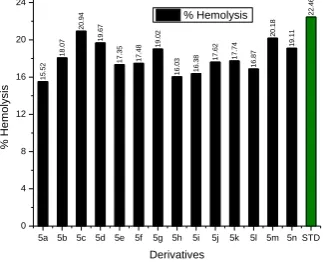
In pyrimidine derivatives case, sample (5a) showed the highest percentage of HRBC membrane stabilization and sample (5c) showed the lowest rate of HRBC membrane stabilization.
Table 3. Anti-inflammatory activity of tetrahydroquinoline derivatives (4a-j)
Product % Hemolysis % Protection Product % Hemolysis % Protection
4a 13.40 86.59 4g 15.59 84.40
4b 14.53 85.46 4h 15.96 84.03
4c 13.75 86.24 4i 13.59 86.40
4d 11.34 88.65 4j 13.31 86.68
4e 16.27 83.72 Ref. 22.46 77.53
Table 4. Anti-inflammatory activity of pyrimidine derivatives (5a-5n)
Product % Hemolysis % Protection Product % Hemolysis % Protection
5a 15.52 84.47 5h 16.03 83.96
5b 18.07 81.92 5i 16.38 83.61
5c 20.94 79.07 5j 17.62 82.37
5d 19.67 80.32 5k 17.74 82.25
5e 17.35 82.62 5l 16.87 83.12
5f 17.48 82.51 5m 20.18 79.81
5g 19.02 80.97 5n 19.11 80.88
Ref. 22.46 77.53
1
5
.5
2
1
8
.0
7
2
0
.9
4
1
9
.6
7
1
7
.3
5
1
7
.4
8 19
.0
2
1
6
.0
3
1
6
.3
8 17
.6
2
1
7
.7
4
1
6
.8
7
2
0
.1
8
1
9
.1
1
2
2
.4
6
5a 5b 5c 5d 5e 5f 5g 5h 5i 5j 5k 5l 5m 5n STD 0
4 8 12 16 20 24
%
H
e
mo
lysi
s
Derivatives % Hemolysis
Figure 5. Anti-inflammatory activity of pyrimidine derivatives (5a-5n)
CONCLUSION
We have used an eco-friendly route for the preparation of new tetrahydroquinoline and pyrimidine derivatives and screened for their antibacterial against E. coli, Pseudomonas aeruginosa and Staphylococcus aureus, antifungal activity against Candida sp., anti-tuberculosis activity against
tuberculosis bacteria and in vitro anti-inflammatory activity. We have concluded that these series of compounds certainly hold great promise toward good active leads in medicinal chemistry.
ACKNOWLEDGMENTS
The author is thankful to Principal, Doshi Vakil College, Goregaon, District-Raigad, (MS), India, and Head, Department of Chemistry, Doshi Vakil College, Goregaon, District-Raigad, (MS), India.
REFERENCES
1Mallakpour, S. E., Hajipour, A.-R., Mahdavian, A.-R.,
Rafiemanzelat, F., Highly diastereoselective synthesis of novel polymers via tandem Diels-Alder-ene reactions, Polym. Int., 1999, 48(2), 109. DOI: 10.1002/(sici)1097-0126(199902)48:2<109::aid-pi103>3.0.co;2-n.
2Lutz, F. T., Schuffenhauer, A., Synthesis of Tetrahydro- and
Dihydropyridines by Hetero Diels-Alder Reactions of Enantiopure α,β-Unsaturated Sulfinimines, Eur. J. Org.
Chem., 1998, 1629.
DOI:10.1002/(sici)10990690(199808)1998:8<1629::aid-ejoc1629>3.0.co;2-y.
3Villacampa, M., Perez, H. M., Avendano, C., Menendez, C.,
Ultrasound-assisted Diels-Alder reactions of 1-azadienes with "normal" electronic demand, Tetrahedron, 1994, 50(33), 10047. DOI: 10.1016/s0040-4020(01)89620-4.
4El-Sayed, O. A., Aboul-Enein, H. Y., Synthesis and Antimicrobial
Activity of Novel Pyrazolo[3,4-b]quinoline Derivatives, Arch. Pharm. Pharm. Med. Chem.,2001, 334(4), 117.
DOI:10.1002/15214184(200104)334:4<117::aid-ardp117>3.0.co;2-9
5Thumar, N. J., Patel, M. P., Synthesis and Antimicrobial Activity
of Some New N-Substituted Quinoline Derivatives of 1H
-Pyrazole, Arch Pharm., 2011, 344(2), 91.
DOI:10.1002/ardp.201000010.
6Agui, H., Mitani, T., Izawa, A., Komatsu, T., Nakagome, T.,
Studies on quinoline derivatives and related compounds. 5. Synthesis and antimicrobial activity of novel 1-alkoxy-1,4-dihydro-4-oxo-3-quinolinecarboxylic acids, J. Med. Chem.,
1977, 20(6), 791. DOI: 10.1021/jm00216a010.
7Kodihalli, C. R., Hosadu, M. V., Vijayvithal, P. V., Synthesis and
antimicrobial activity of novel naphtho[,1-b] furo-5H-[3,2-d][1,3,4] thiadiazolo[3,-a]pyrimidin-5-ones, ARKIVOC, 2008,
XI, 1. http://dx.doi.org/10.3998/ark.5550190.0009.b01 8Ho, P. L., Yung, R., Tsang, D. C., Que, T. L., Ho, W. H., Seto, T.
K., Ng, W. C., Yam, Ng, W. S., J., increasing resistance of streptococcus pneumonia to fluoroquinoline: results of a Hong Kong multicentre study in 2000, Antimicrob. Chemother. 2000,48, 659.doi.org/10.1093/jac/48.5.659.
9Weiss, K., Restieri, C., Gauthier, R., Laverdière, M., McGeer, A.,
A nosocomial outbreak of fluoroquinolone-resistant streptococcus pneumonia, Clin. Infect. Dis. 2001, 33,
517.doi.org/10.1086/322658
10Basavraj, P., Vaidya, V. P., Vijay Kumar, M. L., Synthesis and
pharmacological evaluation of 2-mercapto-4-substituted-naphtho[2,1-b]furo[3,2-d]pyrimidines, Indian. J. Heterocycl. Chem., 2002, 12, 89.DOI: 10.4103/0250-474X.31004. 11Agudoawu, S., Li, H., Habeeb, A. G., Praveen Rao, P.N., Suresh,
M. R., Knaus, E. E., Design and syntheses of methyl 2- methyl-2-[2-(4-benzoyl-5-phenyl-7-halo-2-azabicyclo[4.1.0]-hept-3-ene)]acetates: novel inhibitors of cyclooxygenase-2 (COX-2) with analgesic-antiinflammatory activity, Drug Dev.
Res., 2000, 49, 75.
DOI:10.1002/(sici)10982299(200002)49:2<75::aid-ddr1>3.0.co;2-#
12Charles, E. S., Rao, K. V. B., Satyavan Sharma, Iyer, R. N.,
13Grivsky, E. M., Lee, Shuliang, Sigel, C. W., Duch, D. S., Nichol,
C. A., Synthesis and antitumor activity of 2,4-diamino-6-(2,5-dimethoxybenzyl)-5-methylpyrido[2,3-d]pyri-midine, J. Med. Chem.,1980, 23(3), 327. DOI: 10.1021/jm00177a025. 14Ram, V. J., Haque, N., Guru, P. Y., chemotherapeutic agents
XXV: synthesis and leishmanicidal activity of carbazolylpyrimidines, Eur. J. Med. Chem., 1992, 27, 851.doi.org/10.1016/0223-5234(92)90121-G.
15Suguira, K., Schmid, M. M., Brown, F. G., Cancer Chemother. Rep., 1973, 2, 231.
16Kumarswamy, M. N., Prathima Matthias, D. A., Chandrasekhar,
C., Vaidya, V. P., Synthesis and pharmacological evaluation of 2-mercapto-4-substituted-naphtho[2,1-b]furo[3,2-d]pyrimidines, Indian J. Pharm. Sci., 2006,
68(6),731.DOI:10.4103/0250-474X.31004.
17Nasr, M. N., Gineinah, M. M., pyrido[2,3-d]pyrimidines and
pyrimido[5‘,4‘:5,6]pyrido[2,3-d]pyrimidines as new antiviral agents: synthesis and biological activity, Arch. Pharm., 2002,
335, 289. doi.org/10.1002/1521-4184(200208)335:6<289. 18Vega, S., Alonso, J., Diaz, A., Junquera, F., synthesis of
3- substituted-4-phenyl-2-thioxo-1,2,3,4,5,6,7,8-octahydroben-zo[4,5]thieno[2,3-a]pyrimidines, J. Heterocycl. Chem., 1990,
27, 269. doi.org/10.1002/jhet.5570270229
19Balzarini, J., McGuigan, C., Global Antibiotic resistance in Streptococcus pneumonia, J.Antimicrob. Chemother., 2002,
50(1), 5. doi.org/10.1093/jac/dkf801.
20Chavan, P., Jadhav, S., Rai, M., Synthesis of tetrahydroquinoline
derivatives via one-pot multi-component (4+2) cycloaddition (povarov) reaction, Asian. J. Research. Chem., 2018, 11(1), 111, DOI:105958/0974-4150.2018.00024X.
21Chavan, P., Jadhav, S., Pansare, D., Farooqui, M., Rai, M.,
Synthesis of (4+2) cycloaddition reaction by using base catalyst under ultrasonic irradiation, World J. Pharm. Res.,
2018, 7(5), 1171. DOI: 10.20959/wjpr201885-11303
22Pansare, D. N., Shelke, R. N., Khade, M. C., Jadhav, V. N.,
Pawar, C. D., Jadhav, R. A., Bembalkar, S. R., New thiazolone derivatives: design, synthesis, anticancer and antimicrobial activity, Eur. Chem. Bull., 2019, 8(1), 7. DOI:
10.17628/ecb.2019.8.7-14.
23Shelke, R. N., Pansare, D. N., Pawar, C. D., Khade, M. C.,
Jadhav, V. N., Deshmukh, S. U., Dhas, A. K., Chavan, P. N., Sarkate, A. P., Pawar, R. P., Shinde, D. B., Thopate, S. R.,
Synthesis and anticancer evaluation of new
benzenesulfonamide derivatives. Eur. Chem. Bull., 2019,
8(1), 1. DOI: 10.17628/ecb.2019.8.1-6.
24World Health Organization Expert Committee on biological standardization, 1992, Technical report series 822. W.H.O., Geneva.
25Chandrappa, C., "In vitro antimitotic, antiproliferative and DNA
fragmentation assay of ethanol extract of Carmona retusa (Vahl.) Masam”, Appl. Cell Biol., 2013, 2(2), 52.
26Kirtikar, K. R., Basu, B. D., Indian Medicinal Plants, Vol. 2. p.
1777.Lalit Mohan Basu, Allahabad, 1933,
27Government of India, "The Ayurvedic pharmacopeia of India,
Part–I, Vol. II. New Delhi: Department of Indian Systems of Medicine & Homeopathy”, 2001, 155.
28Gandhidasan, R., Thamaraichelvan, A., Baburaj, S.,
"Anti-inflammatory action of Lanneacoromandelica by HRBC membrane stabilization," Fitoterapia,1991, 62, 81.
29Rang, H. P., Dale, M. M., Ritter, J. M., Moore, P. K., Pharmacology. 5thEdn. India: Elsevier, 2005, 27.
This paper was presented at the "International Symposium on Exploring New Horizons in Chemical Sciences," January 10–12,
2019, Aurangabad, India (ENHCS–2019).
![Table 2. Pyrimidine derivatives synthesized using piperidine as catalyst via [4+2] cycloaddition route](https://thumb-us.123doks.com/thumbv2/123dok_us/7824191.2088086/5.595.47.547.525.714/table-pyrimidine-derivatives-synthesized-using-piperidine-catalyst-cycloaddition.webp)