Studies on Schiff base diabetic inhibitors Section A-Research paper
Eur. Chem. Bull., 2019, 8(11), 356-362 http://dx.doi.org/10.17628/ecb.2019.8.356-362
356
EATON’S REAGENT CATALYZED SYNTHESIS, IN VITRO
α-AMYLASE INHIBITORY ACTIVITY AND MOLECULAR
DOCKING STUDY OF SOME SCHIFF’S BASES AS DIABETIC-II
INHIBITORS
Sushama Kauthale,
[a]Sunil Tekale,
[a]Ambadas Rode,
[b]Rajesh Patil,
[c]Jaiprakash Sangshetti,
[d]László Kótai,
[e,f]and Rajendra Pawar
*[a]Keywords: α-Amylase, Eaton's reagent, Schiff's bases, Solvent-free, Molecular docking
A series of Schiff’s bases of p-tolylsulphonyl hydrazide were synthesized by using Eaton's reagent under solvent-free condition, characterized by spectroscopic data and for evaluated α-amylase inhibitory activity in vitro. Four among the studied compounds exhibited
varying degrees of α-amylase inhibitory activity with IC50 values in the range of 115.48 to 169.42 µg mL-1. The observed results were supported by the molecular docking study performed to understand the binding interaction of the title compounds with the active site of α -amylase enzyme. Results suggest that Schiff's bases of p-tolylsulphonyl hydrazide derivatives can act as potential antidiabetic drugs.
*Corresponding author
E-mail: [email protected]
[a] Department of Chemistry, Deogiri College, Station Road, Aurangabad (MS) 431 005, India.
[b] Regional Centre for Biotechnology, Faridabad, Haryana (NCR Delhi), 121001, India.
[c] Smt. Kashibai Navale College of Pharmacy, Pune (MS) 411048, India.
[d] Y. B. Chavan College of Pharmacy, Dr. Rafiq Zakaria Campus, Aurangabad (MS) 431001, India.
[e] Research Centre for Natural Sciences, Budapest, H-1117, Magyar Tudósok krt. 2, Hungary
[f] Deuton-X Ltd., Hungary, H-2030, Érd, Selmeci. u. 89
INTRODUCTION
Diabetes mellitus, a metabolic disorder characterized by chronic hyperglycemia condition, has become a significantly growing disease all over the world due to changing lifestyles and increasing junk food in the diet. As per the reports of the International Diabetes Federation (IDF), approximately 366 million people have diabetes and the number may be doubled by 2030.1 It is mainly caused by the lack of insulin,
which includes increased morbidity, disability, mortality and represents a threat to the economies of all countries, especially in developing ones like India.2 In diabetic patients,
the immune system becomes weak by destroying insulin-producing cells, leading to a high level of blood glucose, which significantly increases the risk of long-term heart disease, stroke, dysfunction and kidney failure.3
α-Amylase is an enzyme that catalyzes the hydrolysis of carbohydrates and starch into glucose in human blood, resulting in hyperglycemic condition and eventually type-II Diabetes mellitus (T2DM). It is present in the saliva of human beings, where it begins the chemical process of digestion. Pancreas and salivary glands make α-amylase to hydrolyze dietary starch into disaccharides which are then
converted by other enzymes to glucose that acts as a source of energy to the body. Inhibitors of α-amylase function by modulating the blood glucose level after a meal.4 The ability
of a drug to delay the production and absorption of glucose by inhibiting carbohydrate hydrolyzing enzymes - α -amylase and α-glucosidase is an important therapeutic approach for the development of antidiabetic drugs. Thus α -amylase functioning as a key enzyme for the digestion and absorption of starch in the blood is one of the targets in the treatment of T2DM.
Schiff’s bases are the condensation products of primary amines with carbonyl compounds, named after the scientist Hugo Schiff. Schiff’s bases possess imine or azomethine (– C=N–) functional group and constitute a versatile pharmacophore and reaction intermediates for the design, synthesis, and development of various bioactive lead compounds of various biological interest such as 4-thiazolidinone,5 inorganic metal complexes6 and
azetidinones.7 Furthermore, they are also well known to
exhibit numerous biological activities such as antimicrobial,8 antitubercular,9 antioxidant,10
anticonvulsant,11 anti-inflammatory,12 and anticancer
activity.13 They are also useful in pigments and dyes,14
intermediates for organic synthesis,15 polymer stabilizers16
and corrosion inhibitors.17
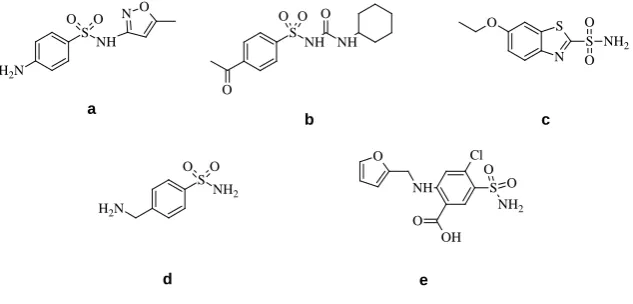
Sulfonamide functionality is the basis of several drugs. Sulfamethoxazole (a) is an antibacterial sulfa drug. Acetohexamide (b) is a sulfonylurea used to treat diabetes mellitus. Ethoxzolamide (c) is a sulfonamide drug that acts on carbonic anhydrase inhibitors and widely used in the treatment of glaucoma and ulcers.18 Mafenide (d), also
NH Cl
S
O OH O
NH2 O
O S
NH2 O O
N H2
N S O
S O
O NH2
O S
NH NH O O O
N H2
S NH O O NO
a
b c
d e
Figure 1: Some biologically active sulphonamide drugs
Table 1. Yields of Eaton's reagent catalyzed synthesis of Schiff's bases
Entry Aldehyde Schiff’s base Code Yield*, % M. P., oC
1
CHO
Cl
N HN S O
O
Cl
1 91 133
2
CHO
Cl Cl
N HN S O
O
Cl Cl
2 90 178-180
3
CHO
NO2
N HN S O O
NO2
3 89 142-143
4
CHO
OMe MeO
N HN S O
O
OMe OMe
4 90 134-136
5
N H
CHO F
N HN S O
O
H N
F
5 80 133-135
6
CHO OMe
N HN S O
O
MeO
6 90 182-183
7
CHO S HN N
O
O 7 92 177-179
*Yields isolated in case of p-toluenesulphonyl hydrazide (5 mmol), aldehyde (5 mmol) using Eaton's reagent (5 mol %)
under solvent-free conditions.
Eaton’s reagent [P2O5: methane sulphonic acid] (1:10 by
weight) is used as an alternative to the polyphosphoric acid (PPA) in organic synthesis.19 It is inexpensive, easy to
handle, easy to separate, less viscous than PPA and commercially available reagent. Philip Eaton firstly synthesized it in 1973. Eaton's reagent has been used for the
synthesis of phenanthrolines,20
tetrahydroisoquinoline-2-ones,21 quinolones,22 3,4-dihydropyrimidin-2(1H)-ones,23
polyamidines24 and chalcones.25 Thus, considering the
Studies on Schiff base diabetic inhibitors Section A-Research paper
Eur. Chem. Bull., 2019, 8(11), 356-362 http://dx.doi.org/10.17628/ecb.2019.8.356-362
358
compounds,26-27 in the present article we report the synthesis
of some Schiff's bases from p-tolyl sulphonyl hydrazide and various aldehydes using Eaton's reagent under solvent-free conditions (Scheme 1).
CHO
X Eaton's reagent Solvent free r.t., 2h
S O
O NH N
X S
O O
NH-NH2
Scheme 1. Eaton’s reagent catalyzed synthesis of Schiff’s bases.
The synthesized compounds were screened for in vitroα -amylase enzyme inhibitory antidiabetic activity whose observed results were supported by computational studies of molecular docking in terms of possible interactions with the
active site of the α-amylase enzyme and high free energy of binding.
RESULTS AND DISCUSSION
In the present work, we synthesized some Schiff's bases of p-toluenesulphonyl hydrazide with various aldehydes under solvent-free conditions at room temperature. p-Toluenesulphonyl hydrazide is a solid compound. After the addition of aldehyde to p-toluenesulphonyl hydrazide, initially, the reaction mixture was difficult to stir at room temperature, particularly in the case of solid aldehydes. But as soon as Eaton's reagent was added to the above mixture, an exotherm was observed, the contents turned into the liquid phase for a while and then a white or yellow solid mass appeared which was stirred at room temperature for 2 h.
Initially, we tried the reaction of benzaldehyde with p-toluene sulphonyl hydrazide using Eaton's reagent (5 mol%) under solvent-free conditions. When tried with different amounts of Eaton's reagent from 5 to 10, 15 and 20 mol %, 5 mol % of the reagent was found to be appropriate for this transformation. Commonly ethanol is the best solvent for the synthesis of Schiff's bases. However, the use of ethanol in this reaction required slightly more time (3 h) for completion. Thus the use of 5 mol% of Eaton's reagent under solvent-free conditions was found to be the best condition for this reaction. Although the synthesis of Schiff's bases is fast and straightforward, comparatively more time was required for completion of the reaction (2 h) which could be most probably due to the presence of a sulphonamide group adjacent to the reaction center - NH2.
Under these reaction conditions, various aldehydes were treated with p-toluene sulphonyl hydrazide to afford the corresponding Schiff's bases in excellent yields in almost all cases. Electron withdrawing groups reacted more smoothly, providing higher yields as compared to those with electron-donating groups. To our delight, methoxy groups in the Schiff's bases remained intact under these reaction conditions (Table 1).
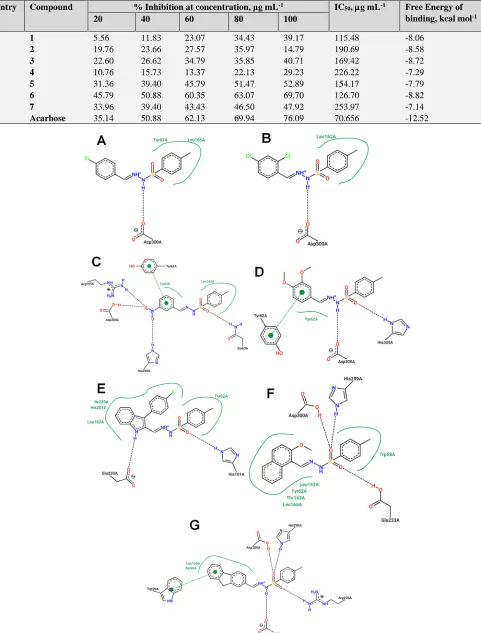
The synthesized compounds were evaluated for amylase inhibitory activity and the results were compared with the standard acarbose. Among all the synthesized Schiff’s bases, compounds 1 (4-chlorophenyl), 3 (3-nitrophenyl), 5 (fluorophenyl substituted indole) and 6 (2-methoxynaphthyl ring) had significant amylase inhibitory activity, but less than the standard acarbose at all the concentrations i.e. 20, 40, 60, 80 and 100 μg mL-1 (Table 2).
Molecular docking study of human pancreatic α-amylase:
α-Amylase is an enzyme that catalyzes the hydrolysis of
α-1,4 glucan linkages in starch. In human beings, α-amylase is composed of 496 amino acids in a single polypeptide chain and occurs as different isozymes synthesized in either salivary glands or the pancreas.
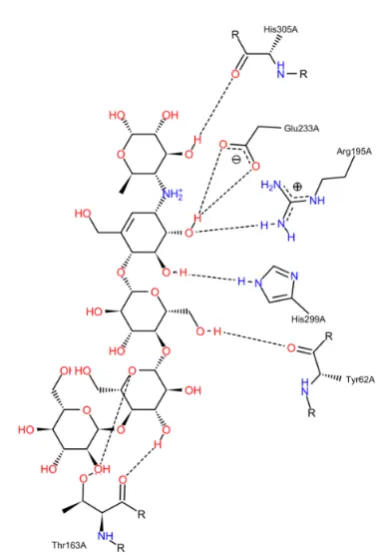
Figure 2. Interactions of acarbose with key residues at the binding site.
The screening of synthesized Schiff’s bases showed that the compounds 1, 2, 3, 5 and 6possesgood α-amylase
inhibitory activity with IC50 values less than 200 μM. The
remaining compounds with IC50higher than 200 μM possess
moderate α-amylase inhibitory activity. Docking results were found in good agreement with the experimentally observed α-amylase inhibitory activity. For the α-amylase inhibitory activity, the hydrogen bond interactions with residues HIS305, GLU233, ARG195, HIS299, TYR62, and
Entry Compound % Inhibition at concentration, μg mL-1 IC
50, µg mL-1 Free Energy of binding, kcal mol-1
20 40 60 80 100
1 1 5.56 11.83 23.07 34.43 39.17 115.48 -8.06
2 2 19.76 23.66 27.57 35.97 14.79 190.69 -8.58
3 3 22.60 26.62 34.79 35.85 40.71 169.42 -8.72
4 4 10.76 15.73 13.37 22.13 29.23 226.22 -7.29
5 5 31.36 39.40 45.79 51.47 52.89 154.17 -7.79
6 6 45.79 50.88 60.35 63.07 69.70 126.70 -8.82
7 7 33.96 39.40 43.43 46.50 47.92 253.97 -7.14
8 Acarbose 35.14 50.88 62.13 69.94 76.09 70.656 -12.52
Studies on Schiff base diabetic inhibitors Section A-Research paper
Eur. Chem. Bull., 2019, 8(11), 356-362 http://dx.doi.org/10.17628/ecb.2019.8.356-362
360
Most of the synthesized Schiff’s bases showed similar hydrogen bond interactions and the aromatic rings of these Schiff’s bases were found to occupy the binding pockets at
the active site of α-amylase. Aromatic rings attached to imino nitrogen in compounds 1, 6, 5, 3, and 2 were found to make crucial hydrophobic interactions with TYR62, whereas the 4-methylphenyl ring in compound 5 and 3 showed significant hydrophobic interactions with the residues HIS201, LEU162 and ILE235 (Figure 3).
For 2, 3 and 6 Schiff’s bases, hydrogen bonding was observed with residues like ASP197, GLU233, HIS299, ASP300, THR163 as the key interactions similar in the case of standard acarbose. For Schiff’s bases 4 and 7, the crucial hydrophobic interaction with TYR62 were not found, but instead, the aromatic rings attached to imino nitrogen were found to occupy the pocket surrounded by the residues TRP59, TRP58 (Figure 3). These compounds form hydrogen bonds with the residues ASP300, HIS299, ASP197, and GLU233. The crucial hydrophobic interaction at the pocket with TYR62 residues was not found in these compounds which may be responsible for their less α -amylase inhibitory activity. This suggests that the presence of naphthyl, 2-indolyl, m-nitrophenyl and ortho-substituted
rings were favorable for α-amylase inhibitory activity. The electronegative chloro and nitro groups on the phenyl ring
were found to be beneficial for α-amylase inhibitory activity. The aromatic rings in these compounds were found to burry in the pockets made of residues like TYR62, LEU165.
EXPERIMENTAL
Chemicals used were SD fine or Aldrich made and used without further purification. The reaction progress was monitored by using silica gel pre-coated on aluminum TLC plates using 40 % ethyl acetate in n-hexane. Melting points of the products were measured in capillaries open at one end and were uncorrected. The products were purified by recrystallization from ethanol and confirmed by analysis of spectroscopic data(1H NMR, 13C NMR, IR and mass
spectra).
General procedure for the solvent-free synthesis of Schiff's bases using Eaton's reagent
A mixture of p-toluenesulfonyl hydrazide (5 mmol) and aldehyde (5 mmol) was stirred with Eaton's reagent (5 mol %) at room temperature under the solvent-free condition for 2 h. Progress of the reaction was monitored by TLC in 40 % ethyl acetate in n-hexane. After completion of the reaction as confirmed by TLC, the reaction mass was poured into ice-cold water, resulting in solid was separated by filtration under vacuum and further purified by recrystallization from ethanol as the pure Schiff's base.
1-(4-Chlorobenzylidene)-2-tosylhydrazine (1)
1HNMR (400 MHz, CDCl
3): δ ppm 2.39 (s, 3H), 7.24
-7.31 (dd, 4H), 7.47 (d, 2H), 7.7 (s, 1H), 7.86 (d, 2H), 8.35 (s, 1H); 13C NMR (100.6 MHz, CDCl
3): δ ppm 78.65, 127.12,
127.74, 128.55, 129.34, 132.43, 134.63, 136.11, 143.16, 145.27; Mass 309.1 (M+1)+.
1-(2,4-Dichlorobenzylidene)-2-tosylhydrazine (2)
1H NMR (400 MHz, DMSO-d
6) δ ppm 2.36 (s, 3H), 7.4
-7.46 (m, 3H), 7.66 (s,1H), 7.7 -7.76 (dd, 3H), 8.19 (s, 1H), 11.82 (s, 1H); 13C NMR (100.6 MHz, DMSO-d
6) δ ppm:
78.77, 127.11, 127.56, 129.04, 129.84, 133.49, 135.09, 136.00, 141.31, 143.36; Mass: 343.1 (M+1)+.
1-(3-Nitrobenzylidene)-2-tosylhydrazine (3)
1H NMR (400 HMz, CDCl
3) δ ppm 2.43 (s, 3H), 7.27
-7.37 (dd, 2H), 7.55-7.59 (dd, 1H), 7.84-7.95 (m, 4H), 8.19 (d, 1H), 8.37(s, 1H), 8.49 (d, 1H); 13C NMR (100.6 MHz,
CDCl3) δ ppm: 62.99, 120.96, 122.84, 124.19, 127.63,
129.68, 132.57, 135.41, 136.01, 138.08, 144.50, 148.04; Mass 320.0 (M+1)+.
1-(3,4-Dimethoxybenzylidene)-2-tosylhydrazine (4)
1H NMR (400 MHz) δ ppm: 2.38 (s, 3H), 3.8 (s, 6H), 6.98
(s, 1H), 7.7 (dd, 2H), 7.4 (s, 2H), 7.8 (dd, 3H), 11.2 (s, 1H);
13C NMR (100.6 MHz) δ ppm: 20.94, 55.50, 108.57, 111.45,
120.91, 126.39, 127.25, 129.55, 136.12, 143.14, 147.18, 148.96, 150.59; IR (neat) cm-1: 3196, 2970, 2930, 1598,
1550, 1029; Mass: 335.2 (M+1)+.
1-[3-(4-Fluorophenyl)-1H-indol-2-yl)methylene)]-2-tosylhydra-zine (5)
1H NMR (400 MHz) δ ppm: 2.43 (s, 3H), 7.10-7.18 (dd,
3H), 7.27-7.34 (m, 6H), 7.77 (s, 2H), 7.82-7.86 (dd, 4H);
13C NMR (100.6 MHz, CDCl
3) δ ppm: 47.65, 112.91,
115.63, 120.15, 121.05, 123.93, 126.69, 127.36, 1237.86, 129.14, 129.65, 132.17, 135.77, 136.39, 140.10, 143.63, 160.14, 162.56; Mass 408.11 (M+1)+.
1-(2-Methoxynaphthalen-1-yl)methylene)-2-tosylhydrazine (6)
1H NMR (400 MHz, DMSO-d
6) δ ppm: 2.37 (s, 3H), 3.6
(s, 3H), 7.4-7.46 (m, 3H), 7.66 (s, 1H), 7.7-7.76 (m, 6H), 8.19 (s, 1H), 11.7 (s, 1H); 13C NMR (100.6 MHz,
DMSO-d6) δ ppm 56.46, 113.09, 113.54, 123.89, 125.00, 127.76,
128.55, 129.64, 130.33, 132.59, 136.17, 143.51, 144.61, 157.31; Mass 355.11 (M+1)+.
(9H-Fluoren-2-yl)methylene)-2-tosylhydrazine (7)
1H NMR (400 MHz) δ ppm: 2.39 (s, 3H), 3.98 (s, 2H), 7.4
(d, 3H), 7.6 (s, 2H), 7.85 (m, 6H), 11.45 (s, 1H); 13C NMR
(100.6 MHz) δ ppm: 20.93, 36.25, 120.15, 123.04, 125.14, 126.13, 126.83, 127.22, 129.64, 132.21, 136.29, 140.31, 142.96, 143.44, 143.59, 147.40; IR (KBr) cm-1: 3194, 2970,
2927, 1595; Mass: 363.2 (M+1)+.
α-Amylase inhibitory activity
Antidiabetic activity of the synthesized compounds was determined in terms of % α-amylase inhibition using the literature method.28 Starch solution (0.5 % w/v) was
bath for 15 minutes. The α-Amylase solution was prepared by mixing 1U mL-1 of α-amylase in the same buffer. The
colorimetric reagent was prepared by mixing an equal volume of sodium potassium tartrate tetrahydrate solution and 96 mM 3,5-dinitrosalicylic acid (DNS) solution. Starch solution (1000 μL) was mixed with increasing concentration of an enzyme inhibitor. 1000 μL of the α-amylase solution was added to the synthesized compounds at different concentrations (20, 40, 60, 80, and 100 μg mL-1) or acarbose
(20-100 μg mL-1) and incubated at 25 °C for 3 minutes to
react with the starch solution. A 1000 μL of 96 mM DNS reagent was added to the above solution and the contents were heated for 15 minutes in the boiling water bath. The final volume was made up with distilled water and absorbance was measured at 540 nm using a spectrophotometer. The percentage inhibition and 50 % inhibitory concentration (IC50) values were then determined
(Table 2).
Molecular Docking
Molecular docking study was performed to explore binding affinity, binding mode and possible molecular interactions of the synthesized compounds against the active site of the α-amylase enzyme and the results were expressed in terms of binding energies. The crystal structure of human
pancreatic α-amylase complexed with Acarbose ((PDB: 2QV4) downloaded from www.rcsb.org was used for docking studies. Autodock Vina29 was used to perform
docking simulations. Marvin Sketch 5.6.0.0 (2011) was used to draw 2D structures of the compounds which were converted into 3D geometry using the same interface. The geometry of 3D molecules was optimized through energy minimization using UCSF Chimera 1.830 during which
Gasteiger charges were added and energy minimization was carried out with the combination of steepest descent and conjugate gradient geometry search criteria until gradient converses to 0.05 and 0.01 respectively. The protein was processed by removing water and other nonstandard residues. The resulting clean protein was further optimized by energy minimization in UCSF Chimera with the Amber ff12SB force field and similar geometry search criteria. During the docking simulation, polar hydrogen was added to protein structure with MGLtools1.5.4. All torsion angles for the compounds were set free to perform flexible docking. Grid box of size 18 x 18 x 18 with 1A0 spacing with x, y and z centers 12.94, 47.17 and 26.2 respectively was chosen, which was large enough to cover the active site of the protein. The results of docking simulations were analyzed in terms of estimated binding free energy in kcal mol-1 and
interactions of ligands with residues at the active site.
CONCLUSION
In summary, we synthesized various Schiff's bases of p-toluenesulphonyl hydrazide using Eaton's reagent (5 mol %) under solvent-free conditions. The synthesis is simple, solvent-free, beneficial and economical from the commercial point of view. The Schiff's bases 1, 3, 5 and 6 exhibited good amylase inhibitory activity and high free binding energies; but less than the standard Acarbose at different concentrations 20, 40, 60, 80 and 100 μg mL-1
highlighting the future scope in the development of
p-toluenesulphonyl hydrazide based compounds as possible diabetic inhibitors as per the pharmaceutical requirement.
ACKNOWLEDGMENTS
Authors are thankful to the Director, Sophisticated Analytical and Instrumentation Facility, Panjab University, Chandigarh, India, for providing spectral data and to the Director, Scan research laboratory, Bhopal for providing the results of biological activity.
REFERENCES
1Kaveeshwar, S. A., Cornwall, J., The current state of diabetes mellitus in India. Australas Med. J., 2014, 7, 45-48. DOI:
10.4066/AMJ.2013.1979.
2Yesudian, C. A. K., Grepstad, M., Visintin, E., Ferrario, A., The economic burden of diabetes in India: A review of the literature. Globalization and Health, 2014, 10(80), 1-18. DOI: 10.1186/s12992-014-0080-x.
3Graves, D. T., Kayal, R. A., Diabetic complications and dysregulated innate immunity. Front. Biosci. 2008, 13, 1227-1239. DOI:10.2741/2757.
4Tundis, R., Loizzo, M. R., Menichini, F., Natural products as alpha-amylase and alpha-glucosidase inhibitors and their hypoglycaemic potential in the treatment of diabetes: An update. Mini Rev. Med. Chem., 2010, 10, 315-331. DOI:10.2174/138955710791331007.
5Mashrai, A., Dar, A. M., , Mir, S., Shamsuzzaman, Strategies for the synthesis of thiazolidinone heterocycles. Med. Chem.
2016, 6, 280-291. http://dx.doi.org/10.4172/2161-0444-1000358.
6Wesley, A., Kalidasa, J. K., Neelakantan, M. A., Review on Schiff bases and their metal complexes as organic photovoltaic materials. Renewable Sust. Energy Rev. 2014, 36, 220-227. DOI:10.1016/j.rser.2014.04.060
7Salunkhe, D.S., Piste, P.B., A brief review on recent synthesis of 2-azetidinone derivatives. Int. J. Pharm. Sci. Res., 2014, 5(3),
666-689. http://dx.doi.org/10.13040/IJPSR.0975-8232.5(3).666-89
8Singh, K., Kumar, Y., Puri, P., Sharma, C., Aneja, K. R.
Synthesis, spectroscopic, thermal and antimicrobial studies of Co(II), Ni(II), Cu(II) and Zn(II) complexes with Schiff base derived from 4-amino-3-mercapto-6-methyl-5-oxo-1,2,4-triazine. Med. Chem. Res. 2012, 21, 1708-1716. https://doi.org/10.1007/s00044-011-9683-4.
9Castelino, P. A.; Dasappa, J. P.; Bhat, K. G.; Joshi, S. A.; Jalalpure, S., Some novel Schiff bases of [1,2,4]triazole bearing haloarene moiety-synthesis and evaluation of antituberculosis properties and neutrophil function test. Med. Chem. Res., 2016, 25, 83-93. DOI: 10.1007/s00044-015-1461-2
10Ejidike, I.P., Ajibade, P.A., Synthesis, characterization, and in
vitro antioxidant and anticancer studies of ruthenium(III) complexes of symmetric and asymmetric tetradentate Schiff bases. J. Coord. Chem., 2015, 68, 2552-2564.
https://doi.org/10.1080/00958972.2015.1043127.
11Paneersalvam, P., Raj, T., Ishar, M. P. S., Singh, B., Sharma, V., Rather, B. A., Anticonvulsant Activity of Schiff Bases of 3-Amino-6,8-dibromo-2-phenyl-quinazolin-4(3H)-ones. Ind. J. Pharm. Sci., 2010, 72(3), 375-378. DOI: 10.4103/0250-474X.70488.
Studies on Schiff base diabetic inhibitors Section A-Research paper
Eur. Chem. Bull., 2019, 8(11), 356-362 http://dx.doi.org/10.17628/ecb.2019.8.356-362
362
13Abd-Elzaher, M. M., Labib, A. A., Mousa, H. A., Moustafa, S. A.,Ali, M. M., El-Rashedy, A. A., Synthesis, anticancer activity and molecular docking study of Schiff base complexes containing thiazole moiety, Beni-Suef Univ. J. Basic Appl. Sci. 2016, 5(1), 85-96.
https://doi.org/10.1016/j.bjbas.2016.01.001.
14Abuamer, K. M., Maihub, A. A., El-Ajaily, M. M., Etorki, A. M., Abou-Krisha, M. M., Almagani, M. A., The role of aromatic Schiff bases in the dyes techniques, Int. J. Org. Chem., 2014,
4(1), 7-15. http://dx.doi.org/10.4236/ijoc.2014.41002.
15Qin, W., Long, S., Panunzio, M., Biondi, S., Schiff bases: A short survey on an evergreen chemistry tool. Molecules, 2013,
18(10), 12264-12289. DOI: 10.3390/molecules181012264.
16Yousif, E., Al-Amiery, A.A., Kadihum, A., Kadhum, A.A.H., Mohamad, A.B., Photostabilizing efficiency of PVC in the presence of Schiff bases as photostabilizers, Molecules, 2015,
20, 19886-19899.
https://doi.org/10.3390/molecules201119665.
17Kumari, P. P., Rao, S. A.; Shetty, P., Corrosion inhibition of mild steel in 2 M HCl by a Schiff base derivative Procedia Mat. Sci., 2014, 5, 499.
https://doi.org/10.1016/j.mspro.2014.07.293.
18Johnson, B. K., Colvin, C. J., Needle, D. B., Medie, F. M., Di, P. A., Champion, G., Abramovitch, R. B., The carbonic anhydrase inhibitor ethoxzolamide inhibits the Mycobacterium tuberculosis
PhoPR regulon and Esx-1 secretion and attenuates virulence
Antimicrob. Agents Chemother., 2015, 59(8), 4436-4445. DOI: 10.1128/AAC.00719-15.
19Eaton, P. E., Carlson, G. R., Lee, J. T. Phosphorus pentoxide-methanesulfonic acid: Convenient alternative to polyphosphoric acid, J. Org. Chem., 1973, 38(23), 4071-4073. https://doi.org/10.1021/jo00987a028.
20Satheeshkumar, R., Prasad, K. J. R., Solvent-free synthesis of dibenzo[b,j][1,10]phenanthroline derivatives using Eaton’s reagent as catalyst, Synth. Commun., 2017, 47(10), 990-998.
https://doi.org/10.1080/00397911.2017.1301480.
21Yang, Q., Ulysse, L. G., Mclaws, M. D., Keefe, D. K., Preparation of tetrahydroisoquinoline-3-ones via cyclization of phenyl acetamides using Eaton's reagent. Org. Synth.,
2012, 89, 44-54. DOI: 10.15227/orgsyn.089.0044.
22Zewge, D., Chen, C. Y., Deer, C., Dormer, P. G., Hughes, D. L., A mild and efficient synthesis of 4-quinolones and quinolone heterocycles, J. Org. Chem., 2007, 72(11), 4276-4279.
https://doi.org/10.1021/jo070181o.
23Borse,A., Patil, M., Patil, N., Shinde, R., A Green, expeditious, one-pot synthesis of 3,4-dihydropyrimidin-2(1H)-ones using a mixture of phosphorus pentoxide-methanesulfonic acid at ambient temperature. 2012, ISRN Org. Chem., Article ID 415645, 6 pages http://dx.doi.org/10.5402/2012/415645.
24Kholkhoev, B. C., Burdukovskii, V. F., Mognonov, D. M., Synthesis of aromatic polyamidines in Eaton’s reagent.
Polym. Sci. Ser. B, 2013, 55(11-12), 601-603.
https://doi.org/10.1134/S1560090413090029
25Tupare, S. D., Nalage, S. V., Bobde, S. R., Hallale, S., Bhosale, S. V., Vyawahare, S. K., Dake, S. A., Bhosale, S. V., Pawar, R. P., Revisit: Eaton’s reagent catalyzed synthesis of mono and bis-chalcone derivatives. Lett. Org. Chem., 2012, 9(7), 526-529. DOI: 10.2174/157017812802139627.
26Kauthale, S., Tekale, S., Damale, M., Sangshetti, J., Pawar, R., Synthesis, biological evaluation, molecular docking, and ADMET studies of some isoxazole-based amides. Med.
Chem. Res., 2018, 27, 429-441.
https://doi.org/10.1007/s00044-017-2070-z.
27Kauthale, S., Tekale, S., Damale, M., Sangshetti, J., Pawar, R., Synthesis, antioxidant, antifungal, molecular docking and ADMET studies of some thiazolyl hydrazones. Bioorg. Med.
Chem. Lett., 2017, 27, 3891-3896.
https://doi.org/10.1016/j.bmcl.2017.06.043.
28Ramachandran, S., Rajasekaran, A., Adhirajan, N., In vivo and in vitro antidiabetic activity of terminalia paniculata bark: An evaluation of possible phytoconstituents and mechanisms for blood glucose control in diabetes. In Vivo and In Vitro Pharm., 2013, 484675. DOI:10.1155/2013/484675.
29Trott, O., Olson, A. J., AutoDock Vina: improving the speed and accuracy of docking with a new scoring function, efficient optimization, and multithreading. J. Comput. Chem., 2010,
31(2), 455-461. doi: 10.1002/jcc.21334.
30Pettersen, E. F., Goddard, T. D., Huang, C. C., Couch, G. S., Greenblatt, D. M., Meng, E. C., Ferrin, T. E., UCSF Chimera-a visualization system for exploratory research and analysis. J. Comp. Chem., 2004, 25(13), 1605-1612. DOI:10.1002/jcc.20084.