Research Article
a
March
2019
International Journals of Advanced Research in
Computer Science and Software Engineering
ISSN: 2277-128X (Volume-9, Issue-3)
Solving Vendor Selection Problem with Fuzzy Parameters
Using Interval Programming with Fuzzy Numbers
Abdel Hadi Nabih *
Professor of Mathematical Statistics & Operations Research, Institute of Statistical Studies and Researches,
Cairo University, Egypt
Naglaa Ragaa Saeid
Associated Professor of Operations Researches, Institute of Statistical
Studies and Researches, Cairo University, Egypt
Islam Hassan Ahmed Gomaa
Candidate of Pre-Master Student in Operations Researches, Institute of Statistical Studies and Researches,
Cairo University, Egypt
Abstract— Vendor Selection (VS) problem is considered as a critical decision that effects on the financial position for any firms. Hence the purchasing managers consider the selection process of the right vendors is a major function of the outsourcing process. Cost, quality, and services are three common criteria for VS problem. In the real cases the parameters of any problems are usually vague or not completely known, so that the Fuzzy Set Theory (FST) is one of the most powerful existing tools capable of addressing ambiguity and blurring information in parameters. A fuzzy parameters for VS problem are dealt with Linear Membership Function (LMF) through using
cut that convert a fuzzy numbers to Interval Multiple Objective Linear Programming (IMOLP). The formulation of IMOLP is determined based on the value of
, then IMOLP model is divided to upper and lower sub-models. A compromise interval solution will obtain from solving the sub-models as conventionally linear programming. The proposed approach is clarified with an illustrative example.Keywords— Vendor selection problem; Interval linear programming; Multi-objective programming; Fuzzy numbers;
cut; Compromise interval solution.I. INTRODUCTION
Under intense competition in the industrial markets, firms are looking for a secure and stable supply process in which the needs of firms from raw materials and components necessary for the inventory and manufacturing process are outsourcing from a number of vendors capable of performing the supply process with the highest level of efficiency to achieve the company's objectives that keep the company Always in competition. This VS process is the most important role for procurement management because about 80% of the final product cost depends on the purchasing cost of the raw materials and components needed for the manufacturing process. The VS process is the process of identifying a number of vendors from among the company's nominated vendors to ensure that the company obtains the quality, price, and delivery. The VS process includes several criteria that vary according to the company's activity. However, the most common standards in most companies are quality, price, and delivery. The process of selecting a vendor is a complex process because it is inherently a Multi-Attribute Decision Making process and because of the different performance of each vendor according to the criteria.
In real cases, the information and data entered into the company, which represent the parameters of the model in the process of formulation, are often vague and incomplete. Because of this, the FST is one of the most powerful existing tools capable of addressing ambiguity and blurring information in parameters.
In this paper, we apply the LMF corresponding to fuzzy parameters of VS problem through using
cut a fuzzy numbers. The proposed method adopts the
cut method to convert a fuzzy VS problem to IMOLP. Then the IMOLP divided to upper and lower sub-models. The proposed approach applied to obtain a compromise interval solution that can be an effective to help a manager to select right vendors.This paper is organized as follows: Section 2 introduces a brief literature review about VS problem and different methods that applied to deal with this problem. In section 3, various preliminaries are reviewed. Problem statement is introduced in section 4. In section 5, a methodology for solving VS problem is given. In section 6, an implement of methodology on illustrative numerical example is given. Finally discussion the conclusion is reviewed in section 7.
II. LITERATURE REVIEW
ISSN(E): 2277-128X, ISSN(P): 2277-6451, pp. 34-41 applied a several methodologies to evaluate and select the right vendors. A mathematical programming model is the most common approaches have been used for VS problem. They contain many approaches, for example Linear Programming (LP), Mixed Integer Programming (MIP), Goal Programming (GP), and Multiple Objective Programming (MOP). According to [8] a linear weighting method is applied to evaluate vendors based on criteria, a LP model developed by [9]
to achieve the criteria of VS at minimum aggregate price. The author[10] presented a GP approach to achieve minimum cost and maximum quality and delivery respectively for VS problem. The author[11] presented the data envelopment analysis for select proper vendors. A mixed-integer non-linear programming approach is discussed by [12].A MOP has been introduced by [13]. In realistic cases, due to the imprecision of the data related to coefficient of VS problem formulation such as capacity of vendors, prices of the units and (or) available budget, the (FST) introduced by [14] is a powerful tool for handling uncertainty and obtaining a best result than other ordinary models. A fuzzy MIP model that includes fuzzy parameters for objectives and constraints has been treated by [15, 16] proposed a fuzzy method for VS Problem that helps a Decision maker (DM) to assign distinct weights to various criteria. In [17], interactive methodology using S-curve membership functions is presented to treat VS problem with fuzzy coefficients. The author [18] presented a fuzzy multi-criteria method to for VS problem with vague data. a new concept of solution in [19] is introduced, negative and positive solution by applied integrated fuzzy theory with TOPSIS to rank vendors based on ideal performance. In [20], a VS problem is formulated with uncertain demand to overcome imprecision data and multi-units.
III. PRELIMINARIES
In this section some basic and important definitions in which needed in the next section.
Definition 3.1. A FST was initiated by [14]. He defined a fuzzy set as
{(
x
,
~(
x
))
:
x
X
}
A
where ~(
x
)
A
measuresthe degree to which element x belongs to a fuzzy set
A
~
, i.e.,
A(
x
)
:
[
0
.
1
]
. Defintion 3.2. An
- cut of a fuzzy setA
~
is an ordinary setL
(
A
~
)
where
L
(
A
~
)
{
x
R
:
~(
x
)
},
[
0
,
1
]
A .
Definition 3.3. A Triangular Fuzzy Numbers (T.F.Ns) can be expressed as
A
~
(
a
,
b
,
c
)
. T.F.Ns can be illustrated as interval [A
,A
], wherea
a
b
A
(
)
c
b
c
A
(
)
IV. VENDOR SELECTION METHODOLOGY WITH BOTH FUZZY AND INTERVAL PROGRAMMING
The same multi-objective VS problem model introduced by [21] is considered as follows:
4.1Notation
(i.)
D
: Demand for the product item through stable period.(ii.)
P
i: Price of a per unit product item of the ordered quantityx
i to the vendori
.(iii.)
F
i: Accepted units percentage provided by vendori
.(iv.)
S
i: Percentage of on-time deliveries by vendori
.(v.)
C
i: Upper capacity for vendori
.
ni i i
x
P
x
z
1 1
(
)
(
)
min
(1))
(
)
(
max
1
2
ni i i
x
F
x
z
(2))
(
)
(
max
1
3
ni i i
x
S
x
z
(3)s.t
n
i
i
D
x
1
ISSN(E): 2277-128X, ISSN(P): 2277-6451, pp. 34-41
n
1,
i
ii
C
x
(5)0
x
i
(6)4.2Fuzzy Vendor selection Problem:
In real cases situations, the parameters of VS problem are imprecise. Due to vagueness of information, a VS problem is considered with fuzzy parameters. The model of VS problem is transformed to fuzzy model with fuzzy parameters as:
ni i i
x
P
x
z
1
1
(
)
~
)
(
min
(7))
(
~
)
(
max
1
2
ni i i
x
F
x
z
(8))
(
~
)
(
max
1
3
ni i i
x
S
x
z
(9)s.t
n
i
i
D
x
1
~
(10)
n
1,
i
i iC
x
(11)0
x
i
(12)Where
P
~
i,
F
~
i,
S
~
iand
D
~
i
i
1
,
2
,...,
n
are fuzzy parameters. These fuzzy parameters are characterized by Tr.F.Ns. The LMF is considered for both fuzzy goals and constraints respectively. We apply the
cut of the fuzzy numbersP
~
i,
F
~
i,
S
~
iand
D
~
i defined as the crisp set(
P
~
i,
F
~
i,
S
~
i,
D
~
i)
for which the degree of the membership functions for these parameters exceeds the level of .
}
)
(
,
)
(
,
)
(
,
)
(
,...,
2
,
1
:
,
,
,
{
)
~
,
~
,
~
,
~
(
~
~
~
~ i
D i
S i
F i
P i
i i i i i i
i
F
S
D
P
F
S
D
i
n
P
F
S
D
P
The
cut method is used to convert the (Tr.F.Ns) to (IMOLP). The fuzzy VS problem transformed into IMOLP as:
ni
i i
x
P
x
z
1
1
(
)
(
)
min
(13))
(
)
(
max
1
2
ni
i i
x
F
x
z
(14))
(
)
(
max
1
3
ni
i i
x
S
x
z
(15)s.t
n
i
i
D
x
1
~
(16)
n
1,
i
x
i
C
i
(17)0
x
i
(18)According to [22] the model (13-18) divided into two sub-models as in (19-25) and (26-32), the optimum values of objectives for lower bound obtaining from solving (19-25), similarly the optimum values of objectives for upper bound obtaining from solving (26-32) as:
ni
i i
x
P
x
z
1
1
(
)
(
)
min
(19))
(
)
(
max
1
2
ni
i i
x
F
x
ISSN(E): 2277-128X, ISSN(P): 2277-6451, pp. 34-41
)
(
)
(
max
1 3
n i i ix
S
x
z
(21) s.t
n i iD
x
1~
(22)
n i iD
x
1~
(23)
n
1,
i
x
i
C
i
(24)0
x
i
(25)
n i i ix
P
x
z
11
(
)
(
)
min
(26))
(
)
(
max
1 2
n i i ix
F
x
z
(27))
(
)
(
max
1 3
n i i ix
S
x
z
(28) s.t
n i iD
x
1~
(29)
n i iD
x
1~
(30)
n
1,
i
x
i
C
i
(31)0
x
i
(32)[23] developed [24] approach for fuzzy decision making.[23] converted the fuzzy MOP model to equivalent crisp linear model and solved it conventionally. We depend on this approach to handle the fuzzy parameters of VS problem with conventional programming model. [23] proposed fuzzy linear program by solving the multiple objective
individually to obtain the upper bound
Z
1j
max
Z
jand lower boundZ
j0
min
Z
j.Based on defining the values of upper and lower bound for the parameters, assuming the LMF for maximization and minimization fuzzy goals as:
33 ) ( for 0, ) ( for , ) ( ) ( for 1, ) ( 0 1 0 0 1 0 1 x Z Z Z x Z Z Z Z Z x Z x Z Z x j j j j Zj
33 ) ( for 0, ) ( for , ) ( ) ( for 1, ) ( 1 1 0 0 1 1 0 Z x Z Z x Z Z Z Z x Z Z Z x Z x j j j j Zj Now, based on the LMF defined in (33) and (34), we adopt the approach suggested by [23]. By introduce the auxiliary variable
corresponding to the grades of overall achievement for the objectives. the equivalent crisp model is obtained as:ISSN(E): 2277-128X, ISSN(P): 2277-6451, pp. 34-41
4.3Steps of the proposed method:
(1) Formulate the fuzzy VS problem model.
(2) Ask the DM to select initial value of
[
0
,
1
]
. (3) Based on value of
cut, construct the IMOLP model.(4) The IMOLP model divided into upper and lower bounds sub-models respectively.
(5) Solve the objectives of a multi-objective VS problem individually with other constraints to determine the both upper and lower bound respectively.
(6) Educe the membership function (33), (34) for each fuzzy goal. (7) Formulate (35) based on step (6).
(8) By any linear software package solver, solve (35) and obtain the compromise interval solution. The steps (5) - (8) is repeated for both bounds sub-model.
V. ILLUSTRATIVE EXAMPLE
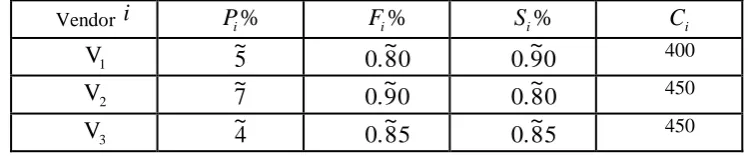
The same case study used in [21] and [25] is considered.
Table 1: fuzzy data for the VS problem
Vendor
i
P
i%
F
i%
S
i%
C
i1
V
~
5
0.
8
~
0
0.
~
9
0
4002
V
~
7
0.
9
~
0
0.
8
~
0
4503
V
~
4
0.
8
~
5
0.
8
~
5
450Step1: construct fuzzy VS problem. The parameters are characterized by T.F.Ns:
450
450
400
)
850
,
800
,
700
(
.
.
)
90
.
0
,
85
.
0
,
70
.
0
(
)
90
.
0
,
80
.
0
,
75
.
0
(
)
95
.
0
,
90
.
0
,
80
.
0
(
)
90
.
0
,
85
.
0
,
80
.
0
(
)
95
.
0
,
90
.
0
,
75
.
0
(
)
85
.
0
,
80
.
0
,
70
.
0
(
)
6
,
4
,
2
(
)
8
,
7
,
5
(
)
6
,
5
,
4
(
3 2 1 3 2 1 3 2 1 3 3 2 1 2 3 2 1 1
x
x
x
x
x
x
t
s
x
x
x
z
Max
x
x
x
z
Max
x
x
x
z
Min
Step 2, 3: To transform the fuzzy VS problem into IMOLP, the
cut is applied. By assuming
0
, we have the following problem:450
450
400
]
850
,
700
[
.
.
]
90
.
0
,
70
.
0
[
]
90
.
0
,
75
.
0
[
]
95
.
0
,
80
.
0
[
]
90
.
0
,
80
.
0
[
]
95
.
0
,
75
.
0
[
]
85
.
0
,
70
.
0
[
]
6
,
2
[
]
8
,
5
[
]
6
,
4
[
3 2 1 3 2 1 3 2 1 3 3 2 1 2 3 2 1 1
x
x
x
x
x
x
t
s
x
x
x
z
Max
x
x
x
z
Max
x
x
x
z
Min
Step 4: Divide the IMOLP model into lower and upper bounds sub-models: According to (4) and (5) the two sub-models are considered as:
The lower bound model:
3 2 1
1
4
x
5
x
2
x
z
Min
3 2
1
2
0
.
70
x
0
.
75
x
0
.
80
x
z
ISSN(E): 2277-128X, ISSN(P): 2277-6451, pp. 34-41
3 2
1
3
0
.
80
x
0
.
75
x
0
.
70
x
z
Max
.
.
t
s
850
3 2 1
x
x
x
700
3 2 1
x
x
x
400
1
x
450
2
x
450
3
x
0
,
,
2 3 1x
x
x
The Upper bound model:
3 2 1
1
6
x
8
x
6
x
z
Min
3 2
1
2
0
.
85
x
0
.
95
x
0
.
90
x
z
Max
3 2
1
3
0
.
95
x
0
.
90
x
0
.
90
x
z
Max
s.t
850
3 2 1
x
x
x
700
3 2 1
x
x
x
400
1
x
450
2
x
450
3
x
0
,
,
2 3 1x
x
x
For Solving sub-model (1):
Step 5: Solving each objective individually subject to given constraints to find the lower and upper bound.
,
3850
1900
Z
1*
515
Z
2*
660
,
535
Z
3*
657
.
Step 6: Use (6)-(7) to construct the membership functions.Step 7: Using (8) to obtain the crisp model that equivalent to fuzzy model which is as:
Max
:
to
subject
,
1950
)
2
5
4
(
3850
x
1
x
2
x
3
,
155
505
70
.
0
75
.
0
70
.
0
1
2
3
x
x
x
,
155
5
.
502
70
.
0
75
.
0
80
.
0
1
2
3
x
x
x
.
850
3 2 1
x
x
x
.
700
3 2 1
x
x
x
,
400
1
x
,
450
2
x
,
450
3
x
0
,
,
2 3 1x
x
x
Step 8: After solving the last model in step 7 by using (Lingo software application), we get:
The level achievement of objectives is
0
.
74
for the optimum valuez
1
2409.862
,
z
2
624.2259
,
616.9725
and
z
3
ISSN(E): 2277-128X, ISSN(P): 2277-6451, pp. 34-41 Now, the steps (5) – (8) are repeated in order to solve the second sub-model (upper):
Step 5: Solving each objective individually subject to given constraints to find the lower and upper bound.
,
5100
4200
Z
1*
610
Z
2*
787
,
650
Z
3*
785
.
Step 6: Use (6)-(7) to construct the membership functions.Step 7: Using (8) to obtain the crisp model that equivalent to fuzzy model which is as:
Max
:
to
subject
,
1800
)
6
8
6
(
6000
x
1
x
2
x
3
,
5
.
177
610
90
.
0
95
.
0
85
.
0
1
2
3
x
x
x
,
135
650
90
.
0
90
.
0
95
.
0
1
2
3
x
x
x
.
850
3 2 1
x
x
x
.
700
3 2 1
x
x
x
,
400
1
x
,
450
2
x
,
450
3
x
0
,
,
2 3 1x
x
x
Step 8: After solving the last model in step 7, by using (Lingo software application), we get: The level achievement of objectives is:
61
.
0
for the optimum valuez
1
2371.676
,
z
2
617.5434
,
and
z
3
609.3353
.
and optimal solutionx
1
367
.
9191
,
x
2
0
,
and
x
3
450
.
The compromise interval solution is obtained as:
1
z
z
2z
3
1
x
x
2
3
x
]
74
.
0
,
61
.
0
[
[
2372
,
2410
]
[
618
,
624
]
[
609
,
617
]
[
368
,
377
]
0
450
The overall achievement level for objectives
0
.
74
is greater than from that of [25] = 0.687 and [21] =0.611.VI. CONCLUSIONS
A process of selection the right vendor represents a safety valve for companies to achieve all firm goals including minimum cost, rejected items, and late delivered items. Hence maintain his Competitive position of the company in the market.
In this paper, an effective fuzzy approach has been introduced to treat the imprecision and ambiguity of the parameters of VS problem. The proposed method is consider as a powerful and applicable tool that help managers to select the proper vendor to accomplish all fuzzy criteria according to preferences of decision maker.
REFERENCES
[1] Dickson, G., An of vendor selection systems and decisions. Journal of Purchasing, 1996. 2: p. 5-17.
[2] Ellram, L.M., The supplier selection decision in strategic partnerships. Journal of Purchasing and materials Management, 1990. 26(4): p. 8-14.
[3] Weber, C.A., J.R. Current, and W. Benton, Vendor selection criteria and methods. European journal of operational research, 1991. 50(1): p. 2-18.
[4] STAMM, C.L. and D.Y. GOLHAR, JIT purchasing: attribute classification and literature review. Production Planning & Control, 1993. 4(3): p. 273-282.
ISSN(E): 2277-128X, ISSN(P): 2277-6451, pp. 34-41 [6] Ho, W., X. Xu, and P.K. Dey, Multi-criteria decision making approaches for supplier evaluation and selection:
A literature review. European Journal of operational research, 2010. 202(1): p. 16-24.
[7] Chai, J., J.N. Liu, and E.W. Ngai, Application of decision-making techniques in supplier selection: A systematic review of literature. Expert systems with applications, 2013. 40(10): p. 3872-3885.
[8] Wind, Y. and P.J. Robinson, The determinants of vendor selection: the evaluation function approach. Journal of Purchasing and Materials Management, 1968. 4(3): p. 29-41.
[9] Pan, A.C., Allocation of order quantity among suppliers. Journal of Purchasing & Materials Management, 1989.
25(3): p. 36-40.
[10] Karpak, B., E. Kumcu, and R. Kasuganti, An application of visual interactive goal programming: a case in vendor selection decisions. Journal of Multi‐ Criteria Decision Analysis, 1999. 8(2): p. 93-105.
[11] Weber, C.A., J. Current, and A. Desai, An optimization approach to determining the number of vendors to employ. Supply Chain management: An international journal, 2000. 5(2): p. 90-98.
[12] Ghodsypour, S.H. and C. O’brien, The total cost of logistics in supplier selection, under conditions of multiple sourcing, multiple criteria and capacity constraint. International journal of production economics, 2001. 73(1): p. 15-27.
[13] Weber, C.A. and J.R. Current, A multiobjective approach to vendor selection. European journal of operational research, 1993. 68(2): p. 173-184.
[14] Zadeh, L.A., Fuzzy sets. Information and control, 1965. 8(3): p. 338-353.
[15] Kumar, M., P. Vrat, and R. Shankar, A fuzzy programming approach for vendor selection problem in a supply chain. International Journal of Production Economics, 2006. 101(2): p. 273-285.
[16] Amid, A., S. Ghodsypour, and C. O’Brien, Fuzzy multiobjective linear model for supplier selection in a supply chain. International Journal of production economics, 2006. 104(2): p. 394-407.
[17] Díaz-Madroñero, M., D. Peidro, and P. Vasant, Vendor selection problem by using an interactive fuzzy multi-objective approach with modified S-curve membership functions. Computers & Mathematics with Applications, 2010. 60(4): p. 1038-1048.
[18] Büyüközkan, G. and G. Çifçi, A novel fuzzy multi-criteria decision framework for sustainable supplier selection with incomplete information. Computers in industry, 2011. 62(2): p. 164-174.
[19] Amiri-Aref, M., N. Javadian, and M. Kazemi, A new fuzzy positive and negative ideal solution for fuzzy TOPSIS. WSEAS Transactions on Circuits and Systems, 2012. 11(3): p. 92-103.
[20] Pan, W., et al., A fuzzy multiobjective model for supplier selection under considering stochastic demand in a supply chain. Mathematical Problems in Engineering, 2015. 2015.
[21] Yücel, A. and A.F. Güneri, A weighted additive fuzzy programming approach for multi-criteria supplier selection. Expert Systems with Applications, 2011. 38(5): p. 6281-6286.
[22] Shaocheng, T., Interval number and fuzzy number linear programmings. Fuzzy sets and systems, 1994. 66(3 ): p. 301-306.
[23] Zimmermann, H.-J., Fuzzy programming and linear programming with several objective functions. Fuzzy sets and systems, 1978. 1(1): p. 45-55.
[24] Bellman, R.E. and L.A. Zadeh, Decision-making in a fuzzy environment. Management science, 1970. 17(4): p. B-141-B-164.