Research Article
a
December
2017
Computer Science and Software Engineering
ISSN: 2277-128X (Volume-7, Issue-12)
A Survey: Content Based Image Retrieval using Block
Truncation Coding
Vipul R. Mahajan
Student M.E.(Computer Engineering) Terna Engineering College, Nerul University of Mumbai, Maharashtra, India
Alka Khade
Assoc. Professor (Computer Engineering) Terna Engineering College, Nerul, University of Mumbai, Maharashtra, India
Abstract- A new approach to index color images using the features extracted from the error diffusion Block truncation coding (EDBTC). The EDBTC produces two color quantizes and a bitmap Image, which is further, managed using vector quantization (VQ) to create the image feature Descriptor. Herein two features are presented namely, colour histogram feature (CHF),bit Pattern histogram feature (BHF) to measure the similarity between a query image and the Target image in database. The CHF and BHF are calculated from the VQ-indexed color quantized and VQ- indexed bitmap image, respectively. The distance calculated from CHF and BHF can be utilized to measure the similarity between two images. A new approach to index colour images using the features extracted from the error diffusion Block truncation coding (EDBTC). The EDBTC produces two colour quantizes and a bitmap Image, which is further, managed using vector quantization (VQ) to create the image feature Descriptor. Herein two features are presented namely, color histogram feature (CHF),bit Pattern histogram feature (BHF) to measure the similarity between a query image and the Target image in database. The CHF and BHF are calculated from the VQ-indexed color quantized and VQ- VQ-indexed bitmap image, respectively. The distance calculated from CHF and BHF can be utilized to measure the similarity between two images.
Keyword- Block Truncation coding, Color Histogram Feature, Bit Pattern Histogram Feature, Vector Quantization
I. INTRODUCTION
Content-based image retrieval (CBIR), also known as query by image content (QBIC) “Content-based” means that the search examines the contents of the image comparatively than the metadata such as keywords, tags, or descriptions related with the image.In this situation might refer to colors, shapes, textures, or any other information that can be derived from the image itself. CBIR is needed because searches that depend on purely on metadata are dependent on explanation quality and completeness. Having humans manually explain images by entering keywords or metadata in a large database can be time consuming and may not capture the keywords wanted to describe the image.
These image retrieval systems involve two phases, indexing and searching, to retrieve a set of similar images from the database, the indexing phase extracts the image features from all of the images in the database which is advanced stored in database as feature vector. In the searching phase, the retrieval system originates the image features from an image submitted by a user (as query image), which are later utilized for performing similarity matching on the feature vectors stored in the data- base. The image retrieval system finally proceeds a set of images to the user with a specific similarity criterion, such as color similarity and texture similarity. Error diffusion is a type of half toning in which the quantization residual is distributed to Neighboring pixels that have not yetbeen processed. Its main use is to convert a multi-level image into a binary image.
Block Truncation Coding, or BTC,[22] is a type of lousy image compression technique for greyscale images. It divides the original images into blocks and then uses a quantiser to reduce the number of grey levels in each block at the same time as maintaining the same mean and
Standard deviation. A pixel image is divided into blocks of classically 4x4 pixels. For each block the Mean and Standard Deviation of the pixel values are calculated; these statistics generally change from block to block. The pixel values selected for each restored, or new, block are chosen so that each block of the BTC compressed image will have (approximately) the same mean and standard deviation as the corresponding block of the original image
II. LITERATURE SURVEY
ISSN(E): 2277-128X, ISSN(P): 2277-6451, pp. 46-51 used for compressing color images, it can also be conveniently used for content-based image retrieval from image databases. From the BTC compressed stream (without performing decoding), we derive two image content description features, one termed the block color co-occurrence matrix (BCCM) and the other block pattern histogram (BPH).We use BCCM and BPH to compute the similarity measures of images for content-based image retrieval applications. Experimental results are presented which demonstrate that BCCM and BPH are comparable to similar state of the art techniques.
The rapid expansion of the Internet and fast advancement in color imaging technologies have made digital color images more and more readily available to professional and amateur users. The large amount of image collections available from a variety of sources (digital camera, digital video, scanner, the Internet, etc.) have posed increasing technical challenges to computer systems to store/transmit and index/manage the image data effectively and efficiently to make such collections easily accessible.
In 2004 [4], S. Silakari, M. Motwani, and M. Maheshwari, presented “Color image clustering using block truncation algorithm” method.With the advancement in image capturing device, the image data been generated at high volume. If images are analyzed properly, they can reveal useful information to the human users. Content based image retrieval address the problem of retrieving images relevant to the user needs from image databases on the basis of low-level visual features that can be derived from the images. Grouping images into meaningful categories to reveal useful information is a challenging and important problem. Clustering is a data mining technique to group a set of unsupervised databased on the conceptual clustering principal: maximizing the infraclass similarity and minimizing the interclass similarity. Proposed framework focuses on color as feature. Color Moment and Block Truncation Coding (BTC) are used to extract features for image dataset. Experimental study using K-Means clustering
In 2012 [20], K.N. Prakash, K.Satya Prasad presented “HSV Color Motif Co-Occurrence Matrix for Content based Image Retrieval” method. In this paper, HSV based color motif co-occurrence matrix (HSV-Motif) is proposed for content based image retrieval (CBIR). The HSV-Motif is proposed in contrast to the RGB based color motif co-occurance matrix (RGB-Motif). First the RGB (red, green, and blue) image is converted into HSV (hue, saturation, and value) image, then the H and S images are used for histogram calculation by quantizing into Q levels and the local region of V (value) image is represented by seven motif, which are evaluated by taking into consideration of local difference between the pixels. Motif extracts the information based on distribution of edges in an image. Two experiments have been carried out for proving the worth of our algorithm. It i s further mentioned that the database considered for experiments are Corel 1000 database (DB1), and MIT VisTex database (DB2). The results after being investigated show a significant improvement in terms of their evaluation measures as compared to RGB-Motif
In 2014 [21] ,Anurag Gupta, Sachin Kumar, Abhishek Raja presented “Enhancement Image Compression Using BTC Algorithm” method.Block Truncation Coding (BTC) is an efficient image coding method. In computer graphics we can convert information into images by which we can understand information easily but sometimes images are big. So we can represent a data by reducing a number of bits and correlation between pixels. That is the main reason behind image compression. In image compression, information can be compress when it is redundant.
BTC is one bit adaptive moment-preserving quantize that preserves certain statistical moments of small blocks of the input image in the quantized output. This algorithm preserves the standard mean and the standard deviation. Various methods have been proposed for image compression such as BTC and absolute moment block truncation coding (AMBTC). AMBTC preserves the higher mean and lower mean of the blocks and use this quantity to quantize output. AMBTC provides better image quality, quiet faster and simple compared to BTC.
III. PROPOSED SYSTEM
ISSN(E): 2277-128X, ISSN(P): 2277-6451, pp. 46-51
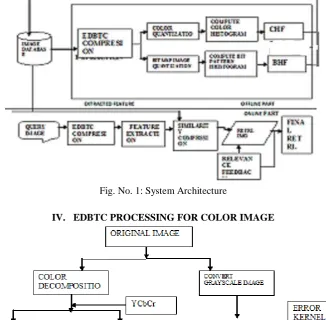
Fig. No. 1: System Architecture
IV. EDBTC PROCESSING FOR COLOR IMAGE
Fig. No. 2: Processing for color image
A. The EDBTC compresses an image in an effective way by including the error diffusion kernel to generate a bitmap image. Simultaneously, it produces two extreme quantizes, specifically, minimum and maximum quantizes. The EDBTC system have a great advantage in its low computational complexity in the bitmap image and two extreme quantizes group
B. The EDBTC bitmap image can be obtained by performing thresholding of the interbank average value with the error kernel. In a block based process, the raster-scan path (from left to right and top to bottom) is applied to process each pixel
C. The EDBTC performs the thresholding operation by including the error kernel. We first need to compute the minimum, maximum, and mean value of the interband average pixels
D. The bitmap image is made
E. The intermediate value is also generated at the same time with the bitmap image generation.
F. The residual quantization error of EDBTC can be calculated
G. The EDBTC thresholding process is performed in a successive way. One pixel is only processed once, and the residual quantization error is diffused and gathered in to the neighboring unprocessed pixels.
H. The two extreme quantizes consist of RGB color information obtained by searching the minimum and maximum of value in an image block for each RGB color space. Two EDBTC color quantizes are computed by looking for the minimum and maximum of all image pixels in each image block
V. METHODOLOGY
ISSN(E): 2277-128X, ISSN(P): 2277-6451, pp. 46-51
quantizes. The EDBTC system have a great advantage in its low computational complexity in the bitmap image and two extreme quantizes group
II. The EDBTC bitmap image can be obtained by performing thresholding of the interbank average value with the error kernel. In a block based process, the raster-scan path (from left to right and top to bottom) is applied to process each pixel in a given image. Suppose that f (x , y) and f¯(x , y) denote the original and interband average value, respectively. The interband average value can be calculated as
The fR(x, y), fG(x, y), and fB(x, y) denote the image pixels in the red, green, and blue (RGB) color channels, respectively. The interband average image can be viewed as the grayscale type of a color image.
III. The EDBTC performs the thresholding operation by including the error kernel. We first need to compute the minimum, maximum, and mean value of the interband average pixels as
∀x,y
∀x,y
The bitmap image h(x, y) is made using the following rule:
IV. The intermediate value o(x, y) is also generated at the same time with the bitmap image generation. The value
o(x, y) can be calculated as
(6)
V. The residual quantization error of EDBTC can be calculated as
(7)
VI. The EDBTC thresholding process is performed in a successive way. One pixel is only processed once, and the residual quantization error is diffused and gathered in to the neighboring unprocessed pixels. The value f¯(x , y)
of unprocessed yet pixel is updated using the following strategy:
(8)
Where is the error kernel to diffuse the quantization residual into its neighboring pixels which have not yet been processed in the EDBTC thresholding
VII. The two extreme quantizes consist of RGB color information obtained by searching the minimum and maximum of value in an image block for each RGB color space. Two EDBTC color quantizes are computed by looking for the minimum and maximum of all image pixels in each image block as
∀x,y ∀x,y ∀x,y
∀x,y ∀x,y ∀x,y
A. Vector Quantization
VQ compresses an image in lossy method based on block coding principle. It is a fixed-to-fixed length algorithm. The VQ finds a codebook by iteratively partitioning a given source vector with its known statistical properties to produce the code vectors with the smallest average distortion when a distortion measurement is given as,
Let C = {c1 , c2 , . . . ,cNc } be the color codebook generated using VQ consisting Nc code words. The VQ needs many images involved as the training set. The vector ck contains RGB color (or grayscale) information which is identical to the two EDBTC quantizes. Except for generating the color codebook, it is also required to construct the bit pattern codebook
B=(B1,B2….BNb) consisting of Nb binary code words. For generating the bit pattern codebook, bitmap images
ISSN(E): 2277-128X, ISSN(P): 2277-6451, pp. 46-51
B. Color Histogram Feature (CHF)
The CHF is derived from the two EDBTC color quantizes, while BHF is computed from EDBTC bitmap image. In this paper, the CHFmin and CHFmax are developed from the color minimum and maximum quantizers, respectively. The CHFmin and CHFmax capture color information from a given image. These features represent the combination of pixel brightness and color distribution in an image.
C. Bit Pattern Histogram Feature (BHF)
Another feature generated from a VQ-indexed EDBTC data stream is the BHF. This feature captures the visual pattern, edge, and textural information in an image. The BHF can be obtained by tabulating the occurrence of a specific bit pattern codebook in an image
D. Image Retrieval with EDBTC Feature
The similarity distance computation is needed to measure the similarity degree between two images. The distance plays the most important role in the CBIR system since the retrieval result is very sensitive with the chosen distance metric. The image matching between two images can be performed by calculating the distance between the query image given by a user against the target images in the database based on their corresponding features (CHF and BHF). After the similarity distance calculation, the system returns a set of retrieved image ordered in ascending manner based on their their similarity distance s c o re s .
/
+ /
/
Table2.1: Comparison of various techniques
Years Author’s Parameters Shortcomings Improvement
1979 E. J. Delp and O. R. Mitchell
BTC used with vector Image Quality, Compression ratio not good
BTC Starting Phase
2003 G. Qiu Features derived from the compressed data stream
Not Perform The Decoding Procedure
Comparatively Image Quality, Compression ratio is good 2009 Dr. Sanjay Silakari Clustering Feature Separation difficult Color moment and BTC is
good 2012 K. N. Prakash HSV Color Motif
Co-Occurrence Matrix Through CBIR
Feature extraction from different segment of image difficult
Image Retrieval result is improved
2014 Anurag Gupta Block size 2*2, 4*4, 8*8 Blocking effect, contour false Improve compression algorithm 2014 Jing-Ming Guo EDBTC feature used Higher retrieval accuracy other
feature can be added
Remove Blocking effect and contour false
VI. CONCLUSION
In Content Based image Retrieval using Error Diffusion Block Truncation coding Features with Relevance feedback, Error Diffusion improves image quality comparative to only Block truncation coding. we use the Relevance feedback at the last step so it will reduce unnecessary image which are not match with input image. So, by using feature and Relevance feedback we will try to improve accuracy of retrieval system as well as quality of image
REFERENCES
[1] G. Qiu, “Color image indexing using BTC,” IEEE Trans. Image Process., vol. 12, no. 1, pp. 93–101, Jan. 2003. [2] M. R. Gahroudi and M. R. Sarshar, “Image retrieval based on textureand color method in BTC-VQ compressed
domain,” in Proc. Int. Symp. Signal Process. Appl., Feb. 2007, pp.1-4.
ISSN(E): 2277-128X, ISSN(P): 2277-6451, pp. 46-51 [4] S. Silakari, M. Motwani, and M. Maheshwari, “Color image clustering using block truncation algorithm,” Int. J.
Comput. Sci. Issues, vol. 4, no. 2, 2009, pp. 31–35.
[5] Z.-M. Lu and H. Burkhardt, “Colour image retrieval based on DCT-domain vector quantisation index histograms,” Electron. Lett., vol. 41, no. 17, pp. 956–957, 2005.
[6] P. Poursistani, H. Nezamabadi-Pour, R. A. Moghadam, and M. Saeed, “Image indexing and retrieval in JPEG compressed domain based on vector quantization,” Math. Comput. Model., vol. 57, nos. 5–6, pp. 1005–1017, 2013. [Online]. Available: http://dx.doi.org/10.1016/j.mcm.2011.11.064
[7] M. E. ElAlami, “A novel image retrieval model based on the most relevant features,” Knowl.-Based Syst., vol. 24, no. 1, pp. 23–32, 2011.
[8] J.-M. Guo, H. Prasetyo, and H.-S. Su, “Image indexing using the color and bit pattern feature fusion,” J. Vis. Commun. Image Represent., vol. 24, no. 8, pp. 1360–1379, 2013.
[9] E. J. Delp and O. R. Mitchell, “Image compression using block truncation coding,” IEEE Trans. Commun., vol. 27, no. 9, pp. 1335–1342, Sep. 1979.
[10] ] Y.-G. Wu and S.-C. Tai, “An efficient BTC image compression tech-nique,” IEEE Trans. Consum. Electron., vol. 44, no. 2, pp. 317–325, May 1998.
[11] J.-M. Guo and Y.-F. Liu, “Joint compression/watermarking scheme using majority-parity guidance and halftoning-based block truncation coding,”IEEE Trans. Image Process., vol. 19, no. 8, pp. 2056–2069, Aug. 2010.
[12] J.-M. Guo, “Improved block truncation coding using modified error diffusion,” Electron. Lett., vol. 44, no. 7, Mar. 2008, pp. 462–464.
[13] J.-M. Guo, S.-C. Pei, and H. Lee, “Watermarking in halftone images with parity-matched error diffusion,” Signal Process., vol. 91, no. 1, pp. 126–135, 2011
[14] S.-C. Pei and J.-M. Guo, “Hybrid pixel-based data hiding and block-based watermarking for error-diffused halftone images,” IEEE Trans. Circuits Syst. Video Technol., vol. 13, no. 8, pp. 867–884, Aug. 2003.
[15] Y. F. Liu, J. M. Guo, and J. D. Lee, “Halftone image classification using LMS algorithm and naive Bayes,” IEEE Trans. Image Process., vol. 20, no. 10, pp. 2837–2847, Oct. 2011
[16] Y.-F. Liu, J.-M. Guo, and J.-D. Lee, “Inverse halftoning based on the Bayesian theorem,” IEEE Trans. Image Process., vol. 20, no. 4, pp. 1077–1084, Apr. 2011.
[17] J.-M. Guo and Y.-F. Liu, “High capacity data hiding for error-diffused block truncation coding,” IEEE Trans. Image Process., vol. 21, no. 12,pp. 4808–4818, Dec. 2012.
[18] ] J.-M. Guo and Y.-F. Liu, “Halftone-image security improving using overall minimal-error searching,” IEEE Trans. Image Process., vol. 20, no. 10, pp. 2800–2812, Oct. 2011.
[19] Color Image Clustering using Block Truncation Algorithm IJCSI International Journal of Computer Science Issues, Vol. 4, No. 2, 2009
[20] HSV Color Motif Co-Occurrence Matrix for Content based Image Retrieval International Journal of Computer Applications (0975 – 888) Volume 48– No.16, June 2012