arXiv:1607.02126v1 [nucl-th] 7 Jul 2016
multi-reference covariant density functional theory and subbarrier fusion of
16O+
208Pb
J. M. Yao1, 2, 3 and K. Hagino2, 4, 5
1School of Physical Science and Technology, Southwest University, 400715 Chongqing, China
2
Department of Physics, Tohoku University, Sendai 980-8578, Japan
3Department of Physics and Astronomy, University of North Carolina, Chapel Hill, NC 27516-3255, USA
4Research Center for Electron Photon Science, Tohoku University, 1-2-1 Mikamine, Sendai 982-0826, Japan
5 National Astronomical Observatory of Japan, 2-21-1 Osawa, Mitaka, Tokyo 181-8588, Japan
We discuss anharmonicity of the multi-octupole-phonon states in208Pb based on a covariant
den-sity functional theory, by fully taking into account the interplay between the quadrupole and the octupole degrees of freedom. Our results indicate the existence of a large anharmonicity in the transition strengths, even though the excitation energies are similar to those in the harmonic limit. We also show that the quadrupole-shape fluctuation significantly enhances the fragmentation of the two-octupole-phonon states in208
Pb. Using those transition strengths as inputs to coupled-channels calculations, we then discuss the fusion reaction of16
O+208
Pb at energies around the Coulomb bar-rier. We show that the anharmonicity of the octupole vibrational excitation considerably improves previous coupled-channels calculations in the harmonic oscillator limit, significantly reducing the height of the main peak in the fusion barrier distribution.
PACS numbers: 21.60.Jz, 23.20.-g, 21.10.Re, 25.70.Jj
Collective vibrational excitations exist commonly in many-fermion systems [1]. Here, the concept ofphonon is an important keystone to understand these excita-tions. For instance, for finite nuclear systems, vibrations of the nuclear surface are treated as elementary excita-tions [2, 3]. The phonons for these vibraexcita-tions are boson-like in character and multiple excitations of the same type are possible, resulting in multi-phonon states [2]. In a harmonic vibration, all the levels in a phonon mul-tiplet are degenerate in energy and the energy spacing between neighboring multiplets is a constant. The en-ergy patterns close to such harmonic vibration have been observed in nearly spherical nuclei in different mass re-gions, and these states have been primarily interpreted as multipole phonon states [2, 4, 5].
From a microscopic viewpoint, however, the collective excitations are generated by a coherent superposition of quasiparticle excitations of fermions in orbits close to the Fermi surface. The Pauli principle correction, together with residual interactions among phonons (that is, mode-mode couplings), modifies the structure of multi-phonon states and make them highly fragmented [6]. To assess the degree of such anharmonicity is a fundamental ques-tion in nuclear physics, that needs to be studied more extensively. In particular, we mention that recent stud-ies on the anharmonicity in the multi-quadrupole-phonon states have questioned the concept of low-energy vibra-tional modes in atomic nuclei[7, 8].
The double-magic nucleus 208Pb provides an ideal laboratory to examine the concept of multi-octupole-phonon excitations in nuclear systems, as the first ex-cited 3− state of this nucleus has long been interpreted
as a collective one-octupole-phonon state [9]. In the past decades, several experimental searches for the
two-octupole-phonon (TOP) states in 208Pb have been car-ried out [10–13]. Even though many of the TOP mem-bers have been identified, the multi-phonon excitations in 208Pb have not yet been understood completely. This is
the case especially for the nature of the TOP multiplets, which has been predicted to show a strong fragmenta-tion [13–15].
Incidentally, heavy-ion fusion reactions provide an al-ternative way to probe the multi-phonon excitations in atomic nuclei, which significantly affect the sub-barrier fusion cross sections [16–19] as illustrated by coupled-channels calculations [16, 20, 21]. Previous coupled-channels calculations for the fusion reaction of 16O+208Pb based on multi-harmonic-phonon excitations
fail to reproduce the observed energy dependence of fu-sion cross sections [22–24], and overestimate the height of the main peak in the so called fusion barrier distribu-tion [25]. It has been a long-standing unsolved quesdistribu-tion how the fusion cross sections for the16O+208Pb system can be accounted for by the coupled-channels approach.
fragmented by its internal fermionic structure and by coupling to other shape degrees of freedom. We show that these anharmonic features considerably improve the coupled-channels calculations for the fusion reaction of 16O+208Pb, significantly reducing the height of the main
peak in the fusion barrier distribution.
In the multi-reference covariant density functional the-ory, the wave functions for nuclear collective states are constructed by superposing a set of quantum-number projected nonorthogonal mean-field reference states |β2β3i around the equilibrium shape. Here, the reference states|β2β3iare obtained by deformation constrained relativistic mean-field calculations with the quadrupole and octupole deformation parameters,β2and β3, respectively. The wave functions thus read
|JM πi=X
q
fJπ(q) ˆPJ
M0PˆNPˆZPˆπ|qi, (1)
where q refers to (β2, β3) and ˆP’s are projection opera-tors onto the angular momentumJ, the parity (π=±), and the neutron and proton numbers (N, Z) [3]. For the sake of simplicity, we have restricted all the reference states |qi to be axially deformed. We note that the ef-fects of pairing vibrations are not taken into account in the present calculation, even though they may have an influence on low-lying excited 0+ states [30]. The weight
function fJπ(q) in Eq. (1) as well as the energy EπJ
for each GCM state |JM πiare determined by the Hill-Wheeler-Griffin equation [31]. As in our previous stud-ies [27], the mixed-density prescription is adopted for the energy overlap in the Hamiltonian kernel. In the calcula-tions presented below, we employ the relativistic energy functional PC-F1 [32]. The pairing correlation among the nucleons is treated in the BCS approximation with a density-independentδ-force supplemented with a smooth energy cutoff [33]. The strength parameters in the pair-ing force are chosen accordpair-ing to the PC-F1 force [32].
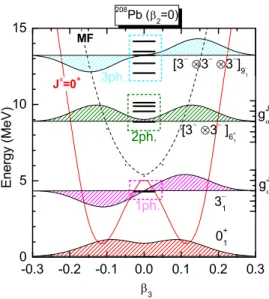
We first examine the concept of one-dimensional vibra-tion in 208Pb with octupole degree of freedom, by freez-ing the quadrupole degree of freedom at β2 = 0. The deformation energy curve in the mean-field approxima-tion as well as the projected energy curve forJπ = 0+are shown in Fig. 1. The excitation energies of natural-parity “phonon” states and the collective wave functions de-fined bygJπ(q)≡P
q′ NJπ
q,q′ 1/2
fJπ(q′) for the 0+
1, 3−1, [3−⊗3−]6+, and [3−⊗3−⊗3−]9− states are also shown,
whereNJπ
q,q′ is the norm kernel in the Hill-Wheeler-Griffin equation [28]. The mean-field energy curve is almost parabolic and is centered at β3 = 0. As expected, the dynamical octupole effect originated from the symme-try restoration generates two octupole minima and shifts the dominant component in the 0+state to an octupole-deformed configuration with |β3| ∼ 0.1. One can also see that the multiples of two- and three-“phonon” states appear at similar excitation energies to each other. The
-0.3 -0.2 -0.1 0.0 0.1 0.2 0.3 0
5 10 15
g
J
J=0
+
2ph.
[3 3 3]
9 1
3
1
0
+ 1
3
MF
E
n
e
r
g
y
(
M
e
V
)
208
Pb (
2
=0)
[3 3 ]
6 + 1
g
J
1ph.
3ph.
FIG. 1: (Color online) The total energy (normalized to the GCM ground state) of the208
Pb nucleus as a function of oc-tupole deformation parameterβ3. The quadrupole degree of
freedom is frozen atβ2 = 0. The energy curve with
projec-tion onto the particle numbers (N, Z) and the spin-parity of 0+
is also shown by the solid line, together with the excitation energies and the collective wave functions for the states.
spin-average of the excitation energies for the natural-parity two- and three-octupole phonon states is 9.6 MeV and 13.1 MeV, respectively, which is about twice and three times the energy of the one-octupole phonon state, 4.3 MeV,close to∼4.0 MeV from non-relativistic GCM calculations [34, 35] (the excitation energies are expected to be lowered down if the cranking mean-field states are adopted in the configuration mixing calculations [36, 37]). Notice, however, that there are some energy displace-ments, indicating the existence of anharmonicity. The energy displacement appears to increase with the num-ber of the “phonons” in the states. As can be seen in the figure, the wave functions for the 0+
1 and 3−1 states show a similarity to the wave functions for the zero and one-phonon states of a harmonic oscillator, while those of the [3−⊗3−]6+and [3−⊗3−⊗3−]9− states are considerably distorted.
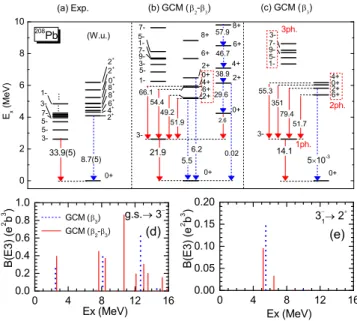
It is interesting to notice that an anharmonicity is stronger in the transition strengths as shown in Fig. 2(c), where the E3 transition strength from the 3−
1 state to the ground state is underestimated by a factor of more than two. Moreover, theE2 transition strength from the first 2+ state to the ground state is underestimated by three orders of magnitude. The strength of theE3 tran-sition from the two-phonon multiplets to the 3−
1 state is also much larger than twice the B(E3) value from the 3−
1 state to the ground state. In particular, the E3 transition from the [3−
1 ⊗3−1]0+ state to the 3−1 state is
0 2 4 6 8 10
0 4 8 12 16
0.0 0.2 0.4 0.6 0.8 1.0
0 4 8 12 16
0.00 0.05 0.10 0.15 0.20 3- 9- 7-0+ 0+ 2+ 6+ 4+ 6+ 8+ 8+ 7- 5- 1- 3- 5-2 + 2 + . . . 3-0+ 0+ 3- 7-2+ 4+ 9- 7- 1-2+ 8 + 8 + 3ph. 1ph. (c) GCM ( ) (b) GCM ( - )
5- 1- 3-208 Pb E x ( M e V ) 0+ (W .u.) 8.7(5) 33.9(5) (a) Exp. 6 + 0 + 4 + 2 + 2ph. . . . 21.9 14.1 5.5 49.2 6+ 2.6 51.9 54.4 51.7 79.4 1- 5-351 55.3 510 -3 66.1 6.2 6+ 2+ 0+ 4+ 29.6 38.9 46.7 57.9 0.02 Ex (MeV) GCM ( 3 ) GCM ( 2 -3 ) B ( E 3 ) ( e 2 b 3 )
g.s. 3
(d) B ( E 3 ) ( e 2 b 3 ) Ex (MeV) 3 1 2 (e)
FIG. 2: (Color online) The low-lying energy spectra of208
Pb obtained by mixing the octupole-quadrupole (β3 −β2)
de-formed configurations (the panel (b)) and by mixing only the octupole (β3) deformed configurations (the panel (c)), in
com-parison with the experimental data taken from Ref. [38] (the panel (a)). The panels (d) and (e) show the E3 transition strengths from the the ground state to 3− states and from
the first 3− state to 2+ states, respectively, as a function of
the excitation energy of the final states. In the panels (a)-(c), the red solid and the blue dashed lines indicate theE3 and E2 transition strengths (in W.u.), respectively. All the calcu-lated excitation energies are scaled to the empirical excitation energy of the lowest 3−state by dividing them by a constant
factor.
transition strengths has been found also in the “multi-quadrupole-phonon” excitations inRefs. [7, 8].
To examine the anharmonicity arising from the cou-pling between the octupole and the quadrupole shape fluctuations, we next carry out the GCM calculation in the two-dimensional (β2, β3) deformation plane. The cal-culated low-lying energy spectra are shown in Fig. 2(b), where only natural-parity states are plotted. Here, the spectra are scaled by a constant factor so that the energy of the first 3− state matches with the empirical value,
2.62 MeV. Notice that the inclusion of the quadrupole shape fluctuation slightly alters the excitation energies of the [3−
1 ⊗3−1]0+,2+,4+,6+ states. One can see that,
af-ter including this effect, the transition strengths for the 3−
1 →0 +
1 and the 2 + 1 →0
+
1 transitions arecloser to the experimental data. TheB(E3; 3−
1 →0
+
1) value is
consis-tent with 21.93 W.u. by the Gogny D1S force [35], al-though it is slightly larger than 18.7 W.u by the Skyrme SLy4 force [34]. Moreover, the electric dipole transi-tion strengths are also well reproduced by this calcula-tion. For instance, we obtain the B(E1) value from the first 4+ state to the first 5− state to be 1.5×10⁻⁴ W.u.,
(g) (f) (e) (h) (d) (c) (b) B -0.4 -0.2 -0.1 0.1 0.2 0.4 (a) -0.10 -0.05 0.00 0.05 0.10 3 1 6 + 1 0 + 3 0 + 1 2 9 1 5 1 2_1 6_1 -0.10 -0.05 0.00 0.05 0.10 2 B 4_1
-0.2 0.0 0.2 1 1 3 -0.10 -0.05 0.00 0.05 0.10
-0.2 0.0 0.2
2
3
-0.2 0.0 0.2 2
+ 1
3
FIG. 3: (Color online) The distribution of the collective wave functions gJ π
for several selected low-lying states of 208
Pb shown in Fig. 2(b).
which is compared to the experimental upper bound of 1.0×10⁻⁴ W.u. [11]. We note that, in the octupole-quadrupole shape-mixing calculation, the E3 transition strengths from the four TOP states to the 3−
1 state are similar to each other, about three times theB(E3) value from the 3−
1 state to the ground state. Figures 2(d) and (e) show the calculated B(E3) values from the ground state to 3− state and those from the first 3− state to 2+ states as a function of the excitation energy of the final states, respectively. The solid and the dotted lines in-dicate the results of the octupole-quadrupole shape fluc-tuation and of the octupole vibration only, respectively. One can see that generally the E3 transitions become more fragmented after taking into account the fluctua-tion in the quadrupole shape. In particular, theE3 tran-sition from the 3−
1 state to excited 2+states are strongly quenched. Similar phenomenon is also found in the E3 transitions from the 3−
1 state to other excited states (not shown here).
Figure 3 shows the distribution of the collective wave functions for the ground state and some selected exci-tation states. Comparing with the wave functions in Fig. 1, one can see a rather large fluctuation along the quadrupole deformation in all the states. For the multi-plets of the TOP states, only the 0+ state has two nodes alongβ3 direction, showing again the anharmonicity in the wave functions.
10
-210
-110
010
110
210
3σ
fus(mb)
No Coupling 2 phonon (HO) "2 phonon" (GCM)
65
70
75
80
85
90
E
c.m.(MeV)
0
200
400
600
800
1000
1200
d
2
(E
σ
fus) / dE
2
(mb / MeV)
16
O +
208Pb
(a)
(b)
FIG. 4: (Color online) The fusion cross sections (upper panel) and the fusion barrier distributions (lower panel) for the 16
O+208
Pb system obtained with the semi-microscopic coupled-channels calculation with the coupling strengths from the MR-DFT calculations (the solid line). The dashed and the dotted lines show the results of the two-phonon coupling in the harmonic oscillator limit and of the no-coupling limit, respectively. The experimental data are taken from Ref. [22].
that the 2+ states and high-lying states with the
PC-PK1 force may have a problem of convergence, as they are much more sensitive to the model space than those by the F1 force, even though both F1 and PC-PK1 forces give much better convergent solutions for the quadrupole-phonon states in58,60Ni [40]. In view of this,
we present only the PC-F1 results in this paper.
In order to further test the results of the present cal-culation for the208Pb nucleus, we next discuss the sub-barrier fusion reaction of the16O+208Pb system. To this end, we employ the semi-microscopic approach [40] and solve the coupled-channels equations by using the tran-sition strengths from the GCM calculations as inputs. In this approach, the internuclear potential and the cou-pling potentials are generated from a phenomenological deformed Woods-Saxon potential. For this, we use the parameters ofV0=178 MeV,R0=0.978×(161/3+ 2081/3) fm, and a=1.005 fm, which are similar to those used in Ref. [22]. In the coupled-channels calculations, in addi-tion to the entrance channel, we include the one-octupole phonon state, 3−
1, at 2.615 MeV, the “one-quadrupole” phonon state, 2+
1, and several states which are strongly coupled to those 3−
1 and 2 +
1 states by the octupole and
the quadrupole couplings. The whole TOP candidate states are included in this model space. As is shown in Ref. [40], we scale all the excitation energies to the empirical excitation energy of the 3−
1 state. We also scale all the coupling strengths to the empirical coupling strength between the ground state and the 3−
1 state, that is, β = 0.144, which is estimated from the measured B(E3) strength with the radius parameter ofr0=1.1 fm. The resultant coupled-channels equations are solved us-ing the computer codeCCFULL[41].
The solid line in Fig. 4 is the fusion cross sections (the upper panel) and the fusion barrier distribution (the lower panel) so obtained. Here, the fusion barrier distri-bution is defined as the second energy derivative of the product of the energy E and fusion cross section σfus, that is, d2(Eσfus)/dE2 [17, 25]. This is compared to the two-phonon calculations in the harmonic oscillator limit (the dashed line) and to the single-channel calcula-tion (the dotted line). For the former, we include the 3−
1, 2 + 1, (3−1)
2, (2+ 1)
2, and 3−
1 ⊗2 +
1 states within the harmonic oscillator coupling scheme [16]. It has been a long-standing problem that for this particular system the coupled-channels calculation with the harmonic oscil-lator couplings overestimates the height of the main peak in the barrier distribution [22–24]. It is remarkable that the present GCM calculation yields a much lower peak in the fusion barrier distribution, leading to a much bet-ter agreement with the experimental data both for the fusion cross sections and for the barrier distribution. For this good reproduction, it turns out that the coupling be-tween the 3−
1 and the 2 +
1 states, as well as the couplings between the TOP states and the excited negative parity states, play an important role. In the previous coupled-channels calculations, the 3−, 2+
1 and the 5−1 states have been treated as independent phonon states, and these couplings were absent in the calculations. In contrast, in the present GCM calculation, the 2+1 and the 5−1 states have in part the two and three octupole phonon char-acters, respectively. Likewise, the 1− states have both
the (3−
1)
3 and the 3−
1 ⊗2 +
1 characters. Apparently those anharmonicity effects in the transition strengths lead to the strong couplings between the ground state and those states via multiple octupole excitations, significantly im-proving the previous coupled-channels calculations.
In summary, the multi-octupole-phonon excitations in 208Pb have been examined with the multi-dimensional
strengths play an important role in this reaction, lead-ing to a much better reproduction of fusion barrier dis-tribution as compared to the previous coupled-channels calculations.
Our calculations indicate that anharmonicity of nu-clear vibrations is much larger in the collective wave func-tions and in the transition properties as compared to the anharmonicity in the excitation energies. An interesting feature is that the anharmonicity may be large even if the energy spectrum resembles a harmonic oscillator. It will be interesting to reexamine systematically nuclear vibrations with a fully microscopic theory such as the multi-reference density functional approaches based on both nonrelativistic and relativistic energy functionals in future.
We thank D. J. Hinde and T. Ichikawa for useful dis-cussions. This work was partially supported by the NSFC under Grant Nos. 11575148, 11475140, and 11305134, and JSPS KAKENHI Grant Number 2640263.
[1] G. F. Bertsch and R. A. Broglia, Oscillations in Finite Quantum System (Cambridge University Press, Cam-bridge, 1994).
[2] A. Bohr and B. Mottelson,Nuclear Structure(Benjamin, New York, 1975), Vol. 2.
[3] P. Ring and P. Schuck,The Nuclear Many-Body Problem
(Springer-Verlag, Berlin, 1980).
[4] T. Aumann, P. F. Bortignon, and H. Emling, Nucl. Part. Sci.48, 351 (1998).
[5] F. Corminboeuf, T. B. Brown, L. Genilloud, C. D. Han-nant, J. Jolie, J. Kern, N. Warr, and S. W. Yates, Phys. Rev. Lett.84, 4060 (2000).
[6] D. M. Brink, A. F. R. de Toledo Piza, and A.K. Kerman, Phys. Lett.19B, 413 (1965).
[7] P. E. Garrett, K. L. Green, and J. L. Wood, Phys. Rev. C78, 044307 (2008); P. E. Garrett and J. L. Wood, J. Phys.G37, 064028 (2010).
[8] E. A. Coello Perez and T. Papenbrock, Phys. Rev. C92, 064309 (2015).
[9] I. Hamamoto, Phys. Rep.10, 63 (1974).
[10] M. Yeh, P. E. Garrett, C. A. McGrath, S. W. Yates, and T. Belgya, Phys. Rev. Lett.76, 1208 (1996).
[11] M. Yeh, M. Kadi, P. E. Garrett, C. A. McGrath, S. W. Yates, and T. Belgya, Phys. Rev. C57, R2085 (1998).
[12] K. Vetter, A. O. Macchiavelli, D. Cline, H. Amro, S. J. Asztalos, B. C. Busse, R. M. Clark, M. A. Deleplanque, R. M. Diamond, P. Fallon, R. Gray, R. V. F. Janssens, R. Kr¨ucken, I. Y. Lee, R. W. MacLeod, E. F. Moore, G. J. Schmid, M. W. Simon, F. S. Stephens, and C. Y. Wu, Phys. Rev. C58, R2631 (1998).
[13] B. D. Valnion, V. Yu. Ponomarev, Y. Eisermann, A. Goll-witzer, R. Hertenberger, A. Metz, P. Schiemenz, and G. Graw, Phys. Rev. C63, 024318 (2001).
[14] V. Yu. Ponomarev and P. von Neumann-Cosel, Phys. Rev. Lett.82, 501 (1999).
[15] B. A. Brown, Phys. Rev. Lett.85, 5300 (2000).
[16] K. Hagino and N. Takigawa, Prog. Theor. Phys. 128, 1001 (2012).
[17] M. Dasgupta, D.J. Hinde, N. Rowley, and A. M. Ste-fanini, Annu. Rev. Nucl. Part. Sci.48, 401 (1998). [18] A. B. Balantekin and N. Takigawa, Rev. Mod. Phys.70,
77 (1998).
[19] B. B. Back, H. Esbensen, C. L. Jiang, and K. E. Rehm, Rev. Mod. Phys.86, 317 (2014).
[20] K. Hagino, N. Takigawa, and S. Kuyucak, Phys. Rev. Lett.79, 2943 (1997).
[21] K. Hagino, S. Kuyucak, and N. Takigawa, Phys. Rev. C
57, 1349 (1998).
[22] C. R. Morton, A. C. Berriman, M. Dasgupta, D. J. Hinde, J. O. Newton, K. Hagino, and I. J. Thompson, Phys. Rev. C60, 044608 (1999).
[23] H. Esbensen and S. Misicu, Phys. Rev. C 76, 054609
(2007).
[24] S. Yusa, K. Hagino, and N. Rowley, Phys. Rev. C85, 054601 (2012).
[25] N. Rowley, G.R. Satchler, and P.H. Stelson, Phys. Lett. B254, 25 (1991).
[26] T. Niksic, D. Vretenar, P. Ring, Prog. Part. Nucl. Phys. 66, 519 (2011).
[27] J. M. Yao, J. Meng, P. Ring, and D. Vretenar, Phys. Rev. C81, 044311 (2010); J. M. Yao, K. Hagino, Z. P. Li, J. Meng, and P. Ring, Phys. Rev. C89, 054306 (2014).
[28] J. M. Yao, E. F. Zhou, and Z. P. Li, Phys. Rev. C92, 041304(R) (2015).
[29] E. F. Zhou, J. M. Yao, Z. P. Li, J. Meng, and P. Ring, Phys. Lett. B753, 227 (2016).
[30] P. F. Bortignon, inElementary Modes of Excitation in Nuclei, Proceedings of the International School of Physics “Enrico Fermi”, Course LXIX, Varenna, 1976, edited by A. Bohr and R.A. Broglia (North Holland, Amsterdam, 1977).
[31] D. L. Hill and J. A. Wheeler, Phys. Rev.89, 1102 (1953); J. J. Griffin and J. A. Wheeler, ibid.108, 311 (1957). [32] T. B¨urvenich, D. G. Madland, J. A. Maruhn, and P.-G.
Reinhard, Phys. Rev. C65, 044308 (2002).
[33] S. J. Krieger, P. Bonche, H. Flocard, P. Quentin, and M. S. Weiss, Nucl. Phys.A 517, 275 (1990).
[34] P.-H. Heenen, A. Valor, M. Bender, P. Bonche, and H. Flocard, Eur. Phys. J.A11, 393 (2001).
[35] L. M. Robledo, EPJ Web of Conferences 66, 02091 (2014).
[36] Z. P. Li, T. Niksic, P. Ring, D. Vretenar, J. M. Yao, and J. Meng, Phys. Rev. C86, 034334 (2012).
[37] M. Borrajo, T. Rodriguegz and J. L. Egido, Phys. Lett.
B746, 341-346 (2016).
[38] National Nuclear Data Center,
http://www.nndc.bnl.gov/.
[39] P. W. Zhao, Z.P. Li, J.M. Yao, and J. Meng, Phys. Rev. C82, 054319 (2010).
[40] K. Hagino and J. M. Yao, Phys. Rev. C91, 064606 (2015). [41] K. Hagino, N. Rowley, and A. T. Kruppa, Comp. Phys.