The Journal of Nutrition
Nutritional Epidemiology
Lifestyle and Other Factors Explain One-Half of
the Variability in the Serum 25-Hydroxyvitamin
D Response to Cholecalciferol Supplementation
in Healthy Adults
1–4
Judy R Rees,
5* Leila A Mott,
5Elizabeth L Barry,
5John A Baron,
5,7Roberd M Bostick,
8,9Jane C Figueiredo,
10,11Robert S Bresalier,
12Douglas J Robertson,
6,13and Janet L Peacock
5,14Departments of5Epidemiology and6Medicine, Geisel School of Medicine at Dartmouth, Lebanon, NH;7Department of Medicine, University of North Carolina School of Medicine, Chapel Hill, NC;8Department of Epidemiology, Rollins School of Public Health, 9Winship Cancer Institute, Emory University, Atlanta, GA;10Samuel Oschin Comprehensive Cancer Institute, Cedars-Sinai Medical Center,11Department of Preventive Medicine, Keck School of Medicine, University of Southern California, Los Angeles, CA; 12Department of Gastroenterology, Hepatology and Nutrition, the University of Texas MD Anderson Cancer Center, Houston, TX; 13VA Medical Center, White River Junction, VT; and14Division of Health and Social Care Research, King’s College London, London, United Kingdom
Abstract
Background: Many factors have been associated with serum 25-hydroxyvitamin D [25(OH)D] concentrations in observational studies, with variable consistency. However, less information is available on factors affecting the magnitude of changes in serum 25(OH)D resulting from vitamin D supplementation.
Objective:This study aimed to identify factors associated with the serum 25(OH)D response to supplementation with 1000 IU cholecalciferol/d during the first year of a large, multicenter, randomized, placebo-controlled colorectal adenoma chemoprevention trial.
Methods:Eligible older adults who were not vitamin D–deficient [serum 25(OH)D$12 ng/mL] were randomly assigned in a modified 232 factorial design to 1 of 4 groups: daily 1000 IU cholecalciferol, 1200 mg Ca as carbonate, both, or placebo. Women could elect 2-group (calcium6cholecalciferol) random assignment. In secondary analyses, we used multivariable models to assess factors associated with serum 25(OH)D concentrations in all enrollees (n= 2753) and with relative changes in serum 25(OH)D after 1 y cholecalciferol supplementation among those randomly assigned (n= 2187).
Results:In multivariable models, 8 factors accounted for 50% of the variability of proportional change in serum 25(OH)D after cholecalciferol supplementation. Larger increases were associated with being female (34.5% compared with 20.5%;
P< 0.001) and with lower baseline serum 25(OH)D (P< 0.0001), optimal adherence to study pill intake (P= 0.0002), wearing long pants and sleeves during sun exposure (P= 0.0002), moderate activity level (P= 0.01), use of extra vitamin D–containing supplements during the trial (P = 0.03), and seasons of blood draw (P # 0.002). Several genetic polymorphisms were associated with baseline serum 25(OH)D and/or serum response, but these did not substantially increase the modelsÕR2values. Other factors, including body mass index, were associated with serum 25(OH)D at
baseline but not with its response to supplemental cholecalciferol.
Conclusions:The factors that most affected changes in serum 25(OH)D concentrations in response to cholecalciferol supplementation included sex, baseline serum 25(OH)D, supplement intake adherence, skin-covering clothes, physical activity, and season. Genetic factors did not play a major role. This trial was registered at www.clinicaltrials.gov as NCT00153816. J Nutr2016;146:2312–24.
Keywords:
randomized controlled trial, cholecalciferol, vitamin D3, calcium, 25-hydroxyvitamin D, dose responseIntroduction
Observational data suggest that inadequate vitamin D status is
associated with an increased risk of fracture, cancer, and other
chronic diseases (1–4). Although the definition of an adequate
serum concentration remains controversial (12 ng/mL) (5, 6), it
has been argued that one-quarter of Americans have
inade-quate serum concentrations of 25-hydroxyvitamin D [25(OH)D]
15(12–20 ng/mL), and 8% are deficient (<12 ng/mL) (7, 8).
However, the National Academy of Medicine (NAM) made
relatively minor changes to DRIs in 2010, stating that
ã2016 American Society for Nutrition.
‘‘a majority of the population is meeting its needs for
vita-min D’’ (7).
Many factors are known to be associated with serum 25(OH)D
concentrations, including sun exposure, BMI, skin pigmentation,
medications, and comorbidities (5, 7–26), but, to our knowledge,
there is limited evidence on a few factors that may affect the
magnitude of serum response to cholecalciferol
supplementa-tion, e.g., baseline serum 25(OH)D, BMI, age, calcium intake,
and season (27, 28). The NAM provides intake
recommenda-tions by age and sex, but it is unclear whether supplementation
should be varied according to vitamin D status, weight, or other
factors (7). In addition, although common genetic variants have
been associated with circulating serum 25(OH)D concentrations
in genome-wide association studies (29, 30), their role in
affect-ing the magnitude of serum response to supplementation is also
less clear (31–33).
In this study, we report the results of analyses of the potential
impact of a large number of personal, medical, environmental,
lifestyle, and genetic factors on the serum 25(OH)D
concentra-tion response to 1 y of oral supplementaconcentra-tion with 1000 IU
cholecalciferol/d during a multicenter, randomized,
placebo-controlled colorectal adenoma chemoprevention trial.
Methods
As described previously (34), we conducted a randomized, double-blind, placebo-controlled trial (NCT00153816) to test the effects of daily supplementation with 1000 IU cholecalciferol and/or 1200 mg elemental calcium (as calcium carbonate) on large-bowel adenoma recurrence. From May 2004 through July 2008, we recruited participants from 11 centers in the continental United States and Puerto Rico. Participants aged 45–75 y were eligible for enrollment if they had$1 large-bowel adenoma removed and no adenomas remaining after a complete colonoscopic surveillance examination within 4 mo of enrollment. Participants had no familial colorectal cancer syndromes, no history of serious gastrointestinal disease, no serious health concerns that might jeopardize several years of partic-ipation in the trial, and no contraindications to, or medical indications for, vitamin D or calcium supplementation.
Participants provided detailed information at enrollment on health, medications, and behavioral factors, such as sun exposure and exercise [International Physical Activity Questionnaire, Short Form (35)], and completed the Block Brief 2000 FFQ (Nutritionquest). They were counseled by study coordinators to help them avoid consuming >1200 mg
Ca and 400 IU vitamin D/d in their food during the study. Participants also agreed to avoid taking vitamin D or calcium supplements other than those provided for the trial, but because vitamin D use in the community gained popularity, the protocol was amended to promote participant retention. From April 2008 onward, if personal supplements#1000 IU vitamin D and/or 400 mg elemental calcium were reported as being taken, these were permitted in addition to the study pills. For those who wished to take a multivitamin during the study, we provided one that lacked calcium and vitamin D. Blood drawn at enrollment and 1 y after random assignment (mean of 14.5 mo after the baseline blood draw) was tested for 25(OH)D with the use of a Gamma-B 25-Hydroxy Vitamin D Liquid-Phase RIA kit (IDS) in laboratory processes moni-tored through the international Vitamin D External Quality Assessment Scheme. In addition, we genotyped single-nucleotide polymorphisms (SNPs) in selected genes related to vitamin D metabolism, as described previously (31): genomic DNA was isolated from buffy coat samples by BioServe Biotechnologies with the use of DNAQuiK (36). Genotyping was conducted by KBioscience with the use of KASP technology (37); or by Genome Quebec Innovation Center with the use of Sequenom iPLEX Gold (38) or predesigned TaqMan assays (rs228570 and rs10766197) (39).
After a placebo run-in phase of 56–84 d, eligible participants who reported taking$80% of run-in study pills were randomly assigned, provided that their baseline serum 25(OH)D concentration was$12 ng/mL. Participants were randomly assigned in a modified 232 factorial design stratified by study center, sex, and surveillance interval to 1 of 4 study arms: daily 1000 IU cholecalciferol, 1200 mg Ca as carbonate, both, or placebo. Women with concerns about osteoporosis who de-clined to forego calcium supplementation were randomly assigned to calcium alone or calcium with vitamin D. Tablets for the study were prepared and tested according to the FDAÕs guidelines for Good Manufacturing Practices. Trained study coordinators interviewed ran-domly assigned participants by telephone biannually to document changes in health and medications and ascertain self-reported adherence to study-pill intake. Medications were classified according to their constituent drug groups (e.g., loop or thiazide diuretic), but for logistical reasons, drug doses and adherence were not considered in this analysis. Participation in the trial continued through the next surveillance colonoscopy after 3 or 5 y, a surveillance interval determined by each participantÕs medical provider. All candidate variables that were examined are shown inSupplemental Table 1.
All participants provided written informed consent; the research was approved by the Committee for the Protection of Human Subjects at Dartmouth College and by institutional review boards at each clinical center. In secondary analyses, we analyzed data from all participants for whom we had a baseline serum 25(OH)D concentration to identify factors associated with serum concentrations at enrollment. We identi-fied potential predictors of serum 25(OH)D concentrations from published research, and used this information to inform our selection of variables for analysis. To explore associations of potential exposures with baseline serum 25(OH)D concentrations, we used linear regression models. Variables with a univariateP< 0.05 were carried forward to the multiple linear regression analysis. The general strategy for modeling included 2 stages:1) Potential predictors were considered in groups of similar factors, including demographic, sun-related, behavioral, health, medication-related, and nutritional. The best model was obtained within each group by including all variables and then removing the one with the largestPvalue > 0.05. The model was then refitted and the process repeated until all variables remaining had P < 0.05, giving the best model. 2) All variables from the best group models were entered simultaneously into a further model, and the same procedure was used to reduce the variables to a set of variables that were all significant with P< 0.05, giving the final best model. The 25(OH)D data were positively skewed and were log transformed for analysis to fulfill the distributional assumptions.
With the use of the same modeling strategy, we next examined factors influencing the serum response to vitamin D supplementation in an intention-to-treat analysis of randomly assigned participants for whom we knew both baseline and year 1 serum concentrations. The outcome variable was the logarithm of year 1 serum 25(OH)D concentration; the
1
This study was supported by a grant from the NIH National Cancer Institute (CA178272 to JRS). The parent trial was supported by a grant from the NIH National Cancer Institute (CA098286 to JAB). JLP is supported by the National Institute for Health Research Biomedical Research Centre based at GuyÕs and St ThomasÕNational Health Service Foundation Trust and King#s College London, United Kingdom. The study tablets used in the trial were provided by Pfizer Consumer Healthcare. Use of the Dartmouth Biospecimen Storage Facility was supported by the Center for Molecular Epidemiology Centers of Biomedical Research Excellence program with a grant from the National Institute of General Medical Sciences (P20 GM104416).
2
Author disclosures: JR Rees, LA Mott, EL Barry, JA Baron, RM Bostick, JC Figueiredo, RS Bresalier, DJ Robertson, and JL Peacock, no conflicts of interest.
3
The views expressed are those of the authors and not necessarily those of the National Health Service, the National Institute for Health Research, or the UK Department of Health.
4
Supplemental Tables 1–6 are available from the ‘‘Online Supporting Material’’ link in the online posting of the article and from the same link in the online table of contents at http://jn.nutrition.org.
*To whom correspondence should be addressed. E-mail: judith.r.rees@ dartmouth.edu
15
potential predictors included baseline serum 25(OH)D concentration and randomly assigned treatment group (vitamin D or placebo). The rationale for this analysis approach was to adjust the year 1 serum concentration for baseline serum 25(OH)D concentration and test the effect of each factor on year 1 serum 25(OH)D concentration while removing the effect of regression to the mean. Effects of each factor on response to vitamin D supplementation were tested by fitting the interaction between that factor and the treatment variable. Estimates represent the percentage increase in serum 25(OH)D from baseline associated with supplementation; these are presented separately for individuals in each category of the variable (e.g., in men and women). Statistical significance was assessed with likelihood ratio tests. Because serum 25(OH)D concentration was log transformed, estimated effects are ratios of geometric means, which are expressed as the percentage differences in final serum 25(OH)D concentration between those receiving vitamin D and those receiving placebo. To assist in interpreting the proportional effects, we also calculated the equivalent changes in absolute serum 25(OH)D concentration for participants with median baseline serum 25(OH)D who had increases of 20%, 25%, 30%, 35%, and 40%. In the final model, we included terms for the main effects of the stratification factors: study center, colonoscopy surveillance interval, study arm, and sex.
We conducted exploratory analyses of the effects of medications by adding each separately to the final model, whether or not it was significant in univariate analyses. This was done to provide information systematically on each medication, even though, because of power issues, most had been excluded from the final model. We also defined optimal adherence as the self-reported intake of$80% of study pills, on average, over the entire study period, no personal vitamin D supple-mentation, and no gaps in pill intake of >7 d. To assess the potential impact of adherence on these results, we repeated the analyses on the subgroup of optimally adherent participants.
In a simple exercise, we classified participants at baseline and year 1 into categories of deficiency (<12 ng/mL), inadequacy (12 to <20 ng/mL), and adequacy ($20 ng/mL) in order to describe changes in the categories of vitamin D sufficiency in those treated with vitamin D or placebo (7). We restricted this analysis to participants who had not been taking vitamin D supplements at baseline, because only in those participants would the change in serum 25(OH)D be unaffected by the study requirement to stop those supplements at enrollment.
Finally, we genotyped 41 SNPs in selected genes involved in the vitamin D and/or calcium metabolism pathways [selected previously (31)] to assess their effects on the final model. Population stratification can lead to spurious associations between genetic markers and disease phenotypes because of subpopulation heterogeneity in allele frequencies and disease rates (40); to address this concern, a common statistical approach is to restrict genetic analyses to a single ethnic or racial group. We restricted these analyses to our largest subgroup, non-Hispanic whites, and then developed new multivariable models for baseline serum 25(OH)D concentrations and for serum response to 1000 IU cholecalciferol supplementation with the use of the approach described previously. All 41 SNPs were analyzed univariately with the use of an additive model. For SNPs that were associated with serum 25(OH)D baseline concentrations or follow-up changes atP< 0.05, correlations among them were explored, and for those SNPs in high linkage disequilibrium, defined asr2> 0.95, only 1 SNP was included in the group SNP model. We then added to the final model all SNPs that remained significant in the group model after backward elimination. For serum response, we also assessed genetic variant associations within the optimally adherent subgroup. Analyses were performed with the use of SAS software version 9.3 and Stata software version 12.
Results
Of 19,083 individuals who were potentially eligible for the trial,
2813 were enrolled, 2753 had baseline serum 25(OH)D
mea-sured, 2259 were randomly assigned, and 2187 were included
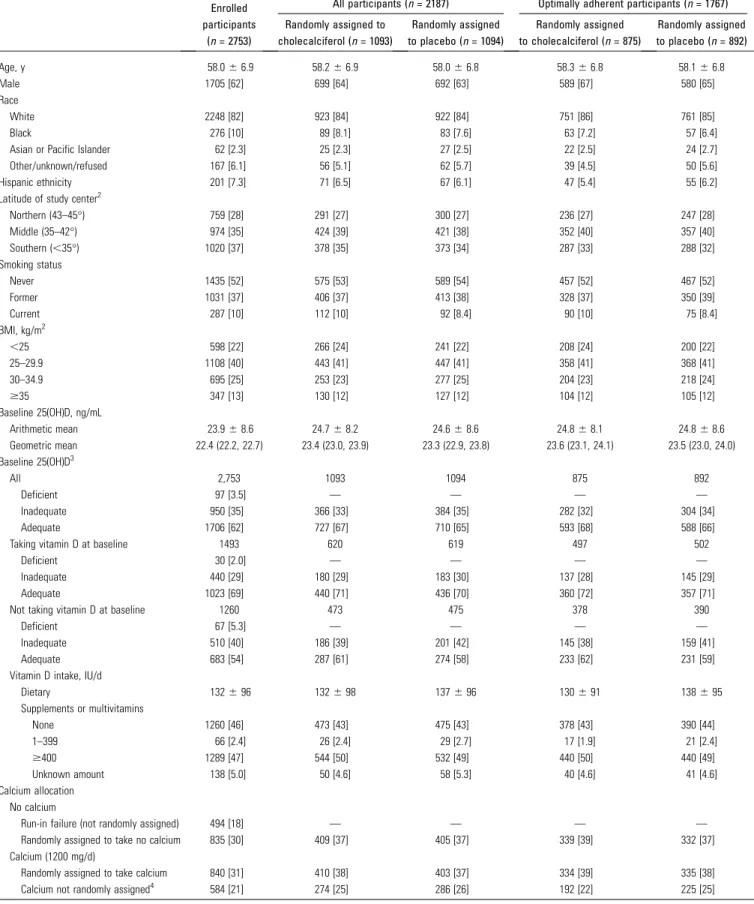
in the response analysis (
Figure 1
). The mean baseline serum
25(OH)D concentration for all 2753 enrollees was (mean
6
SD)
23.9
6
8.6 ng/mL. At enrollment, 54% of participants had been
taking vitamin D supplements and 56% had been taking calcium
supplements; they were asked (and agreed) to stop doing so.
Subsequently, 107 of 2186 (4.9%) reported taking any personal
vitamin D supplements up to 1000 IU/d between random
assignment and year 1. Adequate serum 25(OH)D concentrations
(i.e.,
$
20 ng/mL) (7) were seen at baseline in 69% of those taking
supplements before enrollment and 54% of those not taking
sup-plements (
Table 1
). Mean concentrations ranged from 24.8 ng/mL in
whites to 18.1 ng/mL in blacks, with the highest concentrations
during the summer and fall, and a downward trend with increasing
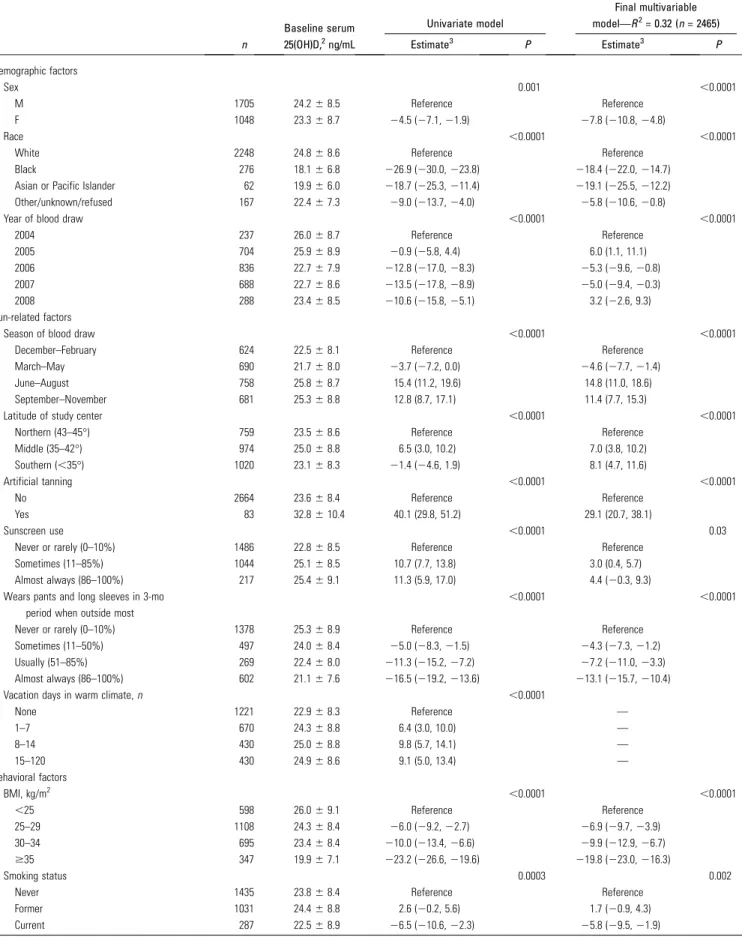
BMI (
Table 2
).
At baseline, the final multivariable model incorporated 17
factors that were significantly associated with serum 25(OH)D
concentration, including demographic, sun-related,
health-related, behavioral, and nutritional factors; those factors
explained 32% of the variability in baseline serum 25(OH)D in
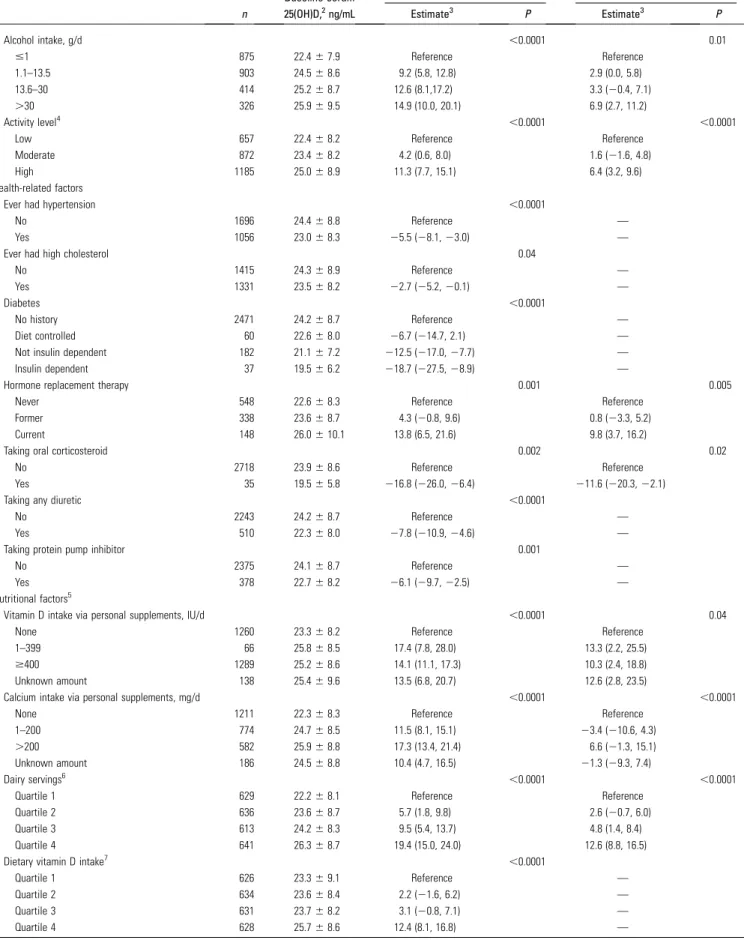
2753 individuals (Table 2). Several medications were
associ-ated with baseline serum 25(OH)D concentrations in univariate
analyses; in multivariable models, current or former users of
hormone replacement therapy had higher serum 25(OH)D
concentrations (
P
= 0.005), and oral corticosteroid users had
lower concentrations (
P
= 0.02). When we tested all medications
(even if not significant in univariate analyses) by adding each to
the final adjusted model, calcium channel blockers also were
statistically significantly associated with higher baseline serum
25(OH)D concentrations (
P
= 0.02) (
Supplemental Table 2
).
Of 2753 participants included in the baseline analysis, 566
were excluded from the response analysis: 494 failed run-in
[including 97 whose baseline serum 25(OH)D measurement was
<12 ng/mL], and a further 72 randomly assigned participants did
not have a 1-y blood draw (Figure 1). Optimal adherence was
achieved by 1767 (81%). Of the 420 with suboptimal
adher-ence, 228 (10% of the total) reported taking <80% of the pills,
on average; 223 (10%) reported periods of
$
1 wk without
taking pills; 73 (3%) had taken personal vitamin D supplements
<400 IU/d; 30 (1%) had taken between 400 and 1000 IU/d; 4
had taken large doses (up to 50,000 IU/wk for a limited period);
and 1 failed to report pill intake during the year 1.
After 1 y of supplementation, the unadjusted mean serum
25(OH)D concentration for those randomly assigned to 1000 IU
cholecalciferol/d increased by 6.3 ng/mL, from 24.6 to 30.9 ng/mL.
For those randomly assigned to calcium only or placebo, the
mean serum 25(OH)D concentration fell by 1.1 ng/mL, from
24.5 to 23.4 ng/mL (data not shown), yielding a relative increase
of 7.4 ng/mL, just over 1 SD of baseline concentrations,
attribut-able to cholecalciferol supplementation.
contribute significantly to the model, nor did it materially alter
the coefficients for sex in the model.
A model developed for the subsample of optimally adherent
participants was similar to the overall model (
Supplemental Table
3
), except that race was included in the model, whereas physical
activity did not contribute significantly; use of personal vitamin D
supplements could not be included because of the optimal adherence
restriction. Significant univariate SNP analyses in baseline and
response models restricted to non-Hispanic whites are shown in
Supplemental Tables 4
and
5
. The serum 25(OH)D concentration
was significantly associated with rs10741657 in cytochrome P450
family 2 subfamily R member 1 (
CYP2R1
;
P
= 0.0003), and rs4588
in the vitamin D binding protein (
GC
;
P
< 0.0001). However,
inclusion of these variables in the final multivariable model barely
changed the
R
2from 0.28 to 0.29 and had a substantial impact only
on the coefficients for smoking status (Supplemental Table 4).
When we examined serum response to vitamin D
supple-mentation (Supplemental Table 5), only the rs10766197
poly-morphism of
CYP2R1
contributed significantly (
P
= 0.001), but,
again, this did not affect the
R
2value of 0.48 (Supplemental
Table 5) or the coefficients of the other variables. When we
restricted to optimally adherent participants, 3 polymorphisms
contributed significantly to the final model: rs10766197 in
CYP2R1
(
P
= 0.01), rs1801725 in the calcium-sensing receptor
(
CASR
;
P
= 0.02), and rs4516035 in the vitamin D receptor
(
VDR
;
P
= 0.04) (
Supplemental Table 6
). Inclusion of these
variables in the model marginally increased
R
2from 0.49 to 0.51
(Supplemental Table 6).
In crude analyses of individuals who had not been taking
vitamin D supplements before the study or during year 1, we also
assessed changes in proportions of individuals in the categories
of inadequate (12 to <20 ng/mL) and adequate (
$
20 ng/mL)
serum 25(OH)D concentrations (7) (
Figure 2
). After 1 y, adequate
concentrations were seen in 89% of participants who had
received 1000 IU cholecalciferol/d and in 54% of controls. In
stratified analyses, 83% of those who began with inadequate
concentrations reached adequacy after 1 y of supplementation
compared with 30% of controls. Among those who began the
study with adequate concentrations, 94% of those randomly
assigned to vitamin D were still adequate at 1 y compared with
72% of controls. These figures were similar in participants with
optimal adherence (data not shown).
Discussion
We modeled the determinants of serum 25(OH)D response to
supplementation with 1000 IU cholecalciferol/d after 1 y of
treatment in a large randomized trial in 2187 men and women
aged 45–75 y, from 11 geographically diverse regions of the
United States. At baseline, 17 factors were independently
associated with baseline serum 25(OH)D concentrations, but
we found that 50% of the variability in an individual
Õ
s response
to supplementation could be explained by baseline serum
25(OH)D concentration and just a few other factors. A greater
proportional serum response was seen with a lower baseline
serum 25(OH)D concentration, being female, optimal adherence,
TABLE 1 Baseline characteristics of participants1
Enrolled
participants (n= 2753)
Random assignment of participants (n= 2187)
All participants (n= 2187) Optimally adherent participants (n= 1767)
Randomly assigned to cholecalciferol (n= 1093)
Randomly assigned to placebo (n= 1094)
Randomly assigned to cholecalciferol (n= 875)
Randomly assigned to placebo (n= 892)
Age, y 58.066.9 58.266.9 58.066.8 58.366.8 58.166.8
Male 1705 [62] 699 [64] 692 [63] 589 [67] 580 [65]
Race
White 2248 [82] 923 [84] 922 [84] 751 [86] 761 [85]
Black 276 [10] 89 [8.1] 83 [7.6] 63 [7.2] 57 [6.4]
Asian or Pacific Islander 62 [2.3] 25 [2.3] 27 [2.5] 22 [2.5] 24 [2.7]
Other/unknown/refused 167 [6.1] 56 [5.1] 62 [5.7] 39 [4.5] 50 [5.6] Hispanic ethnicity 201 [7.3] 71 [6.5] 67 [6.1] 47 [5.4] 55 [6.2]
Latitude of study center2
Northern (43–45°) 759 [28] 291 [27] 300 [27] 236 [27] 247 [28]
Middle (35–42°) 974 [35] 424 [39] 421 [38] 352 [40] 357 [40] Southern (,35°) 1020 [37] 378 [35] 373 [34] 287 [33] 288 [32]
Smoking status
Never 1435 [52] 575 [53] 589 [54] 457 [52] 467 [52]
Former 1031 [37] 406 [37] 413 [38] 328 [37] 350 [39]
Current 287 [10] 112 [10] 92 [8.4] 90 [10] 75 [8.4]
BMI, kg/m2
,25 598 [22] 266 [24] 241 [22] 208 [24] 200 [22]
25–29.9 1108 [40] 443 [41] 447 [41] 358 [41] 368 [41]
30–34.9 695 [25] 253 [23] 277 [25] 204 [23] 218 [24]
$35 347 [13] 130 [12] 127 [12] 104 [12] 105 [12]
Baseline 25(OH)D, ng/mL
Arithmetic mean 23.968.6 24.768.2 24.668.6 24.868.1 24.868.6 Geometric mean 22.4 (22.2, 22.7) 23.4 (23.0, 23.9) 23.3 (22.9, 23.8) 23.6 (23.1, 24.1) 23.5 (23.0, 24.0)
Baseline 25(OH)D3
All 2,753 1093 1094 875 892
Deficient 97 [3.5] — — — —
Inadequate 950 [35] 366 [33] 384 [35] 282 [32] 304 [34]
Adequate 1706 [62] 727 [67] 710 [65] 593 [68] 588 [66]
Taking vitamin D at baseline 1493 620 619 497 502
Deficient 30 [2.0] — — — —
Inadequate 440 [29] 180 [29] 183 [30] 137 [28] 145 [29]
Adequate 1023 [69] 440 [71] 436 [70] 360 [72] 357 [71]
Not taking vitamin D at baseline 1260 473 475 378 390
Deficient 67 [5.3] — — — —
Inadequate 510 [40] 186 [39] 201 [42] 145 [38] 159 [41]
Adequate 683 [54] 287 [61] 274 [58] 233 [62] 231 [59]
Vitamin D intake, IU/d
Dietary 132696 132698 137696 130691 138695
Supplements or multivitamins
None 1260 [46] 473 [43] 475 [43] 378 [43] 390 [44]
1–399 66 [2.4] 26 [2.4] 29 [2.7] 17 [1.9] 21 [2.4]
$400 1289 [47] 544 [50] 532 [49] 440 [50] 440 [49]
Unknown amount 138 [5.0] 50 [4.6] 58 [5.3] 40 [4.6] 41 [4.6]
Calcium allocation No calcium
Run-in failure (not randomly assigned) 494 [18] — — — —
Randomly assigned to take no calcium 835 [30] 409 [37] 405 [37] 339 [39] 332 [37] Calcium (1200 mg/d)
Randomly assigned to take calcium 840 [31] 410 [38] 403 [37] 334 [39] 335 [38] Calcium not randomly assigned4 584 [21] 274 [25] 286 [26] 192 [22] 225 [25]
1Values are means6SDs, means (95% CIs), or
n[%], unless otherwise indicated. When numbers do not sum to column totals, this is due to missing data. 25(OH)D, 25-hydroxyvitamin D.
2Because California is long and the study center was based in Los Angeles, we used the latitude for Los Angeles (34.1°) (41). Northern centers (43–45°) included New Hampshire and
Minnesota; middle centers (35–42°) included Ohio, Colorado, Iowa, and North Carolina; and Southern centers (18–34°) included Puerto Rico, Texas, Georgia, South Carolina, and California.
TABLE 2 Factors associated with serum 25(OH)D at baseline in older adults who were not vitamin D–deficient who received daily supplements containing cholecalciferol, calcium, both, or placebo1
n
Baseline serum 25(OH)D,2ng/mL
Univariate model
Final multivariable model—R2= 0.32 (n= 2465)
Estimate3 P Estimate3 P
Demographic factors
Sex 0.001 ,0.0001
M 1705 24.268.5 Reference Reference
F 1048 23.368.7 24.5 (27.1,21.9) 27.8 (210.8,24.8)
Race ,0.0001 ,0.0001
White 2248 24.868.6 Reference Reference
Black 276 18.166.8 226.9 (230.0,223.8) 218.4 (222.0,214.7) Asian or Pacific Islander 62 19.966.0 218.7 (225.3,211.4) 219.1 (225.5,212.2)
Other/unknown/refused 167 22.467.3 29.0 (213.7,24.0) 25.8 (210.6,20.8)
Year of blood draw ,0.0001 ,0.0001
2004 237 26.068.7 Reference Reference
2005 704 25.968.9 20.9 (25.8, 4.4) 6.0 (1.1, 11.1) 2006 836 22.767.9 212.8 (217.0,28.3) 25.3 (29.6,20.8)
2007 688 22.768.6 213.5 (217.8,28.9) 25.0 (29.4,20.3) 2008 288 23.468.5 210.6 (215.8,25.1) 3.2 (22.6, 9.3)
Sun-related factors
Season of blood draw ,0.0001 ,0.0001
December–February 624 22.568.1 Reference Reference March–May 690 21.768.0 23.7 (27.2, 0.0) 24.6 (27.7,21.4)
June–August 758 25.868.7 15.4 (11.2, 19.6) 14.8 (11.0, 18.6) September–November 681 25.368.8 12.8 (8.7, 17.1) 11.4 (7.7, 15.3)
Latitude of study center ,0.0001 ,0.0001
Northern (43–45°) 759 23.568.6 Reference Reference Middle (35–42°) 974 25.068.8 6.5 (3.0, 10.2) 7.0 (3.8, 10.2)
Southern (,35°) 1020 23.168.3 21.4 (24.6, 1.9) 8.1 (4.7, 11.6)
Artificial tanning ,0.0001 ,0.0001
No 2664 23.668.4 Reference Reference
Yes 83 32.8610.4 40.1 (29.8, 51.2) 29.1 (20.7, 38.1)
Sunscreen use ,0.0001 0.03
Never or rarely (0–10%) 1486 22.868.5 Reference Reference Sometimes (11–85%) 1044 25.168.5 10.7 (7.7, 13.8) 3.0 (0.4, 5.7)
Almost always (86–100%) 217 25.469.1 11.3 (5.9, 17.0) 4.4 (20.3, 9.3) Wears pants and long sleeves in 3-mo
period when outside most
,0.0001 ,0.0001
Never or rarely (0–10%) 1378 25.368.9 Reference Reference
Sometimes (11–50%) 497 24.068.4 25.0 (28.3,21.5) 24.3 (27.3,21.2) Usually (51–85%) 269 22.468.0 211.3 (215.2,27.2) 27.2 (211.0,23.3) Almost always (86–100%) 602 21.167.6 216.5 (219.2,213.6) 213.1 (215.7,210.4)
Vacation days in warm climate,n ,0.0001
None 1221 22.968.3 Reference —
1–7 670 24.368.8 6.4 (3.0, 10.0) —
8–14 430 25.068.8 9.8 (5.7, 14.1) —
15–120 430 24.968.6 9.1 (5.0, 13.4) —
Behavioral factors
BMI, kg/m2 ,0.0001 ,0.0001
,25 598 26.069.1 Reference Reference
25–29 1108 24.368.4 26.0 (29.2,22.7) 26.9 (29.7,23.9)
30–34 695 23.468.4 210.0 (213.4,26.6) 29.9 (212.9,26.7)
$35 347 19.967.1 223.2 (226.6,219.6) 219.8 (223.0,216.3)
Smoking status 0.0003 0.002
Never 1435 23.868.4 Reference Reference
Former 1031 24.468.8 2.6 (20.2, 5.6) 1.7 (20.9, 4.3)
Current 287 22.568.9 26.5 (210.6,22.3) 25.8 (29.5,21.9)
TABLE 2 Continued
n
Baseline serum 25(OH)D,2ng/mL
Univariate model
Final multivariable model—R2= 0.32 (n= 2465)
Estimate3 P Estimate3 P
Alcohol intake, g/d ,0.0001 0.01
#1 875 22.467.9 Reference Reference
1.1–13.5 903 24.568.6 9.2 (5.8, 12.8) 2.9 (0.0, 5.8)
13.6–30 414 25.268.7 12.6 (8.1,17.2) 3.3 (20.4, 7.1)
.30 326 25.969.5 14.9 (10.0, 20.1) 6.9 (2.7, 11.2)
Activity level4 ,0.0001 ,0.0001
Low 657 22.468.2 Reference Reference
Moderate 872 23.468.2 4.2 (0.6, 8.0) 1.6 (21.6, 4.8) High 1185 25.068.9 11.3 (7.7, 15.1) 6.4 (3.2, 9.6) Health-related factors
Ever had hypertension ,0.0001
No 1696 24.468.8 Reference —
Yes 1056 23.068.3 25.5 (28.1,23.0) —
Ever had high cholesterol 0.04
No 1415 24.368.9 Reference —
Yes 1331 23.568.2 22.7 (25.2,20.1) —
Diabetes ,0.0001
No history 2471 24.268.7 Reference —
Diet controlled 60 22.668.0 26.7 (214.7, 2.1) —
Not insulin dependent 182 21.167.2 212.5 (217.0,27.7) — Insulin dependent 37 19.566.2 218.7 (227.5,28.9) —
Hormone replacement therapy 0.001 0.005
Never 548 22.668.3 Reference Reference
Former 338 23.668.7 4.3 (20.8, 9.6) 0.8 (23.3, 5.2) Current 148 26.0610.1 13.8 (6.5, 21.6) 9.8 (3.7, 16.2)
Taking oral corticosteroid 0.002 0.02
No 2718 23.968.6 Reference Reference
Yes 35 19.565.8 216.8 (226.0,26.4) 211.6 (220.3,22.1)
Taking any diuretic ,0.0001
No 2243 24.268.7 Reference —
Yes 510 22.368.0 27.8 (210.9,24.6) —
Taking protein pump inhibitor 0.001
No 2375 24.168.7 Reference —
Yes 378 22.768.2 26.1 (29.7,22.5) —
Nutritional factors5
Vitamin D intake via personal supplements, IU/d ,0.0001 0.04
None 1260 23.368.2 Reference Reference
1–399 66 25.868.5 17.4 (7.8, 28.0) 13.3 (2.2, 25.5)
$400 1289 25.268.6 14.1 (11.1, 17.3) 10.3 (2.4, 18.8) Unknown amount 138 25.469.6 13.5 (6.8, 20.7) 12.6 (2.8, 23.5)
Calcium intake via personal supplements, mg/d ,0.0001 ,0.0001
None 1211 22.368.3 Reference Reference
1–200 774 24.768.5 11.5 (8.1, 15.1) 23.4 (210.6, 4.3)
.200 582 25.968.8 17.3 (13.4, 21.4) 6.6 (21.3, 15.1) Unknown amount 186 24.568.8 10.4 (4.7, 16.5) 21.3 (29.3, 7.4)
Dairy servings6 ,0.0001 ,0.0001
Quartile 1 629 22.268.1 Reference Reference
Quartile 2 636 23.668.7 5.7 (1.8, 9.8) 2.6 (20.7, 6.0)
Quartile 3 613 24.268.3 9.5 (5.4, 13.7) 4.8 (1.4, 8.4) Quartile 4 641 26.368.7 19.4 (15.0, 24.0) 12.6 (8.8, 16.5)
Dietary vitamin D intake7 ,0.0001
Quartile 1 626 23.369.1 Reference —
Quartile 2 634 23.668.4 2.2 (21.6, 6.2) —
Quartile 3 631 23.768.2 3.1 (20.8, 7.1) —
Quartile 4 628 25.768.6 12.4 (8.1, 16.8) —
season of baseline and year 1 blood draws, wearing pants and
sleeves when out in the sun, physical activity, and personal
vitamin D supplement intake beyond that prescribed. The
rs10766197 polymorphism of
CYP2R1
was significantly
asso-ciated with serum response in non-Hispanic whites, but it did
not improve the explanatory value (
R
2) of the multivariable
model. Although our model confirmed the findings of others that
response to supplementation varies with season of blood
collection and baseline serum 25(OH)D concentration (27, 42),
other aspects of the analysis were unexpected. For example, we
found a significantly greater proportional serum 25(OH)D
concentration increase from supplementation in women than
in men, a finding that, to our knowledge, has not been reported
in other trials (5, 21, 27, 43, 44). We may have seen this result
because our sample size was very large and we could adjust for
many potential confounders. Our results also contrast with
studies that reported a significant association between response
to supplementation and BMI (27), including a systematic review
suggesting that the dose per kilogram of body weight explains
34.5% of the serum response (28). Although BMI affected
baseline serum 25(OH)D concentrations, it did not
indepen-dently affect the serum response to supplementation in our
study. Other studies provide mixed or limited evidence that
response to supplementation is associated with calcium intake,
estrogen use, and dietary fat (27), but our results supported none
of these associations. The inconsistencies seen across studies
may reflect small sample sizes, as well as differences in the
covariates collected and how they were measured. Age and race
were not associated with response to supplementation in our
study or in several others (21, 27, 45–51). Several variables
(being female, greater physical activity, wearing long pants and
sleeves while outdoors, and personal vitamin D supplement use)
contributed significantly to both baseline and response models;
this suggests either that these factors are independent
deter-minants of both baseline serum 25(OH)D concentration and
response to supplementation, or that they have residual effects in
the response model because they are imperfectly represented by
baseline serum 25(OH)D concentration, e.g., because of
mea-surement error. Similarly, some other predictors in the response
model are correlated—e.g., seasons of baseline and year 1 blood
draws and baseline serum 25(OH)D concentration and physical
activity—yet they contributed independently to the final model.
It is possible that some of the variability between studies in the
predictors of response to supplementation may be due to the
intercorrelation of such variables and the impact of collinearity
in model building.
Overall, our model for baseline concentrations contained 17
factors that explained 32% of the variability in baseline serum
25(OH)D. We confirmed the observations of others that baseline
concentrations reflect a variety of personal characteristics;
nutritional, behavioral and lifestyle factors; and measures of sun
exposure (5, 7–26, 42). Our finding of an association between
glucocorticoid use and lower serum 25(OH)D concentrations
adds to mixed evidence from previous studies. Furthermore, it is
unclear whether there is a biological basis for the association, or
if confounding by comorbid illness accounts for it; the latter
possibility is supported by a small meta-analysis that showed
significantly lower serum 25(OH)D in patients treated with
glucocorticoids than in healthy controls, but not in diseased
controls (52, 53). Our finding that hormone replacement
ther-apy was associated with significantly higher serum 25(OH)D
baseline concentrations is supported by Cheng et al. (54) in
univariate but not multivariable models. Alcohol intake was
independently associated with higher baseline serum 25(OH)D
TABLE 2 Continuedn
Baseline serum 25(OH)D,2ng/mL
Univariate model
Final multivariable model—R2= 0.32 (n= 2465)
Estimate3 P Estimate3 P
Dietary calcium intake8 ,0.0001
Quartile 1 632 22.668.4 Reference —
Quartile 2 622 23.968.7 5.7 (1.8, 9.9) —
Quartile 3 635 23.968.2 6.2 (2.2, 10.3) —
Quartile 4 630 25.968.7 15.5 (11.2, 20.0) —
Dietary magnesium intake9 0.01
Quartile 1 630 23.368.7 Reference —
Quartile 2 630 24.368.5 4.8 (0.8, 8.9) —
Quartile 3 631 23.968.2 3.5 (20.4, 7.5) —
Quartile 4 628 24.969.0 7.1 (3.1, 11.3) —
Multivitamin use ,0.0001
No 1265 22.568.4 Reference —
Yes 1478 25.168.6 12.7 (9.8, 15.7) —
1All variables shown had a univariate association with 25(OH)D after all variables in Supplemental Table 1 were tested. When numbers do not sum to 2573, this is due to missing
data. MET, metabolic task equivalent; 25(OH)D, 25-hydroxyvitamin D.
2Values are means6SDs.
3Percentage change (95% CI) in serum 25(OH)D concentration from baseline to year 1 relative to controls, adjusted for study center, colonoscopy surveillance follow-up interval
(3 or 5 y), sex, and randomization protocol (2- or 4-group).
4High activity:$3 d/wk of vigorous activity achieving$1500 MET-min/wk, or 7 d of any combination of activities, achieving$3000 MET-min/wk. Moderate activity:$3 d/wk of
vigorous activity of$20 min/d, or$5 d/wk of moderate activity and/or walking of$30 min/d, or$5 d/wk of any activity achieving$600 MET-min/wk. Low: less than moderate activity level.
5Sex-specific quartiles were used in nutrition analyses.
6Cutoffs for quartiles—men: 0.6, 1.0, and 1.7; women: 0.5, 1.0, and 1.5.
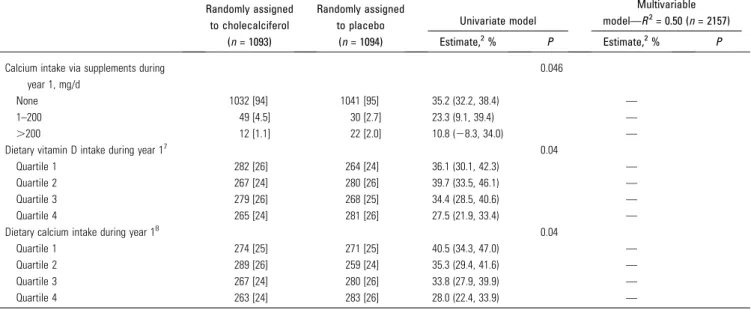
TABLE 3 Factors associated with serum 25(OH)D response to supplementation with 1000 IU cholecalciferol/d in older adults who were not vitamin D–deficient1
Randomly assigned to cholecalciferol
(n= 1093)
Randomly assigned to placebo
(n= 1094)
Univariate model
Multivariable
model—R2= 0.50 (n= 2157)
Estimate,2% P Estimate,2% P
Baseline serum 25(OH)D,3ng/mL ,0.0001 ,0.0001
25th percentile (18.2) 41.0 (37.1, 45.1) 32.6 (23.2, 42.7)
50th percentile (23.2) 34.4 (31.4, 37.4) 27.4 (18.5, 36.9) 75th percentile (30.0) 27.8 (24.3, 31.5) 22.2 (13.5, 31.7)
Optimal adherence4 ,0.0001 0.0002
No 218 [20] 201 [18] 21.4 (15.3, 27.8) 20.0 (11.6, 29.1)
Yes 875 [80] 892 [82] 37.7 (34.3, 41.1) 35.0 (24.3, 46.8) Demographic factors
Sex ,0.0001 ,0.0001
M 699 [64] 692 [63] 29.5 (25.9, 33.2) 20.5 (11.8, 29.9) F 394 [36] 402 [37] 42.8 (37.6, 48.3) 34.5 (24.7, 45.1)
Race 0.002
White 923 [84] 922 [84] 32.2 (29.0, 35.4) —
Black 89 [8.1] 83 [7.6] 52.5 (40.7, 65.1) —
Asian or Pacific Islander 25 [2.3] 27 [2.5] 53.9 (33.1, 78.0) —
Other/unknown/refused 56 [5.1] 62 [5.7] 34.1 (21.7, 47.7) — Sun-related factors
Season of baseline blood draw ,0.0001 0.002
December–February 249 [23] 247 [23] 48.6 (41.9, 55.6) 30.8 (19.8, 42.7) March–May 257 [24] 281 [26] 24.4 (19.0, 30.0) 15.8 (6.4, 26.0)
June–August 308 [28] 288 [26] 28.2 (22.9, 33.7) 30.6 (19.7, 42.4) September–November 279 [26] 278 [25] 39.8 (33.8, 46.0) 32.9 (21.9, 44.9)
Season of year 1 blood draw ,0.0001 0.001
December–February 272 [25] 265 [24] 42.1 (36.0, 48.4) 31.1 (20.3, 42.8)
March–May 269 [25] 267 [24] 47.6 (41.3, 54.2) 38.4 (27.0, 50.9) June–August 276 [25] 274 [25] 24.8 (19.5, 30.4) 23.6 (13.4, 34.8) September–November 276 [25] 288 [26] 24.8 (19.6, 30.3) 17.1 (7.4, 27.7)
Wears pants and long sleeves in 3-mo period when outside most
,0.0001 0.0002
Never or rarely (0–10%) 560 [51] 565 [52] 28.4 (24.4, 32.5) 19.7 (11.3, 28.8) Sometimes (11–50%) 175 [16] 205 [19] 33.0 (26.0, 40.4) 22.0 (12.0, 32.9)
Usually (51–85%) 111 [10] 96 [8.8] 46.0 (35.6, 57.0) 35.4 (22.9, 49.2) Almost always (86–100%) 245 [22] 227 [21] 45.6 (38.7, 52.8) 32.8 (22.5, 43.9) Behavioral factors
Alcohol intake, g/d 0.04
#1 319 [32] 342 [33] 41.1 (35.5, 47.0) —
1.1–13.5 371 [37] 394 [38] 30.9 (26.0, 35.9) —
13.6–30 179 [18] 155 [15] 32.6 (25.2, 40.4) —
.30 136 [14] 134 [13] 31.1 (23.0, 39.7) —
Activity level5 0.0001 0.01
Low 267 [25] 247 [23] 40.2 (33.9, 46.9) 27.6 (17.5, 38.4) Moderate 344 [32] 350 [32] 41.4 (35.9, 47.2) 31.9 (22.1, 42.6) High 467 [43] 485 [45] 27.1 (22.9, 31.5) 22.6 (13.7, 32.2)
Health-related factors
Taking proton-pump inhibitor 0.02
No 942 [86] 922 [84] 32.7 (29.5, 36.0) —
Yes 151 [14] 171 [16] 43.3 (35.1, 52.0) —
Nutritional factors6
Vitamin D intake via personal supplements
during year 1, IU/d
0.0003 0.03
None 1037 [95] 1042 [95] 35.2 (32.2, 38.4) 36.6 (32.1, 41.4) 1–399 39 [3.6] 34 [3.1] 29.1 (14.1, 46.1) 40.1 (24.2, 58.1)
$400 17 [1.6] 17 [1.6] 26.4 (221.8, 12.1) 7.8 (29.4, 28.2)
concentrations in our study, whereas the evidence from
other studies is mixed (15, 55–59). Surprisingly, we found
that sunscreen use was associated with slightly higher serum
25(OH)D concentrations; this may be because individuals who
regularly use sunscreen have greater sun exposure, but may use
sunscreen ineffectively (7, 60). In contrast, individuals who
regularly wore long pants and long sleeves outdoors had lower
concentrations of serum 25(OH)D, a finding that may relate to
more effective sun protection, or may reflect confounding by
other factors.
Incorporation of selected genetic variants in the full baseline
and response models extended our previous work in
mini-mally adjusted models (31). Although the association between
rs10766197 and serum response is consistent with our previous
TABLE 3 ContinuedRandomly assigned
to cholecalciferol (n= 1093)
Randomly assigned
to placebo (n= 1094)
Univariate model
Multivariable model—R2= 0.50 (n= 2157)
Estimate,2% P Estimate,2% P
Calcium intake via supplements during
year 1, mg/d
0.046
None 1032 [94] 1041 [95] 35.2 (32.2, 38.4) —
1–200 49 [4.5] 30 [2.7] 23.3 (9.1, 39.4) —
.200 12 [1.1] 22 [2.0] 10.8 (28.3, 34.0) —
Dietary vitamin D intake during year 17 0.04
Quartile 1 282 [26] 264 [24] 36.1 (30.1, 42.3) —
Quartile 2 267 [24] 280 [26] 39.7 (33.5, 46.1) —
Quartile 3 279 [26] 268 [25] 34.4 (28.5, 40.6) —
Quartile 4 265 [24] 281 [26] 27.5 (21.9, 33.4) —
Dietary calcium intake during year 18 0.04
Quartile 1 274 [25] 271 [25] 40.5 (34.3, 47.0) —
Quartile 2 289 [26] 259 [24] 35.3 (29.4, 41.6) —
Quartile 3 267 [24] 280 [26] 33.8 (27.9, 39.9) —
Quartile 4 263 [24] 283 [26] 28.0 (22.4, 33.9) —
1Values are means (95% CIs) or
n[%]. All variables shown had a univariate association with 25(OH)D response after all variables in Supplemental Table 1 were tested. When numbers do not sum to column totals, this is due to missing data. 25(OH)D, 25-hydroxyvitamin D.
2Percentage change in serum 25(OH)D concentration from baseline to year 1 relative to controls, adjusted for study center, colonoscopy surveillance follow-up interval (3 or 5 y),
sex, and random assignment group (2- or 4-group).
3Percentiles of baseline serum 25(OH)D are derived from all participants with measured year 1 serum 25(OH)D. To assist with interpretation, the equivalent year 1 serum 25(OH)D
concentration for participants with a median baseline concentration (23.2 ng/mL) and an increase of 20% would be 27.8 ng/mL. Concentrations for other increases are as follows: 25%, 29.0 ng/mL; 30%, 30.2 ng/mL; 35%, 31.3 ng/mL; and 40%, 32.5 ng/mL.
4Self-reported intake of$80% of study pills, no personal vitamin D supplementation, and no gaps in pill intake of$7 d.
5High activity:$3 d/wk of vigorous activity achieving$1500 MET-min/wk, or 7 d of any combination of activities, achieving$3000 MET-min/wk. Moderate activity:$3 d/wk of
vigorous activity of$20 min/d, or$5 d/wk of moderate activity and/or walking of$30 min/d, or$5 d/wk of any activity achieving$600 MET-min/wk. Low: less than moderate activity level.
6Sex-specific quartiles are calculated for the whole study population.
7Cutoffs for quartiles—men: 26.6, 59.65, and 114.15 IU/d; women: 18.05, 42.6, and 101.8 IU/d. 8Cutoffs for quartiles—men: 251.63, 384.35, and 589.65 mg/d; women: 206.80, 317.50, and 497.90 mg/d.
FIGURE 2 Changes in serum
results (31), 2 polymorphisms (rs6013897 and rs7968585) that
contributed significantly to the minimally adjusted model did
not do so in the full model. Furthermore, the inclusion of genetic
information in the full model in non-Hispanic whites did not
substantially improve the
R
2value of the model (
R
2= 48%). The
finding that genetic factors may have only a small impact on
serum response is supported by some research (43), but not all
(42). However, even if the impact of the genetic variants appears
to be relatively small overall, there may be cumulative effects in
individuals with multiple risk alleles (61). In the baseline model,
our findings implicating rs10741657 in
CYP2R1
and rs4588
(a missense mutation) in
GC
are largely consistent with other
reports (30, 42, 43, 61, 62). In optimally adherent participants,
our findings implicating rs4516035 in
VDR
and rs1801725
(a missense mutation) in
CASR
appear to be novel and merit
further investigation. Recent evidence also suggests that DNA
methylation in
CYP2R1
and cytochrome P450 family 24
subfamily A member 1 (
CYP24A1
) may be associated with
poorer response to vitamin D supplementation (63); we could
not address this question in our study. Ideally, a more
compre-hensive examination of rare and common variations in the
genome will be necessary to further our understanding.
In a crude analysis of participants who had not been taking
vitamin D supplements before enrollment or during year 1 of the
study, adequate concentrations of serum 25(OH)D (
$
20 ng/mL)
(7) were found after 1 y in 89% of those randomly assigned to
1000 IU cholecalciferol daily, as well as in 54% of controls. The
NAM
Õ
s RDA [defined as the intake likely to ‘‘meet or exceed the
needs of about 97.5% of the population’’ (7)] is 600 and 800 IU/d
for those aged
#
70 and >70 y, respectively. Supplementation
with 1000 IU/d did not meet the NAM target in our
partici-pants, a finding that is consistent with the assertion that the
RDA may not achieve its target in the general population (64, 65).
However, this finding was not adjusted for potential
confound-ing (e.g., by season), and our population had special
charac-teristics that may affect generalizability, including a history of
colorectal adenoma (but not familial polyposis syndromes), the
exclusion of vitamin D–deficient participants (serum 25(OH)D
concentration <12 ng/mL), a lower prevalence of minorities (18%
compared with 28%), and a higher prevalence of overweight
participants (78% compared with 72%) than in the general
population (66, 67).
Our models account for 32% and 50% of the variability in
baseline serum 25(OH)D and the response to supplementation,
respectively. The unexplained variability may relate to
differ-ences in absorption, metabolism, and genetic factors, which we
could not address in this study. Predictions from our overall
model are consistent with those of others. For example, 1000 IU/d
is expected to increase a baseline serum 25(OH)D of 30 to 38 ng/mL
in Garland
Õ
s model (68) and to 39 ng/mL in ours, although in our
model, optimal adherence increases the postsupplementation
concentration to 42 ng/mL. This difference is not unexpected,
but illustrates the importance of adherence as a source of error
in dose–response estimation during long-term
supplementa-tion. Perhaps not surprisingly, there is considerable variation
within (5) and between (69) studies in the slope representing
the increase in serum 25(OH)D concentration after vitamin D
supplementation. Relative to other studies (69), we observed
only a modest mean increase in serum 25(OH)D concentration of
6.3 ng/mL after supplementation with 1000 IU cholecalciferol/d,
and a decrease of 1.1 ng/mL in controls. Several study-related
factors may have affected these changes:
1
) more than one-half of
participants were taking vitamin D supplements at baseline, and
they agreed to stop doing so;
2
) participants were counseled
to avoid excessive vitamin D and calcium intake during the study;
and
3
) three-quarters of our participants were overweight or
obese, and so would expect a smaller effect than that seen in other
studies (69).
Strengths of our study include the large sample size, inclusion
of racial and ethnic minorities of both sexes, availability of
detailed personal data, good adherence to pill intake, and
detailed information on lapses in pill intake and use of personal
vitamin D supplements (which occurred in <5% of participants).
We avoided bias that could have resulted from regression to the
mean by examining relative proportional increases in our
models, comparing those receiving supplements or placebo.
Limitations of the study include factors affecting
generalizabil-ity, such as our enrollment of individuals with colorectal polyps
and our counseling of participants to avoid excessive dietary
intake of calcium and vitamin D during the study.
In this large, multicenter chemoprevention trial, we found
that 50% of the variability in serum response to
supplementa-tion with 1000 IU cholecalciferol/d was explained by 8 factors:
baseline serum 25(OH)D concentration, sex, optimal adherence,
season, use of long pants and long sleeves for protection from the
sun, physical activity level, and personal vitamin D
supplemen-tation. In contrast to previous smaller studies, we identified a
significantly higher response to supplementation in women than
in men. Associations were identified with several genetic factors
that merit further investigation.
Acknowledgments
JRR, LAM, ELB, JAB, and JLP designed the research; JRR,
ELB, JAB, RMB, JCF, RSB, DJR, and JLP conducted the
re-search and/or collected the essential data; LAM analyzed the
data; JRR, LAM, ELB, JAB, RMB, JCF, DJR, and JLP wrote the
paper; and JRR had primary responsibility for the final content.
All authors read and approved the final manuscript.
References
1. Heaney RP. Vitamin D in health and disease. Clin J Am Soc Nephrol 2008;3:1535–41.
2. Chung M, Lee J, Terasawa T, Lau J, Trikalinos TA. Vitamin D with or without calcium supplementation for prevention of cancer and frac-tures: an updated meta-analysis for the U.S. Preventive Services Task Force. Ann Intern Med 2011;155:827–38.
3. Chung M, Balk EM, Brendel M, Ip S, Lau J, Lee J, Lichtenstein A, Patel K, Raman G, Tatsioni A, et al. Vitamin D and calcium: a systematic review of health outcomes. Evid Rep Technol Assess (Full Rep) 2009; (183):1–420.
4. Wang S. Epidemiology of vitamin D in health and disease. Nutrition research reviews 2009;22:188–203.
5. Aloia JF, Patel M, Dimaano R, Li-Ng M, Talwar SA, Mikhail M, Pollack S, Yeh JK. Vitamin D intake to attain a desired serum 25-hydroxyvitamin D concentration. Am J Clin Nutr 2008;87: 1952–8.
6. Bischoff-Ferrari HA, Giovannucci E, Willett WC, Dietrich T, Dawson-Hughes B. Estimation of optimal serum concentrations of 25-hydroxyvitamin D for multiple health outcomes. Am J Clin Nutr 2006;84:18–28. Corrected and republished from: Am J Clin Nutr 2007;86(3):809. 7. Institute of Medicine. Dietary reference intakes for calcium and vitamin
D. Washington (DC): The National Academies Press, 2010.
8. Looker AC, Pfeiffer CM, Lacher DA, Schleicher RL, Picciano MF, Yetley EA. Serum 25-hydroxyvitamin D status of the US population: 1988–1994 compared with 2000–2004. Am J Clin Nutr 2008;88: 1519–27.
10. Brock K, Huang WY, Fraser DR, Ke L, Tseng M, Stolzenberg-Solomon R, Peters U, Ahn J, Purdue M, Mason RS, et al. Low vitamin D status is associated with physical inactivity, obesity and low vitamin D intake in a large US sample of healthy middle-aged men and women. J Steroid Biochem Mol Biol 2010;121:462–6.
11. Brock KE, Graubard BI, Fraser DR, Weinstein SJ, Stolzenberg-Solomon RZ, Lim U, Tangrea JA, Virtamo J, Ke L, Snyder K, et al. Predictors of vitamin D biochemical status in a large sample of middle-aged male smokers in Finland. Eur J Clin Nutr 2010;64:280–8.
12. Looker AC, Johnson CL, Lacher DA, Pfeiffer CM, Schleicher RL, Sempos CT. Vitamin D status: United States, 2001–2006. NCHS Data Brief 2011;(59):1–8.
13. Yetley EA. Assessing the vitamin D status of the US population. Am J Clin Nutr 2008;88:558S–64S.
14. Chen W, Dawsey SM, Qiao YL, Mark SD, Dong ZW, Taylor PR, Zhao P, Abnet CC. Prospective study of serum 25(OH)-vitamin D concen-tration and risk of oesophageal and gastric cancers. Br J Cancer 2007;97:123–8.
15. Egan KM, Signorello LB, Munro HM, Hargreaves MK, Hollis BW, Blot WJ. Vitamin D insufficiency among African-Americans in the south-eastern United States: implications for cancer disparities (United States). Cancer Causes Control 2008;19:527–35.
16. Glass D, Lens M, Swaminathan R, Spector TD, Bataille V. Pigmentation and vitamin D metabolism in Caucasians: low vitamin D serum levels in fair skin types in the UK. PLoS One 2009;4:e6477.
17. Hunter D, De Lange M, Snieder H, MacGregor AJ, Swaminathan R, Thakker RV, Spector TD. Genetic contribution to bone metabolism, calcium excretion, and vitamin D and parathyroid hormone regulation. J Bone Miner Res 2001;16:371–8.
18. Park S, Johnson MA. Living in low-latitude regions in the United States does not prevent poor vitamin D status. Nutr Rev 2005;63:203–9. 19. Rockell JE, Green TJ, Skeaff CM, Whiting SJ, Taylor RW, Williams SM,
Parnell WR, Scragg R, Wilson N, Schaaf D, et al. Season and ethnicity are determinants of serum 25-hydroxyvitamin D concentrations in New Zealand children aged 5–14 y. J Nutr 2005;135:2602–8.
20. Jones G. Pharmacokinetics of vitamin D toxicity. Am J Clin Nutr 2008;88:582S–6S.
21. Blum M, Dallal GE, Dawson-Hughes B. Body size and serum 25 hydroxy vitamin D response to oral supplements in healthy older adults. J Am Coll Nutr 2008;27:274–9.
22. Arunabh S, Pollack S, Yeh J, Aloia JF. Body fat content and 25-hydroxyvitamin D levels in healthy women. J Clin Endocrinol Metab 2003;88:157–61.
23. Melamed ML, Michos ED, Post W, Astor B. 25-hydroxyvitamin D levels and the risk of mortality in the general population. Arch Intern Med 2008;168:1629–37.
24. Zhao G, Ford ES, Li C, Kris-Etherton PM, Etherton TD, Balluz LS. Independent associations of serum concentrations of 25-hydroxyvita-min D and parathyroid hormone with blood pressure among US adults. J Hypertens 2010;28:1821–8.
25. Bogh MK, Schmedes AV, Philipsen PA, Thieden E, Wulf HC. Interdepen-dence between body surface area and ultraviolet B dose in vitamin D production: a randomized controlled trial. Br J Dermatol 2011;164:163–9. 26. Nesby-OÕDell S, Scanlon KS, Cogswell ME, Gillespie C, Hollis BW, Looker AC, Allen C, Doughertly C, Gunter EW, Bowman BA. Hypovitaminosis D prevalence and determinants among African American and white women of reproductive age: third National Health and Nutrition Examination Survey, 1988–1994. Am J Clin Nutr 2002;76:187–92.
27. Mazahery H, von Hurst PR. Factors affecting 25-hydroxyvitamin D concentration in response to vitamin D supplementation. Nutrients 2015;7:5111–42.
28. Zittermann A, Ernst JB, Gummert JF, Borgermann J. Vitamin D supplementation, body weight and human serum 25-hydroxyvitamin D response: a systematic review. Eur J Nutr 2014;53:367–74.
29. Ahn J, Yu K, Stolzenberg-Solomon R, Simon KC, McCullough ML, Gallicchio L, Jacobs EJ, Ascherio A, Helzlsouer K, Jacobs KB, et al. Genome-wide association study of circulating vitamin D levels. Hum Mol Genet 2010;19:2739–45.
30. Wang TJ, Zhang F, Richards JB, Kestenbaum B, van Meurs JB, Berry D, Kiel DP, Streeten EA, Ohlsson C, Koller DL, et al. Common genetic determinants of vitamin D insufficiency: a genome-wide association study. Lancet 2010;376:180–8.
31. Barry EL, Rees JR, Peacock JL, Mott LA, Amos CI, Bostick RM, Figueiredo JC, Ahnen DJ, Bresalier RS, Burke CA, et al. Genetic variants in CYP2R1, CYP24A1, and VDR modify the efficacy of vitamin D3 supplementation for increasing serum 25-hydroxyvitamin D levels in a randomized controlled trial. J Clin Endocrinol Metab 2014;99:E2133–7.
32. Didriksen A, Grimnes G, Hutchinson MS, Kjaergaard M, Svartberg J, Joakimsen RM, Jorde R. The serum 25-hydroxyvitamin D response to vitamin D supplementation is related to genetic factors, BMI, and baseline levels. Eur J Endocrinol 2013;169:559–67.
33. Fu L, Yun F, Oczak M, Wong BY, Vieth R, Cole DE. Common genetic variants of the vitamin D binding protein (DBP) predict differences in response of serum 25-hydroxyvitamin D [25(OH)D] to vitamin D supplementation. Clin Biochem 2009;42:1174–7.
34. Baron JA, Barry EL, Mott LA, Rees JR, Sandler RS, Snover DC, Bostick RM, Ivanova A, Cole BF, Ahnen DJ, et al. A trial of calcium and vitamin D for the prevention of colorectal adenomas. N Engl J Med 2015;373:1519–30.
35. International Physical Activity Questionnaire [Internet]. [updated 2016; cited 2016 Aug 9]. Available from: http://www.ipaq.ki.se.
36. Bioserve Biotechnologies, Limited[Internet]. [updated 2015; cited 2016 Aug 9]. Available from: http://www.bioserve.com.
37. LGC Limited [Internet]. [updated 2015; cited 2016 Aug 9]. Available from: http://www.lgcgenomics.com.
38. Sequenom [Internet]. [updated 2016; cited 2016 Aug 9]. Available from: http://www.sequenom.com.
39. Thermofisher Scientific[Internet]. [updated 2016; cited 2016 Aug 9]. Available from: http://www.invitrogen.com
40. Cardon LR, Palmer LJ. Population stratification and spurious allelic association. Lancet 2003;361:598–604.
41. Maxmind. Average latitude and longitude for US states [Internet]. [updated 2016; cited 2016 Aug 9]. Available from: http://www. maxmind.com/app/state_latlon.
42. Sollid ST, Hutchinson MY, Fuskevag OM, Joakimsen RM, Jorde R. Large individual differences in serum 25-hydroxyvitamin D response to vitamin D supplementation: effects of genetic factors, body mass index, and baseline concentration. Results from a randomized controlled trial. Horm Metab Res 2016;48:27–34.
43. Waterhouse M, Tran B, Armstrong BK, Baxter C, Ebeling PR, English DR, Gebski V, Hill C, Kimlin MG, Lucas RM, et al. Environmental, personal, and genetic determinants of response to vitamin D supple-mentation in older adults. J Clin Endocrinol Metab 2014;99:E1332–40. 44. Ng K, Scott JB, Drake BF, Chan AT, Hollis BW, Chandler PD, Bennett GG, Giovannucci EL, Gonzalez-Suarez E, Meyerhardt JA, et al. Dose response to vitamin D supplementation in African Americans: results of a 4-arm, randomized, placebo-controlled trial. Am J Clin Nutr 2014;99:587–98.
45. Gallagher JC, Sai A, Templin, 2nd T, Smith L. Dose response to vitamin D supplementation in postmenopausal women: a randomized trial. Ann Intern Med 2012;156:425–37.
46. Zhao LJ, Zhou Y, Bu F, Travers-Gustafson D, Ye A, Xu X, Hamm L, Gorsage DM, Fang X, Deng HW, et al. Factors predicting vitamin D response variation in non-Hispanic white postmenopausal women. J Clin Endocrinol Metab 2012;97:2699–705.
47. Wagner D, Hanwell HE, Schnabl K, Yazdanpanah M, Kimball S, Fu L, Sidhom G, Rousseau D, Cole DE, Vieth R. The ratio of serum 24,25-dihydroxyvitamin D(3) to 25-hydroxyvitamin D(3) is predictive of 25-hydroxyvitamin D(3) response to vitamin D(3) supplementation. J Steroid Biochem Mol Biol 2011;126:72–7.
48. Forsythe LK, Livingstone MB, Barnes MS, Horigan G, McSorley EM, Bonham MP, Magee PJ, Hill TR, Lucey AJ, Cashman KD, et al. Effect of adiposity on vitamin D status and the 25-hydroxycholecalciferol response to supplementation in healthy young and older Irish adults. Br J Nutr 2012;107:126–34.
49. Zwart SR, Mehta SK, Ploutz-Snyder R, Bourbeau Y, Locke JP, Pierson DL, Smith SM. Response to vitamin D supplementation during Antarctic winter is related to BMI, and supplementation can mitigate Epstein-Barr Virus Reactivation. J Nutr 2011;141:692–7.
51. Talwar SA, Aloia JF, Pollack S, Yeh JK. Dose response to vitamin D supplementation among postmenopausal African American women. Am J Clin Nutr 2007;86:1657–62.
52. Skversky AL, Kumar J, Abramowitz MK, Kaskel FJ, Melamed ML. Association of glucocorticoid use and low 25-hydroxyvitamin D levels: results from the National Health and Nutrition Examination Survey (NHANES): 2001–2006. J Clin Endocrinol Metab 2011;96:3838–45. 53. Davidson ZE, Walker KZ, Truby H. Clinical review: Do
glucocorticos-teroids alter vitamin D status? A systematic review with meta-analyses of observational studies. J Clin Endocrinol Metab 2012;97:738–44. 54. Cheng TY, Millen AE, Wactawski-Wende J, Beresford SA, LaCroix AZ,
Zheng Y, Goodman GE, Thornquist MD, Neuhouser ML. Vitamin D intake determines vitamin d status of postmenopausal women, partic-ularly those with limited sun exposure. J Nutr 2014;144:681–9. 55. Janssen HC, Emmelot-Vonk MH, Verhaar HJ, van der Schouw YT.
Determinants of vitamin D status in healthy men and women aged 40– 80 years. Maturitas 2013;74:79–83.
56. Jacques PF, Felson DT, Tucker KL, Mahnken B, Wilson PW, Rosenberg IH, Rush D. Plasma 25-hydroxyvitamin D and its determinants in an elderly population sample. Am J Clin Nutr 1997;66:929–36. 57. McCullough ML, Weinstein SJ, Freedman DM, Helzlsouer K, Flanders
WD, Koenig K, Kolonel L, Laden F, Le Marchand L, Purdue M, et al. Correlates of circulating 25-hydroxyvitamin D: Cohort consortium vita-min D pooling project of rarer cancers. Am J Epidemiol 2010;172:21–35. 58. Shirazi L, Almquist M, Malm J, Wirfalt E, Manjer J. Determinants of serum levels of vitamin D: a study of life-style, menopausal status, dietary intake, serum calcium, and PTH. BMC Womens Health 2013;13:33. 59. Lee K. Sex-specific relationships between alcohol consumption and
vitamin D levels: the Korea National Health and Nutrition Examination Survey 2009. Nutr Res Pract 2012;6:86–90.
60. Diehl JW, Chiu MW. Effects of ambient sunlight and photoprotection on vitamin D status. Dermatol Ther 2010;23:48–60.
61. Nissen J, Vogel U, Ravn-Haren G, Andersen EW, Madsen KH, Nexo BA, Andersen R, Mejborn H, Bjerrum PJ, Rasmussen LB, et al. Common variants in CYP2R1 and GC genes are both determinants of serum 25-hydroxyvitamin D concentrations after UVB irradiation and after consumption of vitamin D(3)-fortified bread and milk during winter in Denmark. Am J Clin Nutr 2015;101:218–27.
62. Engelman CD, Meyers KJ, Iyengar SK, Liu Z, Karki CK, Igo RP, Jr., Truitt B, Robinson J, Sarto GE, Wallace R, et al. Vitamin D intake and season modify the effects of the GC and CYP2R1 genes on 25-hydroxyvitamin D concentrations. J Nutr 2013;143:17–26.
63. Zhou Y, Zhao LJ, Xu X, Ye A, Travers-Gustafson D, Zhou B, Wang HW, Zhang W, Lee Hamm L, Deng HW, et al. DNA methylation levels of CYP2R1 and CYP24A1 predict vitamin D response variation. J Steroid Biochem Mol Biol 2014;144 Pt A:207–14.
64. Veugelers PJ, Ekwaru JP. A statistical error in the estimation of the recommended dietary allowance for vitamin D. Nutrients 2014;6: 4472–5.
65. Heaney RP, Holick MF. Why the IOM recommendations for vitamin D are deficient. J Bone Miner Res 2011;26:455–7.
66. Humes KR, Jones NA, Ramirez RR. Overview of Race and Hispanic Origin: 2010. 2010 Census Briefs [Internet]. Washington (DC): US Census Bureau; 2011 [cited 2016 May 26]. Available from: http://www. census.gov/prod/cen2010/briefs/c2010br-02.pdf.
67. Ogden CL, Carroll MD, Curtin LR, McDowell MA, Tabak CJ, Flegal KM. Prevalence of overweight and obesity in the United States, 1999– 2004. JAMA 2006;295:1549–55.
68. Garland CF, French CB, Baggerly LL, Heaney RP. Vitamin D supple-ment doses and serum 25-hydroxyvitamin D in the range associated with cancer prevention. Anticancer Res 2011;31:607–11.