Journal Algebra Discrete Math.
cJournal “Algebra and Discrete Mathematics”
Multi-solid varieties and Mh-transducers
Slavcho Shtrakov
Communicated by B. V. Novikov
Abstract. We consider the concepts of colored terms and
multi-hypersubstitutions. If t ∈Wτ(X) is a term of typeτ, then
any mapping αt : P os
F
(t) → IN of the non-variable positions of a term into the set of natural numbers is called a coloration of t.
The set Wc
τ(X) of colored terms consists of all pairs ht, αti.
Hy-persubstitutions are maps which assign to each operation symbol a term with the same arity. IfM is a monoid of hypersubstitutions then any sequenceρ= (σ1, σ2, . . .)is a mappingρ:IN→M, called a multi-hypersubstitution overM. An identity t ≈s, satisfied in a varietyV is an M-multi-hyperidentity if its imagesρ[t ≈s]are also satisfied in V for all ρ ∈ M. A variety V is M-multi-solid, if all its identities areM−multi-hyperidentities. We prove a series of inclusions and equations concerningM-multi-solid varieties. Fi-nally we give an automata realization of multi-hypersubstitutions and colored terms.
Introduction
LetFbe a set ofoperation symbols, andτ :F →N be atypeorsignature. LetXbe a finite set of variables, then the setWτ(X)ofterms of type
τ with variables from X is the smallest set, such that
(i) X∪ F0 ⊆Wτ(X);
(ii) iff isn−ary operation symbol andt1, . . . , tnare terms, then
the “string" f(t1. . . tn)is a term.
An algebraA=hA;FAiof typeτ is a pair consisting of a setAand a setFA of operations defined onA. Iff ∈ F, thenfA denotes aτ(f)-ary
2000 Mathematics Subject Classification: 08B15, 03C05, 08A70.
Journal Algebra Discrete Math.
operation on the set A. An identity s ≈ t is satisfied in the algebra A
(writtenA |=s≈t), if sA=tA.Alg(τ) denotes the class of all algebras of typeτ andId(τ)- the set of all identities of typeτ.The pair(Id, M od)
is a Galois connection between the classes of algebras from Alg(τ) and subsets of Id(τ), where Id(R) := {t ≈ s |∀A ∈ R, (A |= t ≈ s)} and
M od(Σ) :={A|∀t≈s∈Σ, (A |=t≈s)}. The fixed points with respect to the closure operatorsIdM od andM odId form complete lattices
L(τ) :={R | R ⊆ Alg(τ) and M odIdR=R}and
E(τ) :={Σ|Σ⊆Id(τ) andIdM odΣ = Σ}
of all varieties of type τ and of all equational theories (logics) of type τ. These lattices are dually isomorphic.
A hypersubstitution of type τ (briefly a hypersubstitution) is a map-ping which assigns to each operation symbolf ∈ F a termσ(f)of typeτ, which has the same arity as the operation symbolf (see [5]). The set of all hypersubstitutions of typeτ is denoted byHyp(τ).Ifσis a hypersubstitu-tion, then it can be uniquely extended to a mappingσˆ:Wτ(X)→Wτ(X)
on the set of all terms of type τ, as follows
(i) if t=xj for somej ≥1, then ˆσ[t] =xj;
(ii) if t=f(t1, . . . , tn) , thenσˆ[t] =σ(f)(ˆσ[t1], . . . ,σˆ[tn]),
wheref is ann-ary operation symbol andt1,. . . , tnare terms.
The set Hyp(τ) is a monoid.
Let M be a submonoid of Hyp(τ). An algebra A is said to M -hypersatisfy an identity t≈sif for every hypersubstitution σ ∈M, the identity σˆ[t] ≈ σˆ[s] holds in A. A variety V is called M-solid if every identity of V is M-hypersatisfied in V.
The closure operator is defined on the set of identities of a given type
τ as follows: χM[u ≈ v] := {σˆ[u] ≈ σˆ[v] | σ ∈ M} and χM[Σ] =
S
u≈v∈Σ
χM[u≈v].
Given an algebra A = hA;FAi and a hypersubstitution σ, then σ[A] = hA; (σ(FA)i := hA; (σ(f)A)
f∈Fi is called the derived algebra. The closure operatorψM on the set of algebras of a given type τ, is
de-fined as follows: ψM[A] ={σ[A]|σ ∈M} and ψM[R] = S
A∈R
ψM[A].
It is well known [5] that if M is a monoid of hypersubstitutions of type τ, then the class of allM-solid varieties of typeτ forms a complete sublattice of the lattice L(τ) of all varieties of typeτ.
Our aim is to transfer these results to another kind of hypersubstitu-tion and to coloured terms.
Journal Algebra Discrete Math.
given term with another term of the same type. The positional composi-tion gives a composed term as a result of the replacement of subterms in given positions with other terms of the same type. The positional com-position of colored terms is an associative operation. In [4] the authors studied colored terms which are supplied with one coloration. This is a very “static" concept where each term has one fixed coloration. Here we consider composition of terms which produces an image of terms and coloration of this image. This “dynamical" point of view gives us an advantage when studying multi-hypersubstitutions, multi-solid varieties etc.
In Section 2 we use colored terms to investigate the monoid of multi-hypersubstitutions. It is proved that the lattice of multi-solid varieties is a sublattice of the lattice of solid varieties. A series of assertions are proved, which characterize multi-solid varieties and the corresponding closure op-erators. We study multi-solid varieties by deduction of a fully invariant congruence. The completeness theorem for multi-hyperequational theo-ries is proved.
A tree automata realization of multi-hypersubstitutions is given in Section 3.
1. Composition of colored terms
The concept of the composition of mappings is fundamental in almost all mathematical theories. Usually we consider composition as an oper-ation which inductively replaces some variables with other objects such as functions, terms, etc. Here, we consider a more general case when the replacement can be applied to objects which may be variables or sub-functions, subterms, etc. which are located at a given set of positions.
If t is a term, then the set var(t) consisting of these elements of X
which occur intis called the set ofinput variables (or variables)for t. If
t=f(t1, . . . , tn) is a non-variable term, then f isroot symbol (root) oft
and we will write f =root(t).For a term t ∈ Wτ(X) the set Sub(t) of
its subterms is defined as follows: if t∈X∪ F0, then Sub(t) = {t} and if t=f(t1, . . . , tn), thenSub(t) ={t} ∪Sub(t1)∪. . .∪Sub(tn).
The depth of a term t is defined inductively: if t ∈ X ∪ F0 then
Depth(t) = 0; and if t=f(t1, . . . , tn), then
Depth(t) =max{Depth(t1), . . . , Depth(tn)}+ 1.
Definition 1. Let r, s, t∈Wτ(X) be three terms of type τ. Byt(r←s)
Journal Algebra Discrete Math.
composition of the terms tand s, by r. I.e.(i) t(r ←s) =tif r /∈Sub(t); (ii) t(r←s) =s ift=r and
(iii) t(r←s) =f(t1(r ←s), . . . , tn(r←s)),
if t=f(t1, . . . , tn) and r∈Sub(t),r 6=t.
If ri ∈/ Sub(rj) wheni6=j, then t(r1 ← s1, . . . , rm ←sm) means the
inductive composition of t, r1, . . . , rm, s1, . . . , sm. In the particular case
when rj =xj for j= 1, . . . , m andvar(t) ={x1, . . . , xm} we will briefly write t(s1, . . . , sm)instead of t(x1←s1, . . . , xm←sm).
Let τ be a type and F be its set of operation symbols. Denote by
maxar= max{τ(f)|f ∈ F}andINF :={m∈IN|m≤maxar}. LetIN∗F be the set of all finite strings overINF. The setIN∗F is naturally ordered bypq ⇐⇒ p is a prefix ofq.The Greek letter ε, as usual denotes the empty word (string) over INF.
For any term t, the set of positions P os(t) ⊆ IN∗F of t is induc-tively defined as follows: P os(t) = {ε} if t ∈ X ∪ F0 and P os(t) :=
{ε}S1≤i≤n(iP os(ti)), if t = f(t1, . . . , tn), n ≥ 0, where iP os(ti) := {iq|q ∈P os(ti)},andiq is concatenation of the stringsiandq fromIN∗F.
For a given position p∈P os(t), the length ofp is denoted byl(p). Any term can be regarded as a tree with nodes labelled with the operation symbols and its leaves labelled as variables or nullary operation symbols.
Let t ∈ Wτ(X) be a term of type τ and let subt :P os(t) → Sub(t)
be the function which maps each position in a term t to the subterm of
t, whose root node occurs at that position.
Definition 2. Let t, r∈ Wτ(X) be two terms of type τ and p ∈ P os(t)
be a position in t. The positional composition of t and r on p is a term s:= t(p;r) obtained from t when replacing the term subt(p) by r on the
position p, only.
More generally, the positional composition of terms is naturally de-fined for the compositional pairst(p1, . . . , pm;t1, . . . , tm), also.
Remark 1. The positional composition has the following properties: 1. If hhp1, p2i,ht1, t2iiis a compositional pair oft, then
t(p1, p2;t1, t2) =t(p1;t1)(p2;t2) =t(p2;t2)(p1;t1);
2. If S=hp1, . . . , pmiand T =ht1, . . . , tmi with
Journal Algebra Discrete Math.
andπ is a permutation of the set{1, . . . , m}, then
t(p1, . . . , pm;t1, . . . , tm) =t(pπ(1), . . . , pπ(m);tπ(1), . . . , tπ(m)).
3.If t, s, r∈Wτ(X), p∈P os(t) and q ∈P os(s), then t(p;s(q;r)) =
t(p;s)(pq;r).
We will denote respectively“←” for inductive composition and“; ”
for positional composition.
The concept of colored terms is important when studying deductive closure of sets of identities and the lattice of varieties of a given type. Col-ored terms (trees) are useful tools in Computer Science, General Algebra, Theory of Formal Languages, Programming, Automata theory etc.
Let t be a term of type τ. Let us denote by SubF(t) the set of all subterms of t which are not variables, i.e. whose roots are labelled by an operation symbol from F and letP osF(t) :={p∈P os(t) |sub
t(p)∈
SubF(t)}. Any function α
t :P osF(t) → IN is called a colorationof the
term t.
For a given termt,P osX(t)denotes the set of all its variable positions
i.e. P osX(t) :=P os(t)\P osF(t).
By Ct we denote the set of all colorations of the term t i.e. Ct := {αt | αt : P osF(t) → IN}. If p ∈ P osF(t) then αt(p) ∈ IN denotes the
value of the functionαtwhich is associated with the root operation
sym-bol of the subterms=subt(p), and αt[p]∈Cs denotes the "restriction"
of the functionαt on the setP osF(s) defined byαt[p](q) =αt(pq) for all
q∈P osF(s).
Definition 3. The setWc
τ(X)of all colored terms of typeτ is defined as
follows:
(i) X ⊂Wc τ(X);
(ii) If f ∈ F, then hf, qi ∈Wc
τ(X) for eachq ∈IN;
(iii) If t = f(t1, . . . , tn) ∈ Wτ(X), then ht, αti ∈ Wτc(X) for each
αt∈Ct.
Let ht, αti ∈ Wc
τ(X). The set Subc(ht, αti) of colored subterms of ht, αti is defined as follows:
Forx∈X we haveSubc(x) :={x}
and ifht, αti=hf, qi(ht1, αt1i, . . . ,htn, αtni), then
Subc(ht, αti) :={ht, αti} ∪Subc(ht1, αt1i)∪. . .∪Subc(htn, αtni).
Journal Algebra Discrete Math.
(i) if t=xi ∈X, then
xi(hr, αri ← hs, αsi) :=
hs, αsi if r=xi;
xi otherwise
(ii) if t = f(t1, t2, . . . , tn), αt(ε) = q, αt[i] = αti for i = 1,2, . . . , n,
thenht, αti(hr, αri ← hs, αsi) :=hs, αsi whenhr, αri=ht, αti and ht, αti(hr, αri ← hs, αsi) :=
hf, qi(ht1, αt1i(hr, αri ← hs, αsi), . . . ,htn, αtni(hr, αri ← hs, αsi)
otherwise.
If hri, αrii∈/ Subc(hrj, αrji)for i6=j, then the denotations ht, αti(hr1, αr1i ← hs1, αs1i, . . . ,hrm, αrmi ← hsm, αsmi) is clear.
Let ht, αti,hs, αsi ∈ Wc
τ(X) be two colored terms of type τ and let
p ∈P os(t). The positional composition of the colored terms ht, αti and
hs, αsi at the position p is defined as follows: ht, αti(p;hs, αsi) :=ht(p;s), αi, where
α(q) =
αs(k) if q=pk, for somek∈P os(s);
αt(q) otherwise.
The positional composition of colored terms can be defined for a se-quence (p1, . . . , pm)∈P os(t)m of positions with
(∀pi, pj ∈S) (i6=j =⇒ pi 6≺pj &pj 6≺pi).
It is denoted by
ht, αti(p1, . . . , pm;hs1, αs1i, . . . ,hsm, αsmi).
Theorem 1. If t, s, r∈Wτ(X), p∈P os(t) andq ∈P os(s), then
ht, αti(p;hs, αsi(q;hr, αri)) =ht, αti(p;hs, αsi)(pq;hr, αri),
where αt∈Ct, αs∈Cs, αr ∈Cr.
Proof. Let us consider the non-trivial case when t, r and sare not vari-ables. Thus we obtain hs, αsi(q;hr, αri) =hs(q;r), αi, where
α(m) =
αr(k) if m=qk, for some k∈P osF(r);
αs(m) otherwise
and ht, αti(p;hs(q;r), αi) =ht(p;s(q;r)), βi, where
β(l) =
α(v) if l=pv, for some v∈P osF(s(q;r));
Journal Algebra Discrete Math.
=
αr(k) if l=pqk, for some k∈P osF(r);
αs(v) if l=pv, for some v∈P osF(s), q 6≺v;
αt(l) otherwise.
On the other side we obtain ht, αti(p;hs, αsi) =ht(p;s), γi, where
γ(m) =
αs(v) if m=pv, for somev ∈P osF(s);
αt(m) otherwise
andht(p;s), γi=ht(p;s)(pq;r), δi, where
δ(l) =
αr(k) if l=pqk, for some k∈P osF(r);
γ(l) otherwise =
=
αr(k) if l=pqk, for some k∈P osF(r);
αs(v) if l=pv, for some v∈P osF(s), q 6≺v;
αt(l) otherwise.
Clearly,δ =β andt(p;s(q;r)) =t(p;s)(pq;r).
The following example illustrates the positions, subterms and posi-tional composition of colored terms.
Example 1. Let τ = (2), F = {f}. The colorations of terms in the example are presented as bold superscripts of the operation symbols.
Let ht, αti = f1
(f1
(x1, x2), f2(x1, x2)), hs, αsi = f3(f2(x1, x2), x2) andhr, αri=f3(x1, x2) be three colored terms of typeτ.
Then we have P os(t) = {ε,1,2,11,12,21,22}, hsubt(2), αt[2]i =
f2
(x1, x2),hsubt(12), αt[12]i=x2 and
Subc(hs, αsi) ={hs, αsi,hf(x1, x2), αs[1]i, x1, x2}. For the positional composition we have
ht, αti(2;hs, αsi(12;hr, αri)) =
f1
(f1
(x1, x2), f3(f2(x1, x2), x2))(212;hr, αri) =
f1
(f1
(x1, x2), f3(f2(x1, f3(x1, x2)), x2)) =
ht, αti(2;hs, αsi)(212;hr, αri).
2. Multi-hypersubstitutions and deduction of identities
Definition 4. [4] Let M be a submonoid of Hyp(τ) and let ρ be a mapping of IN into M i.e. ρ : IN → M. Any such mapping is called a multi-hypersubstitution of type τ overM.
Denote by σq the image of q∈INunderρ i.e. ρ(q) =σq ∈Hyp(τ).
Journal Algebra Discrete Math.
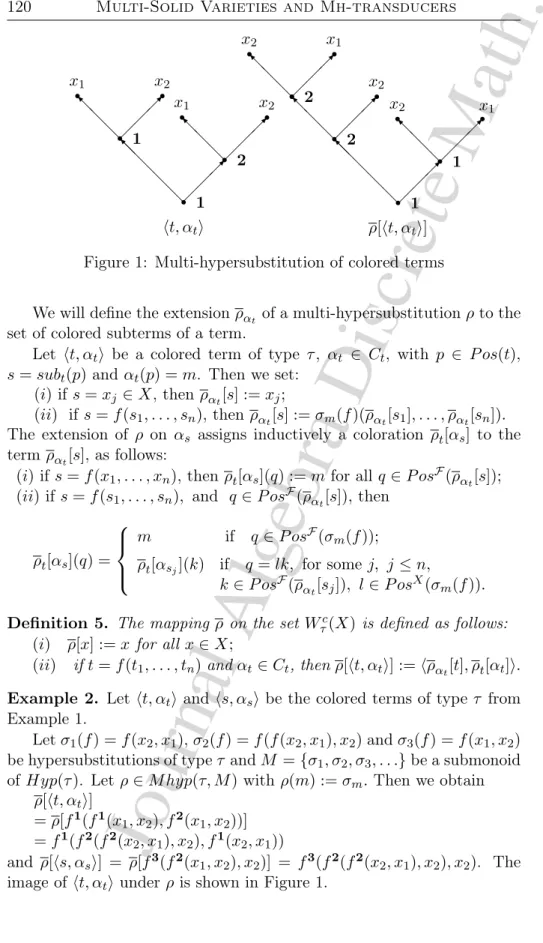
@ @ @ @ @ I @ @ @ I r r r r @ @ @ I r r r 1 1x1 x2
x1 x2
2
ht, αti
@ @ @ @ @ I @ @ @ I r r r r @ @ @ I r r r 1 2 x2 x2 1
ρ[ht, αti]
@ @ @ I r r r
x2 x1
x1
2
Figure 1: Multi-hypersubstitution of colored terms
We will define the extensionραt of a multi-hypersubstitutionρ to the set of colored subterms of a term.
Let ht, αti be a colored term of type τ, αt ∈ Ct, with p ∈ P os(t),
s=subt(p)and αt(p) =m. Then we set:
(i) if s=xj ∈X, thenραt[s] :=xj;
(ii) if s=f(s1, . . . , sn), thenραt[s] :=σm(f)(ραt[s1], . . . , ραt[sn]).
The extension of ρ on αs assigns inductively a coloration ρt[αs] to the
term ραt[s], as follows:
(i) if s=f(x1, . . . , xn), thenρt[αs](q) :=m for all q∈P osF(ραt[s]);
(ii)if s=f(s1, . . . , sn), and q ∈P osF(ραt[s]),then
ρt[αs](q) =
m if q ∈P osF(σ
m(f));
ρt[αsj](k) if q=lk, for some j, j ≤n,
k∈P osF(ραt[sj]), l∈P os X(σ
m(f)).
Definition 5. The mapping ρ on the set Wc
τ(X) is defined as follows:
(i) ρ[x] :=x for all x∈X;
(ii) ift=f(t1, . . . , tn) andαt∈Ct, thenρ[ht, αti] :=hραt[t], ρt[αt]i.
Example 2. Letht, αti and hs, αsi be the colored terms of type τ from Example 1.
Letσ1(f) =f(x2, x1),σ2(f) =f(f(x2, x1), x2)andσ3(f) =f(x1, x2) be hypersubstitutions of typeτ andM ={σ1, σ2, σ3, . . .}be a submonoid of Hyp(τ). Let ρ∈M hyp(τ, M) withρ(m) :=σm.Then we obtain
ρ[ht, αti]
=ρ[f1
(f1
(x1, x2), f2(x1, x2))]
=f1
(f2
(f2
(x2, x1), x2), f1(x2, x1)) and ρ[hs, αsi] = ρ[f3
(f2
Journal Algebra Discrete Math.
Proposition 1. Let ρ ∈ M hyp(τ, M) be a multi-hypersubstitution and t, s∈Wτ(Xn) with αt∈Ct,αs∈Cs andp∈P os(t) . Thenρ[ht, αti(p;hs, αsi)] =ρ[ht, αti(p;xj)](xj ←ρ[hs, αsi]),
for eachj, j > n.
Proof. We will use induction on the lengthl(p) of the positionp. First, let us observe that the case l(p) = 0 is trivial. So, our basis of induction is l(p) = 1. Then t =f(t1, . . . , tp−1, tp, tp+1, . . . , tm) for some
f ∈ Fm. Hence, for eachj, j > n, we have
ρ[ht, αti(p;hs, αsi)] =ρ[hf(t1, . . . , tp−1, s, tp+1, . . . , tm), αt′i] =
=ρ[hf(t1, . . . , tp−1, xj, tp+1, . . . , tm)(xj ←s), αt′i] =
=ρ[ht, αti(p;xj)](xj ←ρ[hs, αsi]),
where αt′ is a coloration of the term t′ = f(t1, . . . , tp−1, s, tp+1, . . . , tm)
for which αt′(q) = αt(q) when q ∈ P osF(t)\ {p} and αt′(pq) = αs(q)
whenq ∈P osF(s).
Our inductive supposition is that when l(p) < k, the proposition is true, for somek∈IN.
Letl(p) =kandp=qiwhereq∈IN∗
F andi∈IN. Henceq ∈P osF(t) and l(q) < k. Let u, v ∈ Sub(t) be subterms of t for which u =subt(p)
and v = subt(q). Then we have v =g(v1, . . . , vi−1, vi, vi+1, . . . , vj) with
vi=u for someg∈ Fj.By the inductive supposition, for everyj, j > n
andl, l > n, we obtain
ρ[ht, αti(p;hs, αsi)] =
=ρ[ht, αti(q;xj)(xj ←ρ[hv, αt[q]i(i;hs, αsi)] =
=ρ[ht, αti(qi;xl)](xl←ρ[hs, αsi])
=ρ[ht, αti(p;xj)](xj ←ρ[hs, αsi]).
A binary operation is defined in the set M hyp(τ, M) as follows:
Definition 6. Let ρ(1) and ρ(2) be two multi-hypersubstitutions over the
submonoid M. Then the composition ρ(1) ◦chρ(2) : IN → M maps each color q∈IN as follows:
(ρ(1)◦chρ(2))(q) :=ρ(1)(q)◦hρ(2)(q) :=σq(1)◦hσ(2)q .
Lemma 1. For every two multi-hypersubstitutions ρ(1) andρ(2) over M
and for each colored term ht, αti of type τ, it holds
Journal Algebra Discrete Math.
So,M hyp(τ, M)is a monoid, whereρid= (σid, σid, . . .)is the identity
multi-hypersubstitution.
Let A = hA,Fi be an algebra of type τ. Each colored term ht, αti
defines a term-operation on the set A, as followsht, αtiA=tA.
Letρ= (σ1, σ2, . . .)be any multi-hypersubstitution over a monoidM of hypersubstitutions of type τ, and let
ρ(F) ={t∈Wτ(X) | ∃σ ∈ρ and f ∈ F such thatt=σ(f)}.
The algebra ρ[A] := hA, ρ(F)ρ[A]i is called a derived algebra under the multi-hypersubstitution ρ.
LetRbe a class of algebras of typeτ. The operatorψc
M is defined as
follows:
ψc
M[A] :={ρ[A]|ρ∈M hyp(τ, M)} and ψMc [R] :={ψcM[A]| A ∈ R}.
Lemma 2. For each ht, αti ∈Wc
τ(X) it holds
ht, αtiρ[A]=ρ[ht, αti]A.
Proof. If t = xj ∈ X, then ρ[ht, αti]A = xAj and ht, αtiρ[A] = x ρ[A]
j =
xA
j . Let us assume that t = f(t1, . . . , tn), αt(ε) = q ∈ IN, hf, qiρ[A] =
ρ(hf, qi)Aandht
i, αtii
ρ[A]=ρ[ht
i, αtii]
Afor alli= 1, . . . , n, then we have
ht, αtiρ[A]=hf, qiρ[A](ht1, αt[1]iρ[A], . . . ,htn, αt[n]iρ[A]) =
=ρ(hf, qi)A(ρ[ht1, αt[1]i]A, . . . , ρ[htn, αt[n]i]A) =ρ[ht, αti]A.
Let ρ be a multi-hypersubstitution. Byρ[t≈s]we will denote ρ[t≈
s] := {ραt[t] ≈ ραs[s] | αt ∈ Ct, αs ∈ Cs}. Let Σ ⊆ Id(τ) be a set of
identities of typeτ. The operator χc
M, is defined as follows:
χc
M[t≈s] :={ρ[t≈s]|ρ∈M hyp(τ, M)}
and χc
M[Σ] :={χcM[t≈s]|t≈s∈Σ}.
Definition 7. An identity t ≈ s ∈ IdA in the algebra A is called an M-multi-hyperidentity in A, if for each multi-hypersubstitution ρ ∈
M hyp(τ, M) and for every two colorations αt ∈ Ct, αs ∈ Cs, the
iden-tity ραt[t] ≈ ραs[s] is satisfied in A. When t ≈ s is an M
-multi-hyperidentity in A we will write A |=M h t ≈ s, and the set of all
M-multi-hyperidentities inA is denoted by HCMIdA.
Algebras in which all identities areM-multi-hyperidentities are called
M-multi-solid i.e. an algebraAof typeτ isM-multi-solid, ifχc
M[IdA]⊆
Journal Algebra Discrete Math.
Theorem 2. Let Σ⊆Id(τ) and R ⊆ Alg(τ). Then(i) χM[Σ]⊆χMc [Σ] for all Σ⊆Id(τ);
(ii) ψM[R] =ψMc [R] for all R ⊆Alg(τ).
Proof. (i) Let σ ∈ M. Then we consider the multi-hypersubstitution
ρ ∈ M hyp(τ, M) with ρ(q) = σ for all q ∈ IN. If t ∈ Wτ(X) then
we will show that bσ[t] = ραt[t] for αt ∈ Ct. We will prove more, that
b
σ[r] := ραr[r]for each r ∈Sub(t). That will be proved by induction on the depth of the termr.
Ifr ∈X thenbσ[r] =ραt[r] =r.
Let us assume that r =f(r1, . . . , rn) with r1, . . . , rn ∈Sub(t). Our
inductive supposition is thatbσ[rk] =ραt[rk]for1≤k≤n. Then we have
ραt[r] =ρ(αt(ε))(f)(ραt[r1], . . . , ραt[rn]) =σ(f)(bσ[r1], . . . ,bσ[rn]) =
=bσ[f(r1, . . . , rn)] = ˆσ[r].
Lett≈s∈Σ. Thus we haveσˆ[t] =ραt[t],σˆ[s] =ραs[s]and
ˆ
σ[t]≈σˆ[s]∈χM[Σ] ⇐⇒ ραt[t]≈ραs[s]∈χ c M[Σ].
Henceσˆ[t]≈σˆ[s]∈χc M[Σ].
(ii) Let A ∈ R and q ∈ IN be the color of f in the fundamental colored termhf(x1, . . . , xn), qi. Let ρ∈M hyp(τ, M). Then we consider
the hypersubstitutionσ ∈M withσ(f) =ρ(q)(f)and from Lemma 2 we obtain
hf, qiρ[A]=ρ[hf(x1, . . . , xn), qi]A = (ρ(q)(f)(x1, . . . , xn))A
=σ(f)(x1, . . . , xn)A.
This shows thatψcM[A]⊆ψM[A].
Let σ ∈Hyp(τ),A ∈ R and ρ ∈M hyp(τ, M) with ρ(q) = σ for all
q∈IN. From Lemma 2 we obtain
σ(f)A = ˆσ[f(x1, . . . , xn)]A=ρ[hf(x1, . . . , xn), qi]A =
=hf(x1, . . . , xn), qi]ρ[A]=hf, qiρ[A].
This shows that ψM[A]⊆ ψcM[A]. Altogether we have ψMc [A] = ψM[A]
and thusψMc [R] =ψM[R].
Journal Algebra Discrete Math.
Proof. Let V be an M-multi-solid variety. If t ≈ s ∈ χM[IdV], thent ≈ s ∈ χc
M[IdV] because of (i) of Theorem 2. Hence every M
-multi-solid variety isM-solid one.
LetRB be the variety of rectangular bands, which is of typeτ = (2). The identities satisfied inRB are:
IdRB =
{f(x1, f(x2, x3))≈f(f(x1, x2), x3)≈f(x1, x3), f(x1, x1)≈x1}. In [5] it was proved that RB is a solid variety, which means that for each identityt≈swithIdRB |=t≈sand for each hypersubstitution σ
we have IdRB |= ˆσ[t]≈σˆ[s].
Let M,ρ ,ht, αti and hs, αsi be as in Example 2 i.e.
ht, αti=f1
(f1
(x1, x2), f2(x1, x2)) and hs, αsi=f3(f2(x1, x2), x2).
Since
t=f(f(x1, x2), f(x1, x2))≈f(x1, x2)≈f(x1, f(x2, x2))≈f(f(x1, x2), x2), it follows thatIdRB |=t≈s. Following the results in Example 2 we have
ραt[t] =f(f(f(x2, x1), x2), f(x2, x1))and
ραs[s] =f(f(f(x2, x1), x2), x2).
Thus we obtain IdRB |= ραt[t] ≈ f(x2, x1) and IdRB |= ραs[s] ≈ x2.
HenceIdRB 6|=ραt[t]≈ραs[s],and RB is notM-multi-solid.
The operators χc
M andψMc are connected by the condition that
ψc
M[A] satisfies u≈v ⇐⇒ A satisfies χcM[u≈v].
ψc
M and χcM are additive and closure operators.
Let R ⊂ Alg(τ) and Σ⊂Id(τ). Then we set:
HCMM odΣ :={A ∈ Alg(τ)|t≈s∈Σ =⇒ A |=M ht≈s};
HCMIdR:={t≈s∈Id(τ) |χcM[t≈s]⊆IdR};
and
HCMV arR:=HCMM odHCMIdR.
A setΣof identities of typeτis called anM−multi-hyperequational theory if Σ =HCMIdHCMM odΣand a class Rof algebras of typeτ is called
an M−multi-hyperequational class if R=HCMM odHCMIdR.
Theorem 4. Let Σ ⊆ Id(τ) and R ⊆ Alg(τ). If Σ = HCMIdR and R=HCMM odΣ, then R=M odΣ andΣ =IdR.
Proof. Let Σ = HCMIdR and R= HCMM odΣ. First, we will prove
thatΣ =χc
M[Σ] andR=ψcM[R].
χc
M andψcM are closure operators and hence we haveΣ⊆χcM[Σ]and R ⊆ψMc [R].
We will prove the converse inclusions. Let r ≈ v ∈ χc
M[Σ]. Then
there is an identity t≈s∈Σ withr ≈v ∈χc
M[t≈s], i.e. χcM[r ≈v]⊆
Journal Algebra Discrete Math.
χcM[t ≈ s]⊆ IdR and χcM[r ≈ v]⊆ χcM[t ≈ s] ⊆ IdR. Hence r ≈ v ∈HCMIdRand r≈v∈Σ, i.e. Σ =χcM[Σ].
LetA ∈ψc
M[R]. Then there is an algebraB ∈ RwithA ∈ψcM[B], i.e. A=ρ[B]for someρ∈M hyp(τ, M). HenceψcM[A] =ψcM[ρ[B]]⊆ψMc [B].
Since B ∈ R=HCMM odΣwe have χcM[Σ]⊆IdB i.e. ψcM[B]⊆M odΣ
and ψc
M[A]⊆ψcM[B]⊆M odΣ. Hence A ∈HCMM odΣ and A ∈ R, i.e. R=ψMc [R].
Now, we obtain
M odΣ ={A | Σ⊆IdA}={A |χc
M[Σ]⊆IdA}=HCMM odΣ =R and
IdR={r≈v | R |=r≈v}={r ≈v |ψcM[R]|=r ≈v}=HCMIdR= Σ.
HenceR=M odΣand Σ =IdR.
Proposition 2. LetA ∈ Alg(τ),R ⊆ Alg(τ),t≈s∈Id(τ),Σ⊆Id(τ), αt∈Ctandαs∈Csand letρbe a multi-hypersubstitution overM. Then
we have:
(i) A |=ραt[t]≈ραs[s] ⇐⇒ ρ[A]|=t≈s ;
(ii) A |=M ht≈s ⇐⇒ χcM[t≈s]⊆IdA ⇐⇒ ψMc [A]|=t≈s;
(iii) Σ⊆HCMIdR ⇐⇒ χcM[Σ]⊆IdR ⇐⇒ Σ⊆IdψMc [R]
(iv) R ⊆HCMM odΣ ⇐⇒ ψMc [R]⊆M odΣ ⇐⇒ R ⊆M odχcM[Σ]
(v) HCMIdR ⊆IdR;
(vi) V arR ⊆HCMV arR;
(vii) The pair hHCMId, HCMM odi forms a Galois connection.
Proof. (i) follows from Theorem 4 and Lemma 2.
(ii) Let ρ be an arbitrary multi-hypersubstitution over the monoid
M. Let us assume that A |=M h t ≈ s. Hence A |= ραt[t] ≈ ραs[s] i.e. A |=χc
M[t≈s]and ψMc [A]|=t≈s.
(iii)and (v) follow from(ii).
(iv) follows from(iii).
(vi) From (ii), it follows that HCMV arR is a variety. Then R ⊆
HCMV arR, and V arR ⊆HCMV arR.
(vii) follows from Theorem 4.
Proposition 3. For everyΣ⊆Id(τ)andR ⊆ Alg(τ)the following hold: (i) χcM[HCMIdR] =HCMIdR=IdψcM[R];
(ii) ψc
M[HCMM odΣ] =HCMM odΣ =M odχcM[Σ];
(iii) V arψc
M[R] =HCMV arR=M odHCMIdR;
(iv) M odχcM[Σ] =HCMM odΣ =IdHCMM odΣ;
(iv) Idψc
M[R] =HCMIdR=M odHCMIdR.
Proof. (i) From Proposition 2 we obtain
HCMIdR ⊆HCMIdR
=⇒ χc
M[χcM[HCMIdR]]⊆χcM[HCMIdR]⊆IdR
=⇒ χc
Journal Algebra Discrete Math.
The converse inclusion is obvious.
(ii) can be proved in an analogous way as(i).
(iii) We have consequently,
HCMV arR=HCMM odHCMIdR
=M odχcM[HCMIdR] =M odHCMIdR
=M odIdψc
M[R] =V arψMc [R].
(iv) and(v) can be proved in an analogous way as (iii).
For given setΣof identities the setIdM odΣof all identities satisfied in the varietyM odΣ is the deductive closure ofΣ, which is the smallest fully invariant congruence containing Σ(see [1, 2, 9]).
A remarkable fact is, that there exists a variety V ⊂ Alg(τ) with
IdV = Σif and only ifΣ is a fully invariant congruence [2].
A congruence Σ ⊆ Id(τ) is called a fully invariant congruence if it additionally satisfies the following axioms (some authors call them “de-ductive rules", “derivation rules", “productions" etc.):
(i) (variable inductive substitution)
(t ≈ s∈ Σ) & (r ∈Wτ(X)) & (x ∈ var(t)) =⇒ t(x ← r) ≈ s(x ←
r)∈Σ;
(ii) (term positional replacement)
(t≈s∈Σ) & (r∈Wτ(X)) & (subr(p) =t) =⇒ r(p;s)≈r∈Σ.
For any set of identities Σ the smallest fully invariant congruence containingΣis called the D−closure ofΣ and it is denoted byD(Σ).
In [5] totally invariant congruences are studied as fully invariant con-gruences which preserve the hypersubstitution images i.e. if t ≈ s ∈ Σ
thenσˆ[t]≈σˆ[s]∈Σfor allσ ∈Hyp(τ).
We extend that results, to the case of multi-hypersubstitutions over a given submonoidM ⊆Hyp(τ).
Definition 8. A fully invariant congruence Σ is M h-deductively closed if it additionally satisfies
M h1 (Multi-Hypersubstitution)
(t≈s∈Σ) & (ρ∈M hyp(τ, M)) =⇒ ρ[t≈s]⊆Σ.
For any set of identities Σ the smallest M h−deductively closed set containingΣis called theM h−closure ofΣand it is denoted byM h(Σ).
It is clear that for each fully invariant congruence Σ we have M h(Σ) =
χc M[Σ].
Let Σ be a set of identities of type τ. For t ≈ s ∈ Id(τ) we say
Σ ⊢M h t ≈s (“Σ M h-proves t ≈s") if there is a sequence of identities
Journal Algebra Discrete Math.
applying any of the derivation rules of fully invariant congruence orM h1 -rule to previous identities in the sequence and the last identity tn ≈sn
ist≈s.
Let t ≈ s be an identity and A be an algebra of type τ. Then
A |=M ht≈smeans thatA |=M h(t≈s) (see Definition 7).
Let Σ ⊆ Id(τ) be a set of identities and A be an algebra of type
τ. Then A |=M h Σ means that A |= M h(Σ). For t, s ∈ Wτ(X) we
say Σ |=M h t ≈ s (read: “Σ M h−yields t ≈ s") if, given any algebra B ∈ Alg(τ),
B |=M hΣ ⇒ B |=M ht≈s.
Remark 2. In a more general case we have χcM[Σ]⊆M h(Σ)and there are examples when χc
M[Σ]6=M h(Σ).
It is easy to see that each M h−deductively closed set is a totally invariant congruence [5]. On the other side from Theorem 3 it follows that the totally invariant congruenceIdRB is notM h−deductively closed.
Lemma 3. For any set Σ ⊆ Id(τ) of identities and t ≈ s ∈ Id(τ) the following equivalences hold:
Σ⊢M ht≈s ⇐⇒ χcM[Σ]⊢t≈s ⇐⇒ M h(Σ)⊢t≈s.
Theorem 5. (Completeness Theorem for Multi-hyperequational Logic.) For Σ⊆Id(τ) and t≈s∈Id(τ) we have:
Σ|=M ht≈s ⇐⇒ Σ⊢M ht≈s.
Proof. From HCMIdHCMM odΣ =IdHCMM odΣ =IdM odχcM[Σ] we
obtain that Σ|=M h t ≈s is equivalent to t ≈s ∈HCMIdHCMM odΣ.
From Theorem 14.19 [2] we have HCMIdHCMM odΣ |= t ≈ s and
HCMIdHCMM odΣ⊢t≈s. HenceχcM[Σ]⊢t≈sand Σ⊢M ht≈s.
The converse implication follows from the fact that M h(Σ)is a fully invariant congruence which is closed under the rule M h1.
Corollary 1. Let M be a submonoid of Hyp(τ). Then the class of all M−multi-solid varieties of type τ is a complete sublattice of the lattice
L(τ) of all varieties of type τ and dually, the class of all M− multi-hyperequational theories of type τ is a complete sublattice of the lattice
E(τ) of all equational theories (fully invariant congruences) of type τ.
Lemma 4. For any set Σ ⊆ Id(τ) of identities and t ≈ s ∈ Id(τ) the following equivalence holds:
Journal Algebra Discrete Math.
Proof. “⇒” Let Σ|=M h t≈s. We have to prove M h(Σ)|=t≈s. Let A ∈ Alg(τ)be an algebra for whichA |=M h(Σ). This impliesA |=M hΣand A |=M ht≈s, because of Σ|=M ht≈s. HenceA |=M h(t≈s). On
the other side, we havet≈s∈M h(t≈s) and A |=t≈s.
“ ⇐” Let M h(Σ)|=t≈s. Since χc
M[Σ]⊆M h(Σ)and from
Propo-sition 2 (ii)we have Σ|=M ht≈s.
Corollary 2. For any set Σ ⊆Id(τ) of identities and t ≈s∈ Id(τ) it holds:
Σ|=M h t≈s ⇐⇒ χcM[Σ]|=t≈s.
Example 3. Letτ be an arbitrary type.
(i) Let t∈Wτ(X) be a term of typeτ.Let us consider the following
two functionsLef t:Wτ(X)→XandRight:Wτ(X)→X, which assign
to each termtthe leftmost and the rightmost variable oft. For instance, if t=g(f(x1, x2), x3, x4),thenLef t(t) =x1 andRight(t) =x4.
Let us denote byK1 ⊂Hyp(τ)the set of all hypersubstitutions which preserve the functions Lef t andRight i.e. σ ∈K1, iff for all t∈Wτ(X)
we have Lef t(t) = Lef t(ˆσ[t]) and Right(t) =Right(ˆσ[t]).Then K1 is a submonoid of Hyp(τ). Let us consider the monoidM hyp(τ, K1) of multi-hypersubstitutions, generated by K1. It is a submonoid of
M hyp(τ, Hyp(τ)). The variety RB of rectangular bands is K1 -multi-solid.
(ii) Let V str : Wτ(X) → X∗ be a mapping, which assigns to each
term tthe string of the variables int. For instance, if
t=f(x1, g(f(x1, x2), x3, x2), x4), then V str(t) =x1x1x2x3x2x4.
This mapping is defined inductively as follows: if t = xj ∈ X, then
V str(t) :=xj;and ift=f(t1, . . . , tn), then
V str(t) :=V str(t1)V str(t2). . . V str(tn).
Let K2 ⊂Hyp(τ)be the set of all hypersubstitutions which preserve
V str i.e. σ ∈ K2, if and only if for each t∈ Wτ(X) it holds V str(t) =
V str(ˆσ[t]).Then K2 is a submonoid of Hyp(τ).
Let us consider the monoidM hyp(τ, K2)of multi-hypersubstitutions, generated by K2. It is a submonoid ofM hyp(τ, Hyp(τ))and K2 ⊆K1.
It is not difficult to prove that the variety RB isK2-multi-solid. Finally, let us note that if Σ is the set of identities satisfied in RB, and if we add to K1 and K2 the hypersubstitution σ ∈ Hyp(τ) with
σ(f) =f(x2, x1), thenM1 :=K1∪ {σ}andM2 :=K2∪ {σ}are monoids, again such thatχc
M1[Σ] =Id(τ), but χ
c
Journal Algebra Discrete Math.
3. Tree automata realization
We consider an automata realization of the multi-hypersubstitutions. This concept will allow to use computer programmes in the case of fi-nite monoids of hypersubstitutions to obtain the images of terms under multi-hypersubstitutions.
In Computer Science terms are used as data structures and they are called trees. The operation symbols are labels of the internal nodes of trees and variables are their leaves.
The concept of tree automata was introduced in the 1960s in various papers such as [10]. G´ecseg & Steinby’s book [6] is a good survey of the theory of tree automata and [3] is a development of this theory. Tree automata are classified as tree recognizers and tree transducers. Our aim is to define tree automata which interpret the application of multi-hypersubstitutions of the colored terms of a given type.
Definition 9. A colored tree transducer of typeτ is a tupleA=hX,F, Pi
where as usual X is a set of variables, F is a set of operation symbols andP is a finite set of productions (rules of derivation) of the forms
(i) x→x, x∈X;
(ii) hf, qi(ξ1,· · · , ξn)→ hr, αri(ξ1,· · ·, ξn),
with hr, αri(ξ1,· · · , ξn)∈Wτc(X∪χm), hf, qi ∈ Fc, ξ1,· · · , ξn∈χn,
where χn={ξ1,· · ·, ξn} is an auxiliary alphabet.
(All auxiliary variablesξj belong to a set χm ={ξ1,· · · , ξm} where m =
maxar is the maximum of the arities of all operation symbols in F.)
Definition 10. Let M ⊆ Hyp(τ) be a submonoid of Hyp(τ) and ρ ∈
M hyp(τ, M) be a multi-hypersubstitution over M. A colored tree trans-ducer Aρ = hX,F, Pi is called M h−transducer over M, if for the rules
(ii) in P we have r=σ(q)(f) and αr(p) =q for all p∈P osF(r).
The M h−transducer Aρ runs over a colored term ht, αti starting
at the leaves of t and moves downwards, associating along the run a resulting colored term (image) with each subterm inductively: if t =
x ∈ X then the M h−transducer Aρ associates with t the term x ∈
Wτc(X), if x → x ∈ P; if ht, αti = hf, qi(ht1, αt1i. . . ,htn, αtni) then
withht, αtitheM h−transducerAρ associates the colored termhs, αsi=
hu, αui(ht1, αt1i. . . ,htn, αtni),ifhf, qi(ξ1, . . . , ξn)→ hu, αui(ξ1,· · · , ξn)∈
P, whereu=σ(q)(f) and αu(p) =q for allp∈P osF(u).
For treesht, αti,and hs, αsiwe sayht, αti directly derives hs, αsi by Aρ, if hs, αsi can be obtained from ht, αti by replacing of an occurrence of a subtreehf, qi(hr1, αr1i,· · · ,hrn, αrni),inht, αti by
hu, αui(hr1, αr1i,· · · ,hrn, αrni)∈W c
Journal Algebra Discrete Math.
If ht, αti directly derives hs, αsi in Aρ, we write ht, αti →Aρ hs, αsi.
Furthermore, we sayht, αti deriveshs, αsi in Aρ, if there is a sequence
ht, αti →Aρ hs1, αs
1i →Aρ hs2, αs2i →Aρ · · · →Aρ hsn, αsni = hs, αsi of
direct derivations or ifht, αti=hs, αsi. In this case we writeht, αti ⇒∗Aρ hs, αsi. Clearly,⇒∗
Aρ is the reflexive and transitive closure of→Aρ.
Let us denote by T hyp(τ, M) the set of all M h−transducers of type
τ over M.
A termht, αtiis translated to the termhs, αsiby theM h−transducer
Aρif there exists a run ofAρsuch that it associates withht, αtithe colored
term hs, αsi. In this case we will writeAρ(ht, αti) =hs, αsi.
Lemma 5. Aρ(ht, αti) =hs, αsi ⇐⇒ ρ[ht, αti] =hs, αsi.
Proof. For a variable-term x we have Aρ(x) = x = ρ[x]. Suppose that for i= 1, . . . , nwe have Aρ(hti, αtii) =ρ[hti, αtii]. Then we obtain
Aρ(hf, qi(ht1, αt1i, . . . ,htn, αtni)) =
Aρ(hf, qi)(Aρ(ht1, αt1i), . . . , Aρ(htn, αtni)) =ρ[ht, αti] =ρ[ht, αti],
whereαt(ε) =q and αt[i] =αti for i= 1, . . . , n.
The product (superposition) of two M h−transducersAρ1
andAρ2 is defined by the following equation
Aρ1
◦Aρ2
(ht, αti) :=Aρ1
(Aρ2
(ht, αti)).
Lemma 6. Let M ⊆ Hyp(τ) be a monoid of hypersubstitutions. Then the superposition of M h−transducers of a given type is associative i.e.
Aρ1
◦(Aρ2
◦Aρ3
)(ht, αti) = (Aρ1
◦Aρ2
)◦Aρ3
(ht, αti)
for all ρ1, ρ2, ρ3 ∈M Hyp(τ, M) and for all ht, αti ∈Wτc(X).
Theorem 6. Let M ⊆Hyp(τ) be a monoid of hypersubstitutions. Then the set T hyp(τ, M) is a monoid which is isomorphic to the monoid of all multi-hypersubstitutions overM i.e.
T hyp(τ, M)∼=M hyp(τ, M).
Proof. We define a mappingϕ:M hyp(τ, M)→T hyp(τ, M) byϕ(ρ) :=
Aρ.
To show that ϕ is a homomorphism we will prove that Aρ1
◦Aρ2
=
Aρ1◦chρ2
, so thatϕ(ρ1)◦ϕ(ρ2) =ϕ(ρ1◦chρ2).
We have Aρ1 ◦Aρ2(ht, αti) = Aρ1(Aρ2(ht, αti)) = Aρ1(ρ
2[ht, αti]) =
Journal Algebra Discrete Math.
To see that ϕis one-to-one, let Aρ1
=Aρ2
. Then from Lemma 5 for all ht, αti ∈ Wc
τ(X) we have ρ1[ht, αti] =ρ2[ht, αti]. Hence for allf ∈ F andq ∈IN we haveρ1[hf, qi] =ρ2[hf, qi]and therefore ρ1=ρ2.
References
[1] G. Birkhoff,Lattice theory,(3rd ed.) Amer. Math. Soc., Providence, 1967 [2] S. Burris and H. Sankappanavar,A Course in Universal Algebra, The millennium
edition, 2000
[3] H. Comon, M. Dauchet, R. Gilleron, F. Jacquemard, D. Lugiez, S. Tison, M. Tommasi,Tree Automata, Techniques and Applications, 1999, http://www.grappa.univ-lille3.fr/tata/
[4] K. Denecke, J. Koppitz and Sl. Shtrakov, Multi-Hypersubstitutions and Coloured Solid Varieties,J. Algebra and Computation, J. Algebra and Computation, Vol-ume 16, Number 4, August, 2006, pp.797-815.
[5] K. Denecke, D. Lau, R. P¨oschel and D. Schweigert, Hyperidentities, Hyperequa-tional Classes and Clone Congruences,General Algebra 7, Verlag H¨ older-Pichler-Tempsky,Wien 1991, Verlag B.G. Teubner Stuttgart, pp.97-118
[6] F. G´ecseg, M. Steinby,Tree Automata, Akad´emiai Kiad´o, Budapest 1984 [7] E. Gracz´ynska, On connection between identities and hyperidentities,
Bull.Sect.Logic 17(1988),34-41.
[8] G. Gratzer,Universal Algebra, D. van Nostrand Co., Princetown, 1968.
[9] R. McKenzie, G. Mc Nulty and W. Taylor,Algebras, Lattices, Varieties,Vol. I, Belmont, California 1987.
[10] J. W. Thatcher and J.B. Wright, Generalized finite automata, Notices Amer. Math. Soc.,12.(1965), abstract No. 65T-649,820.
Contact information
Sl. Shtrakov Dept. of Computer Sciences, South-West University, 2700 Blagoevgrad, Bulgaria E-Mail: [email protected]
URL: http://shtrakov.swu.bg