A Unified Control Startergy For Three Phase Inverter In Dg
Ramya Kanaka Sowjanya Maddila1, Mr.B,D.S.Prasad21
PG Scholar, Pydah College of Engineering, Kakinada, AP, India.
2Assistant Professor, Pydah College of Engineering, Kakinada, AP, India.
Abstract—This paper presents a neutral point clamped technique based three-phase inverter with grid connected system that operates in both islanded and grid-tied modes. This paper presents the detailed analysis and the parameter design of the control strategy. The 3-phase inverter in the DG system, dosn’t needs any switching between two controllers for the operation. The new proposed control strategy having two loops 1) inner inductor current loop, and 2) a voltage loop in the synchronous reference frame. The inner current loop is used to regulate the inverter as a current source in grid-tied operation. In the islanding mode the voltage controller is automatically controls the load voltage. To check the effectiveness of the proposed system, the waveforms of the grid current and the load voltage are distorted under nonlinear load with the conventional strategy. These issues are addressed by proposing a neutral point clamped (NPC) technique in this paper. The effectiveness of the proposed control strategy is verified by the simulation results using MATLAB/SIMULINK software.
Index Terms—Distributed generation (DG), islanding, load current, seamless transfer, three-phase inverter, unified control, NPC
I. INTRODUCTION
Most of these resources are connected to the utility through power electronic interfacing converters, i.e., three-phase inverter. Moreover, DG is a suitable form to offer high reliable electrical power supply, as it is able to operate either in the grid-tied mode or in the islanded mode. In the grid-tied operation, DG deliveries power to the utility and the local critical load. Upon the occurrence of utility outage, the islanding is formed. Under this circumstance, the DG must be tripped and cease to energize the portion of utility as soon as possible according to IEEE Standard 929-2000. However, in order to improve the power reliability of some local critical load, the DG should disconnect to the utility and continue to feed the local critical load. The load voltage is key issue of these two operation modes, because it is fixed by the utility in the grid-tied operation, and formed by the DG in the islanded mode, respectively.
Therefore, upon the happening of islanding, DG must take over the load voltage as soon as possible, in order to reduce the transient in the load voltage. And this issue brings a challenge for the operation of DG. Droop-based control is used widely for the power sharing of parallel inverters, which is called as voltage mode control in this paper, and it can also be applied to DG to realize the power sharing between DG and utility in the grid-tied mode. In this situation, the inverter is always regulated as a voltage source by the voltage loop, and the quality of the load voltage can be guaranteed during the transition of operation modes.
However, the limitation of this approach is that the dynamic performance is poor, because the bandwidth of the external power loop, realizing droop control, is much lower than the voltage loop. Moreover, the grid current is not controlled directly, and the issue of the inrush grid current during the transition from the islanded mode to the grid-tied mode always exists, even though phase-locked loop (PLL) and the virtual inductance are adopted. The hybrid voltage and current mode control is a popular alternative for DG, in which two distinct sets of controllers are employed. The inverter is controlled as a current source by one sets of a controller in the grid-tied mode, while as a voltage source by the other sets of controller in the islanded mode.
As the voltage loop or current loop is just utilized in this approach, a nice dynamic performance can be achieved. Besides, the output current is directly controlled in the grid-tied mode, and the inrush grid current is almost eliminated. In the hybrid voltage and current mode control, there is a need to switch the controller when the operation mode of DG is changed. During the interval from the occurrence of utility outage and switching the controller to voltage mode, the load voltage is neither fixed by the utility, nor regulated by the DG, and the length of the time interval is determined by the islanding detection process.
Therefore, the main issue in this approach is that it makes the quality of the load voltage heavily reliant on the speed and accuracy of the islanding detection method. Another issue associated with the aforementioned approaches is the waveform quality of the grid current and the load voltage under nonlinear local load. In the grid-tied mode, the output current of DG is generally desired to be pure sinusoidal. When the nonlinear local load is fed, the harmonic component of the load current will fully flow into the utility. A single-phase DG, which injects harmonic current into the utility for mitigating the harmonic component of the grid current, is presented in.
a given reference in the synchronous reference frame (SRF). Second, a novel voltage controller is presented to supply reference for the inner inductor current loop, where a proportional-plus-integral (PI) compensator and a proportional (P) compensator are employed in D-axis and
Q-axis, respectively.
In the grid-tied operation, the load voltage is dominated by the utility, and the voltage compensator inD -axis is saturated, while the output of the voltage compensator in Q-axis is forced to be zero by the PLL. Therefore, the reference of the inner current loop cannot regulated by the voltage loop, and the DG is controlled as a current source just by the inner current loop. Upon the occurrence of the grid outage, the load voltage is no more determined by the utility, and the voltage controller is automatically activated to regulate the load voltage. These happen naturally, and, thus the proposed control strategy does not need a forced switching between two distinct sets of controllers. Further, there is no need to detect the islanding quickly and accurately, and the islanding detection method is no more critical in this approach. Moreover, the proposed control strategy, benefiting from just utilizing the current and voltage feedback control, endows a better dynamic performance, compared to the voltage mode control.
Third, the proposed control strategy is enhanced by introducing a unified load current feed-forward, in order to deal with the issue caused by the nonlinear local load, and this scheme is implemented by adding the load current into the reference of the inner current loop. In the grid-tied mode, the DG injects harmonic current into the grid for compensating the harmonic component of the grid current, and thus, the harmonic component of the grid current will be mitigated. Moreover, the benefit of the proposed load current feed-forward can be extended into the islanded operation mode, due to the improved quality of the load voltage.
II. PROPOSED CONTROL STRATEGY
A. Power Stage
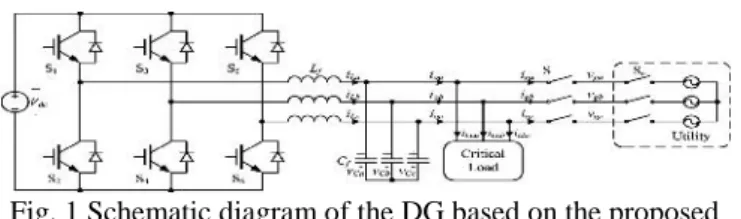
This paper presents a unified control strategy for a three phase inverter in DG to operate in both islanded and grid-tied modes. The schematic diagram of the DG based on the proposed control strategy is shown by Fig. 1. The DG is equipped with a three-phase interface inverter terminated with a LC filter. The primary energy is converted to the electrical energy, which is then converted to dc by the front-end power converter, and the output dc voltage is regulated by it. Therefore, they can be represented by the dc voltage source Vdc in Fig. 1. In the ac side of inverter, the local critical load is connected directly. It should be noted that there are two switches, denoted by Su and Si, respectively, in Fig. 1, and their functions are different.
Fig. 1 Schematic diagram of the DG based on the proposed control strategy
The inverter transfer switch Si is controlled by the DG, and the utility protection switch Su is governed by the utility. When the utility is normal, both switches Si and Su are ON, and the DG in the grid-tied mode injects power to the utility. When the utility is in fault, the switch Su is tripped by the utility instantly, and then the islanding is formed. After the islanding has been confirmed by the DG with the islanding detection scheme, the switch Si is disconnected, and the DG is transferred from the grid-tied mode to the islanded mode. When the utility is restored, the DG should be resynchronized with the utility first, and then the switch Si is turned ON to connect the DG with the grid.
B. Basic Idea
With the hybrid voltage and current mode control, the inverter is controlled as a current source to generate the reference powerPDG + jQDG in the grid-tied mode. And its output powerPDG + jQDG should be the sum of the power injected to the gridPg + jQg and the load demandPload + jQload, which can be expressed as follows by assuming that the load is represented as a parallelRLCcircuit:
In (1) and (2),Vmand ω represent the amplitude and frequency of the load voltage, respectively. When the nonlinear local load is fed, it can still be equivalent to the parallel RLC circuit by just taking account of the fundamental component. During the time interval from the instant of islanding happening to the moment of switching the control system to voltage mode control, the load voltage is neither fixed by the utility nor regulated by the inverter, so the load voltage may drift from the normal range. And this phenomenon can be explained as below by the power relationship.
During this time interval, the inverter is still controlled as a current source, and its output power is kept almost unchanged. However, the power injected to utility decreases to zero rapidly, and then the power consumed by the load will be imposed to the output power of DG. If both active power Pg and reactive power Qg injected into the grid are positive in the grid-tied mode, thenPload andQload will increase after the islanding happens, and the amplitude and frequency of the load voltage will rise and drop, respectively, according to (1) and (2).
controlled to recover to the normal range automatically by regulating the output power of the inverter.
C. Control Scheme
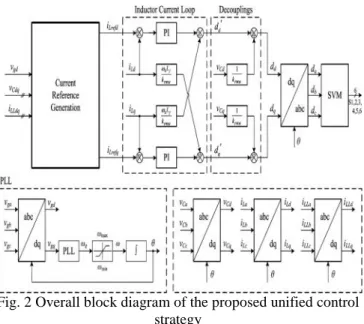
Fig. 2 describes the overall block diagram for the proposed unified control strategy, where the inductor current
iLabc, the utility voltagevgabc,the load voltagevCabc, and the load current iLLabc are sensed. And the three-phase inverter is controlled in the SRF, in which, three phase variable will be represented by dc quantity. The control diagram is mainly composed by the inductor current loop, the PLL, and the current reference generation module.
In the inductor current loop, the PI compensator is employed in both D- and Q-axes, and a decoupling of the cross coupling denoted byω0Lf/kPWM is implemented in order to mitigate the couplings due to the inductor. The output of the inner current loop ddq_, together with the decoupling of the capacitor voltage denoted by 1/kPWM, sets the reference for the standard space vector modulation that controls the switches of the three-phase inverter. It should be noted thatkPWM denotes the voltage gain of the inverter, which equals to half of the dc voltage in this paper.
Fig. 2 Overall block diagram of the proposed unified control strategy
The PLL in the proposed control strategy is based on the SRF PLL, which is widely used in the three-phase power converter to estimate the utility frequency and phase. Furthermore, a limiter is inserted between the PI compensator GPLL and the integrator, in order to hold the frequency of the load voltage within the normal range in the islanded operation. In Fig. 2, it can be found that the inductor current is regulated to follow the current reference
iLref dq, and the phase of the current is synchronized to the grid voltagevgabc.
If the current reference is constant, the inverter is just controlled to be a current source, which is the same with the traditional grid-tied inverter. The new part in this paper is the current reference generation module shown in Fig. 2, which regulates the current reference to guarantee the power match between the DG and the local load and enables the DG to operate in the islanded mode. Moreover, the unified load current feed forward, to deal with the nonlinear local load, is also implemented in this module. The block diagram
of the proposed current reference generation module is shown in Fig. 3, which provides the current reference for the inner current loop in both grid-tied and islanded modes.
Fig. 3 Block diagram of the current reference generation module
In this module, it can be found that an unsymmetrical structure is used in D- and Q-axes. The PI compensator is adopted inD-axes, while the P compensator is employed inQ-axis. Besides, an extra limiter is added in the D-axis. Moreover, the load current feed-forward is implemented by adding the load current iLLdqto the final inductor current referenceiLref dq. The benefit brought by the unique structure in Fig. 3 can be represented by two parts: 1) seamless transfer capability without critical islanding detection; and 2) power quality improvement in both grid-tied and islanded operations. The current reference
iLredqcomposes of four parts inDandQ-axes respectively: 1) The output of voltage controller iref dq ; 2) the grid current referenceIgref dq; 3) the load currentiLLdq; and 4) the current flowing through the filter capacitorCf.
In the grid-tied mode, the load voltage vCdq is clamped by the utility. The current reference is irrelevant to the load voltage, due to the saturation of the PI compensator inD-axis, and the output of the P compensator being zero inQ-axis, and thus, the inverter operates as a current source. Upon occurrence of islanding, the voltage controller takes over automatically to control the load voltage by regulating the current reference, and the inverter acts as a voltage source to supply stable voltage to the local load; this relieves the need for switching between different controls architectures. Another distinguished function of the current reference generation module is the load current feed-forward. The sensed load current is added as a part of the inductor current reference iLref dq to compensate the harmonic component in the grid current under nonlinear local load.
and islanded modes, which is represented by the current reference generation module in Fig. 3.
The contribution of this module can be summarized in two aspects. First, by introducing PI compensator and P compensator in D-axis andQ-axis respectively, the voltage controller is inactivated in the grid-tied mode and can be automatically activated upon occurrence of islanding. Therefore, there is no need for switching different controllers or critical islanding detection, and the quality of the load voltage during the transition from the grid-tied mode to the islanded mode can be improved. The second contribution of this module is to present the load current feed-forward to deal with the issue caused by the nonlinear local load, with which, not only the waveform of the grid current in grid-tied is improved, but also the quality of the load voltage in the islanded mode is enhanced. Besides, it should be noted that a three-phase unbalanced local load cannot be fed by the DG with the proposed control strategy, because there is no flow path for the zero sequence current of the unbalanced load, and the regulation of the zero sequence current is beyond the scope of the proposed control strategy.
III. OPERATION PRINCIPLE OF DG
The operation principle of DG with the proposed unified control strategy will be illustrated in detail in this section, and there are in total four states for the DG, including the grid-tied mode, transition from the grid-tied mode to the islanded mode, the islanded mode, and transition from the islanded mode to the grid-tied mode.
When the utility is normal, the DG is controlled as a current source to supply given active and reactive power by the inductor current loop, and the active and reactive power can be given by the current reference of D- and Q -axis independently. First, the phase angle of the utility voltage is obtained by the PLL, which consists of a Park transformation expressed by (3), a PI compensator, a limiter, and an integrator
Second, the filter inductor current, which has been transformed into SRF by the Park transformation, is fed back and compared with the inductor current referenceiLref dq , and the inductor current is regulated to track the referenceiLref dqby the PI compensatorGI. The reference of the inductor current loopiLref dqseems complex and it is explained as below. It is assumed that the utility is stiff, and the three-phase utility voltage can be expressed as
WhereVgis the magnitude of the grid voltage, andθ∗is the actual phase angle. By the Park transformation, the utility voltage is transformed into the SRF, which is shown as
vgqis regulated to zero by the PLL, so vgdequals the magnitude of the utility voltage Vg . As the filter capacitor voltage equals the utility voltage in the gird-tied mode, vCdequals the magnitude of the utility voltage Vg, andvCqequals zero, too. In theD-axis, the inductor current referenceiLref dcan be expressed by (6) according to Fig. 3
The first part is the output of the limiter. It is assumed that the given voltage referenceVmax is larger than the magnitude of the utility voltage vCd in steady state, so the PI compensator, denoted byGV Din the following part, will saturate, and the limiter outputs its upper value Igref d. The second part is the load current ofD-axisiLLd, which is determined by the characteristic of the local load. The third part is the proportional part− ω0Cf · vCq, where ω0 is the rated angle frequency, andCfis the capacitance of the filter capacitor. It is fixed as vCq depends on the utility voltage. Consequently, the current reference iLref d is imposed by the given referenceIgref dand the load currentiLLd, and is independent of the load voltage. In the Q-axis, the inductor current referenceiLref qconsists of four parts as
WherekGvqis the parameter of the P compensator denoted byGV Qin the following part. The first part is the output of
GV Q, which is zero as the vCq has been regulated to zero by the PLL. The second part is the given current reference
Igref q , and the third part represents the load current inQ -axis. The final part is the proportional part − ω0Cf · vCd, which is fixed since vCd depends on the utility voltage. Therefore, the current referenceiLref qcannot be influenced by the external voltage loop and is determined by the given referenceIgref qand the load currentiLLq.
steady state error is zero,Igref dqrepresents the grid current actually, and this will be analyzed in the next section.
Fig. 4 Simplified block diagram of the unified control strategy when DG operates in the grid-tied mode
IV. SIMULATION RESULTS
Fig 5 simulation block diagram of the proposed system
Fig. 6 Overall block diagram of the proposed unified control strategy
Fig 7 proposed unified control strategy with NPC technique
Fig 8 NPC simulation diagram
Fig 9 waveform of inverter voltage
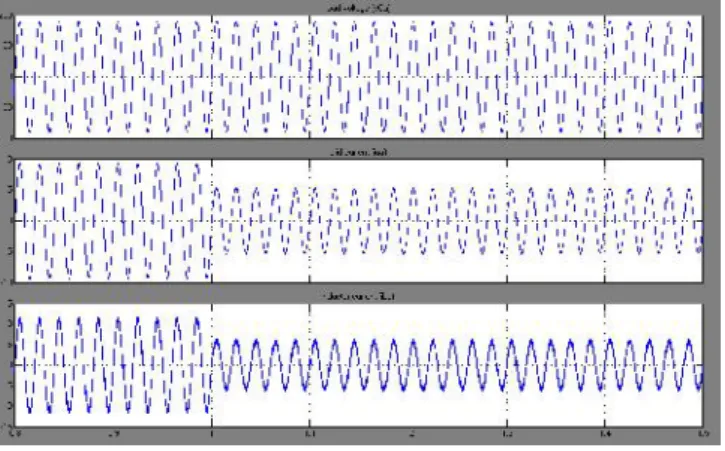
Fig 11 Simulation waveforms of load voltagevC a, grid currentiga, and inductor currentiLawhen DG is in the
grid-tied mode under condition of the step down of the grid current reference from 9 A to 5 A with NPC
Fig. 11 Simulation waveforms of load voltagevC a,grid currentiga, and inductor currentiLawhen DG is transferred
from the grid-tied mode to the islanded mode
CONCLUSION
A unified control strategy with NPC technique was proposed for three-phase inverter in DG to operate in both islanded and grid-tied modes, with no need for switching between two different control architectures or critical islanding detection. A novel voltage controller was presented. It is inactivated in the grid-tied mode, and the DG operates as a current source with fast dynamic performance. Upon the utility outage, the voltage controller can automatically be activated to regulate the load voltage. Moreover, a novel load current feed-forward was proposed, and it can improve the waveform quality of both the grid current in the grid-tied mode and the load voltage in the islanded mode. The proposed unified control strategy was verified by the simulation results.
REFERENCES
[1] R. C. Dugan and T. E. McDermott, “Distributed generation,”IEEE Ind. Appl. Mag., vol. 8, no. 2, pp. 19–25, Mar./Apr. 2002.
[2] R. H. Lasseter, “Microgrids and distributed generation,”
J. Energy Eng., vol. 133, no. 3, pp. 144–149, Sep. 2007. [3] C. Mozina, “Impact of green power distributed generation,” IEEE Ind. Appl. Mag., vol. 16, no. 4, pp. 55– 62, Jul./Aug. 2010.
[4] IEEE Recommended Practice for Utility Interface of Photovoltaic(PV) Systems, IEEE Standard 929-2000, 2000. [5] IEEE Standard for Interconnecting Distributed Resources with Electric Power Systems, IEEE Standard 1547-2003, 2003.
[6] J. Stevens, R. Bonn, J. Ginn, and S. Gonzalez,
Development and Testing of an Approach to Anti-Islanding in Utility-Interconnected Photovoltaic Systems. Livermore, CA, USA: Sandia National Laboratories, 2000.
[7] A. M. Massoud, K. H. Ahmed, S. J. Finney, and B. W. Williams, “Harmonic distortion-based island detection technique for inverter-based distributed generation,” IET RenewablePower Gener.,vol.3,no.4,pp.493–507, Dec. 2009. [8] T. Thacker, R. Burgos, F. Wang, and D. Boroyevich, “Single-phase islanding detection based on phase-locked loop stability,” in Proc. 1st IEEE Energy Convers. Congr. Expo., San Jose, CA, USA, 2009, pp. 3371–3377.
[9] S.-K. Kim, J.-H. Jeon, J.-B. Ahn, B. Lee, and S.-H. Kwon, “Frequencyshift acceleration control for anti-islanding of a distributed-generation inverter,”IEEE Trans. Ind. Electron., vol. 57, no. 2, pp. 494–504, Feb. 2010. [10] A. Yafaoui, B. Wu, and S. Kouro, “Improved active frequency drift antiislanding detection method for grid connected photovoltaic systems,” IEEE Trans. Power Electron., vol. 27, no. 5, pp. 2367–2375, May 2012.
[11] J. M. Guerrero, L. Hang, and J. Uceda, “Control of distributed uninterruptible power supply systems,” IEEE Trans. Ind. Electron., vol. 55,no.8,pp.2845–2859,Aug. 2008. [12] M. C. Chandorkar, D. M. Divan, and R. Adapa, “Control of parallel connected inverters in standaloneACsupply systems,”IEEE Trans. Ind. Appl., vol. 29, no. 1, pp. 136–143, Jan./Feb. 1993.
[13] Y. Li, D. M. Vilathgamuwa, and P. C. Loh, “Design, analysis, and realtime testing of a controller for multibus microgrid system,” IEEE Trans. Power Electron., vol. 19, no. 5, pp. 1195–1204, Sep. 2004.
[14] F. Gao and M. R. Iravani, “A control strategy for a distributed generation unit in grid-connected and autonomous modes of operation,” IEEE Trans. Power Del., vol. 23, no. 2, pp. 850–859, Apr. 2008.
[15] S.-H. Hu, C.-Y. Kuo, T.-L. Lee, and J. M. Guerrero, “Droop-controlled inverters with seamless transition between islanding and grid-connected operations,” in Proc. 3rd IEEE Energy Convers. Congr. Expo., Phoenix, AZ, USA, 2011, pp. 2196–2201.