Alternative Method for the Analysis of Water-Based Metalworking Fluids
Using Fourier Transform Infra-Red Spectroscopy
Saeid Kamalifar
1, Mansour R.Azari*
1, Athena Rafieepour
2, Mohsen Asgari
2, Rezvan Zendehdel
1,
Hamid Soori
3, Elaheh Tavakol
1, Ali Reza Rahmati
1, Maedeh Nadim Ghaziani
41) School of Public Health, Shahid Beheshti University of Medical Sciences, Tehran, Iran.
2) School of Public health, student research committee, Shahid Beheshti University of Medical Sciences, Tehran, Iran.
3) Safety promotion and prevention of injury research center, School of Public Health, Shahid Beheshti University of Medical Sciences, Tehran, Iran
4) School of Public Health, Tehran University of Medical Sciences, Tehran, Iran.
*Author for Correspondence:[email protected]
Received: 20 Jan. 2018, Revised: 22 Jun. 2018, Accepted: 21July 2018
ABSTRACT
Mists of water-based metalworking fluids (MWFs) as a kind of lubricants mineral oil are reported as a respiratory irritant with having carcinogenic compounds such as formaldehyde. Due to the widespread exposure of Iranian metal machining workers to water-based MWFs and limitations of advanced analytical balance in Iran, which is required by the National Institute of Occupational Safety and Health (NIOSH) conventional method No5524, the purpose of this study was set to develop a new analytical method using Fourier-transform infrared (FTIR) spectrometry instead. In this study, the spiked standards in the range of 0.96 to 960 µg/sample were dried and extracted with carbon tetrachloride and scanned by FTIR in the range of 2700 to 3200cm-1 for the best absorption. FTIR and Gas
chromatography analysis of formaldehyde as a toxic ingredient of MWFs was examined and its presence was confirmed. For establishing the validation, the merits of the analysis of the FTIR and NIOSH method No.5524, such as precision, accuracy, LOD, LOQ, and bias were obtained that were 1.49%, 103%, 0.0004, 0.0014 µg/sample, -3%, and 10.87%, 111%, 14.9, 49.1µg/sample and 11% respectively. Regression coefficients (r2) of the calibration line
with the spiked standards (0.96-960µg/sample) were in the range of 0.997 to 0.999. Since the merits of the analysis of the FT-IR method for water-based MWFs were comparable to the respective NIOSH method, the developed method could be very useful in monitoring lathe workers, especially in developing countries. However, collaborative examination for full validation of the method is recommended.
Keywords
:
Air-Borne, Water- Soluble Oil, Analysis, Fourier Transform Infrared Spectroscopy, Validation StudyABBREVIATION
:ACGIH: American Conference of Governmental Industrial Hygienist
ASTM: American Society for Testing and Materials
HSE: Health and Safety Executive
FTIR: Fourier Transform Infrared Spectrometry
GC: gas chromatography
LOD: Limit of Detection
LOQ: Limit of Quantitation
MWFs: water-based metalworking fluids
NIOSH: National Institute for Occupational Safety and Health
OSHA: Occupational Safety and Health Administration
PTFE: Polytetrafluoroethylene
REL: Recommended Exposure Limit
TLV: Threshold Limit Value
INTRODUCTION
Metalworking fluids (MWFs) as a kind of lubricant mineral oils, derived from the refining of crude oil, composed of mixed compounds with diverse hydrocarbon chain length [1]. MWFs are used in
(1977) organization estimated that more than 1.2 million workers are exposed to the mists of MWFs [4]. MWFs are classified into four categories: pure, soluble, synthetic and semi-synthetic compounds [5, 6]. Specific methods for the analysis of each of them has been proposed [7, 8]. Water-based MWFs as a superior coolant and lubricant is a mixture of oil, emulsifier, and water [9]. MWFs additives such as formaldehyde in the form of formalin, nitrosamines, triethanolamine, diethanolamine and derivatives alkanolamines, which are added for the prevention of corrosion and suppression of microbiological organism growth [10, 11].
Occupational exposure of workers in the auto engine manufacturing industries to MWFs and its components such as formaldehyde was reported to be accompanied by complications such as irritation of the eyes and respiratory tract, shortness of breath, asthma, bronchitis and pneumonitis sensitivity [12-14]. In addition, the risk of cervical cancer for female workers exposed to MWFs was reported [15, 16]. In another study, an increased risk of bladder cancer was reported with increased cumulative exposure to soluble MWFs [17]. Epidemiological studies of workers exposed to MWFs reported an increased risk of cancer [18-20]. The American Conference of Governmental Industrial Hygienist (ACGIH) has also classified the mists of unrefined mineral oil as the carcinogenic substance in the category A2 designated as a suspected human
carcinogen [21]. However, this organization has not recommended a threshold limit value (TLV) for the mists of water-based MWFs in their publications. NIOSH organization has presented recommended exposure limit (REL) for the thoracic and total particles of metalworking fluids at 0.4 mg/m3 and 0.5
mg/m3 respectively [8]. The standard level of
occupational exposure to mists of mineral oil according to the British Health and Safety Executive (HSE) and Iran's Ministry of Health was set at 1 mg/m3
[22, 23].
Few methods of the analysis have been presented for MWFs [7, 24-26]. The most applicable method used by health authorities has been the NIOSH method No. 5524, which was recently reviewed in 2014. In this method, MWFs are extracted by ternary solvents and finally, the weight difference of the filter (amount of extracted soluble oil by solvents) was calculated gravimetrically by micro-balance [8]. The American Society for Testing and Materials (ASTM) offered a method number PS 42-97 dated at 1997 for the sampling and analysis of the mists of MWFs. The principles of the ASTM method are fairly similar to NIOSH Method No. 5524 [24].
ASTM offered another method with the code of D664903, this method is similar to the earlier method by ASTM. However, this method has added an extra
extraction step to improve the analysis by removing non-soluble aerosols [27]. Verma and colleagues compared a direct read instrument (DustTrak) against the ASTM method PS42-79 and it was concluded that the ASTM method should be preferred for assessing MWFs [28].
NIOSH presented another method No. 5026 for sampling and analysis of airborne mist of mineral oil in the MWFs [29]. In this method, mists of mineral oil were sampled by a personal sampler equipped with a membrane filter and then the mineral oil was extracted by carbon tetrachloride. Samples and blanks were scanned for the best absorption using IR spectrophotometry in the range of 3200-2700cm-1 and
the amount of mineral oil with consideration of blank sample absorbance were calculated. Historically, organic compounds were analyzed by IR spectrometry [30]. Recently, Fourier Transform-Infra Red (FT-IR) spectrometry is used for the analysis of such chemicals in many studies due to better accuracy, precision, elimination of interferences caused by stray radiation and speed of analysis [31]. FT-IR technique was just presented for the analysis of pure and poorly refined mineral oil [32].
Considering the importance of the occupational exposure to water-based MWFs on the health of the working population and many countries with limited occupational hygiene resources, microbalances with the sensitivity of 0.001 mg required by NIOSH Method 5524 may not be available in laboratories, the aim of this study was to develop a less complex alternative method for quantification of water-based MWFs by using Fourier Transform Infra-Red spectrometry along with possible detection of formaldehyde as an additive by using gas chromatography.
MATERIALS AND METHODS
The soluble oil samples were obtained from a manufacturer of auto engine industry. Soluble mineral oil samples were centrifuged twice at 6000 RPM for 10 minutes for clarification of particulate materials. Then 1ml of soluble oil was weighed by analytical balance (Sartorius: TE 124S model/ 10-5gr precision)
time periods of 1, 2 and 6 hours for obtaining the most efficient elimination of water. In this study, 2 hours drying time as reported by NIOSH method 5524 [8), was the best drying time period. All dried samples were transferred to 15ml Falcon tubes and 10ml carbon tetrachloride (Merck Co. with a purity of 99.98%) were added to each tube. Extracted samples were scanned for the best absorption by FT-IR spectrometry in the range of 2700-3200 cm-1 in
accordance with the NIOSH Method No.5026 [29]. Dried samples containing soluble oil were quantified in accordance to the calibration line obtained from the standards in the range of 0.96 to 960 as µg/sample. The validity of the method for the analysis of water-based MWFs by FT-IR analysis in this study was investigated in three phases according to the criteria proposed by Mitra et al. [34].
The first phase of validation of the FT-IR method for soluble oil the following parameters such as; bias, precision, linear range concentration, the limit of detection (LOD), and limit of quantification (LOQ) was determined.
The second phase of validation, the results of the identical sets of spiked standards analyzed by FT-IR and reference NIOSH method No. 5524, were compared according to the following steps:
a- Two sets of dried spiked standards in the range of 0.96 to 960 as µg soluble oil/filter as described earlier were considered.
b- The first set of spiked standards was prepared and analyzed by FT-IR as described earlier and their mass per sample was calculated according to linear calibration range of 0.96 to 960 µg/sample and equation No.1.
M(μg/sample)=(W-B) (1)
Where:
W= mass of MWFs as determined by FT-IR (mg) B = mass of MWFs in the blank sample as determined by FT-IR (mg)
c-The second set of spiked standards was analyzed according to the NIOSH method No. 5524. In this method, all dried samples were weighed and then extracted by ternary solvents (toluene, methanol, and dichloromethane with 1:1:1 based on volume) and a double solution (deionized water and methanol with 1:1 as volume). After drying the samples again under laboratory hoods for 2 h, they were weighed and soluble oil in the standards was measured according to the weight differences of pre and post-extraction with ternary solvents with consideration of 5 blank samples per set of a standard sample (Equation No. 2).
M(mg/sample)=(W1-W2)-(B1-B2) (2)
Where:
W1= mean post-sampling weight (pre-extraction
weight) of sample-containing filter (mg)
W2 = mean post-extraction weight of
sample-containing filter (mg)
B1 = mean post-sampling weight of all blank filters
(mg)
B2 = mean post-extraction weight of all blank filters
(mg)
The third phase of validation of FT-IR method, a group of lathe operators (n=8) with the same work task were personally monitored by using an open face filter holder equipped with pre-weighed 37mm, Polytetrafluoroethylene (PTFE) filter (SKC Co.) connected to SKC personal sampler pump (SKC EX44-244) with the flow of 2 l/min for total sampling according to the method described by NIOSH method 5524. All samples were dried and weighed in the Sartriuse TE124S analytical balance (10-5gr
precision). Subsequently, all dried filters were cut in half and each half was weighed by analytical balance (10-5gr precision). Each set of samples was analyzed
by NIOSH 5524 and FT-IR spectrometry methods as described earlier. The weight of the soluble oil for each sample was calculated proportionally in accordance with a total weight of the full and halved filter, in order to eliminate probable cutting errors.
This study also focused on the analysis of formaldehyde in poorly refined soluble oil used in the routine lathe operations. The used water-based MWFs sample was obtained from the auto engine manufacturer, it was analyzed for its formaldehyde content by gas chromatography-flame ionization detector according to the NIOSH method No.2541 [33] and FT-IR spectrometry. The sampling for the analysis formaldehyde content of water-based MWFs was conducted from aerosolized water-based MWFs under a chamber, by using an open face filter holder equipped with a 37 mm, PTFE filter (SKC Co.) connected to SKC personal sampler pump with the flow of 2 l/min for a total sampling according to the method NIOSH method under a chamber. Subsequently, samples (n=8) were dried and prepared for FT-IR spectrometry as described earlier. Qualitative detection of formaldehyde was accomplished through comparison of FT-IR spectrum with a typical spectrum of IR absorption of formalin solution obtained from Merck Co. Since, commercial formalin solution with 37% formaldehyde, 10% methanol [34, 35], was scanned for IR absorption of an aldehyde functional group of C-H (2800-2950cm-1)
[36] and a methanol functional group of O-H (3000-3700cm-1) [37, 38].
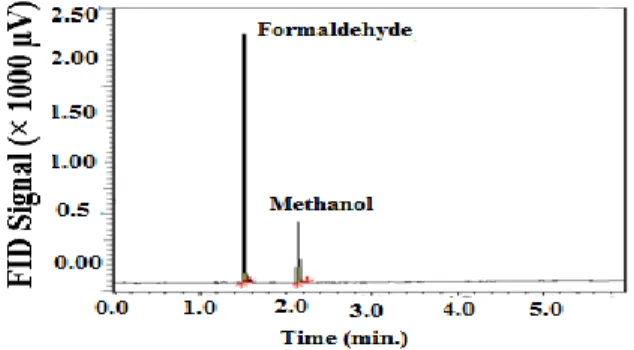
aerosolized water-based MWFs (Super Care nebulizer) in range of 0.5-5 µl under a chamber, by using a solid sorbent tube (10% (2-hydroxymethyl) piperidine on XAD-2, 120 mg/60 mg (SKC Co.) connected to a personal pump with a flow of 50ml/min. After the termination of sampling, the two sections of the XAD-2 tube were poured into two closed vials and 1ml of toluene (99.9% Merck Co.). The vials were sonicated in an ultrasonic bath for 60 minutes. Upon the termination of the extraction period, 1µl of each vial was injected into gas chromatography-flame ionization detector (GC-FID, Shimadzu GC-17A, made in Japan) with the splitless mode of injection. GC-FID was equipped with a capillary column (BP 20 with 30 m× 0.1 mm× 0.1 μm) was set for 2ml/min for the flow of carrier gas (N2 gas
with a purity of 99.999% purchased from (Mahan Gas Co.). The temperature of the injection port and the detector was 280 and 290 as oC, respectively. The
thermal programming of the GC oven for initial temperature was 40 oC with a gradient temperature rise
of 15oC/min to final 180oC [40]. In this method, the
detection of formaldehyde and methanol was achieved through a comparison of retention times of standards
prepared from formalin (Merck Co.) with the peaks observed with the MWFs samples.
The agreement of the analytical results of spiked standards and personal samples for lathe machine operators, analyzed by two methods (FT-IR of this method and NIOSH method 5524), were examined by the Bland-Altman plot. The agreement could be true when the differences between the two sets of data obtained from the two methods fall within two standard deviations (2SD) from the average of the differences [29, 39].
RESULTS AND DISCUSSION
The best absorption of the soluble oil used for water-based MWFs was in the range of 2796-3031cm-1 (Fig.
1). The merits of the analysis of FT-IR and NIOSH method 5524 as accuracy, precision, linear range concentrations, LOD, LOQ and bias were 103%, 1.49%, 0.96-960 µg/sample, 0.0004, 0.0014 µg/sample, -3%, and 111%,10.87%, 48-960 µg/sample, 14.9, 49.1 µg/sample and 11% respectively (Table 1).
Table 1: Comparative study of the merits of MWFs analysis by the FT-IR and NIOSH method No. 5542
Bias % LOQ
(µg/sample) LOD
(µg/sample) Precision
(%) R2
Accuracy (%)
Linear Dynamic
Range (µg/sample)
Method of
analysis
-11 49.1
14.9 10.87
0.9917 11
48-960
NIOSH 5542
-3 0.0014
0.0004 1.49
0.998 3
0.96-960
FT-IR
Not determined Not determined
0.03 7
Not determined 14
50-900
NIOSH 5542*
*Established by NIOSH standard method No. 5524
The agreement of results obtained using two analytical methods (FT-IR in this study and NIOSH method No. 5524), analyzing four sets identical spiked standards (n=32) by each method and along with of personal sampling obtained from industry (n=8) were examined separately by Bland and Altman graph. Since the differences of identical samples were less than two standard deviations in each graph, the agreement of the FT-IR method of analysis with NIOSH method 5524 applied in this study was established.
Qualitative analysis of formaldehyde by FT-IR analysis was checked by the absorption of the standard formalin solution against FT-IR spectrum of water-based MWFs in various ranges of the IR spectrum for the aldehyde functional groups of C-H (2850cm-1) and
a methanol functional group of O-H (3680cm-1) (Fig.
1). Direct detection of formaldehyde functional groups by FT-IR method was not possible and only methanol content of formalin could be detected through the O-H functional group. The presence of formalin (as a mixed solution of formaldehyde and methanol compounds) in MWFs was also examined by NIOSH method No.2541 and qualitative presence of formaldehyde and methanol was confirmed (Fig. 2).
Fig.1: FT-IR spectrum of used water-based MWFs with functional group of O-H, C-H and C-C stretch
Water-based MWFs are widely used in metal machining industries and workers' health risks in the form of respiratory irritants and even various cancer types were reported [40]. Despite the use of formaldehyde in form of formalin solution as a biocide in MWFs [11], the occupational exposure of metal machinists is just expressed as the soluble oil according to reference NIOSH method No. 5524 [8]. The same time the efficiency of the NIOSH method No. 5524 in Iran and possibly other developing countries, due to limited availability of advanced analytical balance with 10-6gr precision could be
compromised.
The merits of analysis of the NIOSH method No 5524 which were experimentally obtained in this study, did not produce as good results in terms of overall precision and accuracy, LOD and LOQ as reported in the original manuscript of NIOSH method. These differences could be due to the application of lesser precision analytical balance (10-5gr) instead of
microbalance (10-6gr). Generally, despite the
agreement of four sets spiked standards and along with actual personal samples of lathe workers analyzed by either FT-IR method of this study or NIOSH reference method, the developed method of this study demonstrated comparable performances compared with data obtained by using the reference NIOSH method No. Since, water-based MWFs were reported to contain toxic compounds such as formaldehyde [41], PAHs and endotoxin [42], analysis of toxic, carcinogenic substances such as formaldehyde could upgrade the monitoring program. Due to the toxicity of water-based MWFs and especially having formalin as a preservative, installation of the industrial ventilation system according to the standard of the ACGIH’s industrial ventilation document [43] required by executive organizations such as OSHA [44] and HSE [45], is recommended as a mandatory protective action the health of Iranian lathe workers.
CONCLUSION
This study offers an alternative method of analysis for water-based MWFs instead of NIOSH Method No. 5524 in the developing countries, which may not have precision analytical balance. Generally, the presence of formaldehyde in water-based MWFs, rationalize the need for a more precise technique in future studies and justification of installation of the industrial ventilation system.
ETHICAL ISSUES
Ethical issues such as plagiarism and chemical safety protocols for the laboratory personnel were observed by the authors of this study.
CONFLICT OF INTEREST
Authors have no conflict of interests
AUTHORS CONTRIBUTIONS
The experimental work of this study under the supervision of Azari, Zendehdel and respective advisors. The task of preparing this manuscript was carried out by Kamalifar and Rafieepour under the supervision of Azari.
FUNDING/ SUPPORTS
This project was carried out with the financial support of the School of Public Health at the Shahid Beheshti University of Medical Sciences (Grant No. 2195).
ACKNOWLEDGEMENTS
The authors would like to express their gratitude and thanks to the School of Public Health and Shahid Beheshti University of Medical Sciences for their financial support (Grant No. 2195) and Mega Motor Company for their cooperation with this project.
REFERENCES
[1] Byers JP. Metalworking fluids. 3th ed, Boca Raton: CRC Press: 2017; 64-68.
[2] Raynor PC, Kim SW, Bhattacharya M. Mist generation from metalworking fluids formulated using vegetable oils. Ann Occup Hyg. 2005; 49(4): 283-93. [3] Park D. The occupational exposure limit for fluid aerosol generated in metalworking operations: limitations and recommendations. Saf Health Work. 2012; 3(1): 1-10.
[4] National Institute for Occupational Safety and Health (NIOSH). Criteria for a recommended Standard: Occupational Exposure to Metalworking Fluids. DHHS Publication. Cincinati: 1998: 98-02. Available at: https://www.cdc.gov/niosh/docs/98-102/default.html.
[5] Gilbert Y, Veillette M, Mériaux A, Lavoie J, Cormier Y, Duchaine C. Metalworking fluid-related aerosols in machining plants. Journal of Occupational and Environmental Hygiene. 2010; 7(5): 280-89. [6] Kim S-b, Yoon C-s, Park D. Vaporization and Conversion of Ethanolamines used in Metalworking Operations. Safety and Health at Work. 2010; 1(2):175-82.
[7] Glaser R, Kurimo R, Neumeister C, Shulman S. Data Supporting ASTM Method D 7049-04, for Determination of Metalworking Fluids. Journal of Testing and Evaluation. 2005; 33(5): 323-30.
[9] Brinksmeier E, Meyer D, Huesmann-Cordes A, Herrmann C. Metalworking fluids-Mechanisms and performance. CIRP Annals - Manufacturing Technology. 2015; 64(2): 605-28.
[10] Misra S, Sköld RO. Lubrication studies of aqueous mixtures of inversely soluble components. Colloids and Surfaces A: Physicochemical and Engineering Aspects. 2000; 170(2): 91-06.
[11] Kargar M, Zare V, Amini J, Manafi Z. The Comparison of Practical Efficiency of Formaldehyde and non Formaldehyde Biocides on Predominant Microbial Population In Metal Working Fluids. Journal of Molecular and Cellular Research. 2014; 26(3): 353-64.
[12] Liu K-S, Huang F-Y, Hayward SB, Wesolowski J, Sexton K. Irritant effects of formaldehyde exposure in mobile homes. Environtal Health Perspectives. 1991; 94: 91-94.
[13] Arican RY, Sahin Z, Ustunel I, Sarikcioglu L, Ozdem S, Oguz N. Effects of formaldehyde inhalation on the junctional proteins of nasal respiratory mucosa of rats. Experimental and Toxicologic Pathology. 2009; 61(4): 297-05.
[14] Naserbakht A, Sadeghniat K. An investigation of respiratory symptoms and spirometry parameters in pathological laboratories employees. Zahedan Journal of Research in Medical Sciences. 2011; 13(5): 43-46. [15] Betenia N, Costello S, Eisen EA. Risk of cervical cancer among female autoworkers exposed to metalworking fluids. Scandinavian journal of work, environment & health. 2012: 78-83.
[16] Friesen MC, Betenia N, Costello S, Eisen EA. Metalworking fluid exposure and cancer risk in a retrospective cohort of female autoworkers. Cancer Causes & Control. 2012; 23(7): 1075-82.
[17] Colt JS, Friesen MC, Stewart PA, Donguk P, Johnson A, Schwenn M, et al. A case-control study of occupational exposure to metalworking fluids and bladder cancer risk among men. Occupational and Environtal Medicine. 2014; 71(10): 667–74.
[18] Mirer F. Updated epidemiology of workers exposed to metalworking fluids provides sufficient evidence for carcinogenicity. Applied Occupational and Environmental Hygiene. 2003; 18(11): 902-12. [19] Friesen MC, Costello S, Eisen EA. Quantitative exposure to metalworking fluids and bladder cancer incidence in a cohort of autoworkers. American Journal of Epidemiology. 2009; 169(12): 1471-78. [20] Shrestha D, Liu S, Hammond SK, LaValley MP, Weiner DE, Eisen EA, et al. Risk of renal cell carcinoma following exposure to metalworking fluids among autoworkers. Occupational and Environtal Medicine. 2016; 73(10): 656–62.
[21] American Conference of Governmental Industrial Hygienists (ACGIH), Threshold limit values for chemical substances and physical agents and
biological exposure indices. Cincinnati (OH): ACGIH. 2011.
[22] Health and Safety Executive (HSE). Methods for the Determination of Hazardous Substances, Health and Safety Laboratory, Measurement of oil mist from mineral oil-based metalworking fluid (MDHS 84). 1997.
[23] Iranian Ministry of Health and Medical Education (MOHME). Allowable occupational level of hazardous chemical and physical parameters of workplaces; Tehran, Iran. 2001.
[24] Glaser RA, Shulman S, Kurimo R, Piacitelli G. An evaluation of ASTM method P-42-97 for sampling and analysis of metalworking fluids. Applied Occupational and Environmental Hygiene. 2003; 18(11): 825-27.
[25] National Institute for Occupational Safety and Health (NIOSH). Method 5524 for "metalworking fluids”. In NIOSH Manual of Analytical Methods (NMAM), 4th ed., Edited by: Eller, P. M. and Cassinelli, M. Cincinnati, Ohio: NIOSH. DHHS/NIOSH Pub. No. 94-113. 2003.
[26] Wlaschitz P, Höflinger W. A new measuring method to detect the emissions of metal working fluid mist. Journal of Hazardous Materials. 2007; 144(3): 736-41.
[27] Canadian Association of Petroleum Producers (CAPP) by BC Research Inc. and Certified Industrial Hygiene Consulting Ltd. Oil Mist Monitoring Protocol Guide. 2004. Available from:
www.capp.ca/~/media/capp/customer portal/publications/85721.pdf.
[28] Verma DK, Shaw DS, Shaw ML, Julian JA, McCollin SA, Tombe Kd. An evaluation of analytical methods, air sampling techniques, and airborne occupational exposure of metalworking fluids. Journal of Occupational and Environmental Hygiene. 2006; 3(2): 53-66.
[29] National Institute for Occupational Safety and Health (NIOSH). Manual of Analytical Methods, Method No. 5026, issue 2: "Oil Mist, Mineral", Fourth ed: NIOSH Publication, Washington, DC. 1996. [30] Derrick MR, Stulik D, Landry JM. Infrared spectroscopy in conservation science. Getty Publication. Los Angeles: 1999.
[31] Robinson JW, Frame ES, Frame II GM. Undergraduate instrumental analysis. 7th ed, New York: CRC Press: 2014.
[32] Asgari M, Azari MR, Zandehdel R, Khodakarim S, Rafieepour A, Tavakol E, et al. Development of a New Method for Analysis of Oil Mists. Health Scope. 2017; 6(3): 1-6.
Fourth ed: NIOSH Publication, Washington, DC. 1994.
[34] Merck. Formaldehyde solution: Sigma-Aldrich Co. 2017. Available from:
http://www.sigmaaldrich.com/catalog/product/sial/53 3998?lang=en®ion=IR.
[35] Schaefer C, Peters PW, Miller RK. Drugs during pregnancy and lactation: treatment options and risk assessment. 3th ed, London: Academic Press: 2014. [36] Klein D. Organic Chemistry As a Second Language: Second Semester Topics. 4 ed: John Wiley & Sons, Inc; 2016.
[37] Rajesh K, Shajesh P, Seidel O, Mukundan P, Warrier KG. A Facile Sol–Gel Strategy for the Synthesis of Rod- Shaped Nanocrystalline High -Surface- Area Lanthanum Phosphate Powders and Nanocoatings. Advanced Functional Materials. 2007; 17(10): 1682-90.
[38] Yan Y, Faber AJ, De Waal H. Luminescence quenching by OH groups in highly Er-doped phosphate glasses. Journal of Non-Crystalline Solids. 1995; 181(3): 283-90.
[39] Bland JM, Altman DG. Statistical methods for assessing agreement between two methods of clinical measurement. International Journal of Nursing Studies. 2010; 47(8): 931-36.
[40] Schwarz M, Dado M, Hnilica R, Veverková D. Environmental and Health Aspects of Metalworking Fluid Use. Polish Journal of Environmental Studies. 2015; 24(1): 37-45.
[41] Aalto- Korte K, Kuuliala O, Suuronen K, Alanko K. Occupational contact allergy to formaldehyde and formaldehyde releasers. Contact Dermatitis. 2008; 59(5): 280-89.
[42] Suuronen K, Henriks-Eckerman M-L, Riala R, Tuomi T. Respiratory exposure to components of water-miscible metalworking fluids. annals of occupational hygiene. 2008; 52(7): 607-14.
[43] American Conference of Governmental Industrial Hygienists (ACGIH). Industrial Ventilation: A Manual of Recommended Practice for Design. 29th ed: American Conference of Governmental Industrial Hygienists; 2016.
[44] J. Sheehan M. Final report of the OSHA metalworking fluids standards advisory committee. Washington, DC. US Department of Labor OSHA, 1999.