International Journal of Research in Engineering & Applied Sciences
Email:- [email protected], http://www.euroasiapub.org
1
Optimization of Land and Water Resources in Nanakamatta Canal Command of
Uttarakhand using Fuzzy Linear Programming
Vivekanand1 M-Tech Scholar,
G.B.Pant University of Agriculture & Technology, Pantnagar, Uttarakhand, INDIA
Vinod Kumar2 Professor
Department of Irrigation and Drainage Engineering, GBPUA&T, Pantnagar, Uttarakhand, INDIA.
Abstract
:The objective of this study is to develop fuzzy linear planning model for optimization of land and water resources in Nanakmatta canal command of Udham Singh Nagar district of Uttarakhand (India). The multi objective fuzzy linear programming (MOFLP) was applied for maximization of the crop sown area and net return (NR). The linear membership functions were developed from the linear programming (LP) results and objectives were fuzzified over the tolerance range.The significant increase in the value of level of satisfaction (λ) was found from 0.5525 to 0.5825 by using the MOFLP model based on maximum approach. Fuzzy Linear Programming (FLP) solution yields a net benefit of 84.61 million rupees against net sown area of 1856.40 ha under normal rainfall with a satisfaction level (λ) of 0.5855 and 75.98 million rupees against net sown area of 1627.90 ha under 50% probability rainfall condition with a satisfaction level (λ) of 0.5525.Keywords:optimization, maximization, multi-objective, Fuzzy Linear Programming
I.
Introduction
Day by day the world’s population is increasing at an alarming rate resulting in increasing demand of food and fiber. On the other hand, per capita land and water resources are decreasing at alarming rate. Water is valuable natural resource, which is used for agriculture, recreation and industrial purpose [1]. Due to industrialization and population growth the demand and utilization of water is increased which resulted in increased pressure on the water resources. The major portion of the water resource is used in agriculture sector for irrigation purpose to enhance the crop production. Due to growing demand for domestic and industrial purpose the share of the irrigation water is diverted for industries, recreation and drinking purpose. Therefore, it is need of the time to utilize the available water resources optimally and judiciously.
Optimization techniques provide a powerful tool for analysis of problems that are formulated with single quantifiable objectives. However, the real-world decision- making problems usually require consideration of multiple, conflicting and non- commensurable criteria. The decision problems like crop area planning involve multi-criteria decision making, where the decision maker generally follows a satisfying solution rather than the maximization objectives [2].Many single as well as multiple objective crop area allocation models were developed in the past [3], [4], [5], [6], [7].
International Journal of Research in Engineering & Applied Sciences
Email:- [email protected], http://www.euroasiapub.org
2
throughout the entire research of the planning process. There are different reasons behind this. Some multi-criteria methods require information that is difficult to obtain in real-world surroundings. Thus there is a need to use linear fuzzy programming techniques for their simplicity in computation and flexibility in implementation. In this study the goal was maximization of net benefit and maximization of cropped area under the available of land and water resources. Multi-objective programming techniques allow to satisfy these conflicting Multi-objectives. Many researchers used fuzzy programming technique in the past mainly for land and water resources management [9], [11], [12], [13].The multi-objective techniques used in the study were Linear Fuzzy Programming under different rainfall conditions. In this study canal surface water and total permissible annual ground water draft was taken equal to the recharge from the rainfall in the command under different rainfall patterns. There were two objective functions benefit maximization and maximization of cropped area.
The Tarai region of the Uttarakhand state of India is of moderate climate and the main occupation of the inhabitation of this region is agriculture. Almost 75% population of this region is dependent on agriculture for their livelihood. Rice, wheat, maize, and some of the pulses are the main crops grown by the farmers of this region. These products not only feed the inhabitation of this region but some of the rice, wheat and pulses are sent to the other parts of the country. The area is bestowed with plenty of water resources and large flat agricultural land and therefore, the optimal planning for land and water resources is necessary to check the misuse.
II.
Materials and Methods
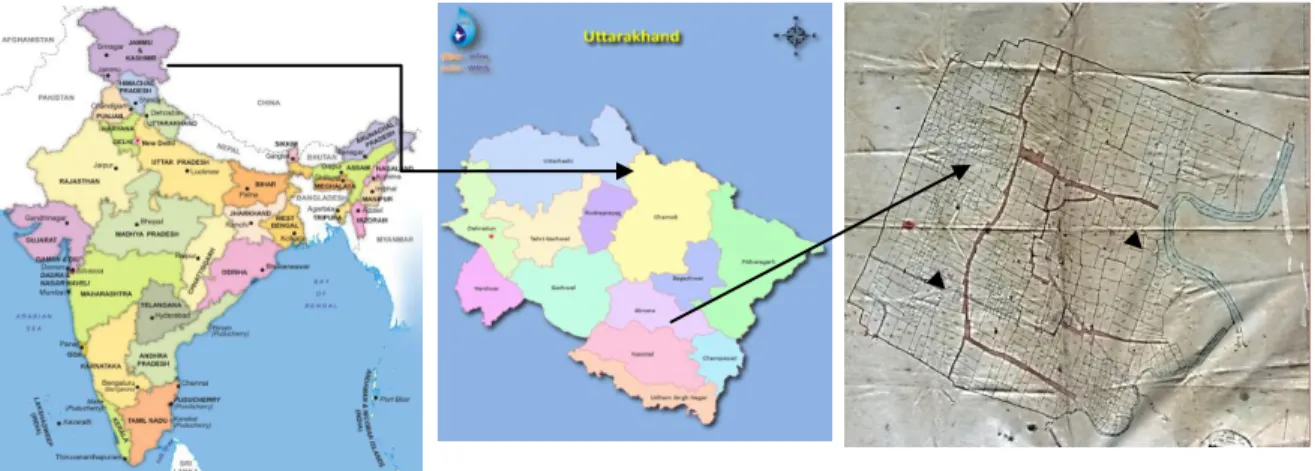
The study was under taken in the Nanakmatta canal command located in Sitarganj Tahsil of Udham Singh Nagar district which is located between 28º 45ʹ N to 29º 23ʹN latitude and laterally extends between 78º 45ʹ E to 80 º 08ʹ longitudes. The Nanakmatta canal originates from Nanak Sagar dam located about 12 km away from the tahsil head quarter. The head discharge of the canal was4.773 (58 cusec). Total length of canal is 13.64 km. The total Cultural Command Area (CCA) was 1236 ha. Agriculture practices in the Nanakmatta canal command area revolve around two main seasons namely Kharif and Rabi. The sowing in the Kharif season (summer crops) begins generally with the onset of southwest monsoon in mid June, while the Rabi season (winter crops) starts with beginning of cold weather i.e., by the end of the month of October or early November. The important crop grown in Kharifseason is rice and that in the Rabi season is wheat.The index map of the study areais shown in Figure 1.
International Journal of Research in Engineering & Applied Sciences
Email:- [email protected], http://www.euroasiapub.org
3
Linear programming modelThe two objective functions being considered, under present study were maximization of crop area and net benefits. Mathematical linear modeling with two objectives with the linear constraints is explained in below.
Model description
i) Maximization of net return: Considering the economic objective of net benefit maximization is commonly considered in the planning area problems and farmers often prefer cropping patterns which can provide more benefits. So mathematically, it can be formulated as:
Max Z1 = ij n
i i j
X R
1
2
1
i=1……n, j=1, 2 … (1)
where, Ri = Net return from the ith crop activity (Rs/ha), Xij= area under crop activity i
during season j (i=1 for paddy, i=2 for wheat, i=3 for sugar cane, i=4 for barseem, i=5 for maize, i=6 for potato and i=7 for cowpea); j = 1 for Rabi and 2 for Kharif season.
ii) Maximization of cropped area: Considering the utility of irrigated agriculture over the rainfed one, the cropped area maximization objective has been introduced in the model formulation. It can be written mathematically as follows:
Max Z2 = ij n
i j
X
∑
1 2
1
i=1……n, j=1….2 … (2)where, j i
X area (ha) under the crop activity i during season j.
Model Constraints:
The model was subjected to the following constraints:
i) Water requirement:The irrigation water demand of all the crops in any month should utmost equal to the total water available.
k j
i n
i k
i X GW
W
k
1
CW i=1…n, j=1,2 k=1….12 …(3)
where, Wikis the total irrigation water used for production of crop i (ha-cm) during month
k, CWk and GWk are the canal water availability at field (= canal water availability at head x
conveyance efficiency) and ground water availability during month k. (k = 1 for January to 12 for December). The conveyance efficiency of the canal system has been taken as 60 percent.
ii) Annual groundwater extraction constraint: The total groundwater use should not exceed the annual allowable groundwater extraction:
AGW
GW
k
k
12
1
k=1…..12 … (4)
where AGW is the allowable annual groundwater extraction (ha-cm) in the command. iii) Total cultivable land constraint: The land allocated to different crops in any month should
International Journal of Research in Engineering & Applied Sciences
Email:- [email protected], http://www.euroasiapub.org
4
k n i j i
A
X
≤
∑
1 i=1….n, j=1, 2 k=1…..12 … (5)
Where Ak is the total cultivable area available during jth season in the command (ha) andXij
is the area under ith crop during jth season (ha).
iv) Affinity Constraints: The area allocated to a crop should be less than the maximum area allotted for that crop in the command area.
j i
X ≤ Aijmax i = 1….n, j=1,2 …(6)
v) Non-negativity constraints: This restriction states that all decision variables of model should be non-negative.
j i
X
≥ 0 and GWk ≥ 0 … (7)Multi-objective Fuzzy Linear Programming Model
The fuzzy objective function is characterized by its membership function, which plays as substitute characterization of preference in determining the preferred outcome for each of the objectives. Membership function for the tth objective denoted by [μZ(x)] and should have the
following conditions: μZ(x)= m t t t m t t Z x Z x Z Z x Z Z x ) ( Z if 0 ) ( if 1 ) ( 0 ) ( Z if 1 t * * t
…(8)In the present problem, a linear membership function has been used and thus the equation 8 changes to
µi(x) =
L U L L U L UZ
Z
Z
Z
Z
Z
Z
Z
Z
Z
if
0
if
Z
if
1
… (9) where,ZL = lowest acceptable level of objective function; andZU = maximum level of objective function.
International Journal of Research in Engineering & Applied Sciences
Email:- [email protected], http://www.euroasiapub.org
5
Figure 2. Linear membership function for objective ZThe µi(x) reflects the degree of achievement and its value will be “1” for perfect
achievement and “0” for no-achievement (worst achievement) of a given strategy and some intermediate values otherwise. The model can be transformed as follows:
Maxx ≥0 mini
L U
L
Z
Z
Z
Z
… (10)
subjected to the constraints A X ≤ B
X ≥ 0
where, A is technological coefficient matrix of m x n and B is the column vector generally for resource of the order (m x 1).
Introducing new variable λ, the Fuzzy Linear Program can be formulated as equivalent Linear Program model with objective function Max λ, subject to
L U
L
Z
Z
Z
Z
≥ λ for each objective function
A X ≤ B
0 ≤ λ ≤ 1and X ≥ 0
The solution of above formulated Fuzzy Linear Programming model was solved by following steps:
1.
The problem was considered as a linear programming model by taking one objective at a time.2.
From step 1, corresponding values of each objective was determined for each derived solution.3.
From step 2, best (ZU) and worst (ZL) values for each objective was calculated.4.
The linear membership function were formulated for each objective functions.5.
The equivalent Linear Programming model for the fuzzy objective problem was formulated as defined above.International Journal of Research in Engineering & Applied Sciences
Email:- [email protected], http://www.euroasiapub.org
6
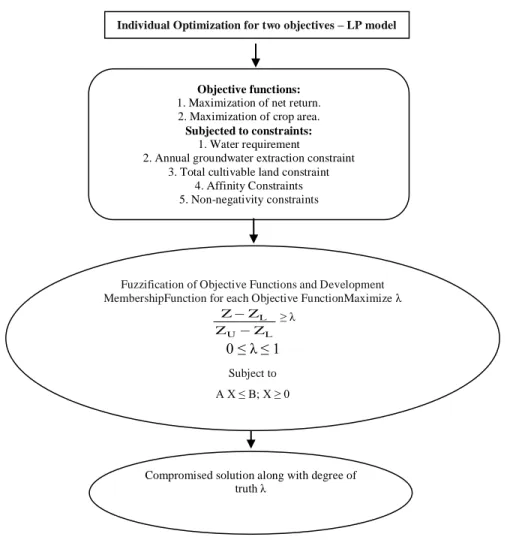
The overall schematic diagram of solving the fuzzy linear programming model is shown in Fig 3III.
Result and Discussions
Multi objective fuzzy linear programming (MOFLP) problem considers fuzzy input data by fuzzy membership functions. The assumption of the method is that, the objectives and constraints are in an imprecise and uncertain situation can be represented by fuzzy sets. The fuzzy objective function can be maximized or minimized. In fuzzy linear programming the fuzziness of available resources are characterized by the membership function over tolerance range. In the present study MOFLP model is developed and applied for the Nanakmatta canal command. The two objectives under considerations are Net Return (NR) and maximize crop area respectively for under normal rainfall condition and 50 percent probability rainfall condition.
Initially in MOFLP model the fuzziness is considered only in the objective function and the constraints are crisp in nature. The MOFLP model is solved as per the procedure given in the methodology. These objective functions are maximized separately subjected to constraints (Eqs. 1–7) using the LINGO (Language for Interactive General Optimization). The results of this individual maximization of the two different objectives are used to develop the membership function for each objective taking the help of the best/upper ZU(+) and worst/lower ZL(−) value of the same. The best/upper
and worst/lower values of the objective function after comparison under normal rainfall condition is presented in Table 1.
Figure 3. Schematic diagram of solving fuzzy linear programming
Individual Optimization for two objectives – LP model
Objective functions:
1. Maximization of net return. 2. Maximization of crop area.
Subjected to constraints:
1. Water requirement
2. Annual groundwater extraction constraint 3. Total cultivable land constraint
4. Affinity Constraints 5. Non-negativity constraints
Fuzzification of Objective Functions and Development
MembershipFunction for each Objective FunctionMaximize λ
L U
L
Z Z
Z Z
≥ λ
0 ≤ λ ≤ 1
Subject to
A X ≤ B; X ≥ 0
International Journal of Research in Engineering & Applied Sciences
Email:- [email protected], http://www.euroasiapub.org
7
Table 1Best/upper and worst/lower values of the objective function after comparison under normal rainfall condition.
Objective function (Z) Maximize net return (Rs) Maximize crop area (ha)
ZU 85785500.00 1946.70
ZL 82962601.72 1728.90
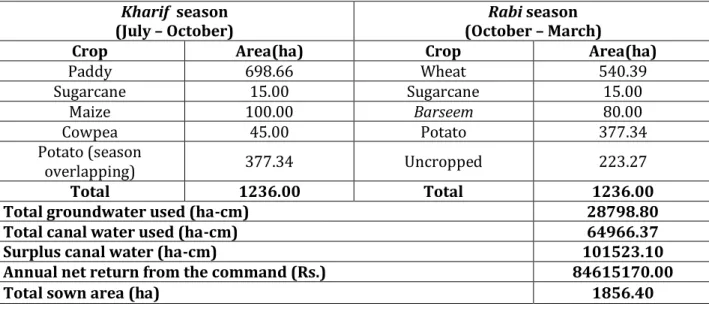
The optimal resource utilization plan for maximization of net return from the crop activities and maximization of land use under normal rainfall conditions for the Nanakmatta canal command system is shown in Table 2.
Table 2 Optimal cropping pattern under normal rainfall condition in the Nanakmatta canal command system
Kharif season (July – October)
Rabi season (October – March)
Crop Area(ha) Crop Area(ha)
Paddy 698.66 Wheat 540.39
Sugarcane 15.00 Sugarcane 15.00
Maize 100.00 Barseem 80.00
Cowpea 45.00 Potato 377.34
Potato (season
overlapping) 377.34 Uncropped 223.27
Total 1236.00 Total 1236.00
Total groundwater used (ha-cm) 28798.80
Total canal water used (ha-cm) 64966.37
Surplus canal water (ha-cm) 101523.10
Annual net return from the command (Rs.) 84615170.00
Total sown area (ha) 1856.40
It was observed from Table 2 that paddy during Kharif season and wheat during Rabi season occupies maximum area but slightly lower than that under existing cropping pattern. This reduction in the area of paddy and wheat is due to the reduced availability of ground water that was restricted to be within the safe limit of ground water development stage. The area under potato crop has increased drastically because of higher return as compared to that of wheat and early planting (month of October). The area under other crops was within the specified limits superimposed in the model. The fuzzified optimal plan resulted in annual return of Rs. 84.615 millionagainst net sown area of 1856.40 ha. A total of 101523.10ha-cm of canal flow remained unutilized during low demand months, therefore, more area could be brought under sowing through re-scheduling of canal water flows during higher water demanding months. This will not only increase the net return but also increase the net sown area in the command and will reduce burden over the ground water draft.
Table 3 Best/upper and worst/lower values of the objective function after comparison under 50 percent probability rainfall condition.
Objective function (Z) Maximize net return (Rs.) Maximize crop area (ha)
ZU 77853370.00 1746.60
ZL 73670486.36 1481.40
International Journal of Research in Engineering & Applied Sciences
Email:- [email protected], http://www.euroasiapub.org
8
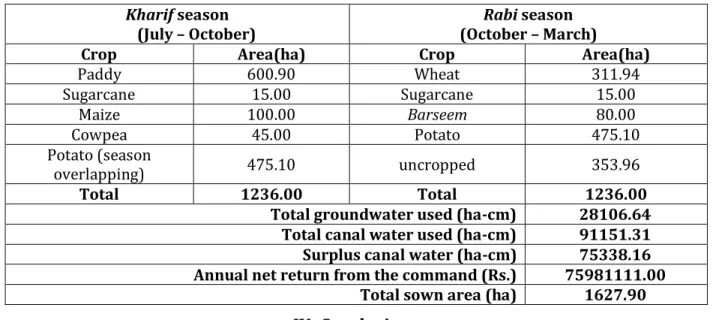
It may be observed from Table 4 that paddy during Kharif season and wheat during Rabi season occupies the maximum area but the wheat area during Rabi season reduced drastically due to increased irrigation demand owing to lesser rainfall received at 50 percent probability. The land left by wheat remained uncropped due to restricted and lower ground water availability because of lower recharge of aquifer. The area under potato crop has also decreased as compared to that under normal rainfall conditions (Table 2) because of lower water availability and higher irrigation demand. The area under other crops was within specified limits superimposed in the model. The fuzzified optimal plan resulted in annual return of Rs. 75.981 millionagainst net sown area of 1627.90 ha. A total of 75338.16 ha-cm of canal flow remained unutilized during low demand months, therefore, more area could be brought under sowing through re-scheduling of canal water flows during higher water demanding months. This will not only increase the net return but will also increase net sown area in the command and reduced burden over the ground water draft.Table 4 Optimal cropping pattern under 50 percent probability rainfall condition in the Nanakmatta canal system command
Kharif season (July – October)
Rabi season (October – March)
Crop Area(ha) Crop Area(ha)
Paddy 600.90 Wheat 311.94
Sugarcane 15.00 Sugarcane 15.00
Maize 100.00 Barseem 80.00
Cowpea 45.00 Potato 475.10
Potato (season
overlapping) 475.10 uncropped 353.96
Total 1236.00 Total 1236.00
Total groundwater used (ha-cm) 28106.64 Total canal water used (ha-cm) 91151.31 Surplus canal water (ha-cm) 75338.16 Annual net return from the command (Rs.) 75981111.00
Total sown area (ha) 1627.90
IV.
Conclusions
The MOFLP model was developed and applied for the Nanakamatta canal command in U.S.Nagar Uttarakhand, India. Based on the study following conclusion were drawn:
a) Under normal rainfall conditions, the fuzzified optimal plan, resulted in annual return of Rs. 84.615 million against net sown area of 1856.40 ha for optimized value λ=0.5855. A total of 101523.10 ha-cm of canal flow remained unutilized during low demand months (July, August and September) however, the groundwater was completely utilized with maximum use during month of October.
b) The fuzzified optimal plan, under 50 percent probability rainfall, resulted in annual return of Rs. 75.981 million against net sown area of 1627.90 ha at optimized value of λ=0.5525. A total of 75338.16 ha-cm of canal flow remained unutilized during low demand months which indicated that more than 25 percent canal water was consumed to cater irrigation water demand as compared to that under normal rainfall conditions.
International Journal of Research in Engineering & Applied Sciences
Email:- [email protected], http://www.euroasiapub.org
9
only increase the net return but will also increase the net sown area in the command and reduced burden over the groundwater draft.V. References
[1] Shinde, S.E. Ingle, P.M. Mane, M.S. Thokal, R.T. and Ayare B.L. 2015.Optimal cropping pattern for sustainable water use in canal command area. Research Journal of Recent Sciences.Vol. 3(4), 25-28.
[2] Gupta, A.P., Harboe, R. and Tabucanon, M.T. 2000. Fuzzy multiple criteria decisionmaking for crop area planning in Narmada river basin. Agricultural Systems, 63: 1-18.
[3] Laxminarayana, V. and Rajagopalan, S. P. 1977. Optimum cropping pattern in a river basin. J. Irrigation and Drainage Div. ASCE 103: 53–70.
[4] Maji, C.C. and Earl O. Heady. 1980. Optimal reservoir management and crop planningunder deterministic and stochastic inflows. Journal paper No.J-9623 of the Iowa Agricultural and Home Economics Experiment Station, Ames, Iowa, Project No.2104.
[5] Paudyl, G N. and Gupta, A.D. 1990. Irrigation planning by multi level optimization. J. of Irrigation and Drainage. Engg. ASCE 116(2), 273-291.
[6] RajuK. Srinivasa and NageshKumar D. 2000. Irrigation Planning of Sri Ram Sagar project using multi-objective fuzzy linear programming. ISH Journal of Hydraulic Engineering, VOL. 6, 2000, NO. 1
[7] Sahoo, B., Lohani, A. K. andSahu, R. K. 2006. Fuzzy multi-objective and linearprogramming based management models for optimal land-water-crop system planning. Water Resources Management. 20 : 931–948.
[8] Cohon, J. L. and Marks, D. 1973. A review and evaluation of multi-objectivetechniques’, Water Resour. Res., 16(1), 14–20.
[9] Eswarmurty, K., Govindaswamy, R. and Singh, I. 1989. Integrated use of water resources inthe lower Bhavani Project in India. Int. J. Water Resour. Dev. 5(4), 279–286.
[10] Yang, T. C. and Yu, P. S. 2006. Application of Fuzzy multi-objective function on reducing groundwater demand for aquaculture in land-subsidence areas. Water Resources Management. 20: 377–390.
[11] Sharma, D. K., Jana, R. K. And Gaur, A. 2007. Fuzzy goal programming for agriculturalland allocation problems. Yugoslav Journal of Operations Research, 1 (17) : 31-42.
[12] Gates, T. K., Heyder, W. E., Fontane, D. G. and Salas, J. D. 1991. Multicriterion strategicplanning for improved irrigation delivery. I: Approach. J. Irrig. Drain Engg. 117 : 897-913.