Online Learned Discriminative Part-Based
Appearance Models for Multi-Human Tracking
Bo Yang and Ram Nevatia
Institute for Robotics and Intelligent Systems, University of Southern California Los Angeles, CA 90089, USA
{yangbo,nevatia}@usc.edu
Abstract. We introduce an online learning approach to produce dis-criminative part-based appearance models (DPAMs) for tracking multi-ple humans in real scenes by incorporating association based and cate-gory free tracking methods. Detection responses are gradually associated into tracklets in multiple levels to produce final tracks. Unlike most pre-vious multi-target tracking approaches which do not explicitly consider occlusions in appearance modeling, we introduce a part based model that explicitly finds unoccluded parts by occlusion reasoning in each frame, so that occluded parts are removed in appearance modeling. Then DPAMs for each tracklet is online learned to distinguish a tracklet with others as well as the background, and is further used in a conservative cate-gory free tracking approach to partially overcome the missed detection problem as well as to reduce difficulties in tracklet associations under long gaps. We evaluate our approach on three public data sets, and show significant improvements compared with state-of-art methods.
Key words: multi-human tracking, online learned discriminative mod-els
1 Introduction
Tracking multiple targets in real scenes remains an important topic in computer vision. Most previous approaches can be classified into Association Based Track-ing (ABT) or Category Free TrackTrack-ing (CFT); ABT is usually a fully automatic process to associate detection responses into tracks, while CFT usually tracks a manual labeled region without requirements of pre-trained detectors. This paper aims at incorporating merits of both ABT and CFT in a unified framework. A key aspect of our approach is online learning discriminative part-based appear-ance models for robust multi-human tracking.
Association based tracking methods focus on specific kinds of objects,e.g., humans, faces, or vehicles [1–5]; they use a pre-trained detector for the con-cerned kind of objects to produce detection responses, then associate them into tracklets,i.e., track fragments, and produce final tracks by linking the tracklets in one or multiple steps. The whole process is typically fully automatic. On the contrary, category free tracking methods, sometimes called “visual tracking” in previous work, continuously track a region based on manual labels in the first frame without requirements of pre-trained detectors [6–8].
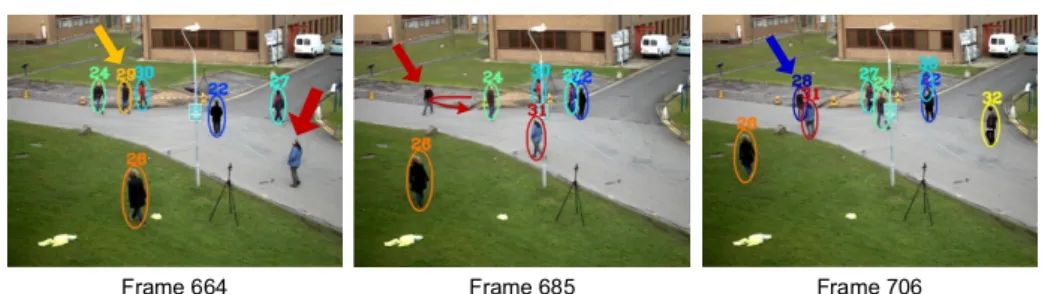
Frame 664 Frame 685 Frame 706
Fig. 1.Limitations of previous association based tracking methods. See text for details. initialization track solution motion cue association based tracking auto & imperfect global available category free tracking manual & perfect individual unavailable
Table 1.Comparison of association based tracking with category free tracking.
We focus on automatically tracking multiple humans in real scenes. As hu-mans may enter or exit scenes frequently, manual initialization is impractical. Therefore, association based tracking is frequently adopted in previous work for this problem [1–4]. In the ABT framework, linking probabilities between tracklet pairs are often defined as
𝑃𝑙𝑖𝑛𝑘(𝑇𝑖→𝑇𝑗) =𝑃𝑎(𝑇𝑖→𝑇𝑗)𝑃𝑚(𝑇𝑖→𝑇𝑗)𝑃𝑡(𝑇𝑖→𝑇𝑗) (1)
where𝑃𝑎(⋅),𝑃𝑚(⋅), and𝑃𝑡(⋅) denote appearance, motion, and temporal linking
probabilities. 𝑃𝑡(⋅) is often a binary function to avoid temporally overlapped
tracklets to be associated, and designs of𝑃𝑎(⋅) and𝑃𝑚(⋅) play an important role
in performance. A global optimal linking solution for all tracklets is often found by a Hungarian algorithm [9, 10] or network flow methods [1, 4].
However, in most previous ABT work, occlusions are not explicitly consid-ered in appearance models for calculating𝑃𝑎(⋅), leading to a high likelihood that
regions of one person are used to model appearances for another. In addition, ABT only fill gaps between tracklets but does not extend them; hence missed detections at the beginning or end of a tracklet cannot be corrected for associ-ations. An example is shown in Figure 1; the man in blue is missed from frame 664 until frame 685 due to failure of detectors. Moreover, to compute𝑃𝑚(⋅) in
Equ. 1, it is often assumed that humans move linearly with a stable speed; this assumption would be problematic for long gaps. For example, in Figure 1, person 29 in frame 664 and person 28 in frame 706 are actually the same person but his track is fragmented due to the failure of the detector during the direction change.
One possible solution to overcoming the detection limitation is to use cate-gory free tracking methods. However, it is difficult to directly use CFT in as-sociation based tracking due to differences in many aspects, as shown in Table 1. First, CFT starts from a perfect manually labeled region; however, in our problem, automatic initialization is provided by an pre-learned detector, and some detections may be imprecise or false alarms. Second, CFT methods often find best solutions for one or few targets individually; however, in multi-target tracking, a global solution for all targets is more important. Finally, CFT often
Tracklets Association Select Tracklets for Category Free Tracking ... +1 -1 Video Frames Pedestrian Detector Occlusion Reasoning for Human Parts Head Tail Tail ... ... ... ... ... +1 -1 Head Tail
...
Learning Appearance Model 1 Learning Appearance Model 2...
Conservative Category Free Tracking +1 -1 ... ... Learning Global Appearance Model Motion CuesCollect Training Samples for Category Free Tracking
Collect Training Samples from All Tracklets Tracklet Legend Detection Response Low Level Association
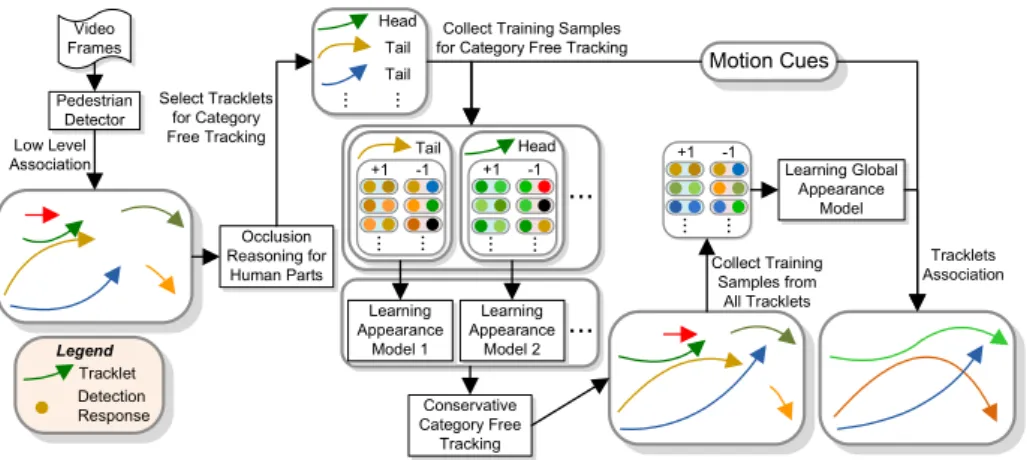
Fig. 2.Tracking framework of our approach. Colors of detection responses come from their tracklets’ colors, and black circles denote samples extracted from backgrounds. Head or tail are the earliest or latest parts of a tracklet. Best viewed in color.
ignores motion cues, to deal with abrupt motion, while most multi-human track-ing problems focus on surveillance videos where people are unlikely to change motion directions and speeds much in a short period,e.g., 4 or 5 frames.
We propose a unified framework that finds global tracking solutions while in-corporating the merits of category free tracking with little extra computational cost. We introduce the online learned Discriminative Part-based Appearance Models (DPAMs) to explicitly deal with occlusion problems and detection limi-tations. The system framework is shown in Figure 2. A human detector is applied to each video frame, and detection responses in neighboring frames are conser-vatively associated into tracklets. Then based on occlusion reasoning for human parts, we select tracklets that are reliable for CFT. DPAMs for each tracklet are online learned to differentiate the tracklet from backgrounds and other possibly close-by tracklets. A conservative CFT method is introduced to safely track re-liable targets without detections, so that missing head or tail parts of tracklets are partially recovered and gaps between tracklets are reduced making linear motion estimations more precise. Finally a global appearance model is learned, and tracklets are associated according to appearance and motion cues.
We emphasize that the category free tracking module in our framework is not proposed to find specific targets from “entry to exit” as most existing CFT methods do, but is used for extrapolating the tracklets and enabling associations to be made more robustly.
The contributions of this paper are:
– A unified framework to utilize merits of both ABT and CFT.
– Part based appearance models to explicitly deal with human inter-occlusions.
– A conservative category free tracking method based on DPAMs.
The rest of the paper is organized as follows: Section 2 discusses related work; building part-based feature sets is described in Section 3; Section 4 intro-duces the online learning process of DPAMs and the conservative CFT method; experiments are shown in Section 5, followed by conclusion in Section 6.
2 Related Work
Tracking multiple humans has attracted much attention from researchers. To deal with large number of humans, many association based tracking approaches have been proposed [11, 5, 2]. These approaches detect humans in each frame and gradually associate them into tracks based on motion and appearance cues. Appearance models are often pre-defined [9, 4] or online learned [1, 12, 13]. Oc-clusions are often ignored [13, 2] or modeled as potential nodes in an association graph [4, 1], but have not been used explicitly for appearance modeling, indi-cating high possibilities that parts used for modeling appearances of a person belong to other individuals. Moreover, performance of ABT is constrained by detection results; missed detections in the beginning or ends of a track cannot be recovered, and tracklets with long gaps between them are difficult to associate according to the commonly used linear motion model [9, 14, 10].
Category free tracking methods do not depend on pre-learned detectors, and appearance models are often based on parts to deal with partial occlusions [6–8]. However, CFT focuses on single or a few objects individually without finding a global solution for all targets, and is difficult to deal with large number of targets due to high complexity. In addition, CFT methods are often sensitive to initialization; once the tracking drifts, it is difficult to recover. If the initialization is imprecise or even a false alarm, the proposed tracks would be problematic.
Note that some previous work also adopts CFT techniques into multi-target tracking problems [9, 3, 15]. However, CFT is often used to generate initial track-lets, which may include many false tracklets or miss some tracklets without care-fully tuning the initialization thresholds for each video. However, we use conser-vative CFT methods to reduce association difficulties and missed detections in an association based framework, but we do not rely it on finding whole tracks. Some previous work also uses parts in tracking [16, 17]; however, only separated persons with few inter-occlusions are considered in [16] while our scenarios are more crowded with frequent occlusions. Parts in [17] are used for detection but not for appearance modeling in tracking as we did.
3 Building Part-Based Feature Sets for Tracklets
In order to improve efficiency, we track in sliding windows one by one instead of processing the whole video at one time. In the following, we will use the term current sliding window to refer to the sliding window being processed.
Given the detection responses in the current sliding window, we adopt the low level association approach as in [13] to generate reliable tracklets from con-secutive frames. These tracklets are then associated in multiple steps.
An appearance model for a tracklet𝑇𝑘 includes two parts: a set of features
𝐹𝑘 ={𝑓𝑘1, 𝑓𝑘2, . . . , 𝑓𝑘𝑛} and a set of weights𝑊 ={𝑤1, 𝑤2, . . . , 𝑤𝑛}. The features
could be color or shape histograms extracted from some regions of responses in the tracklet, and there is a unique𝐹𝑘 for each𝑇𝑘. The set of weights measures
importance of features and is often shared between multiple tracklets. We will use the termappearance modelsto represent the set of weights for clarity. Given
1
2 3
4 5
6 7
8 9 10 11 12 13 14 15 9
7
7
7
5
5
5
5 24
58
(a) (b) (c)
x x
y y
Fig. 3.Illustrations for human parts: (a) parts definition for a normalized 24×58 human detection response; 15 squares are used to build part-based appearance models, their sizes are shown in blue numbers; (b)(c) show automatic occlusion inference results in real scenes; visible parts for each person are labeled with the same color, and occluded parts are not shown and not used for appearance modeling. Best viewed in color.
as ∑𝑖𝑤𝑖ℎ𝑖(𝑓𝑗𝑖, 𝑓𝑘𝑖), where ℎ𝑖(⋅) is an evaluation function for two features, e.g.,
Euclidean distances or correlation coefficient between two vectors.
A tracklet𝑇𝑘is defined as𝑙𝑘detected or interpolated responses in consecutive
frames from time 𝑡1
𝑘 to 𝑡𝑙𝑘𝑘 as 𝑇𝑘 = {𝑑1𝑘, . . . , 𝑑𝑙𝑘𝑘}, where 𝑙𝑘 is the length of
𝑇𝑘. We produce two feature sets 𝐹𝑘ℎ𝑒𝑎𝑑 and 𝐹𝑘𝑡𝑎𝑖𝑙, including features modeling
appearances of 𝑇𝑘’s head and 𝑇𝑘’s tail, i.e., the earliest or latest parts of 𝑇𝑘,
respectively. Appearance linking probability from𝑇𝑘 to𝑇𝑗 is evaluated on𝐹𝑘𝑡𝑎𝑖𝑙
and𝐹ℎ𝑒𝑎𝑑
𝑗 using a set of appropriate weights𝑊.
In order to explicitly consider occlusions, features are extracted from parts instead of from whole human responses. As shown in Figure 3(a), we use 15 parts to represent a human so that the parts are not too large to model occlusions and not too small to include meaningful features. Each response𝑑𝑖
𝑘 is normalized into
24×58 and is a union of the 15 parts defined as𝑑𝑖
𝑘={𝑟𝑘𝑖(1), 𝑟𝑖𝑘(2), . . . , 𝑟𝑘𝑖(15)}.
Each𝑟𝑖
𝑘(𝑢) is a set of features extracted from part𝑢; for example,𝑟𝑘𝑖(1) include
the color histogram or the hog feature of part 1. If part u is occluded, all features in 𝑟𝑖
𝑘(𝑢) are invalid, as they may not come from the concerned human. In this
section, we aim at building 𝐹ℎ𝑒𝑎𝑑
𝑘 and 𝐹𝑘𝑡𝑎𝑖𝑙 for each tracklet 𝑇𝑘 by explicitly
considering human inter-occlusions. Scene occluders, e.g., screens, pillars, are not considered due to difficulty of inferring them.
We assume that all persons stand on the same ground plane, and the camera looks down towards the ground, which is valid for typical surveillance videos. Two scene examples are shown in Figure 3(b)(c). Such assumptions indicate that smaller y-coordinate1 in a 2D frame corresponds to larger depth from the
camera in 3D. Therefore, given detection responses in one frame, we sort them according to their largest y-coordinates indicating their ground plane positions, from largest to smallest. Then we do occlusion reasoning for each person. If more than 30% of a part is occupied by parts of persons who have larger y-coordinates,
Algorithm 1The algorithm of building head feature set for one tracklet. Input:tracklet𝑇𝑘.
Initialize𝐷ℎ𝑒𝑎𝑑
𝑘 =𝜙and𝑆𝑘ℎ𝑒𝑎𝑑(𝑗) =𝜙 ∀𝑗∈ {1, . . . ,15}
For𝑖=𝑡1
𝑘, . . . , 𝑡𝑙𝑘𝑘 do:
– For𝑗= 1, . . . ,15do:
∙ If∣𝑆ℎ𝑒𝑎𝑑
𝑘 (𝑗)∣< 𝛿and𝑟𝑖𝑘(𝑗) is unoccluded,𝑆𝑘ℎ𝑒𝑎𝑑(𝑗) =𝑆ℎ𝑒𝑎𝑑𝑘 (𝑗)∪ {𝑟𝑘𝑖(𝑗)};
– If at least one of𝑟𝑖
𝑘(𝑗) is unoccluded,𝐷𝑘ℎ𝑒𝑎𝑑=𝐷ℎ𝑒𝑎𝑑𝑘 ∪ {𝑑𝑖𝑘}
– If∀𝑗∈ {1, . . . ,15},∣𝑆ℎ𝑒𝑎𝑑
𝑘 (𝑗)∣=𝛿, break; Compute each feature in𝐹ℎ𝑒𝑎𝑑
𝑘 by averaging corresponding features in𝑆𝑘ℎ𝑒𝑎𝑑.
Output:𝐹ℎ𝑒𝑎𝑑
𝑘 .
it is labeled as occluded; otherwise, it is unoccluded. Some examples of automatic detected unoccluded parts are shown in Figure 3(b)(c) in colored squares.
To produce𝐹ℎ𝑒𝑎𝑑
𝑘 for tracklet𝑇𝑘, we decompose the set into 15 subsets as
𝐹ℎ𝑒𝑎𝑑
𝑘 ={𝐹𝑘ℎ𝑒𝑎𝑑(1), 𝐹𝑘ℎ𝑒𝑎𝑑(2), . . . , 𝐹𝑘ℎ𝑒𝑎𝑑(15)} (2)
Each 𝐹ℎ𝑒𝑎𝑑
𝑘 (𝑗) is a subset that contains features only extracted from part 𝑗.
To suppress noise, each feature is taken as the average of valid features from the first 𝛿 responses in 𝑇𝑘, where 𝛿 is a control parameter and is set to 8 in
our experiments. For each part j we introduce a set 𝑆ℎ𝑒𝑎𝑑
𝑘 (𝑗), which contains
multiple𝑟𝑖
𝑘(𝑗)s,i.e., features from part𝑗, from different responses, so that each
feature in 𝐹ℎ𝑒𝑎𝑑
𝑘 (𝑗) is taken as the average value of corresponding features in
𝑆ℎ𝑒𝑎𝑑
𝑘 (𝑗). Meanwhile, we also maintain a set𝐷ℎ𝑒𝑎𝑑𝑘 , which contains all responses
used in building𝐹ℎ𝑒𝑎𝑑
𝑘 ; this set is used in the learning process for appearance
models. For example,𝐷ℎ𝑒𝑎𝑑
𝑘 may include the first, second, and eighth responses
in tracklet𝑇𝑘.
Algorithm 1 shows the process of building𝐹ℎ𝑒𝑎𝑑
𝑘 , where∣𝑆𝑘ℎ𝑒𝑎𝑑(𝑗)∣denotes the
number of elements in𝑆ℎ𝑒𝑎𝑑
𝑘 (𝑗), and𝑆𝑘ℎ𝑒𝑎𝑑=∪𝑗𝑆ℎ𝑒𝑎𝑑𝑘 (𝑗); the process of building
𝐹𝑡𝑎𝑖𝑙
𝑘 is similar. Our algorithm tends to find the earliest 𝛿 unoccluded regions
for each part. If a part is occluded in early frames, we use later unoccluded ones to represent its appearance, assuming that the occluded parts have similar appearances with those temporally nearest unoccluded ones; this is a widely used assumption in CFT work [18, 8]. If a part 𝑗 is occluded in the whole tracklet,
𝐹ℎ𝑒𝑎𝑑
𝑘 (𝑗) would be an empty set, as all features in it are invalid.
4 Online Learning DPAMs for Conservative Category
Free Tracking
In this section, we introduce conservative category free tracking methods, so that tracklets are extended from heads or tails to partially overcome the missed detection problem, and long gaps between tracklets are shortened to make linear motion assumptions more reliable.
4.1 Learning of Discriminative Part-Based Appearance Models
As category free tracking in our framework is a conservative process and we do not heavily rely on it to find whole trajectories, we care more about precision
+1
-1
...
...
Tail(a) (b)
Tk
pktail
pktail+vktail∆t T1
T2
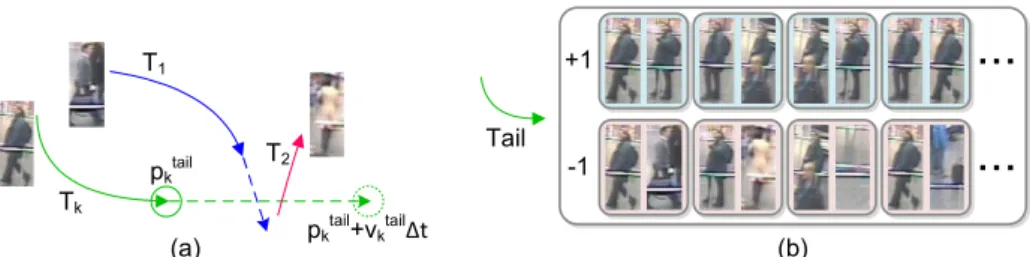
Fig. 4.Online learning of appearance models for category free tracking: (a) estimation of potential distracters for𝑇𝑘; (b) online collected samples for learning DPAMs.
than recall. Therefore, we only do CFT forreliable tracklets, which satisfy three constraints: 1) they are longer than a threshold 𝜁, as short tracklets are more possible to be false alarms; 2) the number of non-empty feature set defined in Equ.2 is larger than a threshold 𝛽, as appearance models may be unreliable if there are not enough unoccluded parts; 3) it does not reach the boundary of current sliding window. We set𝜁= 10 and𝛽= 6 in our experiments.
If𝑇𝑘 qualifies for CFT from its tail, we online learn discriminative part-base
appearance models (DPAMs), so that the learned models well distinguish 𝑇𝑘
with other close-by tracklets as well as the background. Far away tracklets are not worth considering as it is difficult to confuse𝑇𝑘 with them.
A linear motion model is often used in association based tracking work. As shown in Figure 4(a), if the tail of tracklet 𝑇𝑘 locates at position 𝑝𝑡𝑎𝑖𝑙𝑘 , after
time𝛥𝑡, the human is predicted to be at position𝑝𝑡𝑎𝑖𝑙
𝑘 +𝑣𝑘𝑡𝑎𝑖𝑙𝛥𝑡, where𝑣𝑘𝑡𝑎𝑖𝑙 is
the velocity of𝑇’s tail part. Therefore, we may use the linear motion model to estimate which tracklets are possibly close to 𝑇𝑘 in the category free tracking
process; we call these trackletsdistracters.
As the linear motion model is probably invalid over a long period, we do category free tracking only in one second long intervals. If the CFT does not meet termination conditions (detailed later), we do the CFT again for the next one second based on re-learned distracters and appearance models. We expect that the CFT results do not locate too far from the linear estimated positions within one second. The estimated distance between 𝑇𝑘 and another tracklet𝑇𝑖
at frame𝑡 (𝑡 > 𝑡𝑙𝑘𝑘) is defined as
𝐷𝑖𝑠𝑡𝑡=
⎧ ⎨ ⎩
∥(𝑝𝑡𝑎𝑖𝑙
𝑘 +𝑣𝑡𝑎𝑖𝑙𝑘 (𝑡−𝑡𝑙𝑘𝑘))−(𝑝𝑖ℎ𝑒𝑎𝑑−𝑣ℎ𝑒𝑎𝑑𝑖 (𝑡𝑖1−𝑡))∥if𝑡 < 𝑡1𝑖 ∥(𝑝𝑡𝑎𝑖𝑙
𝑘 +𝑣𝑡𝑎𝑖𝑙𝑘 (𝑡−𝑡𝑙𝑘𝑘))−𝑝𝑡𝑖∥ if𝑡∈[𝑡1𝑖, 𝑡𝑙𝑖𝑖] ∥(𝑝𝑡𝑎𝑖𝑙
𝑘 +𝑣𝑡𝑎𝑖𝑙𝑘 (𝑡−𝑡𝑙𝑘𝑘))−(𝑝𝑖𝑡𝑎𝑖𝑙+𝑣𝑡𝑎𝑖𝑙𝑖 (𝑡−𝑡𝑙𝑖𝑖))∥ if𝑡 > 𝑡𝑙𝑖𝑖
(3) where∥ ⋅ ∥denotes the Euclidean distance, and𝑝𝑡
𝑖 denotes the response position
of tracklet𝑇𝑖 at frame𝑡. A tracklet𝑇𝑖 is a distracter for𝑇𝑘 if it satisfies ∃𝑡∈[𝑡1
𝑘, 𝑡𝑙𝑘𝑘] 𝑡1𝑖 ≤𝑡≤𝑡𝑙𝑖𝑖 & ∃𝑡∈(𝑡𝑙𝑘𝑘, 𝑡𝑙𝑘𝑘 +𝛾] 𝐷𝑖𝑠𝑡𝑡< 𝜔ℎ𝑡𝑎𝑖𝑙𝑘 (4)
where𝛾 denotes the frame rate per second, 𝜔is a weight factor, set to 2 in our experiments, andℎ𝑡𝑎𝑖𝑙
𝑘 denotes the height of𝑇𝑘’s tail response. Equ. 4 indicates
that a distracter is a tracklet that has temporal overlap with 𝑇𝑘, so that it
Algorithm 2The learning algorithm for DPAMs. Input:training set𝕊+ and𝕊−.
Initialize the weights for samples𝑤𝑖=2∣𝕊1+∣, if𝑥𝑖∈𝕊+;𝑤𝑖=2∣𝕊1−∣, if𝑥𝑖∈𝕊−.
For𝑡= 1, . . . , 𝑇 do:
– For𝑞= 1, . . . , 𝑛do:
∙ 𝑟=∑𝑖𝑤𝑖𝑦𝑖ℎ𝑞(𝑥𝑖)𝑣𝑞(𝑥𝑖)
∙ 𝛼𝑞=12ln1−1+𝑟𝑟
– Select𝑞∗= argmin 𝑞
∑
𝑖𝑤𝑖exp(−𝛼𝑞𝑦𝑖ℎ𝑞(𝑥𝑖)𝑣𝑞(𝑥𝑖))
– Set𝛼𝑡=𝛼𝑞∗,ℎ𝑡=ℎ𝑞∗,𝑣𝑡=𝑣𝑞∗
– Update sample weights𝑤𝑖=𝑤𝑖exp(−𝛼𝑡𝑦𝑖ℎ𝑡(𝑥𝑖)𝑣𝑡(𝑥𝑖)), and normalize weights.
Output:𝐻(𝑥) =∑𝑇
1 𝛼𝑡ℎ𝑡(𝑥).
such as 𝑇1 and𝑇2 in Figure 4(a). Responses in all distracters should have low
appearance similarities with responses in𝑇𝑘; they form a set named as 𝛹𝑘𝑡𝑎𝑖𝑙.
In addition, to better distinguish𝑇𝑘 from the background, we also collect a
set of responses𝐵𝑡𝑎𝑖𝑙
𝑘 from the background in frame𝑡𝑙𝑘𝑘, defined as
𝐵𝑡𝑎𝑖𝑙
𝑘 ={𝑑𝑙𝑏} ∀𝑙∈[1, 𝛾] & where𝑑𝑙𝑏 is in frame 𝑡𝑙𝑘𝑘 & 𝑝𝑙𝑏=𝑝𝑡𝑎𝑖𝑙𝑘 +𝑣𝑘𝑡𝑎𝑖𝑙𝑙 (5)
The positions of these responses are selected from possible future positions of 𝑇𝑘 in the video, but the responses are extracted at the last frame of 𝑇𝑘.
Therefore, as long as𝑣𝑡𝑎𝑖𝑙
𝑘 is not zero, these responses do not belong to𝑇𝑘 and
should have low appearance similarities with responses in𝑇𝑘.
Then we build positive and negative training sets 𝕊+ and 𝕊− for learning DPAMs for𝑇𝑘’s tail, defined as
𝕊+={𝑥
𝑖= (𝑑𝑖𝑘1, 𝑑𝑖𝑘2), 𝑦𝑖= +1} ∀𝑑𝑖𝑘1, 𝑑𝑖𝑘2 ∈𝐷𝑘𝑡𝑎𝑖𝑙 (6)
𝕊−={𝑥
𝑖= (𝑑𝑖𝑘1, 𝑑𝑖𝑗2), 𝑦𝑖=−1} ∀𝑑𝑘𝑖1∈𝐷𝑡𝑎𝑖𝑙𝑘 & ∀𝑑𝑗𝑖2 ∈𝐵𝑘𝑡𝑎𝑖𝑙∪𝛹𝑘𝑡𝑎𝑖𝑙 (7)
where𝐷𝑡𝑎𝑖𝑙
𝑘 is the set of responses used in building𝐹𝑘𝑡𝑎𝑖𝑙 as shown in Algorithm
1. Some visualized examples are shown in Figure 4(b). For a training sample𝑥𝑖,
a control function𝑣𝑞(𝑥𝑖) is defined to measure its validity of feature𝑞as
𝑣𝑞(𝑥𝑖) =
{
1 if 𝛷(𝑓𝑞) is not unoccluded in both responses in 𝑥𝑖
0 otherwise (8)
where𝛷(𝑓𝑞) denote the part (1 to 15) that a feature𝑓𝑞 belongs to. We adopt the
standard RealBoost algorithm to learn discriminative appearance models based on valid features only as shown in Algorithm 2, where ℎ𝑞(𝑥) denotes the weak
classifier,i.e., an evaluation function for two feature𝑞s,e.g., Euclidean distance or correlation coefficient between two vectors, and is normalized to [−1,1]. We adopt features defined in [13], including color, texture, and shape information.
4.2 Conservative Category Free Tracking
With online learned DPAMs, we adopt a conservative category free tracking method on each reliable tracklet. The CFT is done one frame by one frame. In each frame, a set of samples are generated around the predicted response by the
Tk
pktail
pktail+vktail*1
T1
T2
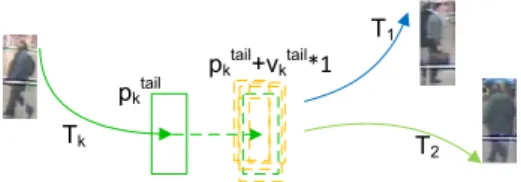
Fig. 5.Illustrations for category free tracking process. The green dashed rectangle is predicted by the linear motion model; the orange dashed ones are samples generated around the predicted position.
linear motion model as shown in Figure 5. Sizes and positions of the samples are randomly disturbed around values of the predicted response. A feature set 𝐹𝑠
for each sample is extracted to evaluate its similarity to𝐹𝑡𝑎𝑖𝑙
𝑘 . The sample with
highest score, named as𝑑∗, is chosen as a potential extension.
However, the potential extension is not taken, if it meets any of the following termination conditions:
– 𝑑∗ goes beyond the frame boundary or the sliding window boundary.
– The similarity between𝑑∗ and𝐹𝑡𝑎𝑖𝑙
𝑘 is smaller than a threshold𝜃1. – The similarity between𝑑∗and any𝐹ℎ𝑒𝑎𝑑
𝑖 is larger than a threshold𝜃2, where
𝑇𝑖 starts at the frame where𝑑∗ locates.
In our experiments, we set𝜃1= 0.8 and𝜃2= 0.2. These constraints assures
a high similarity between𝑑∗and𝐹𝑡𝑎𝑖𝑙
𝑘 and a low similarity between𝑑∗ and any
distracters, so that the category free tracking is less likely to drift or go beyond a true association. For example, in Figure 5, 𝑇𝑘 and 𝑇2 are actually the same
person, and if CFT goes beyond𝑇2’s head,𝑇𝑘 and𝑇2 cannot be associated, and
additional temporal overlapped tracks would be produced for the same person. But if the CFT stops early, we may still successfully associate them.
If𝑑∗ is accepted as an extension, we update 𝑝𝑡𝑎𝑖𝑙
𝑘 and𝑣𝑡𝑎𝑖𝑙𝑘 for𝑇𝑘. However,
we do not update 𝐹𝑡𝑎𝑖𝑙
𝑘 to avoid drift. This is different with most existing
cat-egory free tracking approaches, where appearance models are online updated for continuous tracking. In our framework, CFT is only used to partially over-come detection limitations and shorten gaps between tracklets to make linear motion estimation more accurate. If CFT stops early, it is still possible to fill missing gaps by the global association. But errors in CFT may cause failure of associations as discussed above. The whole CFT method is shown in Algorithm 3.
After conservative category free tracking, we learn a global appearance model similar to [13] using only unoccluded parts from all tracklets, and then use the Hungarian algorithm to find global optimal association results.
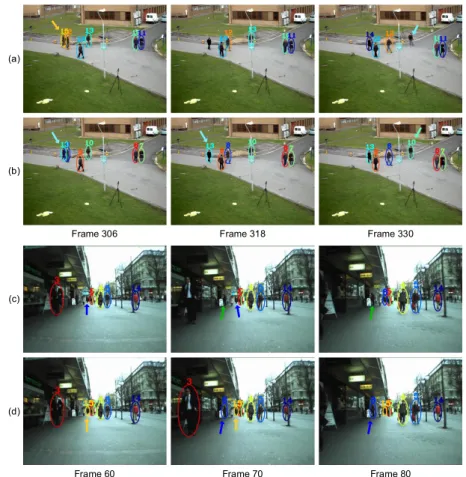
Figure 6 shows some comparing tracking results by using or disabling the category free tracking module. We can see that person 13 in Figure 6(b) would be fragmented into two tracklets without the CFT due to long time missed detec-tions and non-linear modetec-tions. However, the conservative CFT shortens the gaps between the two tracklets so that they become easy to be associated. In addi-tion, person 10 in Figure 6(b) is achieved in frame 330 without having detection responses at that time; person 8 and 15 are similar in Figure 6(d).
Algorithm 3The CFT algorithm for one tracklet from its tail. Input:A reliable tracklet𝑇𝑘 for CFT, and the frame rate per second𝛾. Initialize max frame number for one second tracking𝑡𝑚𝑎𝑥=𝑡𝑙𝑘𝑘+𝛾. Initialize the appearance feature set𝐹𝑡𝑎𝑖𝑙
𝑘 for𝑇𝑘’s tail using Algorithm 1.
While𝑇𝑘 does not meet the boundary of current sliding windowdo:
– Find potential distracters in the predicted tracking path of𝑇𝑘 from𝑡𝑙𝑘𝑘 to𝑡𝑚𝑎𝑥.
– Collect training samples from𝑇𝑘, its distracters, and the background in the pre-dicted path, and learn DPAMs for the next one second using Algorithm 2.
– For𝑡=𝑡𝑙𝑘
𝑘 + 1, . . . , 𝑡𝑚𝑎𝑥 do:
∙ Generate samples around the predicted position𝑝𝑡𝑎𝑖𝑙
𝑘 +𝑣𝑘𝑡𝑎𝑖𝑙∗1.
∙ Extract the feature set for each sample and evaluate its similarity to 𝐹𝑡𝑎𝑖𝑙 𝑘 using the learned DPAMs.
∙ Check whether termination conditions are met. If yes, stop CFT; otherwise, add the best response𝑑∗into𝑇𝑘’s tail, and update𝑝𝑡𝑎𝑖𝑙
𝑘 and𝑣𝑡𝑎𝑖𝑙𝑘
– Update𝑡𝑙𝑘
𝑘, and set𝑡𝑚𝑎𝑥=𝑡𝑙𝑘𝑘+𝛾.
Output:Updated tracklet𝑇𝑘.
5 Experiments
We evaluate our approach on three public data sets: PETS 2009 [19], ETH [20], and Trecvid 2008 [2], which have been commonly used in previous multi-target tracking work. We show quantitative and visualized comparisons with state-of-art methods. We adopt the commonly used evaluation metrics in [10, 2], including recall and precision, showing detection performance after tracking; false alarms per frame (FAF); number of trajectories in the ground truth (GT); mostly tracked (MT), mostly lost (ML), and partially tracked (PT), denoting ratios of tracks with successful tracked parts for more than 80%, less than 20%, and others; fragments (Frag), the number of times that a ground truth track is interupted; id switches (IDS), the number of times that a produced track changes its matched ground truth track.
The three data sets have different resolutions, densities, and average motion speeds. However, we use the same parameter settings on all, and performances all improve compared with state-of-art methods. This indicates low sensitivity of our approach on parameters.
As detection performance would influence tracking results, for fair compar-isons, we use the same detection results as in [13, 10, 2] on three data sets, which are provided by authors of [2, 10]. No scene occluders are manually assigned.
5.1 Results on PETS 2009 data set
We use the same PETS 2009 video clip as used in [21] for fair comparison. The target density is not high in this set. However people are frequently occluded by each other or scene occluders, and may change motion directions frequently.
The quantitative comparison results are shown in Table 2. We modified the ground truth annotations from [21], and fully occluded people that appear later are still labeled as the same person. We can see that by only using part based appearance models, the MT is improved by more than 10%, and fragments are reduced by 43% compared with up-to-date results in [10]. By using category
Frame 306 Frame 318 Frame 330 (a)
(b)
Frame 60 Frame 70 Frame 80
(c)
(d)
Fig. 6.Comparisons of tracking results with or without category free tracking: (a)(c) show results without CFT, (b)(d) show results on the same sequences with CFT.
free tracking, we further improve MT by 5%, and reduce fragments by 85%. This indicates our part based models are effective for modeling humans’ ap-pearances, and the conservative CFT method shortens gaps between tracklets so that fragmented tracks can be associated based on the linear motion model. Some visualized examples are shown in Figure 6(b).
5.2 Results on ETH data set
The ETH data set [20] is captured by a pair of cameras on a moving stroller in busy street scenes. The heights of human may change significantly from 40 pixels to more than 400 pixels. The cameras shift frequently making the linear motion model less reliable, and there are frequent full inter-occlusions due to the low camera angle. We use the same ETH sequences as in [10]. Only data captured by the left camera are used in our experiment.
The quantitative results are shown in Table 3. We can see that using the part models only, MT is improved for about 8%; using category free tracking improves MT significantly for an additional 12%. In ETH data, partial and full occlusions are frequent; therefore, the part based models help build more precise
Method Recall Precision FAF GT MT PT ML Frag IDS
Energy Minimization [21] - - - 23 82.6% 17.4% 0.0% 21 15
PRIMPT [10] 89.5% 99.6% 0.020 19 78.9% 21.1% 0.0% 23 1
Part Model Only 92.8% 95.4% 0.259 19 89.5% 10.5% 0.0% 13 0
Part Model + CFT 97.8% 94.8% 0.306 19 94.7% 5.3% 0.0% 2 0
Table 2. Comparison of results on PETS 2009 dataset. The PRIMPT results are provided by authors of [10]. Our ground truth is more strict than that in [21].
Method Recall Precision FAF GT MT PT ML Frag IDS
PRIMPT [10] 76.8% 86.6% 0.891 124 58.4% 33.6% 8.0% 23 11
Part Model Only 77.5% 90.9% 0.595 124 66.1% 25.0% 8.9% 21 12 Part Model + CFT 81.0% 87.8% 0.861 124 78.2% 12.9% 8.9% 19 11
Table 3.Comparison of tracking results on ETH dataset. The human detection results are the same as used in [10], and are provided by courtesy of authors of [10].
appearance models. The category free tracking method recovers many missed detections, especially for humans who appear for only short periods, e.g., less than 40 frames, and therefore improves MT significantly.
Some tracking examples are shown in Figure 6(d) and Figure 7(a). Person 10 in Figure 7(a) is detected from frame 151 until frame 158, but we start to track her from frame 140 until frame 162. After frame 162, our conservative CFT stops tracking due to large appearance changes caused by the shadows.
5.3 Results on Trecvid 2008 data set
Trecvid 2008 is a very difficult data set, which contains 9 video clips with 5000 frames for each. The videos are captured in a busy airport; the density is very high, and people occlude each other frequently. Quantitative comparison results are shown in Table 4. Compared with [10], using only part based models reduces fragments and id switches by about 11% and 13% respectively; using CFT ad-ditionally reduces fragment and ID switches by about 2% and 3%. In Trecvid 2008 data sets, most improvements come from part based models and less from the category free tracking method, which is quite different with results on PETS 2009 and ETH. This is because Trecvid 2008 is a very crowded data set; in the CFT process, there are often many distracters for each tracklet. Therefore the CFT often stops early because the probability is quite high that at least one of many distracters would have similar appearances with the concerned person.
Figure 7(b)(c) show some tracking examples. We see that person 28 & 29 in Figure 7(b) and person 121 in Figure 7(c) are under heavy occlusions due to high densities of humans; however, our approach is able to find correct discriminative part-based appearance models, and therefore tracks these persons successfully.
5.4 Computational Speed
The processing speed is highly related with the number of humans in videos. We implement our approach using C++ on a PC with 3.0GHz CPU and 8GB memory. The average speeds are 22fps, 10fps, and 6fps on PETS 2009, ETH, and Trecvid 2008 respectively. Compared with [10], which reported 7fps on Trecvid 2008, our approach does not impose much extra computational cost2. The major
Method Recall Precision FAF GT MT PT ML Frag IDS
Offline CRF Tracking [2] 79.2% 85.8% 0.996 919 78.2% 16.9% 4.9% 319 253
OLDAMs [13] 80.4% 86.1% 0.992 919 76.1% 19.3% 4.6% 322 224
PRIMPT [10] 79.2% 86.8% 0.920 919 77.0% 17.7% 5.2% 283 171
Part Model Only 78.7% 88.2% 0.807 919 73.0% 20.9% 6.1% 253 149 Part Model + CFT 79.2% 87.2% 0.895 919 75.5% 18.6% 5.9% 247 145
Table 4.Comparison of tracking results on Trecvid 2008 dataset. The human detection results are the same as used in [2, 13, 10], and are provided by authors of [2].
Frame 140 Frame 151 Frame 162 Frame 174
Frame 545 Frame 560 Frame 575 Frame 590
Frame 3185 Frame 3220 Frame 3270 Frame 3310
(a)
(b)
(c)
Fig. 7.Tracking results of our approach on ETH and Trecvid data sets.
extra cost is from the feature extractions for all samples in the CFT module, which could be constrained by setting the number of evaluated samples.
6 Conclusion
We introduced online learned discriminative part-based appearance models for multi-human tracking by incorporating merits of association based tracking and category free tracking. Part-based models are able to exclude occluded regions in appearance modeling, and a conservative category free tracking can partially overcome limitations of detection performance as well as reduce gaps between tracklets in the association process. Experiments on three public data sets show significant improvement with little extra computational cost.
Acknowledgments. Research was sponsored, in part, by the Army Research Laboratory and was accomplished under Cooperative Agreement Number W911NF-10-2-0063. The views and conclusions contained in this document are those of the authors and should not be interpreted as representing the official policies, either expressed or implied, of the Army Research Laboratory or the U.S.
Govern-ment. The U.S. Government is authorized to reproduce and distribute reprints for Government purposes notwithstanding any copyright notation herein.
References
1. Shitrit, H.B., Berclaz, J., Fleuret, F., Fua, P.: Tracking multiple people under global appearance constraints. In: ICCV. (2011)
2. Yang, B., Huang, C., Nevatia, R.: Learning affinities and dependencies for multi-target tracking using a crf model. In: CVPR. (2011)
3. Benfold, B., Reid, I.: Stable multi-target tracking in real-time surveillance video. In: CVPR. (2011)
4. Pirsiavash, H., Ramanan, D., Fowlkes, C.C.: Globally-optimal greedy algorithms for tracking a variable number of objects. In: CVPR. (2011)
5. Song, B., Jeng, T.Y., Staudt, E., Roy-Chowdhury, A.K.: A stochastic graph evo-lution framework for robust multi-target tracking. In: ECCV. (2010)
6. Wang, S., Lu, H., Yang, F., Yang, M.H.: Superpixel tracking. In: ICCV. (2011) 7. Liu, B., Huang, J., Yang, L., Kulikowsk, C.: Robust tracking using local sparse
appearance model and k-selection. In: CVPR. (2011)
8. Grabner, H., Matas, J., Gool, L.V., Cattin, P.: Tracking the invisible: Learning where the object might be. In: CVPR. (2010)
9. Xing, J., Ai, H., Lao, S.: Multi-object tracking through occlusions by local tracklets filtering and global tracklets association with detection responses. In: CVPR. (2009)
10. Kuo, C.H., Nevatia, R.: How does person identity recognition help multi-person tracking? In: CVPR. (2011)
11. Pellegrini, S., Ess, A., Schindler, K., Gool, L.V.: You’ll neverwalk alone: Modeling social behavior for multi-target tracking. In: ICCV. (2009)
12. Stalder, S., Grabner, H., Gool, L.V.: Cascaded confidence filtering for improved tracking-by-detection. In: ECCV. (2010)
13. Kuo, C.H., Huang, C., Nevatia, R.: Multi-target tracking by on-line learned dis-criminative appearance models. In: CVPR. (2010)
14. Song, X., Shao, X., Zhao, H., Cui, J., Shibasaki, R., Zha, H.: An online approach: Learning-semantic-scene-by-tracking and tracking-by-learning-semantic-scene. In: CVPR. (2010)
15. Breitenstein, M.D., Reichlin, F., Leibe, B., Koller-Meier, E., Gool, L.V.: On-line multi-person tracking-by-detection from a single, uncalibrated camera. IEEE Transactions on Pattern Analysis and Machine Intelligence33(2011) 1820–1833 16. Ramanan, D., Forsyth, D.A., Zisserman, A.: Tracking people by learning their
appearance. IEEE Transactions on Pattern Analysis and Machine Intelligence29
(2007) 65–81
17. Wu, B., Nevatia, R.: Detection and segmentation of multiple, partially occluded objects by grouping, merging, assigning part detection responses. International Journal of Computer Vision82(2009) 185–204
18. Kalal, Z., Matas, J., Mikolajczyk, K.: P-n learning: Bootstrapping binary classifiers by structural constraints. In: CVPR. (2010)
19. : Pets 2009 dataset. (http://www.cvg.rdg.ac.uk/PETS2009.)
20. Ess, A., Bastian Leibe, K.S., van Gool, L.: Robust multiperson tracking from a mobile platform. IEEE Transactions on Pattern Analysis and Machine Intelligence
31(2009) 1831–1846
21. Andriyenko, A., Schindler, K.: Multi-target tracking by continuous energy mini-mization. In: CVPR. (2011)