GAO COst EstimAtinG
And AssEssmEnt GuidE
Best Practices for developing and managing
Capital Program Costs
United States Government Accountability Office
Applied Research and Methods
GAO
PrefAce
The U.S. Government Accountability Office is responsible for, among other things, assisting the Congress in its oversight of the federal government, including agencies’ stewardship of public funds. To use public funds effectively, the government must meet the demands of today’s changing world by employing effective management practices and processes, including the measurement of government program performance. In addition, legislators, government officials, and the public want to know whether government programs are achieving their goals and what their costs are. To make those evaluations, reliable cost information is required and federal standards have been issued for the cost accounting that is needed to prepare that information.1 We developed the Cost Guide in order to establish a consistent methodology that is based on best practices and that can be used across the federal government for developing, managing, and evaluating capital program cost estimates.
For the purposes of this guide, a cost estimate is the summation of individual cost elements, using established methods and valid data, to estimate the future costs of a program, based on what is known today.2 The management of a cost estimate involves continually updating the estimate with actual data as they become available, revising the estimate to reflect changes, and analyzing differences between estimated and actual costs—for example, using data from a reliable earned value management (EVM) system.3
The ability to generate reliable cost estimates is a critical function, necessary to support the Office of Management and Budget’s (OMB) capital programming process.4 Without this ability, agencies are at risk of experiencing cost overruns, missed deadlines, and performance shortfalls—all recurring problems that our program assessments too often reveal. Furthermore, cost increases often mean that the government 1 Federal Accounting Standards Advisory Board, Statement of Federal Financial Accounting Standards No. 4: Managerial Cost Accounting Standards and Concepts (Washington, D.C.: July 1995).
2 In the context of the Cost Guide, a program refers to all phases in a capital asset’s life cycle—that is, concept analysis, technology
definition, requirements planning, acquisition, and operations and maintenance.
3 EVM is a project management tool that integrates the technical scope of work with schedule and cost elements for investment
planning and control. It compares the value of work accomplished in a given period with the value of the work expected in that period. Differences in expectations are measured in both cost and schedule variances. The Office of Management and Budget (OMB) requires agencies to use EVM in their performance-based management systems for the parts of an investment in which development effort is required or system improvements are under way.
4 Office of Management and Budget, Preparation, Submission, and Execution of the Budget, Circular No. A-11 (Washington,
D.C.: Executive Office of the President, June 2006); Management of Federal Information Resources, Circular No. A-130 Revised (Washington, D.C.: Executive Office of the President, Nov. 28, 2000); and Capital Programming Guide: Supplement to Circular A-11, Part 7, Preparation, Submission, and Execution of the Budget (Washington, D.C.: Executive Office of the President, June 2006). www.whitehouse.gov/omb/circulars/index.html.
cannot fund as many programs as intended or deliver them when promised. The methodology outlined in this guide is a compilation of best practices that federal cost estimating organizations and industry use to develop and maintain reliable cost estimates throughout the life of a government acquisition program. By default, the guide will also serve as a guiding principle for our auditors to evaluate the economy, efficiency, and effectiveness of government programs.
The U.S. Government Accountability Office, the Congressional Budget Office (CBO), and others have shown through budget simulations that the nation is facing a large and growing structural deficit in the long term, primarily because the population is aging and health care costs are rising. As Comptroller General David Walker noted, “Continuing on this unsustainable path will gradually erode, if not suddenly damage, our economy, our standard of living and ultimately our national security.”5 New budgetary demands and demographic trends will place serious budgetary pressures on federal discretionary spending, as well as on other federal policies and programs, in the coming years. As resources become scarce, competition for them will increase. It is imperative, therefore, that
government acquisition programs deliver as promised, not only because of their value to their users but also because every dollar spent on one program will mean one less available dollar to fund other efforts. To get better results, programs will need higher levels of knowledge when they start and standardized monitoring metrics such as EVM so that better estimates can be made of total program costs at completion.
cOntentS
Preface i
Abbreviations xv
Introduction 1
The Guide’s Case Studies 3
The Cost Guide in Relation to Established Standards 3
The Guide’s Readers 3
Acknowledgments 4
Chapter 1
The Characteristics of Credible Cost Estimates and a Reliable Process for Creating Them 5
Basic Characteristics of Credible Cost Estimates 6
A Reliable Process for Developing Credible Cost Estimates 8
Chapter 2
Why Government Programs Need Cost Estimates and the Challenges in Developing Them 15
Cost Estimating Challenges 17
Earned Value Management Challenges 23
Chapter 3
Criteria for Cost Estimating, EVM, and Data Reliability 25
Determining Data Reliability 29
Chapter 4
Cost Analysis Overview 31
Differentiating Cost Analysis and Cost Estimating 31
Main Cost Estimate Categories 31
The Overall Significance of Cost Estimates 36
Cost Estimates in Acquisition 37
The Importance of Cost Estimates in Establishing Budgets 38
Cost Estimates and Affordability 39
Chapter 5
The Cost Estimate’s Purpose, Scope, and Schedule 47
Purpose 47
Scope 47
Schedule 48
Chapter 6
The Cost Assessment Team 51
Team Composition and Organization 52
Cost Estimating Team Best Practices 53
Certification and Training for Cost Estimating and EVM Analysis 54
Chapter 7
Technical Baseline Description Definition and Purpose 57
Process 57
Schedule 58
Contents 58
Key System Characteristics and Performance Parameters 61
Chapter 8
Work Breakdown Structure 65
Best Practice: Product-Oriented WBS 65
Common WBS Elements 68
WBS Development 71
Standardized WBS 71
WBS and Scheduling 75
WBS and EVM 75
WBS and Risk Management 75
WBS Benefits 76
Chapter 9
Ground Rules and Assumptions 79
Ground Rules 79
Assumptions 79
Global and Element-Specific Ground Rules and Assumptions 80
Assumptions, Sensitivity, and Risk Analysis 82
Chapter 10
Data 89
Data Collection 89
Types of Data 91
Data Applicability 95
Validating and Analyzing the Data 96
EVM Data Reliability 98
Data Normalization 100
Recurring and Nonrecurring Costs 101
Inflation Adjustments 102
Selecting the Proper Indexes 103
Data Documentation 104
Chapter 11
Developing a Point Estimate 107
Cost Estimating Methods 107
Production Rate Effects on Learning 121
Pulling the Point Estimate Together 122
Chapter 12
Estimating Software Costs 125
Unique Components of Software Estimation 126
Estimating Software Size 127
Estimating Software Development Effort 131
Scheduling Software Development 133
Software Maintenance 134
Parametric Software Estimation 135
Commercial Off-the-Shelf Software 136
Enterprise Resource Planning Software 137
Software Costs Must also Account for Information Technology Infrastructure and Services 139
Unique Components of IT Estimation 139
Chapter 13
Sensitivity Analysis 147
Sensitivity Factors 148
Steps in Performing a Sensitivity Analysis 149
Sensitivity Analysis Benefits and Limitations 150
Chapter 14
Cost Risk and Uncertainty 153
The Difference Between Risk and Uncertainty 153
Point Estimates Alone Are Insufficient for Good Decisions 154
Budgeting to a Realistic Point Estimate 155
Developing a Credible S Curve of Potential Program Costs 159
Chapter 15
Validating the Estimate 179
The Cost Estimating Community’s Best Practices for Validating Estimates 179
Chapter 16
Documenting the Estimate 191
Elements of Cost Estimate Documentation 193
Other Considerations 195
Chapter 17
Presenting the Estimate to Management 197
Chapter 18
Managing Program Costs: Planning 199
Linking Cost Estimation as the Foundation for EVM Analysis 199
The Nature and History of EVM 202
Implementing EVM 204
Federal and Industry Guidelines for Implementing EVM 211
The Thirteen Steps in the EVM Process 215
Integrated Baseline Reviews 231
Award Fees 233
Progress and Performance-Based Payments Under Fixed-Price Contracts 234
Validating the EVM System 236
Chapter 19
Managing Program Costs: Execution 243
Validating the Performance Measurement Baseline with an IBR 243
Contract Performance Reports 249
Monthly EVM Analysis 255
Project Future Performance 265
Provide Analysis to Management 269
Continue EVM until the Program Is Complete 269
Chapter 20
Managing Program Costs: Updating 273
Incorporating Authorized Changes into the Performance Measurement Baseline 273
Using EVM System Surveillance to Keep the Performance Measurement Baseline Current 276
Overtarget Baselines and Schedules 284
Update the Program Cost Estimate with Actual Costs 293
A
ppendixesAppendix I
Auditing Agencies and Their Web Sites 297
Appendix II
Case Study Backgrounds 298
Appendix III
Experts Who Helped Develop This Guide 305
Appendix IV
The Federal Budget Process 308
Appendix V
Federal Cost Estimating and EVM Legislation, Regulations, Policies, and Guidance 310
Appendix VI
Data Collection Instrument 321
Appendix VII
Data Collection Instrument: Data Request Rationale 323
Appendix VIII
SEI Checklist 327
Appendix IX
Examples of Work Breakdown Structures 328
Appendix X
Schedule Risk Analysis 353
Appendix XI
Learning Curve Analysis 367
Appendix XII
Technology Readiness Levels 373
Appendix XIII
EVM-Related Award Fee Criteria 374
Appendix XIV
Integrated Baseline Review Case Study and Other Supplemental Tools 377
Exhibit A – Program X: Subject Contractor 382
Exhibit B – IBR Discussion Assessment Forms 383
Exhibit C – IBR Action Item Forms 385
Exhibit D – Sample IBR Discussion Questions 387
Appendix XV
Common Risks to Consider in Software Cost Estimating 393
Appendix XVI
Contacts and Acknowledgments 404
References 405
L
istoff
iguresFigure 1: The Cost Estimating Process 8
Figure 2: Challenges Cost Estimators Typically Face 17
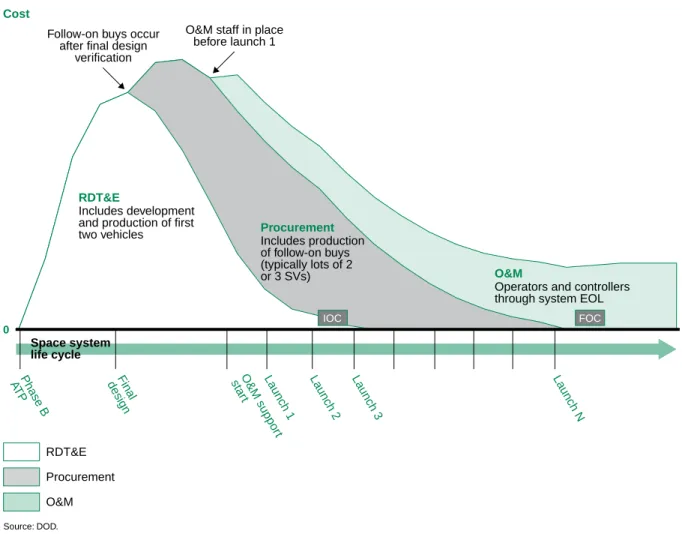
Figure 3: Life-Cycle Cost Estimate for a Space System 33
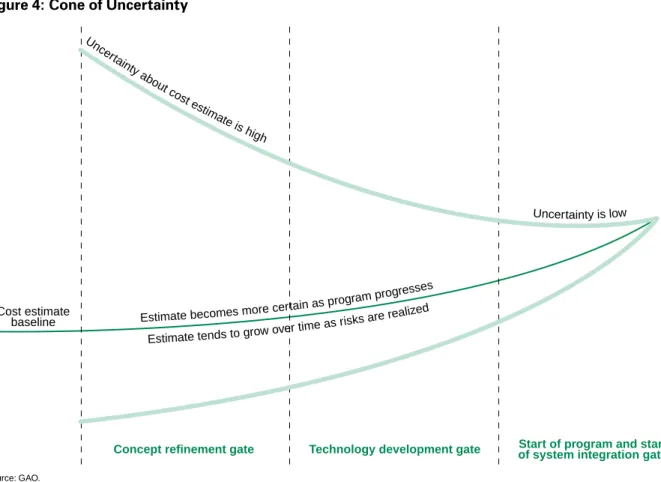
Figure 4: Cone of Uncertainty 38
Figure 5: An Affordability Assessment 40
Figure 6: Typical Capital Asset Acquisition Funding Profiles by Phase 41
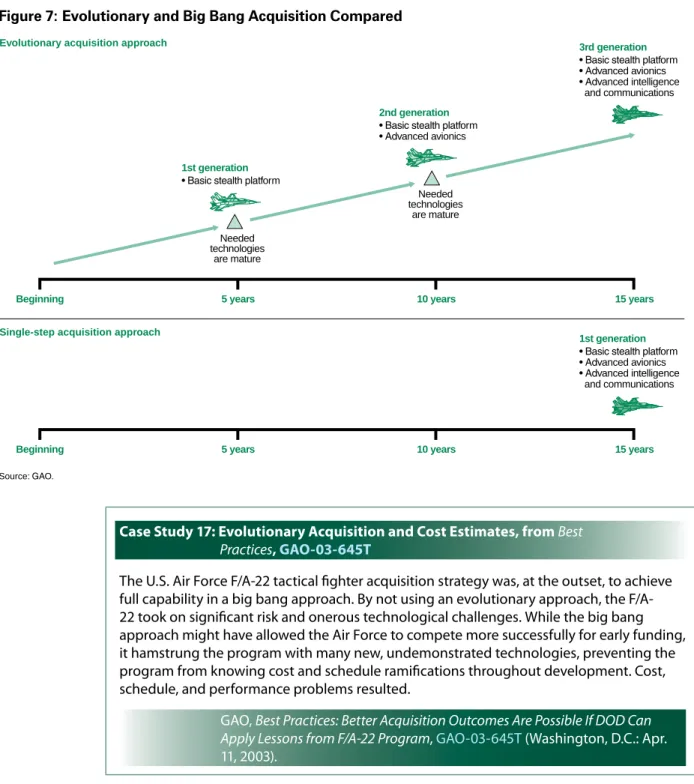
Figure 7: Evolutionary and Big Bang Acquisition Compared 43
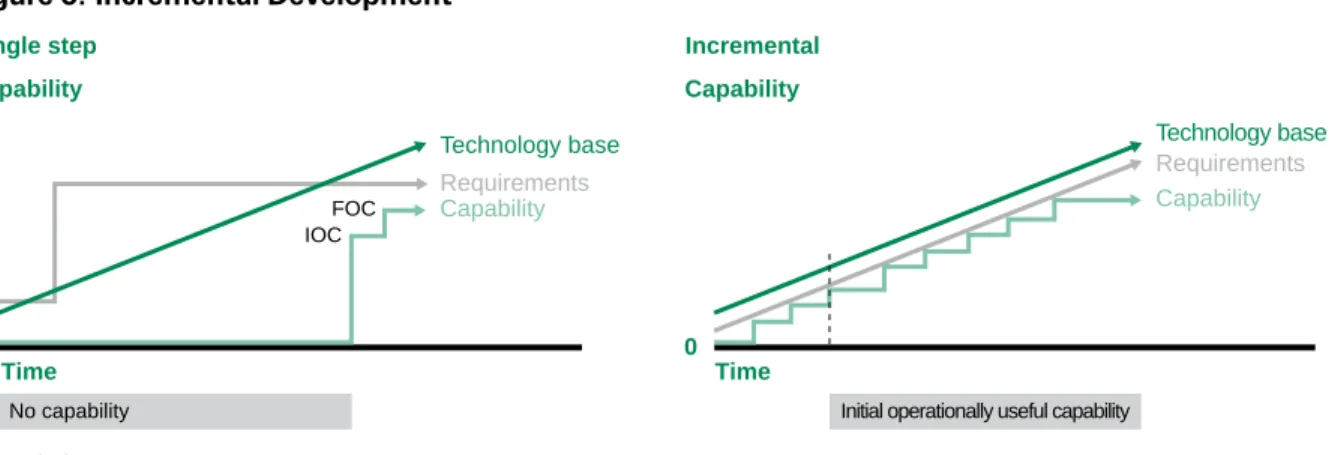
Figure 8: Incremental Development 44
Figure 9: Disciplines and Concepts in Cost Analysis 51
Figure 10: A Product-Oriented Work Breakdown Structure 66
Figure 11: A Work Breakdown Structure with Common Elements 70
Figure 12: A Contract Work Breakdown Structure 70
Figure 13: A Learning Curve 120
Figure 14: A Sensitivity Analysis That Creates a Range around a Point Estimate 150
Figure 15: Changes in Cost Estimate Uncertainty across the Acquisition Life Cycle 155
Figure 16: A Cumulative Probability Distribution, or S Curve 157
Figure 17: A Risk Cube Two-Dimensional Matrix 164
Figure 18: The Distribution of Sums from Rolling Two Dice 167
Figure 19: A Point Estimate Probability Distribution Driven by WBS Distributions 168
Figure 20: Integrating Cost Estimation, Systems Development Oversight, and Risk
Management 199
Figure 21: Integrating EVM and Risk Management 201
Figure 22: Inputs and Outputs for Tracking Earned Value 207
Figure 23: WBS Integration of Cost, Schedule, and Technical Information 216
Figure 24: Identifying Responsibility for Managing Work at the Control Account 217
Figure 25: An Activity Network 219
Figure 26: Activity Durations as a Gantt Chart 221
Figure 27: Earned Value, Using the Percent Complete Method, Compared to
Planned Costs 227
Figure 28: The Genesis of the Performance Measurement Baseline 228
Figure 29: The Time-Phased Cumulative Performance Measurement Baseline 229
Figure 30: A Performance-Based Payments Structured Contract 235
Figure 31: The EVM System Acceptance Process 236
Figure 32: IBR Control Account Manager Discussion Template 248
Figure 33: Monthly Program Assessment Using Earned Value 250
Figure 35: A Contract Performance Report’s Five Formats 252 Figure 36: Understanding Program Cost Growth by Plotting Budget at Completion
Trends 261
Figure 37: Understanding Program Performance by Plotting Cost and Schedule
Variances 262
Figure 38: Understanding Expected Cost Overruns by Plotting Estimate at
Completion 263
Figure 39: Rolling Wave Planning 269
Figure 40: The Effect on a Contract of Implementing an Overtarget Budget 285
Figure 41: Steps Typically Associated with Implementing an Overtarget Budget 289
Figure 42: Establishing a New Baseline with a Single Point Adjustment 291
Figure 43: MasterFormat™ Work Breakdown Structure 351
Figure 44: Network Diagram of a Simple Schedule 354
Figure 45: Example Project Schedule 355
Figure 46: Estimated Durations for Remaining WBS Areas in the Schedule 356
Figure 47: Cumulative Distribution of Project Schedule, Including Risk 357
Figure 48: Identified Risks on a Spacecraft Schedule: An Example 357
Figure 49: A Risk Register for a Spacecraft Schedule 358
Figure 50: Spacecraft Schedule Results from a Monte Carlo Simulation 358
Figure 51: A Schedule Showing Critical Path through Unit 2 359
Figure 52: Results of a Monte Carlo Simulation for a Schedule Showing Critical
Path through Unit 2 360
Figure 53: Sensitivity Index for Spacecraft Schedule 360
Figure 54: Evaluation of Correlation in Spacecraft Schedule 361
Figure 55: An Example of Probabilistic Branching Contained in the Schedule 361
Figure 56: Probability Distribution Results for Probabilistic Branching in Test Unit 362
Figure 57: A Project Schedule Highlighting Correlation Effects 363
Figure 58: Risk Results Assuming No Correlation between Activity Durations 363
Figure 59: Risk Results Assuming 90 Percent Correlation between Activity
Durations 364
Figure 60: Schedule Analysis Results with and without Correlation 364
Figure 61: IBR Team’s Program Summary Assessment Results for Program X 379
Figure 62: Program X IBR Team’s Assessment Results by Program Area 379
Figure 63: Program X IBR Team’s Detailed Assessment Results for an Individual
L
istoft
AbLesTable 1: GAO’s 1972 Version of the Basic Characteristics of Credible Cost Estimates 6
Table 2: The Twelve Steps of a High-Quality Cost Estimating Process 9
Table 3: Cost Estimating and EVM Criteria for Federal Agencies: Legislation,
Regulations, Policies, and Guidance 26
Table 4: Life-Cycle Cost Estimates, Types of Business Case Analyses, and Other
Types of Cost Estimates 34
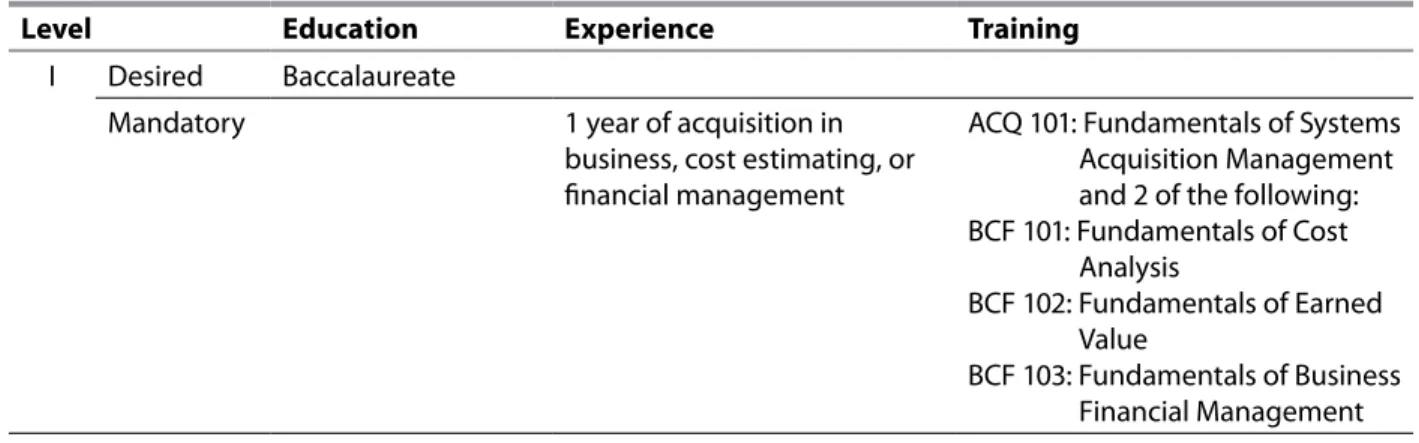
Table 5: Certification Standards in Business, Cost Estimating, and Financial Management in the Defense Acquisition Education, Training, and Career
Development Program 54
Table 6: Typical Technical Baseline Elements 58
Table 7: General System Characteristics 61
Table 8: Common Elements in Work Breakdown Structures 68
Table 9: Cost Element Structure for a Standard DOD Automated Information
System 72
Table 10: Basic Primary and Secondary Data Sources 92
Table 11: Three Cost Estimating Methods Compared 108
Table 12: An Example of the Analogy Cost Estimating Method 109
Table 13: An Example of the Engineering Build-Up Cost Estimating Method 111
Table 14: An Example of the Parametric Cost Estimating Method 113
Table 15: The Twelve Steps of High-Quality Cost Estimating Summarized 126
Table 16: Sizing Metrics and Commonly Associated Issues 127
Table 17: Common Software Risks That Affect Cost and Schedule 133
Table 18: Best Practices Associated with Risks in Implementing ERP 138
Table 19: Common IT Infrastructure Risks 142
Table 20: Common Labor Categories Described 143
Table 21: Potential Sources of Program Cost Estimate Uncertainty 160
Table 22: A Hardware Risk Scoring Matrix 165
Table 23: A Software Risk Scoring Matrix 166
Table 24: Eight Common Probability Distributions 168
Table 25: The Twelve Steps of High-Quality Cost Estimating, Mapped to the
Characteristics of a High-Quality Cost Estimate 180
Table 26: Questions for Checking the Accuracy of Estimating Techniques 183
Table 27: Eight Types of Independent Cost Estimate Reviews 188
Table 28: What Cost Estimate Documentation Includes 193
Table 29: Key Benefits of Implementing EVM 206
Table 30: Ten Common Concerns about EVM 207
Table 32: EVM Implementation Guides 214
Table 33: Typical Methods for Measuring Earned Value Performance 225
Table 34: Integrated Baseline Review Risk Categories 246
Table 35: Contract Performance Report Data Elements: Format 1 253
Table 36: EVM Performance Indexes 259
Table 37: Best Predictive EAC Efficiency Factors by Program Completion Status 266
Table 38: Basic Program Management Questions That EVM Data Help Answer 270
Table 39: ANSI Guidelines Related to Incorporating Changes in an EVM System 274
Table 40: Elements of an Effective Surveillance Organization 277
Table 41: Key EVM Processes across ANSI Guidelines for Surveillance 278
Table 42: Risk Factors That Warrant EVM Surveillance 278
Table 43: A Program Surveillance Selection Matrix 279
Table 44: A Color-Category Rating System for Summarizing Program Findings 283
Table 45: Overtarget Budget Funding Implications by Contract Type 286
Table 46: Common Indicators of Poor Program Performance 287
Table 47: Options for Treating Variances in Performing a Single Point Adjustment 290
Table 48: Case Studies Drawn from GAO Reports Illustrating This Guide 298
Table 49: Phases of the Budget Process 308
Table 50: The Budget Process: Major Steps and Time Periods 309
Table 51: Aircraft System Work Breakdown Structure 328
Table 52: Electronic/Automated Software System Work Breakdown Structure 329
Table 53: Ground Software Work Breakdown Structure 330
Table 54: Missile System Work Breakdown Structure 331
Table 55: Ordnance System Work Breakdown Structure 333
Table 56: Sea System Work Breakdown Structure 334
Table 57: Space System Work Breakdown Structure 335
Table 58: Surface Vehicle System Work Breakdown Structure 336
Table 59: Unmanned Air Vehicle System Work Breakdown Structure 337
Table 60: Department of Energy Project Work Breakdown Structure 339
Table 61: General Services Administration Construction Work Breakdown
Structure 340
Table 62: Automated Information System: Enterprise Resource Planning
Program Level Work Breakdown Structure 341
Table 63: Environmental Management Work Breakdown Structure 342
Table 64: Pharmaceutical Work Breakdown Structure 342
Table 65: Process Plant Construction Work Breakdown Structure 344
C
Ases
tudiesCase Study 1: Basic Estimate Characteristics, from NASA, GAO-04-642 7
Case Study 2: Basic Estimate Characteristics, from Customs Service Modernization,
GAO/AIMD-99-41 8
Case Study 3: Following Cost Estimating Steps, from NASA, GAO-04-642 12
Case Study 4: Cost Analysts’ Skills, from NASA, GAO-04-642 18
Case Study 5: Recognizing Uncertainty, from Customs Service Modernization,
GAO/AIMD-99-41 18
Case Study 6: Using Realistic Assumptions, from Space Acquisitions, GAO-07-96 19
Case Study 7: Program Stability Issues, from Combating Nuclear Smuggling,
GAO-06-389 20
Case Study 8: Program Stability Issues, from Defense Acquisitions, GAO-05-183 20
Case Study 9: Development Schedules, from Defense Acquisitions, GAO-06-327 21
Case Study 10: Risk Analysis, from Defense Acquisitions, GAO-05-183 21
Case Study 11: Risk Analysis, from NASA, GAO-04-642 22
Case Study 12: Applying EVM, from Cooperative Threat Reduction, GAO-06-692 23
Case Study 13: Rebaselining, from NASA, GAO-04-642 24
Case Study 14: Realistic Estimates, from Defense Acquisitions, GAO-05-183 39
Case Study 15: Importance of Realistic LCCEs, from Combating Nuclear Smuggling,
GAO-07-133R 41
Case Study 16: Importance of Realistic LCCEs, from Space Acquisitions, GAO-07-96 42
Case Study 17: Evolutionary Acquisition and Cost Estimates, from Best Practices,
GAO-03-645T 43
Case Study 18: Incremental Development, from Customs Service Modernization,
GAO/AIMD-99-41 44
Case Study 19: The Estimate’s Context, from DOD Systems Modernization,
GAO-06-215 49
Case Study 20: Defining Requirement, from United States Coast Guard,
GAO-06-623 60
Case Study 21: Managing Requirements, from DOD Systems Modernization,
GAO-06-215 63
Case Study 22: Product-Oriented Work Breakdown Structure, from Air Traffic
Control, GAO-08-756 67
Table 67: Software Implementation Project Work Breakdown Structure 345
Table 68: Major Renovation Project Work Breakdown Structure 346
Table 69: Sample IT Infrastructure and Service Work Breakdown Structure 347
Table 70: CSI MasterFormatTM 2004 Structure Example: Construction Phase 352
Table 71: The Anderlohr Method for the Learning Lost Factor 370
Case Study 23: Developing Work Breakdown Structure, from NASA, GAO-04-642 77 Case Study 24: Developing Work Breakdown Structure, from Homeland Security,
GAO-06-296 77
Case Study 25: The Importance of Assumptions, from Space Acquisitions,
GAO-07-96 80
Case Study 26: Testing Ground Rules for Risk, from Space Acquisitions,
GAO-07-96 84
Case Study 27: The Industrial Base, from Defense Acquisition, GAO-05-183 85
Case Study 28: Technology Maturity, from Defense Acquisitions, GAO-05-183 86
Case Study 29: Technology Maturity, from Space Acquisitions, GAO-07-96 86
Case Study 30: Informing Management of Changed Assumptions, from
Customs Service Modernization, GAO/AIMD-99-41 87
Case Study 31: Fitting the Estimating Approach to the Data, from
Space Acquisitions, GAO-07-96 91
Case Study 32: Data Anomalies, from Cooperative Threat Reduction, GAO-06-692 99
Case Study 33: Inflation, from Defense Acquisitions, GAO-05-183 102
Case Study 34: Cost Estimating Methods, from Space Acquisitions, GAO-07-96 110
Case Study 35: Expert Opinion, from Customs Service Modernization,
GAO/AIMD-99-41 118
Case Study 36: Production Rate, from Defense Acquisitions, GAO-05-183 122
Case Study 37: Underestimating Software, from Space Acquisitions, GAO-07-96 125
Case Study 38: Sensitivity Analysis, from Defense Acquisitions, GAO-05-183 149
Case Study 39: Point Estimates, from Space Acquisitions, GAO-07-96 156
Case Study 40: Point Estimates, from Defense Acquisitions, GAO-05-183 156
Case Study 41: Validating the Estimate, from Chemical Demilitarization,
GAO-07-240R 181
Case Study 42: Independent Cost Estimates, from Space Acquisitions, GAO-07-96 187
Case Study 43: Documenting the Estimate, from Telecommunications,
GAO-07-268 192
Case Study 44: Validating the EVM System, from Cooperative Threat Reduction,
GAO-06-692 238
Case Study 45: Validating the EVM System, from DOD Systems Modernization,
GAO-06-215 239
Case Study 46: Cost Performance Reports, from Defense Acquisitions, GAO-05-183 255
Case Study 47: Maintaining Performance Measurement Baseline Data, from
National Airspace System, GAO-03-343 275
Case Study 48: Maintaining Realistic Baselines, from Uncertainties Remain,
This is a work of the U.S. government and is not subject to copyright protection in the United States. The published product may be reproduced and distributed in its entirety without further permission from GAO. However, because this work may contain copyrighted images or other material, permission from the copyright holder may be necessary if you wish to reproduce this material separately.
b
estp
rACtiCesC
heCkLists1. Best Practices Checklist: The Estimate 45
2. Best Practices Checklist: Purpose, Scope, and Schedule 49
3. Best Practices Checklist: Cost Assessment Team 56
4. Best Practices Checklist: Technical Baseline Description 64
5. Best Practices Checklist: Work Breakdown Structure 78
6. Best Practices Checklist: Ground Rules and Assumptions 88
7. Best Practices Checklist: Data 105
8. Best Practices Checklist: Developing a Point Estimate 123
9. Best Practices Checklist: Estimating Software Costs 145
10. Best Practices Checklist: Sensitivity Analysis 151
11. Best Practices Checklist: Cost Risk and Uncertainty 176
12. Best Practices Checklist: Validating the Estimate 189
13. Best Practices Checklist: Documenting the Estimate 196
14. Best Practices Checklist: Presenting the Estimate to Management 198
15. Best Practices Checklist: Managing Program Costs: Planning 240
16. Best Practices Checklist: Managing Program Costs: Execution 270
AbbreviAtiOnS
ACWP actual cost of work performed
ANSI American National Standards Institute
AOA analysis of alternatives
BAC budget at completion
BCA business case analysis
BCWP budgeted cost for work performed
BCWS budgeted cost for work scheduled
CAIG Cost Analysis Improvement Group
CBO Congressional Budget Office
CEA cost-effectiveness analysis
CER cost estimating relationship
COSMIC Common Software Measurement International Consortium
CPI cost performance index
CPR contract performance report
C/SCSC Cost/Schedule and Control System Criteria
CSDR cost and software data report
DAU Defense Acquisition University
DCAA Defense Contract Audit Agency
DCMA Defense Contract Management
Agency
DOD Department of Defense
EA economic analysis
EAC estimate at completion
EIA Electronic Industries Alliance
ERP enterprise resource planning
EVM earned value management
FAR Federal Acquisition Regulation
GR&A ground rules and assumptions
IBR integrated baseline review
ICA independent cost assessment
ICE independent cost estimate
IGCE independent government cost estimate
IMS integrated master schedule
IT information technology
LCCE life-cycle cost estimate
NAR nonadvocate review
NASA National Aeronautics and Space Administration
NDIA National Defense Industrial
Association
OMB Office of Management and Budget
OTB overtarget baseline
OTS overtarget schedule
PMB performance measurement baseline
PMI Project Management Institute
SCEA Society of Cost Estimating and
Analysis
SEI Software Engineering Institute
SLOC source line of code
SPI schedule performance index
TCPI to complete performance index
intrOductiOn
Because federal guidelines are limited on processes, procedures, and practices for ensuring credible cost estimates, the Cost Guide is intended to fill that gap. Its purpose is twofold—to address generally accepted best practices for ensuring credible program cost estimates (applicable across government and industry) and to provide a detailed link between cost estimating and EVM. Providing that link is especially critical, because it demonstrates how both elements are needed for setting realistic program baselines and managing risk.
As a result, government managers and auditors should find in the Cost Guide principles to guide them as they assess (1) the credibility of a program’s cost estimate for budget and decision making purposes and (2) the program’s status using EVM. Throughout this guide, we refer to program cost estimates that encompass major system acquisitions, as well as government in-house development efforts for which a cost estimate must be developed to support a budget request.
The basic information in the Cost Guide includes the purpose, scope, and schedule of a cost estimate; a technical baseline description; a work breakdown structure (WBS); ground rules and assumptions; how to collect data; estimation methodologies; software cost estimating; sensitivity and risk analysis; validating a cost estimate; documenting and briefing results; updating estimates with actual costs; EVM; and the composition of a competent cost estimating team.6 The guide discusses pitfalls associated with cost estimating and EVM that can lead government agencies to accept unrealistic budget requests—as when risks are embedded in an otherwise logical approach to estimating costs. Since the Department of Defense (DOD) is considered the leader in government cost estimating, the guide relies heavily on DOD for terminology and examples that may not be used by, or even apply to, other federal agencies.
Chapters 1–17 of the Cost Guide discuss the importance of cost estimating and best practices associated with creating credible cost estimates. They describe how cost estimates predict, analyze, and evaluate a program’s cost and schedule and serve as a critical program control planning tool. Once cost estimates have been presented to and approved by management, the chapters also establish the basis for measuring actual performance against the approved baseline plan using an EVM system.
Those chapters explain how EVM, if it is to work, must have a cost estimate that identifies the effort that is needed—the work breakdown structure—and the period of time over which the work is to be performed—the program schedule.7 In essence, the cost estimate is the basis for establishing the program’s 6 Experienced and well trained staff are crucial to developing high-quality cost estimates.
7 There is at this time no standard work breakdown structure for major automated information systems; there is only a generic cost
detailed schedule, and it identifies the bounds for how much program costs can be expected to vary, depending on the uncertainty analysis. When all these tasks are complete, the cost estimate can be used to lay the foundation for the performance measurement baseline (PMB), which will measure actual program performance.
Since sound acquisition management requires more than just a reliable cost estimate at a project’s outset, chapters 18–20 provide guidance on converting the cost estimate into an executable program and a means for managing program costs. Our program assessments have too often revealed that not integrating cost estimation, system development oversight, and risk management—three key disciplines, interrelated and essential to effective acquisition management—has resulted in programs costing more than planned and delivering less than promised. Therefore, chapters 18–20 address best practices in implementing and integrating these disciplines and using them to manage costs throughout the life of a program.
OMB has set the expectation that programs will maintain current estimates of cost. This requires rigorous performance-based program management, which can be satisfied with EVM. Chapters 18–20 address the details of EVM, which is designed to integrate cost estimation, system development oversight, and risk management. Additionally, for programs classified as major acquisitions—regardless of whether the development work is completed in-house or under contract—the use of EVM is a requirement for development, as specified by OMB.8 The government may also require the use of EVM for other acquisitions, in accordance with agency procedures.
Since linking cost estimating and EVM results in a better view of a program and allows for greater understanding of program risks, cost estimators and EVM analysts who join forces can use each other’s data to update program costs and examine differences between estimated and actual costs. This way, scope changes, risks, and other opportunities can be presented to management in time to plan for and mitigate their impact. In addition, program status can be compared to historical data to better understand variances. Finally, cost estimators can help EVM analysts calculate a cumulative probability distribution to determine the level of confidence in the baseline.
But bringing a program to successful completion requires knowing potential risks and identifying ways to respond to them before they happen—using risk management to identify, mitigate, and assign resources to manage risks so that their impact can be minimized. This requires the support of many program management and engineering staff and it results in better performance and more reliable
predictions of program outcomes. By integrating EVM data and risk management, program managers can develop current estimates at completion (EAC) for all levels of management, including OMB reporting requirements. Therefore, chapters 18–20 expand on these concepts by examining program cost planning, execution, and updating.
8 Major acquisition and investment means that a system or project requires special management attention because (1) of its
importance to the mission or function of the agency, a component of the agency, or another organization; (2) it supports financial management and obligates more than $500,000 annually; (3) it has significant program or policy implications; (4) it has high executive visibility; (5) it has high development, operating, or maintenance costs; or (6) it is defined as major by the agency’s capital planning and investment control process.
t
heg
uide’
sC
Ases
tudiesThe Cost Guide contains a number of case studies drawn from GAO program reviews. The case studies highlight problems typically associated with cost estimates and augment the key points and lessons learned that the chapters discuss. For example, GAO has found that in many programs cost growth results from optimistic assumptions about technological enhancements. Experts on cost estimating have also found that many program managers believe they can deliver state-of-the-art technology upgrades within a constrained budget before proof is available that the requirements are feasible. Studies have shown that it costs more to develop technology from scratch than to develop it incrementally over time.9 Appendix II gives some background information for each program used in the case studies. (Appendix I is a list of auditing agencies.)
t
heC
ostg
uideinr
eLAtiontoe
stAbLisheds
tAndArdsOur intent is to use this Cost Guide in conjunction with Government Auditing Standards and Standards for Internal Control in the Federal Government, commonly referred to as the yellow book and the green book, respectively.10 If auditors cite compliance with these standards and internal controls and find
inconsistencies between them and the Cost Guide, they should defer to the yellow and green books for the prevailing rules.
This guide’s reference list identifies cost estimating guides and sources available from other government agencies and organizations that we relied on to determine the processes, practices, and procedures most commonly recommended in the cost estimating community. Users of the guide may wish to refer to those references for more information. In addition, we relied on information from the Society of Cost Estimating and Analysis (SCEA), which provides standards for cost estimating, and the Project
Management Institute (PMI), which provides EVM standards.11
t
heg
uide’
sr
eAdersThe federal audit community is the primary audience for this guide. In addition, agencies that do not have a formal policy for conducting or reviewing cost estimates will benefit from it, because it will inform them of the criteria GAO uses in assessing a cost estimate’s credibility. Besides GAO, auditing agencies include Inspectors General and audit services such as the Naval Audit Service and the Army Audit Agency. Appendix I lists other auditing agencies that GAO may contact at the start of an audit. The list may help ease the burden on agencies as they work to meet the needs of various oversight offices and should help speed up delivery of data request items.
We intend to periodically update the Cost Guide. Comments and suggestions from experienced users are always welcome, as are recommendations from experts in the cost estimating and EVM disciplines.
9 For more information on these studies, see GAO, Best Practices: Successful Application to Weapon Acquisitions Requires Changes in DOD’s Environment, GAO/NSIAD-98-56 (Washington, D.C.: Feb. 24, 1998), pp. 8 and 62.
10 See Comptroller General of the United States, Government Auditing Standards: January 2007 Revision, GAO-07-162G
(Washington, D.C.: January 2007), and GAO, Standards for Internal Control in the Federal Government: Exposure Draft, GAO/ AIMD-98-21.3.1 (Washington, D.C.: December 1997).
A
CknowLedgmentsThe Cost Guide team thanks the many members of the cost community who helped make the guide a reality. After we discussed our plans for developing the guide with members of the cost community, several experts expressed interest in working with us. The number of experts who helped us create this guide grew over time, beginning with our first meeting in June 2005. Their contributions were invaluable. Together with these experts, GAO has developed a guide that clearly outlines its criteria for assessing cost estimates and EVM data during audits and that we believe will benefit all agencies in the federal government. We would like to thank everyone who gave their time by attending meetings, giving us valuable documentation, and providing comments. Those who worked with us on this guide are listed in appendix III. Additional acknowledgments are in appendix XVI.
the characteristics of credible cost
estimates and a reliable Process for
creating them
chAPter 1
More than 30 years ago, we reported that realistic cost estimating was imperative when making wise decisions in acquiring new systems. In 1972, we published a report called Theory and Practice of Cost Estimating for Major Acquisitions, in which we stated that estimates of the cost to develop and produce weapon systems were frequently understated, with cost increases on the order of $15.6 billion from early development estimates.12 In that report, we identified factors in the cost estimating function that were causing this problem and offered suggestions for solving or abating the problem of unexpected cost growth.
We found that uniform guidance on cost estimating practices and procedures that would be the basis for formulating valid, consistent, and comparable estimates was lacking within DOD. In fact, evidence showed that each military service issued its own guidance for creating cost estimates and that the guidance ranged from a detailed estimating manual to a few general statements. In addition, we reported that cost estimators often ignored this guidance.13
In that 1972 report, we also stated that cost estimates for specific systems were frequently revisions of previously developed estimates and that accurate revisions of both the original and updated cost estimates required documentation showing data sources, assumptions, methods, and decisions basic to the estimates. However, we discovered that in virtually every system we reviewed for the report, documentation
supplying such information was inaccurate or lacking. Among the resulting difficulties were that known costs had been excluded without adequate or valid justification;
■
historical cost data used for computing estimates were sometimes invalid, unreliable, or ■
unrepresentative;
inflation was not always included or was not uniformly treated when it was included; and ■
understanding the proper use of the estimates was hindered because the estimates were too low.
■ 14
Another finding was that readily retrievable cost data that could serve in computing cost estimates for new weapon systems were generally lacking. Additionally, organized and systematic efforts were not made to 12 Comptroller General of the United States, Theory and Practice of Cost Estimating for Major Acquisitions, B-163058 (Washington,
D.C.: July 24, 1972), p. 1.
13 Comptroller General of the United States, Theory and Practice of Cost Estimating for Major Acquisitions, pp. 26–27. 14 Comptroller General of the United States, Theory and Practice of Cost Estimating for Major Acquisitions, pp. 28–32.
gather actual cost information to achieve comparability between data collected on various weapon systems or to see whether the cost data the contractors reported were accurate and consistent.15
Our conclusion was that without realism and objectivity in the cost estimating process, bias and overoptimism creep into estimates that advocates of weapon systems prepare, and the estimates tend to be too low. Therefore, staff not influenced by the military organization’s determination to field a weapon system, or by the contractor’s intention to develop and produce the system, should review every weapon system at major decision points in the acquisition.16
b
AsiCC
hArACteristiCsofC
redibLeC
oste
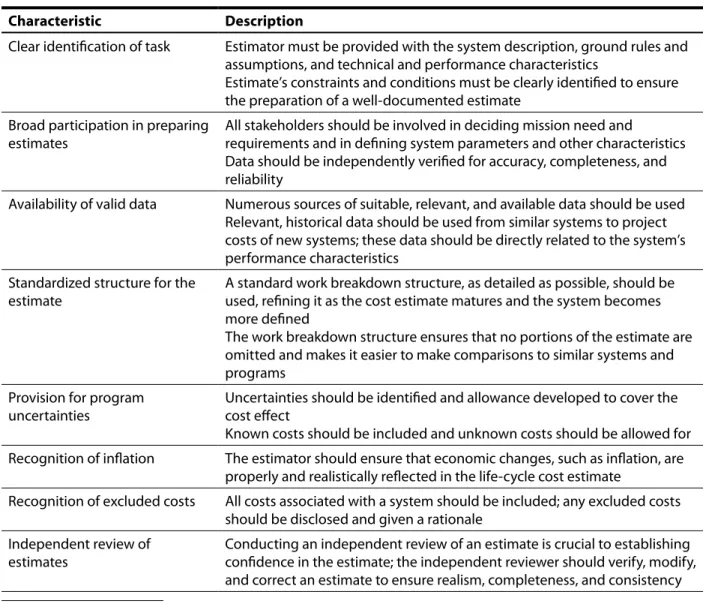
stimAtesThe basic characteristics of effective estimating have been studied and highlighted many times. Their summary, in table 1, is from our 1972 report, Theory and Practice of Cost Estimating for Major Acquisitions. These characteristics are still valid today and should be found in all sound cost analyses.
Table 1: GAO’s 1972 Version of the Basic Characteristics of Credible Cost Estimates
Characteristic Description
Clear identification of task Estimator must be provided with the system description, ground rules and assumptions, and technical and performance characteristics
Estimate’s constraints and conditions must be clearly identified to ensure the preparation of a well-documented estimate
Broad participation in preparing
estimates All stakeholders should be involved in deciding mission need and requirements and in defining system parameters and other characteristics Data should be independently verified for accuracy, completeness, and reliability
Availability of valid data Numerous sources of suitable, relevant, and available data should be used Relevant, historical data should be used from similar systems to project costs of new systems; these data should be directly related to the system’s performance characteristics
Standardized structure for the
estimate A standard work breakdown structure, as detailed as possible, should be used, refining it as the cost estimate matures and the system becomes more defined
The work breakdown structure ensures that no portions of the estimate are omitted and makes it easier to make comparisons to similar systems and programs
Provision for program
uncertainties Uncertainties should be identified and allowance developed to cover the cost effect Known costs should be included and unknown costs should be allowed for Recognition of inflation The estimator should ensure that economic changes, such as inflation, are
properly and realistically reflected in the life-cycle cost estimate
Recognition of excluded costs All costs associated with a system should be included; any excluded costs should be disclosed and given a rationale
Independent review of
estimates Conducting an independent review of an estimate is crucial to establishing confidence in the estimate; the independent reviewer should verify, modify, and correct an estimate to ensure realism, completeness, and consistency
15 Comptroller General of the United States, Theory and Practice of Cost Estimating for Major Acquisitions, pp. 31–32. 16 Comptroller General of the United States, Theory and Practice of Cost Estimating for Major Acquisitions, p. 32.
Characteristic Description
Revision of estimates for
significant program changes Estimates should be updated to reflect changes in a system’s design requirements. Large changes that affect costs can significantly influence program decisions
Source: GAO.
In a 2006 survey to identify the characteristics of a good estimate, participants from a wide variety of industries—aerospace, automotive, energy—as well as consulting firms and the U.S. Navy and Marine Corps corroborated the continuing validity of the characteristics in table 1.
Despite the fact that these basic characteristics have been published and known for decades, we find that many agencies still lack the ability to develop cost estimates that can satisfy them. Case studies 1 and 2, drawn from GAO reports, show the kind of cross-cutting findings we have reported in the past. Because of findings like those in case studies 1 and 2, the Cost Guide provides best practice processes, standards, and procedures for developing, implementing, and evaluating cost estimates and EVM systems and data. By satisfying these criteria, agencies should be able to better manage their programs and inform decision makers of the risks involved.
Case Study 1: Basic Estimate Characteristics, from NASA,
GAO-04-642
GAO found that the National Aeronautics and Space Administration’s (NASA) basic cost estimating processes—an important tool for managing programs—lacked the discipline needed to ensure that program estimates were reasonable. Specifically, none of the 10 NASA programs GAO reviewed in detail met all GAO’s cost estimating criteria, which are based on criteria Carnegie Mellon University’s Software Engineering Institute developed. Moreover, none of the 10 programs fully met certain key criteria—including clearly defining the program’s life cycle to establish program commitment and manage program costs, as required by NASA.
In addition, only 3 programs provided a breakdown of the work to be performed. Without this knowledge, the programs’ estimated costs could be understated and thereby subject to underfunding and cost overruns, putting programs at risk of being reduced in scope or requiring additional funding to meet their objectives. Finally, only 2 programs had a process in place for measuring cost and performance to identify risks.
GAO, NASA: Lack of Disciplined Cost-Estimating Processes Hinders Effective Program Management, GAO-04-642 (Washington, D.C.: May 28, 2004).
Case Study 2: Basic Estimate Characteristics, from Customs Service Modernization, GAO/AIMD-99-41
GAO analyzed the U.S. Customs Service approach to deriving its $1.05 billion Automated Commercial Environment life-cycle cost estimate with Software Engineering Institute (SEI) criteria. SEI had seven questions for decision makers to use in assessing the reliability of a project’s cost estimate and detailed criteria to help evaluate how well a project satisfies each question. Among the criteria were several very significant and closely intertwined requirements that are at the core of effective cost estimating. Specifically, embedded in several of the questions were requirements for using (1) formal cost models; (2) structured and documented processes for determining the software size and reuse inputs to the models; and (3) relevant, measured, and normalized historical cost data (estimated and actual) to calibrate the models.
GAO found that Customs did not satisfy any of these requirements. Instead of using a cost model, it used an unsophisticated spreadsheet to extrapolate the cost of each Automated Commercial Environment increment. Its approach to determining software size and reuse was not documented and was not well supported or convincing. Customs had no historical project cost data when it developed the $1.05 billion estimate and did not account for relevant, measured, and normalized differences in the increments. Clearly, such fundamental changes can dramatically affect system costs and should have been addressed explicitly in Customs’ cost estimates.
GAO, Customs Service Modernization: Serious Management and Technical Weaknesses Must Be Corrected, GAO/AIMD-99-41 (Washington, D.C.: Feb. 26, 1999).
A r
eLiAbLep
roCessford
eveLopingC
redibLeC
oste
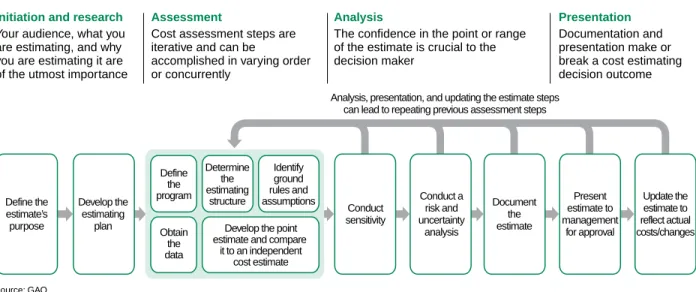
stimAtesCertain best practices should be followed if accurate and credible cost estimates are to be developed. These best practices represent an overall process of established, repeatable methods that result in high-quality cost estimates that are comprehensive and accurate and that can be easily and clearly traced, replicated, and updated. Figure 1 shows the cost estimating process.
Figure 1: The Cost Estimating Process
Source: GAO.
Your audience, what you are estimating, and why you are estimating it are of the utmost importance
Cost assessment steps are iterative and can be
accomplished in varying order or concurrently
The confidence in the point or range of the estimate is crucial to the decision maker
Documentation and presentation make or break a cost estimating decision outcome Initiation and research Assessment Analysis Presentation
Present estimate to management for approval Document the estimate Conduct a risk and uncertainty analysis Conduct sensitivity
Analysis, presentation, and updating the estimate steps can lead to repeating previous assessment steps
Develop the estimating plan Define the estimate’s purpose Determine the estimating structure Identify ground rules and assumptions
Develop the point estimate and compare
it to an independent cost estimate Obtain the data Define the
program Update the
estimate to reflect actual costs/changes
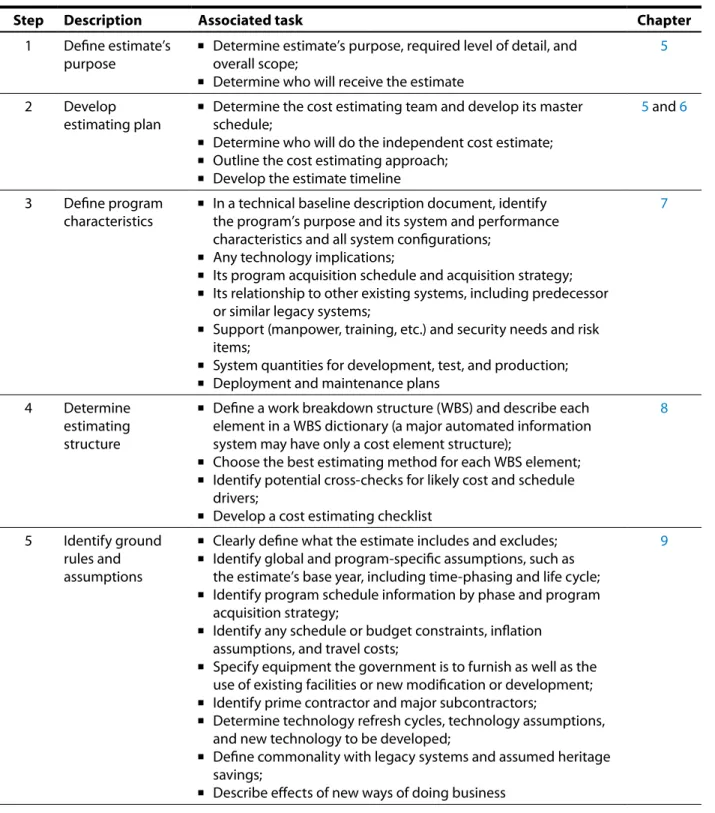
We have identified 12 steps that, followed correctly, should result in reliable and valid cost estimates that management can use for making informed decisions. Table 2 identifies all 12 steps and links each one to the chapter in this guide where it is discussed.
Table 2: The Twelve Steps of a High-Quality Cost Estimating Process
Step Description Associated task Chapter
1 Define estimate’s
purpose Determine estimate’s purpose, required level of detail, and
■
overall scope;
Determine who will receive the estimate
■
5
2 Develop
estimating plan Determine the cost estimating team and develop its master
■
schedule;
Determine who will do the independent cost estimate;
■
Outline the cost estimating approach;
■
Develop the estimate timeline
■
5 and 6
3 Define program
characteristics In a technical baseline description document, identify
■
the program’s purpose and its system and performance characteristics and all system configurations;
Any technology implications;
■
Its program acquisition schedule and acquisition strategy;
■
Its relationship to other existing systems, including predecessor
■
or similar legacy systems;
Support (manpower, training, etc.) and security needs and risk
■
items;
System quantities for development, test, and production;
■
Deployment and maintenance plans
■
7
4 Determine estimating structure
Define a work breakdown structure (WBS) and describe each
■
element in a WBS dictionary (a major automated information system may have only a cost element structure);
Choose the best estimating method for each WBS element;
■
Identify potential cross-checks for likely cost and schedule
■
drivers;
Develop a cost estimating checklist
■
8
5 Identify ground rules and assumptions
Clearly define what the estimate includes and excludes;
■
Identify global and program-specific assumptions, such as
■
the estimate’s base year, including time-phasing and life cycle; Identify program schedule information by phase and program
■
acquisition strategy;
Identify any schedule or budget constraints, inflation
■
assumptions, and travel costs;
Specify equipment the government is to furnish as well as the
■
use of existing facilities or new modification or development; Identify prime contractor and major subcontractors;
■
Determine technology refresh cycles, technology assumptions,
■
and new technology to be developed;
Define commonality with legacy systems and assumed heritage
■
savings;
Describe effects of new ways of doing business
■
Step Description Associated task Chapter
6 Obtain data ■ Create a data collection plan with emphasis on collecting current and relevant technical, programmatic, cost, and risk data;
Investigate possible data sources;
■
Collect data and normalize them for cost accounting, inflation,
■
learning, and quantity adjustments;
Analyze the data for cost drivers, trends, and outliers and
■
compare results against rules of thumb and standard factors derived from historical data;
Interview data sources and document all pertinent information,
■
including an assessment of data reliability and accuracy; Store data for future estimates
■
10
7 Develop point estimate and compare it to an independent cost estimate
Develop the cost model, estimating each WBS element, using
■
the best methodology from the data collected,a and including all
estimating assumptions;
Express costs in constant year dollars;
■
Time-phase the results by spreading costs in the years they are
■
expected to occur, based on the program schedule;
Sum the WBS elements to develop the overall point estimate;
■
Validate the estimate by looking for errors like double counting
■
and omitted costs;
Compare estimate against the independent cost estimate and
■
examine where and why there are differences;
Perform cross-checks on cost drivers to see if results are similar;
■
Update the model as more data become available or as changes
■
occur and compare results against previous estimates
11, 12, and 15
8 Conduct sensitivity
analysis Test the sensitivity of cost elements to changes in estimating
■
input values and key assumptions;
Identify effects on the overall estimate of changing the program
■
schedule or quantities;
Determine which assumptions are key cost drivers and which
■
cost elements are affected most by changes
13
9 Conduct risk and uncertainty analysis
Determine and discuss with technical experts the level of cost,
■
schedule, and technical risk associated with each WBS element; Analyze each risk for its severity and probability;
■
Develop minimum, most likely, and maximum ranges for each
■
risk element;
Determine type of risk distributions and reason for their use;
■
Ensure that risks are correlated;
■
Use an acceptable statistical analysis method (e.g., Monte Carlo
■
simulation) to develop a confidence interval around the point estimate;
Identify the confidence level of the point estimate;
■
Identify the amount of contingency funding and add this to the
■
point estimate to determine the risk-adjusted cost estimate; Recommend that the project or program office develop a risk
■
management plan to track and mitigate risks
Step Description Associated task Chapter
10 Document the
estimate Document all steps used to develop the estimate so that a cost
■
analyst unfamiliar with the program can recreate it quickly and produce the same result;
Document the purpose of the estimate, the team that prepared
■
it, and who approved the estimate and on what date;
Describe the program, its schedule, and the technical baseline
■
used to create the estimate;
Present the program’s time-phased life-cycle cost;
■
Discuss all ground rules and assumptions;
■
Include auditable and traceable data sources for each cost
■
element and document for all data sources how the data were normalized;
Describe in detail the estimating methodology and rationale
■
used to derive each WBS element’s cost (prefer more detail over less);
Describe the results of the risk, uncertainty, and sensitivity
■
analyses and whether any contingency funds were identified; Document how the estimate compares to the funding profile;
■
Track how this estimate compares to any previous estimates
■
16
11 Present estimate to management for approval
Develop a briefing that presents the documented life-cycle cost
■
estimate;
Include an explanation of the technical and programmatic
■
baseline and any uncertainties;
Compare the estimate to an independent cost estimate (ICE) and
■
explain any differences;
Compare the estimate (life-cycle cost estimate (LCCE)) or
■
independent cost estimate to the budget with enough detail to easily defend it by showing how it is accurate, complete, and high in quality;
Focus in a logical manner on the largest cost elements and cost
■
drivers;
Make the content clear and complete so that those who are
■
unfamiliar with it can easily comprehend the competence that underlies the estimate results;
Make backup slides available for more probing questions;
■
Act on and document feedback from management;
■
Request acceptance of the estimate
■
17
12 Update the estimate to reflect actual costs and changes
Update the estimate to reflect changes in technical or program
■
assumptions or keep it current as the program passes through new phases or milestones;
Replace estimates with EVM EAC and independent estimate at
■
completion (EAC) from the integrated EVM system; Report progress on meeting cost and schedule estimates;
■
Perform a post mortem and document lessons learned for
■
elements whose actual costs or schedules differ from the estimate;
Document all changes to the program and how they affect the
■
cost estimate
16, 18, 19, and 20
Source: GAO, DHS, DOD, DOE, NASA, SCEA, and industry.
a In a data-rich environment, the estimating approach should precede the investigation of data sources; in reality, a lack of data often
Each of the 12 steps is important for ensuring that high-quality cost estimates are developed and delivered in time to support important decisions.17 Unfortunately, we have found that some agencies do not
incorporate all the steps and, as a result, their estimates are unreliable. For example, in 2003, we completed a cross-cutting review at the National Aeronautics and Space Administration (NASA) that showed that the lack of an overall process affected NASA’s ability to create credible cost estimates (case study 3).
Case Study 3: Following Cost Estimating Steps, from NASA,
GAO-04-642
NASA’s lack of a quality estimating process resulted in unreliable cost estimates throughout each program’s life cycle. As of April 2003, the baseline development cost estimates for 27 NASA programs varied considerably from their initial baseline estimates. More than half the programs’ development cost estimates increased. For some of these programs, the increase was as much as 94 percent. In addition, the baseline development estimates for 10 programs that GAO reviewed in detail were rebaselined—some as many as four times. The Checkout and Launch Control System (CLCS) program—whose baseline had increased from $206 million in fiscal year 1998 to $399 million by fiscal year 2003—was ultimately terminated. CLCS’ cost increases resulted from poorly defined requirements and design and fundamental changes in the contractors’ approach to the work. GAO also found that
the description of the program objectives and overview in the program commitment
■
agreement was not the description used to generate the cost estimate;
the total life cycle and WBS were not defined in the program’s life-cycle cost estimate;
■
the 1997 nonadvocate review identified the analogy to be used as well as six different
■
projects for parametric estimating, but no details on the cost model parameters were documented; and
no evidence was given to explain how the schedule slip, from June 2001 to June 2005,
■
affected the cost estimate.
GAO recommended that NASA establish a framework for developing life-cycle cost estimates that would require each program to base its cost estimates on a WBS that encompassed both in-house and contractor efforts and also to prepare a description of cost analysis requirements. NASA concurred with the recommendation; it intended to revise its processes and its procedural requirements document and cost estimating handbook accordingly.
GAO, NASA: Lack of Disciplined Cost-Estimating Processes Hinders Effective Program Management, GAO-04-642 (Washington, D.C.: May 28, 2004).
NASA has since developed a cost estimating handbook that reflects a “renewed appreciation within the Agency for the importance of cost estimating as a critical part of project formulation and execution.” It has also stated that “There are newly formed or regenerated cost organizations at NASA Headquarters . . . . The field centers cost organizations have been strengthened, reversing a discouraging trend of decline.”
17 The 12 steps outlined in table 2 are appropriate for estimating the costs of large, complex programs. We note, however, that
planning trade-offs, initial rough-order estimations, and other less visible analyses can be accomplished in less time than with the process outlined in the table.
Finally, NASA reported in its cost handbook that “Agency management, from the Administrator and Comptroller on down, is visibly supportive of the cost estimating function.”18
While these are admirable improvements, even an estimate that meets all these steps may be of little use or may be overcome by events if it is not ready when needed. Timeliness is just as important as quality. In fact, the quality of a cost estimate may be hampered if the time to develop it is compressed. When this happens, there may not be enough time to collect historical data. Since data are the key drivers of an estimate’s quality, their lack increases the risk that the estimate may not be reliable. In addition, when time is a factor, an independent cost estimate (ICE) may not be developed, further adding to the risk that the estimate may be overly optimistic. This is not an issue for DOD’s major defense acquisition programs, because an ICE is required for certain milestones.
Relying on a standard process that emphasizes pinning down the technical scope of the work,
communicating the basis on which the estimate is built, identifying the quality of the data, determining the level of risk, and thoroughly documenting the effort should result in cost estimates that are defensible, consistent, and trustworthy. Furthermore, this process emphasizes the idea that a cost estimate should be a “living document,” meaning that it will be continually updated as actual costs begin to replace the original estimates. This last step links cost estimating with data that are collected by an EVM system, so that lessons learned can be examined for differences and their reasons. It also provides valuable information for strengthening the credibility of future cost estimates, allowing for continuous process improvement.
18 NASA, Cost Analysis Division, 2004 NASACost Estimating Handbook (Washington, D.C.: 2004), p. i. www.nasa.gov/offices/pae/
Why Government Programs need
cost estimates and the challenges in
developing them
chAPter 2
Cost estimates are necessary for government acquisition programs for many reasons: to support decisions about funding one program over another, to develop annual budget requests, to evaluate resource requirements at key decision points, and to develop performance measurement baselines. Moreover, having a realistic estimate of projected costs makes for effective resource allocation, and it increases the probability of a program’s success. Government programs, as identified here, include both in-house and contract efforts.
For capital acquisitions, OMB’s Capital Programming Guide helps agencies use funds wisely in achieving their missions and serving the public. The Capital Programming Guide stresses the need for agencies to develop processes for making investment decisions that deliver the right amount of funds to the right projects. It also highlights the need for agencies to identify risks associated with acquiring capital assets that can lead to cost overruns, schedule delays, and assets that fail to perform as expected.
OMB’s guide has made developing accurate life-cycle cost estimates a priority for agencies in properly managing their portfolios of capital assets that have an estimated life of 2 years or more. Examples of capital assets are land; structures such as office buildings, laboratories, dams, and power plants; equipment like motor vehicles, airplanes, ships, satellites, and information technology hardware; and intellectual property, including software.
Developing reliable cost estimates has been difficult for agencies across the federal government. Too often, programs cost more than expected and deliver results that do not satisfy all requirements. According to the 2002 President’s Management Agenda:
Everyone agrees that scarce federal resources should be allocated to programs and managers that deliver results. Yet in practice, this is seldom done because agencies rarely offer convincing accounts of the results their allocations will purchase. There is little reward, in budgets or in compensation, for running programs efficiently. And once money is allocated to a program, there is no requirement to revisit the question of whether the results obtained are solving problems the American people care about. 19
The need for reliable cost estimates is at the heart of two of the five governmentwide initiatives in that agenda: improved financial performance and budget and performance integration. These initiatives are 19 President George W. Bush, The President’s Management Agenda: Fiscal Year 2002 (Washington, D.C.: Executive Office of the