The BSCS 5E Instructional Model:
Origins and Effectiveness
A Report Prepared for the
Office of Science Education
National Institutes of Health
by
Rodger W. Bybee, Joseph A. Taylor, April Gardner, Pamela Van
Scotter, Janet Carlson Powell, Anne Westbrook, and Nancy Landes
with research and preparation assistance from
Samuel Spiegel, Molly McGarrigle Stuhlsatz, Amy Ellis, Barbara
Resch, Heather Thomas, Mark Bloom, Renee Moran, Steve Getty,
and Nicole Knapp
BSCS
5415 Mark Dabling Boulevard
Colorado Springs, CO 80918
www.bscs.org
(719) 531-5550
Introduction
Science teachers continuously strive to improve their instructional practices to enhance student learning. Complementing the aims of science teachers, curriculum developers systematically attempt to identify research findings they can incorporate in materials that will facilitate
connections between teachers, the curriculum, and students. Recently, the use of coordinated and coherent sequencing of lessons—learning cycles and instructional models—has gained
popularity in the science education community.
Recent research reports, such as How People Learn: Brain, Mind, Experience, and School (Bransford, Brown & Cocking, 2000) and its companion, How Students Learn: Science in the Classroom (Donovan & Bransford, 2005), have confirmed what educators have asserted for many years: The sustained use of an effective, research-based instructional model can help students learn fundamental concepts in science and other domains. If we accept that
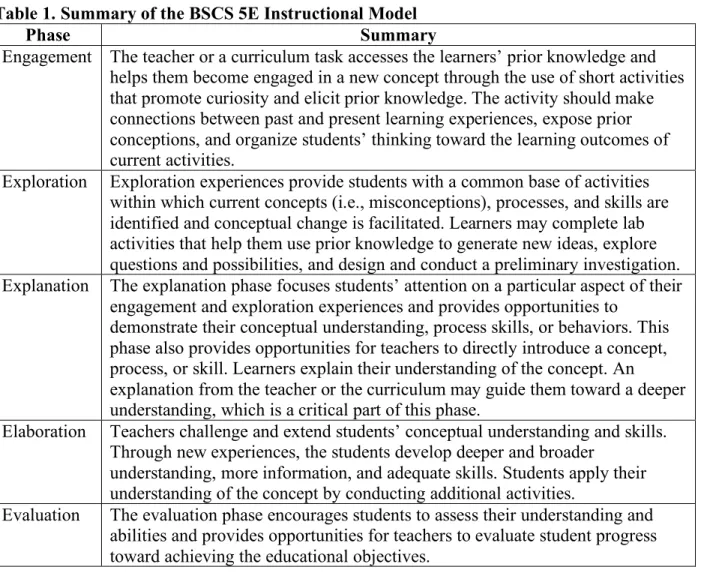
premise, then an instructional model must be effective, supported with relevant research and it must be implemented consistently and widely to have the desired effect on teaching and learning. Since the late 1980s, BSCS has used one instructional model extensively in the development of new curriculum materials and professional development experiences. That model is commonly referred to as the BSCS 5E Instructional Model, or the 5Es, and consists of the following phases: engagement, exploration, explanation, elaboration, and evaluation. Each phase has a specific function and contributes to the teacher’s coherent instruction and to the learners’ formulation of a better understanding of scientific and technological knowledge, attitudes, and skills. The model frames a sequence and organization of programs, units, and lessons. Once internalized, it also can inform the many instantaneous decisions that science teachers must make in classroom situations. See Table 1 for a summary of the BSCS 5E Instructional Model.
This report summarizes recent research on the sequencing of science instruction, including laboratory experiences, in order to facilitate student learning. Specifically, the report provides a rationale and empirical support for the BSCS 5E Instructional Model.
One reason for reviewing the historical development and research base for the BSCS 5E
Instructional Model is its ubiquitous use in education today. This widespread use falls into three primary categories of use: 1) documents that frame larger pieces of work such as curriculum frameworks, assessment guidelines, or course outlines; 2) curriculum materials of various lengths and sizes; and 3) adaptations for teacher professional development, informal education settings, and disciplines other than science. A simple internet search, using a popular search engine such as Google, reveals the wide and varied applications of the 5E model. In spring 2006, this type of search showed the following range of uses:
• more than 235,000 lesson plans developed and implemented using the BSCS 5E
• at least three states that strongly endorse the 5E model, including Texas, Connecticut, and
Maryland.
The first section of this report provides a brief history of instructional models and discusses the Science Curriculum Improvement Study (SCIS) learning cycle (Karplus & Thier, 1967), the predecessor to the BSCS 5Es. After that discussion, the same section summarizes research supporting contemporary views of learning and the effectiveness of different instructional models, with emphasis on the SCIS learning cycle and the BSCS 5E model.
Table 1. Summary of the BSCS 5E Instructional Model
Phase Summary
Engagement The teacher or a curriculum task accesses the learners’ prior knowledge and helps them become engaged in a new concept through the use of short activities that promote curiosity and elicit prior knowledge. The activity should make connections between past and present learning experiences, expose prior conceptions, and organize students’ thinking toward the learning outcomes of current activities.
Exploration Exploration experiences provide students with a common base of activities within which current concepts (i.e., misconceptions), processes, and skills are identified and conceptual change is facilitated. Learners may complete lab activities that help them use prior knowledge to generate new ideas, explore questions and possibilities, and design and conduct a preliminary investigation. Explanation The explanation phase focuses students’ attention on a particular aspect of their
engagement and exploration experiences and provides opportunities to
demonstrate their conceptual understanding, process skills, or behaviors. This phase also provides opportunities for teachers to directly introduce a concept, process, or skill. Learners explain their understanding of the concept. An
explanation from the teacher or the curriculum may guide them toward a deeper understanding, which is a critical part of this phase.
Elaboration Teachers challenge and extend students’ conceptual understanding and skills. Through new experiences, the students develop deeper and broader
understanding, more information, and adequate skills. Students apply their understanding of the concept by conducting additional activities.
Evaluation The evaluation phase encourages students to assess their understanding and abilities and provides opportunities for teachers to evaluate student progress toward achieving the educational objectives.
Origins of
Origins of Contemporary Instructional Models
Although the idea of instructional models is not new, their application and use has increased dramatically in recent years. This discussion presents a brief history of several instructional models, in particular those that influenced the development of the contemporary BSCS 5E Instructional Model. The historical models include brief discussions of several approaches including one by Johann Herbart and John Dewey. We then provide greater philosophical and psychological detail for a model presented by J. Myron Atkin and Robert Karplus because this model was the foundation for the BSCS 5E Instructional Model.
Johann Friedrich Herbart
Johann Friedrich Herbart, a German philosopher, influenced American educational thought around the turn of the 20th century. For Herbart, the primary purpose of education is the development of character, and the process of developing character begins with the students’ interest. Herbart considers concepts to be the fundamental building blocks of the mind, and the function of a concept is justification for including a concept in a course of study. In a
contemporary sense, Herbart is interested in the creation and development of conceptual structures that would contribute to an individual’s development of character.
Herbart proposes two ideas as foundations for teaching: interest and conceptual understanding. The first principle of effective instruction consists of the students’ interest in the subject. Herbart suggests two types of interest, one based on direct experiences with the natural world and the second based on social interactions. Science instruction can quite easily use the natural world and capitalize on the curiosity of students. In addition, teachers can introduce objects from the natural world and use them to help students accumulate a rich set of sense impressions. Herbart suggests the observation and collection of living organisms and the introduction of tools and machines (Herbart, 1901).
Herbart’s model also incorporates the social interests of children and their interactions with other individuals. A thorough education takes into account the contribution of social interactions to learning. Thus, an instructional model should incorporate opportunities for social interaction among students and between students and the teacher.
The second principle of Herbart’s model is the formation of concepts. For Herbart, sense
perceptions of objects, organisms, and events are essential, but in and of themselves they are not sufficient for the development of mind. A very important theme in Herbart’s model is the
coherence of ideas. That is, each new idea must be related to extant ideas. Said in contemporary terms, prior knowledge is the point of departure of instruction.
In summarizing Herbart’s ideas into an instructional model, we begin with the current knowledge and experiences of the students and the new ideas related to concepts the students already have. Introducing new ideas that connect with extant ideas would slowly form concepts. According to Herbart (1901), the best pedagogy allows students to discover the relationships among
experiences. Teachers would guide, question, and suggest through indirect methods. The next step involves direct instruction, where the teacher systematically explains ideas that the student could not be expected to discover independently. In the final step, teachers ask students to
demonstrate their understanding by applying the concepts to new situations. Herbart’s model is one of the first systematic approaches to teaching and has been used in various forms by educators for more than 100 years. Table 2 summarizes Herbart’s instructional model. Table 2. Herbart’s Instructional Model
Phase Summary
Preparation The teacher brings prior experiences to the students’ awareness.
Presentation The teacher introduces new experiences and makes connections to prior experiences.
Generalization The teacher explains ideas and develops concepts for the students. Application The teacher provides experiences where the students demonstrate their
understanding by applying concepts in new contexts.
John Dewey
John Dewey began his career as a science teacher. No doubt, the early influence of science explains the obvious connection between Dewey’s conception of thinking and scientific inquiry. In How We Think (1910, 1933), Dewey outlines what he terms a complete act of thought and describes what he maintains are indispensable traits of reflective thinking. Those traits include (1) defining the problem, (2) noting conditions associated with the problem, (3) formulating a hypothesis for solving the problem, (4) elaborating the value of various solutions, and (5) testing the ideas to see which provide the best solution for the problem.
In Democracy and Education (1916), Dewey further describes the relationship between experience and thinking. He summarizes the general features of the reflective experience:
(i) perplexity, confusion, doubt, due to the fact that one is implicated in an incomplete situation whose full character is not yet determined; (ii) a conjectural anticipation—a tentative interpretation of the given elements, attributing to them a tendency to affect certain consequences; (iii) a careful survey (examination, inspection, exploration, analysis) of all attainable consideration which will define and clarify the problem in hand; (iv) a consequent elaboration of the tentative hypothesis to make it more precise and more consistent; (v) taking one stand upon the project hypothesis as a plan of action which is applied to the existing state of affairs: doing something overtly to bring about the anticipated result, thereby testing the hypothesis. (p. 150)
Based on this quotation, it seems clear that Dewey implies an instructional approach that is based on experience and requires reflective thinking. In contemporary terms, doing hands-on activities in science is not enough. Those experiences also must be minds on.
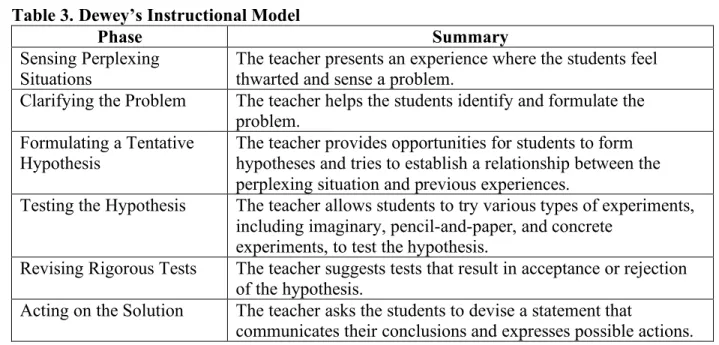
Table 3 synthesizes an instructional model from Dewey’s statements and from Science in General Education.
Table 3. Dewey’s Instructional Model
Phase Summary
Sensing Perplexing
Situations The teacher presents an experience where the students feel thwarted and sense a problem. Clarifying the Problem The teacher helps the students identify and formulate the
problem. Formulating a Tentative
Hypothesis
The teacher provides opportunities for students to form hypotheses and tries to establish a relationship between the perplexing situation and previous experiences.
Testing the Hypothesis The teacher allows students to try various types of experiments, including imaginary, pencil-and-paper, and concrete
experiments, to test the hypothesis.
Revising Rigorous Tests The teacher suggests tests that result in acceptance or rejection of the hypothesis.
Acting on the Solution The teacher asks the students to devise a statement that
communicates their conclusions and expresses possible actions. By 1950, a variation of John Dewey’s instructional model emerged in science methods textbooks (Heiss, Obourn, & Hoffman, 1950). The authors based their “learning cycle” (their term) on Dewey’s complete act of thought. Table 4 presents that learning cycle.
Table 4. Heiss, Obourn, and Hoffman Learning Cycle
Phase Summary
Exploring the Unit Students observe demonstrations to raise questions, propose a hypothesis to answer questions, and plan for testing.
Experience Getting Students test the hypothesis, collect and interpret data, and form a conclusion.
Organization of Learning Students prepare outlines, results, and summaries; they take tests.
Application of Learning Students apply information, concepts, and skills to new situations.
The Atkin-Karplus Learning Cycle
In the late 1950s and early 1960s, an era of curriculum reform, instructional models were popularized by leaders of the reform movement. In a popular and now-classic article, “Messing About in Science,” David Hawkins (1965) describes a teaching model that uses the symbols of the circle, the triangle, and the square. In general, the symbols represent phases of an
instructional model that includes unstructured exploration, multiple programmed experiences, and didactic instruction.
The model described by Hawkins provides the basic strategies for the units developed by the Elementary Science Study (ESS). The systematic approach to instruction did not, however, gain
the widespread acceptance of other curriculum development studies, in particular the Science Curriculum Improvement Study (SCIS).
Robert Karplus, a theoretical physicist at the University of California–Berkeley, became interested in science education in the late 1950s. His interest led to an exploration of children’s thinking and their explanations of natural phenomena. By 1961, Karplus began connecting the developmental psychology of Jean Piaget to the design of instructional materials and science teaching.
In 1961, J. Myron Atkin, then at the University of Illinois, shared Karplus’s ideas about teaching science to young children. Eventually, they collaborated on a model of guided discovery in instructional materials (Atkin & Karplus, 1962). Karplus continued refining his ideas and the instructional model as he tested different instructional materials and observed the responses of elementary children.
By 1967, Robert Karplus and his colleague Herbert Thier used the original terms and provided greater clarity and a curricular context as they described the three phases of their model for science teaching. “The plan of a unit may be seen, therefore, to consist of this sequence: preliminary exploration, invention, and discovery” (Karplus & Thier, 1967, p. 40).
The three phases and the sequence of the SCIS learning cycle are exploration, invention, and discovery. Exploration refers to relatively unstructured experiences in which students gather new information. Invention refers to a formal statement, often the definition and terms for a new concept. Following the exploration, the invention phase allows interpretation of newly acquired information through the restructuring of prior concepts. The discovery phase involves application of the new concept to another, novel situation. During this phase, the learner continues to
develop a new level of cognitive organization and attempts to transfer what he or she has learned to new situations. (See Table 5.)
A number of studies have shown that the SCIS learning cycle has many advantages when compared with other approaches to instruction. These studies are summarized in Abraham and Renner (1986). Jack Renner and his colleagues (Renner, Abraham, & Birnie, 1985; Abraham & Renner, 1986; Renner, Abraham, & Birnie, 1988) have investigated, respectively, the form of acquisition of information in the learning cycle, the sequencing of phases in the learning cycle, and the necessity of each phase of the learning cycle. These studies have generally supported use of the SCIS learning cycle as originally designed by Atkin and Karplus. Research on discovery, guided discovery, and statement-of-rule learning (Egan & Greeno, 1973; Gagne & Brown, 1961; Roughead & Scandura, 1968) supports the “sequencing and necessity” conclusions drawn by Renner and his colleagues. Lawson (1995) provides an excellent detailed history of the development and modifications of the SCIS learning cycle.
Table 5. Atkin-Karplus Learning Cycle
Phase Summary
Exploration Students have an initial experience with phenomena.
Invention Students are introduced to new terms associated with concepts that are the object of study.
Discovery Students apply concepts and use terms in related but new situations. Analyses of elementary programs indicate that SCIS was one of the effective programs
(Shymansky, Kyle, & Alport, 1983). These positive effects on learning relate at least in part to the learning cycle. The SCIS learning cycle was used as central to a theory of instruction
prescribed by Lawson, Abraham, & Renner (1989). In addition, the SCIS learning cycle has been applied successfully in different educational settings.
The BSCS 5E Instructional Model
In the mid-1980s, BSCS received a grant from IBM to conduct a design study that would produce specifications for a new science and health curriculum for elementary schools. Among the innovations that resulted from this design study was the BSCS 5E Instructional Model. As mentioned earlier and elaborated later in this section, the BSCS model has five phases:
engagement, exploration, explanation, elaboration, and evaluation. When formulating the BSCS 5E Instructional Model, we consciously began with the SCIS learning cycle. The middle three elements of the BSCS model are fundamentally equivalent to the three phases of the SCIS learning cycle.
Table 6. Comparison of the Phases of the SCIS and BSCS 5E Models
SCIS Model BSCS 5E Instructional Model
Engagement (New Phase)
Exploration Exploration (Adapted from SCIS)
Invention (Term Introduction) Explanation (Adapted from SCIS) Discovery (Concept Application) Elaboration (Adapted from SCIS)
Evaluation (New Phase)
The following paragraphs describe the phases of the BSCS 5E Instructional Model. Phases of the BSCS model can be applied at several levels in the design of curriculum materials and
instructional sequences. They may be applied to the organizational pattern of a yearlong program, to units within the curriculum, and to sequences within lessons. These paragraphs are slightly modified from the original descriptions in New Designs for Elementary School Science and Health (BSCS, 1989).
Engagement: The first phase engages students in the learning task. The students mentally focus on an object, problem, situation, or event. The activities of this phase make connections to past experiences and expose students’ misconceptions; they should serve to mitigate cognitive disequilibrium.
Asking a question, defining a problem, showing a discrepant event, and acting out a problematic situation are all ways to engage the students and focus them on the instructional task. The role of
the teacher is to present the situation and identify the instructional task. The teacher also sets the rules and procedures for establishing the task.
Successful engagement results in students being puzzled by, and actively motivated in, the learning activity. Here, the word “activity” refers to both mental and physical activity.
Exploration: Once the activities have engaged the students, the students have a psychological need for time to explore the ideas. Exploration activities are designed so that the students in the class have common, concrete experiences upon which they continue formulating concepts, processes, and skills. Engagement brings about disequilibrium; exploration initiates the process of equilibration. This phase should be concrete and hands on. Educational software can be used in the phase, but it should be carefully designed to assist the initial process of formulating adequate and scientifically accurate concepts.
The aim of exploration activities is to establish experiences that teachers and students can use later to formally introduce and discuss concepts, processes, or skills. During the activity, the students have time in which they can explore objects, events, or situations. As a result of their mental and physical involvement in the activity, the students establish relationships, observe patterns, identify variables, and question events.
The teacher’s role in the exploration phase is that of facilitator or coach. The teacher initiates the activity and allows the students time and opportunity to investigate objects, materials, and situations based on each student’s own ideas of the phenomena. If called upon, the teacher may coach or guide students as they begin reconstructing their explanations. Use of tangible materials and concrete experiences is essential.
Explanation: The word “explanation” means the act or process in which concepts, processes, or skills become plain, comprehensible, and clear. The process of explanation provides the students and the teacher with a common use of terms relative to the learning task. In this phase, the teacher directs students’ attention to specific aspects of the engagement and exploration experiences. First, the teacher asks the students to give their explanations. Second, the teacher introduces scientific or technological explanations in a direct, explicit, and formal manner. Explanations are ways of ordering the exploratory experiences. The teacher should base the initial part of this phase on the students’ explanations and clearly connect the explanations to experiences in the engagement and exploration phases of the instructional model. The key to this phase is to present concepts, processes, or skills briefly, simply, clearly, and directly and to move on to the next phase.
Teachers have a variety of techniques and strategies at their disposal to elicit and develop student explanations. Educators commonly use verbal explanations; but, there are numerous other
Elaboration: Once the students have an explanation and terms for their learning tasks, it is important to involve the students in further experiences that extend, or elaborate, the concepts, processes, or skills. This phase facilitates the transfer of concepts to closely related but new situations. In some cases, students may still have misconceptions, or they may only understand a concept in terms of the exploratory experience. Elaboration activities provide further time and experiences that contribute to learning.
Audrey Champagne (1987) provides a clear description of this phase:
During the elaboration phase, students engage in discussions and information-seeking activities. The group’s goal is to identify and execute a small number of promising approaches to the task. During the group discussion, students present and defend their approaches to the instructional task. This discussion results in better definition of the task as well as the identification and gathering of
information that is necessary for successful completion of the task. The teaching cycle is not closed to information from the outside. Students get information from each other, the teacher, printed materials, experts, electronic databases, and experiments that they conduct. This is called the information base. As a result of participation in the group’s discussion, individual students are able to elaborate upon the conception of the tasks, information bases, and possible strategies for its [the task’s] completion. (p. 82)
Note the use of interactions within student groups as a part of the elaboration process. Group discussions and cooperative learning situations provide opportunities for students to express their understanding of the subject and receive feedback from others who are very close to their own level of understanding.
This phase is also an opportunity to involve students in new situations and problems that require the transfer of identical or similar explanations. Generalization of concepts, processes, and skills is the primary goal.
Evaluation: This is the important opportunity for students to use the skills they have acquired and evaluate their understanding. In addition, the students should receive feedback on the adequacy of their explanations. Informal evaluation can occur at the beginning and throughout the 5E sequence. The teacher can complete a formal evaluation after the elaboration phase. As a practical educational matter, teachers must assess educational outcomes. This is the phase in which teachers administer assessments to determine each student’s level of understanding. What are the commonalities and differences between the SCIS learning cycle and the BSCS 5E Instructional Model? The principle commonality underlying both models is the psychological theory that informed the sequence and emphasis for the phases. Both models use the work of Jean Piaget (Piaget & Inhelder, 1969; Piaget, 1975) and subsequent research consistent with the Piagetian theory, specifically the focus of cognitive sciences and the work on misconceptions, the difference between novice and expert explanations of phenomena, and naive versus canonical theories. The view of learning is summarized here and discussed in greater detail in the next section.
Briefly, the theory underlying both SCIS and the BSCS 5Es views learning as dynamic and interactive. Individuals redefine, reorganize, elaborate, and change their initial concepts through interaction with their environment, other individuals, or both. The learner “interprets” objects and phenomena and internalizes the interpretation in terms of the current experience
encountered. To change and improve conceptions often requires challenging the students’ current conceptions and showing those conceptions to be incomplete or inadequate. If a current
conception is challenged, there must be opportunity, in the form of time and experiences, to develop a more accurate conception. In sum, the students’ construction of knowledge can be assisted by using sequences of lessons designed to challenge current conceptions and provide time and opportunities for reconstruction to occur.
The changes introduced to the BSCS model reflect research on learning published since the original SCIS learning cycle. BSCS recognized the need for the explicit engagement of the learner with his or her prior knowledge (Champagne, 1988). BSCS maintained the term
exploration and the original intent of the phase; however, we incorporated cooperative learning into this phase based on the research of Johnson, Johnson, and Holubec (1986). We maintained the invention or concept introduction phase, but changed the term to explanation to emphasize the development of scientific explanations. For the discovery phase, we again incorporated cooperative learning. We also changed this phase to elaboration to emphasize the application and transfer of ideas to further develop current understanding. Finally, we added a phase of evaluation. In this phase, students demonstrate their understandings and abilities through a new activity. This change was made to address the need for formal assessment opportunities that were integral to the instructional plan (Kulm & Malcolm, 1991). This phase also provides
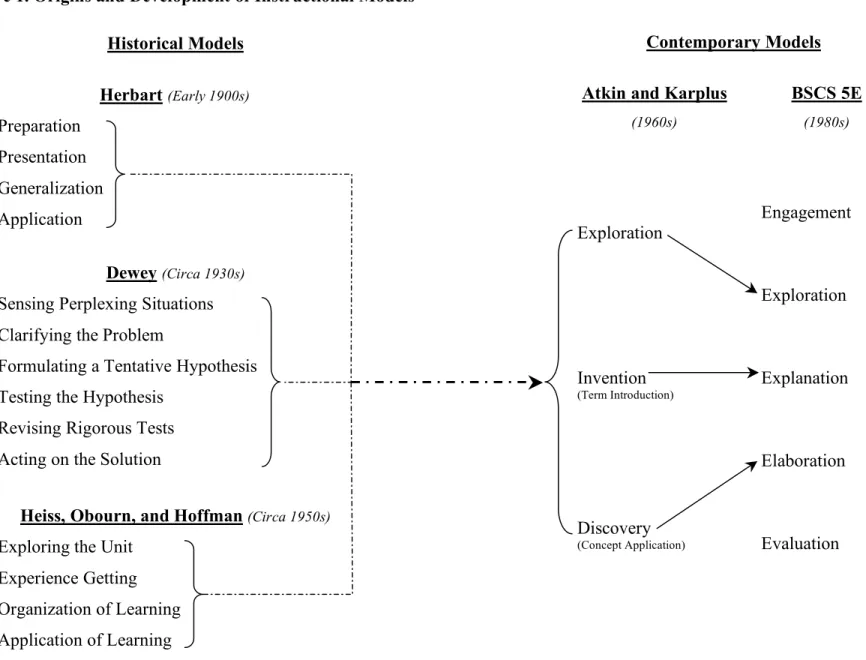
opportunities for self-reflection, an essential component of learning revealed by studies on metacognition (Brown & Campione, 1987). See Figure 1 for a summary of the origins and evolution of the instructional models reviewed in this section.
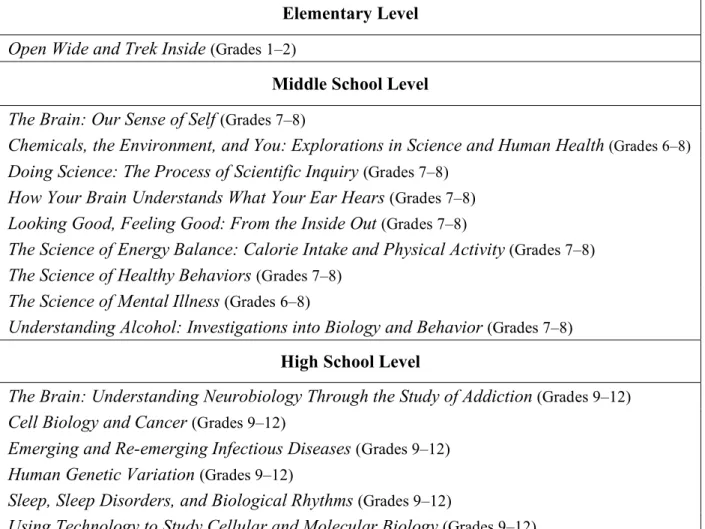
Since the late 1980s, the 5E instructional model has been a central feature in the majority of BSCS programs, especially our core programs. The core programs are summarized in Tables 7 and 8. Field-test results for several of these programs are described in a later section of the report.
Table 7. Core Programs That Incorporate the BSCS 5E Instructional Model
Original Program Contemporary Program
Science for Life and Living © 1992
1st Edition (Grades K–6) BSCS Science Tracks © 2006 2nd Edition (Grades K–5) Middle School Science & Technology © 1994
1st Edition (Grades 6–8) BSCS Science & Technology © 2005 3rd Edition (Grades 6–8) BSCS Biology: A Human Approach © 1997
1st Edition (Grades 9–12)
BSCS Biology: A Human Approach © 2006 3rd Edition (Grades 9–12)
Table 8. Modules in the NIH Curriculum Supplement Series That Incorporate the BSCS 5E Instructional Model
Elementary Level Open Wide and Trek Inside (Grades 1–2)
Middle School Level The Brain: Our Sense of Self (Grades 7–8)
Chemicals, the Environment, and You: Explorations in Science and Human Health (Grades 6–8) Doing Science: The Process of Scientific Inquiry (Grades 7–8)
How Your Brain Understands What Your Ear Hears (Grades 7–8) Looking Good, Feeling Good: From the Inside Out (Grades 7–8)
The Science of Energy Balance: Calorie Intake and Physical Activity (Grades 7–8) The Science of Healthy Behaviors (Grades 7–8)
The Science of Mental Illness (Grades 6–8)
Understanding Alcohol: Investigations into Biology and Behavior (Grades 7–8) High School Level
The Brain: Understanding Neurobiology Through the Study of Addiction (Grades 9–12) Cell Biology and Cancer (Grades 9–12)
Emerging and Re-emerging Infectious Diseases (Grades 9–12) Human Genetic Variation (Grades 9–12)
Sleep, Sleep Disorders, and Biological Rhythms (Grades 9–12)
Using Technology to Study Cellular and Molecular Biology (Grades 9–12)
In summary, the BSCS 5E Instructional Model is grounded in sound educational theory, has a growing base of research to support its effectiveness, and has had a significant impact on science education. While encouraging, these conclusions indicate that it is important to conduct research on the effectiveness of the model, including when and how it is used, and continue to refine the model based on direct research and related research on learning.
Contemporary Models BSCS 5E
(1980s)
Engagement
Exploration
Explanation
Elaboration
Evaluation Atkin and Karplus
(1960s)
Exploration
Invention
(Term Introduction)
Discovery
(Concept Application)
Figure 1. Origins and Development of Instructional Models Historical Models
Herbart (Early 1900s)
Preparation Presentation Generalization Application
Dewey (Circa 1930s)
Sensing Perplexing Situations Clarifying the Problem
Formulating a Tentative Hypothesis Testing the Hypothesis
Revising Rigorous Tests Acting on the Solution
Heiss, Obourn, and Hoffman (Circa 1950s)
Effectiveness of
Effectiveness of Contemporary Instructional Models
The BSCS 5E Instructional Model builds on the work of other instructional models and is supported by current research on learning. BSCS has a long history of developing curriculum materials that reflect the most recent research about learning and teaching. Our current
understanding has been informed by research conducted by cognitive scientists from around the world (Brooks & Brooks, 1993; Driver, et al., 1994; Lambert, et al., 1995; Matthews, 1992; National Research Council, 2000; Piaget, 1976; Posner, et al., 1982; Vygotsky, 1962). Cognitive research shows that learning is an active process occurring within and influenced by the learner. Hence, learning results from an interaction between what information is encountered and how the student processes that information based on perceived notions and extant personal
knowledge. The BSCS 5E Instructional Model applies this research to curriculum materials.
How People Learn
Several reports from the National Research Council and the National Academy of Sciences (NRC and NAS) present significant syntheses of contemporary research on learning. The first NRC review, How People Learn: Brain, Mind, Experience, and School (Bransford, Brown & Cocking, 1999), has been followed by other reports that go beyond the synthesis and discuss strategies for applying the findings to practice, including How People Learn: Bridging Research and Practice (Donovan, Bransford, & Pellegrino, 1999) and How Students Learn: Science in the Classroom (Donovan & Bransford, 2005).
How People Learn (Bransford, Brown & Cocking, 1999) offers insights about learners and learning that are especially important for this review. Three major findings are highlighted because they have a strong research base and clear implications for the use of systematic and carefully designed instruction:
1. Students come to the classroom with preconceptions about how the world works. If their initial understanding is not engaged, they may fail to grasp new concepts and information that are taught, or they may learn for the purpose of a test but revert to their preconceptions outside the classroom. 2. To develop competence in an area of inquiry, students must: (a) have a
deep foundation of factual knowledge, (b) understand facts and ideas in the context of a conceptual framework, and (c) organize knowledge in ways that facilitate retrieval and application.
3. A “metacognitive” approach to instruction can help students learn to take control of their own learning by defining learning goals and monitoring their progress in achieving them. (pp. 10–13)
These findings have parallel implications for classroom instruction and translating those implications into curriculum materials. The findings imply that teachers must be able to do the following:
• Recognize and draw out preconceptions from their students and base instructional decisions on the information they get from their students.
• Teach their subject matter in depth so that facts are conveyed in a context with examples and a conceptual framework.
• Integrate metacognitive skills into the curriculum and teach those skills explicitly. Relative to this review and the BSCS 5E Instructional Model, a quote from How People Learn (Bransford, Brown, & Cocking, 1999) seems especially germane:
An alternative to simply progressing through a series of exercises that derive from a scope and sequence chart is to expose students to the major patterns of a subject domain as they arise naturally in problem situations. Activities can be structured so that students are able to explore, explain, extend, and evaluate their progress. Ideas are best introduced when students see a need or a reason for their use—this helps them see relevant uses of the knowledge to make sense of what they are learning. (p. 127)
This quotation directs attention to a research-based recommendation for a structure and sequence of instruction that exposes students to problem situations (i.e., engage their thinking) and then provides opportunities to explore, explain, extend, and evaluate their learning. This research summary from the National Research Council supports the design and sequence of the BSCS 5E Instructional Model.
Integrated Instructional Units
Following the work of Bransford, Brown, and Cocking, the National Research Council published America’s Lab Report: Investigations in High School Sciences (2006). This report examined the status of science laboratories and developed a vision for their future role in high school science education. The NRC committee (NRC, 2006) used the following definition for laboratory experiences:
Laboratory experiences provide opportunities for students to interact directly with the material world (or with data drawn from the material world), using tools, data collection techniques, models, and theories of science. (p. 31)
Note that this definition includes physical manipulation of substances, organisms, and systems; interactions with simulations; interactions with actual (not artificially created) data; analysis of large databases; and remote access to instruments and observations, for example, via World Wide Web links.
The committee was very clear that science education includes both learning about the methods and processes of scientific research and the knowledge derived from those processes. The learning goals that should be attained as a result of laboratory experiences include the following:
• Enhancing mastery of subject matter • Developing scientific reasoning
• Understanding the complexity and ambiguity of empirical work • Developing practical skills
• Understanding the nature of science
• Cultivating interest in science and interest in learning science • Developing teamwork abilities (NRC, 2006, p. 76–77)
In the analysis of laboratory experiences, the committee applied results from the large and growing body of cognitive research. Some researchers have investigated the sequence of science instruction, including the role of laboratory experiences, as these sequences enhance student achievement of the aforementioned learning goals. The NRC committee (NRC, 2006) proposed the phrase “integrated instructional units”:
Integrated instructional units interweave laboratory experiences with other types of science learning activities, including lectures, reading, and discussion. Students are engaged in forming research questions, designing and executing experiments, gathering and analyzing data, and constructing arguments and conclusions as they carry out investigations. Diagnostic, formative assessments are embedded into the instructional sequence and can be used to gauge the students’ developing
understanding and to promote their self-reflection on their thinking. (p. 82)
Integrated instructional units have two key features; first, laboratory and other experiences are carefully designed or selected on the basis of what students should learn from them. And second, the experience is explicitly linked to and integrated with other learning activities in the unit. The features of integrated instructional units map directly to the BSCS instructional model. Stated another way, the BSCS model is a specific example of integrated instructional units. According to the NRC committee’s report, integrated instructional units connect laboratory experience with other types of science learning activities including reading, discussions, and lectures.
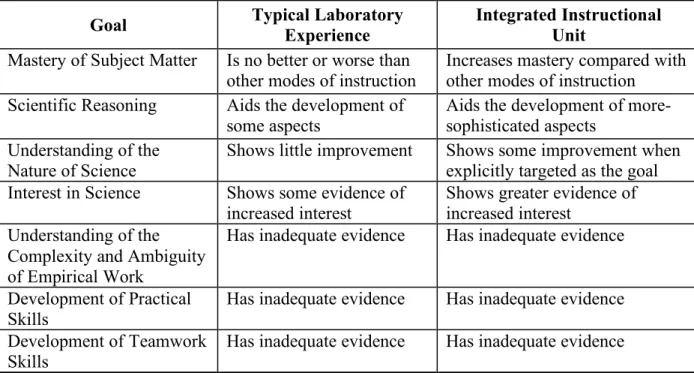
Typical (or traditional) laboratory experiences differ from the integrated instructional units in their effectiveness in attaining the goals of science education. Research shows that typical laboratories suffer from fragmentation of goals and approaches. Although the studies are still preliminary, research indicates that integrated instructional units are more effective than typical laboratory research for improving mastery of subject matter, developing scientific reasoning, and
Table 9. Attainment of Goals: Typical Laboratory Experience versus Integrated Instructional Units
Goal Typical Laboratory Experience Integrated Instructional Unit Mastery of Subject Matter Is no better or worse than
other modes of instruction Increases mastery compared with other modes of instruction Scientific Reasoning Aids the development of
some aspects Aids the development of more-sophisticated aspects Understanding of the
Nature of Science Shows little improvement Shows some improvement when explicitly targeted as the goal Interest in Science Shows some evidence of
increased interest
Shows greater evidence of increased interest
Understanding of the Complexity and Ambiguity of Empirical Work
Has inadequate evidence Has inadequate evidence Development of Practical
Skills Has inadequate evidence Has inadequate evidence Development of Teamwork
Skills
Has inadequate evidence Has inadequate evidence
Source: NRC. (2006). America’s lab report: Investigations in high school science. Washington, DC: The National Academies Press.
Direct Instruction and Discovery Learning
Over the years, different groups have advocated different strategies for teaching science. On one end of the continuum is direct instruction. At its extreme, direct instruction relies on lecturing and rote memorization. At the other end of the continuum is discovery learning or full inquiry. The extreme position in this view is that students must discover all the knowledge themselves without direct guidance from the teacher. In reality, most teaching strategies are somewhere in the middle of the continuum. One difficulty, however, is that the terms “direct instruction” and “discovery learning” are interpreted differently by different people. Not only are they interpreted differently, they have had additional values ascribed to them, such as “one is good, the other is bad.” As we shall see, a case can be made for the general idea of integrated instructional units and, specifically, the BSCS 5E Instructional Model. That case emerges from research that often is cited as supporting “direct instruction.”
Research headed by David Klahr and colleagues has stimulated review and discussion of the relative importance of direct instruction and discovery learning as instructional approaches to science teaching (Chen & Klahr, 1999; Klahr & Nigam, 2004). In the 1999 study, Chen and Klahr investigated the efficacy of different instructional approaches for an important aspect of scientific reasoning. Specifically, they intended to compare the efficacy of direct instruction vs. discovery learning. They asked the question: “What is the effectiveness of different instructional strategies in children’s acquisition of the domain-general strategy, Control of Variables Strategy, or CVS.” They had children aged seven to 10 years old design and evaluate experiments after direct instruction in CVS and without direct instruction (i.e., discovery learning). They reported that with explicit training (i.e., direct instruction), children were able to learn and transfer the
basic strategy for designing unconfounded experiments, that is, they could apply CVS (Chen & Klahr, 1999).
One interesting aspect of the research conducted by Klahr and his colleagues is that their approach actually paralleled a key characteristic of an instructional model or integrated
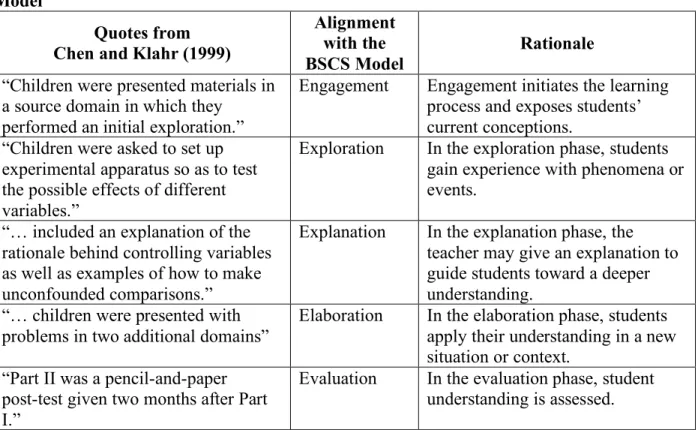
instructional unit. While this is evident in the articles, it is not expressed in their conclusion that direct intervention is the most effective strategy for teaching the Control of Variables Strategy. The following quotations are from the methodological sections of the key articles cited in the direct instruction versus discovery learning debate. In Table 10, we point out the phases that parallel the BSCS 5E Instructional Model. The entire approach used by Klahr and colleagues could well be described as an integrated instructional unit that centers on students learning the key concepts of CVS.
The present study consisted of two parts. Part I included hands-on design of experiments. Children were asked to set up experimental apparatus so as to test the possible effects of different variables. The hands-on study was further divided into four phases. In Phase 1, children were presented with materials in a source domain in which they performed an initial exploration followed by (for some groups) training. Then they were assessed in the same domain in Phase 2. In Phases 3 and 4, children were presented with problems in two additional domains (Transfer-1 and Transfer-2). Part II was a paper-and-pencil posttest given two months after Part I. The posttest examined children’s ability to transfer the strategy to remote situations. (Chen & Klahr, 1999, p. 4)
In a further summary of the design, the researchers note the following:
… children were given explicit instructions regarding CVS. Training occurred between the Exploration and Assessment phases. It included an explanation of the rationale behind controlling variables as well as examples of how to make
unconfounded comparisons. (Chen & Klahr, 1999, p. 4)
Chen and Klahr’s 1999 research article presents a very well-designed study that, in our view, most likely used an integrated instructional approach closely resembling the BSCS 5E Instructional Model. As indicated in their summary of the methodology for the
intervention, Chen and Klahr used an instructional sequence that included four of the five phases in the 5E model. With an engagement phase omitted, the researchers had the students begin with an exploration, proceeded to an explanation of CVS that included a demonstration, and then had the students apply or elaborate CVS to these new situations for which they used the terms assessment and Transfer-1 and Transfer-2.
Table 10. Alignment between Chen and Klahr’s Work and the BSCS 5E Instructional Model
Quotes from Chen and Klahr (1999)
Alignment with the
BSCS Model Rationale
“Children were presented materials in a source domain in which they
performed an initial exploration.”
Engagement Engagement initiates the learning process and exposes students’ current conceptions.
“Children were asked to set up experimental apparatus so as to test the possible effects of different variables.”
Exploration In the exploration phase, students gain experience with phenomena or events.
“… included an explanation of the rationale behind controlling variables as well as examples of how to make unconfounded comparisons.”
Explanation In the explanation phase, the teacher may give an explanation to guide students toward a deeper understanding.
“… children were presented with
problems in two additional domains” Elaboration In the elaboration phase, students apply their understanding in a new situation or context.
“Part II was a pencil-and-paper post-test given two months after Part I.”
Evaluation In the evaluation phase, student understanding is assessed. In this section, we have pointed out the similarity of the methodology used by Klahr and
colleagues to the BSCS model. Our discussion describes the research method Klahr’s team uses and points out the parallel of the method to the 5E instructional model. However, Klahr and colleagues isolate one strategy of that model, the training, explanation, or direct instruction, as the key factor in student learning. Others have generalized these results to claim that direct instruction is the best way to teach the process skills of science (Adelson, 2004; Begley, 2004a, 2004b). The entire context and teaching approach used in Klahr’s research presents a situation that suggests such a conclusion is far beyond the evidence.
In a second article, the authors (Klahr & Nigram, 2004) clarify the characteristics of direct instruction:
… we use an extreme type of direct instruction in which the goals, the materials, the examples, the explanations, and the pace of instruction are all
teacher-controlled. (p. 2)
The researchers (Klahr & Nigram, 2004) also describe discovery learning:
In our discovery learning condition, there is no teacher intervention beyond the suggestion of a learning objective: no guiding questions and no feedback about the quality of the child’s selection of materials, explorations, or self-assessments. (p. 2)
Here are the outstanding differences between direct instruction and discovery learning: The main definition is that, in direct instruction, the instructor provided good and bad examples of CVS, explained what the differences were between them, and told the students how and why CVS worked, whereas in the discovery condition there were no examples and no explanations, even though there was an equivalent amount of design and manipulation of materials. (Klahr & Nigam, 2004, p. 4)
In this study by Klahr and Nigam, the researchers used a methodology generally similar to that described earlier. As a result of a very detailed and thorough study, the authors (Klahr & Nigam, 2004) concluded:
These results suggest a re-examination of the long-standing claim that the limitations of direct instruction, as well as the advantages of discovery methods, will manifest themselves in broad transfer to authentic contexts. (p. 7)
We note that integrated instructional models such as the SCIS learning cycle (Karplus & Thier, 1967) and the BSCS 5E Instructional Model are not limited by the constraints that Klahr and Nigam impose on direct instruction. On the contrary, both SCIS cycle and the BSCS 5E Instructional Model incorporate direct instruction in one phase in an integrated instructional model.
Klahr and his colleagues have not explicitly acknowledged that the teaching strategies used in their research could be interpreted as much more than direct instruction. The implications of their research, however, have been stated in the extreme by the popular press, with titles such as “Instruction Versus Exploration in Science” (Adelson, 2004) and “Carnegie Mellon Researchers Say ‘Direct Instruction,’ Rather Than ‘Discovery Learning,’ is Best Way to Teach Process Skills in Science.” Unfortunately, characterization of these instructional approaches as separate, as opposed to possibly being integrated, has done a disservice to both approaches.
A Review of the Support for Contemporary Instructional Models
Teaching strategies and instructional models may have their foundations on solid research and they may expand on previous models, but we need to evaluate them to determine if they are actually effective in improving students’ mastery of subject matter, scientific reasoning, interest in science, and understanding of the nature of science. In this section, we review the studies of the effectiveness of instructional models based on the learning cycle. However, before beginning this review, it is important to acknowledge the difficulties in conducting this type of educational research. Unlike other types of research, it is often not feasible, appropriate, or, at times, even ethical to use methods that include randomized samples. Other challenges related to conducting effectiveness studies include assessing the different degrees of fidelity of implementation by different teachers and differences in the experience and qualifications of the teachers.
Methodology
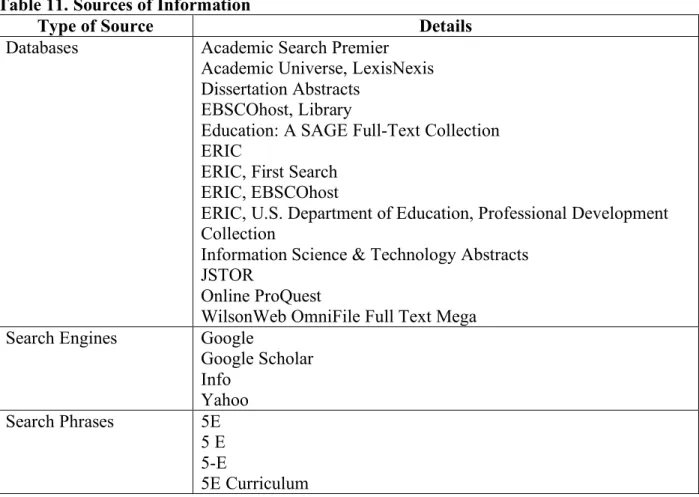
The information synthesized in this section was gathered by searching established databases; using Web search engines; and reviewing the table of contents and citations in articles, handbooks, journals, and summary chapters. The searches were conducted by five different research teams. This process provided a wide sweep of the available information with enough redundancies to catch details one researcher might have missed. Table 11 summarizes the specific databases, search engines, and search phrases used to find the literature, dissertations, and reports cited here.
Table 11. Sources of Information
Type of Source Details
Databases Academic Search Premier Academic Universe, LexisNexis Dissertation Abstracts
EBSCOhost, Library
Education: A SAGE Full-Text Collection ERIC
ERIC, First Search ERIC, EBSCOhost
ERIC, U.S. Department of Education, Professional Development Collection
Information Science & Technology Abstracts JSTOR
Online ProQuest
WilsonWeb OmniFile Full Text Mega Search Engines Google
Google Scholar Info
Yahoo Search Phrases 5E
5 E 5-E
5E Cycle 5E Education 5-E effectiveness 5E instruction
5E Instructional Model 5E Model Effectiveness 5-E learning
5E Learning 5E lessons 5E model
5E model lessons 5E Science 5E Teacher 5-E teacher Learning Cycle
Books Reviewed Handbook of Research on Curriculum (1992)
Handbook of Research on Teacher Education (1996)
Handbook of Research on Science Teaching and Learning (1994) Handbook on Science Teaching and Learning (1997)
Science Teaching and the Development of Thinking (1995) Journals Reviewed The American Biology Teacher
Journal of Research on Science Teaching Science Education
School Science and Mathematics The Science Teacher
Historical Research on the SCIS Learning Cycle
Lawson (1995) completed a comprehensive review of more than 50 research studies on the learning cycle that were conducted through the 1980s. The earliest studies investigated the effectiveness of the Science Curriculum Improvement Study (SCIS) program developed in the 1960s for teaching elementary science. Because the SCIS program used a learning cycle
instructional model, the results of studies about SCIS provide evidence about the effectiveness of this type of instruction. Later studies focused specifically on the learning cycle model. Several studies focused on the impact of omitting one or more phases of the learning cycle, changing the sequence of the phases, or using different instructional formats within the phases.
In addition, Guzzetti, Snyder, Glass, & Gamas (1993) conducted a rigorous meta-analysis that included 47 research studies conducted from 1981 through the spring of 1991. The focus of these studies was the effectiveness of different instructional interventions, including the learning cycle, for addressing student misconceptions in science. This section summarizes what these studies reveal about the learning cycle’s effectiveness for improving students’ mastery of subject matter,
Mastery of subject matter: Ten studies cited by Lawson investigated the impact of the learning cycle approach on subject matter knowledge of elementary through undergraduate students. Typically, these studies compared learning gains for students taught using a learning cycle approach with those taught using a “traditional” approach. The traditional approaches are generally described as a lecture followed by a verification lab or activity. Six of the studies (Bishop, 1980; Bowyer, 1976; Nussbaum, 1979; Renner & Paske, 1977; Saunders &
Shepardson, 1987; Schneider & Renner, 1980) found that students who were taught using the learning cycle had greater gains in subject matter knowledge than students taught using more traditional approaches. These studies examined science subject matter learning from the elementary (Nussbaum, 1979), middle school (Bishop, 1980; Bowyer, 1976; Saunders & Shepardson, 1987), high school (Schneider & Renner, 1980), and college (Renner & Paske, 1977) levels. Furthermore, two of the studies (Bishop, 1980; Schneider & Renner, 1980) found that the achievement gains among students who experienced learning cycle instruction persisted in delayed post-tests of students’ understanding of science concepts.
Four of the studies that Lawson reviewed found no differences in achievement between students who experienced learning cycles and those who received traditional instructional formats. Horn (1980) reported that SCIS curriculum materials were no more effective than traditional text materials for helping first graders learn new vocabulary and understand text. Vermont (1985) found no differences in learning the mole concept and changing misconceptions between college chemistry students who experienced either learning cycle or traditional lecture-laboratory
instructional approaches. In the other two studies, researchers reported some differences in favor of the learning cycle approach, but not in the area of content achievement. For example,
Campbell (1977) found that college physics students in learning cycle–based classes used formal reasoning patterns and had more positive attitudes toward science than students in traditional classes, although he found no significant differences in content achievement. Similarly, Davis (1978) found more positive attitudes and better understanding of the nature of science among fifth and sixth graders in learning cycle classes than in classes using a traditional approach, but there were no differences in content achievement between students who experienced the two approaches.
Several additional studies that had inconclusive results may help identify variables that limit the effectiveness of this model. In a study of college chemistry students, Ward and Herron (1980) developed learning cycle versions of three experiments. Students in the learning cycle sections clearly had greater achievement on one of the three experiments, but there was no difference between scores in the learning cycle and traditional sections for the other two experiments. The researchers speculated that limited time spent on activities in the experiments, flaws in the achievement test, and teaching assistants’ lack of fidelity in implementing the learning cycle might explain the results. Another possible explanation is the developmental level of students. Purser and Renner (1983) compared subject matter learning for high school students enrolled in an eight-month biology course that used either a learning cycle or a traditional approach. Most of the students were at a concrete or transitional level of reasoning, based on Piagetian tasks. The researchers found no achievement differences between students for concepts that required formal thought. However, students in the learning cycle section had greater learning gains for concepts that required concrete thought.
Guzzetti, Snyder, Glass, & Gamas (1993) used cluster analysis to identify instructional approaches that had the largest effects on conceptual change. They concluded that
“Meta-analysis of research testing the success of the Learning Cycle and its modifications in eradicating misconceptions provides support for the approach.” Specifically, they found that the average effect of the learning cycle on conceptual change was about one-quarter of a standard deviation unit, with larger effects when additional strategies (such as prediction laboratories) were
included as part of the learning cycle. They further noted that when a learning cycle that included laboratory work was compared with a one that did not include a laboratory, the differential effect was about one and one-half standard deviations. When a laboratory was combined with other forms of traditional instruction (i.e., lecture, demonstration, and nonrefutational text not in a learning cycle format), however, it was much less effective. Comparison of a prediction laboratory–learning cycle combination with traditional instruction showed positive results in favor of the former, by one-third of a standard deviation.
Scientific reasoning: Many of the studies reviewed by Lawson investigated the impact of learning cycle instruction on students’ scientific reasoning abilities. This instructional model consistently showed superior results over more traditional instructional approaches for cultivating the development of these abilities: 17 of 18 studies had positive results. For the purpose of our discussion, we have divided the studies into two categories. The first category contains studies that address scientific inquiry abilities (e.g., asking questions, designing
experiments, developing and communicating scientific explanations), which are the cornerstones of how scientific reasoning is defined in America’s Lab Report. The second category contains studies that address more general reasoning skills, such as conservation of number or weight, proportional reasoning, or development from concrete to formal operational thinking.
Scientific inquiry abilities
Thier (1965) and Allen (1971) reported that elementary students who had experienced the SCIS curriculum had a superior ability to describe objects by their properties, compared with students who experienced traditional instruction. Allen (1967), however, found no difference in
classifying skills for elementary school students who were taught using either SCIS or non-SCIS materials. Other studies noted gains in identifying and controlling variables by students who experienced the learning cycle approach, as opposed to those who experienced more traditional instruction (Allen, 1973b; Lawson, Blake, & Nordland, 1975; Lawson & Wollman, 1976). Several studies identified the superiority of the learning cycle approach for developing science process skills such as classifying, measuring, experimenting, and predicting (Renner, et al. 1973; Brown, Weber, & Renner, 1975; Bowyer, 1976; TaFoya, 1976).
General reasoning skills
Many studies of the SCIS program and the learning cycle investigated the impact of these approaches on students’ general reasoning skills. The studies reviewed by Lawson assessing these types of skills all showed that instruction based on the learning cycle was more effective
gains in reasoning skills and in proportional reasoning for students who experienced instruction using the learning cycle model (McKinnon & Renner, 1971; Renner & Lawson, 1975; Wollman & Lawson, 1978). Finally, a number of studies assessed the development of formal thinking skills among students who experienced either learning cycle or traditional instruction. These studies also found greater gains for students who were taught science using a learning cycle format (Carlson, 1975; Schneider & Renner, 1980; Saunders & Shepardson, 1987).
Renner and Paske (1977) obtained ambiguous results in a study of college students enrolled in a physics course for nonscience majors. Students enrolled in the course sections that used a learning cycle format had greater gains on formal tasks from the low to the high concrete levels, and from the high concrete to the low formal levels. Students enrolled in the course sections that used the traditional lecture-demonstration approach had greater gains from the low to the high formal levels. The researchers concluded that a learning cycle approach is more effective for producing reasoning gains for students at a concrete level, but the traditional method may be better for further progress in reasoning among students at a formal level of reasoning. Interest and attitudes about science: Instruction that uses a learning cycle approach
consistently results in more positive attitudes about science. Lawson reviewed 12 publications that reported the impact of learning cycle instruction on students’ attitudes. Eight of the studies found more positive attitudes for students who experienced learning cycle instruction than for those who did not. Four studies that did not do this comparison also reported positive attitudes about science among students in learning cycle classes. Lawson commented that finding a positive relationship between the use of learning cycle programs and student attitudes is typical; he noted only one study that found no relationship between attitudes and the SCIS program (presented at a meeting of the National Science Teachers Association in 1977).
With regard to the SCIS program, Malcolm (1976) found that students who experienced the SCIS program had higher levels of self-concept that those who experienced a textbook-based program. Hendricks (1978) found general affective domain gains for students in a SCIS program, and Allen (1973a) reported slightly better motivation for students in a SCIS program. Others who reported positive attitudes about science following exposure to the SCIS program include Brown (1973); Brown, Weber, and Renner (1975); Krockover and Malcolm (1976); Haan (1978); and Lowery, Bowyer, and Padilla (1980).
Lawson reviewed four studies that focused specifically on the impact of the learning cycle approach (as opposed to the entire SCIS program) on student attitudes toward science. All reported a positive relationship. Campbell (1977) found not only more positive attitudes toward laboratory work in a physics course, but also a decreased likelihood of withdrawing from the course among college students in the learning cycle sections of the course as compared with those in the traditional sections. Another study found that college students enrolled in learning cycle sections of a nonmajor physics course enjoyed their instruction more than those enrolled in the traditional sections (Renner & Paske, 1977). Middle school students taught science using a learning cycle approach also had more positive attitudes about science than those taught using a traditional approach (Davis, 1978; Bishop, 1980).
Critical features of the learning cycle approach: Some researchers have critiqued conclusions of the studies because the learning cycle programs include multiple teaching strategies within the phases of the learning cycle. This multifactorial nature of instruction and analysis makes it difficult to determine whether the success of the model is due to the entire package, to specific phases within the model, or to one or more of the strategies used within the phases. A series of studies conducted in high school physics and chemistry classes by Renner and his colleagues addressed this criticism (Renner, Abraham, & Birnie, 1984; Abraham & Renner, 1984; Abraham & Renner, 1986; Renner, Abraham, & Birnie, 1985, 1988). These studies investigated the effects of changing the sequence of the learning cycle phases, omitting one or more of the phases, and using different instructional formats within the phases.
Regarding gains in science subject matter knowledge, the researchers found that • optimum learning of concepts requires all three phases of the learning cycle; • students learn new concepts better when the term introduction phase is second;
• the combination of the exploration and the term introduction phases is more effective for conceptual learning than using the term introduction phase alone;
• the laboratory format is effective only when it is used in conjunction with discussions; and
• the effectiveness of the laboratory format depends on the clarity of the data that leads to the concept.
The studies also reported differences for the Piagetian categories of learners—formal operational and concrete operational. For formal operational learners, optimum learning occurred when all phases of the learning cycle are present, but the sequence and instructional format of the learning cycle phases did not matter. For concrete operational learners, highest achievement occurred when the term introduction phase was last and the laboratory format was used.
These studies also provided information about the impact of the learning cycle approach on student attitudes about science instruction. Students believed the sequence of the instructional phases was important and preferred to gather their own data from an experiment before they discussed the concept. They regarded the laboratory format most positively and the reading format the most negatively.
In summary, the line of research by Renner and his colleagues reinforced the notion that the learning cycle is most effective when used as originally designed:
• All three phases of the model must be included in instruction, and the exploration phase must precede the term introduction phase.
• The specific instructional format may be less important than including all phases of the model, but laboratory work (typical in the exploration phase) is more effective for many students, provided it is followed by discussion (term introduction).
Impact of the learning cycle approach on teaching behaviors: Several of the studies reviewed by Lawson investigated the impact of using SCIS curriculum materials on teacher behaviors. Studies that compared teachers who were trained in the SCIS learning cycle and used SCIS materials with those who were not found that SCIS teachers asked higher-order questions that emphasized skills such as interpretation, analysis, prediction, and synthesis more often than non-SCIS teachers, who asked recognition and recall questions (Moon, 1969; Porterfield, 1969; Wilson, 1969; Eaton, 1974). Simmons (1974) found that SCIS teachers were more student-oriented than non-SCIS teachers, and Kyle (1985) reported that SCIS teachers allotted more time for teaching science than non-SCIS teachers.
Findings from Recent Research on the Learning Cycle
The effectiveness of the learning cycle is also well documented in more contemporary research. Like the earlier studies, recent research studies link the use of the learning cycle to positive changes in students’ mastery of subject matter, scientific reasoning, and interest and attitudes toward science. In the following sections, we discuss studies that describe the learning cycle’s effectiveness toward furthering student outcomes in each of these three categories.
Mastery of subject matter: A significant line of research shows that learning cycle–based teaching approaches help students develop deep understanding of science concepts. For example, several comparative studies examined student learning gains across traditional and learning cycle–based teaching approaches. Across multiple disciplines and grade levels, teaching
approaches based upon the learning cycle were found to result in greater gains of subject matter learning. Examples include studies of undergraduate physics (Ates, 2005) and biology students (Lord, 1997) as well as studies of high school physics (Billings, 2001) and elementary school science students (Ebrahim, 2004).
Interestingly, there also is evidence that merely reading instructional materials that are structured with a learning cycle can be educative. In a randomized-control trial study of 123 high school students, Musheno and Lawson (1999) found that students who were randomly assigned to read learning cycle–based instructional materials scored higher on a subject matter assessment than their counterparts who were randomly assigned to read materials that were structured in a more traditional, encyclopedic fashion.
A subset of this comparative research on learning cycle–based teaching explores the effect of augmenting the learning cycle with other teaching strategies. For example, Odom and Kelly (2001) found that integrating concept mapping into learning cycle–based instruction enhanced its impact on the subject matter learning gains of high school biology students. Similarly, Lavoie (1999) compared student learning gains resulting from the standard learning cycle of exploration, term introduction, and concept application with those resulting from this standard learning cycle preceded by a predict-discuss activity. Although both approaches resulted in considerable learning gains for high school biology students, the augmented learning cycle produced gains that were significantly larger.
Scientific reasoning: Learning cycle–based teaching is also useful in helping students develop the ability to reason scientifically. For example, Johnson and Lawson (1998) found that learning cycle–based teaching had a statistically significant positive effect on the scientific reasoning (i.e.,