Open Access
Research
Prevalence and associated factors of suicidal ideation among
school-going adolescents in Guyana: results from a cross sectional
study
Emmanuel Rudatsikira
1, Adamson S Muula*
2and Seter Siziya
3Address: 1Departments of Epidemiology and Biostatistics and Global Health, Loma Linda University, School of Public Health, Loma Linda,
California, USA, 2Department of Community Health, University of Malawi, College of Medicine, Blantyre, Malawi, Africa and 3Department of
Community Medicine, University of Zambia, School of Medicine, Lusaka, Zambia, Africa
Email: Emmanuel Rudatsikira - [email protected]; Adamson S Muula* - [email protected]; Seter Siziya - [email protected] * Corresponding author
Abstract
Background: Adolescent suicidal behaviour is a neglected public health issue especially in middle-and low-income countries. Informed policy decision-making on suicidal behaviour will need reliable information on the prevalence and correlates of suicidal ideation which is a determinant of suicidal behaviour.
Methods: We estimated the prevalence and associated factors of suicidal ideation among school-going adolescents using data from the Global School-Based Health Survey conducted in 2004 in Guyana.
Results: Of the 1197 respondents, 18.4% (14.9% males and 21.6% females)reported having seriously considered committing suicide in the last12 months. Males were less likely to seriously consider committingsuicide than females (OR = 0.45; 95% CI [0.30, 0.67]). Subjects whoreported having been bullied were more than twice as likely tocontemplate committing suicide as those who had not been bullied (OR = 2.46 [1.71, 3.54]). History of depression was positivelyassociated with suicidal ideation (OR = 2.67; 95% [1.87, 3.81] whilehaving close friends and understanding parents were negativelyassociated with suicide ideation (OR = 0.51; 95% CI [0.28, 0.94] and OR = 0.51; 95% CI [0.35, 0.76] respectively).
Conclusion: Suicidal ideation is a significant public health issue among in-school adolescents in Guyana that requires attention. The design, implementation and evaluation of suicidal behaviour interventions should incorporate our knowledge of these associated factors.
Background
Suicidal behaviour is an important public health problem worldwide. The World Health Organization (WHO) reports that in 2000, more than 800,000 people died of suicide around the world [1]. Flisher et al. (1993) report
that 85.7% of those who make a suicide attempt have seri-ously thought about doing so earlier [2]. Risk factors for suicidal ideation include depression [3], cigarette smok-ing [4], alcohol and drug use [5-7], low parental care [8], and experience of bullying [9].
Published: 23 August 2007
Clinical Practice and Epidemiology in Mental Health 2007, 3:13 doi:10.1186/1745-0179-3-13
Received: 9 May 2007 Accepted: 23 August 2007
This article is available from: http://www.cpementalhealth.com/content/3/1/13
© 2007 Rudatsikira et al; licensee BioMed Central Ltd.
Guyana is a South American country bordering the North Atlantic Ocean, between Suriname and Venezuela. It has an estimated population of 769,000. There are limited data about suicide in Guyana. Much of the available health research literature on this country is on tropical infectious diseases. Hence, the aim of this study is to assess the prevalence and associated factors of suicidal ideation among adolescent students in Guyana.
Methods
Our study involved secondary analysis of existing data available from the Guyana Global School-Based Health Survey (GSHS) conducted in 2004. The GSHS was devel-oped by the World Health Organization (WHO) in col-laboration with United Nations' UNICEF, UNESCO, and UNAIDS with technical assistance from Centers for Dis-ease Control and Prevention (CDC) in Atlanta, USA. The survey aims to provide data on health and other social behaviours among school-going adolescent students. The GSHS uses a two-stage probability sampling tech-nique. In the first stage, primary sampling units are schools which are selected with a probability proportional to their enrolment size. In the second step classrooms are chosen randomly within a selected school. All the stu-dents within the selected classes are eligible for participa-tion. Before administering the survey to teens, parental permission and approval from the Ministry of Health were obtained. Students' participation was anonymous and voluntary. A questionnaire is self-completed anony-mously by the students and this takes between 30 to 40 minutes. The school response rate was 100 percent while the student response rate was 80 percent, thus making overall response rate 80 percent.
Our main outcome variable was self-reported history of suicidal ideation within the past 12 months. Study partic-ipants were asked the question: During the past 12 months, did you ever seriously consider attempting sui-cide? Data were also collected on age, gender, current cig-arette smoking, having been bullied, alcohol use, depression, self assessment of parental supervision and having friends. To assess depression, we considered responses to the following question: "During the past 12 months, did you ever feel so sad or hopeless almost every day for two weeks or more in a row that you stopped doing some usual activities?"
A weighting factor was used in the analysis to reflect the likelihood of sampling each student and to reduce bias by compensating for differing patterns of non response. The weight used for estimation is given by the following for-mula:
W = W1 * W2 * f1 * f2 * f3 * f4,
where W1 = the inverse of the probability of selecting the school
W2 = the inverse of the probability of selecting the class-room within the school
fl = a school-level non response adjustment factor calcu-lated by school size category (small, medium, large) f2 = a class-level non response adjustment factor calcu-lated for each school
f3 = a student-level non response adjustment factor calcu-lated by class
f4 = a post stratification adjustment factor calculated by grade.
We conducted logistic regression analysis using SUDAAN software version 9.0 (Research Triangle Institute, NC, USA) to estimate the association between relevant predic-tor variables and suicidal ideation in the last 12 months. We report unadjusted Odds Ratios for selected predictor variables while considering suicidal ideation in the last 12 months as a dependent variable. We thereafter report results of adjusted odds ratios for the factors, having con-trolled for factors identified as significant in the bivariate analysis. An α of 0.05 was used in both bivariate and mul-tivariate analyses.
Results
Table 1 presents selected characteristics of the study pop-ulation of 1197 Guyanese adolescents. Most of the sample was female (51.0%), 14 years old (30.3%), non smokers, non alcohol drinkers and with understanding parents (78.1%). Overall 18.4% (14.9% males and 21.6% females) had seriously considered suicide in the last 12 months.
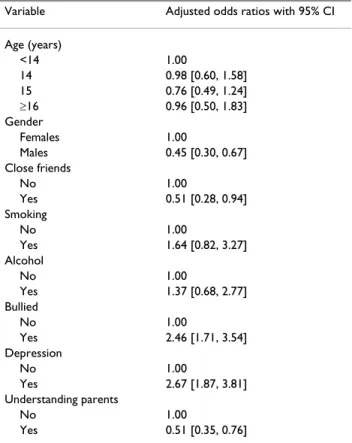
Table 3 presents results from multivariate analysis. Male gender, having close friends and understanding parents remained negatively associated with suicidal ideation. Likewise, having been bullied and depression remained positively associated with suicidal ideation.
Discussion
Our study found that overall 18.4% (14.9% males and 21.6% females) had seriously considered suicide in the last 12 months. Our estimates are much higher than the prevalence of suicidal ideation among Americans of Car-ibbean descent (10.7%) [10], but similar to rates of sui-cidal ideation in Brazil (17.1%) [11]. Previous studies have reported similar results with regard to female adoles-cents having a higher prevalence of suicidal ideation than males [12-14].
The high rate of suicidal ideation in Guyana can be explained in part by poverty and high prevalence of HIV/ AIDS in the country. Guyana is one of the poorest coun-tries in the Caribbean region with $1,029 GDP per capita [15] and ranks third in the prevalence of HIV/AIDS [16]. In a study of risk and resilience factors of suicidality
among Latino and African American youth, O'Donnell et al found that those with unmet needs were at greater risk of suicidal ideation [17]. Several studies have reported the association between suicidal behaviours and HIV/AIDS [18-20]. This is primarily due to social isolation and hope-lessness.
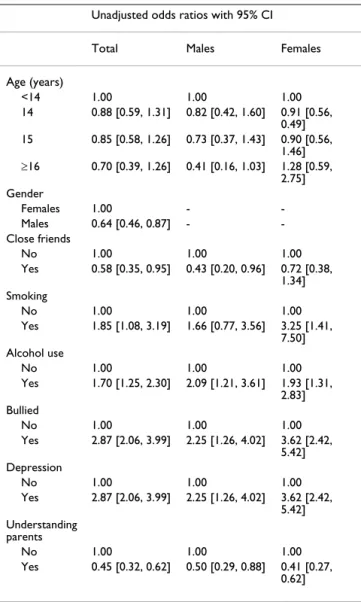
Results from this study indicate that history of current smoking, alcohol use, depression, having been bullied and being females were associated with higher odds of having experienced suicidal ideation. Several studies indi-cate that suicidal ideation is positively associated with depression [2,15,21], alcohol and substance abuse [4,5,7]. In a study of 2341 US high school students, Klomek et al found that victims of bullying were more than five times likely to have seriously considered com-mitting suicide than those who were not bullied.
Table 2: Factors associated with suicidal ideation among adolescents in Guyana, 2004
Unadjusted odds ratios with 95% CI
Total Males Females
Age (years)
<14 1.00 1.00 1.00
14 0.88 [0.59, 1.31] 0.82 [0.42, 1.60] 0.91 [0.56, 0.49] 15 0.85 [0.58, 1.26] 0.73 [0.37, 1.43] 0.90 [0.56,
1.46] ≥16 0.70 [0.39, 1.26] 0.41 [0.16, 1.03] 1.28 [0.59,
2.75] Gender
Females 1.00 -
-Males 0.64 [0.46, 0.87] - -Close friends
No 1.00 1.00 1.00
Yes 0.58 [0.35, 0.95] 0.43 [0.20, 0.96] 0.72 [0.38, 1.34] Smoking
No 1.00 1.00 1.00
Yes 1.85 [1.08, 3.19] 1.66 [0.77, 3.56] 3.25 [1.41, 7.50] Alcohol use
No 1.00 1.00 1.00
Yes 1.70 [1.25, 2.30] 2.09 [1.21, 3.61] 1.93 [1.31, 2.83] Bullied
No 1.00 1.00 1.00
Yes 2.87 [2.06, 3.99] 2.25 [1.26, 4.02] 3.62 [2.42, 5.42] Depression
No 1.00 1.00 1.00
Yes 2.87 [2.06, 3.99] 2.25 [1.26, 4.02] 3.62 [2.42, 5.42] Understanding
parents
No 1.00 1.00 1.00
Yes 0.45 [0.32, 0.62] 0.50 [0.29, 0.88] 0.41 [0.27, 0.62] Table 1: Selected socio-demographic characteristics of the study
population in the Guyana Global School-Based Health Survey, 2004
Total 100 (1197)
Males 49.0 (504)
Females 51.0 (693)
Age (years)
<14 25.8 (302) 24.1 (115) 27.4 (187) 14 30.3 (378) 32.4 (165) 28.3 (213) 15 32.5 (386) 28.7 (146) 36.2 (240) ≥16 11.4 (131) 14.8 (78) 8.1 (53) Smoking
No 92.9 (1077) 89.2 (429) 96.4 (648) Yes 7.1 (75) 10.8 (51) 3.6 (24) Alcohol use
No 55.3 (684) 43.6 (226) 66.5 (458) Yes 44.7 (513) 56.4 (278) 33.5 (235) Bullied
No 61.1 (664) 59.2 (269) 62.9 (395) Yes 38.9 (410) 40.9 (182) 37.1 (228) Depression
No 67.4 (789) 71.1 (347) 64.1 (442) Yes 32.6 (385) 29.0 (140) 35.9 (245) Suicidal ideation
No 81.6 (953) 85.1 (417) 78.4 (536) Yes 18.4 (219) 14.9 (72) 21.6 (147) Close friends
No 9.2 (106) 8.6 (42) 9.8 (64) Yes 90.8 (1091) 91.4 (462) 90.2 (629) Understanding
parents
In this study, adolescents who had close friends and understanding parents were less likely to report having thought of committing suicide in the past 12 months. Chiou et al report that parent-child conflict is one of the most common precipitating factors of suicide attempts [21]. Heider et al have reported that among adults in the European Study of Epidemiology of Mental Disorders project, suicidality was associated with low parental care as a child [22]. Fortuna et al report that among Latino sub-groups in United tates, family conflict is independently associated with suicide attempts [23]. Cheng and Chan indicate that support from family and friends lower suici-dality by reducing death acceptability and stress [24].
Our study had a number of limitations. Data collection used a self-completed questionnaire. There is therefore possibility that some study participants may have misre-ported on our outcome of interest or the predictor varia-bles. The study also only recruited adolescents in school. To the extent that in-school adolescents differ from out of school adolescents, our finding may not be applicable to all adolescents in Guyana. Also since data used in this study are from a cross sectional survey, we can not ascribe causation to any of the factors that were identified as asso-ciated with suicidal ideation.
Conclusion
We found a 12-month overall prevalence of suicidal idea-tion among school-going adolescents in Guyana at 18.4%. Factors associated with the outcome were female gender, having being bullied, alcohol use, cigarette smok-ing and depression. Havsmok-ing a supportsmok-ing environment with friends and understanding parents was associated with lower odds of having contemplating suicide. Public health intervention aimed to reduce adolescent suicidal behaviours should factor in the socio-demographic corre-lates of suicidal ideation. The clustering of multiple unhealthy lifestyles and co-morbid conditions such as cig-arette smoking, alcohol use and depression is of public health concern.
Abbreviations
CDC- Centers for Disease Control and Prevention GSHS- Global School-Based Health Survey HIV- Human immunodeficiency virus
OR- Odds ratio
WHO- World Health Organisation
UNAIDS- Joint United Nations' HIV/AIDS Programme UNESCO- United Nations Educational, Scientific and Cultural Organisation
UNICEF- United Nations Children' Fund
Competing interests
The author(s) declare that they have no competing inter-ests.
Authors' contributions
ER conducted data analysis, participated in interpretation of finding and writing of manuscript.
ASM participated in interpretation of findings and draft-ing manuscript.
SS participated in interpretation of findings and drafting of manuscript.
All authors read and approved the final draft of the man-uscript.
Acknowledgements
We thank the World Health Organization (WHO) and Centers for Disease Control (CDC) for providing the data set from which this study was gen-erated. The University of Malawi, College of Medicine, provides support to ASM through the Junior Faculty Training program.
Table 3: Factors associated with suicidal ideation among adolescents in Guyana, 2004
Variable Adjusted odds ratios with 95% CI
Age (years)
<14 1.00
14 0.98 [0.60, 1.58] 15 0.76 [0.49, 1.24]
≥16 0.96 [0.50, 1.83] Gender
Females 1.00
Males 0.45 [0.30, 0.67] Close friends
No 1.00
Yes 0.51 [0.28, 0.94] Smoking
No 1.00
Yes 1.64 [0.82, 3.27] Alcohol
No 1.00
Yes 1.37 [0.68, 2.77] Bullied
No 1.00
Yes 2.46 [1.71, 3.54] Depression
No 1.00
Yes 2.67 [1.87, 3.81] Understanding parents
No 1.00
Publish with BioMed Central and every scientist can read your work free of charge
"BioMed Central will be the most significant development for disseminating the results of biomedical researc h in our lifetime."
Sir Paul Nurse, Cancer Research UK
Your research papers will be:
available free of charge to the entire biomedical community
peer reviewed and published immediately upon acceptance
cited in PubMed and archived on PubMed Central
yours — you keep the copyright
Submit your manuscript here:
http://www.biomedcentral.com/info/publishing_adv.asp
BioMedcentral
References
1. Krug EG, Dahlberg LL, Mercy JA, Zwi AB, Lozano R: World health report on violence and health. Geneva: World Health Organiza-tion; 2002.
2. Flisher AJ, Ziervogel CF, Chalton DO, Leger PH, Robertson BA: Risk-taking behaviour of Cape Peninsula high-school stu-dents. S Afr Med J 1993, 83:474-6.
3. Galaif ER, Sussman S, Newcomb MD, Locke TF: Suicidality, depres-sion and alcohol use among adolescents: a review of empiri-cal findings. J Adolesc Med Health 2007, 19(1):27-35.
4. Parks HS, Schepp KG, Jang EH, Koo HY: Predictors of suicidal ide-ation among high school students in South Korea. J Sch Health
2006, 76:181-188.
5. Makhija NJ: Childhood abuse and adolescent suicidaility: a direct link and an indirect link through alcohol and substance abuse. Int J Adolesc Med Health 2007, 19:45-51.
6. Sher L, Sperling D, Zalsman G, Vardi G, Merrick J: Alcohol and sui-cidal behaviour in adolescents. Minerva Pediatr 2006, 58:333-9. 7. Makhija NJ, Sher L: Preventing suicide in adolescents with
alco-hol use disorders. Int J Adolesc Med Health 2007, 19:53-9. 8. Heider D, Bernert S, Matschinger H, Haro JM, Alonso J, Angermeyer
MC, ESEMed/MHEDEA 2000 Investigators: Parental bonding and suicidality in adulthood. Aust N Z J Psychiatry 2007, 41:66-73. 9. Brunstein Klomek A, Marrocco F, Kleinman M, Schonfeld IS, Gould
MS: Bullying, depression, and suicidality in adolescents. J Am Acad Child Adolesc Psychiatry 2007, 46:40-9.
10. Joe S, Baser RE, Breeden G, Neighbors HW, Jackson JS: Prevalence of and risk factors for lifetime suicide attempts among blacks in the United States. JAMA 2006, 296:2112-23.
11. Botega NJ, Barros MB, Oliveira HB, Dalgalarrondo P, Marin-Leon L: Suicidal behavior in the community: prevalence and factors associated with suicidal ideation. Rev Bras Psiquiatr 2005, 27:45-53.
12. Beautrais AL, Wells JE, McGee MA, Oakley Browne MA, New Zea-land Mental Health Survey Team: Suicidal bahaviour in Te Rau Hinengaro: the New Zealand Mental Health Survey. Aust N Z J Psychiatry 2006, 40:896-904.
13. Dervic K, Akkaya-Kalayci T, Kapusta ND, Kaya M, Merl E, Vogel E, Pellegrin E, Friedrich MH: Suicidal ideation among Viennese high school students. Wien Klin Wochenschr 2007, 119:174-180. 14. Sindartha T, Jena S: Suicidal behaviours in adolescents. Indian J
Pediatr 2006, 73:783-8.
15. Countries of the World Gross Domestic Product (GDP) per capita [http://www.studentsoftheworld.info/infopays/rank/ PIBH2.html]
16. O'Toole BJ, McConkey R, Casson K, Goetz-Goldberg D, Yazdani A: Knowledge and attitudes of young people in Guyana to HIV/ AIDS. Int J STD AIDS 2007, 18:193-7.
17. O'Donnell , O'Donnell C, WardLaw DM, Stueve A: Risk and resil-iency factors influencing suicidality among urban African American and Latino Youth. Am J Community Psychol 2004, 33:37-49.
18. Cooperwan NA, Simoni JM: Suicidal ideation and attempted sui-cide among women living with HIV/AIDS. J Behav Med 2005, 28:149-56.
19. Jin H, Hampton AJ, Yu X, Heaton RK, Shi C, Marcotte TP, Young C, Sadek J, Wu Z, Grant I, HNRC China Collaboration Group: Depres-sion and suicidality in HIV/AIDS in China. J Affect Disord 2006, 94:269-75.
20. Shelton AJ, Atkinson J, Risser JMH, McCurdy SA, Useche B, Padgett PM: The prevalence of suicidal behaviours in a group of HIV-positive men. AIDS Care 2006, 18:574-576.
21. Chiou P-N, Chen Y-S, Lee Y-C: Characteristics of adolescent sui-cide attempters admitted to an acute psychiatric ward in Taiwan. Journal of the Chinese Medicine Association 2007, 69(9):428-435.
22. Heider D, Bernett S, Matschinger H, Haro JM, Alonso J, Angermeyer MC, Seemed/mhedea2000 Investigators: Parental bonding and suicidality in adulthood. Aust NZ J Psychiatry 2007, 41:66-73. 23. Fortuna LR, Perez DJ, Canino G, Sribney W, Alegria M: Prevalence
and correlatos of lifetime suicidal ideation and suicide attempts among Latino subgroups in United Status. J Clin Psy-chiatry 2007, 68:572-81.