Abstract:
Introduction: Our prior studies suggest that obesity and obesity-related factors alter the pharmacokinetics (PK) and pharmacodynamics (PD) of nanoparticles (NP), such as pegylated
liposomal doxorubicin (Doxil®; PLD). Specifically, obese patients will have higher circulating levels of hormones and chemokines which lead to higher mononuclear phagocyte system (MPS) function,
higher NP clearance, and ultimately reduced tumor exposure and anti-cancer efficacy of NP
compared to non-obese patients. Thus we performed studies evaluating hormone and chemokine
mediators in obese and non-obese patients with ovarian cancer and endometrial cancer.
Methods: In obese and non-obese patients with ovarian and endometrial cancer, the concentration of estradiol, estrone, 5-dihydrotestosterone (DHT) and testosterone was measured in
plasma samples using LC-MS/MS assays. In addition, CCL2 and CCL5 chemokines were
measured using a multiplex immunochemistry assay.
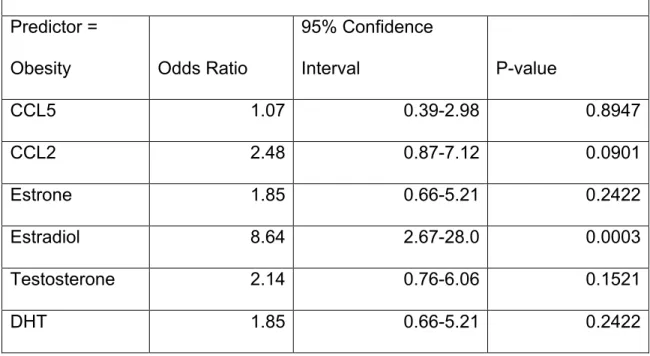
Results: A univariate analysis for CCL5, CCL2, estrone, estradiol, testosterone and DHT revealed a significant odds ratio for the relationship between estradiol and body mass index (BMI)
(OR 8.64, 95% CI 2.67-28.0, P<0.001). A multivariate analysis was then performed to assess the
effect of other factors, including BMI, age at diagnosis, stage and the concentration of other
hormones and chemokines on estradiol concentration. The multivariate analysis revealed that there
was only a significant relationship between BMI and estradiol concentration.
Conclusion: A positive correlation was demonstrated between BMI and estradiol concentration. Higher circulating levels of hormones in obese patients may explain reduced
Introduction:
Nanotechnology offers a number of advantages over traditional drug delivery systems for the treatment of solid tumors1,2. Advantages of NPs in solid tumor treatment include increased blood circulation time, enhanced delivery of entrapped drug to tumors, improved therapeutic time and a reduction in off target effects1,2. The abnormal and distinctive blood and lymphatic vasculature allow for selective delivery and accumulation of nanoparticles (NP) at solid tumor sites via the enhanced permeability and retention effect (EPR)3. Unfortunately, only a limited number of NPs have become clinically successful due to high interpatient and intra-patient variability in the pharmacokinetics (PK) and pharmacodynamics (PDs) of NPs4,5.
Various NP platforms exist, however liposomes, lipid vesicles formed by a lipid bilayer membrane surrounding an aqueous core, are the most common NP drug carriers approved by the FDA6. One such carrier approved for use in humans is Doxil, also commonly known as PEGylated liposomal doxorubicin (PLD). In a meta-analysis of interpatient variability in the PK of liposomal anticancer agents compared to small molecule (SM) formulations of the agent, the PK variability of liposomal drugs, measured as coefficient variance (CV%) of area under the concentration versus time curve (AUC), was significantly greater5. This PK variability is significant as it has been associated with high variability in the efficacy and toxicity of NPs5,7,8.
recognizes, internalizes and eventually clears NPs. The immunological properties of NPs trigger the MPS10. Identifying factors to predict the PK and PD of NPs, and to allow for selection of individualized dosing may further enhance tolerability and improve quality of life for patients with malignancy while preserving or improving efficacy11. Our group previously reported associations between the PK variability of NPs and patient age, gender, body habitus, type of cancer and the function of monocytes in patients with cancer12-14. Patients with a higher ratio of total body weight to ideal body weight had a higher clearance of PEGylated liposomal agents15,16. In addition, the PK variability of NPs and other carrier-mediated agents (CMAs) is even greater in obese patients. The factors affecting the PK of NPs and CMAs in obese patients are unclear, however we believe they may be attributed to the effects of serum hormones (e.g. testosterone and estrogens) on immune cell function17. This hypothesis is supported by a series of studies demonstrating that serum hormones, such as estrogens and testosterone, modulate immune system activity and macrophage phagocytic and chemotactic function. Of particular interest are the reports of various estrogens stimulating the phagocytic activity of the MPS in vitro18- 20.
Obesity has been associated with increased risk and worse outcomes for both endometrial and ovarian cancer11,30. We hypothesize that obesity and obesity-related factors alter the PK and PD of NPs, such as PLD. Specifically, obese patients will have a higher distribution of NPs to fat and higher circulating levels of serum hormones and chemokines which lead to higher MPS function, higher NP clearance, and ultimately reduced tumor exposure and anti-cancer efficacy of NPs compared to non-obese patients. These hormone and chemokine mediators of MPS function and NP PK and PD have not been extensively evaluated in patients with cancer and especially not as related to body habitus. To test this hypothesis, we measured hormone and chemokine mediators in existing blood samples from obese and non-obese patients with ovarian and endometrial cancer enrolled on the UNC Health Registry/Cancer Survivorship Cohort (UNC CSC). The UNC CSC is a registry of cancer survivors who consent to the use of their data and specimens for future research. Specific aims of this study included profiling hormone and chemokine mediators of MPS function and NP PK/PD in obese and non-obese patients with ovarian and endometrial cancer.
Methods:
as being either obese or normal weight based on BMI. According to the World Health Organization (WHO), a simple weight to height relationship called Body Mass Index (BMI) is used to classify body habitus in the adult population13,14. The resulting value (kg/m2) is used to define underweight (BMI <18.5 kg/m2), normal weight (BMI: 18.5–24.9 kg/m2), overweight (BMI: 25-29.9 kg/m2), and obese (BMI >30 kg/m2). Following these guidelines, in our study obesity was defined as a BMI >30 kg/m2. Normal weight was defined as a BMI between 18.5-24.9 kg/m2. Patients that would be classified as overweight based on BMI (25-30 kg/m2) were not included in this study.
Patient samples were obtained from the UNC CSC repository. The Biospecimen Processing Core Facility (BSP) functioned as the processing and biobanking core for the UNC CSC by processing blood specimens and repository management. The concentration of total estrogen, estrone, 5-dihydrotestosterone (DHT) and testosterone was measured in serum (500 uL) from each patient. The concentration of CCL2 and CCL5 chemokines was measured in plasma (500 uL) from each patient27,28. Hormone and chemokines were measured in the UNC Cytokine and Biomarker Core Facility using an existing ELISA assays36. Multiplex cytokine/chemokine assays (R&D Systems, Minneapolis, MN) were performed for quantification of CCL2 and CCL5 in plasma according to manufacturer’s protocol12.
Statistical Analyses:
to convert them from a continuous to a discrete variable in order to use an odds ratio. Concentrations below the median were considered “low concentration”. Concentrations above the median were considered “high concentration”.
Results:
A summary of the patient demographics for this study are included in Table 1. The results of the univariate analysis for CCL5, CCL2, estrone, estradiol, testosterone and DHT are listed in Table 2. In all patients, the odds ratio was significant for the relationship between estradiol and BMI (P=0.0003). The odds of a high concentration of estradiol among obese patients was 8.64-times the odds of a high concentration of estradiol among non-obese patients (OR 8.64, 95% CI 2.67-28.0). A multivariate analysis was then performed in all patients to assess the effect of other factors, including BMI, age at diagnosis, stage and the concentration of other hormones and chemokines on estradiol concentration. The multivariate analysis revealed a significant relationship between BMI and estradiol concentration (P=0.0023). These results can be found in Table 3.
The univariate analysis was repeated with obese and non-obese patients separated by cancer type. In patients with ovarian cancer, the odds ratios were all non-significant. In patients with endometrial cancer alone, the odds ratio for the relationship between estradiol and BMI increased indicating a stronger relationship than that between BMI and estradiol concentration in all patients (e.g. in patients with ovarian and endometrial) (OR 11.20, 95% CI 2.51-50.08, P=0.0016). These results can be found in Table 4.
sought to test the hypothesis that obese patients with cancer have elevated levels of hormones and chemokines. To be clinically relevant these studies were performed in patients with ovarian and endometrial cancer which have a high incidence of obesity and in which PLD has been used as treatment.
adipocytes testosterone can be converted by CYP19 into estradiol or by 5a-reductase (SR5A1) into DHT39. If the testosterone is being shunted to the estradiol pathway, there may not be sufficient reserves for the generation of DHT thus clouding the relationship between DHT and BMI.
significant until patients are morbidly obese. Additional studies are need to evaluate these factors.
References:
1. Farokhzad OC, Langer R. Impact of nanotechnology on drug delivery. ACS Nano 2009;3:16-20.
2. Peer D, Karp JM, Hong S, Farokhzad OC, Margalit R, Langer R. Nanocarriers as an emerging platform for cancer therapy. Nat Nanotechnol 2007;2:751-60.
3. Maeda H, Wu J, Sawa T, Matsumura Y, Hori K. Tumor vascular permeability and the EPR effect in macromolecular therapeutics: a review. J Control Release 2000;65:271-84.
4. Zamboni WC. Concept and clinical evaluation of carrier-mediated anticancer agents. Oncologist 2008;13:248-60.
5. Schell RF, Sidone BJ, Caron WP, Walsh MD, White TF, Zamboni BA, Ramanathan RK, Zamboni WC. Meta-analysis of inter-patient pharmacokinetic variability of liposomal and non-liposomal anticancer agents. Nanomedicine. 2014 Jan;10(1):109-17.
6. Song G, Wu H, Yoshino K, Zamboni WC. Factors affecting the pharmacokinetics and pharmacodynamics of liposomal drugs. J Liposome Res 2012;22:177-92.
7. Caron WP, Song G, Kumar P, Rawal S, Zamboni WC. Interpatient pharmacokinetic and pharmacodynamic variability of carrier-mediated anticancer agents. Clin Pharmacol Ther. 2012;91(5):802-12.
8. Wu H, Ramanathan RK, Zamboni BA, et al. Population
pharmacokinetics of pegylated liposomal CKD-602 (S-CKD602) in patients with advanced malignancies. J Clin Pharmacol. 2012;52(2):180-94.
9. Hume DA. The mononuclear phagocyte system. Curr Opin Immunol 2006;18:49-53.
10. Moghimi SM, Hunter AC, Murray JC. Long-circulating and target- specific nanoparticles: theory to practice. Pharmacol Rev 2001;53:283-318.
12. Song G, Tarrant TK, White TF, et al. Roles of chemokines CCL2 and CCL5 in the pharmacokinetics of PEGylated liposomal doxorubicin in vivo and in patients with recurrent epithelial ovarian cancer.
Nanomedicine. 2015;11(7):1797-807.
13. Song G, Moore SM, Tarrant TK, Dobrovolskaia MA, Barrow DA, Kumar P*, Newman SE, Bae-Jump V, Gehrig PA, Zamboni WC. Relationship between complement factors and CC chemokines and the
pharmacokinetics (PK) and pharmacodynamics (PD) of PEGylated liposomal doxorubicin (Doxil) in patients with refractory epithelial ovarian cancer (EOC). 2012 Proceedings of 24th EORTC-NCI-AACR
Symposium on ‘Molecular Targets and Cancer Therapeutics, #126. 14. Zamboni WC, Strychor S, Joseph E, et al. Plasma, tumor, and tissue
disposition of STEALTH liposomal CKD-602 (S-CKD602) and nonliposomal CKD-602 in mice bearing A375 human melanoma xenografts. Clin Cancer Res. 2007;13(23):7217-23.
15. Zamboni WC, Strychor S, Maruca L, et al. Pharmacokinetic study of pegylated liposomal CKD-602 (S-CKD602) in patients with advanced malignancies. Clin Pharmacol Ther. 2009;86(5):519-26.
16. Wu H, Infante JR, Keedy VL, et al. Factors affecting the pharmacokinetics and pharmacodynamics of PEGylated liposomal irinotecan (IHL-305) in patients with advanced solid tumors. Int J Nanomedicine. 2015;10:1201-9.
17. Nielsen H. Effect of cis-platinum on human blood monocyte function in vitro. Cancer Immunol Immunother [cisplatin]. 1984;18(3):223-5. 18. Nicol T, Bilbey D, Charles LM, Cordingley JL, Vernon-Roberts B.
Oestrogen: the natural stimulant of body defence. J Endocrin [oestrogen]. 1964;30(3):277-91.
19. Chao T, Phuangsab A, Van Alten P, Walte R. Steroid sex hormones and macrophage function: Regulation of chemiluminescence and
phagocytosis. Am J Reprod Immunol [hormone]. 1996;35(2):106-13. 20. Vernon-Roberts B. The effects of steroid hormones on
macrophageactivity. Int Rev Cytol [hormone]. 1969;25:131-59.
22. Cleary, M.P. and M.E. Grossmann, Minireview: Obesity and breast cancer: the estrogen connection. Endocrinology, 2009. 150(6): p. 2537-42.
23. Connolly BS, Barnett C, Vogt KN, Li T, Stone J, Boyd NF. A meta-analysis of published literature on waist-to-hip ratio and risk of breast cancer. Nutrition and cancer, 2002.44: p. 127-38.
24. Harvie M, Hooper L, Howell AH. Central obesity and breast cancer risk: a systematic review. Obesity reviews : an official journal of the
International Association for the Study of Obesity, 2003.4:157-73. 25. Johnson AR, Milner, J.J., and Makowski, L. The inflammation highway:
metabolism accelerates inflammatory traffic in obesity. Immunologic Reviews. 2012;In press.
26. Flegal KM, Carroll MD, Ogden CL, Curtin LR. Prevalence and trends in obesity among US adults, 1999-2008. Jama.303(3):235-41.
27. Harris MI, Klein R, Welborn TA, Knuiman MW. Onset of NIDDM occurs at least 4-7 yr before clinical diagnosis. Diabetes Care. 1992;15(7):815-9. Epub 1992/07/01. PubMed PMID: 1516497.
28. Calle EE, Rodriguez C, Walker-Thurmond K, Thun MJ. Overweight, obesity, and mortality from cancer in a prospectively studied cohort of U.S. adults. The New England journal of medicine. 2003;348(17):1625-38.
29. Jemal A, Siegel R, Xu J, Ward E. Cancer statistics, 2010. CA Cancer J Clin.60(5):277-300. PubMed PMID: 20610543.
30. Steiner E, Plata K, Interthal C, Schmidt M, Faldum A, Hengstler JG, et al. Diabetes mellitus is a multivariate independent prognostic factor in endometrial carcinoma: a clinicopathologic study on 313 patients. Eur J Gynaecol Oncol. 2007;28(2):95-7.
31. Reed MJ, Cheng RW, Noel CT, Dudley HA, James VH. Plasma levels of estrone, estrone sulfate, and estradiol and the percentage of unbound estradiol in postmenopausal women with and without breast disease. Cancer Res. 1983 Aug;43(8):3940-3.
33. Andrepoulou E., et al., Pegylated liposomal doxorubicin HCl (Doxil; Caelyx/Doxil): Experience with long-term maintenance in responding patients with recurrent epithelial ovarian cancer. Annals of Oncology. 2007 18(4):716-721.
34. Muggia F., et al., Phase II trial of pegylated liposomal doxorubicin in previously treated metastatic endometrial cancer: A Gynecologic Oncology Group Study. J Clinical Onocology. 2002 May;20(9):2360-2364.
35. Gadducci A., et al., Old and new perspectives in the pharmacologic treatment of advanced or recurrent endometrial cancer: Hormonal therapy, chemotherapy and molecularly targeted therapies. Critical Reviews in Oncology/Hematology. 2006 June;58(3):242-256. 36. Caron WP, Lay JC, Fong AM, La-Beck NM, Kumar P, Newman SE,
Zamboni BA, Crona DJ, Clarke-Pearson DL, Brewster WR, Le LV, Bae-Jump V, Gehrig PA, Zamboni WC. Translational studies of phenotypic probes of the mononuclear phagocyte system and nanosomal
pharmacology. J of Pharmacol Exp Ther. 2013;347(3):599-606.
37. La-beck NM, Zamboni BA, Gabizon A, et al. Factors affecting the pharmacokinetics of pegylated liposomal doxorubicin in patients. Cancer Chemother Pharmacol. 2012;69(1):43-50.
38. Song G, Tarrant TK, Barrow DA, Gehrig P, Hull JH, Hanna SK, Strychor S, Ramalingam S, Belani CP, Edwards RP, Ramanathan RK, Zamboni WC. The effect of CC chemokine ligand-2 (CCL2/MCP-1) and CC
chemokine ligand-5 (CCL5/RANTES) on the pharmacokinetics (PK) and pharmacodynamics (PD) of PEGylated liposomal CKD-602 (S-CKD602) in patients with advanced solid tumors. Proceedings of AACR 2012, #754.
39. Li J, Papadopoulos V, Vihma V. Steroid biosynthesis in adipose tissue. Steroids. 2015;103:89-104.
40. Gordon AN, Tonda M, Sun S, Rackoff W. Long-term survival advantage for women treated with pegylated liposomal doxorubicin compared with topotecan in a phase 3 randomized study of recurrent and refractory epithelial ovarian cancer. Gynecol Oncol. 2004;95(1):1-8.
Figures and Tables:
Table 1: Patient demographics, hormone and chemokine concentrations
Demographic or Result All Patients (n=61) Patients with Endometrial Cancer (n=39) Patients with Ovarian Cancer (n=22) Mean ± SD
(Range)
BMI (kg/m2) Obese Wt 41.5 ± 7.2 46.2 ± 4.6 34.3 ± 3.64
Normal Wt 22.7 ± 1.68 22.5 ± 1.96 23.1 ± 0.67
TBW (kg) Obese Wt 110.21 ± 22.18 122.7 ± 17.77 90.98 ± 12.3
Normal Wt 59.25 ± 6.73 58.1 ± 7.42 61.8 ± 3.88
BSA (m2) Obese Wt 2.1 ± 0.21 2.2 ± 0.18 1.96 ± 0.16
Normal Wt 1.62 ± 0.12 1.6 ± 0.13 1.67 ± 0.07
Estradiol (pg/mL) Obese Wt 110.03 ± 73.2 126.6 ± 81.97 84.6 ± 50.03
Normal Wt 61.7 ± 50.58 59.8 ± 47.67 65.9 ± 56.01
Estrone (pg/mL) Obese Wt 73.1 ± 28.1 75.9 ± 30.4 68.6 ± 24.55
Normal Wt 62.1 ± 20.7 59.5 ± 19.25 68.1 ± 22.52
Testosterone (pg/mL) Obese Wt 4.75 ± 16.99 7.05 ± 21.71 1.20 ± 0.74
Normal Wt 1.26 ± 1.29 1.34 ± 1.44 1.07 ± 0.89
5-DHT (pg/mL) Obese Wt 205.7 ± 141.2 237.6 ± 164.7 156.7 ± 76.88
Normal Wt 147.01 ± 86.2 151.8 ± 92.26 136.3 ± 70.63
CCL2 (pg/mL) Obese Wt 178.98 ± 84.4 38613.2 ± 5653.7 217.5 ± 113.5
Normal Wt 174.14 ± 86.2 140.7 ± 69.7 248.4 ± 218.97
Table 2. Univariate Analysis: Odds of high concentration of
hormone/chemokine among obese vs. normal ovarian and endometrial patients enrolled on the UNC Cancer Survivorship Cohort
Predictor =
Obesity Odds Ratio
95% Confidence
Interval P-value
CCL5 1.07 0.39-2.98 0.8947
CCL2 2.48 0.87-7.12 0.0901
Estrone 1.85 0.66-5.21 0.2422
Estradiol 8.64 2.67-28.0 0.0003
Testosterone 2.14 0.76-6.06 0.1521
Table 3. Multivariate Analysis for Estradiol: odds of high concentration of estradiol among obese patients, adjusted for site, stage, age at diagnosis, and other hormone/chemokine concentrations. *Reference group: Stage 1-2.
Odds Ratio
95% Confidence
Interval P-Value
BMI 8.33 2.05-33.85 0.0030
Age at diagnosis 0.58 0.15-2.29 0.4356
Stage 3-4* 2.53 0.21-30.32 0.4629
Stage Unknown* 0.69 0.15-3.17 0.6316
CCL5 0.65 0.15-2.71 0.5503
CCL2 0.90 0.18-4.50 0.8933
Estrone 0.44 0.07-2.85 0.3896
Testosterone 2.78 0.24-35.51 0.4156
Table 4. Univariate Analysis: Odds of high hormone/chemokine concentration among
obese vs. normal patients enrolled on Cancer Survivorship Cohort by cancer type
Mediator Endometrial Cancer Ovarian Cancer
Odds
Ratio
95% CI P-Value Odds
Ratio
95% CI P-Value
CCL5 0.89 0.25-3.16 0.8554 1.40 0.23-8.46 0.7140
CCL2 1.70 0.45-6.36 0.4325 5.63 0.75-42.36 0.0936
Estrone 3.25 0.87-12.13 0.0796 0.714 0.12-4.32 0.7140
Estradiol 11.20 2.51-50.08 0.0016 5.33 0.78-36.33 0.0873
Testosterone 3.25 0.87-12.13 0.0796 1.14 0.18-7.23 0.8876