ORIGINAL ARTICLE
Economic High-quality Development Research Based on Tax Cut and
Fee Reduction
Kui Xing*
Anhui University of Finance and Economics, Bengbu 233000, Anhui, China. E-mail: [email protected]
Abstract:In order to promote high-quality economic development, China has implemented large-scale tax cut and fee reduction. In order to verify the role of tax cut and fee reduction in promoting high-quality economic development, the author uses entropy weight method and relative deviation fuzzy evaluation method to establish a multi-dimensional index system to measure the level of China's economic development. Finally, the author also puts forward countermeasures and suggestions from the perspective of tax cut and fee reduction policy optimization, which include publicizing the preferential policies of tax cut and fee reduction through multiple channels, strengthening the efforts of tax cut and fee reduction of private enterprises and comprehensively implementing the legal principles of tax and so on to provide theoretical reference for the high-quality development of China's economy.
Keywords:Tax Cut and Fee Reduction; High Quality Economic Development; Entropy Method; Relative Deviation Fuzzy Evaluation
1. Introduction
In recent years, the policy of reducing taxes and fees has been deeply rooted in people's hearts. This policy reduces the burden of enterprises in the process of implementation and stimulates market vitality. In order to further promote China's high-quality economic development and economic transformation, China has expanded the scale of tax cut and fee reduction since 2019. China has implemented a series of measures, such as preferential individual income tax relief and deepening the reform of value-added tax, which has driven China's GDP growth by about 0.8 percentage points in 2019. However, what is the role of tax cut and fee reduction in promoting high-quality economic development? This requires us to establish a high-quality development index system to measure China's economic development level in multiple dimensions. To a certain extent, this solves the problem of establishing an index system to measure the high-quality development of the economy. At the same time, this index system can also be extended to the economic development of enterprises, which has far-reaching practical significance for exploring the path of high-quality and sustainable development of China's economy, and for optimizing the tax reduction path.
2. Research ideas
In order to further verify the implementation of the tax cut and fee reduction policy and its impact on the high-quality development of China's economy, based on the existing research[10,11], this article first analyzed and refined
the primary indicators of the enterprise's profit source[1,2]. Then entropy weight method is used to calculate the weight of
each index, and a multi index, macro and micro high-quality economic development index system is established. Af-Copyright © 2020 Kui Xing
ter that, this article takes the profit, employee income and tax payment of 20 national top 500 enterprises as the evaluation index. Through the establishment of the index system, using the relative deviation fuzzy evaluation method, the relative deviation matrix of the ideal scheme of high-quality economic benefits is established, and MATLAB software is used to calculate the comprehensive score of each enterprise. This article also empirically tests the impact of tax cut and fee reduction policies in the comprehensive evaluation index system of high-quality economy. Finally, some countermeasures and suggestions on how to better promote the high-quality development of economy are put forward in this article[3,4].
3. Research design
3.1 Sample selection and data source
In order to study the economic development of Chinese enterprises under the background of tax cut and fee reduction, based on the representativeness and availability of data, 20 most representative enterprises were selected among the top 500 enterprises as the research samples. The data of operating cost, operating income, investment income per share, operating profit, monthly average wage of employees, employee welfare, and so on, are all from wind database, and can ensure the accuracy of data by checking the annual report of listed companies.
3.2 Construction of high quality economic development index system under the background of
tax cut and fee reduction
In order to verify that the implementation of tax cut and fee reduction policy promotes the high-quality development of economy, we select indicators such as enterprise profit, employee income, government tax, and establish a high-quality economic development indicator system.
3.2.1 Selection of indicators
High quality development means high economic benefits. Therefore, through the investigation and analysis of enterprise profit source, employee income source and government tax revenue source, we first use entropy weight method to quantify the same degree of indicators. On the basis of normalization of different coefficients, we calculate the entropy value and difference coefficient of each index, and get the corresponding weight of each index. So we can select high-quality development indicators with high economic benefits, and establish a high-quality development indicator system based on enterprise profit, employee income and tax[5,6].
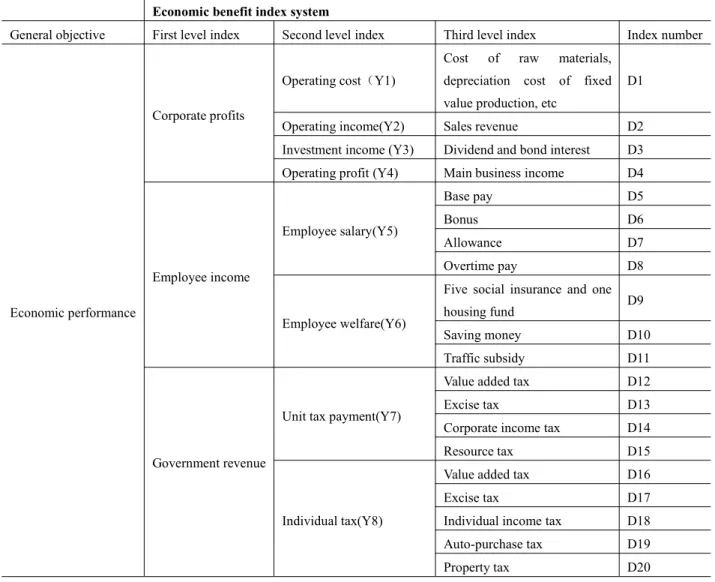
Under the high-quality development system, the enterprise profit index can be subdivided into operation cost, operation income, investment income and operation profit index; the employee income can be subdivided into employee salary and employee welfare expense; the government tax mainly includes enterprise tax and individual
tax[7,9]. Therefore, we can make the index system of high-quality economic development more complete and
scientific by taking enterprise profit, employee income and government tax revenue as the first level indicators. Finally, the economic benefit index system is shown inTable 1[8].
Economic benefit index system
General objective First level index Second level index Third level index Index number
Economic performance
Corporate profits
Operating cost(Y1)
Cost of raw materials, depreciation cost of fixed value production, etc
D1
Operating income(Y2) Sales revenue D2
Investment income (Y3) Dividend and bond interest D3 Operating profit (Y4) Main business income D4
Employee income
Employee salary(Y5)
Base pay D5
Bonus D6
Allowance D7
Overtime pay D8
Employee welfare(Y6)
Five social insurance and one
housing fund D9
Saving money D10
Traffic subsidy D11
Government revenue
Unit tax payment(Y7)
Value added tax D12
Excise tax D13
Corporate income tax D14
Resource tax D15
Individual tax(Y8)
Value added tax D16
Excise tax D17
Individual income tax D18
Auto-purchase tax D19
Property tax D20
Table 1. High quality economic development index system
3.2.2 Entropy method
Information entropy is a measure of the degree of system disorder. Generally, the weight of an index in the overall goal can be calculated by using information entropy through the degree of variation of an index value which has studied.
3.2.3 The construction of relative deviation fuzzy evaluation model
From the perspective of specific indicators to measure the development of enterprises, we analyze the indicator system mentioned above. Taking the profits, employees' income and taxes paid by 20 of the top 500 enterprises of China as the evaluation indexes, the relative deviation fuzzy matrix is used to process the financial data of 20 enterprises, and the relative deviation fuzzy matrix and the weight of each evaluation index are obtained. Then the relative deviation fuzzy matrix is established, and the relative deviation fuzzy evaluation model is the foundation for the following. The following is an empirical analysis of the operation of 20 enterprises.
A) Construct observation matrix
The observation matrix is constructed for all indicators of the enterprise to be evaluated, and an observation matrix is obtained:
B) Establish an ideal plan
C) Establish relative deviation fuzzy matrix
and
D) Establish the weight of each evaluation index E) Establish a comprehensive evaluation model
4. Empirical analysis
The following is an empirical analysis of the comprehensive evaluation of the economic benefits of enterprises under the background of tax cut and fee reduction. According to the designed comprehensive evaluation index system of high-quality economic development, we use the evaluation index system of high-quality economic development constructed by the 20 most representative stable enterprises in China to comprehensively evaluate the economic benefits of high-quality development of enterprises in China in the list of top 500 enterprises.
According to the index system above, we select 20 representative samples of China's top 500 enterprises. We have analyzed the economic benefit data of these 20 enterprises, such as the operating income, investment income per share, operating profit, monthly average wage of employees in 2019. In terms of index design, we select seven indexes from the established index system that can reflect the high-quality economic benefits of enterprises, and then conduct comprehensive evaluation and analysis. These seven indicators include operating cost (x1), operating income (x2), investment income (x3), operating profit (x4), employee salary (x5), employee welfare (x6), and income tax (X7). For these 20 high-quality development evaluation enterprises, including Sinopec, CSCEC, Ping An, SAIC, ICBC, China Railway, China railway construction, China Life Insurance, China Construction Bank, Agricultural Bank of China, Bank of China, HNA technology, Greenland holding, Baosteel, Shenhua, Vanke, Midea Group and China Merchants Bank.
First of all, establish an ideal plan. Business income (x2), investment income (x3), business profit (x4), employee salary (x5), employee welfare (x6), income tax (X7) are all benefit indicators, and business cost (x1) is cost indicators. According to the above standards, the relative deviation fuzzy matrix is established.
According to the above formula, the following results are calculated:
Then, the weight vector is established by entropy method, and the calculation results are as follows:
Finally, the comprehensive evaluation model is established, and the comprehensive evaluation score is calculated by the following formula and MATLAB software.
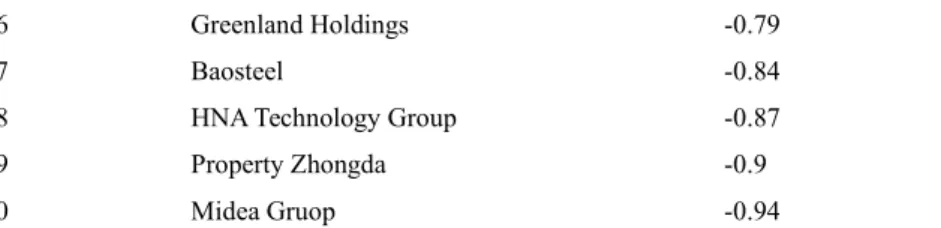
MATLAB software is used to calculate the comprehensive evaluation score of the enterprise economic benefit index system. As shown inTable 2.
Ranking Enterprise name Comprehensive evaluation score
1 Sinopec Group 2.48
2 CNPC 2.25
3 ICBC 0.89
4 China Construction Group 0.59
5 Ping An group of China 0.59
6 Agricultural Bank of China 0.27
7 China Construction Bank 0.16
8 SAIC Group 0.08
9 Bank of China 0.07
10 China Railway Group -0.23
11 China Railway Construction -0.23
16 Greenland Holdings -0.79
17 Baosteel -0.84
18 HNA Technology Group -0.87
19 Property Zhongda -0.9
20 Midea Gruop -0.94
Table 2. Comprehensive evaluation score of industrial economic benefit index
It can be seen from the table that the top four comprehensive scores of 20 enterprises are Sinopec, PetroChina, industrial and Commercial Bank of China and CSCEC, among which 4 are state-owned enterprises. This shows that compared with other enterprises, state-owned enterprises have a faster development speed of high quality, while private enterprises have a relatively slow development of high quality. From the phenomenon that the comprehensive evaluation scores of 20 private enterprises are generally low, we can see that the entrepreneurship and innovation vitality of private enterprises need to be further stimulated, and the relevant preferential policies to encourage the high-level development of private enterprises need to be improved.
5. The incentive path optimization of tax cut and fee reduction
Through the above research, we finally determined the fuzzy comprehensive evaluation system of high-quality economic development, and studied the factors that affect the efficient and healthy economic development of enterprises. Therefore, based on the above research, in order to give full play to the incentive effect of tax cut and fee reduction policy on the high-quality development of China's economy and promote the improvement of the economic efficiency of China's enterprises, we put forward the following policy suggestions to optimize the role of tax cut and fee reduction policy on the high-quality development of China's economy.
5.1 Promote preferential policies of tax cut and fee reduction through multiple channels
In order to let more business owners understand the preferential measures, the relevant departments should vigorously publicize and promote the policy of tax cut and fee reduction, so as to improve the incentive effect of tax cut and fee reduction. First of all, the tax authorities should update the preferential policies on the official website of the tax authorities in time. At the same time, the government should introduce the process and relevant conditions for enterprises to enjoy the policies in detail in the relevant columns of the official website[10]. Only by browsing the
website of the tax authorities can enterprises be familiar with the preferential policies. The tax authorities can open online communication platform, create government departments WeChat official account, micro-blog, etc., and promote the preferential tax policy with the help of new media platform, publish information on policy change, and transfer tax reduction preferential policies to enterprises. In addition, the tax department can also expand the audience of the new round of tax reduction policies and effectively convey the preferential policies to enterprises and relevant taxpayers through various channels such as publishing brochures, holding lectures on tax reduction policies regularly, sending SMS to taxpayers, etc.
5.2 Increase tax cut and fee reduction for private enterprises
China should adhere to the policy of tax cut and fee reduction as an important entry point to promote supply side reform and high-quality economic development. In addition, China should further increase tax cut and fee reduction for private enterprises. At present, China has introduced a number of preferential measures to reduce taxes and fees. The functional departments of the government should continue to implement the policy of tax cut and fee reduction, and ensure the timely implementation of preferential measures, so as to effectively reduce the tax burden of enterprises. In particular, private enterprises are faced with not only the burden of tax and social insurance funds, but also the problems of high external financing burden, high logistics costs, rising land prices, rising wages and so on. For some private enterprises, the financing cost is often higher than the tax burden of enterprises, which is the main aspect of increasing
the production and operation cost of enterprises. Therefore, it is suggested that the relevant departments increase the tax cut and fee reduction for local private enterprises, especially small and micro enterprises, and improve the investment and financing service system for local small and medium enterprises. These measures can alleviate the financing difficulties and expensive situation faced by local private enterprises, and reduce the burden of survival and development of private enterprises.
5.3 Fully implement the principle of tax law
At present, there are only eight kinds of taxes that have been levied in our country, which are formulated in the form of laws. And the rest is in the form of tax administrative regulations and departmental rules, which reflects the imperfection of our tax legal system. This paper suggests that the taxes to be levied should not be issued in the form of administrative regulations, but should be strengthened, and the corresponding draft laws with extensive enforcement and enforcement effect should be issued, and submitted to the National People's Congress and its Standing Committee for deliberation. China gradually improves the legal level of value-added tax and other taxes, and upgrades the administrative regulations to the legal level, so as to realize the legalization of tax[11].
5.4 Further deepen the reform of tax system
By analyzing the current tax structure, we can find that the proportion of indirect tax is high and the proportion of direct tax is low. The imbalance of the proportion of indirect tax and direct tax is obviously disadvantageous to China's economic transformation and upgrading. Therefore, in order to pursue high-quality and high-level economic development, it is necessary to speed up the optimization of tax system structure. In China, efforts have been made to reduce the operating cost of the real economy and the tax burden of enterprises, which on the surface has reduced the national tax revenue. However, in the long run, it has played a practical role in promoting the high-quality development of the real economy through in-depth reform measures in exchange for the substantial benefits of enterprise growth.
6. Conclusion
Entropy method is used to establish the relative deviation fuzzy evaluation index system of high-quality economic development. In view of the economic benefits of enterprises, the comprehensive evaluation system of high-quality economic development established in this paper has certain practical significance. It can make up for the shortcomings of the ranking standard of the top 500 enterprises in the common sense, and evaluate the economic benefits and development potential of an enterprise reasonably.
This comprehensive evaluation model can provide a scientific theoretical basis and reference for the high-quality economic development of some regions in China. To some extent, it can solve the problem of establishing an indicator system to measure the high-quality economic development, and can also be extended to the economic development of enterprises. At the same time, it can better promote the high-level economic development of enterprises and the high-level economic development of China, and it provides path guidance for the tax cut and fee reduction policies.
References
1. Li X, Yang H. A research on optimization of the tax system for promoting high-quality development. Taxation Research 2019; (5): 18-24. doi: 10.19376/j.cnki.cn11-1011/f.2019.05.004.
2. Guo Q. Potential fiscal impact and risk prevention of tax and fee reduction (in Chinese). Management World 2019; 35(6): 1-10+194. doi: 10.19744/j.cnki.11-1235/f.2019.0075.
3. Fan Z, Peng F. The tax reduction effect and the division of labor effect of "camp reform": Based on the perspective of industrial interconnection (in Chinese). Economic Research Journal 2017; 52(2): 82-95.
6. Wu P, Yang L, Zhang T. Integrated evaluation of economy development in Shaanxi Province. Future and Development 2018; 42(8): 101-108+86. doi: 10.3969/j.issn.1003-0166.2018.08.019.
7. Han Y, Zhang D. Construction and application of high-quality development index system in Jilin Province (in Chinese). Economy Research Guide 2019; (20): 27-28+48.
8. Ren B, Li Y. Power transformation of China’s economy from high speed growth to high quality development in the new era. Review of Economy and Management 2019; 35(1): 5-12. doi: 10.13962/j.cnki.37-1486/f.2019.01.001. 9. Liu G, Zheng S. Comprehensive evaluation of high-quality development of regional economy in China (in
Chinese). Productivity Research 2018; (10): 59-63. doi: 10.19374/j.cnki.14-1145/f.2018.10.012.
10. Li H. Construction of taxation system and advance of tax reduction and fee reduction under the goal of high-quality development (in Chinese). Taxation Research 2019; (5): 25-29. doi: 10.19376/j.cnki.cn11-1011/f.2019.05.005.
11. Wang Y, Xu X. Tax reduction and fee reduction and high-quality economic development: Micro evidence from small and micro enterprises (in Chinese). Taxation Research 2019; (12): 16-21.