I DO
WE DO
YOU DO
An RTI Intervention
for Math Problem Solving
Grades 1-5
Copyright 2011 by Dr. Sherri Dobbs Santos
All rights reserved
The classroom teacher may reproduce copies of materials in this book for
classroom use only. The reproduction of any part for an entire school or school
system is strictly prohibited.
ISBN: 978-1-257-91811-9
Special thanks to Lynda Clary-Burke for creating the rubric used in this manual for
the problem solving assessments. Her brilliance, expertise, and insight are second
to none.
Also, special thanks to Jenny Salter, my friend and colleague, for proofreading and
editing this manual. Her eye for detail is impeccable.
Lastly, thank you to my daughter Christian Santos and her friend Zachary Geiwitz
for solving each problem in the manual. Their diligence in double and triple checking
the answers is greatly appreciated.
3
TABLE OF CONTENTS
What is RTI?
...
5
Intervention Based on Research
...
6
Intervention Overview
...
12
Explanation of Universal Screening ... 12
Explanation of Progress Monitoring ... 12
Explanation of Progress Monitoring Graphs and Data Analysis ... 12
Sample Progress Monitoring Graphs ... 12
Progress Monitoring Data Recording Graphs ... 15
Implementation Directions
...
17
I DO
–
WE DO
–
YOU DO 1
stGrade
...
19
PROGRESS MONITORING ASSESSMENT
SAMPLE
... 20
Universal Screening/Baseline Assessment 1
stGrade ... 21
Data Point Assessment #1 with Rubric 1
stGrade ... 22
Math Problem Solving Cards 1
stGrade
...
35
‘I DO –
WE DO
–
YOU DO’
SAMPLE CARD
... 36
MATH PROBLEM SOLVING CARDS TEMPLATE ...
73
I DO
–
WE DO
–
YOU DO 2
ndGrade
...
75
Universal Screening/Baseline Assessment 2
ndGrade ... 76
Data Point Assessment #1 with Rubric 2
ndGrade ... 77
Math Problem Solving Cards 2
ndGrade
...
89
I DO
–
WE DO
–
YOU DO 3
rdGrade
...
127
Universal Screening/Baseline Assessment 3
rdGrade ... 128
Data Point Assessment #1 with Rubric 3
rdGrade ... 129
4
I DO
–
WE DO
–
YOU DO 4
thGrade
...
179
Universal Screening/Baseline Assessment 4
thGrade ... 180
Data Point Assessment #1 with Rubric 4
thGrade ... 181
Math Problem Solving Cards 4
thGrade
...
193
I DO
–
WE DO
–
YOU DO 5
thGrade
...
231
Universal Screening/Baseline Assessment 5
thGrade ... 232
Data Point Assessment #1 with Rubric 5
thGrade ... 233
Math Problem Solving Cards 5
thGrade
...
245
5
of students with learning and behavior needs. The RTI process begins with high-quality
instruction and universal screening of all children in the general education classroom.
Struggling learners are provided with interventions at increasing levels of intensity to
accelerate their rate of learning. These services may be provided by a variety of personnel,
including general education teachers, special educators, and specialists. Progress is closely
monitored to assess both the learning rate and level of performance of individual students.
Educational decisions about the intensity and duration of interventions are based on individual
student response to instruction. RTI is designed for use when making decisions in both general
education and special education, creating a well-integrated system of instruction and
intervention guided by child outcome data. (National Center for Learning Disabilities, 2008)
RTI MODEL
The
‘I DO –
WE DO
–
YOU DO’
intervention in this manual is one which can be used for RTI purposes
but is also a model of what good teaching looks like. This manual includes the research behind the
intervention, directions for the implementation of the intervention, and assessments that can be
used for Progress Monitoring of the intervention. It is designed to provide the teacher/
interventionist with the tools necessary to improve student achievement in the area of math
problem solving. The timeline of the intervention is 12 weeks with progress being monitored weekly.
A total of 36
‘I DO –
WE DO
–
YOU DO’ problem solving cards are included to guide both teachers
and students through the problem solving process and provide a format through which ideas are
modeled, discussed, explained, and solved. This format fosters a deeper understanding of the
underlying thought processes involved with problem solving and encourages non-threatening,
open-ended dialogue to occur between teachers and their students. The decision to adjust, revise,
lengthen, or discontinue the intervention should be based on the data collected on a weekly basis
and should be made in the context of a committee that includes the teacher, the student’s parents,
administrators, counselors, and/or other highly qualified educational personnel. The student
’s RTI
should be assessed by looking at how much progress was made overall
and
where the student is
functioning in relation to the standards set forth by the state and/or district. Students who make
significant progress but who are still functioning below grade level may simply need more time to
catch up.
Just because a student is below grade level does not mean he/she has a disability and
is a candidate for special education.
The RTI process is an individualized process and rash
6
EVIDENCE BASED
The ‘I DO – WE DO –YOU DO’ Math Problem Solving Intervention was developed using the two strongest of
eight recommendations cited in the following report:
Gersten, R., Beckmann, S., Clarke, B., Foegen, A., Marsh, L., Star, J. R., & Witzel, B. (2009). Assisting students struggling with mathematics: Response to Intervention (RtI) for elementary and middle schools (NCEE 2009-4060). Washington, DC: National Center for Education Evaluation and Regional Assistance, Institute of Education Sciences, U.S. Department of Education. Retrieved from
http://ies.ed.gov/ncee/wwc/publications/practiceguides/.
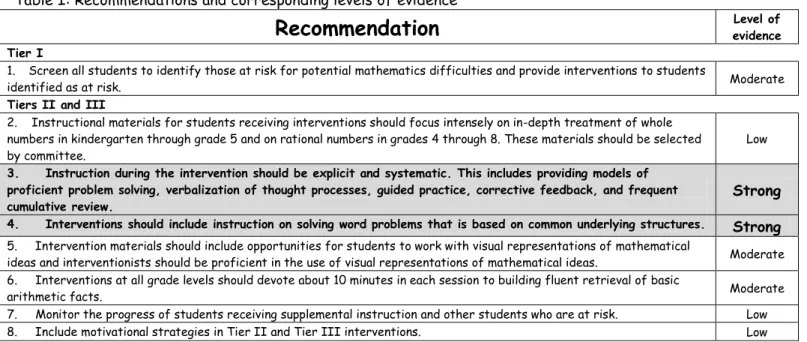
Table I shows a summary of the report that was written by a panel of highly qualified individuals: “The
recommendations were developed by a panel of researchers and practitioners with expertise in various dimensions of this topic. The panel includes a research mathematician active in issues related to K–8
mathematics education, two professors of mathematics education, several special educators, and a mathematics coach currently providing professional development in mathematics in schools. The panel members worked collaboratively to develop recommendations based on the best available research evidence and our expertise in
mathematics, special education, research, and practice.”
http://ies.ed.gov/ncee/wwc/pdf/practiceguides/rti_math_pg_042109.pdf
The panel used the criteria established by the What Works Clearinghouse to support each recommendation and to determine the level of evidence found to back them up. The level of strength of evidence found for each recommendation is explained below: http://ies.ed.gov/ncee/wwc/pdf/practiceguides/rti_math_pg_042109.pdf
Strong:refers to consistent and generalizable evidence that an intervention program causes better outcomes.
Moderate:refers either to evidence from studies that allow strong causal conclusions but cannot be generalized with assurance to the population on which a recommendation is focused (perhaps because the findings have not been widely replicated)—or to evidence from studies that are generalizable but have more causal ambiguity than offered by experimental designs (such as statistical models of correlational data or group comparison designs for which the equivalence of the groups at pretest is uncertain).
Low:refers to expert opinion based on reasonable extrapolations from research and theory on other topics and evidence from studies that do not meet the standards for moderate or strong evidence.
Table I: Recommendations and corresponding levels of evidence
Recommendation
evidence Level ofTier I
1. Screen all students to identify those at risk for potential mathematics difficulties and provide interventions to students
identified as at risk. Moderate
Tiers II and III
2. 2. Instructional materials for students receiving interventions should focus intensely on in-depth treatment of whole
numbers in kindergarten through grade 5 and on rational numbers in grades 4 through 8. These materials should be selected by committee.
Low
3. 3. Instruction during the intervention should be explicit and systematic. This includes providing models of
proficient problem solving, verbalization of thought processes, guided practice, corrective feedback, and frequent
cumulative review. Strong
4. 4. Interventions should include instruction on solving word problems that is based on common underlying structures. Strong
5. 5. Intervention materials should include opportunities for students to work with visual representations of mathematical
ideas and interventionists should be proficient in the use of visual representations of mathematical ideas. Moderate
6. 6. Interventions at all grade levels should devote about 10 minutes in each session to building fluent retrieval of basic
arithmetic facts. Moderate
7. 7. Monitor the progress of students receiving supplemental instruction and other students who are at risk. Low
8. Include motivational strategies in Tier II and Tier III interventions. Low
7
RECOMMENDATIONS #3 AND #4 (see
table on the previous page).The National Mathematics Advisory Panel (NMAP) defines explicit instruction as follows (2008, p. 23):
“Teachers provide clear models for solving a problem type using an array of examples.”
“Students receive extensive practice in use of newly learned strategies and skills.”
“Students are provided with opportunities to think aloud (i.e., talk through the decisions they make and the steps they take).”
“Students are provided with extensive feedback.”
Research Citations for Explicit Instruction:
Artus, L. M., & Dyrek, M. (1989). The effects of multiple strategy intervention on achievement in mathematics. Unpublished master’s thesis, Saint Xavier College, Chicago.
Butler, F. M., Miller, S. P., Crehan, K., Babbitt, B., & Pierce, T. (2003). Fraction instruction for students with mathematics disabilities: Comparing two teaching sequences. Learning Disabilities Research & Practice, 18(20), 99–111.
Darch, C., Carnine, D., & Gersten, R. (1984). Explicit instruction in mathematics problem solving. Journal of Educational Research, 77(6), 351–359.
Fuchs, L. S., Compton, D. L., Fuchs, D., Paulsen, K., Bryant, J. D., & Hamlett, C. L. (2005). The prevention,
identification, and cognitive determinants of math difficulty. Journal of Educational Psychology, 97(3), 493–513. Fuchs, L. S., Fuchs, D., Craddock, C., Hollenbeck, K. N., & Hamlett, C. L. (2008). Effects of small-group tutoring with and without validated classroom instruction on at-risk students’ math problem solving: Are two tiers of prevention better than one? Journal of Educational Psychology, 100(3), 491–509.
Fuchs, L. S., Fuchs, D., Finelli, R., Courey, S. J., & Hamlett, C. L. (2004). Expanding schema-based transfer instruction to help third graders solve real-life mathematical problems. American Educational Research Journal, 41(2), 419–445.
Fuchs, L. S., Fuchs, D., Prentice, K., Burch, M., Hamlett, C. L., Owen, R., et al. (2003a). Explicitly teaching for transfer: Effects on third-grade students’ mathematical problem solving. Journal of Educational Psychology, 95(2), 293–305.
Fuchs, L. S., Fuchs, D., Prentice, K., Burch, M., Hamlett, C. L., Owen, R., et al. (2003b). Enhancing third-grade
students’ mathematical problem solving with self-regulated learning strategies. Journal of Educational Psychology, 95(2), 306–315.
Fuchs, L. S., Fuchs, D., Prentice, K., Hamlett, C. L., Finelli, R., & Courey, S. J. (2004). Enhancing mathematical problem solving among third-grade students with schema-based instruction. Journal of Educational Psychology, 96(4), 635–647.
RECOMMENDATION #3
Instruction during the intervention should be explicit and systematic. This includes providing models of proficient problem solving, verbalization of thought processes, guided practice, corrective feedback, and frequent cumulative review.
8
A randomized field trial. Journal of Research on Educational Effectiveness, 1(1), 2–32.
Fuchs, L. S., Seethaler, P. M., Powell, S. R., Fuchs, D., Hamlett, C. L., & Fletcher, J. M. (2008). Effects of preventative tutoring on the mathematical problem solving of third- grade students with math and reading difficulties. Exceptional Children, 74(2), 155–173.
Jitendra, A. K., Griffin, C. C., McGoey, K., Gardill, M. C., Bhat, P., & Riley, T. (1998). Effects of mathematical word problem solving by students at risk or with mild disabilities. The Journal of Educational Research, 91(6), 345–355.
Schunk, D. H., & Cox, P. D. (1986). Strategy training and attributional feedback with learning disabled students. Journal of Educational Psychology, 78(3), 201–209.
Tournaki, N. (2003). The differential effects of teaching addition through strategy instruction versus drill and practice to students with and without learning disabilities. Journal of Learning Disabilities, 36(5), 449–458. Walker, D. W., & Poteet, J. A. (1989). A comparison of two methods of teaching mathematics story problem-solving with learning disabled students. National Forum of Special Education Journal, 1, 44–51.
Wilson, C. L., & Sindelar, P. T. (1991). Direct instruction in math word problems: Students with learning disabilities. Exceptional Children, 57(6), 512–519.
Witzel, B. S. (2005). Using CRA to teach algebra to students with math difficulties in inclusive settings. Learning Disabilities—A Contemporary Journal, 3(2), 49–60.
Witzel, B. S., Mercer, C. D., & Miller, M. D. (2003). Teaching algebra to students with learning difficulties: An investigation of an explicit instruction model. Learning Disabilities Research & Practice, 18(2), 121–131.
Woodward, J. (2006). Developing automaticity in multiplication facts: Integrating strategy instruction with timed practice drills. Learning Disability Quarterly, 29(4), 269–289.
Xin, Y. P., Jitendra, A. K., & Deatline-Buchman, A. (2005). Effects of mathematical word-problem-solving instruction on middle school students with learning problems. Journal of Special Education,
39(3), 181–192.
*NOTE: The NMAP notes that this does not mean that all mathematics instruction should be explicit. But it does recommend that struggling students receive some explicit instruction regularly and that some of the explicit instruction ensure that students possess the foundational skills and conceptual knowledge necessary for understanding their grade-level mathematics. National Mathematics Advisory Panel (2008).
The NMAP supports recommendation #3 and believes that districts and schools should select materials for interventions that reflect this orientation. In addition, professional development for interventionists should contain guidance on these components of explicit instruction.
LEVEL OF EVIDENCE: STRONG
The NMAP judged the level of evidence supporting this recommendation to be strong. This recommendation is based on six randomized controlled trials that met WWC standards or met standards with reservations and that examined the effectiveness of explicit and systematic instruction in mathematics interventions.
9
Darch, C., Carnine, D., & Gersten, R. (1984). Explicit instruction in mathematics problem solving. Journal of Educational Research, 77(6), 351–359.
Fuchs, L. S., Fuchs, D., Prentice, K., Burch, M., Hamlett, C. L., Owen, R., et al. (2003a). Explicitly teaching for transfer: Effects on third-grade students’ mathematical problem solving. Journal of Educational Psychology, 95(2), 293–305.
Jitendra, A. K., Griffin, C. C., McGoey, K., Gardill, M. C., Bhat, P., & Riley, T. (1998). Effects of mathematical word problem solving by students at risk or with mild disabilities. The Journal of Educational Research, 91(6), 345–355.
Schunk, D. H., & Cox, P. D. (1986). Strategy training and attributional feedback with learning disabled students. Journal of Educational Psychology, 78(3), 201–209.
Tournaki, N. (2003). The differential effects of teaching addition through strategy instruction versus drill and practice to students with and without learning disabilities. Journal of Learning Disabilities, 36(5), 449–458. Wilson, C. L., & Sindelar, P. T. (1991). Direct instruction in math word problems: Students with learning disabilities. Exceptional Children, 57(6), 512–519.
The results of the six randomized controlled trials of mathematics interventions show extensive support for various combinations of the following components of explicit and systematic instruction:
INSTRUCTION DURING THE INTERVENTION SHOULD INCLUDE TEACHER DEMONSTRATION & STUDENT VERBALIZATION
INSTRUCTION DURING THE INTERVENTION SHOULD BE EXPLICIT AND SYSTEMATIC GUIDED PRACTICE
INSTRUCTION DURING THE INTERVENTION SHOULD INCLUDE CORRECTIVE FEEDBACK
INSTRUCTION DURING THE INTERVENTION SHOULD INCLUDE SCAFFOLDED PRACTICE
These studies have shown that explicit and systematic instruction can significantly improve proficiency in word problem solving and operations across grade levels and diverse student populations.
All six studies examined interventions that included teacher demonstrations early in the lessons.
For example, three studies included instruction that began with the teacher verbalizing aloud the steps to solve sample mathematics problems. However, the effects of this component of explicit instruction cannot be
evaluated from these studies because the demonstration procedure was used in instruction for students in both treatment and comparison groups.
Scaffolded practice, a transfer of control of problem solving from the teacher to the student, was a component in four of the six studies. Although it is not possible to parse the effects of scaffolded instruction from the other components of instruction, the intervention groups in each study demonstrated significant positive gains on word problem proficiencies or accuracy measures.
Three of the six studies included opportunities for students to verbalize the steps to solve a problem. Again, although effects of the interventions were statistically significant and positive on measures of word problems, operations, or accuracy, the effects cannot be attributed to a single component of these multicomponent interventions.
10
interventions were positive and significant on word problems and measures of operations skills, but the effects of the corrective feedback component cannot be isolated from the effects of other components in three cases. With only one study in the pool of six including cumulative review as part of the intervention, Fuchs et al.
(2003a), the support for this component of explicit instruction is not as strong as it is for the other
components. But this study did have statistically significant positive effects in favor of the instructional group that received explicit instruction in strategies for solving word problems, including cumulative review.
……….
THE SECOND RECOMMENDATION WHICH SHAPED THE DESIGN OF THE
‘I DO –
WE DO
–
YOU
DO’
MATH PROBLEM SOLVING INTERVENTION WAS
RECOMMENDATION #4 (see table).
Students who have difficulties in mathematics typically experience severe difficulties in solving word problems related to the mathematics concepts and operations they are learning. This is a major impediment for future success in any math-related discipline. Based on the importance of building proficiency and the convergent findings from a body of high-quality research, the panel recommends that interventions include systematic explicit instruction on solving word problems, using the problems’ underlying structure. Simple word problems give meaning to mathematical operations such as subtraction or multiplication. When students are taught the underlying structure of a word problem, they not only have greater success in problem solving but can also gain insight into the deeper mathematical ideas in word problems. The panel also recommends systematic instruction on the structural connections between known, familiar word problems and unfamiliar, new problems. By making explicit the underlying structural connections between familiar and unfamiliar problems, students will know when to apply the solution methods they have learned. (Gersten, R., Beckmann, S., Clarke, B., Foegen, A., Marsh, L., Star, J. R., & Witzel, B. [2009])
LEVEL OF EVIDENCE: STRONG
The panel judged the level of evidence supporting this recommendation to be strong. This recommendation is based on nine randomized controlled trials that met WWC standards or met standards with reservations and that examined the effectiveness of word problem-solving strategies.
Research Citations that Support Recommendation #4 (the nine randomized controlled trials):
Darch, C., Carnine, D., & Gersten, R. (1984). Explicit instruction in mathematics problem solving. Journal of Educational Research, 77(6), 351–359.
Fuchs, L. S., Fuchs, D., Craddock, C., Hollenbeck, K. N., & Hamlett, C. L. (2008). Effects of small-group tutoring with and without validated classroom instruction on at-risk students’ math problem solving: Are two tiers of prevention better than one? Journal of Educational Psychology, 100(3), 491–509.
Fuchs, L. S., Fuchs, D., Finelli, R., Courey, S. J., & Hamlett, C. L. (2004). Expanding schema-based transfer instruction to help third graders solve real-life mathematical problems. American Educational Research Journal, 41(2), 419–445.
Recommendation #4:
Interventions should include instruction on solving word problems that is based on common underlying structures.
11 95(2), 293–305.
Fuchs, L. S., Fuchs, D., Prentice, K., Burch, M., Hamlett, C. L., Owen, R., et al. (2003b). Enhancing third-grade
students’ mathematical problem solving with self-regulated learning strategies. Journal of Educational Psychology, 95(2), 306–315.
Fuchs, L. S., Fuchs, D., Prentice, K., Hamlett, C. L., Finelli, R., & Courey, S. J. (2004). Enhancing mathematical problem solving among third-grade students with schema-based instruction. Journal of Educational Psychology, 96(4), 635–647.
Fuchs, L. S., Seethaler, P. M., Powell, S. R., Fuchs, D., Hamlett, C. L., & Fletcher, J. M. (2008). Effects of preventative tutoring on the mathematical problem solving of third- grade students with math and reading difficulties. Exceptional Children, 74(2), 155–173.
Jitendra, A. K., Griffin, C. C., McGoey, K., Gardill, M. C., Bhat, P., & Riley, T. (1998). Effects of mathematical word problem solving by students at risk or with mild disabilities. The Journal of Educational Research, 91(6), 345–355.
Xin, Y. P., Jitendra, A. K., & Deatline-Buchman, A. (2005). Effects of mathematical word-problem-solving instruction on middle school students with learning problems. Journal of Special Education,
39(3), 181–192.
The aforementioned research demonstrates that instruction on solving word problems based on underlying problem structure leads to statistically significant positive effects on measures of word problem solving. Three of the randomized controlled trials isolated this practice. In these studies, interventionists taught students to identify problems of a given type by focusing on the problem structure and then to design and execute
appropriate solution strategies for each problem. These techniques typically led to significant and positive effects on word-problem outcomes for students
Six of the randomized controlled trials took the instructional intervention on problem structure a step further. They demonstrated that teaching students to distinguish superficial from substantive information in problems also leads to marginally or statistically significant positive effects on measures of word problem solving. After students were explicitly taught the pertinent structural features and problem-solution methods for different problem types, they were taught superficial problem features that can change a problem without altering its underlying structure. They were taught to distinguish substantive information from superficial information in order to solve problems that appear new but really fit into one of the categories of problems they already know how to solve. They were also taught that the same underlying problem structures can be applied to problems that are presented in graphic form (for example, with tables or maps). These are precisely the issues that often confuse and derail students with difficulties in mathematics. These six studies consistently demonstrated marginally or statistically significant positive effects on an array of word problem-solving proficiencies for students experiencing difficulties in mathematics. (Gersten, R., Beckmann, S., Clarke, B., Foegen, A., Marsh, L., Star, J. R., & Witzel, B. [2009])
12
OVERVIEW of the
‘
I DO
–
WE DO
–
YOU DO
’
INTERVENTION
UNIVERSAL SCREENING
A Universal Screening/Baseline Assessment must be given BEFORE any intervention actually begins.
Additionally, the student must complete the assessment INDEPENDENTLY without any assistance
so as to get an accurate picture of where he/she is functioning. It is the Universal Screening that
alerts the teacher/tutor to the need for further intervention. Other factors may also indicate the
need for intervention such as poor classroom performance, substandard scores on standardized
tests, and/or low scores on c
ommon formative assessments. The Universal Screening for the ‘I DO
–
WE DO
–
YOU DO’
Math Problem Solving Intervention is a sample math word problem from the
student’s
grade level and is identical to the data point assessments given weekly. Each assessment
is scored using a rubric designed specifically to assess five key elements of math problem solving.
Developed by Lynda Clary-Burke, an elementary school teacher in Henry County, Georgia, the
problem solving rubric gets to the core of where the student is struggling and gives the
teacher/interventionist/tutor valuable information as to what to emphasize or focus on in future
intervention sessions. The continuity between the Universal Screening and the Data Point
Assessments makes the analysis of the data collected throughout the intervention period easier to
read and understand.
An educator will essentially be comparing ‘oranges to oranges’ since the
assessments are the same (the problems are different for each assessment but the design and the
processes for completion are identical).
PROGRESS MONITORING
As previously stated, in order to see whether or not the
‘I DO –
WE DO
–
YOU DO’ Math Problem
Solving Intervention is effective, data should be gathered on a weekly basis through data point
assessments. As with the Universal Screening, the student completes each data point assessment
INDEPENDENTLY without assistance. Each assessment is scored using the rubric below the actual
problem the student completes. The rubric assesses the following five problem solving elements:
Problem Solving, Reasoning and Proof, Communications, Connections, and Representation
.
Each
element is scored on a scale of
‘
1
’
to
‘
4
’
with
‘
3
’
being the goal score (proficient). The 1
–
4 scale is
defined by the following descriptors:
1 = Not Evident
2 = Emerging
3 = Proficient
4 = Exemplary
PROGRESS MONITORING GRAPHS AND DATA ANALYSIS
For the purpose of collecting data for the
‘I DO – WE DO –YOU DO’Math Problem Solving
Intervention, a total of five graphs are needed; one for each of the five elements from the
assessment rubric. The graphs that follow are examples of how the data should be documented and
what each graph
may
look like after a 12 week implementation period is complete. Careful
examination of the data collected each week must occur (preferably in the context of a data
analysis team) in order to adequately assess the effectiveness of the intervention and to pinpoint
areas of weakness. This on-going weekly review of the data is crucial and should be the catalyst
which drives future instruction for the struggling student.
13 US/BL DP1 DP2 DP3 DP4 DP5 DP6 DP7 DP8 DP9 DP10 DP11 DP12 Date 2/20/2011 2/27/2011 3/3/2011 3/10/2011 3/17/2011 3/24/2011 4/1/2011 4/8/2011 4/15/2011 4/22/2011 4/29/2011 5/6/2011 5/13/2011 Student Score 2 3 2 2 1 1 2 2 3 2 2 1 2 Goal Score 3 3 3 3 3 3 3 3 3 3 3 3 3 0 1 2 3 4 Stu de nt S co re
SAMPLE GRAPH A:
Element: Problem Solving
Student Score Goal Score
US/BL DP1 DP2 DP3 DP4 DP5 DP6 DP7 DP8 DP9 DP10 DP11 DP12 Date 2/20/2011 2/27/2011 3/3/2011 3/10/2011 3/17/2011 3/24/2011 4/1/2011 4/8/2011 4/15/2011 4/22/2011 4/29/2011 5/6/2011 5/13/2011 Student Score 2 3 2 2 1 1 2 2 3 2 2 1 2 Goal Score 3 3 3 3 3 3 3 3 3 3 3 3 3 0 1 2 3 4 Stu de nt S co re
SAMPLE GRAPH B:
Element: Reasoning & Proof
Student Score Goal Score
US/BL DP1 DP2 DP3 DP4 DP5 DP6 DP7 DP8 DP9 DP10 DP11 DP12 Date 2/20/2011 2/27/2011 3/3/2011 3/10/2011 3/17/2011 3/24/2011 4/1/2011 4/8/2011 4/15/2011 4/22/2011 4/29/2011 5/6/2011 5/13/2011 Student Score 1 2 1 1 1 1 1 1 2 2 1 1 1 Goal Score 3 3 3 3 3 3 3 3 3 3 3 3 3 0 1 2 3 4 Stu de nt S co re
SAMPLE GRAPH C
:
Element: Communications
Student Score Goal Score
US/BL DP1 DP2 DP3 DP4 DP5 DP6 DP7 DP8 DP9 DP10 DP11 DP12 Date 2/20/2011 2/27/2011 3/3/2011 3/10/2011 3/17/2011 3/24/2011 4/1/2011 4/8/2011 4/15/2011 4/22/2011 4/29/2011 5/6/2011 5/13/2011 Student Score 2 1 2 2 2 3 3 2 2 3 3 4 4 Goal Score 3 3 3 3 3 3 3 3 3 3 3 3 3 0 1 2 3 4 Stu de nt S co re
SAMPLE GRAPH D:
Element: Connections
Student Score Goal Score
Scale Interpretation: 1=Not Evident 2=Emerging 3=Proficient 4=Exemplary Scale Interpretation: 1=Not Evident 2=Emerging 3=Proficient 4=Exemplary Scale Interpretation: 1=Not Evident 2=Emerging 3=Proficient 4=Exemplary Scale Interpretation: 1=Not Evident 2=Emerging 3=Proficient 4=Exemplary
14
What do the sample graphs on the previous page tell us about Student ‘X’? By looking at each element’s graph separately, one can
pinpoint that this student mostly struggles with the communications aspect of problem solving. This gives the teacher/tutor valuable information which should be used to guide future instruction with this student. The teacher/tutor will know that the student needs lots
of practice ‘thinking aloud’ and explaining the processes he/she uses to solve a problem. The teacher/tutor should allow ample time for open and thought provoking dialog to occur as the student works through the processes of problem solving and should provide instant feedback and encouragement to reassure the student as he/she works through the intervention problems. The graphs above also show that the student has made great strides in being able to make connections to similar problems or ideas as well as being able to create representations to solve problems. However, continued focus on reasoning and proof and problem solving are needed to ensure a greater likelihood of overall success.
DOCUMENTATION FOR PROGRESS MONITORING
After each weekly data point assessment, the teacher/tutor should plot the scores on the five
graphs on the following 2 pages. Graphs are an easy-to-
read ‘snap shot’ of how the student
performs each week and are an excellent tool to use when looking at overall progress and
effectiveness of the intervention. The data should be analyzed weekly rather than at the end of
the 12 weeks so that changes or adjustments to the intervention may be made DURING the 12
week period. The progress monitoring graphs on the following two pages can be used for any grade
(in this manual grades 1 through 5 are the focus but the same process can be used for grades
higher than 5).
SPECIAL NOTE: The word problems in each section of this manual represent appropriate grade
level problems based on the Georgia Performance Standards (GPS). If the problems designated for
a particular grade level are too difficult for a student in need of the ‘I DO –
WE DO
–
YOU DO’
intervention, then use the materials for the grade level below the grade of the student. Although
mathematical computa
tion is important, the main purpose of the ‘I DO –
WE DO
–
YOU DO’
intervention is to teach students the underlying structures and processes of problem solving.
US/BL DP1 DP2 DP3 DP4 DP5 DP6 DP7 DP8 DP9 DP10 DP11 DP12 Date 2/20/2011 2/27/2011 3/3/2011 3/10/2011 3/17/2011 3/24/2011 4/1/2011 4/8/2011 4/15/2011 4/22/2011 4/29/2011 5/6/2011 5/13/2011 Student Score 3 3 3 2 2 3 2 2 2 3 3 4 3 Goal Score 3 3 3 3 3 3 3 3 3 3 3 3 3 0 1 2 3 4 Stu de nt S co re
SAMPLE GRAPH E:
Element: Representations
Student Score Goal Score
Scale Interpretation: 1=Not Evident
2=Emerging 3=Proficient 4=Exemplary
‘I DO – WE DO –YOU DO’ Progress Monitoring Graphs 15
Plot below the score of each element assessed on a scale from 1-4 with the goal score equaling 3 (the goal line has already been graphed). Each of the 5 graphs that follow represent one of the five Problem Solving elements. Be sure to include the
Universal Screening/Baseline (assessed BEFORE the intervention began) so as to have a point to which other assessments can be compared. US/BL DP1 DP2 DP3 DP4 DP5 DP6 DP7 DP8 DP9 DP10 DP11 DP12 Date Student Score Goal Score 3 3 3 3 3 3 3 3 3 3 3 3 3 0 1 2 3 4 Stu d e n t Sc o re
Element: Problem Solving
Student Score Goal Score
US/BL DP1 DP2 DP3 DP4 DP5 DP6 DP7 DP8 DP9 DP10 DP11 DP12 Date Student Score Goal Score 3 3 3 3 3 3 3 3 3 3 3 3 3 0 1 2 3 4 Stu d e n t Sc o re
Element: Reasoning and Proof
16
‘I DO – WE DO –YOU DO’ Progress Monitoring Graphs US/BL DP1 DP2 DP3 DP4 DP5 DP6 DP7 DP8 DP9 DP10 DP11 DP12 Date Student Score Goal Score 3 3 3 3 3 3 3 3 3 3 3 3 3 0 1 2 3 4 Stu d en t Sco re
Element: Communication
Student Score Goal Score
US/BL DP1 DP2 DP3 DP4 DP5 DP6 DP7 DP8 DP9 DP10 DP11 DP12 Date Student Score Goal Score 3 3 3 3 3 3 3 3 3 3 3 3 3 0 1 2 3 4 Stu d e n t Sc o re
Element: Connections
Student Score Goal Score
US/BL DP1 DP2 DP3 DP4 DP5 DP6 DP7 DP8 DP9 DP10 DP11 DP12 Date Student Score Goal Score 3 3 3 3 3 3 3 3 3 3 3 3 3 0 1 2 3 4 Stu d e n t Sc o re
Element: Representation
17
Problem Solving Sheets per grade level. However, if a skill is not covered or more cards are needed,
feel free to create your own using the blank template on page 73.
Below are the steps that need to be followed for each intervention session:
STEP ONE:
Teacher/tutor/interventionist uses the darkly shaded “
TEACHER MODELS
” card
to show the student the steps in the problem solving process (reading the problem, talking
about the problem, writing how to solve the problem, and then solving the problem using
pictures, words, or numbers).
STEP TWO:
The teacher/tutor/interventionist
and
the student
work together
using the
lightly shaded “
TEACHER AND STUDENT COLLABORATE
” card to solve a sim
ilar problem.
THE TEACHER WALKS THE STUDENT THROUGH EACH STEP AND PROVIDES FEEDBACK
AND ENCOURAGEMENT THROUGHOUT.
STEP THREE:
The student uses the “
STUDENT COMPLETES INDEPENDENTLY
” card to solve
another similar problem independently (as teacher/tutor/interventionist looks on and
supervises). If the student ‘gets stuck’, the teacher
/tutor/interventionist should refer back to
the “
TEACHER MODEL
” problem and review and reteach if necessary.
DELIVERY METHOD
The ‘I DO –
WE DO
–
YOU DO’ math problem
solving intervention is most conducive to one-on-one
instruction in which the teacher/tutor works individually with the student. However, this
intervention can also be implemented with a small group of two to five students. If a small group
approach is us
ed, be sure that every student in the group has his/her own set of ‘Problem Solving
Cards’.
INTERVENTION SESSIONS
A total of 36 ‘‘I DO –
WE DO
–
YOU DO’ Problem Solving Cards are
included in this manual for each
grade 1
st–
5
thand cover a variety of problems appropriate for the specified grade level. Each card
is designed to represent one complete RTI intervention session lasting approximately 20 minutes.
It is
imperative
that each intervention session follow the specific steps listed above and is
completed in a
thorough
manner. Going over each problem briefly or just handing the student a
sheet to complete is
NOT
a part of this intervention. The ‘I DO –
WE DO
–
YOU DO’ Math Problem
Solving Intervention is intended to address areas of weakness and actually impact overall student
performance in the area of math problem solving.
LENGTH OF INTERVENTION
The ‘I DO –
WE DO
–
YOU DO’ intervention is designed to be implemented three times per week
for 20 minutes per session for a total of 12 weeks. Weekly data point assessments are given on a
day in which an intervention session does not occur
(i.e., Intervention Sessions = M, Tu, W, Assessment = Friday).
I DO
WE DO
YOU DO
FIRST
GRADE
20 ‘I DO – WE DO –YOU DO’ Math Problem Solving Progress Monitoring Assessment 1ST GRADE
Math Problem Solving RTI Progress Monitoring Assessment SAMPLE
Directions: Have the student complete the data point assessment on this page to assess RTI progress. Do not help the student in any way so as
to get a true picture of the student’s ability relative to math problem solving.
Data Point #SAMPLE
(given to student after completing __ weeks of the intervention)Step One: Read the problem
Teddy the bear chased 4
hunters up a tree on Monday
and 7 hunters up a tree on
Tuesday.
How many more hunters did
Teddy chase up a tree on
Tuesday than Monday?
3
Step Two: Think about the problem and write HOW you will solve the problem on the lines below: First I would think about the problem and create a movie in my head. I would see a bear chasing hunters through the woods and up into a tree. On the first day (Monday) I would see 4 men in a tree with Teddy looking at them from the bottom and I would see 7 hunters in the tree on
Tuesday. I noticed the words ‘How many more’ and know that I need to subtract
the amount of men in the tree on Monday from the amount of men in the tree on Tuesday.
Step Three: Solve the problem using pictures, words, or numbers.
Using the rubric below, assess how well the student performed in each of the five problem solving elements. DO NOT average the five scores but rather graph each element separate so as to specifically identify the area(s) of greatest concern within the problem solving process. The information derived from this data and the analysis thereof should guide instruction for future sessions.
Level of
Performance Problem Solving Reasoning and Proof Communication Connections Representation
Exemplary
4
The student understands the problem. He/she used and noted a rule in the solution. He/she clearly verified that the strategy is correct. If the student found errors he/she explained how the error was discovered and what should be done to correct the problem.
The student showed that he/she knew more about a math idea that he/she used in his/her plan. Or, the student explained a rule and how it was used to solve this problem.
All of the student’s math
thinking is correct.
The student used a lot of specific math language and /or notation throughout his/her work. The paths of the
student’s thinking were
clear. He/she showed step-by-step how he/she arrived at the answer(s).
The student noticed something mathematical in his/her work that reminded him/her of math big ideas, or math strategies & he/she used that to extend his/her answer.
And/or the student showed how this problem is like another problem.
The student used another math representation to help solve the problem and explain his/her work in another way.
All of the student’s
representations are labeled and correct.
Proficient
3
The student understood the problem and his/her strategy works.
The student’s answer is correct.
All of the student’s math
thinking is correct. The student used math language and/or notation throughout his/her work. No one had to guess
about the student’s lines
of thinking or his/her answer(s).
The student noticed something mathematical about his/her work that reminded him/her of some other work and he/she noted it in some way.
The student used a math representation to help solve the problem and explain his/her work, and it is labeled and correct.
Emerging
2
The student only understood part of the problem. Teacher needs to help the student understand how to understand the entire problem.
The student’s strategy works
for part of the problem. He/she needs help in understanding how to finish the problem.
Some of the student’s
math thinking is correct. The student needs clarity to help in understanding the problem.
The student used some math language and/or math notation. The student needs help in understanding the where and why math language could have been used more effectively in his/her work.
The student tried to notice something, but it is not about the math in the problem.
The student needs help in making connections to what he/she knows and understands.
The student tried to use math representation to help solve the problem and explain his/her work, but it has mistakes in it. The student needs help making representations that really show his/her thinking
Not Evident
1
The student did not understand the problem. The student needs help in understanding the problem and choosing a strategy to solve the problem.
The student’s math
thinking is not correct. The student needs help finding, understanding, and correcting the errors.
The student used no math language and/or math notation. The student needs help to show him/her where he/she could have used math language and/or math notation.
The student did not notice anything about the problem or the numbers in his/her work. The student needs help in making connections to other work and strategies.
The student did not use a math representation to help solve the problem and explain his/her work. The student needs help to understand how to do this better.
1ST GRADE ‘I DO – WE DO –YOU DO’ Math Problem Solving Progress Monitoring Assessment 21
Directions: Have the student complete the baseline assessment on this page before beginning the “I DO – WE DO –YOU DO” Math Problem
Solving Intervention. Do not help the student in any way so as to get a true picture of the student’s ability relative to math problem solving.
Step One: Read the problem
There are 3 red grapes
on the table. Laura puts 2
green grapes on the
table.
How many grapes are
there in all? _____
Step Two: Think about the problem and write HOW you will solve the problem on the lines below:
Step Three: Solve the problem using pictures, words, or numbers.
Using the rubric below, assess how well the student performed in each of the five problem solving elements. DO NOT average the five scores but rather graph each element separate so as to specifically identify the area(s) of greatest concern within the problem solving process. The information derived from this data and the analysis thereof should guide instruction for future sessions.
Level of
Performance Problem Solving Reasoning and Proof Communication Connections Representation
Exemplary
4
The student understands the problem. He/she used and noted a rule in the solution. He/she clearly verified that the strategy is correct. If the student found errors he/she explained how the error was discovered and what should be done to correct the problem.
The student showed that he/she knew more about a math idea that he/she used in his/her plan. Or, the student explained a rule and how it was used to solve this problem.
All of the student’s math
thinking is correct.
The student used a lot of specific math language and /or notation throughout his/her work. The paths of the
student’s thinking were clear. He/she showed step-by-step how he/she arrived at the answer(s).
The student noticed something mathematical in his/her work that reminded him/her of math big ideas, or math strategies & he/she used that to extend his/her
answer …
And/or the student showed how this problem is like another problem.
The student used another math representation to help solve the problem and explain his/her work in another way.
All of the student’s
representations are labeled and correct.
Proficient
3
The student understood the problem and his/her strategy works.
The student’s answer is
correct.
All of the student’s math
thinking is correct. The student used math language and/or notation throughout his/her work. No one had to guess
about the student’s lines
of thinking or his/her answer(s).
The student noticed something mathematical about his/her work that reminded him/her of some other work and he/she noted it in some way.
The student used a math representation to help solve the problem and explain his/her work, and it is labeled and correct.
Emerging
2
The student only understood part of the problem. Teacher needs to help the student understand how to understand the entire problem.
The student’s strategy works
for part of the problem. He/she needs help in understanding how to finish the problem.
Some of the student’s
math thinking is correct. The student needs clarity to help in understanding the problem.
The student used some math language and/or math notation. The student needs help in understanding the where and why math language could have been used more effectively in his/her work.
The student tried to notice something, but it is not about the math in the problem.
The student needs help in making connections to what he/she knows and understands.
The student tried to use math representation to help solve the problem and explain his/her work, but it has mistakes in it. The student needs help making representations that really show his/her thinking
Not Evident
1
The student did not understand the problem. The student needs help in understanding the problem and choosing a strategy to solve the problem.
The student’s math
thinking is not correct. The student needs help finding, understanding, and correcting the errors.
The student used no math language and/or math notation. The student needs help to show him/her where he/she could have used math language and/or math notation.
The student did not notice anything about the problem or the numbers in his/her work. The student needs help in making connections to other work and strategies.
The student did not use a math representation to help solve the problem and explain his/her work. The student needs help to understand how to do this better.
22 ‘I DO – WE DO –YOU DO’ Math Problem Solving Progress Monitoring Assessment 1ST GRADE
Directions: Have the student complete the data point assessment on this page to assess RTI progress. Do not help the student in any way so as
to get a true picture of the student’s ability relative to math problem solving.
Data Point #1
(given to student after completing 1week of the intervention)Step One: Read the problem
Dante put 3 books on the
shelf. His friend Tray put
4 more books on the
shelf. How many books
are there now? _______
Step Two: Think about the problem and write HOW you will solve the problem on the lines below:
Step Three: Solve the problem using pictures, words, or numbers.
Using the rubric below, assess how well the student performed in each of the five problem solving elements. DO NOT average the five scores but rather graph each element separate so as to specifically identify the area(s) of greatest concern within the problem solving process. The information derived from this data and the analysis thereof should guide instruction for future sessions.
Level of
Performance Problem Solving
Reasoning and
Proof Communication Connections Representation
Exemplary
4
The student understands the problem. He/she used and noted a rule in the solution. He/she clearly verified that the strategy is correct. If the student found errors he/she explained how the error was discovered and what should be done to correct the problem.
The student showed that he/she knew more about a math idea that he/she used in his/her plan. Or, the student explained a rule and how it was used to solve this problem.
All of the student’s math
thinking is correct.
The student used a lot of specific math language and /or notation throughout his/her work. The paths of the
student’s thinking were clear. He/she showed step-by-step how he/she arrived at the answer(s).
The student noticed something mathematical in his/her work that reminded him/her of math big ideas, or math strategies & he/she used that to extend his/her
answer …
And/or the student showed how this problem is like another problem.
The student used another math representation to help solve the problem and explain his/her work in another way.
All of the student’s
representations are labeled and correct.
Proficient
3
The student understood the problem and his/her strategy works.
The student’s answer is
correct.
All of the student’s math
thinking is correct.
The student used math language and/or notation throughout his/her work. No one had to guess
about the student’s lines
of thinking or his/her answer(s).
The student noticed something mathematical about his/her work that reminded him/her of some other work and he/she noted it in some way.
The student used a math representation to help solve the problem and explain his/her work, and it is labeled and correct.
Emerging
2
The student only understood part of the problem. Teacher needs to help the student understand how to understand the entire problem.
The student’s strategy works
for part of the problem. He/she needs help in understanding how to finish the problem.
Some of the student’s
math thinking is correct. The student needs clarity to help in understanding the problem.
The student used some math language and/or math notation. The student needs help in understanding the where and why math language could have been used more effectively in his/her work.
The student tried to notice something, but it is not about the math in the problem.
The student needs help in making connections to what he/she knows and understands.
The student tried to use math representation to help solve the problem and explain his/her work, but it has mistakes in it. The student needs help making representations that really show his/her thinking
Not Evident
1
The student did not understand the problem. The student needs help in understanding the problem and choosing a strategy to solve the problem.
The student’s math
thinking is not correct. The student needs help finding, understanding, and correcting the errors.
The student used no math language and/or math notation. The student needs help to show him/her where he/she could have used math language and/or math notation.
The student did not notice anything about the problem or the numbers in his/her work. The student needs help in making connections to other work and strategies.
The student did not use a math representation to help solve the problem and explain his/her work. The student needs help to understand how to do this better.
1ST GRADE ‘I DO – WE DO –YOU DO’ Math Problem Solving Progress Monitoring Assessment 23
to get a true picture of the student’s ability relative to math problem solving.
Data Point #2
(given to student after completing 2weeks of the intervention)Step One: Read the problem
Eight puppies are in the
cage. Princess takes two
out of the cage. How
many are still in the cage?
_______
Step Two: Think about the problem and write HOW you will solve the problem on the lines below:
Step Three: Solve the problem using pictures, words, or numbers.
Using the rubric below, assess how well the student performed in each of the five problem solving elements. DO NOT average the five scores but rather graph each element separate so as to specifically identify the area(s) of greatest concern within the problem solving process. The information derived from this data and the analysis thereof should guide instruction for future sessions.
Level of
Performance Problem Solving
Reasoning and
Proof Communication Connections Representation
Exemplary
4
The student understands the problem. He/she used and noted a rule in the solution. He/she clearly verified that the strategy is correct. If the student found errors he/she explained how the error was discovered and what should be done to correct the problem.
The student showed that he/she knew more about a math idea that he/she used in his/her plan. Or, the student explained a rule and how it was used to solve this problem.
All of the student’s math
thinking is correct.
The student used a lot of specific math language and /or notation throughout his/her work. The paths of the
student’s thinking were clear. He/she showed step-by-step how he/she arrived at the answer(s).
The student noticed something mathematical in his/her work that reminded him/her of math big ideas, or math strategies & he/she used that to extend his/her
answer …
And/or the student showed how this problem is like another problem.
The student used another math representation to help solve the problem and explain his/her work in another way.
All of the student’s
representations are labeled and correct.
Proficient
3
The student understood the problem and his/her strategy works.
The student’s answer is
correct.
All of the student’s math
thinking is correct.
The student used math language and/or notation throughout his/her work. No one had to guess about the student’s lines
of thinking or his/her answer(s).
The student noticed something mathematical about his/her work that reminded him/her of some other work and he/she noted it in some way.
The student used a math representation to help solve the problem and explain his/her work, and it is labeled and correct.
Emerging
2
The student only understood part of the problem. Teacher needs to help the student understand how to understand the entire problem.
The student’s strategy works
for part of the problem. He/she needs help in understanding how to finish the problem.
Some of the student’s
math thinking is correct. The student needs clarity to help in understanding the problem.
The student used some math language and/or math notation. The student needs help in understanding the where and why math language could have been used more effectively in his/her work.
The student tried to notice something, but it is not about the math in the problem.
The student needs help in making connections to what he/she knows and understands.
The student tried to use math representation to help solve the problem and explain his/her work, but it has mistakes in it. The student needs help making representations that really show his/her thinking
Not Evident
1
The student did not understand the problem. The student needs help in understanding the problem and choosing a strategy to solve the problem.
The student’s math
thinking is not correct. The student needs help finding, understanding, and correcting the errors.
The student used no math language and/or math notation. The student needs help to show him/her where he/she could have used math language and/or math notation.
The student did not notice anything about the problem or the numbers in his/her work. The student needs help in making connections to other work and strategies.
The student did not use a math representation to help solve the problem and explain his/her work. The student needs help to understand how to do this better.
24 ‘I DO – WE DO –YOU DO’ Math Problem Solving Progress Monitoring Assessment 1ST GRADE
1st grade
Directions: Have the student complete the data point assessment on this page to assess RTI progress. Do not help the student in any way so as
to get a true picture of the student’s ability relative to math problem solving.
Data Point #3
(given to student after completing 3 weeks of the intervention)Step One: Read the problem
Barbie has 4 dimes. She
loses 2 dimes.
How many dimes does she
have left? ______
How much money does
she have left? ______
Step Two: Think about the problem and write HOW you will solve the problem on the lines below:
Step Three: Solve the problem using pictures, words, or numbers.
Using the rubric below, assess how well the student performed in each of the five problem solving elements. DO NOT average the five scores but rather graph each element separate so as to specifically identify the area(s) of greatest concern within the problem solving process. The information derived from this data and the analysis thereof should guide instruction for future sessions.
Level of
Performance Problem Solving
Reasoning and
Proof Communication Connections Representation
Exemplary
4
The student understands the problem. He/she used and noted a rule in the solution. He/she clearly verified that the strategy is correct. If the student found errors he/she explained how the error was discovered and what should be done to correct the problem.
The student showed that he/she knew more about a math idea that he/she used in his/her plan. Or, the student explained a rule and how it was used to solve this problem.
All of the student’s math
thinking is correct.
The student used a lot of specific math language and /or notation throughout his/her work. The paths of the
student’s thinking were clear. He/she showed step-by-step how he/she arrived at the answer(s).
The student noticed something mathematical in his/her work that reminded him/her of math big ideas, or math strategies & he/she used that to extend his/her
answer …
And/or the student showed how this problem is like another problem.
The student used another math representation to help solve the problem and explain his/her work in another way.
All of the student’s
representations are labeled and correct.
Proficient
3
The student understood the problem and his/her strategy works.
The student’s answer is
correct.
All of the student’s math
thinking is correct.
The student used math language and/or notation throughout his/her work. No one had to guess
about the student’s lines
of thinking or his/her answer(s).
The student noticed something mathematical about his/her work that reminded him/her of some other work and he/she noted it in some way.
The student used a math representation to help solve the problem and explain his/her work, and it is labeled and correct.
Emerging
2
The student only understood part of the problem. Teacher needs to help the student understand how to understand the entire problem.
The student’s strategy works
for part of the problem. He/she needs help in understanding how to finish the problem.
Some of the student’s
math thinking is correct. The student needs clarity to help in understanding the problem.
The student used some math language and/or math notation. The student needs help in understanding the where and why math language could have been used more effectively in his/her work.
The student tried to notice something, but it is not about the math in the problem.
The student needs help in making connections to what he/she knows and understands.
The student tried to use math representation to help solve the problem and explain his/her work, but it has mistakes in it. The student needs help making representations that really show his/her thinking
Not Evident
1
The student did not understand the problem. The student needs help in understanding the problem and choosing a strategy to solve the problem.
The student’s math
thinking is not correct. The student needs help finding, understanding, and correcting the errors.
The student used no math language and/or math notation. The student needs help to show him/her where he/she could have used math language and/or math notation.
The student did not notice anything about the problem or the numbers in his/her work. The student needs help in making connections to other work and strategies.
The student did not use a math representation to help solve the problem and explain his/her work. The student needs help to understand how to do this better.