ORIGINAL ARTICLE
Is the Delphi method valid for business ethics? A survey analysis
Leire San-Jose1,2 &Jose Luis Retolaza3
Received: 29 September 2016 / Accepted: 24 November 2016 / Published online: 3 December 2016 #The Author(s) 2016. This article is published with open access at Springerlink.com
Abstract Although Delphi has come a long way in the
development of the method itself, or even in business organisation, it has not been used at all in business ethics. To fill this gap, we have reviewed the literature on the use of Delphi in business, and particularly in the field of business ethics; we have also evidenced the method’s lack of use in this field, but noted its potential contribution to this research stream. An online survey has been administered to scholars in business ethics that have previously participated in a Delphi survey. The scholars come from nine different countries, and the survey has been held between January 2015 and March-June 2016. The findings show that in the ex-perts’ opinion Delphi is as rigorous, appropriate and useful as any other research method in the field of business ethics, such as focus group, interviews, surveys (online) and case analysis. The Delphi method is assessed anonymously and economically by a group of experts dispersed around the world. Moreover, applying the Delphi method in business ethics could enrich the consensus on limiting the fuzzy area in which ethical business decisions (ethical decision-making) are argued
and determined. It is a way of facilitating the search for a solution to the ethical dilemmas delimiting a problem, which is a further advantage of the Delphi technique.
Keywords Consensus . Ethical Decision-Making (EDM) .
Management . Research method . Fuzzy
Introduction: is the Delphi method used in ethical
decision-making?
Based on the study by Rest [54], Jones [38] developed the concept of moral intensity, in which one of the six components consists of the social consensus that Bis defined as the degree of social agreement that a pro-posed act is evil (or good)^ [38: 375]. Many papers have subsequently focused on it; however, and follow-ing a review of the empirical literature containfollow-ing ethi-cal papers and on ethiethi-cal decision-making conducted by Craft [15], it is confirmed that despite its multiple ben-efits (predicting technological advances, achieving a bet-ter understanding of a subject, and reaching a level of agreement on topics without conclusive information) the Delphi method has not been widely used either to ana-lyse or to identify areas of agreement on ethical busi-ness decisions. Nevertheless, the Delphi method could be useful for research in business ethics, as it is now used in the business area, because of its potential in terms of consensus, feedback, and removing group pres-sure. There are both practical demands, as rigorous methods such as Delphi could be useful for delimiting ethical dilemmas, and Delphi could fill a research lacu-na. To support the possibility of adding value in the field of business ethics, it needs to be considered that the Delphi method generates a range of alternative * Leire San-Jose
Jose Luis Retolaza [email protected]
1 University of the Basque Country UPV/EHU, Avda. Lehendakari
Agirre 83, 48015 Bilbao, Spain
2
University of Huddersfield, Huddersfield, UK
3 Deusto Business School, Madrid, Spain
solutions to the issues and problems a researcher faces [43], to avoid ignoring ethical decisions. Quite the op-posite in fact, Delphi should be considered a potential way of resolving research questions in business ethics, or at least of helping to demarcate ethical problems in order to reduce the fuzzy space in which ethical deci-sions are made. Precisely this method could approach the positions of Coates [12] and Mitroff [46], where the former revealed the mistrust that ethics produces in him from a utilitarian perspective, whereby the latter provides him with a way of responding to an unethical point of view, specifically because the appearance of ethical issues in human activities is inevitable. However, to some extent we agree with Coates [12], in his consideration that the extremes are overvalued because Bthe exceptional should be treated as just that, not as the norm, the mean, the commonplace, or the routine^ [12: 348]. As we will argue in this paper, the Delphi method in business ethics could be used to es-tablish the limits of ethical dilemmas, those that are generally accepted (the consensus will permit an overall result accepted by experts participating in the Delphi method). This delimitation is useful, although the results would not be unique; the integrating or diverging posi-tions in a Delphi process will in some way permit de-marcating the problem. Consensus will suitably delimit the dilemmas in a narrow area, and if no consensus is achieved it will be an option for establishing new and more specific problems caused by the disruption of po-sitions among experts. In any case, it will be positive for the field of business ethics.
The lack of use of the Delphi method in business ethics is surprising [44,63] because the Delphi method has several benefits and advantages, which have already been shown in the business area, both for an organisation itself and for fore-casting purposes [41,49,55]. To fill this gap, this paper seeks (1) to establish the validity and utility of the Delphi method as a research tool in ethical decision-making, determining the fuzzy area in which decisions are applied, and (2) to identify the behaviour of scholars in business ethics in order to assess the contribution this method makes. The research will be based on a literature review of Delphi surveys in the field of business ethics.
Accordingly, we have set out to answer the following re-search question:BIs the Delphi method valid for resolving business ethics problems?^ This research process, although generally ignored by business ethics researchers, has a proven track record in forecasting significant developments in the future, establishing policies and strategic planning, and as a decision-making tool for evaluating business models or con-crete business actions [32,49].
To reinforce and complete these contributions and transfer them to business ethics, an online survey on Delphi methods
applied to business ethics has been administered to 21 scholars from nine countries (USA, UK, Spain, Switzerland, Italy, the Netherlands, France, Colombia, and Australia) between January and February 2015 and March-June 2016. This pro-cess involves more than 85% of the scholars in business ethics that have taken part in a Delphi method in recent years,1 .2As the sample size approaches the population size, the variance decreases, and so our results are only slightly below optimal ones. This survey’s result reflects not only an understanding of the use of the Delphi method in business ethics, but also the behaviour of business ethics scholars as participants in a Delphi method. The opinions of Goldschmidt and Turoff have been taken into account for the pre-test on the survey involv-ing the Delphi method questionnaire, along with those of other practitioners. Their expertise involves both practical and the-oretical matters. Goldschmidt and Turoff have reviewed the Delphi survey, and based on their academic expertise in Delphi we have confirmed the validity of the questions, as according to these experts in DelphiBbecause they are based on the previous literature contributions^. Goldschmidt reviewed Sackman’s comparison of Delphi with physiological standards regarding the evaluation of opinion questionnaires developed by the American Psychological Association [31]. Turoff wrote one of the first papers on this topic in 1970, and he and Professor Linstone went on to write the most cited book about DelphiBThe Delphi Method^[43]. Their expertise is therefore beyond doubt.
Our findings suggest that the Delphi method could be on a par with other methods (survey, interview, focus group, and case study) used in business ethics. The experts are extremely honest and highly confident, they do not feel any peer pres-sure, and feedback is helpful to them; however, they do not give much importance to consensus (one of the potential char-acteristic of Delphi), with this being referred to asBConsensus Paradox^, probably because argumentation and discussion are key elements in business ethics, but there is a barrier to the possibility that opinions are diluted. Moreover, this paper sug-gests that using the Delphi method renders it possible to refine the fuzzy application space in which business ethics is embed-ded, not only to determine the decisions in a value system, but also to establish the value system itself. The aim is therefore to contribute to knowledge in business ethics, both by accepting a new process to resolve, predict or evaluate ethical businesses aspects, and as a tool to improve ethical decision-making.
1We have obtained the list of participants from two academic associations:
EBEN (European Business Ethics Network) and ISBEE (International Society for Business, Economics and Ethics).
2
There are two recent papers with results on the Delphi method. One was presented at the ISBEE conference in Shanghai in July 2016, and called
The paper is structured as follows: We first describe the literature on the use of the Delphi method not only in the business area, but also in business ethics, where the Delphi method can be classified into three groups, namely, Forecast, Decision and Policy. We also provide an overview of the Delphi method’s characteristics. We then present our data-gathering and analysis procedures, as well as a discussion of our results. We end with a pertinent overview of the properties of the Delphi method for its use in applied and fundamental business ethics based on fuzzy logic, with the aim being to establish its benefits and, in particular, refine the boundaries within which ethical business argumentation should take place. The concluding remarks and references are presented.
Overview of the literature on the Delphi method
in the business area
The Delphi method was first developed at the beginning of the Cold War to forecast the impact of technology on warfare; however, its consolidation began with the Rand Project in 1950, when the aim was to ask expert opinion to forecast the probability, frequency, and intensity of possible enemy at-tacks. In a second stage after the 1960s, the technique was used primarily by corporate planners as a forecasting tool for industry and human services, but since then its application has been extended to other purposes, such as exploration, evalua-tion, or defining previously developed models in a consensual manner.
There are many experts whose contributions increase the quality and understanding of the Delphi method itself. Studies in this subject began before the 1980s [7,19,20,43,62,64], continuing over the next decades [34,55,67], but it is now in the 21st century that the application has spread to the social sciences, and especially to help resolve business research questions [1,40,41,49].
Global theoretical research into the use of the Delphi meth-od in social sciences has been highlighted by Landeta [40,41], where it has been considered an appropriate research method in the field; Nielsen & Thangadurai [49], following van Zolingen and Klaassen, have used the classification of the Delphi method based on the research objective in three major areas: Classical, Policy and Decision. It permits classifying the papers published in the business area that have used the Delphi method. Accordingly, the number of papers in the so-cial area, and in particular those with a business focus, have increased since then; for example, to resolve business value issues [58], to increase our understanding of the value chain in retailing [5], to define international business models [18], and to establish the opportunities of business intelligence [11].
With the aim of showing Delphi’s usefulness in the busi-ness area, and before analysing its potential use in busibusi-ness ethics, we have used three types of Delphi processes to make
the classification. The classical one, whose aim is the forecast-ing of actions, issues, and factors (e.g., [18,37]), is called Forecast in the following table (Table1). The second and third types that could be components of the Goals-Delphi [56,60], which we will return to in due course, are based more on preferences than on predictions [8]. There are at least two types in this classification level. These Delphi methods are used to determine the strategies carried out to achieve certain future goals, called Policy, and those Delphi processes used to decide what action or actions will be taken to improve the quality of the decision are called Decision. This differentiation is important for this paper’s purpose, namely, to show that it is possible to use the Delphi method for resolving research prob-lems in business ethics, and it also enables us to understand that its applicability in the field of business ethics could be useful in those types as well. In general, the Policy Delphi has been used in business for the medicine curriculum [25], as well as for establishing cultural values [58], the value chain [5], and defining the business intelligence process [11]. The Decision Delphi has commonly been used to evaluate busi-ness models [48,52,53].
All these papers highlight five of the most important char-acteristics of the Delphi method [51]: feedback, group assess-ment, communication, anonymity, and a consensus process. It is establishedBthat iteration with feedback allows interchange among the members of the group in a controlled manner^[5: 66]; some assessment of the group increases the responsibility of members trying to do their best [e.g.,5,48]; a rigorous and continuous communication flow (e.g., [37] place particular attention on communication) is provided in an efficient Delphi process, anonymity is guaranteed between the panel experts at least during the process (special attention has been paid by [5,48,52,53]), and finally, the option to establish a consensus process [4,16].
Not just these characteristics, but certain other issues are also relevant and necessary to develop a rigorous process. Following Okoli & Pawlowski [51], the choice of experts is one of the most valuable elements for achieving a successful result when applying a Delphi method; the papers reviewed above have covered the selection process and criteria exhaus-tively (e.g., [5,58]). Depending on the selection of experts, whatever their expertise and the criterion on which this deci-sion is based, the results will either be useful or simply biased by this process [68]. Secondly, the Delphi process can be continuously iterated until consensus is achieved or disrup-tions of posidisrup-tions are clear, although a three-round Delphi method is acceptable to the experts [17]. The business papers reviewed have maintained this minimum exigency.
participants’confidentiality and honesty are not in doubt [43] because they are the necessary condition for reliable consen-sus results, at least in general. We expect business ethics scholars to be aligned with the values of their argument, so it is assumed they will be totally honest, integrated and impli-cated in the research method’s process and results. Moreover, other situations could affect the results, such as pressure on the group to move the answer in a certain direction [5,48] or the feedback’s lack of relevance for achieving consensuses (e.g., [36,55]). The validity and reliability of the Delphi method are evident in these research cases, the former because secure and honest processes are involved, and the latter because the se-lection of experts, feedback and the anonymity of the partici-pants are guaranteed [59].
Overview of the literature on the Delphi method
in the field of business ethics
As mentioned, the Delphi method has not been widely used for research into business ethics in either theoretical or applied studies, but there are some ethical views in investigations in specific fields, such as medicine, the food industry and bio-technology. We have presented them to show Delphi’s poten-tial use in the field of business ethics. Few papers therefore use the Delphi mechanism to resolve ethical business problems. In our analysis of papers in the Web of Science3we have found only two papers when searching forBbusiness ethics*^and Delphi as topics (including a review of those words not only in the title, but also in the abstract and keywords), namely,
BCurricular priorities for business ethics in medical practice and research: recommendations from Delphi consensus panels^, written by DuBois et al. and published in BMC Medical Education in 2014, andBPrinciples and criteria of sustainable development for the mineral exploration industry^, written by Caron et al. and published in Journal of Cleaner Production in 2016. Both include business ethics as-pects, but the first one focuses on medicine and the second one on a specific industry: mineral exploration. These papers are therefore an example of the option of using the Delphi survey technique in the field of business ethics. It is precisely a sam-ple that can be used not only in the business area, but also in business ethics. Those papers are classified asBpolicy^and
Bdecision^ types, and it evidences that the Delphi has been used for these purposes in ethics.
Moreover, we have reviewed the most important journals on business ethics or ethics (see Annex1) to confirm this situation. There is at least another paper, published in 2008 in Business Ethics: A European Review, and it uses a Delphi method combined with interviews to identify the contexts,
mechanisms and outcomes that provide possible explanations of information handling [26]. It is a Decision Delphi that im-proves the governance of performance measurement systems in public services.
Yet there are a few other papers that seek to adopt an ethical view using the Delphi method. This method has been used with a broader ethical perspective [2,27] to identify and rank the importance of each aspect of the review conducted by research ethics committees (RECs), as well as to provide input and refine the operational definitions of each one of these factors by polling a sample of institutional researchers, regu-latory officials, ethicists, and REC members at the University of Michigan Medical School.
In this line, DuBois & Dueker [24] have applied a Decision Delphi with an ethical component, and they contribute to the responsible conducting of research, using the panellists’ con-sensus to establish nine overarching objectives that require rethinking common modes of instruction. The results will be used in education and training programmes. It is again a Decision Delphi with ethical components in which forecasting is not the focus, but instead the preference is to improve the quality of ethical and conduct issues, as one of the most valu-able aspects of the Delphi process. The method used has been qualified, while the anonymity of the process minimises the limitations of other methods, such as domineering group members, personality conflicts, or groupthink; moreover, on the positive side, it is not expensive and can be adapted to the convenience of participants.
Another paper showing considerable interest in stake-holders, albeit with a methodological view, has been written by Geist [28]. It compares the Delphi method in two ways; on paper and through a real-time computerised model, although the paper format is more highly valued by the experts. The most important contribution the paper makes is that the Delphi process itself increases the interest participants have in the nature of the programme in which they take part in a company. This suggests that the Delphi method is a powerful tool for engaging stakeholders, being yet another reason for its poten-tial use in business ethics. This is consistent with our hypoth-esis because of its utility not only to the ethical decision itself, but also to the contribution made by the ethical decision-making process or interests.
Other authors, such as Wainwright et al. [66], highlight the importance of ethical aspects, with the Delphi method now being widely used in health and medicine, albeit not in other areas such as business. They do not resolve moral questions, but argue for the use of potential consensus methods to devel-op a shared understanding of ethical practice. Moreover, they defend the use of vignettes to illustrate the kind of situations that may occur in practice. Support is therefore forthcoming for the arguments on behalf of agreement methods, such as the Delphi method, with the aim being to improve ethical deci-sion-making.
3
Consequently, although outside the medical, biotechnology or nursing areas, a Decision Delphi has been applied with an ethical perspective to determine ethical leadership character-istics [47]. A panel of leaders with four different views (busi-ness, education, political, and religious) listed and assigned values to the characteristics considered to be most important in being an ethical leader.BThe analysis of data revealed that there was a great deal of consensus between groups concerning the ethical and leadership traits to which they were asked to assign values^[47: 199]; it increases to 90%, and means an alignment in terms of ethical leadership, although the ethical concept is not exactly the same.
The few papers on business ethics using the Delphi method lead us to compare it with other widely used methods; the review of the Web of Science papers explained previously, and conducted in June 2016 by authors, shows it is the most widely used survey in business ethics (393 papers, 44.91%), followed by case study (283 times, 32.34%) and interview (123 times). The less widely used ones are focus group and the Delphi method, with less than 8.34%4and 0.1%, respec-tively. The correlation to the business area in general is quite similar, with the more widely used being survey and case study, with focus group and the Delphi method being the ones least used. However, the percentages are higher for these two last methods (focus group and Delphi) in comparison with other methods.
It is obvious that there are differences across methods, and depending on the research question and objective, one method is better than another; however, the characteristics could also have an influence. It is not the aim of this paper to compare methods, but a quick review of their differences provides a better understanding of the validity and utility of the Delphi method in business ethics.
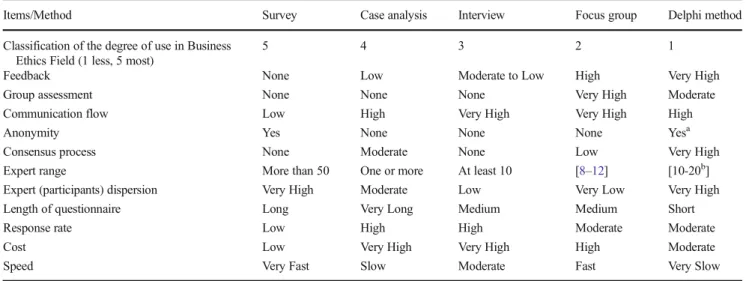
The next table (see Table2) compares the methods’most important characteristics (the first five elements), as well as other variables about the experts, length of the questionnaire, response rate, and cost and speed. It is based on the Delphi method used for business purposes because of the link with business ethics; moreover, the scale and range are based on generalising and making it easier to understand, so it is not universal.
The Delphi method is the one that provides more feedback and the highest consensus [51,65], with moderate assessment of the group and a high communication flow, but with ano-nymity among participants [5, 47,52]. There is no overall consensus on the optimal number of participants in each one
of the methods, but case study may involve only one, with focus group, interview and Delphi starting with ten [22,51], and survey needs a higher number of participants [43]. The Delphi method is suitable when the experts’contributions are highly dispersed (e.g., [22,58,65]. Moreover, despite its mod-erate response rate and slow development speed, the Delphi method has a modest cost [51]. Therefore, the Delphi method will be valid for those research questions that give greater importance to feedback, consensus and the opinion of disperse participants, but without a long pool of questions, and with little time to compile the data, and a modest cash budget [61]. The field of business ethics needs economical methods with short timeframes that provide rigorous and valid research results that can be generalised. Compared to other methods, Delphi is highly specific for those processes requiring feedback; this is not the case for a survey questionnaire. The Delphi method is excellent for those business ethics problems in which the experts are disperse, but the aim is not a first re-sponse to questions (a survey does that), as the valuable part is the reflection and group thinking among experts. The advantage of Delphi over a case study is that it initially involves resolving problems, with cases coming second. The iteration of Delphi is a useful advantage compared, for example, to the interview method, in which there is no iteration between different inter-viewees, or a joint reflection. The iteration is highly valued in business ethics research because the discus-sion and compilation of thoughts and new views enrich the conclusion [3]. Interview permits feedback, but it is based on a one-to-one application, reducing the global contact and global discussion needed to resolve research questions in business ethics.
Compared with focus group, which is not widely use at all [14], it highlights that Bstrong personalities can come to dominate and those of a more reticent disposi-tion may be reluctant to speak up^ [14: 56]. Focus groups have an objective, the focus content; they are held in a relaxed atmosphere in which experts interact face-to-face and the researcher manages the conversation to ensure it is focused. In business ethics, full partici-pation is positively valued, and Delphi guarantees this in a similar way for all the experts. Moreover, the dif-ferent views are relevant, and so the dispersion and higher number of participants in the Delphi method compared to focus groups permit the inclusion of more points of view. Business ethics experts are few, but widely dispersed throughout the world, so it is more difficult to gather them together in a focus group, and when this is achieved it is very expensive (money and time costs). The first advantage of using Delphi for business ethics research stems from its principal charac-teristic that other methods do not develop, namely, it 4The use of focus group in the field of business ethics has been analysed
can be used for seeking consensus. This will be devel-oped further here in a next section on the two potential uses of Delphi in the field of business ethics; first, support for ethical decision-making models because of the consistency of their reasoning process, and second, resolving ethical conflicts, or at least reducing their limits of agreement. Neither advantage is achieved by the other methods.
Methodology
An online survey5has been used to gather information about the business ethics scholars previously involved in a Delphi process, with the aim being to establish not only the validity of the Delphi method for the purpose of business ethics, but also the process and the part experts play in it. This is based on the notion propounded by Linstone & Turoff regarding new tech-nologies, wherebyBthe ability to communicate, coordinate, collaborate and fully participate with others is the new online order^[42: 1718] that reinforces our choice to use an online survey.
The purpose of the online survey is to add experts’values to our theoretical arguments. To do so, it has been necessary to establish two conditions: the sample should include only busi-ness ethics scholars and those that have previously taken part in a Delphi. This is because only those scholars with both characteristics could integrate and understand both aspects: the needs of business ethics research and the Delphi process
and its advantages; firstly, because they have a theoretical understanding of the field, and secondly, because they have taken part in a Delphi process, experiencing and understand-ing it in practice.
Before sending the survey, and with the aim of validating our short questionnaire, we conducted a pre-test in December 2014 in which five scholars collaborated: two renowned Delphi experts (Goldschmidt and Turoff)6and two Spanish academics and a British one that have participated in a Delphi in the specifically delimited area of accounting stan-dards [1].7We have asked them to review the online survey (they are encouraged to improve the quality of the questions), and following their suggestions we have changed a word in the first question, and added a control variable featuring the research area. According to some of the expertsBDelphi ben-efits depend on what the research question is, for some things, Delphi is ideal^, which opens the door to its use for business ethics purposes.
The questionnaire has been constructed as follows: firstly, using the post-Delphi questions developed by Scheibe, Skutsch, & Schofer [57] for the characteristics section; sec-ondly, based on the checklist drawn up by Hasson et al. [34], questions have been formulated on Delphi’s applicability to business ethics, and thirdly, using the variables proposed by Woudenberg [70], the questionnaire has been completed with
5
Using the platformwww.encuestafacil.com
6Their relevance has been explained in a previous section.
7When the pre-test was made, it was the latest paper published using a Delphi
in the business area. We randomly chose five of the Delphi expert participants, and three of them helped us review the questionnaire in that stage, which guarantees its validity because they have understood the questions and con-sidered the items used to be coherent.
Table 2 Comparing the characteristics and issues of the Delphi method with other methods: a qualitative view
Items/Method Survey Case analysis Interview Focus group Delphi method
Classification of the degree of use in Business Ethics Field (1 less, 5 most)
5 4 3 2 1
Feedback None Low Moderate to Low High Very High
Group assessment None None None Very High Moderate
Communication flow Low High Very High Very High High
Anonymity Yes None None None Yesa
Consensus process None Moderate None Low Very High
Expert range More than 50 One or more At least 10 [8–12] [10-20b] Expert (participants) dispersion Very High Moderate Low Very Low Very High
Length of questionnaire Long Very Long Medium Medium Short
Response rate Low High High Moderate Moderate
Cost Low Very High Very High High Moderate
Speed Very Fast Slow Moderate Fast Very Slow
a
There is anonymity among experts during the Delphi process, but there is no anonymity with the researcher
b
a review of all the questions (phrasing and wording). The questionnaire’s results only reflect their opinion and valuation of the Delphi process in research questions in business ethics, with descriptive statistics then being used to reinforce and confirm this consensus in quantitative terms.
Ethical experts are defined as Bpeople who are knowl-edgeable about and skilled at applying moral values in their work context, regardless of their role or rank^ [21: 3]; therefore, the ethical experts at academic level are chosen not only because of their knowledge and skills applying ethical values but also because of their publication level [13]. Scholars in business ethics are spread across different countries, so a mailing survey reduces costs and increases data collection, and permits doing so rapidly; moreover, one of the biggest drawbacks of online surveys in this research is the difficulty in locating representative samples. This is overcome here because on the one hand all the scholars have mail, and on the other, apart from being academics with published papers they have previously tak-en part in a Delphi process (we will explain why in due course). This limits and reduces the sample. This overall drawback of online surveys is not therefore significant, and as we are able to gather the results from almost the whole population (87.50%) there are no statistical limitations aris-ing from the use of a small number of individuals in the sample. No consensus or feedback is required here because the aim is to record the participants’ opinions on Delphi’s use for business ethics research purposes. It has used a simple survey to do so.
A total of 21 completed questionnaires have been returned -a significant number considering the population’s accessible list using an online survey involving experts in nine different countries (USA, UK, Spain, Switzerland, Italy, the Netherlands, France, Colombia, and Australia) between January and February 2015 and March-May 2016. It was ini-tially difficult to obtain information because many of the ex-perts in the field had not taken part in Delphi processes. The list contained 24 business ethics scholars that have previously participated in a Delphi process. The response rate is 87.50%.
Results: characteristics, behaviour and comparison
of the Delphi method applied in business ethics
The business ethics experts that have recently participated in a Delphi method have answered a short online questionnaire (see Annex2) to explain their opinion about its characteristics, their behaviour as Delphi participants, and their opinion about the method compared to other methods.
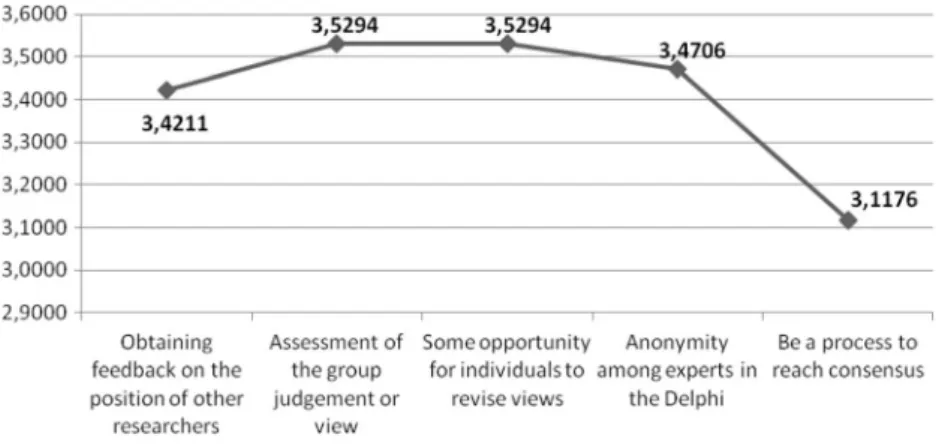
The next figure (Fig.1) shows that all the characteristics that define the Delphi method are important for experts (more than three8points on a five-point Likert scale); however, the most important characteristic is obtaining feedback on the position of other researchers, and the least important one is reaching a consensus. This could explain the lower use of the Delphi method compared to other methods (we will explain why in due course); in other words, consensus is not a major concern in this field, so there is an expected paradox called
BConsensus Paradox^.
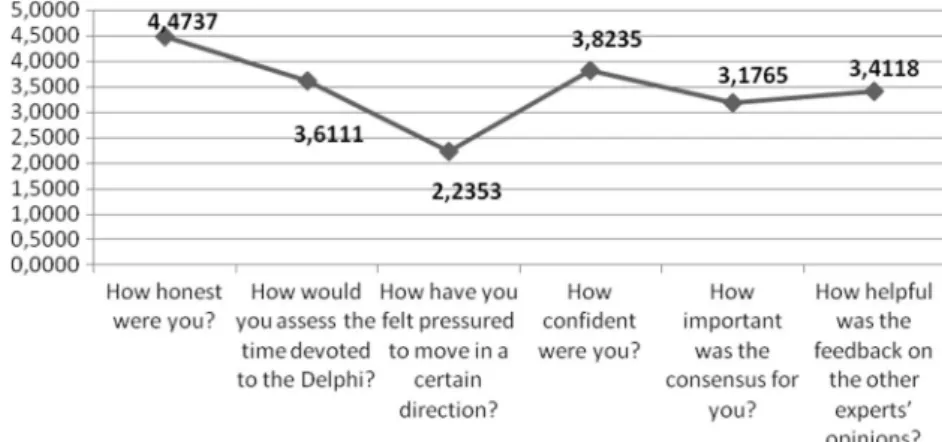
The behaviour of panellists is important in a Delphi process because of the focus on a narrow group of individuals, and because of the exhaustive feedback with each one of them. In this case, therefore, in which they are participants in a business ethics subject, the Delphi method shows (see Fig. 2) that they considered themselves to be very honest (4.47 on a five-point Likert scale), and they do not feel obliged to move in a certain direction, which means that the researcher has control over the feedback without pressure from the other participants, they have enough time to respond, they are highly confident, and the feedback was helpful to them on a higher-than-average basis.
Fig. 1 Characteristics of the Delphi method in business ethics (a Likert scale of 1–5 has been used)
8
Figure3 shows that the selection of experts is the most important step for obtaining qualified and relevant Delphi re-sults that fit the theory (e.g., [51]). As in other areas, in busi-ness ethics it seems that the selection of experts and the elim-ination of extreme positions are more important than research-er bias and the fatigue of expresearch-erts. Moreovresearch-er, the importance given to the elimination of extreme positions in business ethics could mean a relative importance for the centralisation of some of the answers to research questions in that field, although consensus was not the most important point for them (see the previous figure).
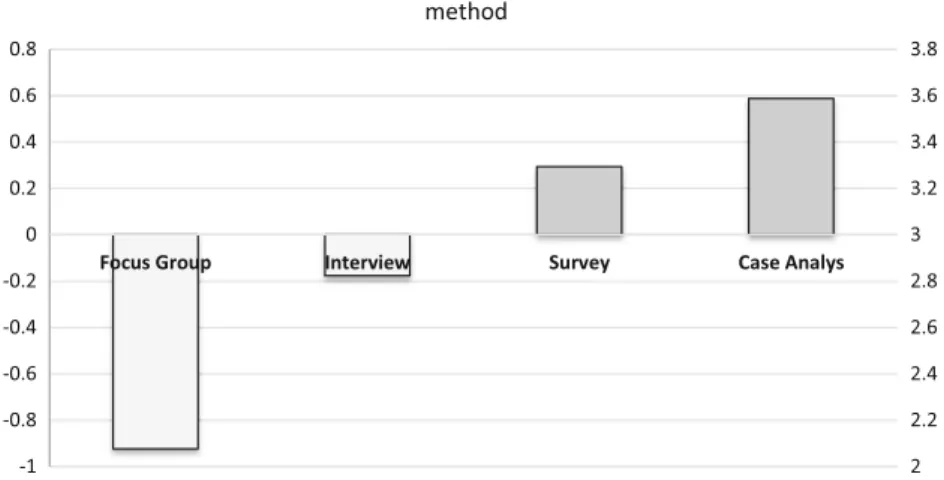
Value has been given to the use of the Delphi method by comparing it with other methods (see Fig.4): focus group, interview, survey, and case analysis. The comparison has shown that the Delphi method is no worse than any other method because there are no experts that consider this to be true (no one scored the Delphi method with one or two on the five-point Likert scale), but 50% of respondents consider it much better (scoring the Delphi method compared to other methods with four or five on the five-point Likert scale). The median is three for the first three methods and four for the comparison with case analysis. The Delphi method’s use-fulness is therefore similar to focus group, interview and sur-vey, but better (close to four) when compared to case analysis.
The Delphi method for refining the fuzziness
of applied and fundamental business ethics:
a proposal
It is clear that little has been published in the field of business ethics using the Delphi method, and as we know, it is not used much either for research into business ethics. Moreover, as we have shown in the previous section, scholars in business ethics that have played an active part in a Delphi process think that, apart from being useful in general, Delphi will contribute to business ethics research questions. This section therefore shows how and why Delphi will improve the ethical-decisions based on the utilities in other specific areas, and the argumentation is based on the fuzzy logic in which there are no single results, but instead a whole range of them. It is because business ethics decisions are not usually individual ones, but instead come in a range; however, there are many casuistic situations, statements and different positions that make difficult or impossible to make decisions in the field of business ethics, not even narrowing down the problem to be solved [14]. In this regard, the Delphi process could be understood using fuzzy logic to clarify the reasons for using this method with business ethics in mind.
Fig. 2 Behaviour of business ethics experts in a Delphi method
As described earlier, there are different types of Delphi. Historically, the Delphi method has been used for different purposes, with perhaps the best known being for obtaining predictions about future scenarios subject to uncertainty [35, 50]; as Godet explainsBthe most frequent objective of Delphi studies is to bring clarity to a particular decision which may be clouded by a certain amount of uncertainty^ [30: 75]. Nevertheless, the Delphi survey technique has also been used for decision-making in relation to the resolution of social is-sues, such as the use of land, population growth, urban devel-opment, pollution, agriculture, or organ transplants [39]. This second perspective originally received the name of Goals Delphi [56], and is used for ethical purposes.
The main difference between the traditional and Goals Delphi is that the former has a prospective basis because it seeks to anticipate the future, while the latter has a construc-tive nature, as it is used to reach consensus on possible future actions, some of which have a clear ethical component in the decision. More recently, certain authors (e.g., [44,45]) have proposed the use of an Ethical Delphi, as a specific application of this methodology, with the aim being to resolve ethical questions, or at least establish the dimensions of ethical prob-lems.BAn ethical Delphi is an iterative participatory process between experts for exchanging views and arguments on eth-ical issues. The method is structured around the notion of a virtual committee where the exchange of ideas is conducted remotely through a series of opinion exchanges (in the form of
‘Rounds’)^[44: 5]. This type of Delphi is particularly useful
when the issues are controversial, or may have a present or future impact on a large number of stakeholders with different interests, or affect or be affected by sensitive public policy. To date, this type of Delphi has been exclusively applied in rela-tion to biotechnology, an area in which the authors inserted this proposal.
The Delphi method could have two different uses: on the one hand, in the field of applied ethics, where it could be a good technique to support ethical decision-making models,
not because of the number of opinions gathered, but because of the consistency of their reasoning and arguments. However, other Delphi methods may be applied to resolve fundamental ethical conflicts, where the goal would not be to reach an immediate agreement, which a priori is impossible, but to establish the limits of disagreement, so as to facilitate the reasoning on the ethical problem involved. We could consider both as specific types within the so-called Goals Delphi, the Ethical Goal Delphi component that includes a significant fuzzy logic.
In this vein, from Kant through to the present day there have been various attempts to formalise ethics [29,33]. It seems that this could fit a better reasoning in terms of ‘com-mon sense’that is more vague regarding both its premises and the rules of argumentation. Not only logical aspects, but cog-nitive, psychological or linguistic ones play an important role in the ethical argument; fundamentally ethical propositions are expressed through a formalised language, not being assimilat-ed in the same way by different people. Since most of the predicates used in human language are vague, ethics could hardly be otherwise. As Wittgenstein affirms Bthe meaning of a word is its use in language^ [69: 43]. In this sense, resorting to fuzzy sets can provide conceptual support to fa-cilitate the discussion. Fuzzy logic can be used both to repre-sent uncertainty and imprecision [23]. In the case of ethics, the imprecision is related to the meaning of ethical propositions, and should reflect the degree of match between the denotative and connotative meanings of the same value, while uncertain-ty refers to the degree of belief we have in the truth of a certain proposition.
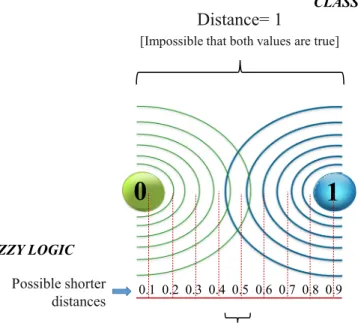
To focus the possible role of the Delphi method regarding the clarification of ethical issues in the field of fuzzy logic, we should consider that there is no opposition, but rather comple-mentarity with classical logic, whereby a classical set (see Fig.5) is simply a case of a fuzzy set in which the degree of membership is necessarily 0 or 1. For their part, the non-classical sets include all intermediate values between these
2 2.2 2.4 2.6 2.8 3 3.2 3.4 3.6 3.8
-1 -0.8 -0.6 -0.4 -0.2 0 0.2 0.4 0.6 0.8
Focus Group Interview Survey Case Analys
The scale (Likert 1-5) is referred to the Delphi score compared to each
method
two extremes [6]. This means that the distance between two antinomian positions in classical logic will always be 1, while fuzzy logic can adopt many intermediate positions, and the disparity between conflicting views can actually be less than one; for example 0.1 or 0.01 (see Fig.5). It could possibly facilitate agreements, or at least reduce the differences because of the more options or degrees of agreement.
Fuzzy logic finds its centrality in the membership function [μP (x)] (Dubois et al., 2000).
x∈
rP∼⇔μp xð Þ ¼r
Returning to applied business ethics, the emphasis would be on the x value (concrete behaviour) that best fits P (the value system), but in the case of fundamental ethics we would be trying to define P. As already noted, the Delphi method can be used in the same way in both applied and fundamental ethics, but they are two different types of resolutions. In
applied ethics, being part is key: a solution may or may not be part of a certain system of values (function x belongs to P). For example, to determine a fair price, we would argue and determine whether or not a particular x, the price, is fair, which would correspond to its membership in P, or not. In funda-mental ethics, the discussion focuses on the nature of P. For example, staying with the previous example, it involves an attempt to determine the fair price; it could be the price set by the market, or the price that covers production costs with a certain margin; it might be determined as a result of an inter-agreement between the parties, or any other conceptualisation that might be made of it. However, it is nonetheless an inter-active process whereby, on the one hand, the definition of P (deductive perspective) contributes to clarifying the possible inclusion or exclusion of x, and on the other, the decision on x helps to define P (inductive perspective).
The following figure (see Fig.6) shows the combination of the Delphi method and fuzzy logic, which may allow
Distance= 1
[Impossible that both values are true]
0
1
0.1 0.2 0.3 0.4 0.5 0.6 0.7 0.8 0.9
Possible shorter distances
[Possibility attribute overlying the value]
CLASSICAL LOGIC
FUZZY LOGIC
Fig. 5 Classical vs. fuzzy logic
overcoming certain characteristics about the antimony of eth-ical discussion. In an etheth-ical decision-making process, the Delphi method could be used to establish and clarify the di-mensions of the problem.
In the case of applied ethics, a consensus could be achieved among experts (this area has been called 1: consensus area), but in the worst case, a best option would be achieved (re-ferred to as 2: fuzzy application space). Thus, the Delphi method may include and consider the process of reasoning compared to the determination of the solution using, for ex-ample, a decision method such as voting. Thus, following the example of the fair price, a consensus could be reached in which the price is set precisely between 15 and 25% higher than the market price. However, not all experts have to agree, so some experts might think that a 5% increase would suffice, with the lower area in this case ranging between 5 and 15%. Nevertheless, there could be other experts who defend that the fair price is 50% or more regarding the market price; there would then be an upper area between 25 and 50%. These two areas (5–15% and 25–50%) will be those that are desig-nated as area 2, out of total consensus but within acceptable fuzziness. There is also an outlier zone, area 3, which signals other options outside the ranges: outliers with the reasoning completely outside the consensus; for example−1% or 100% regarding market price. Finally, there is a zone, area 4, in which no logical scores are considered.
Following the explanation of the Delphi-fuzzy figure (continuing with Fig. 6), but in the case of fundamental ethics where consensus is normally unattainable, the Delphi method allows delimiting the fuzzy application space as the argument area, and also allows identifying the dis-tance between the participants and the consensus area (called area 1). In this case, the aim is to define the value system (P). For example, continuing with the fair trade case, it will involve whether the overpays will be fair. One might ask, for instance, why the fair price is not the market price. Why is it unethical? What are the criteria for the new price? What criteria are applied? Costs? Benefits? Needs? In this case, it would be optimal to reach consensus (area referred to as 1), but it is complex because it works with different value sys-tems. However, the Delphi method is optimal because the reasoned reflection process improves the options for reaching some sort of consensus on the value system. It is more than likely that no consensus will be reached with the Delphi method, although it may identify areas of disagree-ment and the distances between experts; furthermore, it al-lows excluding the areas that fall outside the discussion because of a lack of consistency in the participants’ argu-ments. Thus, it allows us to limit the discussion of the prob-lem area (fuzzy application space). The aim is to solve a conceptual problem, so it will be complex. It is admittedly a limitation of the Delphi approach, but it will be useful and feasible at least for delimiting the discussion area.
In sum, the Delphi process helps to establish the possibly fuzzy space and determine the distance and arguments with the consensus area. The Delphi method is useful to define different positions through inter-reasoning toward a consensu-al middle ground.
Concluding remarks
Delphi is a method that has largely been designed to reach consensus in situations of uncertainty. These con-sensuses have traditionally referred mainly to the future scenarios in which Delphi is used, on the one hand, to complete the information base held by the different ex-perts involved, which is not always symmetrical, and on the other, to compare the different individual mental maps that experts have created in order to integrate the available data into a future scenario. In the case of ethical problems, we are dealing with certain aspects that are similar and others that are different; the former include the degree of uncertainty regarding a possible reference scenario, while the latter involve a scenario of a regulatory nature, instead of being positive. This is not an insignificant difference, as while the traditional Delphi seeks to predict the trend in certain variables, the Delphi applied to issues of business ethics seeks to reach a consensus on what should be done when faced with ethical problems. This difference may well explain why Delphi has been used so little in the field of ethics.
According to the experts, focus group and interview re-ceive a higher appraisal, yet Delphi, in turn, outperforms case analysis and the questionnaire, whereby it may be concluded that, whenever possible, it is better to convene experts or work with them directly, but when this is difficult or even impossi-ble due to the cost in terms of time and travel it seems that Delphi could be a suitable technique for discussing ethical matters.
consensuses, and it does indeed appear that these are required for their universal application in a firm, they are nonetheless unwilling to advance in consensuses that anticipate ideological risks (consequences that are in-compatible with their ideological principles). This leads to a lack of trust in Delphi, precisely where its strength lies, namely, the possibility of advancing toward consensuses.
Nevertheless, in those approaches of a positive na-ture, experts may not agree on future scenarios, and these may simply be reduced, normally to no more than three, with a different probability of occurrence. With regard to the Delphi applied to business ethics, the per-spective shifts from the scenario’s centroid function to its boundaries, generating a fuzzy proposal, which may sometimes be capable of integrating different ethical perspectives. In those cases in which this does not oc-cur, Delphi provides a scenario of dialogue, which al-lows focusing on the best path toward convergence (fuzzy possibility space), dismissing possible arguments located within the ambit of divergence (marginal space that is external to the set). From this fuzzy perspective, the Delphi in ethics is not only presented as a more suitable technique when meeting costs are overly high, but also that it may overcome the reticence of the
BConsensus Paradox^ through the use of a fuzzy per-spective focusing on the scenarios’ boundaries. This possibility opens a new dimension in Delphi’s use as a way of addressing ethical problems of both a theoret-ical and a practtheoret-ical nature.
The small number of participants in the survey may be a limitation; however, the scarce use of Delphi in the field of business ethics means there are few business ethics scholars, so the conclusions from this survey could be extrapolated to the entire population at this stage. The second limitation involves the low incentives among experts to participate in Delphi processes with high integration and implications not only for the re-sults, but also for the process itself, which is highly relevant in business ethics research. In future research, once Delphi has become widespread, the analysis will need to be replicated. It would also be useful to conduct a rigorous analysis using Delphi as a complementary method in business ethics research.
Acknowledgements This work is part of the research group ECRI Ethics in Finance and Social Value (GIU 15/10) at UPV/EHU, and it is supported by FESIDE (BOPV 20.01.2014).
We would like to thank Professor Goldschmidt and Professor Turoff and the business ethics academic experts as panellist of Ethics in Finance Delphi method presented at the 18th International Symposium on Ethics, Business and Society (held at the IESE, Barcelona, Spain, 30th June 30– 1st July 2014) and EBEN (European Business Ethics network) and
ISBEE (International Society for Business, Economics and Ethics) mem-bers for their helpful comments on earlier versions of this paper.
Annex 1. Business Ethics Journals
Annex 2. Questionnaire
Have you ever participated in a Delphi as an expert? Yes/No
When was the last time (year is enough) that you partici-pated in a Delphi?
What is your research area?
Where are you from?
Please rate the following questions in regards to the last
Delphi process in which you have taken part, scale of 1–5
[1. Poor, 1. Fair, 3. Average, 4. Good, 5. Excellent]: How honest were you?
How would you assess the time devoted to the Delphi? How have you felt pressured to move in a certain direction? How confident were you?
How important was the consensus for you?
How helpful was the feedback on the other experts’opinions?
Please rate the importance of the following Delphi Characteristics in regards to the of Business Ethics
Research, scale of 1 – 5 [1. Poor, 1. Fair, 3. Average, 4.
Good, 5. Excellent]:
Obtaining feedback on the position of other researchers Assessment of the group judgment or view
Business & Society
Business Ethics And Corporate Responsibility Business Ethics: A European Review Business Ethics And Corporate Sustainability Business Ethics And Electronic Economy
Business Ethics New Challenges For Business Schools And Corporate Leaders
Business Ethics Of Innovation Business Ethics Quarterly
Ethics And Information Technology Ethics And Policy Of Biometrics Ethics Behaviour
Ethics Committees In Central Eastern Europe Ethics For Life Scientists
Ethics Global Politics Ethics In Science Medicine Ethics International Affairs
Some opportunity for individuals to revise views Anonymity among experts in the Delphi Be a process to reach consensus
Please rate the importance of the following Delphi Risks in
regards to the of Business Ethics Research, scale of 1–5 [1.
Poor, 1. Fair, 3. Average, 4. Good, 5. Excellent]: Selection of experts
Elimination of extreme positions Distortion produced by the researcher
Fatigue due to lapse of time of application of the technique
Please rate the utility of the Delphi comparing with the following techniques in regards to the Business Ethics
Research, scale 1–5 [1. Much worse, 2.worse, 3.similar,
4.better, 5.far better]: Focus Group
Interview Survey Case Analysis
Open AccessThis article is distributed under the terms of the Creative C o m m o n s A t t r i b u t i o n 4 . 0 I n t e r n a t i o n a l L i c e n s e ( h t t p : / / creativecommons.org/licenses/by/4.0/), which permits unrestricted use, distribution, and reproduction in any medium, provided you give appro-priate credit to the original author(s) and the source, provide a link to the Creative Commons license, and indicate if changes were made.
References
1. Álvarez I, Calvo JA, Mora A (2014) Involving academics in the accounting standard setting process: an application of the Delphi methodology to the assessment of IASB proposals. J Manag Govern 18(3):765–791
2. Armstrong AE, Parsons S, Barker PJ (2000) An inquiry into moral virtues, especially compassion, in psychiatric nurses: findings from a Delphi study. J Psychiatr Ment Health 7(4):297–306
3. Bampton R, Cowton CJ (2002) The e-interview. Forum: qualitative social research Sozialforschung 3(2):1–12. http://www.qualitative-research.net/index.php/fqs/article/viewArticle/848/1842. Accessed 29 Sept 2016
4. Beretta R (1996) A critical view of the Delphi technique. Nurse Res 3(4):79–89
5. Bhattacharya M, Petrick I, Mullen T, Kvasny L (2011) A Delphi study of RFID applicable business processes and value chain activ-ities in retail. J Technol Manag Innov 6(3):63–81
6. Bilgiç T, Türkşen IB (2000) Measurement of membership func-tions: Theoretical and empirical work. In: Dubois D, Prade, H (eds) Fundamentals of fuzzy sets. Springer, pp 195–227
7. Brown BB (1968) Delphi process: a methodology used for the elicitation of opinions of experts. Rand Corporation, Santa Monica 8. Buckley C (1995) Delphi: a methodology for preferences more than
predictions. Libr Manag 16(7):16–19
9. Caron J, Durand S, Asselin H (2016) Principles and criteria of sustainable development for the mineral exploration industry. J Clean Prod 119:215–222
10. Chen FM, Liu YQ (2016) Research on the risk factors of mobile business: based on the sorting Delphi Method. Int J Eng Res Afr 21: 215–230
11. Chen MK, Wang SC (2010) The use of a hybrid fuzzy-Delphi-AHP approach to develop global business intelligence for information service firms. Expert Syst Appl 37(11):7394–7407
12. Coates JF (1994) Ethics, the new plague on American civilization. Technol Forecast Soc 47(3):345–350
13. Cohen JR, Pant LW, Sharp DJ (1996) A methodological note on cross-cultural accounting ethics research. Int J Account 31(1):55– 66
14. Cowton CJ, Downs Y (2015) Use of focus groups in business ethics research: potential, problems and paths to progress. Bus Ethics Eur Rev 24(1):54–66
15. Craft JL (2013) A review of the empirical ethical decision-making literature: 2004–2011. J Bus Ethics 117(2):221–259
16. Critcher C, Gladstone B (1998) Utilising the Delphi technique in policy discussion: a case study of a privatised utility in Britain. Public Adm 76(3):431–449
17. Cyphert FR, Gant WL (1971) The Delphi technique: a case study. Phi Delta Kappan 52:272–273
18. Czinkota MR, Ronkainen IA (2005) A forecast of globalization, international business and trade: report from a Delphi study. J World Bus 40(2):111–123
19. Dalkey N, Helmer O (1951) The use of experts for the estimation of bombing requirements: a project Delphi experiment. Rand Corporation, Santa Monica
20. Dalkey N, Helmer O (1963) An experimental application of the Delphi method to the use of experts. Manag Sci 9(3):458–467 21. Dane E, Sonenshein S (2015) On the role of experience in ethical
decision making at work. An ethical expertise perspective. Organ Psychol Rev 5(1):74–96
22. Delbecq AL, van de Ven AH, Gustafson DH (1975) Group tech-niques for program planning: a guide to nominal group technique and Delphi processes. Scott-Foresman, Glenview
23. Dubois D, Ostasiewicz W, Prade H (2000) Fuzzy sets: history and basic notions. In: Dubois D, Prade H (eds) Fundamentals of fuzzy sets: the handbooks of fuzzy sets. Kluwer, Dordrecht, pp 21–24 24. DuBois JM, Dueker JM (2009) Teaching and assessing the
respon-sible conduct of research: a Delphi consensus panel report. J Res Adm 40:49–70
25. DuBois JM, Kraus EM, Gursahani K, Mikulec A, Bakanas E (2014) Curricular priorities for business ethics in medical practice and research: recommendations from Delphi consensus panels. BMC Med Educ 14(1):235–248
26. Fisher C, Downes B (2008) Performance measurement and metric manipulation in the public sector. Bus Ethics Eur Rev 17(3):245– 258
27. Geisser ME, Alschuler KN, Hutchinson R (2011) A Delphi study to establish important aspects of ethics review. J Empir Res Hum Res 6(1):21–24
28. Geist MR (2010) Using the Delphi method to engage stakeholders: a comparison of two studies. Eval Program Plann 33(2):147–154 29. Gensler HJ (1996) Formal ethics. Routledge, New York
30. Godet M (2008) Strategic foresight la prospective. Cahiers du LIPSOR, Paris
31. Goldschmidt PG (1975) Scientific inquiry or political critique? Remarks on Delphi assessment, expert opinion, forecasting, and group process by H. Sackman. Technol Forecasting Soc 7(2): 195–213
32. Gordon T (2004) The Delphi method. In: Glenn JC, Gordon TJ (eds) Futures research methodology. American Council for The United Nations University Millennium Project, Washington, D.C 33. Hare RM (1981) Moral thinking: its levels, method, and point.
34. Hasson F, Keeney S, McKenna H (2000) Research guidelines for the Delphi survey technique. J Adv Nurs 32(4):1008–1015 35. Helmer O (1967) Analysis of the future: the Delphi method. Rand
Corporation, Santa Monica
36. Hsu CC, Sandford BA (2007) The Delphi technique: making sense of consensus. Pract Assess Res Eval 12(10):1–8
37. Huang SJ, Wu MS, Chen LW (2013) Critical success factors in aligning IT and business objectives: a Delphi study. Total Qual Manag Bus 24(9–10):1219–1240
38. Jones TM (1991) Ethical decision making by individuals in orga-nizations: an issue-contingent model. Acad Manag Rev 16(2):366– 395
39. Kaufman J, Gustafson DH (1973) Multi- county land use policy formation: a delphi analysis technical report of the department of industrial engineering. University of Wisconsin, Madison 40. Landeta J (1999) El método Delphi. Una técnica de previsión del
futuro. Ariel, Madrid
41. Landeta J (2006) Current validity of the Delphi method in social sciences. Technol Forecast Soc Chang 73(5):467–482
42. Linstone HA, Turoff M (2011) Delphi: a brief look backward and forward. Technol Forecast Soc Chang 78(9):1712–1719
43. Linstone H, Turoff M (1975) The Delphi method. Addison-Wesley, Reading
44. Millar K, Thorstensen E, Tomkins S, Mepham B, Kaiser M (2007) Developing the ethical Delphi. J Agric Environ Ethics 20(1):53–63 45. Millar K, Tomkins S, Thorstensen E, Mepham B, Kaiser M (2006) Ethical Delphi manual. LEI, The Hague, Wageningen UR. http://edepot.wur.nl/216590. Accessed 20 Nov 2016
46. Mitroff II (1994) A reply to Coates. Technol Forecast Soc Chang 47(3):351
47. Moorhouse J (2002) Desired characteristics of ethical leaders in business, educational, political and religious organizations from East Tennessee: A Delphi Investigation. Electronic Theses and Dissertations. Paper n° 709.http://dc.etsu.edu/etd/709. Accessed 20 Nov 2016
48. Müller RM, Linders S, Pires LF (2010) Business intelligence and service-oriented architecture: a Delphi study. Inf Syst Manag 27(2): 168–187
49. Nielsen C, Thangadurai M (2007) Janus and the Delphi oracle: entering the new world of international business research. J Int Manag 13(2):147–163
50. North HQ, Pyke DL (1969) Probes of technological future. Harv Bus Rev 47(3):68–79
51. Okoli C, Pawlowski SD (2004) The Delphi method as a research tool: an example, design considerations and applications. Inf Manag 42(1):15–29
52. Pätäri S (2010) Industry-and company-level factors influencing the development of the forest energy business—insights from a Delphi Study. Technol Forecast Soc Chang 77(1):94–109
53. Pätäri S, Sinkkonen K (2014) Energy service companies and energy performance contracting: is there a need to renew the business model? Insights from a Delphi study. J Clean Prod 66:264–271 54. Rest JR (1986) Moral development: advances in research and
the-ory. Praeger, New York
55. Rowe G, Wright G (1999) The Delphi technique as a forecasting tool: issues and analysis. Int J Forecast 15(4):353–375
56. Scheibe M, Skutsch M, Schofer J (1975) Experiments in Delphi methodology. In: Linstone H, Turoff M (eds) The Delphi method: techniques and applications. Addison-Wesley, London, pp 262–287 57. Scheibe M, Skutsch M, Schofer J (2002). IV. C. Experiments in Delphi methodology. In: In: Linstone H, Turoff M (eds) The Delphi method: techniques and applications, pp 257–281
58. Schmiedel T, Vom Brocke J, Recker J (2013) Which cultural values matter to business process management? Results from a global Delphi study. Bus Process Manag J 19(2):292–317
59. Shaw SM (2008) Leadership development and the characteristics/ traits of ethical and effective leaders: the Delphi technique. ProQuest, New York
60. Skutsch M, Schofer JL (1973) Goals-Delphis for urban planning: concepts in their design. Socio Econ Plan Sci 7(3):305–313 61. Stewart DW, Shamdasani PN (2014) Focus groups: theory and
practice (Vol. 20). Sage publications, Beverly Hills
62. Tersine RJ, Riggs WE (1976) The Delphi technique: a long-range planning tool. Bus Horiz 19(2):51–56
63. Thorstensen E, Kaiser M (2006) The ethical Delphi. A new tool for ethical assessments. In: Kaiser M, Lien M E (eds) Ethics and the politics of food: preprints of the 6th Congress of the European Society for Agricultural and Food Ethics, EurSAFE 2006, Oslo, Norway, June 22–24, 2006 (Vol. 6). Wageningen Academic Pub. Wageningen, Netherlands
64. Turoff M (1970) The design of a policy Delphi. Technol Forecast Soc Chang 2(2):149–171
65. Van Dijk JA (1990) Delphi questionnaires versus individual and group interviews: a comparison case. Technol Forecast Soc Chang 37(3):293–304
66. Wainwright P, Gallagher A, Tompsett H, Atkins C (2010) The use of vignettes within a Delphi exercise: a useful approach in empirical ethics? J Med Ethics 36(11):656–660
67. Weaver MO, Connolly SM (1988) From the beginning: using Delphi for curriculum development: integrating evaluation, design, and implementation. Train Dev 42(2):18–23
68. Winkler J, Moser R (2016) Biases in future-oriented Delphi studies: a cognitive perspective. Technol Forecast Soc Chang 105:63–76 69. Wittgenstein L (1958) Philosophical investigations. Blackwell,
Oxford