ORIGINAL ARTICLE
Benefits of combination of insulin degludec and liraglutide are
independent of baseline glycated haemoglobin level and duration
of type 2 diabetes
H. W. Rodbard
1, J. B. Buse
2, V. Woo
3, T. Vilsbøll
4, I. H. Langbakke
5, K. Kvist
5& S. C. L. Gough
6 1Endocrine and Metabolic Consultants, Rockville, MD, USA2Diabetes Care Center, School of Medicine, University of North Carolina, Chapel Hill, NC, USA 3Department of Endocrinology, University of Manitoba, Winnipeg, MB, Canada
4Diabetes Research Division, Gentofte Hospital, University of Copenhagen, Hellerup, Copenhagen, Denmark 5Novo Nordisk A/S, Søborg, Denmark
6Oxford Centre for Diabetes Endocrinology and Metabolism, Academic Health Science Network, NIHR Oxford Biomedical Research Centre, Oxford, UK
Aim:To evaluate, usingpost hocanalyses, whether the novel combination of a basal insulin, insulin degludec, and a glucagon-like peptide-1 receptor agonist, liraglutide (IDegLira), was consistently effective in patients with type 2 diabetes (T2D), regardless of the stage of T2D progression.
Methods:Using data from the DUAL I extension [insulin-naïve patients uncontrolled on oral antidiabetic drugs (OADs), n=1660, 52 weeks] and DUAL II (patients uncontrolled on basal insulin plus OADs, n=398, 26 weeks) randomized trials, the efficacy of IDegLira was investigated with regard to measures of disease progression stage including baseline glycated haemoglobin (HbA1c), disease duration and previous insulin dose.
Results:Across four categories of baseline HbA1c (≤7.5–9.0%), HbA1c reductions were significantly greater with IDegLira (1.1–2.5%) compared with IDeg or liraglutide alone in DUAL I. In DUAL II, HbA1c reductions were significantly greater with IDegLira (0.9–2.5%) than with IDeg in all but the lowest HbA1c category. In DUAL I, insulin dose and hypoglycaemia rate were lower across all baseline HbA1c categories for IDegLira versus IDeg, while hypoglycaemia was higher with IDegLira than liraglutide, irrespective of baseline HbA1c. In DUAL II, insulin dose and hypoglycaemia rate were similar with IDegLira and IDeg (maximum dose limited to 50 U) independent of baseline HbA1c. The reduction in HbA1c with IDegLira was independent of disease duration and previous insulin dose but varied depending on pre-trial OAD treatment.
Conclusions:IDegLira effectively lowered HbA1c across a range of measures, implying suitability for patients with either early or advanced T2D.
Keywords: basal insulin, GLP-1 analogue, glycaemic control, type 2 diabetes
Date submitted 14 August 2015; date of first decision 2 September 2015; date of final acceptance 3 September 2015
Introduction
Despite the advances in treatment for type 2 diabetes (T2D), many patients remain in poor glycaemic control for many years [1–3]. This may be attributable to the complex pathophysiology of T2D or a combination of factors, including clinical inertia, an actual or perceived fear of weight gain and hypoglycaemia, or a lack of adherence to treatment [2,4–6].
IDegLira (Xultophy
®
) is the first fixed-ratio combination of a basal insulin, insulin degludec (IDeg), and a glucagon-like peptide-1 receptor analogue, liraglutide. IDegLira is adminis-tered as a once-daily injection independently of meals or time of day in people with T2D and is titrated in dose steps, with each dose step containing 1 U of IDeg and 0.036 mg of liraglu-tide. For patients starting IDegLira as add-on therapy to oral antidiabetic drugs (OADs), the recommended starting dose isCorrespondence to: Dr Helena W. Rodbard, Endocrine and Metabolic Consultants, 3200 Tower
Oaks Blvd., Suite 250, Rockville, MD 20852, USA. E-mail: [email protected]
This is an open access article under the terms of the Creative Commons Attribution-NonCommercial-NoDerivs License, which permits use and distribution in any medium, provided the original work is properly cited, the use is non-commercial and no modifications or adaptations are made.
10 dose steps (10 U IDeg and 0.36 mg liraglutide) once daily, while for patients switching to IDegLira from basal insulin, the recommended starting dose is 16 dose steps (16 U IDeg and 0.6 mg liraglutide) once daily; the maximum dose is 50 dose steps (50 U IDeg/1.8 mg liraglutide) once daily [7].
The efficacy and safety of the two components of IDegLira, IDeg and liraglutide, have been extensively investigated in clinical development programmes (reviewed in Bode [8], Keating [9] and Vora et al. [10]). The IDegLira phase IIIa programme comprised the 52-week DUAL I (26-week main trial and 26-week extension trial) and the 26-week DUAL II trials [11–13].
The objective of the presentpost hocanalyses was to deter-mine the robustness of the efficacy results with IDegLira and its component parts in the DUAL I and DUAL II trials as a func-tion of three variables, which could be considered surrogates of baseline disease severity: glycated haemoglobin (HbA1c) level at baseline, diabetes duration and diabetes treatment at screening.
Materials and Methods
extension to 52 weeks [13], comparing IDegLira with IDeg or liraglutide in insulin-naïve patients uncontrolled on OADs (metformin with or without pioglitazone). Throughout the present report, when referring to DUAL I, results from the full 52-week trial are reported. In DUAL II, IDegLira was compared with IDeg for a treatment period of 26 weeks in patients who were previously uncontrolled on 20–40 U of basal insulin plus metformin with or without sulphonylureas or glinides; these latter two classes were discontinued at randomization [11]. In DUAL II, IDeg was limited to a maximum dose of 50 U so that the contribution of the liraglutide component of IDegLira could be evaluated at equivalent insulin doses. The trial pro-tocols were approved by independent ethics committees or institutional review boards at all participating institutions and conducted in accordance with the Declaration of Helsinki and Good Clinical Practice guidelines [14,15]. Written informed consent from all patients was obtained before enrolment. The trials were registered at clinicaltrials.gov: NCT01336023 and NCT01392573.
The baseline characteristics of the patients with T2D in the two trials are summarized in Table S1.
Statistical Analysis
In the present post hoc analyses, changes in HbA1c,
end-of-trial insulin dose and confirmed hypoglycaemia rate were assessed for each study across baseline HbA1c categories:≤7.5% (≤58 mmol/mol); >7.5 to ≤8.5% (>58 to ≤69 mmol/mol);>8.5 to≤9.0% (>69 to≤75 mmol/mol); and
>9.0% (>77 mmol/mol). Change in HbA1c was also analysed across four body mass index (BMI) categories: <25 kg/m2 (DUAL I only),≥25 to<30,≥30 to<35 and≥35 kg/m2, and across concomitant medication (metformin vs metformin plus other OADs). Change in HbA1c and end-of-trial insulin dose were assessed using analysis of covariance, with treatment, region, previous antidiabetic treatment and stratification fac-tors (DUAL I only) as fixed facfac-tors and baseline HbA1c as covariate. Confirmed hypoglycaemia was defined as the occur-rence of episodes requiring assistance (severe), or episodes in which plasma glucose concentration (determined from self-monitored plasma glucose) was below 3.1 mmol/l, irre-spective of symptoms. For DUAL I, the number of confirmed hypoglycaemic episodes was analysed using a negative bino-mial regression model with a log link and the logarithm of the exposure time as offset. The model included treatment, region, sub-study, HbA1c stratification factors and previous antidiabetic treatment at screening as fixed factors. The same model was used to analyse hypoglycaemia in DUAL II, but was not applied to the different baseline HbA1c categories, as the difference for the whole trial was non-significant.
For each treatment group, change in HbA1c was tested for dependence on disease duration, using a regression model with disease duration as a covariate, to estimate whether the coefficient was significantly different from zero. The variables specified above were also included in the model. Changes in HbA1c with IDegLira and the comparators were also assessed by pre-trial therapy. In DUAL I, IDegLira was stratified into metformin versus metformin plus pioglitazone. In DUAL II, data were analysed according to metformin or metformin and
sulphonylurea/glinide pretreatment, and according to pre-trial insulin dose (≤30 or>30 U). For change in HbA1c and insulin dose, missing data were imputed using last observation carried forward.
The HbA1c values are presented in % and in mmol/mol. Val-ues in mmol/mol were calculated from the value expressed in % using the International Federation of Clinical Chemistry and Laboratory Medicine equation: HbA1c (mmol/mol)=(HbA1c [%]−2.15)×10.929 [16].
Results
Change in Glycated Haemoglobin Across Different Baseline Categories
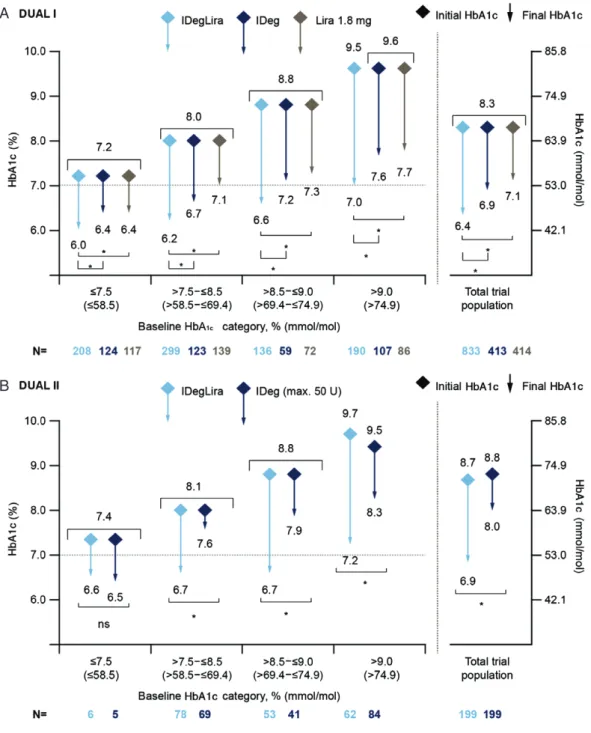
In both trials, IDegLira effectively lowered HbA1c across all baseline categories of HbA1c (Figure 1A, B). In DUAL I, HbA1c reductions with IDegLira were significantly greater versus reductions with IDeg or with liraglutide in all base-line HbA1c categories (Figure 1A), with observed mean reductions from baseline of 1.1–2.5% (12–27 mmol/mol). In DUAL II, HbA1c observed mean reductions were 0.9–2.5% (10–27 mmol/mol) across baseline HbA1c categories with IDegLira, which were significantly greater versus the reduc-tions with IDeg in all baseline HbA1c categories except for ≤7.5% (≤58 mmol/mol), in which patient numbers were low (Figure 1B). The largest reductions in HbA1c occurred in the highest baseline HbA1c category: 2.5% (27 mmol/mol) with IDegLira in both trials (Figure 1).
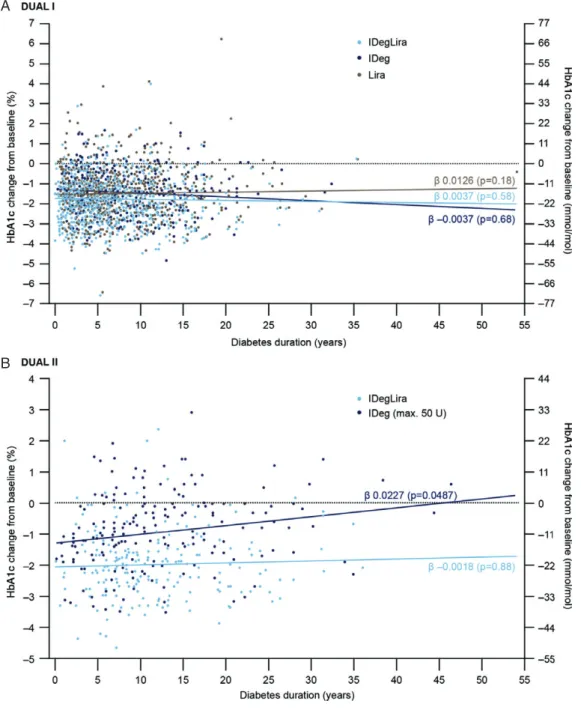
In both trials, the reductions in HbA1c occurred with IDegLira regardless of diabetes duration (Figure 2). In DUAL I, the regression coefficients [±standard error (s.e.)] showed that for one additional year with diabetes, the mean HbA1c was reduced by −0.0037% (±0.0067) for IDegLira, 0.0037% (±0.0091) for IDeg and −0.0126% (±0.0094) for liraglutide (all non-significant; Figure 2A). In DUAL II, the regression coefficients showed that for an additional 26 weeks with diabetes, the mean HbA1c was reduced by 0.0018% (±0.0117; non-significant) for IDegLira and
−0.0227% (±0.0114; p=0.0487) for IDeg (max 50 U;
Figure 2B).
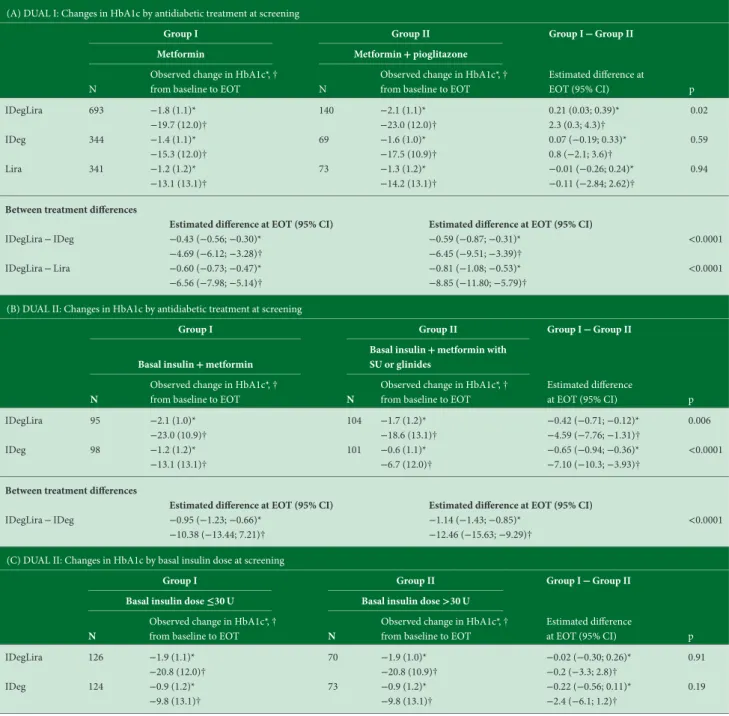
In DUAL I, the analysis of HbA1c reduction according to concomitant medication showed that, in the IDegLira arm, the reduction in HbA1c was slightly greater in patients treated with (and continuing) metformin plus pioglitazone [2.1% (23 mmol/mol)] compared with those using metformin alone [1.8% (19 mmol/mol); estimated treatment difference (ETD) 0.21% (2.3 mmol/mol); p=0.02; Table 1A]; this difference between pre-trial treatments was not seen in the IDeg or liraglu-tide arms. The HbA1c reductions were significantly greater with IDegLira compared with IDeg and liraglutide in patients in the metformin group and those in the metformin plus pioglitazone group (p<0.001 in all comparisons; Table 1A).
A
B
Figure 1. Change in glycated haemoglobin (HbA1c;y-axis) in relation to categories of baseline HbA1c (x-axis) in DUAL I (A) and DUAL II (B). Mean
HbA1c for each treatment at baseline (diamonds) and at end-of-trial (end of arrow) with extent of the reduction in HbA1c depicted by the length of the arrow. Vertical axes show HbA1c (left axis expressed in %, right axis expressed in mmol/mol). Data are mean from observed values based on full analysis set with last observation carried forward; p-values from analysis of covariance analysis. *p<0.01. IDeg, insulin degludec; IDegLira, insulin degludec/liraglutide combination; Lira, liraglutide; ns, not significant.
only [2.1% (23 mmol/mol)] compared with patients treated with metformin plus pre-trial sulphonylureas or glinides [1.7% (19 mmol/mol); ETD −0.42% (−4.6 mmol/mol); p=0.006; Table 1B]. Similarly, with IDeg, the reduction in HbA1c was greater in patients treated with metformin as the only pre-trial OAD versus metformin plus pre-trial sulphonylureas or glin-ides (Table 1B). Additionally, the HbA1c reductions were significantly greater with IDegLira versus those with IDeg in patients treated with metformin only, and those treated with
metformin plus sulphonylureas or glinides pre-trial (p<0.001 for both comparisons; Table 1B).
Notably, in DUAL II, pre-trial insulin dose (≤30 or>30 U) had no effect on end-of-trial HbA1c in either of the treat-ment arms [end-of-trial difference for IDegLira: 0.02% (0.22 mmol/mol); p=0.91; Table 1C].
A
B
Figure 2. Change in glycated haemoglobin (HbA1c;y-axis) in relation to duration of diabetes (x-axis) in DUAL I (A) and DUAL II (B). The fit line for each
treatment is least squares mean. The regression analysis estimates the linear relationship between disease duration and change in HbA1c from baseline. The regression coefficient (𝛽) is the slope of the line given by the relationship, and the reported p value corresponds to the test of whether the slope of the line is equal to 0, indicating no relationship between the two variables. IDeg, insulin degludec; IDegLira; insulin degludec/liraglutide combination; Lira, liraglutide. DUAL I regression coefficients (𝛽)±standard error of the mean (s.e.m.): IDegLira 0.0037±0.0067 (p=0.58), IDeg−0.0037±0.0091 (p=0.68), liraglutide 0.0126±0.0094 (p=0.18). DUAL II regression coefficients (𝛽)±s.e.m.: IDegLira−0.0018±0.0117 (p=0.88), IDeg 0.0227±0.0114 (p=0.0487).
IDegLira versus IDeg or liraglutide alone (all p<0.001; Figure S1A). In DUAL II, the reduction of HbA1c with IDegLira was 1.6–2.1% (17–23 mmol/mol; Figure S1B) and was greater with IDegLira compared with insulin degludec in all BMI categories.
Insulin Dose and Rate of Hypoglycaemia
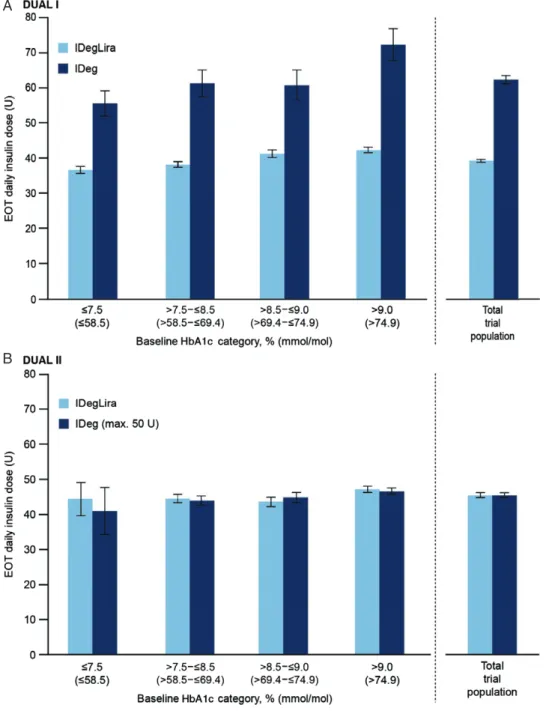
In DUAL I, the mean observed insulin dose for all patients at end-of-trial was lower with IDegLira (39 U) versus IDeg (62 U)
[13]. The ETD in mean daily insulin doses for IDegLira and IDeg was−23 U (−26;−20), p<0.0001. Similarly, across all HbA1c categories, mean insulin dose was lower with IDegLira versus IDeg (not analysed statistically; Figure 3A).
Table 1.Changes in glycated haemoglobin (HbA1c) by antidiabetic treatment (A, B) or by basal insulin dose (C) at screening.
(A) DUAL I: Changes in HbA1c by antidiabetic treatment at screening
Group I Group II Group I−Group II
Metformin Metformin+pioglitazone
N
Observed change in HbA1c*,†
from baseline to EOT N
Observed change in HbA1c*,† from baseline to EOT
Estimated difference at
EOT (95% CI) p
IDegLira 693 −1.8 (1.1)* 140 −2.1 (1.1)* 0.21 (0.03; 0.39)* 0.02
−19.7 (12.0)† −23.0 (12.0)† 2.3 (0.3; 4.3)†
IDeg 344 −1.4 (1.1)* 69 −1.6 (1.0)* 0.07 (−0.19; 0.33)* 0.59
−15.3 (12.0)† −17.5 (10.9)† 0.8 (−2.1; 3.6)†
Lira 341 −1.2 (1.2)* 73 −1.3 (1.2)* −0.01 (−0.26; 0.24)* 0.94
−13.1 (13.1)† −14.2 (13.1)† −0.11 (−2.84; 2.62)†
Between treatment differences
Estimated difference at EOT (95% CI) Estimated difference at EOT (95% CI)
IDegLira−IDeg −0.43 (−0.56;−0.30)* −0.59 (−0.87;−0.31)* <0.0001
−4.69 (−6.12;−3.28)† −6.45 (−9.51;−3.39)†
IDegLira−Lira −0.60 (−0.73;−0.47)* −0.81 (−1.08;−0.53)* <0.0001
−6.56 (−7.98;−5.14)† −8.85 (−11.80;−5.79)†
(B) DUAL II: Changes in HbA1c by antidiabetic treatment at screening
Group I Group II Group I−Group II
Basal insulin+metformin
Basal insulin+metformin with SU or glinides
N
Observed change in HbA1c*,†
from baseline to EOT N
Observed change in HbA1c*,† from baseline to EOT
Estimated difference
at EOT (95% CI) p
IDegLira 95 −2.1 (1.0)* 104 −1.7 (1.2)* −0.42 (−0.71;−0.12)* 0.006
−23.0 (10.9)† −18.6 (13.1)† −4.59 (−7.76;−1.31)†
IDeg 98 −1.2 (1.2)* 101 −0.6 (1.1)* −0.65 (−0.94;−0.36)* <0.0001
−13.1 (13.1)† −6.7 (12.0)† −7.10 (−10.3;−3.93)†
Between treatment differences
Estimated difference at EOT (95% CI) Estimated difference at EOT (95% CI)
IDegLira−IDeg −0.95 (−1.23;−0.66)* −1.14 (−1.43;−0.85)* <0.0001
−10.38 (−13.44; 7.21)† −12.46 (−15.63;−9.29)†
(C) DUAL II: Changes in HbA1c by basal insulin dose at screening
Group I Group II Group I−Group II
Basal insulin dose≤30 U Basal insulin dose>30 U
N
Observed change in HbA1c*,†
from baseline to EOT N
Observed change in HbA1c*,† from baseline to EOT
Estimated difference
at EOT (95% CI) p
IDegLira 126 −1.9 (1.1)* 70 −1.9 (1.0)* −0.02 (−0.30; 0.26)* 0.91
−20.8 (12.0)† −20.8 (10.9)† −0.2 (−3.3; 2.8)†
IDeg 124 −0.9 (1.2)* 73 −0.9 (1.2)* −0.22 (−0.56; 0.11)* 0.19
−9.8 (13.1)† −9.8 (13.1)† −2.4 (−6.1; 1.2)†
Data are observed mean (standard deviation). Estimated treatment differences are based on analysis of covariance. CI, confidence interval; EOT, end-of-trial; IDeg, insulin degludec; IDegLira, insulin degludec/liraglutide combination; Lira, liraglutide.
*HbA1c in %. †HbA1c in mmol/mol.
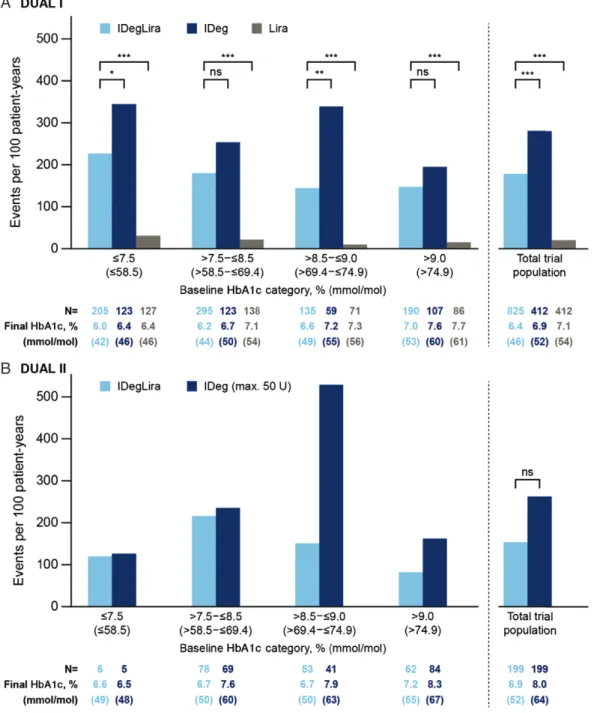
In DUAL I, the rate of hypoglycaemia was significantly lower with IDegLira versus IDeg for the total trial population (Figure 4). Rates of hypoglycaemia were numerically lower with IDegLira than with IDeg in all HbA1c categories, and signifi-cantly lower in the categories≤7.5% (≤58 mmol/mol) and>8.5 to≤9.0% (>69 to≤75 mmol/mol). The rate of hypoglycaemia was higher with IDegLira than with liraglutide for the overall trial population and for all HbA1c categories.
The pattern of hypoglycaemia by HbA1c category in DUAL II is shown in Figure 4B. The rates of hypoglycaemia were
similar except for the category HbA1c>8.5 to≤9.0% (>69 to ≤75 mmol/mol), where there were a high number of events (25 and 30 events) in 2 IDeg-treated patients. When these 2 patients were excluded, the rate of confirmed hypoglycaemia decreased from 530 events/100 patient-years of exposure to 246 events/100 patient-years of exposure.
Discussion
A
B
Figure 3. Insulin dose at end-of-trial according to baseline HbA1c category in DUAL I (A) and DUAL II (B). Data are mean dose (U) from the safety
analysis set, last observation carried forward. Error bars are standard error of the mean. EOT, end-of-trial; IDeg, insulin degludec; IDegLira, insulin degludec/liraglutide combination.
performed to determine whether the efficacy of IDegLira versus comparators would differ across various measures of disease progression in T2D. The results showed that patients with values characteristic of more advanced T2D benefit from treatment with IDegLira to the same extent as those at an ear-lier stage of the disease. IDegLira was efficacious, with respect to HbA1c-lowering, across all categories of baseline HbA1c up to 10% (86 mmol/mol; the HbA1c value specified as a maxi-mum in the inclusion criteria of both studies). There was no apparent relationship between duration of disease and efficacy in terms of HbA1c for IDegLira, IDeg or liraglutide in DUAL I.
A
B
Figure 4. Confirmed hypoglycaemia rate by baseline HbA1c category in DUAL I (A) and DUAL II (B). *p<0.05; **p=0.001; ***p<0.0001. Confirmed
hypoglycaemia: patient requiring assistance and/or recorded plasma glucose<3.1 mmol/l; rates from the safety analysis set; p-values from the full analysis set using a negative binomial regression model. IDeg, insulin degludec; IDegLira; insulin degludec/liraglutide combination; Lira, liraglutide; ns, not significant.
of previous OAD treatment. The greater HbA1c reductions in DUAL II in patients receiving metformin only pre-trial versus those receiving metformin plus sulphonylureas or glinides in the IDegLira and IDeg arms was probably attributable to the discontinuation of the sulphonylureas or glinides at random-ization. It should be noted, however, that the HbA1c reductions in this group were large, considering patients discontinued a treatment at randomization. Additionally, IDegLira was efficacious across all BMI categories investigated (<25 to ≥35 kg/m2) [13].
trials that excluded extreme phenotypes, which are difficult to manage, e.g. patients with HbA1c values>10% (86 mmol/mol), BMI >40 kg/m2 (excluded in DUAL I) or receiving insulin doses in excess of 40 U/day (excluded in DUAL II).
The consistent finding of a high level of efficacy for patients with a wide spectrum of baseline characteristics is reassuring from the perspective of clinical decision-making.
In conclusion, the robustness of the efficacy of IDegLira is independent of the variables generally regarded as indicative of the stage of disease progression (baseline levels of HbA1c, duration of diabetes and baseline diabetes medication) in two different trial populations. This indicates that IDegLira is an effective option for treatment intensification for patients inade-quately controlled using OADs or basal insulin, irrespective of their baseline HbA1c.
Acknowledgements
The authors thank Adele Norman and Daria Renshaw at Water-meadow Medical for excellent medical writing and editorial support. Novo Nordisk provided funding to Watermeadow Medical for medical writing and editorial support. Novo Nordisk conducted the statistical analyses and reviewed the manuscript for medical accuracy. The corresponding author had full access to all the data in the analyses and all authors had final responsibility for the decision to submit for publication.
Conflict of Interest
H.W.R. has served on advisory panels for Amylin, AstraZeneca, Biodel Inc., Bayer Health Care, LLC, Merck, Novo Nordisk, Roche Pharmaceuticals and Sanofi, as a consultant for Biodel Inc., Merck Sharp & Dohme, Roche Pharmaceuticals and Takeda, Merck, Sanofi, has received research support from AstraZeneca, Biodel Inc., Boehringer Ingelheim, Hamni, Janssen, Eli Lilly, Merck Sharp & Dohme, Novartis, Novo Nordisk, Roche Pharmaceuticals and Sanofi and has served as a speaker for AstraZeneca, BMS, Boehringer Ingelheim, Janssen, Eli Lilly, Merck Sharp & Dohme, Novo Nordisk, Sanofi and Takeda. J. B. B. has served as consultant for and is a shareholder with PhaseBio Pharmaceuticals Inc. and has served as a consultant or investigator for Andromeda, AstraZeneca, Boehringer Ingelheim, BMS, Elcelyx Therapeu-tics Inc., Eli Lilly, GI Dynamics, GlaxoSmithKline; Halozyme Therapeutics, F. Hoffmann-La Roche Ltd., Intarcia Therapeu-tics, Johnson & Johnson, Lexicon, LipoScience, Medtronic, Merck Sharp & Dohme, Metabolon Inc., Metavention, Novo Nordisk, Orexigen Therapeutics Inc., Osiris Therapeutics Inc., Pfizer Inc., PhaseBio Pharmaceuticals Inc., Quest Diagnos-tics, Rhythm Pharmaceuticals, Sanofi, Spherix Inc., Takeda, ToleRx and TransTech Pharma. V. W. has served on advi-sory boards and speaker bureaus for Novo Nordisk, Eli Lilly, Merck Sharp & Dohme, Boehringer Ingelheim, BMS, Sanofi, AstraZeneca, Johnson & Johnson, Roche and Abbott. T. V. has served as a consultant and participated in speaker’s bureaus for AstraZeneca, Boehringer Ingelheim, BMS, Eli Lilly, Merck Sharp & Dohme, Novo Nordisk, Novartis, Sanofi, Takeda and Zealand Pharma and has served on advisory
panels for AstraZeneca, Boehringer Ingelheim, BMS, Eli Lilly, GI Dynamics Inc., Merck Sharp & Dohme, Novo Nordisk, Sanofi and Takeda. I. H. L. and K. V. are employees of Novo Nordisk. S. C. L. G. has received honoraria for lectures and advisory boards from AstraZeneca, Lilly, Novo Nordisk, Sanofi, GSK, MSD, Boehringer Ingelheim and Pfizer, and research grants from Eli Lilly, Novo Nordisk and Sanofi.
All authors confirm that they meet the International Com-mittee of Medical Journal Editors uniform requirements for authorship and that they have contributed to: critical analysis and interpretation of the data, drafting/critically revising the article and sharing in the final responsibility for the content of the manuscript and the decision to submit it for publication. I. H. L. and K. V. were responsible for statistical analysis.
Supporting Information
Additional Supporting Information may be found in the online version of this article:
Figure S1.Glycated haemoglobin(HbA1c) reduction across baseline body mass index categories in DUAL I (A) and DUAL II (B).
Table S1. The DUAL I and DUAL II trials. (A) Methods. (B) Baseline characteristics in DUAL I [12,13]. (C) Baseline characteristics in DUAL II [11].
References
1. Dale J, Martin S, Gadsby R. Insulin initiation in primary care for patients with type 2 diabetes: 3-year follow-up study. Prim Care Diabetes 2010;4: 85–89. 2. Khunti K, Wolden ML, Thorsted BL, Andersen M, Davies MJ. Clinical inertia in
people with type 2 diabetes: a retrospective cohort study of more than 80,000 people. Diabetes Care 2013;36: 3411–3417.
3. Wu N, Aagren M, Boulanger L, Friedman M, Wilkey K. Assessing achievement and maintenance of glycemic control by patients initiating basal insulin. Curr Med Res Opin 2012;28: 1647–1656.
4. Khunti K, Damci T, Meneghini L, Pan CY, Yale JF, SOLVE Study Group. Study of Once Daily Levemir (SOLVETM): insights into the timing of insulin initiation in people with poorly controlled type 2 diabetes in routine clinical practice. Diabetes Obes Metab 2012;14: 654–661.
5. Peyrot M, Rubin RR, Lauritzen T et al. Resistance to insulin therapy among patients and providers: results of the cross-national Diabetes Attitudes, Wishes, and Needs (DAWN) study. Diabetes Care 2005;28: 2673–2679.
6. Peyrot M, Barnett AH, Meneghini LF, Schumm-Draeger PM. Insulin adherence behaviours and barriers in the multinational global attitudes of patients and physicians in insulin therapy study. Diabet Med 2012;29: 682–689. 7. Novo Nordisk. Xultophy summary of product characteristics. Last updated
2014. Available from URL: https://www.medicines.org.uk/emc/medicine/29493 Accessed 10 July 2015.
8. Bode B. An overview of the pharmacokinetics, efficacy and safety of liraglutide. Diabetes Res Clin Pract 2012;97: 27–42.
9. Keating GM. Insulin degludec and insulin degludec/insulin aspart: a review of their use in the management of diabetes mellitus. Drugs 2013;73: 575–593. 10. Vora J, Christensen T, Rana A, Bain SC. Insulin degludec versus insulin glargine
in type 1 and type 2 diabetes mellitus: a meta-analysis of endpoints in phase 3a trials. Diabetes Ther 2014;5: 435–446.
11. Buse JB, Vilsboll T, Thurman J et al. Contribution of liraglutide in the fixed-ratio combination of insulin degludec and liraglutide (IDegLira). Diabetes Care 2014;
12. Gough SC, Bode B, Woo V et al. Efficacy and safety of a fixed-ratio combi-nation of insulin degludec and liraglutide (IDegLira) compared with its com-ponents given alone: results of a phase 3, open-label, randomised, 26-week, treat-to-target trial in insulin-naive patients with type 2 diabetes. Lancet Dia-betes Endocrinol 2014;2: 885–893.
13. Gough SC, Bode BW, Woo VC et al. One-year efficacy and safety of a fixed combination of insulin degludec and liraglutide in patients with type 2 diabetes: results of a 26-week extension to a 26-week main trial. Diabetes Obes Metab 2015;17: 965–973.
14. International Conference of Harmonisation. ICH harmonised tripartite guide-line. Good clinical practice. 01 May 1996.
15. World Medical Association. Declaration of Helsinki: ethical principles for medical research involving human subjects. Last amended by the 59th WMA Assembly, Seoul, Republic of Korea, October 2008.