Fast and Private Computation of Cardinality of
Set Intersection and Union
*Emiliano De Cristofaro†, Paolo Gasti‡, Gene Tsudik‡
†PARC ‡UC Irvine
Abstract
In many everyday scenarios, sensitive information must be shared between parties without com-plete mutual trust. Private set operations are particularly useful to enable sharing information with privacy, as they allow two or more parties to jointly compute operations on their sets (e.g., intersec-tion, union, etc.), such that only the minimum required amount of information is disclosed. In the last few years, the research community has proposed a number of secure and efficient techniques for Private Set Intersection (PSI), however, somewhat less explored is the problem of computing the
magnitude, rather than the contents, of the intersection – we denote this problem as Private Set In-tersection Cardinality (PSI-CA). This paper explores a few PSI-CA variations and constructs several protocols that are more efficient than the state-of-the-art.
1
Introduction
Proliferation of, and growing reliance on, electronic information generate an increasing amount of sensitive data stored and processed in the cyberspace. Consequently, there is a compelling need for efficient cryptographic techniques that allow sharing information while protecting privacy. Among these, Private Set Intersection (PSI) [15, 29, 18, 26, 19, 27, 12, 11, 22], and Private Set Union (PSU) [29, 19, 21,16, 36] have recently attracted a lot of attention from the research community. In particular, PSI allows one party (client) to compute the intersection of its set with that of another party (server), such that: (i) server does not learn client input, and (ii) client learns no information about server input, beyond the intersection. Efficient PSI protocols have been used as building blocks for many privacy-oriented applications, e.g., collaborative botnet detection [32], denial-of-service identification [2], on-line gaming [7], intelligence-community systems [24], location sharing [33], just to cite a few.
Nonetheless, in certain information-sharing settings, PSI and PSU functionalities offer very limited privacy to server. Consider the following scenario where, after running PSI, the set intersection learned by client corresponds to entire server input: server privacy is actually non-existent, while client’s is fully preserved. This illustrates the need for server to enforce a policy, based on the cardinality of set intersection/union, that governs whether it is willing to take part in PSI or PSU protocols. (We explore this intuition in Section6.)
*This is the extended version of the paper that appears in the 11th International Conference on Cryptology and Network
This paper investigates Private Set Intersection Cardinality (PSI-CA) and Private Set Union Cardi-nality (PSU-CA). These functionalities are appealing in scenarios where client is only allowed to learn themagnitude – rather than thecontent– of set intersection/union. For instance, PSI-CA is useful in social networking, e.g., when two parties want to privately determine the number of common connec-tions (or interests) in order to decide whether or not to become friends. Moreover, PSI-CA is useful to privately compare equal-size low-entropy vectors, e.g., to realize private computation of Hamming Distance between two strings on an arbitrarily large alphabet: two parties may use PSI-CA, by treating each symbol, together with its position in the string, as a unique set element, such that client privately learns the number of elements (symbols) in common (thereby also obtaining the Hamming Distance). Other relevant applications of PSI-CA include role-based association rule mining [28], affiliation-hiding authentication [3], as well as to estimating the similarity of sample sets [6]. Finally, efficient PSI-CA protocols are becoming instrumental to privacy-preserving genomic tests, as recently showed in [4].
1.1 Contributions
This paper focuses on PSI-CA – a cryptographic primitive, involving server (on input of a private setS) and client (on input of a private setC), that results in client outputting|S ∩ C|. Computation of PSI-CA naturally implies that of PSU-CA, since|S|,|C|are always mutually disclosed and|S ∪ C| =
|S|+|C| − |S ∩ C|.
Although prior work has yielded some PSI-CA techniques (see Section2), a number of open prob-lems still remain to be addressed. This paper presents the following contributions:
1. We present a very efficient PSI-CA protocol that incurs computational and communication com-plexities linear in the set sizes. Our protocol is secure under the DDH assumption in the Random Oracle Model (ROM) against semi-honest adversaries. This protocol is a very close variant of the protocol of Agrawal, Evfimievski, and Srikant [1], and our merit is really a security analysis of this modification rather than the protocol itself.
2. We introduce the concept ofAuthorized PSI-CA (APSI-CA), whereby client input must be pre-authorized by an off-line mutually-trusted authority, and present an appropriate protocol extension with linear complexities (as opposed to quadratic in related prior techniques).
3. We show how to combine PSI-CA with PSI such that server can decide whether to allow client to obtain the set intersection according to its policy, based on the size of the intersection itself (privately obtained using PSI-CA). This first-of-a-kind approach is very efficient, as it requires onlyoneadditional message on top of PSI-CA protocol.
2
Related Work
2.1 (Authorized) Private Set Intersection and Union
Agrawal, Evfiviemski, and Srikant [1] introduce a Private Set Intersection (PSI) construction based on commutative encryption.1 The protocol has linear complexity – that is, assuming that server and client sets containwandvitems, respectively, computation and communication complexity amounts to
O(w+v). [1] also presents a variant that only discloses the size of the intersection – we review it in Section2.2below.
The work in [15] propose a few protocols for Private Set Intersection (PSI) based on Oblivious Poly-nomial Evaluations (OPE-s) and additively homomorphic encryption (e.g., Paillier [34]). The intuition is to represent a set as a polynomial and its elements – as the polynomial’s roots. Client encrypts the coef-ficients, that are then evaluated homomorphically by server. As a result, client learns the intersection and nothing else. Client’s computation complexity amounts toO(w+v), and server’s toO(wv) exponen-tiations. [15] proposes techniques to asymptotically reduce server workload toO(wlog logv), by using Horner’s rule and balanced bucket allocation. [19] obtains similar complexities while also offering PSU techniques. Whereas, [29] extends OPE-s to more than two players, all learning the intersection/union, with quadratic computational and linear communication complexities. Additional PSU constructs appear in [21,16,36].
Other PSI constructs, such as [18,26], rely on Oblivious Pseudo-Random Functions (OPRF-s) and reduce computation overhead to alinearnumber of exponentiations. Recent results in the Random Oracle Model (ROM) have led to very efficient PSI protocols, also with linear complexities, while using much more efficient cryptographic tools. They replace OPRFs with unpredictable functions [27] and blind signatures [12], with security underOne-More-DH andOne-More-RSA assumptions [5], respectively. Finally, [11] achieves linear communication and computational complexities, using short exponents, with security in the malicious model, while [22] shows a construction in the semi-honest model based on garbled circuits [39] which, leveraging so-called Oblivious Transfer Extension [25], scales relatively gracefully for very large security parameters.
Authorization of client input in PSI has been first investigated in [8] and [10]. Authorized Private Set Intersection (APSI) is later formalized in [12] and [11] that construct efficient techniques with linear complexity in the presence of, respectively, semi-honest and malicious adversaries. Finally, [37] pro-poses Policy-Enhanced PSI, allowing two parties to privately share information while enforcing complex policies. In this model, both parties’ sets must be authorized, and both parties obtain the intersection.
2.2 Private Set Intersection Cardinality
Prior work yielded several PSI-CA protocols:
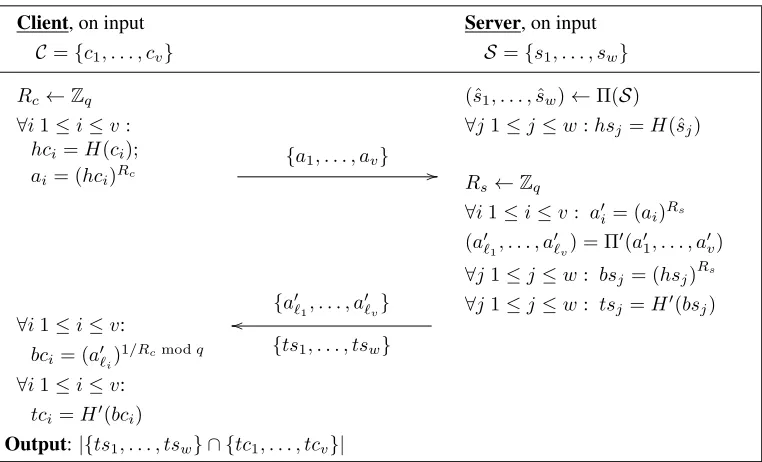
• Agrawal, Evfimievski, and Srikant [1] present an adaptation of their PSI protocol to PSI-CA, also secure under the DDH assumption in the presence of semi-honest adversaries. Their construction is actually similar to ours (presented in Figure1), although we also present two extensions.
• The PSI protocol by Freedman, Nissim, and Pinkas [15] can be extended to PSI-CA with the same complexity, i.e.,O(wlog logv)computation andO(w+v)communication.
1
• Hohenberger and Weis [20] present a PSI-CA construction, also based on [15], and with similar (sub-quadratic) complexities.
• Kissner and Song [29] proposes a PSI-CA protocol for multiple (n≥ 2) parties, incurringO(n2·v)
communication andO(v2)computational overhead.
• Vaidya and Clifton [38] construct a multi-party PSI-CA protocol, based on commutative one-way hash functions [31] and Pohlig-Hellman encryption [35]. It incursnrounds, and involvesO(n2·v)
communication andO(vn)computational overhead.
• Camenisch and Zaverucha [8] present an APSI variant (private intersection of certified sets) that computes the cardinality of (certified) set intersection and incursquadratic communication and computation complexity.
3
Preliminaries
This section defines PSI-CA/PSU-CA functionalities, along with their privacy requirements, and introduces computational assumptions.
3.1 Definitions
Definition 1 (Private Set Union Cardinality (PSU-CA)) A protocol involving server, on input a set of
witemsS ={s1, . . . , sw}, and client, on input a set ofvitemsC={c1,· · · , cv}. It results in the latter outputting|U |, where:U =S ∪ C.
Definition 2 (Private Set Intersection Cardinality (PSI-CA)) A protocol involving server, on input a set ofwitemsS ={s1, . . . , sw}, and client, on input a set ofvitemsC ={c1,· · ·, cv}. It results in the latter outputting|I|, where:I =S ∩ C.
Informally, both PSI-CA and PSU-CA entail the following privacy requirements:
• Server Privacy. Client learns no information beyond: (1) cardinality of set intersection/union and (2) upper bound on the size ofS.
• Client Privacy.No information is leaked about client setC, except an upper bound on its size.
• Unlinkability. Neither party can determine if any two instances of the protocol are related, i.e., executed on the same input by client or server, unless this can be inferred from the actual protocol output.
Remark: As mentioned earlier in the paper, for any C andS, the size of C ∪ S can be computed as |C|+|S| − |C ∩ S|. Thus, privately computing cardinality of theintersectionofC andSallows one to privately compute the cardinality of theirunionas well. Consequently, the rest of the paper only focuses on PSI-CA.
3.2 Computational Assumptions
Client, on input Server, on input
C={c1, . . . , cv} S={s1, . . . , sw}
Rc←Zq (ˆs1, . . . ,sˆw)←Π(S)
∀i1≤i≤v: ∀j1≤j≤w:hsj =H(ˆsj)
hci=H(ci);
ai= (hci)Rc
{a1, . . . , av}
/
/ R
s←Zq
∀i1≤i≤v: a0i= (ai)Rs (a0`1, . . . , a0`v) = Π0(a01, . . . , a0v)
∀j1≤j≤w: bsj= (hsj) Rs
∀j1≤j≤w: tsj=H0(bsj)
∀i1≤i≤v:
{ts1, . . . , tsw}
{a0`
1, . . . , a
0
`v}
o
o
bci= (a0`i)
1/Rcmodq
∀i1≤i≤v:
tci=H0(bci)
Output:|{ts1, . . . , tsw} ∩ {tc1, . . . , tcv}|
Figure 1:Proposed PSI-CA Protocol. All computation is modp.ΠandΠ0are random permutations.
Pr[x, y← {0,1}l:A(g, gx, gy, gxy) = 1]−Pr[x, y, z← {0,1}l:A(g, gx, gy, gz) = 1]
One-More-DH Assumption. Informally, the One-More-DH assumption [5] states that the DH problem is hard even if the adversary is given access to a “DHx(·)” oracle. Formally, let(G, q, g)←KeyGen(κ) the Key-Generation algorithm outputting a multiplicative group of orderqand assumex←Zq. We say that the One-More-DH problem is(τ, t)-hard if for every algorithmAthat runs in timetwe have:
P r[{(gi,(gi)x)}i=1,···v+1← ADHx(·)(g1,· · ·, gch)]≤τ
wherech > vandAmade at mostvqueries to theDHx(·)oracle.
Gap-One-More-DH Assumption [27]. We say that that Gap-More-DH problem is hard if One-More-DH is hard even when the adversary has access to a “DDH(·,·,·,·)” oracle. Formally,
P r[{(gi,(gi)x)}i=1,···v+1← ADHx(·),DDH(·,·,·,·)(g1,· · ·, gch)]≤τ
wherech > vandAmade at mostvqueries to theDHx(·)oracle.
To ease exposition, we replace the oracleDDH(·,·,·,·)with DLx(·,·) that, on input(a, b), returns 1 iffb = ax. Note, in fact, that the oracle DLx(·,·) can be easily constructed from DDH(·,·,·,·) and
DHx(·,·)asDLx(·,·) =DDH(a, DHx(a),·,·).
4
New PSI-CA and PSU-CA
two primesp, q(whereq|p−1), a generatorgof a subgroup of sizeq, and two hash functions (modeled as random oracles), H : {0,1}∗ → Z∗p andH0 : {0,1}∗ → {0,1}κ, given the security parameter κ. (Notationa←Adenotes thatais chosen uniformly at random fromA).
Intuition.First, client masks its set items (ci-s) with a random exponent (Rc) and sends resulting values (ai-s) to server, which “blindly” exponentiates them with its own random valueRs. Server shuffles the resulting values (a0i-s) and sends them to client. Then, server sends client the output of a one-way func-tion,H0(·), computed over the exponentiations of server’s items (sj-s) to randomnessRs. Finally, client tries to match one-way function outputs received from server with one-way function outputs computed over the shuffled (a0i-s) values, stripped of the initial randomnessRc. Client learns the set intersection cardinality (and nothing else) by counting the number of such matches. As showed below, unless they corresponding to items in the intersection, one-way function outputs received from server cannot be used by client to learn related items in server’s set (under the DDH assumption). Also, client does not learn whichitems are in the intersection as the matching occurs usingshuffleda0ivalues.
Complexity. Protocol complexity is linear in the sizes of the two sets. Let |S| = w and |C| = v. Client performs2(v+ 1)exponentiations with short, i.e.,|q|-bit, exponents modulo|p|-bit andvmodular multiplications. Server computes(v+w)modular exponentiations with short exponents andwmodular multiplications. In practice, one can select |p| = 1024 or|p| = 2048, and|q| = 160 or|q| = 224. Communication overhead amounts to2(v+ 1)|p|-bit andw κ-bit values.
Semi-Honest Participants. We start with security in the semi-honest model. Note that the term ad-versaryrefers to insiders, i.e., protocol participants. Outside adversaries are not considered, since their actions can be mitigated via standard network security techniques.
Definition 3 (Correctness) If both parties are honest, at the end of the protocol, executed on on inputs
((S, v),(C, w)), server outputs⊥, and client outputs(|S ∩ C|).
The following client and server privacy definitions follow from those in related work [15,14,18]. In particular, as formalized in [17] (Sec. 7.2.2), in case of semi-honest parties, the traditional “real-versus-ideal” definition framework is equivalent to a much simpler framework that extends the formulation of honest-verifier zero-knowledge. Informally, a protocol privately computes certain functionality if whatever can be obtained from one party’s view of a protocol execution can be obtained from input and output of that party. In other words, the view of a semi-honest party (includingC orS, all messages received during execution, and the outcome of that party’s internal coin tosses), on each possible input
(C,S), can be efficiently simulated considering only that party’s own input and output.
Definition 4 (Client Privacy) LetViewS(C,S)be a random variable representing server’s view during execution of PSI-CA with inputsC,S. There exists aPPTalgorithmS∗such that:
{S∗(S,|S ∩ C|)}(C,S) ≡ {c ViewS(C,S)}(C,S)
Definition 5 (Server Privacy) LetViewC(C,S)be a random variable representing client’s view during execution of PSI-CA with inputsC,S. There exists aPPTalgorithmC∗such that:
In other words, on each possible pair of inputs (C,S), client’s view can be efficiently simulated by
C∗ on input: C and |S ∩ C|(as well as v, w). Thus, as in [17], we claim that the two distributions implicitly defined above are computationally indistinguishable. (Notation “≡” indicates computationalc indistinguishability.)
We claim that the protocol in Figure1is correct under Definition3and secure under Definitions4 and5above. Proof of such claims is provided next.
Proofs
Correctness.For anyci held by client andsj held by server, ifci =sj, hence,hci =hsj, we obtain:
tc`i =H
0(bc
`i) =H
0(a `i
(1/Rc)) =H0(hc
iRs) =H0(hsjRs) =H0(bsj) =tsj
Hence, client learns set intersection cardinality by counting the number of matching pairs(tc`i, tsj).
Client Privacy. We claim that the views of server – i.e.,S andai = H(ci)Rc fori = 1, . . . , v where
H is modeled as a random oracle – is indistinguishable fromr1, . . . , rv withri ← Zp. Therefore it is possible to construct a PPT algorithmS∗such that{S∗(S,|S ∩ C|)}(C,S)≡ {c ViewS(C,S)}(C,S).
Whenv= 1, for anyhc1=H(c1)there existsRc1 such thata1=hc
Rc1
1 . Therefore,a1is uniformly distributed – i.e., distributed identically tor1.
Forv≥2, elementsa1, . . . , avare indistinguishable fromr1, . . . , rvassuming the hardness of DDH. In particular, the existence of an efficient distinguisherDthat outputs0when presented withr1, . . . , rv and outputs 1 when it observesa1, . . . , avallows us to construct a simulatorSIMsthat violates the DDH assumption, as follows.
Upon receiving a DDH challenge(¯g,g¯x,¯gy,¯gz),SIMs:
• Selects random setCcomposed ofvelementsC={c1, . . . , cv},v−2random valuesd1, . . . , dv−2 fromZqandRcat random fromZq.
• Sends{a1, . . . , av}={g¯y,g¯z,(¯gy)d1, . . . ,(¯gy)dv−2}toD.
• Answers queries forHas follows: H(c1) = ¯g;H(c2) = ¯gx;H(ci) = ¯gdi−2 for3 ≤i ≤v and with a random value otherwise. Queries and responses toHare stored bySIMSfor consistency. Note that if (¯g,g¯x,¯gy,g¯z) is a Diffie-Hellman tuple, i.e. z = xy, thena1, . . . , av is distributed like
a1, . . . , av; thus,Dmust output1. If(¯g,g¯x,¯gy,g¯z)is not a Diffie-Hellman tuple, thena1, . . . , av is not properly distributed (sincea2 6= (H(c2))y)and thereforeDmust output0. As a result, SIMs can use D’s output to respond to the DDH challenge correctly iffD’s output is correct. Therefore, Dcan only
answer correctly with negligible advantage over random guessing.
Server Privacy.We show that client’s view can be efficiently simulated by a PPT algorithmSIMC, i.e., {SIMC(C,|S ∩ C|)}(C,S)
c
≡ {ViewC(C,S)}(C,S). The simulator is constructed as follows:
1. SIMCbuilds two tablesT1 = (u, h)andT2 = (u0, h0)to answer theHandH0queries respectively.
2. SIMC constructs a setT S = {ts1, . . . , tsw}, wheretsi ← {0,1}κ, and a random subsetT S0 = {ts01, . . . , ts0|S∩C|} ⊆T S, such that|T S0|=|S ∩ C|.
3. Then,SIMCadds|S ∩C|distinct pairs(H(ci)Rs, ts0i ∈T S0)toT2and continues to answer queries toHandH0consistently usingT1andT2 as defined in Step 1.
4. Upon receiving{a1, . . . , av}from client,SIMC picksRs ←Zq and computesa0i =aRi s. Finally
SIMCsendsΠ0(a0i, . . . , a0v)and{ts1, . . . , tsw}to client.
Any efficient semi-honest clientC∗cannot distinguish between an interaction with an honest server with inputS={s1, . . . , sw}andSIMC.
By construction,C∗’s view differs from the interaction with an honest server only in the way elements {ts1, . . . , tsw}are constructed. Let distinguisherDbe an algorithm that outputs0on input an element from distribution:
D0 ={(H(s1), . . . , H(sw)),Π(ts1 =H0(H(s1)Rs), . . . , tsw=H0(H(sw)Rs)),
(a1=H(c1)Rc, . . . , av =H(cv)Rc),Π0(a10 =H(c1)RcRs, . . . , a0v =H(cv)RcRs)}hsi
and1on input an element from:
D1 =
(hs1, . . . , hsw),Π ts1 =H0(H(c1)Rs), . . . , ts|S∩C| =H0(H(c|S∩C|)Rs),
ts|S∩C|+1=H0(r|S∩C|+1), . . . , tsw =H0(rw)
,(a1 =H(c1)Rc, . . . , av =H(cv)Rc),
Π0(a01 =H(c1)RcRs, . . . , a0v =H(cv)RcRs)}hsi
withr|S∩C|+1, . . . , rw random elements fromZp and whereDis allowed to select the elements in sets C = {c1, . . . , cv} and S = {s1, . . . , sv}. The existence of D violates the hardness assumption of DDH: Let (g, gx, gy, gz) be a DDH challenge for simulator SIM, which interacts with D as follows:
SIMresponds toH(x)queries from Dwithgrhi for a randomrh
i ∈ Zq, and stores(x, grhi)in table
TH for consistency and to queriesH0(x)with a random string, usingTH0 to store queries-response for consistency.
W.l.o.g., letH(ci) =grhi;SIMcomputesa0i= (gy)rhi·Rcand constructsch= ((g, gx, gr3, . . . , grw),
Π(ts1 =H0(gy), ts2 =H0(gz), ts3 =H0((gy)r3), . . . , tsw =H0((gy)rw)),(a1, . . . , av),(a01, . . . , a0v)) withr3, . . . , rw random elements inZp. Note thatchbelongs to distributionD0 iff(g, gx, gy, gz)is a proper Diffie-Hellman tuple, i.e.,z = xy and to D1 otherwise. Moreover, whileD can test for which elementsH0(a0i) =tsj, pairsi, jare distributed as expected because of the permutationΠ0. Therefore, Dhas only negligible advantage in distinguishing the two distributions.
5
Fast Authorized PSI-CA
Client, on input Server, on input
C={(c1, σ1), . . . ,(cv, σv)} S={s1, . . . , sw} (∀i,1≤i≤v:σie=hci)
Rc←ZN/2
∀i, 1≤i≤v:
ai= (σi)2Rc
{a1, . . . , av}
/
/
Rs←ZN/2
∀i, 1≤i≤v, tci=H0((ai)eRs) (tc`1, . . . , tc`v) = Π(tc1, . . . , tcv) ∀j, 1≤j≤w, bsj = (hsj)Rs
∀i, 1≤j ≤w:
tsj=H0((bsj)2Rc)
{bs1, . . . , bsw}
{tc`1, . . . , tc`v}
o
o
Output:|{tc`1, . . . , tc`v} ∩ {ts1, . . . , tsw}|
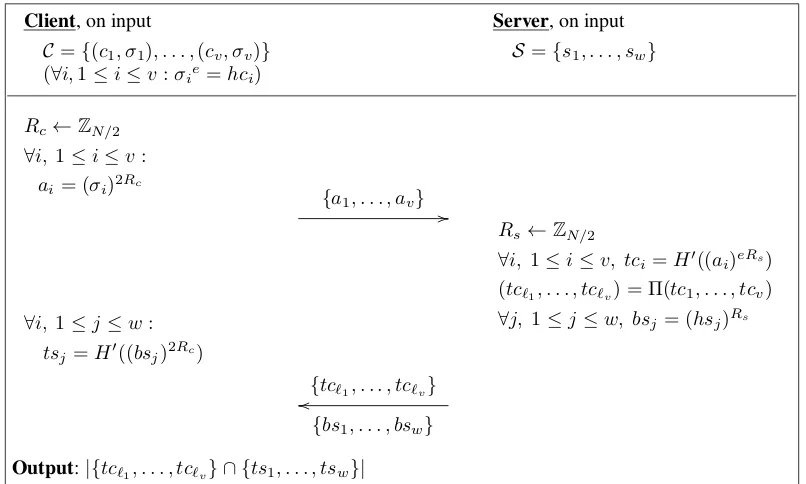
Figure 2:Authorized PSI-CA. All computation is modN.
Definition 6 (Authorized PSI-CA (APSI-CA)) A protocol involving a server, on input of a set of w
items: S ={s1,· · ·, sw}, and a client, on input of a set ofvitems with associated authorizations (i.e., signatures),C={(c1, σi)· · ·,(cv, σv)}. It results in client outputting|I∗|, where:
I∗={sj ∈ S | ∃(ci, σi)∈ Cs.t. ci =sj ∧Verify(σi, ci) = 1}.
APSI-CA entails the following informal privacy requirements:
• Server Privacy (APSI-CA).The client learns no information beyond what can be inferred from the protocol output, i.e., (1) cardinality of set intersection on authorized items and (2) upper bound on the size ofS.
• Client Privacy (APSI-CA).No information is leaked about items or authorizations in client set (except an upper bound on their number).
• Unlinkability. Similar to PSI-CA, we require that neither server nor client can determine if any two instances of the protocol are related, i.e., executed on the same input by client or server.
We illustrate our APSI-CA protocol in Figure2. Observe that the CA is responsible for generating all public parameters: on input the security parameterκ, it executes(N, e, d, g)←RSA.KGen(κ), where
g is a generator ofQRN, and selectsH : {0,1}∗ → ZN∗ (Full-Domain Hash) and H0 : {0,1}∗ → {0,1}κ (random oracles). The CA authorizes client inputc
i by issuingσi = H(ci)dmodN (i.e., an RSA signature). The protocol is executed between client and server, on common input(N, e, H, H0). We assume that server’s input (S) is randomly permuted before protocol execution to mask anyordering of the items contained in it. Finally,hciandhsj denote, respectively,H(ci)andH(sj).
• Correctness. For any(σi, ci) held by client and sj held by server, if: (1)σi is a genuine CA signature on ci, and (2) ci = sj, hence, hci = hsj, we obtain: tc`i = H
0((σ
i)2eRcRs) =
H0((hci)2RcRs) =tsj.
• Privacy. In this version of the paper, we only provide some intuition for our security arguments, and defer to future work formal proofs. Client privacy is based on its input being statistically indis-tinguishable from a random distribution inQRN. Arguments regarding server privacy are similar to those for PSI-CA, thus, we do not repeat them here. We argue that if one could violate APSI-CA server privacy, then the one would also violate server privacy of the APSI construct in Figure 1 of [11], proven secure under the RSA and DDH assumptions. Finally, note that the protocol is unlinkable, given that random values,Rc, Rs, are selected fresh for each protocol execution.
• Efficiency. This APSI-CA protocol incurs linear computation (for both parties) and communica-tion complexity. Specifically, client and server perform respectivelyO(w)andO(w+v)modular exponentiations. However, exponents are now taken in the RSA settings, while in PSI-CA can be taken from a smaller group, thus, be much shorter (e.g.,160-bit vs1024-bit long). Communication complexity amounts toO(w+v). Note that this is significantly lower than related work, i.e., [8], which incurs quadratic overhead (see Section2.2).
6
Combining PSI-CA and PSI
As mentioned in Section1, it is often desirable to privately assess the magnitude of the set intersec-tion before engaging in an actual (private) set intersecintersec-tion computaintersec-tion. We are motivated by potential concerns with respect to server privacy, arising in PSI executions where the intersection obtained by client is close to the entire server set (i.e.,|S ∩ C| ≈ |S|).
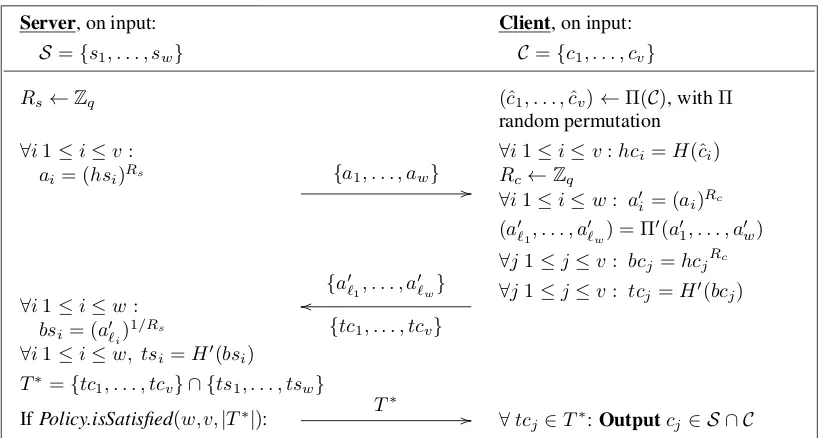
We now show how to combine our proposed PSI-CA construct with with PSI functionality, in order to address such concerns. Specifically, rather than engaging in PSI, parties first run the PSI-CA protocol with their client/server roles reversed. This way, server learns (only) the intersection cardinality and the size of the parties’ inputs, and uses this information to decide whether to proceed with PSI. In case it de-cides to proceed, client only needs to receive one more message from server to compute the intersection. In other words, server defines apolicy– based on the size of (i) the two sets and (ii) the intersection – and only if the policy is satisfied, server engages in PSI protocol (thus, client privately obtains the set intersection).
The resulting protocol is presented in Figure3. In the first two rounds, server and client run PSI-CA with their roles reversed(i.e., server learns the cardinality of the intersection), and, assuming server’s policy is satisfied, the last round allows client to learn the set intersection. The same approach can be used for other private set operations, such as PSU [19]. Indeed, similar concerns about server privacy occur in a scenario where|C ∪ S| ≈ |C|+|S|, and can again be addressed by running PSI-CA with roles reversed. Observe that protocol in Figure3incurs complexities comparable to the underlying PSI-CA (illustrated in Figure1): only one additional message must be sent to realize policy-based PSI.
Server, on input: Client, on input:
S={s1, . . . , sw} C={c1, . . . , cv}
Rs←Zq (ˆc1, . . . ,cˆv)←Π(C), withΠ
random permutation
∀i1≤i≤v: ∀i1≤i≤v:hci=H(ˆci)
ai= (hsi)Rs {a1, . . . , aw} Rc ←Zq
/
/ ∀i1≤i≤w: a0
i= (ai)Rc (a0`
1, . . . , a
0
`w) = Π
0(a0
1, . . . , a0w)
∀j1≤j ≤v: bcj =hcjRc
∀j1≤j ≤v: tcj =H0(bcj)
∀i1≤i≤w:
{tc1, . . . , tcv}
{a0`1, . . . , a0`w}
o
o
bsi = (a0`i)
1/Rs
∀i1≤i≤w, tsi=H0(bsi)
T∗ ={tc1, . . . , tcv} ∩ {ts1, . . . , tsw}
IfPolicy.isSatisfied(w,v,|T∗|): T ∗
/
/ ∀tcj∈T∗:Outputcj∈ S ∩ C
Figure 3: Combining PSI-CA and PSI for a three-round policy-based Private Set Intersection protocol. (All computation is modp).
Remark: Our technique in Figure 3 is not to be confused with the concept of Policy-Enhanced PSI, recently proposed by [37]. Using the latter, two parties privately obtain the intersection of their sets, while enforcing policies pertaining what/how to share, based on policies and authorizations related to single items. Whereas, policy enforced by server in our protocol is much simpler – it is based on the cardinality of set intersection: depending on this (and on its relationship to set size), server decides whether or not to disclose set intersection’s content to client. A vaguely comparable approach is so-called Knowledge-oriented Multi-party Secure Computation [30], where each participating party is able to reason about the increase in knowledge that other parties could gain as a result of the secure computation, and may choose not to participate to restrict that gain.
7
Conclusion
This paper presented a protocol for PSI-CA, with linear computational and communication com-plexities. It can be used to compute PSU-CA, without introducing any additional overhead. Then, we presented two novel extensions. First, we introduced Authorized PSI-CA, or APSI-CA, that is useful in settings where client input must be authorized by a certification authority. Then, we used PSI-CA to realize a PSI protocol where server determines (in privacy-preserving manner) cardinality of set inter-section before deciding whether or not to engage in a PSI interaction with client. Such an approach is very efficient, as it requires onlyoneadditional message on top of our PSI-CA protocol.
We will release an optimized implementation of all protocols presented in this paper along with the final version of the paper. As part of future work, we plan to investigate extensions to guarantee security in the presence of malicious adversaries and in the UC framework.
References
[1] R. Agrawal, A. Evfimievski, and R. Srikant. Information sharing across private databases. InSIGMOD, 2003.
[2] B. Applebaum, H. Ringberg, M. Freedman, M. Caesar, and J. Rexford. Collaborative, Privacy-preserving Data Aggregation at Scale. InPETS, 2010.
[3] G. Ateniese, M. Blanton, and J. Kirsch. Secret handshakes with dynamic and fuzzy matching. InNDSS, 2007.
[4] P. Baldi, R. Baronio, E. De Cristofaro, P. Gasti, and G. Tsudik. Countering GATTACA: Efficient and Secure Testing of Fully-Sequenced Human Genomes. InCCS, 2011.
[5] M. Bellare, C. Namprempre, D. Pointcheval, and M. Semanko. The one-more-RSA-inversion problems and the security of Chaum’s blind signature scheme.Journal of Cryptology, 16(3), 2003.
[6] C. Blundo, E. De Cristofaro, and P. Gasti. EsPRESSo: Efficient Privacy-Preserving Evaluation of Sample Set Similarity. InDPM, 2012.
[7] E. Bursztein, J. Lagarenne, M. Hamburg, and D. Boneh. OpenConflict: Preventing Real Time Map Hacks in Online Games. InS&P, 2011.
[8] J. Camenisch and G. M. Zaverucha. Private intersection of certified sets. InFinancial Cryptography, 2009.
[9] E. De Cristofaro, P. Gasti, and G. Tsudik. Fast and Private Computation of Cardinality of Set Intersection and Union. InCANS, 2012.
[10] E. De Cristofaro, S. Jarecki, J. Kim, and G. Tsudik. Privacy-preserving policy-based information transfer. In
PETS, 2009.
[11] E. De Cristofaro, J. Kim, and G. Tsudik. Linear-Complexity Private Set Intersection Protocols Secure in Malicious Model. InAsiacrypt, 2010.
[12] E. De Cristofaro and G. Tsudik. Practical private set intersection protocols with linear complexity. In Finan-cial Cryptography, 2010.
[13] A. Evfimievski, J. Gehrke, and R. Srikant. Limiting privacy breaches in privacy preserving data mining. In
PODS, 2003.
[14] M. Freedman, Y. Ishai, B. Pinkas, and O. Reingold. Keyword search and oblivious pseudorandom functions. InTCC, 2005.
[15] M. Freedman, K. Nissim, and B. Pinkas. Efficient private matching and set intersection. InEurocrypt, 2004.
[16] K. Frikken. Privacy-Preserving Set Union. InACNS, 2007.
[17] O. Goldreich.Foundations of Cryptography. Cambridge U. Press, 2004.
[18] C. Hazay and Y. Lindell. Efficient protocols for set intersection and pattern matching with security against malicious and covert adversaries. InTCC, 2008.
[19] C. Hazay and K. Nissim. Efficient Set Operations in the Presence of Malicious Adversaries. InPKC, 2010.
[20] S. Hohenberger and S. Weis. Honest-verifier private disjointness testing without random oracles. InPET, 2006.
[21] J. Hong, J. W. Kim, J. Kim, K. Park, and J. H. Cheon. Constant-Round Privacy Preserving Multiset Union. Cryptology ePrint Archive, Report 2011/138, 2011.http://eprint.iacr.org/2011/138.
[23] B. Huberman, M. Franklin, and T. Hogg. Enhancing privacy and trust in electronic communities. InACM Conference on Electronic commerce, 1999.
[24] Intelligence Advanced Research Projects Activity (IARPA). Automatic Privacy Protection and Se-curity And Privacy Assurance Research Programs. https://www.fbo.gov/utils/view?id=
920029a5107a9974c2e379324a1dcc4e.
[25] Y. Ishai, J. Kilian, K. Nissim, and E. Petrank. Extending oblivious transfers efficiently.CRYPTO, 2003.
[26] S. Jarecki and X. Liu. Efficient Oblivious Pseudorandom Function with Applications to Adaptive OT and Secure Computation of Set Intersection. InTCC, 2009.
[27] S. Jarecki and X. Liu. Fast secure computation of set intersection. InSCN, 2010.
[28] M. Kantarcioglu, R. Nix, and J. Vaidya. An efficient approximate protocol for privacy-preserving association rule mining.KDD, 2009.
[29] L. Kissner and D. Song. Privacy-preserving set operations. InCrypto, 2005.
[30] P. Mardziel, M. Hicks, J. Katz, and M. Srivatsa. Knowledge-oriented secure multiparty computation. In
PLAS, 2012.
[31] A. Menezes, P. V. Oorschot, and S. Vanstone.Handbook of Applied Cryptography. CRC, 1997.
[32] S. Nagaraja, P. Mittal, C. Hong, M. Caesar, and N. Borisov. BotGrep: Finding Bots with Structured Graph Analysis. InUsenix Security, 2010.
[33] A. Narayanan, N. Thiagarajan, M. Lakhani, M. Hamburg, and D. Boneh. Location Privacy via Private Proximity Testing. InNDSS, 2011.
[34] P. Paillier. Public-key cryptosystems based on composite degree residuosity classes. InEurocrypt, 1999.
[35] S. Pohlig and M. Hellman. An improved algorithm for computing logarithms over GF(p) and its crypto-graphic significance.IEEE Transactions on information Theory, 24(1), 1978.
[36] J. H. Seo, J. H. Cheon, and J. Katz. Constant-Round Multi-Party Private Set Union using Reversed Laurent Series. InPKC, 2012.
[37] E. Stefanov, E. Shi, and D. Song. Policy-enhanced private set intersection: Sharing information while en-forcing privacy policies. InPKC, 2012.
[38] J. Vaidya and C. Clifton. Secure set intersection cardinality with application to association rule mining.
Journal of Computer Security, 13(4), 2005.