VOWEL ACCOMMODATION STRATEGIES USED BY ESL TEACHERS IN FOREIGNER-DIRECTED SPEECH
Laura Elizabeth Barnes
A thesis submitted to the faculty at the University of North Carolina at Chapel Hill in partial fulfillment of the requirements for the degree of Master of Arts in the Department of Linguistics.
Chapel Hill 2015
Approved by:
Misha Becker
Jennifer Smith
© 2015
ABSTRACT
Laura Barnes: Vowel Accommodation Strategies Used by ESL Teachers in Foreigner-Directed Speech
(Under the direction of Misha Becker)
In this study, features of Foreigner-Directed Speech (FDS) are investigated by measuring
the durations of tense and lax vowels in the speech of ESL teachers to both a nonnative speaker
of English and a native speaker of English. Comparing tense and lax vowel pairs within subjects
from both a group of ESL teachers and a control group of native English speakers (with no
experience teaching ESL), it is investigated whether vowel duration is lengthened in both tense
and lax vowels, or whether vowel duration is hyperarticulated in tense and lax pairs—lax vowels
shorter, tense vowels longer—to see if duration is key in aiding L2 English speakers. It was
found that the ESL teacher group did not display any significant features of FDS when compared
to the control subject group, and that both groups showed greater durational distance within the
tense-lax pair /e/-/ɛ/ than within /i/-/ɪ/. Other patterns were found that could be attributed to FDS,
though the statistical significance of these patterns could not be established to confirm this
ACKNOWLEDGEMENTS
I’m incredibly grateful to the Linguistics faculty at UNC Chapel Hill for their support and
advice over the past two years, and for the opportunity I had to be continuously learning from
them. Thanks also to Walt Wolfram at NC State for being on my committee and giving me
advice on this project.
I’m also thankful for the other grad students who reached out to me and gave
encouragement throughout my time here, and for the friendships made through the Linguistics
program. It would have been impossible to accomplish this degree without the community of
support around me.
A huge thanks also to my friends and family who have supported me in this endeavor and
listened to me talk about my thesis project constantly. Greg, Rachel, Melinda, and Stephanie—
thank you for keeping me sane and for rooting for me during this whole process!
TABLE OF CONTENTS
LIST OF TABLES………vii
LIST OF FIGURES………..viii
CHAPTER 1:INTRODUCTION……….1
CHAPTER 2: BACKGROUND LITERATURE………3
2.1 Foreigner-Directed Speech (FDS)……….3
2.2 L2 segmental perception and vowel contrasts………...5
2.3 Tense and lax vowel distinctions………...7
2.4 Areas for further research………..8
CHAPTER 3: METHODOLOGY………...9
3.1 Subjects………...…..9
3.2 Confederates………10
3.3 Design………..10
3.4 Stimuli………..11
3.5 Procedure……….12
CHAPTER 4: RESULTS AND DISCUSSION……..………...…16
4.1 ESL teachers’ results………16
4.2 Control group subjects’ results………19
4.3 Comparison of ESL group and control group results………..22
CHAPTER 5: GENERAL DISCUSSION……….29
APPENDIX B: GROUP RESULTS……….….48
LIST OF TABLES
Table 3.4.1 Stimuli……….12
Table 4.3.1 Significant of ESL teacher group (NDS vs FDS difference)
vs control group (NDS vs FDS difference) for tense/lax pairs…………..………22
Table 4.3.2 Significance of FDS vs NDS durational difference for /i/-/ɪ/……….23
Table 4.3.3 Significance of FDS vs NDS durational difference for /e/-/ɛ/………24
Table 4.3.4 Statistical analysis for durational difference between
/e/ and /ɛ/ for ESL teachers………..………..24
Table 4.3.5 Statistical analysis for durational difference between
/e/ and /ɛ/ for control group...24
Table 4.3.8 Statistical analysis for durational difference between
/i/ and /ɪ/ for ESL teachers………..…..26
Table 4.3.9 Statistical analysis for durational difference between
LIST OF FIGURES
Figure 4.1.1 Average /i/ durations for ESL teachers in ms………17
Figure 4.1.2 Average /ɪ/ durations for ESL teachers in ms………17
Figure 4.1.3 Average /e/ durations for ESL teachers in ms………...18
Figure 4.1.4 Average /ɛ/ durations for ESL teachers in ms………...18
Figure 4.2.1 Average /i/ durations for control participants in ms………...…...20
Figure 4.2.2 Average /ɪ/ durations for control participants in ms………..20
Figure 4.2.3 Average /e/ durations for control participants in ms……….21
Figure 4.2.4 Average /ɛ/ durations for control participants in ms……….21
Figure 4.3.6 Durational difference between /e/ and /ɛ/ for ESL teachers………..25
Figure 4.3.7 Durational difference between /e/ and /ɛ/ for control subjects………..25
Figure 4.3.10 Durational difference between /i/ and /ɪ/ for ESL teachers……….26
Figure 4.3.11 Durational difference between /i/ and /ɪ/ for control subjects……….27
Figure 1.1 Teacher 1: /i/……….32
Figure 1.2 Teacher 1: /ɪ/……….………32
Figure 1.3 Teacher 1: /e/………33
Figure 1.5 Teacher 2: /i/……….34
Figure 1.6 Teacher 2: /ɪ/……….34
Figure 1.7 Teacher 2: /e/………35
Figure 1.8 Teacher 2: /ɛ/………35
Figure 1.9 Teacher 3: /i/ ………36
Figure 1.10 Teacher 3: /ɪ/………..36
Figure 1.11 Teacher 3: /e/………..…37
Figure 1.12 Teacher 3: /ɛ/………..37
Figure 1.13 Teacher 4: /i/……….……..38
Figure 1.14 Teacher 4: /ɪ/………...38
Figure 1.15 Teacher 4: /e/………..39
Figure 1.16 Teacher 4: /ɛ/………..39
Figure 2.1 Control 1: /i/……….40
Figure 2.2 Control 1: /ɪ/……….40
Figure 2.3 Control 1: /e/……….……41
Figure 2.4 Control 1: /ɛ/……….41
Figure 2.6 Control 2: /ɪ/……….42
Figure 2.7 Control 2: /e/………43
Figure 2.8 Control 2: /ɛ/……….43
Figure 2.9 Control 3: /i/……….44
Figure 2.10 Control 3: /ɪ/………...44
Figure 2.11 Control 3: /e/………...45
Figure 2.12 Control 3: /ɛ/………...45
Figure 2.13 Control 4: /i/………...46
Figure 2.14 Control 4: /ɪ/………...46
Figure 2.15 Control 4: /e/………..47
Figure 2.16 Control 4: /ɛ/………..47
Figure 1.1 Average durational distance between ESL teachers’ /i/-/ɪ/ in FDS………..48
Figure 1.2 Average durational distance between ESL teachers’ /e/-/ɛ/ in FDS……….48
Figure1.3 Average durational distance between ESL teachers’ /i/-/ɪ/ in NDS………..49
Figure1.4 Average durational distance between ESL teachers’ /e/-/ɛ/ in NDS……….49
Figure 2.1 Average durational distance between control subjects’ /i/-/ɪ/ in FDS………….…….50
Figure 2.3 Average durational distance between control subjects’ /i/-/ɪ/ in NDS……….51
CHAPTER 1: INTRODUCTION
In acquiring a second language as an adult learner, being able to perceive nonnative
phonetic contrasts is no easy task (Brosseau-Lapre, Rvachew, Clayards, and Dickson, 2013;
Flege, Bohn, and Jang, 1997; Tsukada et al., 2005; Werker, Gilbert, Humphrey, and Tees, 1981).
But, since successful perceptual learning is important to successful production of a language,
categorizing sounds into their phonemic categories in the acquisition process is clearly essential
to productivity (Brosseau-Lapre et al., 2013). The ability to perceive and categorize vowels in
particular in acquiring a second language has been found to positively correlate to successful
speech production, no matter what age the learner first began to acquire the second language
(Flege, MacKay, and Meador, 1999; Bundgaard-Nielsen, Best, Kroos, and Tyler, 2012).
The role of vowel perception in acquiring the phonemic categories of a second language
is important for the second language learner, and this has led to some studies examining what
type of input native speakers produce directly in conversation with nonnative speakers, and how
a native speaker may modify his or her speech in conversation with a nonnative speaker to
provide more readily understandable speech, or stereotypical examples of speech to the listener.
Some of these modifications of normal speech towards nonnative speakers can be seen in slower
overall speech rate, elongated vowels in stressed syllables, hyper-articulation of vowel duration
contrasts, and hyper-articulation of vowel formant frequencies (Rahimian, 2013; Scarborough et
al., 2007; Uther et al, 2007).
This kind of speech modification is known as Foreigner-Directed Speech (FDS), and has
native speakers’ conversing with an imaginary nonnative speaker (Scarborough et al., 2007).
However, a study has not yet been implemented that examines FDS as used by ESL teachers,
who converse extensively with nonnative speakers. It is possible that this experience in
interacting with nonnative speakers of English produces not only the characteristics of FDS in
the teachers’ speech, but to an even greater degree than in the speech of native English speakers
with no experience teaching English to nonnative learners.
This present study will focus specifically on ESL teachers, whose occupation entails that
they have experience working extensively with nonnative English speakers, in order to see if
vowel duration hyper-articulation is one of the aspects of FDS they employ in speaking with
students, or if vowel elongation occurs in their speech. It would be useful to know, both
theoretically and in the interests of applied linguistics, if teachers are using accommodation
strategies to help nonnative speakers phonemically categorize vowels; or if not, perhaps being
aware of various accommodation strategies that can be used in Foreigner-Directed Speech would
help them be more effective in the classroom.
In addition, as Scarborough et al (2007) note in the conclusion of their study, further
research needs to be done that tests what other phonetic features are altered from native-directed
speech to FDS. In this study, I seek to expand research that explores the hyper-articulation of
vowels in Foreigner-Directed Speech, particularly in that of lax and tense vowel pairs, in order to
see if a stronger effect can be found in the speech of ESL teachers, in comparison with native
speakers of English who have no experience teaching ESL. In this way, some of the nuances of
FDS as realized in lax and tense vowels can be further explored as they relate to Second
CHAPTER 2: BACKGROUND LITERATURE
2.1. Foreigner-Directed Speech (FDS)
Foreigner-Directed Speech (FDS) has been researched as a phenomenon similar to Infant
Directed Speech (IDS), in that particular phones in each are hyper-articulated, for the presumed
reason of aiding phonemic categorization in both infants and nonnative speakers of a target
language (Rahimian 2013). Vowels in particular are noted in both IDS and FDS for having
lengthened durations compared to Native-Directed Speech (or in speech directed to adults).
Some studies also suggest that vowels produced in FDS have hyper-articulated formant
frequencies (where low formants become lower, and high formants become even higher)
resulting in an expanded vowel space, and these along with longer vowel durations are both used
by native speakers to accommodate to nonnative speakers (Rahimian, 2013; Scarborough et al
2007). Studies such as Rogers et al (2013) disagree with Scarborough, however, in terms of the
importance of vowel formant hyper-articulation, and instead put forth vowel duration as the
primary distinguishing factor in FDS. According to Rogers, vowel duration is what nonnative
speakers rely on to recognize and categorize vowels they are acquiring in their phonology,
especially when acquiring an L2 later in life (Rahimian 2013).
To continue other studies which have investigated formant hyper-articulation in
Infant-Directed Speech (IDS) (Kuhl et al, 1997; Andruski et al, 1999,Burnham et al, 2002), Uther et al
(2007) compared IDS with FDS. They investigated the corner vowels /i/, /u/, and /a/ in the
Speech (ADS). When the vowel space is expanded, the first and second formants (F1 and F2)
become proportionally higher or lower for each vowel being hyper-articulated, resulting in a
larger phonetic contrast between vowels, as well as a larger perceptual space (Uther et al, 2007).
For example, the high close vowel /i/ has a low F1, and a high F2, and if these two formants are
hyper-articulated, F1 will be lower and F2 will be higher than usual, pushing the acoustic
differences between /i/, /u/, and /a/ further apart in the vowel space. In this way, the perceptual
and phonetic distance between vowels can be enhanced for the listener (Uther et al, 2007).
It was found that the subjects’ vowel space was expanded (hyper-articulated) in both IDS
and FDS, which Uther et al (2007) suggest indicates that hyper-articulation is used to aid both
infants and nonnative speakers in distinguishing phonetic contrasts in the target language. In fact,
studies on hyper-articulation in have shown that vowel space expansion in IDS is a factor in
English, Russian, Swedish, and Japanese (Kuhl et al, 1997; Andruski et al, 1999; Burnham et al,
2002). Both IDS and FDS use similar adjustments on the part of the speaker to the perceived
needs of the listener, but the ways in which FDS is realized is still understudied. Uther et al
(2007) further state that the environments in which FDS occurs still requires further study, as
does the investigation of the benefits of FDS to the nonnative speaker.
It has not been researched in depth whether FDS is more strongly apparent in the speech
of those who regularly interact with nonnative speakers of English in a teaching role, though
Rahimian’s study looked at the speech of native English speakers who had experience working
with nonnative speakers in a peer-to-peer role. If duration is key in nonnative speakers’
acquisition and perception of English vowels, as Rogers et al (2013) indicate, and since duration
tense vowels lengthened and lax vowels shortened, to make their distinctions more salient. For
example, it is possible that the durational difference within tense/lax vowel pairs would be
greater in FDS, as opposed to Native-Directed Speech (NDS).
On the other hand, it is possible that both tense and lax vowels would be lengthened in
FDS, and if so, this could indicate that a slower rate of speech is being used overall, which would
serve to lengthen all vowels. If overall lengthening is occurring in FDS, rather than
hyper-articulation of durational contrasts, then it might be that the speaker is relying on a slower speech
rate to assist the listener in comprehension, instead of providing the listener with stereotypical
versions of vowel contrasts.
2.2. L2 segmental perception and vowel contrasts
One study that investigates the importance of vowel categorization in learning a second
language was carried out by Bundgaard-Nielsen et al in 2012, and focuses on a subject pool of
Japanese learners of English, who were studying abroad in Australia in an English immersion
program. Their study tests the idea that L2 vocabulary size and L2 vowel intelligibility are
positively related; that is, these learners of English were predicted to perform better on both
production and perception tasks if their L2 vocabulary size was bigger than that of their peers,
who did not differ from them on time spent learning English, or time spent in the immersion
setting. It was found that vocabulary size positively correlated with both perception and
production for these English learners. Bundgaard-Nielsen et al (2012) also discuss vowel
duration as a perceptual cue for phonemic categorization, stating that other studies have shown
duration to be a much more distinguishable characteristic of vowel contrasts to the L2 learner
Bundgaard-Nielsen et al (2012) focus on Japanese learners of English in particular,
because Japanese has a very small set of vowel categories (5 distinct vowels only) compared
with Australian English (18 distinct vowels, both monophthongs and diphthongs). This means
that Japanese learners of English must “divide their phonetic and phonological space more finely
in order to accommodate all the L2 vowels” (Bundgaard-Nielson et al 2012). This study
demonstrates the importance of vowels in the acquisition of English as an L2, and any
accommodation strategies teachers are using to help students better categorize vowels early on in
their acquisition should theoretically facilitate vocabulary expansion, and fine-tune both
perception and production of English vowels. Whether FDS as used by ESL teachers is
instrumental in aiding learners of English in categorizing vowels remains to be studied.
According to Flege et al (1999) and Bundgaard-Nielsen et al (2012), successfully
perceiving vowels positively relates to vowel production. Since perceiving certain nonnative
phonetic contrasts is difficult for those whose native language does not contain these contrasts, it
follows that producing these contrasts is also difficult for the second language learner
(Brosseau-Lapreet al 2013; Flege et al 1997; Tsukada et al., 2005; Werker et al 1981). Tsukada (2012)
investigated whether or not native Arabic and native Japanese speakers were able to use
knowledge from their L1s, which both contain vowel duration contrasts, to perceive similar
vowel contrasts in a nonnative language. It was found that despite having this knowledge of
vowel length contrasts available in their L1s, the subjects were still unable to perceive many
nonnative vowel contrasts accurately, and did not perform any better than the control group, who
2.3. Tense and lax vowel distinctions
Though an exact definition of the distinction between lax and tense vowels is not
currently agreed upon in the literature, one basic, distinguishing feature within these vowel pairs
is that tense vowels are typically longer in duration than their lax counterparts (Thomas, 2011).
In addition to this description, Thomas (2011) also notes that tense vowels can be breathier than
lax vowels, while lax vowels can be creakier by comparison, and that tense vowels are more
diphthongal in most dialects of both English and Dutch. Articulatory movements are responsible
for the formant value differences between tense and lax vowels, which can be seen in the tongue
root being more advanced, and the ridge of the tongue closer to the roof of the mouth in tense
versus lax vowels (Thomas 2011).
Acquiring tense and lax vowel distinctions in English can pose a challenge for second
language learners, depending on the vowel systems already present in their native languages. As
seen above, Japanese has a much smaller vowel system than English, as does Mandarin Chinese.
According to Chen (2006), Mandarin phonology contains only tense vowels, and has no lax
vowels, so acquiring the tense-lax distinction in English (and in other Germanic languages
containing tense-lax distinctions) can be difficult for native Mandarin speakers. Chen’s (2006)
study also reported that duration seemed to be the main factor for native Mandarin speakers in
perceiving tense versus lax vowels in English, while American English speakers seemed to rely
more on spectral differences to perceive the tense-lax distinction, which is consistent with
2.4 Areas for further research
So far, there is little research on whether or not those who regularly interact with
nonnative speakers of English in a teaching role have more fine-tuned or exaggerated features of
Foreigner-Directed Speech. Rahimian’s (2013) study used subjects who had at least one year
working closely with nonnative speakers of English, but not in a teaching context, and
Scarborough et al’s (2007) study focused on native speakers of English without any specific
background of interaction with nonnative speakers.
The goal of this study is to build on the research accomplished by these two studies, with
the context of phoneme categorization in SLA in mind, and to focus on the features of FDS that
may be evident in ESL teachers’ speech versus that of regular native English speakers’ speech,
specifically in terms of lax and tense vowel durational differences. Rahimian focused on lax and
tense vowel pairs, while Scarborough et al focused on vowels in stressed syllables. Similarly to
Rahimian (2013), I will focus on lax and tense vowel pairs, with the prediction that these vowel
pairs will be hyper-articulated in FDS—lax vowels shorter, tense vowels longer—rather than
CHAPTER 3: METHODOLOGY
3.1. Subjects
The subjects were native English speakers with at least two semesters’ experience
teaching ESL at the adult level, whether in community college, at a university, or through other
organizations. Four ESL teachers were recruited; three male teachers and one female teacher.
Teachers recruited for this study were given a questionnaire asking about the language
backgrounds of students they teach, the length and type of experience they have had teaching
English so far, and whether or not they have had formal pedagogical training in the
ESL/TESOL/TEFL field.
The female teacher (Subject 1) had taught ESL through a volunteer program, had taught
English abroad in Nicaragua, and had more than 2 semesters of experience teaching ESL. One
male teacher (Subject 2) had experience teaching English abroad in both Vietnam and Russia in
various paid positions; he was also the only teacher recruited with any pedagogical training in
ESL. The other two male teachers (Subjects 3 and 4) were undergraduate students who had at
least 2 semesters experience teaching ESL through UNC’s Enrich ESL volunteer program.
The control group for the ESL teacher subjects was a group of native English speakers
who had no experience teaching English to nonnative speakers of English. One male and three
3.2. Confederates
Two confederates volunteered to interact with the ESL teachers in this study. One native
English speaking confederate was used as the control for the experiment, and one Chinese native
speaker, who is learning English, was used to test what accommodation strategies are being used
by the teachers vs. those used by the native English speakers who are not teachers. Both
confederates were MA students in the Linguistics program at UNC.
Since different L1s seem to affect the type of cue one relies upon to differentiate
nonnative contrasts in one’s L2, it is possible that the cues given in Foreigner-Directed Speech
are adjusted by the native speaker according to the L1 background of the nonnative speaker
(Chen, 2006). Because of this possibility, choosing just one nonnative English speaking
confederate from one L1 background, rather than multiple, seemed to be a wise choice for this
study, as well as choosing a confederate with a first language that does not contain tense-lax
vowel contrasts.
3.3. Design
For the experiment task, subjects carried out a mini lesson plan that involved a short “get
to know you” activity, in order to have time interacting back and forth so as to familiarize the
subjects with the speech of each confederate, then read two short narrative paragraphs to the
Chinese L1/English L2 speaker and the native English speaker, one-on-one. Following each
paragraph read, the subject then asked each confederate three short comprehension questions
about the material read. The warm-up questions, the paragraphs, and the comprehension
present in all recordings. The recordings were analyzed by measuring the durations of lax and
tense vowels where they occur between voiceless consonants (Scarborough et al 2007).
All recordings took place in the phonetics lab soundproof booth on UNC’s Chapel Hill
campus, and Praat was used to both record and annotate the sound files (Boersma et al, 2013).
Vowel duration was measured for each token by marking the beginning and end of each vowel in
Praat, using both F1 and F2 and the voicing bar as landmarks, and measuring the duration in
between. The beginning of the vowel was determined to be at the onset of the second formant
(F2) together with the voicing bar, and the end of the vowel was determined to be at the offset of
voicing, and where F2 was still clearly visible (before trailing off).
3.4. Stimuli
Tense and lax vowel pairs were selected to be used in the stimuli. The pairs /i/-/ɪ/ and
/e/-/ɛ/ were measured where they occur between voiceless consonants, for the purpose of comparing
their durations within each subject in both Native-Directed Speech and Foreigner-Directed
Speech. Each vowel being analyzed was used in three different real words, with three repetitions
of each word in the mini lesson plan activity script (with the exception of /e/, which had ten total
Table 3.4.1 Stimuli
Vowel Stimuli
/i/ cheap, keep, sheets
/ɪ/ fish, chips, sips
/e/ take, fate, cake
/ɛ/ pet, chef, shepherd
3.5. Procedure
A short warm-up activity, composed of three “get to know you” questions, was used
before the main lesson plan tasks. This was intended to familiarize the subjects with the speech
of the confederates before completing the actual task, so that the subjects’ speech would be
potentially adjusted according to their perception of the confederates’ speech. Written
instructions were provided for the subjects to read so they knew what procedure to follow upon
entering the soundproof booth with each student.
The actual tasks were composed of two short narrative paragraphs containing the stimuli
listed above. Three follow-up comprehension questions followed each paragraph, and the
subjects read them to the students and asked them to give their answers aloud. These tasks were
meant to mimic a short, in-class reading comprehension activity that might be found in ESL
Before entering the soundproof booth to carry out the mini lesson plan, subjects were
able to quickly look over the script, and the instructions were explained to them as described
below. No subject read the lesson plan material before arriving at the soundproof booth, nor did
they practice reading it aloud before recording with the first confederate. The native
English-speaking and native Chinese-English-speaking confederates recorded with the subjects in alternating
order, in case the subjects changed their speech due to increased familiarity with the reading
material for their second recording. In between each subject’s recording sessions with each
confederate, there was a break of one minute or less. What the subjects read to the confederates
is as follows:
Instructions: Please read through the warm-up questions below with the student first to
get to know him/her a little bit. Then, read the following two paragraphs along with the
comprehension questions provided one-by-one, to test the student’s understanding of each
narrative.
1. Warm-up questions
A. Where are you from?
B. Do you have any siblings?
C. What’s your major?
2. Paragraph One
Every Saturday, I take a walk down to the waterfront with my German Shepherd,
Achilles. I get fish and chips and a bottle of soda from my favorite food truck, and people
the restaurant down the road knows us well enough not to bother asking. The other chef from
that restaurant is scared of big dogs, though, and won’t approach even a German Shepherd as
friendly as Achilles. Today while we were walking along the waterfront, a student walked by us
and dropped his notebook, and sheets of paper flew all over the place. I tried to help him pick up
the paper, but most of the sheets had already blown away, and carrying soda and my meal of fish
and chips made it too cumbersome to help the guy. We walked on further, and I took a few
pictures of the waterfront before I had to take Achilles home.
Questions:
1. Does each chef in the story feel comfortable enough to pet Achilles?
2. When does the narrator usually take his German Shepherd to the waterfront to get fish
and chips?
3. Was the narrator able to pick up all the sheets of paper the student dropped?
3. Paragraph 2
I had a weird dream last night, where I had to bake a cake and cook some soup in a
chicken coop for a homework assignment. Needless to say, baking a cake inside a cramped coop
was no easy task, and neither was making soup. As fate would have it, feathers kept sticking to
the cake in my dream, and I couldn’t keep the soup pot from falling over. Oddly enough, there
was a bottle of whiskey in the coop as well, and I took sips of it as I tried my best to finish the
task before me. Then, a guy in a suit came in to the chicken coop and told me to keep trying, but
to regulate my sips of whiskey, because it wasn’t cheap. The suit guy said the cake baking
got really nervous then, and took two huge sips of whiskey, and the suit guy said “it’s fate!
You’ll never succeed!” Then, I woke up.
1. What did the student have to do in her dream?
2. Was the student’s fate to succeed or fail in her dream?
CHAPTER 4: RESULTS AND DISCUSSION
4.1. ESL Teachers’ Results
The prediction of this study was that ESL teachers would hyper-articulate tense and lax
vowels, so that the durational difference between the longer tense vowels and shorter lax vowels
would be more salient in FDS versus NDS. It was found that three out of four of the ESL
teacher subjects exhibited some durational hyper-articulation in FDS vs NDS, in which cases
their average lax vowel durations were shortened, and their average tense vowel durations were
lengthened, though these differences between FDS and NDS were very small. The data were
analyzed using the GLM (General Linear Model) procedure with appropriate follow up contrasts,
which shows that though some apparent patterns indicate a trend towards ESL teachers
elongating tense vowels and shortening lax vowels in FDS, the durational differences between
lax and tense vowels in FDS versus NDS are not statistically significant. As a result, these data
do not definitively answer whether the observed patterns are due to chance or are indeed caused
by hyper-articulation in FDS. However, some salient details can be discussed in the speech of
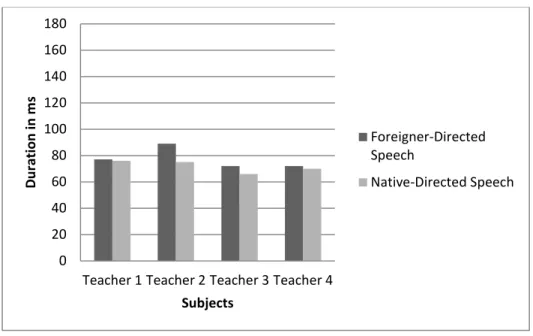
All four teachers showed, on average, a longer tense vowel /i/ in FDS than in NDS.
Figure 4.1.1 Average /i/ durations for ESL teachers in ms
Three of the teachers also showed, on average, a shorter lax /ɪ/ and a longer tense /e/ in
FDS, as predicted.
Figure 4.1.2 Average /ɪ/ durations for ESL teachers in ms
0 20 40 60 80 100 120 140 160 180
Teacher 1 Teacher 2 Teacher 3 Teacher 4
D u ration in m s Subjects Foreigner-Directed Speech Native-Directed Speech 0 20 40 60 80 100 120 140 160 180
Teacher 1 Teacher 2 Teacher 3 Teacher 4
Figure 4.1.3 Average /e/ durations for ESL teachers in ms
However, only one of the teachers (Teacher 2) exhibited a shorter lax /ɛ/ in FDS, which
was unexpected. There was also a seemingly large difference in duration between his NDS /ɛ/
and FDS /ɛ/ (77 ms), which contrasts sharply with the other teachers’ results, where /ɛ/ for them
in FDS was longer, rather than shorter, by roughly 1 ms.
Figure 4.1.4 Average /ɛ/ durations for ESL teachers in ms
0 20 40 60 80 100 120 140 160 180
Teacher 1 Teacher 2 Teacher 3 Teacher 4
D u ration in m s Subjects Foreigner-Directed Speech Native-Directed Speech 0 20 40 60 80 100 120 140 160 180
Teacher 1 Teacher 2 Teacher 3 Teacher 4
In addition, one teacher only lengthened /i/ in FDS (Teacher 4), while the other tense
vowel /e/ was shorter in FDS; his two lax vowels were longer in FDS, contrary to what was
predicted.
In the ESL teacher group, one out of the four teachers exhibited results that confirmed
both tense vowels used in the stimuli were longer on average and both lax vowels were shorter
on average in his Foreigner-Directed Speech. Two of the other teachers had similarly consistent
results, though with the exception of the lax vowel /ɛ/, which did not produce the expected result
of being shorter in FDS. Finally, one of the teachers had such varied duration results that only
one tense vowel /i/ behaved as expected in his speech. It is possible that vowel height was a
factor in this result, since high vowels are known to have shorter durations than low vowels,
which explains why the low-mid lax vowel /ɛ/ might have been produced with a longer duration
than its slightly higher counterpart /e/ at times (Thomas, 2011).
4.2. Control group subjects’ results
The control subjects also displayed some variance across speakers, and like the ESL
teacher subjects, the lax vowel /ɛ/ stands out in their data. But, setting their data apart from that
of the ESL teachers, the pattern three out of four participants followed was to lengthen both tense
and lax vowels in FDS (with the exception of the lax vowel /ɛ/, in two out of three of these same
subjects).
For the tense vowel /i/, Control 1’s average duration appears much longer in FDS
compared with NDS than for the other speakers, with an average duration of 134.4 ms in FDS,
and 57 ms in NDS. The other three control subjects also lengthened /i/ in FDS vs NDS, but the
Figure 4.2.1 Average /i/ durations for control participants in ms
With the exception of Control 4, the other subjects all lengthened the lax vowel /ɪ/ in FDS
on average. As with /i/, Control 1 lengthened this vowel more than the other subjects did, but the
group results were not significant for this contrast.
Figure 4.2.2 Average /ɪ/ durations for control participants in ms
0 20 40 60 80 100 120 140 160 180
Control 1 Control 2 Control 3 Control 4
D u rati on in m s Subjects Foreigner-Directed Speech Native-Directed Speech 0 20 40 60 80 100 120 140 160 180
Control 1 Control 2 Control 3 Control 4
The control group results for /e/ showed very small differences between FDS and NDS,
and /e/ was not significantly longer or shorter in FDS for any speaker. However, the pattern,
while extremely small, shows /e/ lengthened in FDS for all subjects except for Control 4.
Figure 4.2.3 Average /e/ durations for control participants in ms
The control subjects did not consistently lengthen /ɛ/ in FDS, and the differences between
FDS and NDS were tiny. Control 2 was the only subject displaying an average lengthening of /ɛ/
in FDS vs NDS, but this difference was very small.
Figure 4.2.4 Average /ɛ/ durations for control participants in ms
0 20 40 60 80 100 120 140 160 180
Control 1 Control 2 Control 3 Control 4
D u rati on in m s Subjects Foreigner-Directed Speech Native-Directed Speech 0 20 40 60 80 100 120 140 160 180
Control 1 Control 2 Control 3 Control 4
On average, three of the control group participants exhibited longer overall vowel
durations for both tense and lax vowels in Foreigner-Directed Speech. The second control
participant had longer vowel durations for each vowel examined in FDS, and the first and third
participants had longer vowel durations for /i/, /ɪ/, and /e/, but not /ɛ/ in FDS. The fourth
participant only had a longer average duration for /i/ in FDS, and for /ɪ/ and e/, exhibited a
shorter average duration in FDS. Her average /ɛ/ duration in FDS was equal to her average /ɛ/ in
NDS.
4.3. Comparison of ESL teacher group and control group results
The GLM Procedure was used to ascertain contrastive significance within both the ESL
teacher group and the control group, and between the two groups, where a significant difference
is <0.05 for PR > |t|. It was found that there was no significant difference between the average
durational differences within each vowel pair of the ESL teacher group compared to the average
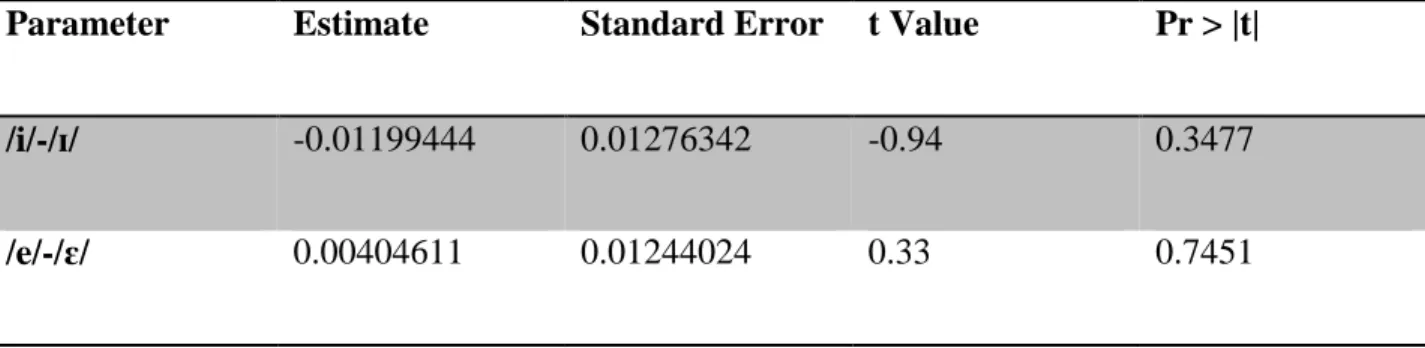
durational difference within each vowel pair of the control group in FDS vs NDS (see table 4.3.1
below).
Table 4.3.1 Significance of ESL teacher group (NDS vs FDS difference) vs control group (NDS
vs FDS difference) for tense/lax pairs
Parameter Estimate Standard Error t Value Pr > |t|
/i/-/ɪ/ -0.01199444 0.01276342 -0.94 0.3477
Despite the variance displayed in these speakers, when the data of the ESL teacher group
as a whole are examined, some interesting patterns emerge. First, when the average distances
within tense and lax pairs in FDS versus NDS are compared, a greater distance in the /i/-/ɪ/ pair
can be found in FDS. The average durational distance between the tense and lax vowels in this
pair is a difference of 9.4 ms from NDS to FDS. This indicates that the tense-lax distinction for
this pair could be undergoing hyper-articulation in FDS, emphasizing the tense-lax distinction in
terms of duration. This difference, while small and lacking statistical significance, was the most
consistent trend in the ESL teachers’ data that shows possible evidence of hyper-articulation in
terms of vowel duration.
In addition, though individual differences were observed across speakers in the control
group, when the group’s average tense/lax distance was compared in FDS versus NDS, a
different pattern than that found in the ESL teacher group was found here. For the tense-lax pair
/e/-/ɛ/, the durational difference was exaggerated in FDS compared to NDS on a very small level,
with the durational difference within this pair greater in FDS by 3.86 ms.
It was also found that there was no significant difference when comparing durational
difference between FDS and NDS in both the ESL teacher group and control subject group for
both tense/lax pairs (see tables 4.3.2 and 4.3.3 below).
Table 4.3.2 Significance of FDS vs NDS durational difference for /i/-/ɪ/
Parameter Estimate Standard Error t Value Pr > |t|
Teachers -0.00940833 0.00902510 -1.04 0.2976
Table 4.3.3 Significance of FDS vs NDS durational difference for /e/-/ɛ/
Parameter Mean estimate Standard Error t Value Pr > |t|
Teachers 0.00011833 0.00879658 0.01 0.9893
Controls -0.00392778 0.00879658 -0.45 0.6554
Though the contrast of FDS vs NDS for durational difference within the tense/lax pair
/e/-/ɛ/ was not significant for either group, the average durational distance between /e/ and /ɛ/
was significant within both FDS and NDS for both groups (see tables 4.3.4 and 4.3.5 below).
Table 4.3.4 Statistical analysis for durational difference between /e/ and /ɛ/ for ESL teachers
Parameter Mean estimate Standard Error t Value Pr>|t|
NDS 0.0267375 0.00622012 4.3 <.0001
FDS 0.02661917 0.00622012 4.28 <.0001
Table 4.3.5 Statistical analysis for durational difference between /e/ and /ɛ/ for control group
Parameter Mean estimate Standard error t value Pr>|t|
NDS 0.01835778 0.00622012 2.95 0.0033
FDS 0.02228556 0.00622012 3.58 0.0004
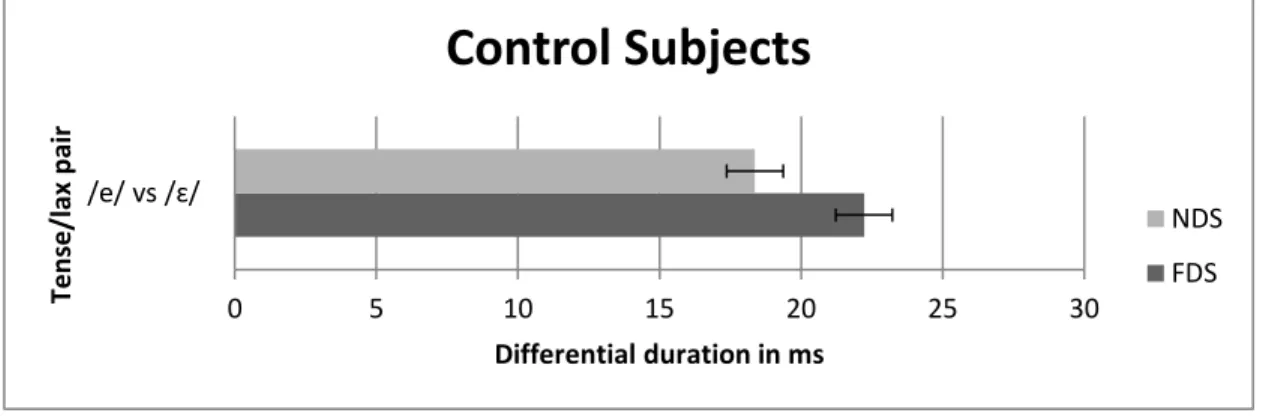
durational difference within /e/-/ɛ/ was 18.37 ms in NDS, and 22.23 ms in FDS. Though the
control group seems to increase the distance between /e/ and /ɛ/ in FDS compared to NDS (see
figure 4.3.7), the increase is not statistically significant.
Figure 4.3.6 Durational difference between /e/ and /ɛ/ for ESL teachers
Figure 4.3.7 Durational difference between /e/ and /ɛ/ for control subjects
It was found that the durational difference in FDS vs NDS within the tense/lax pair /i/- /ɪ/
was not significant for either group (as seen above in example 4.3.2), and the average durational
distance between /i/ and / ɪ / was not significant within either FDS and NDS for either group (see
tables 4.3.8 and 4.3.9 below).
0 5 10 15 20 25 30
/e/ vs /ɛ/
Differential duration in ms
Ten
se/l
ax
p
ai
r
ESL Teachers
NDS FDS
0 5 10 15 20 25 30
/e/ vs /ɛ/
Differential duration in ms
Ten
se/l
ax
p
ai
r
Control Subjects
Table 4.3.8 Statistical analysis for durational difference between /i/ and /ɪ/ for ESL teachers
Parameter Mean estimate Standard error t Value Pr>|t|
NDS 0.00714722 0.00638171 1.12 0.2632
FDS 0.01655556 0.00638171 2.59 0.0097
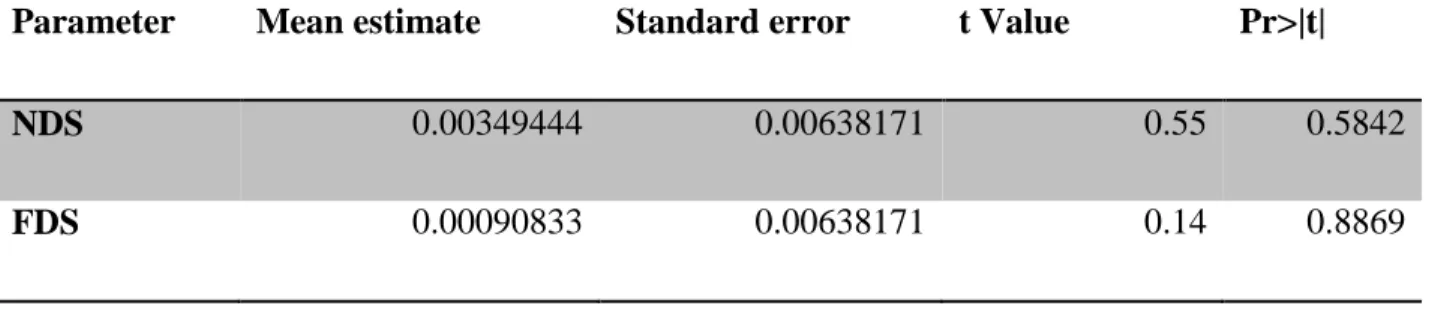
Table 4.3.9 Statistical analysis for durational difference between /i/ and /ɪ/ for control subjects
Parameter Mean estimate Standard error t Value Pr>|t|
NDS 0.00349444 0.00638171 0.55 0.5842
FDS 0.00090833 0.00638171 0.14 0.8869
For the tense/lax pair /i/-/ɪ/, the ESL teacher group’s durational difference was 7.15 ms in
NDS, and 16.55 ms in FDS, making the durational difference in FDS greater than that in NDS by
9.4 ms (see figure 4.3.10 below). While the proportional difference between these two numbers
looks noteworthy, the difference is still not able to be statistically established as significant.
below).
Figure 4.3.10 Durational difference between /i/ and /ɪ/ for ESL teachers
0 5 10 15 20 25 30
/i/ vs /ɪ/
Ten
se/l
ax
p
ai
r
ESL Teachers
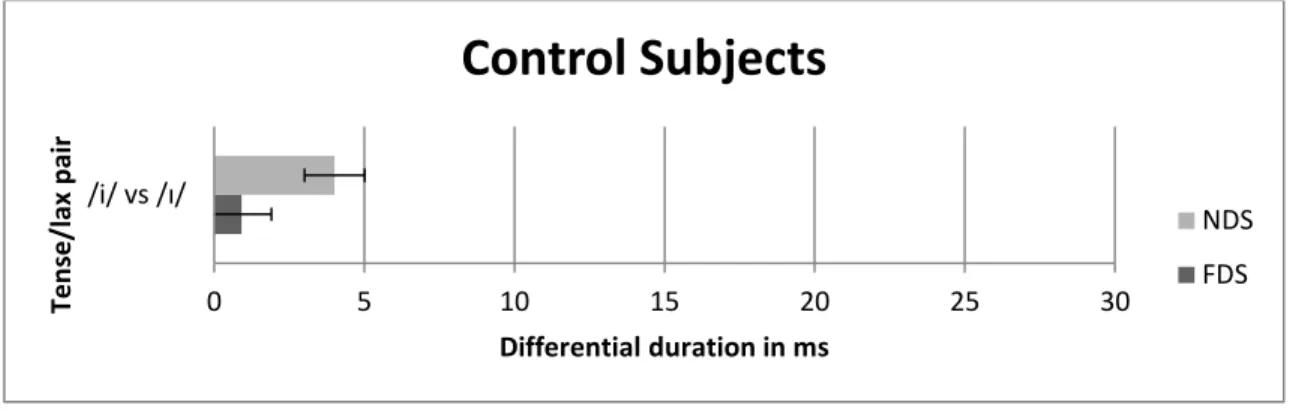
The control subjects’ durational difference for this same pair was 4.01 ms in NDS, and
0.91 ms in FDS, though this difference was also not found to be statistically significant (see
figure 4.3.11). In addition, this difference between FDS and NDS is opposite of what was
predicted, with the durational difference in FDS being shorter than NDS.
Figure 4.3.11 Durational difference between /i/ and /ɪ/ for control subjects
When the durational difference within each tense/lax pair was compared between the
ESL teacher group and the control subject group, the ESL teachers were not found to
hyper-articulate tense and lax vowel duration distinctions more than the control group in any significant
way. It is interesting to note, however, that each group put significant durational distance
between /e/ and /ɛ/, but not between /i/ and /ɪ/. And, though the ESL teachers did not seem to
hyper-articulate the /e/- /ɛ/ contrast by exaggerating the durational differences in FDS versus
NDS, they did seem to do this for the /i/-/ɪ/ contrast in FDS versus NDS, though the durational
distance within this pair was not large.
Contrary to what was expected, the control group seemed to produce more homogeneous
results than the ESL teacher group—the durational distances between /i/-/ɪ/ and /e/- /ɛ/ in FDS
versus NDS were, respectively, 3.1 ms and 3.86 ms. In contrast, the ESL teacher group
produced durational distances for the same pairs in FDS and NDS with a difference of 9.4 ms for
0 5 10 15 20 25 30
/i/ vs /ɪ/
Differential duration in ms
Ten
se/l
ax
p
ai
r
Control Subjects
/i/-/ɪ/, and a difference of 0.11 ms for /e/- /ɛ/. Again, this seems like an interesting proportional
difference, but the statistical analysis does not support that this difference is significant, and
without more subjects to confirm this apparent trend, cannot be claimed as a definitive proof of
vowel duration hyper-articulation in FDS.
CHAPTER 5: GENERAL DISCUSSION
In this study, it was found that there was a significant durational difference between /e/
and /ɛ/, but not between /i/ and /ɪ/, for both the ESL teacher group and the control subject group.
Neither group significantly exhibited features of FDS in either tense /lax vowel durational
exaggeration or in overall vowel lengthening from NDS to FDS. However, though the
differences were small and insignificant, the ESL group displayed a trend more in line with
vowel hyper-articulation, while the control group displayed a trend more consistent with overall
vowel lengthening. Whether these vowel length modifications have anything to do with
experience interacting with nonnative speakers, or are completely due to chance, remains to be
studied further.
Past studies have shown that in both Infant-Directed Speech (IDS) and
Foreigner-Directed Speeh (FDS), vowels are altered from normal speech, presumably to aid the listener to
better perceive phonetic contrasts in the target language (Uther et al, 2007; Scarborough et al,
2007; Kuhl et al, 1997; Andruski et al, 1999; Burnham et al, 2002). However, whether tense
and lax vowels are hyper-articulated in FDS by expanding the vowel space within each pair, or
by emphasizing their durational differences, is still unclear.
In the future, this study could be improved upon and expanded in several different ways.
First, increasing the number of subjects would be helpful in determining the patterns found in
this study more definitively, and in establishing whether the features of FDS analyzed in this
chance, and which are not. Along with testing vowel duration contrasts, it might also shed more
light on the nuances of Foreigner-Directed Speech to perform a study that compares formant
frequencies within and across subjects, to see if there is a marked difference in formant values
from NDS to FDS. This would bring more information to the discussion of whether formant
frequencies (vowel space expansion) or vowel duration contrasts are more hyper-articulated in
Foreigner-Directed Speech by native English speakers, and would also aid further research
investigating what perceptual cues are actually helpful to nonnative learners of English in the
process of phoneme categorization.
Since this study did not definitively conclude that ESL teachers use FDS in a more
exaggerated manner than other native English speakers, and did not show significant effects of
FDS in the speech of either group as a whole, this raises the question of how much features of
FDS vary between individual speakers. Again, testing this question would require a larger
number of subjects for recording and analysis. Since FDS appears to be used for the purpose of
aiding nonnative speakers to perceive nonnative phonetic contrasts, and is adapted to the specific
needs of the intended listener (Uther et al, 2007), it is possible that an individual speaker might
vary his or her use of FDS according to the situation and the interlocutor, and might not vary this
use of FDS the same way another native English-speaking peer might. It would be advantageous
to continue analyzing both durational and formant hyper-articulation in the speech of native
English speakers to nonnative speakers, to uncover any over-arching patterns that may exist in
FDS.
A longitudinal study, focusing on the production and perception of nonnative vowel
features of FDS may be advantageous in phoneme categorization, and whether some types of
hyper-articulation (either formant-related or duration-related) are more helpful than others. There
is still a great deal to be studied and learned about how perception and production work together
in the acquisition of a second language, and what cues native speakers give nonnative speakers to
help categorize nonnative phonemes and contrasts. Whether or not ESL teachers do
hyper-articulate contrasts such as tense and lax vowel durations more so than other native English
speakers, and in what conditions native English speakers do use durational cues to
APPENDIX A: INDIVIDUAL RESULTS
1. ESL teachers
Figure 1.1 Teacher 1: /i/
Figure 1.2 Teacher 1: /ɪ/
Figure 1.3 Teacher 1: /e/
Figure 1.4 Teacher 1: /ɛ/
Figure 1.5 Teacher 2: /i/
Figure 1.6 Teacher 2: /ɪ/
0 20 40 60 80 100 120 140 160
D
u
rati
on
in
m
s
Tokens
FDS /i/ NDS /i/
0 20 40 60 80 100 120 140
D
u
rati
on
in
m
s
Tokens
Figure 1.7 Teacher 2: /e/
Figure 1.8 Teacher 2: /ɛ/
Figure 1.9 Teacher 3: /i/
Figure 1.10 Teacher 3: /ɪ/
0 20 40 60 80 100 120
D
u
rati
on
in
m
s
Tokens
FDS /i/ NDS /i/
0 20 40 60 80 100 120
D
u
rati
on
in
m
s
Tokens
Figure 1.11 Teacher 3: /e/
Figure 1.12 Teacher 3: /ɛ/
Figure 1.13 Teacher 4: /i/
Figure 1.14 Teacher 4: /ɪ/
0 20 40 60 80 100 120
D
u
rati
on
in
m
s
Tokens
FDS /i/ NDS /i/
0 20 40 60 80 100 120
D
u
rati
on
in
m
s
Tokens
Figure 1.15 Teacher 4: /e/
Figure 1.16 Teacher 4: /ɛ/
2. Control subjects
Figure 2.1 Control 1: /i/
Figure 2.2 Control 1: /ɪ/
Figure 2.3 Control 1: /e/
Figure 2.4 Control 1: /ɛ/
Figure 2.5 Control 2: /i/
Figure 2.6 Control 2: /ɪ/
0 20 40 60 80 100 120
D
u
rati
on
in
m
s
Tokens
FDS /i/ NDS /i/
0 20 40 60 80 100 120 140
D
u
rati
on
in
m
s
Tokens
Figure 2.7 Control 2: /e/
Figure 2.8 Control 2: /ɛ/
Figure 2.9 Control 3: /i/
Figure 2.10 Control 3: /ɪ/
0 20 40 60 80 100 120
D
u
rati
on
in
m
s
Tokens
FDS /i/ NDS /i/
0 20 40 60 80 100 120
D
u
rati
on
in
m
s
Tokens
Figure 2.11 Control 3: /e/
Figure 2.12 Control 3: /ɛ/
0 20 40 60 80 100 120 140 160 180
D
u
rati
on
in
m
s
Tokens
FDS /e/ NDS /e/
0 20 40 60 80 100 120
D
u
rati
on
in
m
s
Tokens
Figure 2.13 Control 4: /i/
Figure 2.14 Control 4: /ɪ/
0 50 100 150 200 250
D
u
rati
on
in
m
s
Tokens
FDS /i/ NDS /i/
0 20 40 60 80 100 120 140
D
u
rati
on
in
m
s
Tokens
Figure 2.15 Control 4: /e/
Figure 2.16 Control 4: /ɛ/
APPENDIX B: GROUP RESULTS
Group results
1. ESL teachers
Figure 1.1 Average durational distance between ESL teachers’ /i/-/ɪ/ in FDS
Figure 1.2 Average durational distance between ESL teachers’ /e/-/ɛ/ in FDS
0 10 20 30 40 50 60 70 80 90 100
0 1 2 3 4 5
D u rati on in m s Subjects FDS /i/ FDS /ɪ/ 0 20 40 60 80 100 120 140
0 1 2 3 4 5
Figure1.3 Average durational distance between ESL teachers’ /i/-/ɪ/ in NDS
Figure1.4 Average durational distance between ESL teachers’ /e/-/ɛ/ in NDS
0 10 20 30 40 50 60 70 80 90
0 1 2 3 4 5
D u rati on in m s Subjects NDS /i/ NDS /ɪ/ 0 20 40 60 80 100 120
0 1 2 3 4 5
2. Control subjects
Figure 2.1 Average durational distance between control subjects’ /i/-/ɪ/ in FDS
Figure 2.2 Average durational distance between control subjects’ /e/-/ɛ/ in FDS
0 10 20 30 40 50 60 70 80 90 100
0 1 2 3 4 5
D u rati on in m s Subjects FDS /i/ FDS /ɪ/ 0 20 40 60 80 100 120
0 1 2 3 4 5
Figure 2.3 Average durational distance between control subjects’ /i/-/ɪ/ in NDS
Figure 2.4 Average durational distance between control subjects’ /e/-/ɛ/ in NDS
0 10 20 30 40 50 60 70 80 90
0 1 2 3 4 5
D u rati on in m s Subjects NDS /i/ NDS /ɪ/ 0 20 40 60 80 100 120
0 1 2 3 4 5
REFERENCES
Boersma, Paul & Weenink, David (2013). Praat: doing phonetics by computer [Computer program]. Version 5.3.53, retrieved 22 August 2013 from http://www.praat.org/
Brosseau-Lapre, F., Rvachew, S., Clayards, M., & Dickson, D. (2013). Stimulus variability and perceptual learning of nonnative vowel categories. Applied
Psycholinguistics, 34(3), 419-441. doi:http://dx.doi.org/10.1017/S0142716411000750
Bundgaard-Nielsen, R., Best, C. T., Kroos, C., & Tyler, M. D. (2012). “Second language learners' vocabulary expansion is associated with improved second language vowel intelligibility.” Applied Psycholinguistics, 33(3), 643-664. doi:http://dx.doi.org/ 10.1017/S0142716411000518.
Caisse, M. (1988). Modeling english vowel durations (Order No. 8916603). Available from ProQuest Dissertations & Theses Full Text; ProQuest Dissertations & Theses Global. (303679497). Retrieved from http://search.proquest.com/docview/303679497? accountid=14244.
Chen, Y. (2006). Production of tense-lax contrast by Mandarin speakers of English. Folia
Phoniatrica Et Logopaedica, 58(4), 240-9. Retrieved from http://search.proquest.com/
docview/232954613?accountid=14244.
Flege J, MacKay I, Meador D. Native Italian speakers’ production and perception of English vowels. Journal of the Acoustical Society of America. 1999;106:2973–2987.
Giles, H., Coupland, N. (1988) “Introduction: The Communicative Contexts of Accommodation.”
Language and Communication. Vol 8, No. ¾, pp. 175-182.
Ivanova, J. P. (2011). The effects of teacher talk on L2 learners' comprehension. (Order No. 1502847, The University of Utah). ProQuest Dissertations and Theses, 72. Retrieved from http://search.proquest.com/docview/913106063?accountid=14244. (913106063).
Poole, D. (1992), Language Socialization in the Second Language Classroom. Language
Learning, 42: 593–616. doi: 10.1111/j.1467-1770.1992.tb01045.x
Rahimian, M. (2013). Communication accommodation theory in conversation with second
language learners. (Order No. MS25817, University of Manitoba (Canada)). ProQuest
Dissertations and Theses, 99. Retrieved from http://search.proquest.com/docview/
1513966562?accountid=14244.(1513966562).
Scarborough, R., Brenier, J., Zhao, Y., Hall-Lew, L,. and Dmitrieva, O. (2007) “An Acoustic Study of Real and Imagined Foreigner-Directed Speech.” Proceedings of the
International Congress of Phonetic Sciences.
Thomas, E.R. (2011). Sociophonetics: An Introduction. New York: Palgrave Macmillan, 2011.
Tsukada, K. (2012). “Comparison of native versus nonnative perception of vowel length contrasts in Arabic and Japanese.” Applied Psycholinguistics, 33(3), 501-516. doi:http://dx.doi.org/10.1017/S0142716411000452.
Tsukada, K., Birdsong, D., Bialystok, E., Mack, M., Sung, H & Flege, J.E. (2005). “Vocabulary size matters: The assimilation of second-language Australian English vowels to first- language Japanese vowel categories.” Journal of Phonetics, 33, 263-290.
Uther, M; Knoll, M.A. and Burnham, D. ( 2007). “Do you speak E-NG-L-I-SH? A comparison of foreigner- and infant-directed speech.” Speech Communication. 49, 1 (January 2007), 2-7. DOI=10.1016/j.specom.2006.10.003 http://dx.doi.org/10.1016/j.specom.2006.10.003.
Van der Feest, Suzanne V.H. and Swingley, Daniel. (2011) “Dutch and English listeners’
interpretation of vowel duration.” The Journal of the Acoustical Society of America. DOI: 10.1121/1.3532050.
Watt, Dominic; Llamas, Carmen; and Johnson, Daniel Ezra. “Levels of Linguistic
Accommodation across a National Border.” Journal of English Linguistics. 2010 38: 270. <http:/eng.sagepub.com/content/38/3/270>.
Werker, Janet F., Gilbert, John H.V., Humphrey, Keith and Tees, Richard C. (1981).
“Developmental Aspects of Cross-Language Speech Perception.” Child Development. Vol. 52, No. 1 (Mar., 1981), pp. 349-355 <http://www.jstor.org/stable/1129249>.
Wolfram, Walt. “Chapter 2: Integrating Language Variation into TESOL: Challenges from English Globalization.” Englishes in Multilingual Contexts. Springer Science Business Media, Dordrecht: 2014.
Yang, Jing and Fox, Robert A. (2013) “Perception of English Vowels by Bilingual Chinese- English and Corresponding Monolingual Listeners.” Language and Speech: June 2014,vol. 57 no. 2 215-237. Originally published online September 15, 2013,