doi: 10.3389/fmicb.2017.01158
Edited by: Abhay Satoskar, The Ohio State University Columbus, United States
Reviewed by: Jorge Benach, Stony Brook University, United States Lee Mark Wetzler, Boston University School of Medicine, United States Vijay Pancholi, The Ohio State University Columbus, United States
*Correspondence: Karsten R. O. Hazlett [email protected]
†
Present Address: Brian Franz, Department of Genetics, University of North Carolina, Chapel Hill, NC, United States; Anju Singh and Timothy J. Sellati, Drug Discovery Division, Department of Infectious Diseases, Southern Research, Birmingham, AL, United States
‡
Co-first authors.
Specialty section: This article was submitted to Microbial Immunology, a section of the journal Frontiers in Microbiology
Received:20 January 2017 Accepted:07 June 2017 Published:22 June 2017
Citation: Holland KM, Rosa SJ, Kristjansdottir K, Wolfgeher D, Franz BJ, Zarrella TM, Kumar S, Sunagar R, Singh A, Bakshi CS, Namjoshi P, Barry EM, Sellati TJ, Kron SJ, Gosselin EJ, Reed DS and Hazlett KRO (2017) Differential Growth of Francisella tularensis, Which Alters Expression of Virulence Factors, Dominant Antigens, and Surface-Carbohydrate Synthases, Governs the Apparent Virulence of Ft SchuS4 to Immunized Animals. Front. Microbiol. 8:1158. doi: 10.3389/fmicb.2017.01158
Differential Growth of
Francisella
tularensis,
Which Alters Expression
of Virulence Factors, Dominant
Antigens, and Surface-Carbohydrate
Synthases, Governs the Apparent
Virulence of
Ft
SchuS4 to Immunized
Animals
Kristen M. Holland1‡, Sarah J. Rosa1‡, Kolbrun Kristjansdottir2, Donald Wolfgeher3,
Brian J. Franz1 †, Tiffany M. Zarrella1, Sudeep Kumar1, Raju Sunagar1, Anju Singh4 †,
Chandra S. Bakshi5, Prachi Namjoshi1, Eileen M. Barry6, Timothy J. Sellati4 †,
Stephen J. Kron3, Edmund J. Gosselin1, Douglas S. Reed7and Karsten R. O. Hazlett1*
1Department of Immunology and Microbial Disease, Albany Medical College, Albany, NY, United States,2Department of
Biomedical Sciences, Midwestern University, Downers Grove, IL, United States,3Department of Molecular Genetics and Cell Biology, University of Chicago, Chicago, IL, United States,4Trudeau Institute, Saranac Lake, NY, United States,5Department of Microbiology and Immunology, New York Medical College, Valhalla, NY, United States,6School of Medicine, University of Maryland, Baltimore, MD, United States,7Center for Vaccine Research, University of Pittsburgh, Pittsburgh, PA, United States
The gram-negative bacterium Francisella tularensis (Ft) is both a potential biological
weapon and a naturally occurring microbe that survives in arthropods, fresh water amoeba, and mammals with distinct phenotypes in various environments. Previously,
we used a number of measurements to characterize Ft grown in Brain-Heart Infusion
(BHI) broth as (1) more similar to infection-derived bacteria, and (2) slightly more
virulent in naïve animals, compared to Ft grown in Mueller Hinton Broth (MHB). In
these studies we observed that the free amino acids in MHB repress expression
of select Ft virulence factors by an unknown mechanism. Here, we tested the
hypotheses thatFt grown in BHI (BHI-Ft) accurately displays a full protein composition
more similar to that reported for infection-derived Ft and that this similarity would
make BHI-Ft more susceptible to pre-existing, vaccine-induced immunity than
MHB-Ft. We performed comprehensive proteomic analysis of Ft grown in MHB, BHI,
and BHI supplemented with casamino acids (BCA) and compared our findings to
published “omics” data derived from Ft grown in vivo. Based on the abundance
of ∼1,000 proteins, the fingerprint of BHI-Ft is one of nutrient-deprived bacteria
that—through induction of a stringent-starvation-like response—have induced the FevR regulon for expression of the bacterium’s virulence factors, immuno-dominant antigens, and surface-carbohydrate synthases. To test the notion that increased
abundance of dominant antigens expressed by BHI-Ft would render these bacteria
Ft S4. Contrary to our hypothesis, these experiments reveal that LVS-immunization provides a barrier to infection that is significantly more effective against an MHB-S4 challenge than a BHI-S4 challenge. The differences in apparent virulence to immunized mice are profoundly greater than those observed with primary infection of naïve mice. Our findings suggest that tularemia vaccination studies should be critically evaluated in regard to the growth conditions of the challenge agent.
Keywords: tularemia immunization, bacterial adaptation, virulence factor, bacterial capsules, bacterial media
INTRODUCTION
Francisella tularensis (Ft) is an extremely infectious gram-negative bacterium that is readily aerosolized. Inhalation of this select agent can lead to pulmonary tularemia which has a mortality rate of∼35% in the absence of treatment. Reportedly,
antibiotic-resistant strains of this bacterium were developed by at least one nation’s biological weapons program (Oyston et al., 2004). The risk of such an agent being maliciously employed, in concert with the current lack of a licensed tularemia vaccine, has prompted intense interest inFt. This pathogen is naturally-occurring in diverse environments including warm-and cold-blooded hosts (Oyston et al., 2004) warm-and has both intracellular (replicative) and extracellular (transmissive) phases (Abd et al., 2003; Forestal et al., 2007; Yu et al., 2007; Bar-Haim et al., 2008; Thelaus et al., 2009). Mounting evidence indicates that as Ft progresses through the intracellular cycle (phagocytosis, phagosomal escape, logarithmic cytoplasmic replication, induction of autophagic vacuoles, and cellular egress) the bacterium adapts by modulating expression of manyFtgenes (de Bruin et al., 2007; Chong et al., 2008; Wehrly et al., 2009).
A number of studies have examined the role of relevant environmental cues such as temperature (Horzempa et al., 2008), iron (Deng et al., 2006; Lenco et al., 2007), and amino acid concentration (Hazlett et al., 2008; Zarrella et al., 2011) on bacterial gene expression. Horzempa et al. found that ∼11% of the Ft transcriptome was differentially-expressed in FtLVS grown at 26 and 37◦C in Chamberlain’s defined medium
(CDM;Chamberlain, 1965; Horzempa et al., 2008). These genes included heat-shock proteins and those involved in amino-acid metabolism but, with one exception, did not include members of the Francisella Pathogenicity Island (FPI) which are required for infection of both mammalian and non-mammalian hosts. Deng et al. comparedFtLVS grown in Mueller-Hinton Broth (MHB) that was iron-replete or -deficient and identified 80 Fe-responsive genes (Deng et al., 2006). The most strongly induced (10–20 fold change) genes were those involved with synthesis and utilization of Fe-chelating siderophores (Deng et al., 2006; Sullivan et al., 2006; Ramakrishnan et al., 2008). In this study, more modest impacts (∼2- to 3-fold) were noted for the remaining 75 genes including chaperones, ribosomal proteins, and select FPI proteins such as members of the Intracellular growth locus (Igl). Within the mammalian environment, the bacterium is thought to be exposed to fluctuations in growth phase and levels of nutrients such as amino acids which are ∼20 times higher in the host cell cytoplasm than in the extracellular milieu (Bergstrom et al.,
1974). Guina et al. observed that F. novicida (Fn) mutants lacking a key transcriptional regulator (MglA) have a marked survival defect upon entering stationary phase in a restrictive environment (MHB). In this study, the defects were linked to increased susceptibility to nutrient starvation and oxidative stress (Guina et al., 2007). The impact of stationary phase on the proteome of Ft has been confirmed with both the live vaccine strain (LVS) and the human-virulent strain SchuS4 (S4) (Lenco et al., 2009). Interestingly, FPI-induction in CDM-grown, stationary phase LVS and S4 is lower (∼2-fold) than that reported
forFtLVS and S4 grownin vivowhich show an FPI-induction of∼4- to 5-fold (Twine et al., 2006a; Wehrly et al., 2009; Bent et al., 2013; Thomas-Charles et al., 2013). We have used growth ofFtLVS and S4 in MHB and BHI broth as FPI-restrictive and FPI-permissive models respectively. By using BHI supplemented with casamino acids (BCA) we found that Igl induction in BHI-Ftis sensitive to the concentration of free amino acids (Hazlett et al., 2008).
The mutability of Ft presents a challenge to vaccine development as the nature of the challenge inoculum (with potentially distinct antigenic compositions) can vary widely. Upon entering the mammalian environment, the surviving inoculated bacteria will presumably adapt regardless of its prior history (i.e., phenotype). However, the window of time required for complete bacterial adaptation and the impact of this window on infection and immunization outcomes is still a developing field of inquiry. Cherwonogrodzky et al. first reported that the virulence ofFtLVS for naïve mice could be increased by repeated passage of the bacterium in CDM to promote accumulation of capsular material (Cherwonogrodzky et al., 1994). Loegering et al. demonstrated thatFtLVS passed through host cells were less pro-inflammatory to uninfected macrophages (M8) and more virulent in naïve mice than were non-host-adapted/MHB-grown bacteria (Loegering et al., 2006). Using Ft grown in BHI or MHB as models of host-adapted and non-host-adapted bacteria respectively, we found thatFt LVS and S4 grown in BHI produce/retain more capsular material. We found that this capsular material hinders various immune effectors and shortens the median survival time (MST) of naïve mice by 12–24 h (Hazlett et al., 2008; Zarrella et al., 2011). Faith et al. used an aerosol challenge model of naïve mice to assess the impact of growth in MHB, CDM, and BHI on the aerosolization and infectivity of Ft LVS. The authors found that growth in BHI was associated with better bacterial survival during aerosolization and a decreased LD99 (Faith et al., 2012). Collectively, the
be impacted modestly by the immediate growth history of the challenge agent. This is reminiscent of early work with another zoonotic adaptable pathogen, Yersinia pestis (Yp), in which inoculation of naïve mice with bacteria that were pre-adapted to mammalian environmental temperature resulted in a shorter MST (Rosenwald and Lincoln, 1966). This now is understood to result from adaptive changes in (i) the structure ofYpLPS (to a less inflammatory form) and (ii) regulated expression of virulence factors such as the capsular F1 Ag (Rebeil et al., 2004; Montminy et al., 2006).
While the impact of growth-media/adaptation status on Ft infection of naïve animals is developing, the role of these factors on tularemia vaccination is less well-explored. Recently, we reported that the immune-stimulatory nature of MHB-Ftmakes inactivated forms of these bacteria better immunogens against challenge with Ft LVS (Kumar et al., 2016). Hypothetically, immunization outcomes could be also impacted by differential-growth of the challenge agent, which could display altered susceptibility to vaccine-induced immunity—at least until the challenge agent adapts to the host environment. Examples of this include subunit vaccines against zoonotic pathogens such as the Decorin-binding protein A (DbpA) ofBorrelia burgdorferi(Bb) and the Ft outer membrane protein A (FopA). Immunization with DbpA protects mice against infection within vitrocultivated Bb but not tick-transmittedBb. This is due largely to the fact that DbpA is expressedin vitrobut not by tick-borne spirochetes (Hagman et al., 2000; Blevins et al., 2008). Similarly, vaccination with purified FopA can provide significant protection against challenge with MHB-FtLVS but not against challenge with either Ft S4 (Hickey et al., 2011) or BHI-FtLVS (Hickey, 2011). The protective capacity of FopA immunization correlates with the lower levels of capsule and increased binding of FopA-specific Ab observed with MHB-FtLVS (Hickey et al., 2011; Zarrella et al., 2011).
Here we used a battery of proteomic and serological analyses combined with immunization and challenge assays to further explore the impact of Ft’s phenotypic mutability on tularemia vaccine research. We tested the hypotheses that (i)Ftgrown in BHI (BHI-Ft) displays a full protein composition more similar to that reported for infection-derived Ft and (ii) that this similarity would make BHI-Ftmore susceptible to pre-existing, vaccine-induced immunity than MHB-Ft. Our findings indicate that, compared to Ft grown in MHB, BHI-Ft has increased proteomic similarity to host-adapted Ft and altered reactivity with infection-derived sera from multiple species. Significantly, in multiple experiments, with distinct immunization strategies, we found that immunized mice are significantly more susceptible to respiratory challenge with BHI-FtS4 than to challenge with MHB-Ft S4. In effect, BHI-Ft S4 appears more virulent to immunized mice than does MHB-FtS4 despite the fact that there is little difference in virulence to naïve mice.
MATERIALS AND METHODS
Bacteria and Fractionation
The LVS strain of Ft was acquired from BEI (NR-646) and was grown in vitroin MHB, BHI, or BHI supplemented with
casamino acids (BCA) as previously described (Hazlett et al., 2008; Hickey et al., 2011; Zarrella et al., 2011). LVS mutant strains used here have been described elsewhere (Su et al., 2007).FtS4 was used within the CDC-certified A/BSL-3 facilities of Albany Medical College, the University of Pittsburgh, and the Trudeau Institute. Late-log phaseFtgrown in MHB, BHI, or BCA were harvested by centrifugation (8,000×g, 15 min, 20◦C). Bacterial
pellets were resuspended in the appropriate fresh growth media, transferred to pre-weighed Eppendorf tubes, pelleted as above after which the transfer supernatant was aspirated. Pellet wet weights were determined and used to estimate cell numbers based upon the estimate of 1 mg of wet weight = 5 × 10⁸
bacteria. Cells were resuspended to 2.5×10⁷/µl (higher bacterial concentrations promoted protein precipitation in subsequent steps) in 20 mM Tris, pH 8.0 containing 100 mM NaCl, 20µl/ml protease inhibitor cocktail (Sigma, #P8849). After determining the protein concentrations (DC protein assay, BioRad, Hercules, CA), equilibrated bacterial suspensions were supplemented with EDTA to 5 mM, lysozyme to 100µg/ml, Benzonase (1µl/ml, Sigma), and Triton X-114 (Acros, NJ) to 1% from a 10% stock in PBS. Following a 1 h incubation at room temperature with periodic gentle agitation, a 1/20 vol. aliquot was saved as the whole-cell (WC) fraction; the WC and remaining sample were stored at −20◦C overnight. The samples were thawed
and incubated at RT until further viscosity reduction abated. Following 15 min incubation on ice, the samples were centrifuged (20 min, 16,500×g, 4◦C) to yield Triton X-114 soluble (TxS)
and insoluble (TxI) fractions. The TxS fractions were transferred to fresh tubes and centrifuged again to remove any TxI carry-over; the TxI fractions were washed twice with cold PBS (1 vol). The TxS fractions were incubated in a 32◦C water bath for ∼10 min followed by centrifugation (7,000× g, RT, 15 min) to effect phase partitioning (Bordier, 1981; Radolf et al., 1988; Sjostedt et al., 1991; Hazlett et al., 2001, 2005) into aqueous (top) and detergent (bottom) phases (any protein precipitation at this step rendered the samples useless, such experiments were discarded). Recovered phases were washed by supplementation (to 1% Triton X-114—A or 10 vol PBS—D) followed by phase separation; three washes per recovered phase were performed. The washed Triton insoluble (TxI) phases were resuspended in PBS containing 0.2% sarkosyl (Fisher Scientific, Fair Lawn, NJ) and incubated for 20 min with gentle agitation followed by centrifugation (30 min, 4◦C, 16,500 ×g). The sarkosyl-soluble
(SS) fraction was recovered and centrifuged a second time to remove any carryover of insoluble material. The sarkosyl-insoluble (SI) material was washed once with PBS, 0.2% sarkosyl and dissolved in 10 mM Tris, pH = 8.0 containing 1% SDS. WC, A, D, SS, and SI fractions were resolved by SDS-PAGE. Occasionally the D, SS, and SI phases were pooled to represent the total membrane fraction.
SDS-PAGE and Western Blot Analysis
Resolved gels were stained with either Coomassie blue (BioRad) or transferred to nitrocellulose membranes. Coomassie-stained gels were scanned into Adobe Photoshop using an HP 2820 scanner. Membranes were blocked for 30 min with PBS, 0.05% Tween 20, 5% non-fat dry milk. Primary Abs were applied for overnight incubation at dilutions ranging from 1:1,000 to 1:60,000. Blots to be probed multiple times were first probed with mAb prior to stripping and reprobing with polyclonal sera. HRP-conjugated secondary Abs were used at dilutions ranging from 1:1,000 to 1:20,000. Occasionally the secondary conjugate was a biotinylated goat α-species-specific Ab followed by a tertiary conjugate of streptavidin-linked HRP. Development of the chemiluminescent substrate (SuperSignal West Pico, Pierce, Rockford, IL) was visualized using an Alpha Innotech imaging system in movie mode. Densitometric analysis of developed blots was performed on the same system.
Proteomics
Sample Preparation for Mass Spectrometry
For each growth condition (MHB, BHI, or BCA), the WC and 4 subfractions (A, D, SS, SI) were run on SDS-PAGE gels either Full-Length (WC and A), or in a Gel Plug (D, SS, SI). Each fraction was mixed with sample buffer (w/β-ME) to a final vol of 100µl. Full-Length: loaded 10µl (1×10⁸Fteq)/lane on 4–12%
SDS-PAGE gradient gels ran at 50 V for 4 h (Invitrogen). Gel-Plug: loaded 10µl (5×10⁸ Fteq)/lane on 12% SDS-PAGE gel ran at 50 V for 40 min to create “1D-Gel plug” (Invitrogen). All SDS-PAGE gels were stained with 25 mL Imperial Stain (Thermo 24615) for 1 h at 22◦C and destained overnight at 4◦C.
Trypsin Digestion of Samples from SDS-PAGE Gels SDS-PAGE Gel Sectioning:Samples from full-length SDS-PAGE gels (WC and A) were cut into 10 equal sections. Samples from the D1 and SS gel-plug SDS-PAGE were cut into two equal sections while the SI samples were cut into one section.Trypsin Digestion:Protein bands to be analyzed, from SDS-PAGE gels, were excised by sterile razor blade and chopped into∼1 mm3
pieces. Each sample was washed in water and destained using 100 mM ammonium bicarbonate pH 7.5 in 50% acetonitrile. A reduction step was performed by addition of 100µl 50 mM ammonium bicarbonate pH 7.5 and 10µl of 10 mM Tris (2-carboxyethyl) phosphine HCl at 37◦C for 30 min. Proteins were alkylated by adding 100µl 50 mM iodoacetamide and allowed to react in the dark at 20◦C for 30 min. Gel samples were washed
in water, then acetonitrile, and dried in a SpeedVac. Trypsin digestion was carried out overnight at 37◦C with 1:50
enzyme-protein ratio of sequencing grade-modified trypsin (Promega) in 50 mM ammonium bicarbonate pH 7.5, and 20 mM CaCl2.
Peptides were extracted with 5% formic acid and vacuum dried.
Isotopic Labeling
Peptide digests were reconstituted with 70µl of Tris–HCl buffer solution (10 mM Tris-HCl, 150 mM NaCl, 20 mM CaCl2, pH
7.6), vortexed for at least 20 min to reconstitute the peptide mixture, then split into two vials of 30µl each (16O vial and 18O vial), and 10µl was retained unlabeled and stored in−80◦
C. In a separate vial, Mag-Trypsin beads (Clontech) were prepared
as follows. Thirty microliters mag-trypsin beads per rxn (16O
or18O) were pooled and washed three times with 800 µl of Tris–HCl buffer solution, then brought back up in 30 ul/sample of Tris-HCl buffer, and aliquoted to a new 1.5 ml vial in the quantity of 30µl, vortexing lightly after each aliquot to keep the mag-trypsin beads in suspension. Using a magnetic rack, the Tris-HCl buffer was removed from the beads, and the 30 µl of sample digest from above was added to the beads and vacuum dried. Thirty microliters of either 16O H2O or 97%
18O H
2O (Cambridge Isotopes Laboratories) was added to the
respective 16O or 18O prepared Mag-Trypsin bead vial and
vortexed for 20 min to reconstitute the peptide mixture, and allowed to exchange overnight at 37◦C. After18O exchange, the solution was transferred to a new vial and any free trypsin in solution was inactivated with 1 mM PMSF for 30 min at 4◦C. For
each sample section, the digests were combined 1:1 as follows: Forward (FWD) Sample Set: (BHI)-16O:(BCA)-18O, or (BHI)-16O:(MHB)-18O. Reversed (REV) Sample Set: (BCA)-16 O:(BHI)-18O, or (MHB)-16O:(BHI)-18O. Samples were dried and stored at
−80◦C until analysis. Three biological replicate experiments were
performed.
HPLC for Mass Spectrometry
The peptide samples were loaded to a 0.25 µl C8 OptiPak
trapping cartridge custom-packed with Michrom Magic C8 (Optimize Technologies), washed, then switched in-line with a 20 cm by 75 µm C18 packed spray tip nano column packed
with Michrom Magic C18AQ, for a 2-step gradient. Mobile phase A was water/acetonitrile/formic acid (98/2/0.2) whereas mobile phase B was acetonitrile/isopropanol/water/formic acid (80/10/10/0.2). Using a flowrate of 350 nl/min, a 90 min, 2-step LC gradient was run from 5 to 50% B over 60 min, followed by 50–95% B over the next 10 min, hold 10 min at 95% B, back to starting conditions and re-equilibrated.
LC-MS/MS Analysis
The samples were analyzed via electrospray tandem mass spectrometry (LC-MS/MS) on a Thermo LTQ Orbitrap XL, using a 60,000 RP survey scan, m/z 375–1,950, with lockmasses, followed by 10 LTQ CID scans on doubly and triply charged-only precursors between 375 and 1,500 Da. Ions selected for MS/MS were placed on an exclusion list for 60 s.
Database Searching
were analyzed with MaxQuant version 1.2.2, searching against the uniprot_with_Isoforms_FRATH_07_2012.fasta database using the following criteria: 18O heavy label was selected for quantitation with a min of 1 high confidence peptide to assign quantitation H/L ratio. Trypsin was selected as the protease with max miss cleavage set to 2. Carbamiodomethyl (C) was selected as a fixed modification. Variable modifications were set to Oxidization (M), Formylation (n-term). Orbitrap mass spectrometer was selected using an MS error of 20 ppm and a MS/MS error of 0.5 Da. One percent FDR cutoff was selected for peptide, protein, and site identifications.
Criteria for Protein Identification
Spectral Count Samples. Scaffold (version Scaffold_4.5.1, Proteome Software Inc., Portland, OR) was used to validate MS/MS based peptide and protein identifications. Peptide identifications were accepted if they could be established at
>95.0% probability by the Peptide Prophet algorithm (Keller et al., 2002) with Scaffold delta-mass correction. Protein identifications were accepted if they could be established at
>99.0% probability and contained at least 1 identified peptide. Protein probabilities were assigned by the Protein Prophet algorithm (Nesvizhskii et al., 2003). Proteins that contained similar peptides and could not be differentiated based on MS/MS analysis alone were grouped to satisfy the principles of parsimony.18O Quant Samples.Ratios were reported based on the MS level light and heavy peak areas determined by MaxQuant and reported in the proteinGroups.txt file as heavy/light. Proteins were removed from this results file if they were flagged by MaxQuant as “Contaminants,” “Reverse,” or “Only identified by site.” Complete three biological replicates were performed, with each biological replicate split into two technical replicates [18O forward (FWD) labeling, and18O reverse (REV) labeling]. The abundance data from each biological replicate were normalized within Maxquant to the overall median peak intensity. Light and heavy peak intensities were analyzed in each run to determine protein hits that fell into the category of either (BHI-only hits or BCA-only hits) or (BHI-only hits or MHB-only hits) and retained if they confirmed to this state across all runs. In the case of (BHI-only or BCA-only protein hits) or (BHI-only or MHB-only protein hits), spectral counts can be used as a proxy for abundance.
Proteomics Data Analysis and Presentation
Spectral Counting.For each biological replicate the total spectral counts derived from 1×10⁸Ft(10µg of protein) were used to calculate the mean (±standard deviation) spectral counts (SC) as a semi-quantitative proxy of protein abundance in each growth condition. In each growth condition the proteins were ranked by abundance with the protein having the highest mean spectral counts listed as number one. We also normalized abundance to a quasi-molar metric by dividing the mean spectral counts by 10 for each 10 kDa of mass for each protein; this was used in recognition of the fact that large proteins generate more tryptic peptides, and therefore spectral counts, than smaller proteins.
18O labeled-peptides.For each biological replicate tryptic peptides
were subject to duplicate technical analysis with reciprocal-labeling to determine the mean FC for each biological replicate. The data reported here is the mean FC and standard deviation derived from the means of two to three biological replicates. To determine which mean FCs were statistically significant we performed at-test of the mean FC compared to a FC=1 (no change) andp>0.05 were considered significant.
Infection-Derived Immune Sera Used for
Western Blotting
S4-convalescent mouse serum. Six to eight week old C57BL/6 mice (Taconic, Germantown, NY) of either sex (n=10) were used for raising antisera againstFtS4. Mice were anesthetized by intraperitoneal injection of a cocktail of Ketamine (5 mg/kg) (Fort Dodge Animal Health, Fort Dodge, IA) and Xylazine (4 mg/kg) (Phoenix Scientific, St. Joseph) and checked for the loss of toe-pinch reflex. Anesthetized mice were immunized intranasally (i.n.) on day zero with 2 × 10³ colony forming units (CFU)
of live, MHB-grown Ft LVS in 20 µl (10 µl/nare) of sterile PBS. Identical booster immunizations were administered on d14 and d28. On d42, the immunized mice were challenged i.n. with 26 CFU of MHB-grownFt S4. One hundred percent of these mice survived. The same mice were challenged again with 100 CFU of MHB-grown Ft S4 on d72; again all mice survived. On d100, mice were re-challenged with 500 CFU of MHB-grown Ft S4. On day 111, the surviving mice (100%) were bled by retro orbital venipuncture; sera were harvested and stored at−80◦C until further use. The immunization and
challenge doses were confirmed by plating serial dilutions on MHB chocolate agar plates. The plates were incubated at 37◦C in the presence of 5% CO2for 48 h and the colonies were counted.
S4-convalescent rabbit sera.Rabbit sera used here was previously generated (Reed et al., 2014) in New Zealand White rabbits by scarification on day zero with BHI-grownaroD FtS4 followed by aerosol challenge on d28 with 50–500 LD50 of BHI-grown
WTFtS4. Sera were harvested on d56.LVS-immunized, human sera. The USAMRIID Special Immunization Program supplied aliquots of previously-banked, pre- and post- LVS-immunization sera from 10 sero-positive, de-identified study participants. Provision and use of these human sera as described herein was approved by the Institutional Review Boards of USAMRIID and Albany Medical College. The Institutional Animal Care and Use Committees (IACUCs) of Albany Medical College, the University of Pittsburgh, and the Trudeau Institute approved animal protocols used herein.
Murine Vaccination and Challenge
Four independent challenge experiments were conducted. In the first two, conducted at Albany Medical College and the University of Pittsburgh respectively and shown in Figure 4, groups of female BALB/c mice (n=6–8/group) were immunized
(Charles River) were primed i.n. and boosted twice i.n. with PBS or BHI- FtLVS prior to challenge with 34 CFU of BHI-Ft S4 delivered via aerosol. In the third experiment (Figure 5), two groups (n=20/group) of C57/BL6 mice (Taconic; ½ male, ½ female) were primed i.d. and twice boosted i.n. on d11 and d25 at AMC with either PBS or 200 CFU of live, MHB-FtLVS. Mice were challenged i.n. on d42 at the Trudeau Institute with 26±
2 CFU of either MHB- or BHI-FtS4 and monitored for 21 d. In our final experiment (Figure 6), two groups (n=22–24/group) of C57/BL6 mice (Taconic; ½ male, ½ female) were primed i.d. and boosted i.n. once on d21 at AMC with either PBS or 1,000 CFU of live, BHI-FtLVS. On d42 the mice were challenged i.n. with 29.5±2.5 CFU ofFtS4; half of each group was challenged
at AMC with MHB-FtS4; the other half was challenged at the Trudeau Institute with BHI-FtS4. Survival was monitored for 21 d. The IACUCs of Albany Medical College, the University of Pittsburgh, and the Trudeau Institute approved animal protocols used herein. All challenge-survival data are presented as Kaplan– Meier survival curves with statistical analysis by the Log-rank (Mantel–Cox) test.
RESULTS
Previously, in an effort to identifyin vitrocultivation conditions forFtthat yielded “host-adapted”-like bacteria, we used a variety of biochemical and immunological approaches to compare Ft grown in MHB and BHI to Ft grown within macrophages (M8s). Collectively our findings, based on∼10 bacterial and/or immunological parameters, suggested that BHI-Ft display a phenotype similar to that of infection-derived Ft whereas the phenotype of MHB-Ft is distinct (Hazlett et al., 2008; Zarrella et al., 2011; Singh et al., 2013). To extend our understanding of these phenotypes, here we performed a comprehensive proteomics analysis ofFtLVS grown to late-log phase in broths of MHB and BHI [without and with supplementation of casamino acids (BCA)]. BCA was included here as we previously found that the addition of casamino acids to BHI down-regulates several Igl proteins (Hazlett et al., 2008; Zarrella et al., 2011). We acquired two types of LC-MS/MS data. The first was label-free, spectral counting which provides a semi-quantitative measurement of a protein’s abundance relative to other proteins in the same sample. We also used18/16O2labeling which provides a highly accurate
fold change (FC) of a protein’s abundance between two distinct samples. A comprehensive tally of our proteomics data, alongside the published findings of others, is presented in Table S1.
Overview and Comparison with Existing
Datasets
We detected expression of 1,156 distinctFtLVS proteins, 916 in the18/16O
2labeled samples and an additional 240 by label-free
detection. Our total detection rate of 67% of the hypotheticalFt proteome is identical to that reported for a related quantitative proteomics strategy recently used by Lenco et al. to interrogate the proteomes ofFtLVS andFtS4 (Lenco et al., 2009). Of the 845 proteins for which we have high-quality quantitative data, 17%
were more abundant [>1.5 FC that was statistically significant] in BHI-Ftwhereas 9% were less abundant (Table S1).
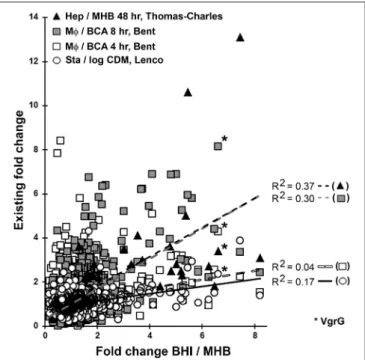
As the quality of ourFt data appeared to be comparable to that of others, we next compared our BHI/MHB proteomics FCs to existing “omics” FC datasets in which Ft grown in mammalian cells and/or mice were compared to bacteria grown in broth (Twine et al., 2006a; Wehrly et al., 2009; Bent et al., 2013; Thomas-Charles et al., 2013). This comparison was possible as FC is a form of data expression common to both “omics” technics. Our goal was to very-broadly test the notion that BHI-Ft is more similar, than MHB-Ft, to what has been reported for host-adapted Ft. While comparing FCs across distinct “omics” platforms and between different laboratories presents some limitations, we perused this analysis with an eye toward broad trends (operons, regulons, and protein families) that were apparent in our data and within multiple reports for host-adaptedFt. As a control, we also included the proteomics data of Lenco et al. who analyzed Ft grown in vitro to stationary and log phase in CDM (Lenco et al., 2009). Our BHI/MHB FC dataset best fit the transcriptional datasets of Bent et al. (FCs derived fromFt L Daygrown in M8s for 4 and 8 h vs. in BCA) (Bent et al., 2013) and Thomas-Charles et al. (FCs derived fromFtLVS grown in hepatocytes for 2 d vs. in MHB) (Thomas-Charles et al., 2013). A linear regression analysis of our data against the Bent et al. 4 h dataset revealed a very low correlation (R2 = 0.04,Figure 1); the correlation between our data and that of Lenco was moderately increased (R2 =
0.17). Our data showed the highest correlation with data derived from 8 and 48 h of intracellular growth (R2 = 0.30 and 0.37
respectively); these latter two R2-values were not significantly different from each other (correlation significance analysis, http://vassarstats.net/). Collectively, these results suggest that on a broad scale, BHI-Ft more closely reflect what has been reported for bacteria that have grown in host cells for 8– 48 h.
Virulence Factors
FIGURE 1 |Comparative omics. The fold changes (FC) for each of the 845 proteins we quantified in both BHI- and MHB-grownFtwere plotted against the transcriptional FC for the same genes determined byBent et al. (2013)at 4 h (white squares), 8 h (gray squares), andThomas-Charles et al. (2013)
(black triangles). Four lines of best fit (least squares, best fit linear regression) are shown for comparison of our data with that of Bent 4 h (R2=0.04), Bent 8 h (R2=0.30), Thomas-Charlie (R2=0.37), andLenco et al. (2009)(R2= 0.17, open circles solid black line). Values for VgrG (6.6—BHI/MHB; 8.1—Bent, 8 h; 4.3—Bent, 4 h; 3.4—Thomas Charles, 48 h; 2.4—Lenco) are indicated by asterisks to facilitate interpretation of the data. MHB,
Mueller-Hinton Broth; BHI, Brain Heart Infusion Broth; M8, Macrophages; BCA, BHI supplemented with Casamino Acids; CDM, Chamberlain’s Defined Medium; Stat., Stationary Phase; Log, Logarithmic phase.
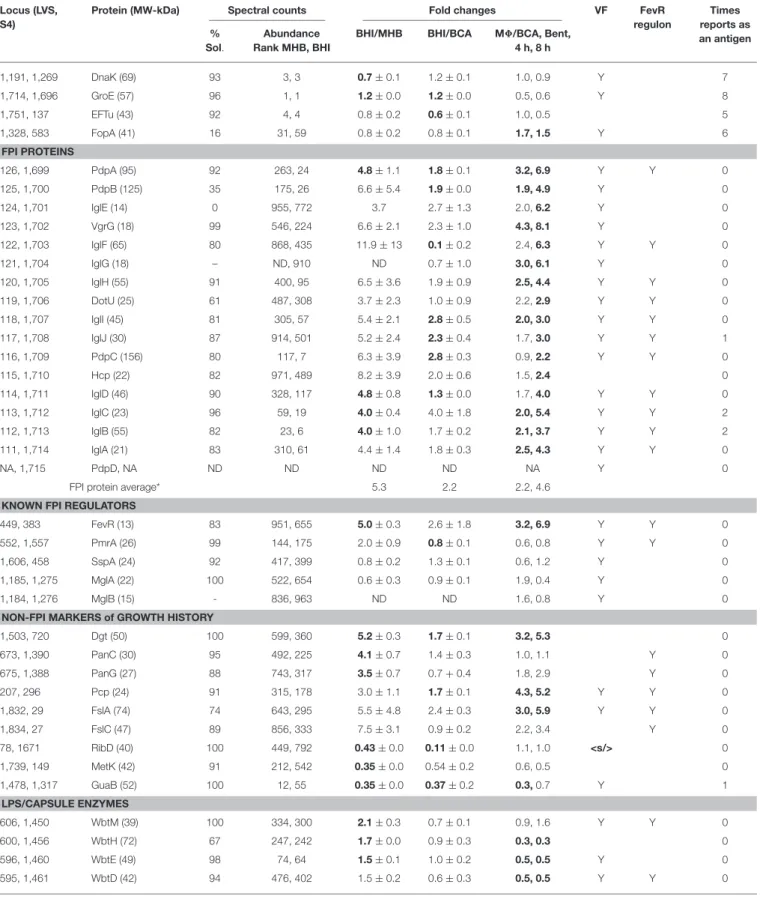
The most studied VFs of Ft include the 17 Francisella Pathogenecity Island (FPI) proteins, which likely form a type-6 secretion system for the delivery of Fteffector proteins into target cells (de Bruin et al., 2007; Ludu et al., 2008; Broms et al., 2009, 2012a,b; Clemens et al., 2015). As shown inTable 1(and Table S1), we detected all FPI proteins with the exception of the 135 kDa protein PdpD (FTT1715)—whose gene is truncated in FtLVS (Lenco et al., 2009). The average FC for the FPI proteins (excluding IglF [high level of variation]) was 5.3 in BHI-Ft relative to MHB-Ft. In general, our FPI data compares favorably with that of Bent et al. and Thomas-Charles et al. particularly for the later time points of intracellular (IC) growth (Table 1and Table S1). Similarly, our findings generally mirror those derived from mouse and M8models withFtS4. Twine et al. purifiedFt S4 from murine spleens 4 d post-infection and used proteomics to compare these to MHB-Ft(Twine et al., 2006a); Wehrley et al. used transcriptional analysis to compare Ft S4 grown within cultured M8s (for 1–24 h) toFtS4 grown in CDM (Wehrly et al., 2009). Based on the availableFtS4 data, the FPI expression we observed withFtLVS in BHI appears to echo S4 FPI induction reported inFtfrom mouse spleens (Twine et al., 2006a) and in M8s at∼12–16 h (Wehrly et al., 2009) (Table S1). To confirm
key findings of our proteomics data, we performed SDS-PAGE and western blot analysis of MHB-, BHI-, and BCA-grownFt LVS along with BHI-grownFtS4. As shown in Figure S1, BHI-grownFtcontained elevated levels of VgrG (FTL0123/FTT1702), IglC (FTL0113/FTT1712), and IglB (FTL0112/FTT1713). IglC and IglB levels were comparable in BHI-grown LVS and S4 while VgrG levels were slightly higher in S4 than LVS—as previously reported (Lenco et al., 2009).
Regulation ofFtvirulence is also an active area of investigation with ∼15 Ft proteins identified as having various degrees of influence on VF/FPI gene expression. The most well-characterized of these are MglA (FTL1185) and SspA (FTL1606) (homologs of theE. colistringent starvation protein A—SspA), and the DNA-binding protein FevR (FTL0449, also called PigR). In the presence of ppGpp, FevR binds both to DNA up-stream of VF promoters and to a protein complex including MglA, SspA, and RNA polymerase to affect transcription of the MglA/SspA/FevR regulon which contains manyFt VF genes— includingfevRand most of the (Brotcke et al., 2006; Charity et al., 2007, 2009; Brotcke and Monack, 2008; Rohlfing and Dove, 2014; Ramsey et al., 2015). We observed a 5.0 FC for FevR in BHI-Ft relative to MHB-Ft(Table 1and Table S1)—values that closely track the average FPI FC. Among the remaining FPI regulators, we observed that PmrA (FTL0552) levels were slightly higher (FC
=2.0,Table 1and Table S1) in BHI-Ftas we previously reported (Hazlett et al., 2008). Levels of SspA, OxyR (FTL1014), QscC (FTL1762), TrmE (FTL1177), SpoT (FTL1413), Fur (FTL1831), and Hfq (FTL0898) were unchanged, and levels of MglA, MglB (FTL1184), MigR (FTL1542), and CphA (FTL0831) trended lower in BHI-Ft(Table 1and Table S1). The changes we observed for the FPI regulators (particularly for FevR) in BHI-Ftappear to mirror those reported for bacteria grown in host cells (Wehrly et al., 2009; Bent et al., 2013) and are greater than that observed forFtgrown to stationary phase in CDM (Lenco et al., 2009).
TABLE 1 |A sub-set of our proteomics data.
Locus (LVS, S4)
Protein (MW-kDa) Spectral counts Fold changes VF FevR
regulon
Times reports as an antigen %
Sol.
Abundance Rank MHB, BHI
BHI/MHB BHI/BCA M8/BCA, Bent, 4 h, 8 h
1,191, 1,269 DnaK (69) 93 3, 3 0.7±0.1 1.2±0.1 1.0, 0.9 Y 7
1,714, 1,696 GroE (57) 96 1, 1 1.2±0.0 1.2±0.0 0.5, 0.6 Y 8
1,751, 137 EFTu (43) 92 4, 4 0.8±0.2 0.6±0.1 1.0, 0.5 5
1,328, 583 FopA (41) 16 31, 59 0.8±0.2 0.8±0.1 1.7, 1.5 Y 6
FPI PROTEINS
126, 1,699 PdpA (95) 92 263, 24 4.8±1.1 1.8±0.1 3.2, 6.9 Y Y 0
125, 1,700 PdpB (125) 35 175, 26 6.6±5.4 1.9±0.0 1.9, 4.9 Y 0
124, 1,701 IglE (14) 0 955, 772 3.7 2.7±1.3 2.0,6.2 Y 0
123, 1,702 VgrG (18) 99 546, 224 6.6±2.1 2.3±1.0 4.3, 8.1 Y 0
122, 1,703 IglF (65) 80 868, 435 11.9±13 0.1±0.2 2.4,6.3 Y Y 0
121, 1,704 IglG (18) – ND, 910 ND 0.7±1.0 3.0, 6.1 Y 0
120, 1,705 IglH (55) 91 400, 95 6.5±3.6 1.9±0.9 2.5, 4.4 Y Y 0
119, 1,706 DotU (25) 61 487, 308 3.7±2.3 1.0±0.9 2.2,2.9 Y Y 0
118, 1,707 IglI (45) 81 305, 57 5.4±2.1 2.8±0.5 2.0, 3.0 Y Y 0
117, 1,708 IglJ (30) 87 914, 501 5.2±2.4 2.3±0.4 1.7,3.0 Y Y 1
116, 1,709 PdpC (156) 80 117, 7 6.3±3.9 2.8±0.3 0.9,2.2 Y Y 0
115, 1,710 Hcp (22) 82 971, 489 8.2±3.9 2.0±0.6 1.5,2.4 0
114, 1,711 IglD (46) 90 328, 117 4.8±0.8 1.3±0.0 1.7,4.0 Y Y 0
113, 1,712 IglC (23) 96 59, 19 4.0±0.4 4.0±1.8 2.0, 5.4 Y Y 2
112, 1,713 IglB (55) 82 23, 6 4.0±1.0 1.7±0.2 2.1, 3.7 Y Y 2
111, 1,714 IglA (21) 83 310, 61 4.4±1.4 1.8±0.3 2.5, 4.3 Y Y 0
NA, 1,715 PdpD, NA ND ND ND ND NA Y 0
FPI protein average* 5.3 2.2 2.2, 4.6
KNOWN FPI REGULATORS
449, 383 FevR (13) 83 951, 655 5.0±0.3 2.6±1.8 3.2, 6.9 Y Y 0
552, 1,557 PmrA (26) 99 144, 175 2.0±0.9 0.8±0.1 0.6, 0.8 Y Y 0
1,606, 458 SspA (24) 92 417, 399 0.8±0.2 1.3±0.1 0.6, 1.2 Y 0
1,185, 1,275 MglA (22) 100 522, 654 0.6±0.3 0.9±0.1 1.9, 0.4 Y 0
1,184, 1,276 MglB (15) - 836, 963 ND ND 1.6, 0.8 Y 0
NON-FPI MARKERS of GROWTH HISTORY
1,503, 720 Dgt (50) 100 599, 360 5.2±0.3 1.7±0.1 3.2, 5.3 0
673, 1,390 PanC (30) 95 492, 225 4.1±0.7 1.4±0.3 1.0, 1.1 Y 0
675, 1,388 PanG (27) 88 743, 317 3.5±0.7 0.7+0.4 1.8, 2.9 Y 0
207, 296 Pcp (24) 91 315, 178 3.0±1.1 1.7±0.1 4.3, 5.2 Y Y 0
1,832, 29 FslA (74) 74 643, 295 5.5±4.8 2.4±0.3 3.0, 5.9 Y Y 0
1,834, 27 FslC (47) 89 856, 333 7.5±3.1 0.9±0.2 2.2, 3.4 Y 0
78, 1671 RibD (40) 100 449, 792 0.43±0.0 0.11±0.0 1.1, 1.0 <s/> 0
1,739, 149 MetK (42) 91 212, 542 0.35±0.0 0.54±0.2 0.6, 0.5 0
1,478, 1,317 GuaB (52) 100 12, 55 0.35±0.0 0.37±0.2 0.3,0.7 Y 1
LPS/CAPSULE ENZYMES
606, 1,450 WbtM (39) 100 334, 300 2.1±0.3 0.7±0.1 0.9, 1.6 Y Y 0
600, 1,456 WbtH (72) 67 247, 242 1.7±0.0 0.9±0.3 0.3, 0.3 0
596, 1,460 WbtE (49) 98 74, 64 1.5±0.1 1.0±0.2 0.5, 0.5 Y 0
595, 1,461 WbtD (42) 94 476, 402 1.5±0.2 0.6±0.3 0.5, 0.5 Y Y 0
TABLE 1 |Continued
Locus (LVS, S4)
Protein (MW-kDa) Spectral counts Fold changes VF FevR
regulon
Times reports as an antigen %
Sol.
Abundance Rank MHB, BHI
BHI/MHB BHI/BCA M8/BCA, Bent, 4 h, 8 h
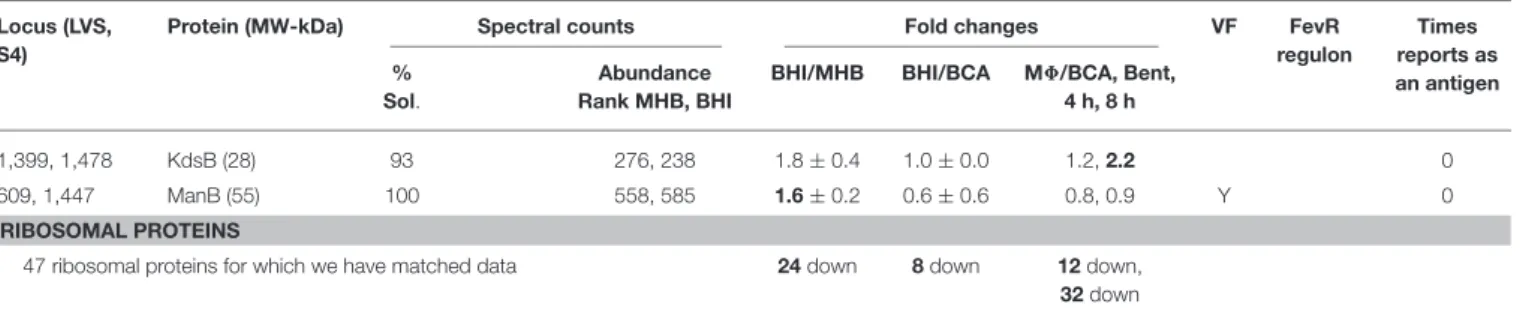
1,399, 1,478 KdsB (28) 93 276, 238 1.8±0.4 1.0±0.0 1.2,2.2 0 609, 1,447 ManB (55) 100 558, 585 1.6±0.2 0.6±0.6 0.8, 0.9 Y 0
RIBOSOMAL PROTEINS
47 ribosomal proteins for which we have matched data 24down 8down 12down, 32down
FTL (LVS) and FTT (S4) locus numbers are indicated along with the proteins name and mass predicted from the LVS genome. Data based upon label-free spectral counts include solubility [the percentage of each protein’s total tryptic peptides detected in either the soluble (S) or membrane (M) fractions] and abundance rank for each protein in MHB-Ft and BHI-Ft. Fold change data is based on reciprocal16O and18O labeling performed in biological duplicate to yield the indicated mean and standard deviations. Numerical data in bold font represent statistically significant changes [for each protein the status as a virulence factor (VF) was drawn from (Baron and Nano, 1998; Lai et al., 2001; Santic et al., 2005; Brotcke et al., 2006; Maier et al., 2006; Tempel et al., 2006; Maier et al., 2007; Santic et al., 2007; Su et al., 2007; Thomas et al., 2007; Bonquist et al., 2008; Sammons-Jackson et al., 2008; Barker et al., 2009; Buchan et al., 2009; Dean et al., 2009; Schmerk et al., 2009; Ahlund et al., 2010; McCaffrey et al., 2010; Broms et al., 2011, 2012a; Straskova et al., 2012; Robertson et al., 2013, 2014; Rasmussen et al., 2015)]; status as a FevR regulon member was drawn fromCharity et al. (2007, 2009),Brotcke and Monack (2008), andRamsey et al. (2015); the number of times each protein has been reported as a target of infection-derived Ab was drawn from references (Twine et al., 2006b, 2010, 2012a; Janovska et al., 2007; Sundaresh et al., 2007; Savitt et al., 2009; Fulton et al., 2011; Nuti et al., 2011; Golovliov et al., 2013; Chu et al., 2014), and the transcriptional fold changes upon intracellular growth for 4 and 8 h were drawn fromBent et al. (2013).*Excludes values for IglF.
in decreased abundance of ribosomes. Of the 47 ribosomal proteins for which we had robust FC data, 24 were statistically less abundant in BHI-Ftcompared to MHB-Ft(Table 1and Table S2) Among these 47 proteins, 8 were reduced in BHI compared to BCA; 12 and 32 are reportedly reduced after 4 and 8 h respectively of growth in M8. Thus in our data, as well as that of Bent for LVS (Bent et al., 2013) and Lenco for LVS and S4 (Lenco et al., 2009), FPI induction appears to correlate with ribosomal protein reduction.
Collectively, the protein fingerprint of log-phase BHI-Ft (compared to MHB Ft) is one of nutrient-depleted bacteria that—through induction of a stringent starvation-like response— have induced the FevR regulon for high-level expression of the bacterium’s VFs.
LPS and Capsule Synthesis
Another category of Ft proteins that contribute significantly to virulence are the ∼65 enzymes that
synthesize/modify/incorporate carbohydrates into the bacterium’s surface-coating of polysaccharides. Principal among these polysaccharides is the four sugar, O-antigen moiety synthesized by the Wbt enzymes and incorporated into polymers found in both the bacterium’s LPS and the discrete O-Ag capsule. Previously, we demonstrated that BHI-Fthave higher molecular weight capsular polysaccharides and longer polymers of LPS O-Ag compared to MHB-Ft although the mechanistic basis for this observation was unknown (Zarrella et al., 2011). In our proteomics data (Table 1 and Table S1) for BHI-Ft, we observe moderately increased levels of several Wbt enzymes (M, H, E, and D) as well as KdsB and ManB—enzymes that contribute to synthesis of the KDO core which links O-Ag to Lipid A. Among the remaining ∼40 LPS/Capsule related proteins (Lpx, Waa, Lpc, Lpt, Flm, and Nax members) for which we have robust data, no significant differences were noted between MHB-Ft and BHI-Ft (Table S1). As with many Ft
LPS/capsule synthases, perturbations of WbtM, WbtE, WbtD, and ManB reduce the bacterium’s polysaccharide coat rendering the pathogen highly susceptible to host defenses (Thomas et al., 2007; Lai et al., 2010; Lindemann et al., 2011; Twine et al., 2012b; Okan et al., 2013; Rasmussen et al., 2015). Currently, it is unclear if the increased abundance of the Wbt, Kds, and Man enzymes reported here for BHI-Ft is sufficient to account for the increased surface polysaccharides we previously described. Another potential factor, increased retention of capsular material, has also been postulated for BHI-Ft(Faith et al., 2012) and a mechanism of such retention, lipid-modification of O-Ag capsule, has recently been reported for BHI-Ft (Barker et al., 2016).
Immuno-Dominant Antigens
To date, 81Francisellaproteins have been reported one or more times to be immunogenic in an immunization or sub-lethal infection model (Twine et al., 2006b, 2010, 2012a; Janovska et al., 2007; Sundaresh et al., 2007; Savitt et al., 2009; Fulton et al., 2011; Nuti et al., 2011; Golovliov et al., 2013; Chu et al., 2014). We detected 100% of these proteins, which is significantly (p<
FIGURE 2 |Ftprotein abundance correlates with antibody reactivity. The average normalized abundance of the 1,139Ftproteins we detected (Y-axis) was plotted against the number of times (0 to>3) that each protein has been reported as Ab reactive with infection-derived sera (X-axis). X axis values in parentheses indicate the number ofFtproteins with the indicated number of reports of sero-reactivity (0 to>3). Means and standard deviations from two to three biological replicates are indicated; statistical analysis was via 2-tailed, heteroscedasticT-test with Bonferroni correction with four comparisons. Indicatedp-values are for the BHI dataset.
against the number of published reports of immunogenicity for each protein. As shown in Figure 2 there is a strong linear trend between a protein’s abundance and the likelihood that the protein will have been reported as immunogenic. This trend was similar whether we used data from BHI- or MHB-grown Ft. The mean normalized abundance for the proteins in each category (1 report up to >3 reports) was significantly higher than the abundance of proteins that had not been reported as immunogenic.
As several immunogenic proteins are also differentially expressed to become highly abundant in BHI-Ft (Table 1), we hypothesized that sera from S4-surviving subjects might react differently withFtthat had been differentially cultivated. Inspired by recent reports from the Bosio group (Griffin et al., 2015; Roberts et al., 2016) indicating that C57BL/6 mice can be successfully immunized against challenge with MHB-Ft S4, we generated S4-convalescent mouse sera using live LVS in a prime-boost-boost strategy followed by an increasing challenge-dose regimen (26-100-500 CFU) with MHB-Ft S4. As a source of outbred S4-convalescent Ab, we used rabbits that had been primed with Ft S4 1aroD and challenged with BHI-Ft S4 prior to serum collection (Reed et al., 2014). For comparison, we also used sera from another outbred population, LVS-immunized humans. With these 3 sera, we probed by western blot, whole cell (WC), soluble, and membrane fractions of Ft LVS that had been grown in MHB, BHI, or BCA. As shown inFigure 3, the outbred rabbit and human sera strongly recognized the typical “ladder pattern” indicative of reactivity with the LPS O-antigen (Ag). The ladder pattern was present in the WC and membrane fractions of WT FtLVS (Figure 3)
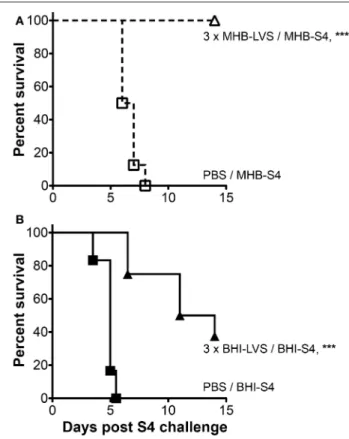
FIGURE 4 |The outcome of tularemia vaccination trials can be influenced by differential growth. Survival of BALB/c mice vaccinated three times with PBS (squares) or liveFtLVS (triangles) prior to challenge withFtS4. In(A)allFt
were grown in MHB (open symbols); in(B), allFtwere grown in BHI (closed symbols). Asterisks indicate significant differences between PBS- and LVS-immunized groups that were identically-challenged. Actual challenge doses were 25 CFU of MHB-FtS4(A)and 34 CFU BHI-FtS4(B). Actualp<
0.0001(A)andp=0.0001(B). Median survival times (MTS) for LVS-immunized mice were≥14 d(A)and 12.5 d(B); for PBS-immunized mice the corresponding values were 6.5 d(A)and 5 d(B). The survival data from 30 mice used in two independent experiments with 6–8 mice/group are represented as Kaplan–Meier survival curves with statistical analysis by the Log-rank (Mantel–Cox) test.
and absent in preparations from O-Ag mutant Ft (data not shown). In contrast, our hyper-immune Mo sera displayed markedly reduced LPS-reactivity and instead showed prominent reactivity with a discrete number of soluble and membrane proteins (Figure 3); this pattern was unchanged when we probed preparations from O-Ag deficientFt(data not shown). A similar discord between human and mouse immune serum reactivity with Ft LPS has been noted previously by Huntley et al. (2007).
Among the protein Ags recognized by these sera were several differentially abundant species. In particular, all three sera reacted with a soluble ∼ 23 kDa moiety present in BHI-Ft at apparently higher levels than in MHB-Ft or BCA-Ft (Figures 3B–D, soluble, asterisk). This pattern of Ab-reactivity was mirrored by the abundance of a ∼23 kDa soluble protein visible on coomassie-stained SDS-PAGE gels (Figure 3A) and by the reactivity with mAb against
FIGURE 5 |BHI-FtS4 appears more virulent than MHB-FtS4 to mice immunized with MHB-LVS. Survival of C57BL/6 mice vaccinated three times with PBS or live MHB-FtLVS prior to i.n. challenge with 26±2 CFU ofFtS4 grown in MHB or BHI. Symbols are as defined inFigure 4; survival differences between immunized mice challenged with MHB-S4 and BHI-S4 are indicated by the statedp-values. Asterisks indicate significant differences between groups (PBS or LVS) that were identically-challenged; actual p valves arep<
0.0001 (MHB-S4) andp<0.0001 (BHI-S4). All significant differences are indicated. MTS values are≥21 d (LVS/MHB-S4), 13 d (LVS/BHI-S4), 8.3 d (PBS/MHB-S4), and 7.5 d (PBS/BHI-S4). The survival data from 40 mice (10 mice/group) are represented as Kaplan–Meier survival curves with statistical analysis by the Log-rank (Mantel–Cox) test.
FIGURE 6 |BHI-FtS4 appears more virulent than MHB-FtS4 to mice immunized with BHI-LVS. Survival of C57BL/6 mice vaccinated twice with PBS or live BHI-FtLVS prior to challenge with 29.5±2.5 CFU ofFtS4 grown in MHB or BHI. Symbols are as defined in Fig 4; survival differences between immunized mice challenged with MHB-S4 and BHI-S4 are indicated by the statedpvalues. Asterisks indicate significant differences between groups (PBS or LVS) that were identically-challenged; actualp-values arep<0.0001 (MHB-S4) andp<0.017 (BHI-S4). All significant differences are indicated. MTS values are>21 d (LVS/MHB-S4), 13.8 d (LVS/BHI-S4), 6 d (PBS/MHB-S4), and 5.8 d (PBS/BHI-S4). The survival data from 46 mice (10–12 mice/group) are represented as Kaplan–Meier survival curves with statistical analysis by the Log-rank (Mantel–Cox) test.
IglC (Figure S2). Within the membrane fractions, the only visible, differentially abundant Ag was a ∼120 kDa band
Differential Growth of
Ft
S4 Governs the
Efficacy of Prophylactic Immunization
As several Ag differences in MHB-Ftand BHI-Ftwere recognized by immune/convalescent sera, we hypothesized that immunized hosts might be differentially susceptible to challenge with these two forms of the bacteria. Previously, we observed that naïve mice infected with BHI-Ft (LVS or S4) showed a slightly shorter median survival time (MST) compared to that of mice challenged with MHB-Ft (Hazlett et al., 2008; Zarrella et al., 2011). Here, we envisioned two distinct scenarios for immunized mice challenged withFtS4 previously grown in MHB or BHI. The elevated reactivity of the differentially-expressed, dominant Ags could render a challenge inoculum of BHI-Ft S4 more susceptible to pre-existing immunity (which could result in increased host survival). Alternatively, the thicker carbohydrate coating, coupled to the immediate benefit of pre-formed VFs, could make the BHI-FtS4 challenge inoculum less susceptible to pre-existing immunity (which should result in decreased host survival).
Our first indication that the latter might be true came inadvertently from independent vaccination trials. For both trials, BALB/c mice were immunized using a prime-boost-boost strategy in which live Ft LVS served as the positive control for protection against challenge with Ft S4. In one case, the Ft strains were grown in MHB; in the second case both Ft strains were cultured in BHI. While LVS immunization provided significant protection (p≤0.0001) against S4 challenge in both cases, protection for the MHB-based trial was absolute (100%) but only partial (38% survival, 12.5 d MST) for the BHI-based trial (Figure 4). The MST for control mice challenged with MHB-Ft S4 was 6.5 vs. 5 d for those challenged with BHI-Ft S4. While these results were intriguing, differences between the independent trails necessitated further experimentation.
To assess more rigorously the impact of differential cultivation on Ft vaccination, we set up a large-scale trial in which mice vaccinated with live MHB-FtLVS in a prime-boost-boost strategy were challenged with either MHB- or BHI-grownFtS4. For these experiments, we used C57BL/6 mice, which are harder to protect against challenge with FtS4 (Twine et al., 2012a), as a highly stringent test of immunization efficacy. For LVS-immunized mice, we again observed complete (100%) protection against challenge with MHB-FtS4 (Figure 5), which was significantly (p
=0.007) higher than the survival observed for mice challenged
with BHI-Ft S4 (44% survival, 13 d MST). Survival of control mice was not significantly different between the MHB-Ft S4 group (8.3 d MST) and the BHI-FtS4 challenged group (7.5 d MST). In the former experiment, theFtLVS used for vaccination had been grown in MHB raising the specter that survival among the mice challenged with MHB-FtS4 might have been the result of a more specifically tailored, vaccine-induced immunity. To test this notion, we assessed the ability of BHI-FtLVS to protect against challenge with MHB- and BHI-grown Ft S4. C57BL/6 mice were primed and boosted a single time with live BHI-Ft LVS. Contrary to the notion of immunogen-tailoring, we again observed that immunized mice survived challenge with MHB-FtS4 (70% survival, undefinable MST) significantly better (p=
0.038) than those challenged with BHI-FtS4 (33% survival, 13.75
d MST) (Figure 6). Survival of PBS-immunized control mice was not significantly different (p=0.398) between the groups
challenged with MHB-FtS4 (6 d MST) and those challenged with BHI-FtS4 (5.8 d MST).
Collectively, our vaccination studies demonstrate that challenge with BHI-Ft S4 provides a more stringent test of vaccine efficacy than challenge with MHB-FtS4.
DISCUSSION
Several years ago we began characterizing broth- and M8-grown Ft with the goal of identifying culture conditions that would yield “host-adapted”-like bacteria. Our rationale was that these Ftcould be used with greater confidence in efforts to (i) identify vaccine Ag candidates expressed during infection and/or (ii) unravel details of the host-pathogen interaction that are operable during infection. In previous studies, using a limited cadre of
∼10 metrics that discern MHB-Ftfrom M8- or mouse-grownFt, we concluded thatFtLVS and S4 grown in BHI roughly mimic the phenotype of the mammalian, infection-derived pathogen (Hazlett et al., 2008; Zarrella et al., 2011). Here we used∼ 100-fold more data to extend and further characterize the phenotypes of MHB-, BHI-, and BCA- grownFt. By comparing these FCs to those previously reported for infection of cells or mice, we can reasonably conclude that the differences observed betweenFt grown in MHB and BHI are most similar to that of LVS grown in MHB (or BCA) and host cells for 8 and 48 h (R2=0.3 and 0.37).
These correlation coefficients are significantly higher than that of our data fit to LVS grown to stationary phase in CDM (R2=0.17).
Similarly, our data best fit that of S4 grown in M8s for 12 h (R2=
0.18), which is higher than the results for stationary phase CDM-grown S4 (R2=0.10). Presumably, growth within host cells elicits
changes inFtthat are not fully recapitulated by growth in CDM but are more closely (though not perfectly) mimicked by growth in BHI. While comparing FCs across distinct “omics” platforms and between different laboratories presents some limitations (which likely lowered the observedR2-values) the over-arching
notion that BHI-Ft are more “host-adapted”-like than MHB-Ftappears largely intact following interrogation of∼1,000 data
points.
2010; Broms et al., 2011, 2012a; Straskova et al., 2012; Robertson et al., 2013, 2014), and, as shown here, are more abundant in BHI-Ft(Table 1and Table S1). Charity et al. have used genetic approaches to show that activation of the FevR regulon requires ppGpp generated by the activity of RelA and/or SpoT (Charity et al., 2009). Dean and Faron have used serine hydroxamate to induce amino acid starvation (Dean et al., 2009; Faron et al., 2013) and observed that this starvation causes ppGpp levels to rise by 2- to 3-fold with a corresponding 2- to 3-fold increase in iglApromoter activity (Faron et al., 2013). Consistent with the impact of serine hydroxamate, we found the absence of casamino acids induced an average FPI protein induction of 2.2-fold and a 2.6 induction of FevR (Table 1). These values are lower than the full FPI induction reported for Ft grown in M8 for 8 h (ave-FPI 4.6, FevR 6.9) and what we observed between BHI- and MHB- grownFt(ave FPI-5.3, FevR 5.0). These data suggest that while amino acid limitation alone can induce the FevR regulon 2- to 3-fold, additional, possibly nutritional, signals contribute to full FPI induction. Severe nutrient starvation and induction of the stringent starvation response (mediated by RelA/SpoT and ppGpp) results in decreased abundance of ribosomes. Of the 47 ribosomal proteins for which we had robust FC data, 24 were statistically less abundant in BHI-Ft compared to MHB-Ft (Table 1 and Table S2) Among these 47 proteins, 8 were reduced in BHI compared to BCA; 12 and 32 are reportedly reduced after 4 and 8 h respectively of growth in M8. Thus in our data, as well as that of Bent for LVS (Bent et al., 2013) and Lenco for LVS and S4 (Lenco et al., 2009), FPI induction appears to correlate with ribosomal protein reduction. Intriguingly, siderophore and pantheonate synthesis proteins are elevated in BHI-Ftcompared to MHB-Ftbut not between BHI- and BCA-Ft (Table 1) possibly indicating that the iron and pantheonate present in MHB act as additional nutritional cues guiding the stringent starvation response. Up regulation of these genes in vivo and their contributions to virulence have been reported previously (Deng et al., 2006; Sullivan et al., 2006; Lenco et al., 2007, 2009; Ramakrishnan et al., 2008; Wehrly et al., 2009; Bent et al., 2013; Miller et al., 2013; Thomas-Charles et al., 2013).
In the course of our analysis we also noted media-dependent changes in protein abundance that mirror changes observed during infection, but for proteins that have not been shown to be dependent on the major regulatory players such as MglA/SspA/FevR, or PmrA. Such proteins include the 12 FPI co-regulated proteins such as Dgt (FTL1503) identified by Lenco et al. (2009) as well as several proteins that are repressed by growth in BHI and mammalian cells such as GuaB (FTL1478) and MetK (FTL1739) (Table 1 and Table S1). The regulatory mechanisms governing expression of these MglA/SspA/FevR/PmrA-independant proteins, many of which appear to be growth phase insensitive (Lenco et al., 2009), remain to be elucidated. Another group of proteins worth noting are those that have been shown to be up-regulated during infection but were not up-regulated in BHI-Ft. The primary examples of this are several ATP synthases (FTL1794-1798) and TCA enzymes (FTL1783-1786) which we detected as media-non-responsive but have been shown in LVS and S4 to be down-regulated during infection of cells and mice respectively (Twine
et al., 2006a; Bent et al., 2013). Thus, BHI-Ftare good, but not perfect, mimics of host-adaptedFt.
Given the differences in protein abundance, it is not surprising that host-adaptedFthave an initial growth advantagein vivothat manifests as a slightly shorter MST of naïve animals infected with BHI-Ft(Hazlett et al., 2008; Zarrella et al., 2011). Our finding that these differences in apparent virulence are magnified in the context of pre-existing specific immunity further supports the notion that the growth status ofFtis an important factor to be considered in tularemia research. For example, in three separate experiments, challenge of LVS-vaccinated mice with MHB-FtS4 revealed survival rates of 100, 100, and 70%; the corresponding survival rates for mice challenged with BHI-Ft S4 in the same experiments were 38, 44, and 33%. Clearly, the status of a Ft challenge inoculum at the time of administration can have a profound impact on experimental outcomes in tularemia vaccine research.
At this time, we cannot state with singular certainty why MHB-FtS4 appears less virulent to immunized hosts than does BHI-FtS4. However, we suspect that this outcome stems from the transient, phenotypic differences between MHB- and BHI-Ft that exist immediately upon host-challenge and prior to complete host adaptation. Broadly speaking we can envision three inter-related properties (reduced capsule, reduced structural integrity, and reduced VF expression) that likely weaken a MHB-grown, S4 challenge inoculum sufficiently to allow pre-existing specific immunity to gain the upper hand. First, MHB-Ft LVS and S4 have less capsular material relative to their BHI-grown counter-parts (Zarrella et al., 2011). This capsule reduces complement deposition, which would limit losses of challenge bacteria to alternatively-activated complement upon entry into the mammalian milieu (Zarrella et al., 2011). Ft capsule also limits access of specific Ab to multipleFt Ags (Zarrella et al., 2011). Reduced Ab binding would have two salient outcomes: (i) bacterial losses due to classical complement activation would be minimized and (ii) Ab-mediated phagocytosis through activating Fc-receptors would be reduced. This capsule also limits the access ofFtligands to TLR2—an activating receptor responsible for MHB-Ft-mediated production of TH1-proinflammatory
cytokines (Zarrella et al., 2011; Singh et al., 2013). Also, we envision that the capsule may directly or indirectly engage a discrete “anti-inflammatory” receptor that also could diminish elicitation of protective cytokine responses. Along these lines, the Bosio group recently reported that exogenous, purified Ft capsule was able to dampen M8cytokine responses to P3C (a synthetic TLR2 agonist) and to an inflammatory, capsule mutant of Ft S4 (Wyatt et al., 2016). Cumulatively, given the well-established role of capsules in promoting bacterial survival, it seems highly likely that differences in survival of immunized hosts would be observed between challenges with (i) bacteria encased in abundant, pre-formed capsule (such as BHI-Ft) vs. (ii) those entering the hostile mammalian environment without a full protective coating of pre-made capsule (such as MHB-Ft).
which makes iFtLVS a better immunogen (Kumar et al., 2016) could also make MHB-Ft S4 a worse pathogen. Previously, we stained early-log phase MHB- and BHI-grown Ft with a fluorescent vital dye mix and analyzed the stained bacteria by flow cytometry. MHB-grown cultures contained five-to-seven times more structurally-compromised (SYTOX green positive) Ft than did BHI-grown cultures (Singh et al., 2013). We also found that compromised Ft induce potent cellular responses (TNF, IL-1β, and IL-6) as first reported by Peng et al. (2011). The SYTOX-positive MHB-Ft(∼20% of the total) were comprised of two populations, one that was moderately stained (fluorescence intensities of 101–102) and one that stained intensely (>103). The fluorescence intensity of the SYTOX-positive BHI-Ft (3.5% of the total) barely exceeded 10 with no signal greater than ∼30. Although not directly tested, we suspect that the severely compromised Ft (present exclusively in MHB-grown cultures) are replication-incompetent and act simply as an inflammatory bolus within an MHB-inoculum. The moderately-compromised MHB-Ftmight be able to replicate in a sufficiently permissive environment (such as a chocolate agar plate or a naïve host) but are hypothesized, in the presence of pre-existing specific immunity, to be rapidly recognized and thus serve as additional inflammatory agonists to engage protective recall responses. As cultures of BHI-Ftcontain fewer, and less intensely stained, SYTOX-positive bacteria, we envision that a BHI-Ftchallenge inoculum remains stealthy enough to avoid a rapid recall response by immunized mice thereby allowing for more productive infections.
The third property of MHB-Ft that likely promotes susceptibility to vaccine-induced-immunity is under-expression of virulence factors. We found that 25% of the ∼190 Ft VFs are less abundant in MHB-Ft. When a challenge inoculum of MHB-Ftenters the relatively permissive environment of a naïve host, a sufficient number of viable bacteria in the inoculum are able to replicate and host-adapt, turning on the VFs in the process. As such, the differences in MST between naïve (or PBS-immunized) mice challenged with MHB- and BHI-grownFtare small (Figures 4–6) (Hazlett et al., 2008; Zarrella et al., 2011). In contrast, upon entry into the less-permissive environment of a vaccinated host, the MHB-Ft inoculum still requires time to adapt but now must do so while being targeted by Ft-specific immune effectors. Within mammalian hosts, one of the main functions of the bacterium’s well-studied VFs—the FPI proteins—is to promote rapid entry into the host cytoplasm where intact Ft replicates exponentially (Meibom and Charbit, 2010; Ozanic et al., 2015). We anticipate that an inoculum of MHB-Ftlikely spends more time being assaulted by extra-cellular immune effectors prior to cytoplasmic replication
than a BHI-Ftinoculum. Given a strong enough armamentarium of immune effectors, a MHB-Ft inoculum might be unable to mount a productive infection whereas a BHI-Ftinoculum is less susceptible to, and spends less time dealing with, these effectors resulting in more productive infections.
ETHICS STATEMENT
Use of these human sera was reviewed by the Albany Medical Center Committee on Research Involving Human Subjects Institutional Review Board and deemed exempt on 4-28-2014. Exemption was granted on the basis that the samples were de-identified and came from previously banked collections (i.e., no fresh sera draws were performed for work in this manuscript).
AUTHOR CONTRIBUTIONS
Conceived and designed the experiments: KK, EB, TS, SJK, EG, DR, KH. Performed the experiments: KH, SR, KK, DW, BF, TZ, SK, RS, AS, PN, CB, KH. Analyzed the data: KK, CB, EB, TS, SJK, EG, DR, KROH. Contributed reagents/materials/analysis tools: EB, TS, SJK, EG, DR, KH. Wrote the paper: KROH.
FUNDING
This work was supported by grants from the Department of Defense (BAA W911NF-11-1-0274—SJK and KROH) and the National Institutes of Health (R01AI100138—TS, EG, and KROH; RO1AI123129—EB, DR, and KROH; U01 AI077909— DR and EB; P01AI056320—CB). The funding agencies had no role in study design, data collection and analysis, decision to publish, or preparation of the manuscript. The content is solely the responsibility of the authors and does not necessarily represent the official views of the National Institutes of Health or the Department of Defense.
ACKNOWLEDGMENTS
We are grateful to Dr. Francis Nano (University of Victoria) for providing α-VgrG antiserum and to Dr. Phillip Pittman (USAMRIID) for providing antiserum from LVS-immunized subjects.
SUPPLEMENTARY MATERIAL
The Supplementary Material for this article can be found online at: http://journal.frontiersin.org/article/10.3389/fmicb. 2017.01158/full#supplementary-material
REFERENCES
Abd, H., Johansson, T., Golovliov, I., Sandstrom, G., and Forsman, M. (2003). Survival and growth ofFrancisella tularensisinAcanthamoeba castellanii.Appl. Environ. Microbiol.69, 600–606. doi: 10.1128/AEM.69.1.600-606.2003 Ahlund, M. K., Ryden, P., Sjostedt, A., and Stoven, S. (2010). Directed screen
ofFrancisella novicidavirulence determinants usingDrosophila melanogaster.
Infect. Immun.78, 3118–3128. doi: 10.1128/IAI.00146-10
Bar-Haim, E., Gat, O., Markel, G., Cohen, H., Shafferman, A., and Velan, B. (2008). Interrelationship between dendritic cell trafficking and Francisella tularensisdissemination following airway infection.PLoS Pathog.4:e1000211. doi: 10.1371/journal.ppat.1000211