Active Learning-Based Elicitation for Semi-Supervised Word Alignment
Vamshi Ambati, Stephan Vogel and Jaime Carbonell
{vamshi,vogel,jgc}@cs.cmu.edu
Language Technologies Institute, Carnegie Mellon University 5000 Forbes Avenue, Pittsburgh, PA 15213, USA
Abstract
Semi-supervised word alignment aims to improve the accuracy of automatic word alignment by incorporating full or par-tial manual alignments. Motivated by standard active learning query sampling frameworks like uncertainty-, margin- and query-by-committee sampling we propose multiple query strategies for the alignment link selection task. Our experiments show that by active selection of uncertain and informative links, we reduce the overall manual effort involved in elicitation of alignment link data for training a semi-supervised word aligner.
1 Introduction
Corpus-based approaches to machine translation have become predominant, with phrase-based sta-tistical machine translation (PB-SMT) (Koehn et al., 2003) being the most actively progressing area. The success of statistical approaches to MT can be attributed to the IBM models (Brown et al., 1993) that characterize word-level alignments in parallel corpora. Parameters of these alignment models are learnt in an unsupervised manner us-ing the EM algorithm oversentence-levelaligned parallel corpora. While the ease of automati-cally aligning sentences at the word-level with tools like GIZA++ (Och and Ney, 2003) has en-abled fast development of SMT systems for vari-ous language pairs, the quality of alignment is typ-ically quite low for language pairs like Chinese-English, Arabic-English that diverge from the in-dependence assumptions made by the generative models. Increased parallel data enables better es-timation of the model parameters, but a large num-ber of language pairs still lack such resources.
Two directions of research have been pursued for improving generative word alignment. The first is to relax or update the independence as-sumptions based on more information, usually syntactic, from the language pairs (Cherry and Lin, 2006; Fraser and Marcu, 2007a). The sec-ond is to use extra annotation, typicallyword-level
human alignment for some sentence pairs, in con-junction with the parallel data to learn alignment in a semi-supervised manner. Our research is in the direction of the latter, and aims to reduce the effort involved in hand-generation of word align-ments by using active learning strategies for care-ful selection of word pairs to seek alignment.
Active learning for MT has not yet been ex-plored to its full potential. Much of the litera-ture has explored one task – selecting sentences to translate and add to the training corpus (Haf-fari and Sarkar, 2009). In this paper we explore active learning for word alignment, where the in-put to the active learner is a sentence pair(S, T)
and the annotation elicited from human is a set of links{aij,∀si ∈S, tj ∈T}. Unlike previous ap-proaches, our work does not require elicitation of full alignment for the sentence pair, which could be effort-intensive. We propose active learning query strategies to selectively elicit partial align-ment information. Experialign-ments in Section 5 show that our selection strategies reduce alignment error rates significantly over baseline.
2 Related Work
Researchers have begun to explore models that use both labeled and unlabeled data to build word-alignment models for MT. Fraser and Marcu (2006) pose the problem of alignment as a search problem in log-linear space with features com-ing from the IBM alignment models. The
linear model is trained on available labeled data to improve performance. They propose a semi-supervised training algorithm which alternates be-tween discriminative error training on the la-beled data to learn the weighting parameters and maximum-likelihood EM training on unlabeled data to estimate the parameters. Callison-Burch et al. (2004) also improve alignment by interpolat-ing human alignments with automatic alignments. They observe that while working with such data sets, alignments of higher quality should be given a much higher weight than the lower-quality align-ments. Wu et al. (2006) learn separate models from labeled and unlabeled data using the standard EM algorithm. The two models are then interpo-lated to use as a learner in the semi-supervised algorithm to improve word alignment. To our knowledge, there is no prior work that has looked at reducing human effort by selective elicitation of partial word alignment using active learning tech-niques.
3 Active Learning for Word Alignment
Active learning attempts to optimize performance by selecting the most informative instances to la-bel where ‘informativeness’ is defined as maximal expected improvement in accuracy. The objective is to select optimal instance for an external expert to label and then run the learning method on the newly-labeled and previously-labeled instances to minimize prediction or translation error, repeat-ing until either the maximal number of external queries is reached or a desired accuracy level is achieved. Several studies (Tong and Koller, 2002; Nguyen and Smeulders, 2004; Donmez and Car-bonell, 2008) show that active learning greatly helps to reduce the labeling effort in various clas-sification tasks.
3.1 Active Learning Setup
We discuss our active learning setup for word alignment in Algorithm 1. We start with an un-labeled dataset U = {(Sk, Tk)}, indexed by k, and a seed pool of partial alignment links A0 = {akij,∀si∈Sk, tj ∈Tk}. This is usually an empty set at iteration t = 0. We iterate for T itera-tions. We take a pool-based active learning strat-egy, where we have access to all the automatically aligned links and we can score the links based on our active learning query strategy. The query strategy uses the automatically trained alignment
modelMtfrom current iterationtfor scoring the links. Re-training and re-tuning an SMT system for each link at a time is computationally infeasi-ble. We therefore perform batch learning by se-lecting a set ofN links scored high by our query strategy. We seek manual corrections for the se-lected links and add the alignment data to the current labeled data set. The word-level aligned labeled data is provided to our semi-supervised word alignment algorithm for training an align-ment modelMt+1overU.
Algorithm 1ALFORWORDALIGNMENT 1: Unlabeled Data Set:U ={(Sk, Tk)}
2: Manual Alignment Set : A0 = {akij,∀si ∈ Sk, tj ∈Tk}
3: Train Semi-supervised Word Alignment using (U,A0)→M0
4: N: batch size
5: fort= 0toT do
6: Lt= LinkSelection(U,At,Mt,N)
7: Request Human Alignment forLt
8: At+1=At+Lt
9: Re-train Semi-Supervised Word Align-ment on (U, At+1)→Mt+1
10: end for
We can iteratively perform the algorithm for a defined number of iterations T or until a certain desired performance is reached, which is mea-sured by alignment error rate (AER) (Fraser and Marcu, 2007b) in the case of word alignment. In a more typical scenario, since reducing human ef-fort or cost of elicitation is the objective, we iterate until the available budget is exhausted.
3.2 Semi-Supervised Word Alignment
the manual alignments. Therefore, the restriction of the alignment paths reduces to restricting the summation in EM.
4 Query Strategies for Link Selection
We propose multiple query selection strategies for our active learning setup. The scoring criteria is designed to select alignment links across sentence pairs that are highly uncertain under current au-tomatic translation models. These links are diffi-cult to align correctly by automatic alignment and will cause incorrect phrase pairs to be extracted in the translation model, in turn hurting the transla-tion quality of the SMT system. Manual correc-tion of such links produces the maximal benefit to the model. We would ideally like to elicit the least number of manual corrections possible in order to reduce the cost of data acquisition. In this section we discuss our link selection strategies based on the standard active learning paradigm of ‘uncer-tainty sampling’(Lewis and Catlett, 1994). We use the automatically trained translation modelθtfor scoring each link for uncertainty, which consists of bidirectional translation lexicon tables computed from the bidirectional alignments.
4.1 Uncertainty Sampling: Bidirectional Alignment Scores
The automatic Viterbi alignment produced by the alignment models is used to obtain transla-tion lexicons. These lexicons capture the condi-tional distributions of source-given-targetP(s/t)
and target-given-sourceP(t/s)probabilities at the word level where si ∈ S and tj ∈ T. We de-fine certainty of a link as the harmonic mean of the bidirectional probabilities. The selection strategy selects the least scoring links according to the for-mula below which corresponds to links with max-imum uncertainty:
Score(aij/sI1, t1J) =
2∗P(tj/si)∗P(si/tj) P(tj/si) +P(si/tj)
(1)
4.2 Confidence Sampling: Posterior Alignment probabilities
Confidence estimation for MT output is an in-teresting area with meaningful initial exploration (Blatz et al., 2004; Ueffing and Ney, 2007). Given a sentence pair (sI1, tJ1) and its word alignment, we compute two confidence metrics at alignment link level – based on the posterior link probability as seen in Equation 5. We select the alignment
links that the initial word aligner is least confi-dent according to our metric and seek manual cor-rection of the links. We use t2s to denote com-putation using higher order (IBM4) target-given-source models and s2t to denote source-given-target models. Targeting some of the uncertain parts of word alignment has already been shown to improve translation quality in SMT (Huang, 2009). We use confidence metrics as an active learning sampling strategy to obtain most informa-tive links. We also experimented with other con-fidence metrics as discussed in (Ueffing and Ney, 2007), especially the IBM 1 model score metric, but it did not show significant improvement in this task.
Pt2s(aij, tJ1/sI1) =
pt2s(tj/si,aij∈A) PM
i pt2s(tj/si) (2)
Ps2t(aij, sI1/tJ1) =
ps2t(si/tj,aij∈A) PN
i ps2t(si/tj) (3)
Conf1(aij/S, T) = 2∗Pt2s∗Ps2t
Pt2s+Ps2t (4)
(5)
4.3 Query by Committee
The generative alignments produced differ based on the choice of direction of the language pair. We useAs2tto denote alignment in the source to target direction andAt2s to denote the target to source direction. We consider these alignments to be two experts that have two different views of the align-ment process. We formulate our query strategy to select links where the agreement differs across these two alignments. In general query by com-mittee is a standard sampling strategy in active learning(Freund et al., 1997), where the commit-tee consists of any number of experts, in this case alignments, with varying opinions. We formulate a query by committee sampling strategy for word alignment as shown in Equation 6. In order to break ties, we extend this approach to select the link with higher average frequency of occurrence of words involved in the link.
Score(aij) = α (6)
where α =
2 aij ∈As2t∩At2s
1 aij ∈As2t∪At2s
0 otherwise
4.4 Margin Sampling
conf(aij/S, T). However we could benefit from information about the second best scoring link as well. In typical multi-class classification prob-lems, earlier work shows success using such a ‘margin based’ approach (Scheffer et al., 2001), where the difference between the probabilities as-signed by the underlying model to the first best and second best labels is used as a sampling cri-teria. We adapt such a margin-based approach to link-selection using the Conf1 scoring function discussed in the earlier sub-section. Ourmargin technique is formulated below, where aˆ1ij and
ˆ
a2ij are potential first best and second best scor-ing alignment links for a word at positioniin the source sentence S with translation T. The word with minimum margin value is chosen for human alignment. Intuitively such a word is a possible candidate for mis-alignment due to the inherent confusion in its target translation.
M argin(i) =
Conf1( ˆa1ij/S, T) −Conf1( ˆa2ij/S, T)
5 Experiments
5.1 Data Setup
Our aim in this paper is to show that active learn-ing can help select the most informative alignment links that have high uncertainty according to a given automatically trained model. We also show that fixing such alignments leads to the maximum reduction of error in word alignment, as measured by AER. We compare this with a baseline where links are selected at random for manual correction. To run our experiments iteratively, we automate the setup by using a parallel corpus for which the gold-standard human alignment is already avail-able. We select the Chinese-English language pair, where we have access to 21,863 sentence pairs along with complete manual alignment.
5.2 Results
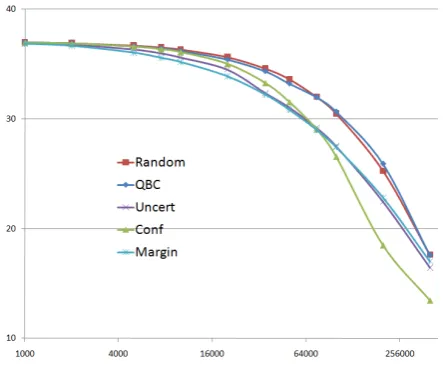
[image:4.595.306.528.62.246.2]We first automatically align the Cn-En corpus us-ing GIZA++ (Och and Ney, 2003). We then use the learned model in running our link selec-tion algorithm over the entire corpus to determine the most uncertain links according to each active learning strategy. The links are then looked up in the gold-standard human alignment database and corrected. In case a link is not present in the gold-standard data, we introduce a NULL align-ment, else we propose the alignment as given in
Figure 1: Performance of active sampling strate-gies for link selection
the gold standard. We select the partial align-ment as a set of alignalign-ment links and provide it to our semi-supervised word aligner. We plot per-formance curves as number of links used in each iteration vs. the overall reduction of AER on the corpus.
Query by committee performs worse than ran-dom indicating that two alignments differing in direction are not sufficient in deciding for uncer-tainty. We will be exploring alternative formula-tions to this strategy. We observe that confidence based metrics perform significantly better than the baseline. From the scatter plots in Figure 11 we can say that using our best selection strategy one achieves similar performance to the baseline, but at a much lower cost of elicitation assuming cost per link is uniform.
We also perform end-to-end machine transla-tion experiments to show that our improvement of alignment quality leads to an improvement of translation scores. For this experiment, we train a standard phrase-based SMT system (Koehn et al., 2007) over the entire parallel corpus. We tune on the MT-Eval 2004 dataset and test on a subset of MT-Eval 2004 dataset consisting of 631 sen-tences. We first obtain the baseline score where no manual alignment was used. We also train a configuration using gold standard manual align-ment data for the parallel corpus. This is the max-imum translation accuracy that we can achieve by any link selection algorithm. We now take the best link selection criteria, which is the confidence
System BLEU METEOR Baseline 18.82 42.70 Human Alignment 19.96 44.22 Active Selection 20% 19.34 43.25
Table 1: Alignment and Translation Quality
based method and train a system by only selecting 20% of all the links. We observe that at this point we have reduced the AER from 37.09 AER to 26.57 AER. The translation accuracy as measured by BLEU (Papineni et al., 2002) and METEOR (Lavie and Agarwal, 2007) also shows improve-ment over baseline and approaches gold standard quality. Therefore we achieve 45% of the possible improvement by only using 20% elicitation effort.
5.3 Batch Selection
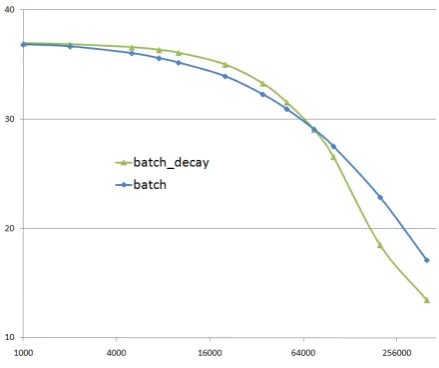
[image:5.595.78.286.62.120.2]Re-training the word alignment models after elic-iting every individual alignment link is infeasible. In our data set of 21,863 sentences with 588,075 links, it would be computationally intensive to re-train after eliciting even 100 links in a batch. We therefore sample links as a discrete batch, and train alignment models to report performance at fixed points. Such a batch selection is only going to be sub-optimal as the underlying model changes with every alignment link and therefore becomes ‘stale’ for future selections. We observe that in some sce-narios while fixing one alignment link could po-tentially fix all the mis-alignments in a sentence pair, our batch selection mechanism still samples from the rest of the links in the sentence pair. We experimented with an exponential decay function over the number of links previously selected, in order to discourage repeated sampling from the same sentence pair. We performed an experiment by selecting one of our best performing selection strategies (conf) and ran it in both configurations - one with the decay parameter (batchdecay) and one without it (batch). As seen in Figure 2, the decay function has an effect in the initial part of the curve where sampling is sparse but the effect gradually fades away as we observe more samples. In the reported results we do not use batch decay, but an optimal estimation of ‘staleness’ could lead to better gains in batch link selection using active learning.
Figure 2: Batch decay effects on Conf-posterior sampling strategy
6 Conclusion and Future Work
Word-Alignment is a particularly challenging problem and has been addressed in a completely unsupervised manner thus far (Brown et al., 1993). While generative alignment models have been suc-cessful, lack of sufficient data, model assump-tions and local optimum during training are well known problems. Semi-supervised techniques use partial manual alignment data to address some of these issues. We have shown that active learning strategies can reduce the effort involved in elicit-ing human alignment data. The reduction in ef-fort is due to careful selection of maximally un-certain links that provide the most benefit to the alignment model when used in a semi-supervised training fashion. Experiments on Chinese-English have shown considerable improvements. In future we wish to work with word alignments for other language pairs like Arabic and English. We have tested out the feasibility of obtaining human word alignment data using Amazon Mechanical Turk and plan to obtain more data reduce the cost of annotation.
Acknowledgments
References
John Blatz, Erin Fitzgerald, George Foster, Simona Gan-drabur, Cyril Goutte, Alex Kulesza, Alberto Sanchis, and Nicola Ueffing. 2004. Confidence estimation for machine translation. InProceedings of Coling 2004, pages 315– 321, Geneva, Switzerland, Aug 23–Aug 27. COLING. Peter F. Brown, Vincent J. Della Pietra, Stephen A. Della
Pietra, and Robert L. Mercer. 1993. The mathematics of statistical machine translation: parameter estimation.
Computational Linguistics, 19(2):263–311.
Chris Callison-Burch, David Talbot, and Miles Osborne. 2004. Statistical machine translation with word- and sentence-aligned parallel corpora. In ACL 2004, page 175, Morristown, NJ, USA. Association for Computa-tional Linguistics.
Colin Cherry and Dekang Lin. 2006. Soft syntactic con-straints for word alignment through discriminative train-ing. InProceedings of the COLING/ACL on Main con-ference poster sessions, pages 105–112, Morristown, NJ, USA.
Pinar Donmez and Jaime G. Carbonell. 2008. Optimizing es-timated loss reduction for active sampling in rank learning. InICML ’08: Proceedings of the 25th international con-ference on Machine learning, pages 248–255, New York, NY, USA. ACM.
Alexander Fraser and Daniel Marcu. 2006. Semi-supervised training for statistical word alignment. InACL-44: Pro-ceedings of the 21st International Conference on Compu-tational Linguistics and the 44th annual meeting of the Association for Computational Linguistics, pages 769– 776, Morristown, NJ, USA. Association for Computa-tional Linguistics.
Alexander Fraser and Daniel Marcu. 2007a. Getting the structure right for word alignment: LEAF. InProceedings of the 2007 Joint Conference on EMNLP-CoNLL, pages 51–60.
Alexander Fraser and Daniel Marcu. 2007b. Measuring word alignment quality for statistical machine translation. Com-put. Linguist., 33(3):293–303.
Yoav Freund, Sebastian H. Seung, Eli Shamir, and Naftali Tishby. 1997. Selective sampling using the query by com-mittee algorithm.Machine. Learning., 28(2-3):133–168. Qin Gao and Stephan Vogel. 2008. Parallel
implementa-tions of word alignment tool. InSoftware Engineering, Testing, and Quality Assurance for Natural Language Pro-cessing, pages 49–57, Columbus, Ohio, June. Association for Computational Linguistics.
Gholamreza Haffari and Anoop Sarkar. 2009. Active learn-ing for multillearn-ingual statistical machine translation. In
Proceedings of the Joint Conference of the 47th Annual Meeting of the ACL and the 4th International Joint Con-ference on Natural Language Processing of the AFNLP, pages 181–189, Suntec, Singapore, August. Association for Computational Linguistics.
Fei Huang. 2009. Confidence measure for word alignment. InProceedings of the Joint ACL and IJCNLP, pages 932– 940, Suntec, Singapore, August. Association for Compu-tational Linguistics.
Philipp Koehn, Franz Josef Och, and Daniel Marcu. 2003. Statistical phrase-based translation. In Proc. of the HLT/NAACL, Edomonton, Canada.
Philipp Koehn, Hieu Hoang, Alexandra Birch Mayne, Christopher Callison-Burch, Marcello Federico, Nicola Bertoldi, Brooke Cowan, Wade Shen, Christine Moran, Richard Zens, Chris Dyer, Ondrej Bojar, Alexandra Con-stantin, and Evan Herbst. 2007. Moses: Open source toolkit for statistical machine translation. InACL Demon-stration Session.
Alon Lavie and Abhaya Agarwal. 2007. Meteor: an auto-matic metric for mt evaluation with high levels of corre-lation with human judgments. InWMT 2007, pages 228– 231, Morristown, NJ, USA.
David D. Lewis and Jason Catlett. 1994. Heterogeneous un-certainty sampling for supervised learning. InIn Proceed-ings of the Eleventh International Conference on Machine Learning, pages 148–156. Morgan Kaufmann.
Hieu T. Nguyen and Arnold Smeulders. 2004. Active learn-ing uslearn-ing pre-clusterlearn-ing. InICML.
Franz Josef Och and Hermann Ney. 2003. A systematic com-parison of various statistical alignment models. Computa-tional Linguistics, pages 19–51.
Kishore Papineni, Salim Roukos, Todd Ward, and Wei-Jing Zhu. 2002. Bleu: a method for automatic evaluation of machine translation. InACL 2002, pages 311–318, Mor-ristown, NJ, USA.
Tobias Scheffer, Christian Decomain, and Stefan Wrobel. 2001. Active hidden markov models for information ex-traction. In IDA ’01: Proceedings of the 4th Interna-tional Conference on Advances in Intelligent Data Anal-ysis, pages 309–318, London, UK. Springer-Verlag. Simon Tong and Daphne Koller. 2002. Support vector
ma-chine active learning with applications to text classifica-tion.Journal of Machine Learning, pages 45–66. Nicola Ueffing and Hermann Ney. 2007. Word-level
con-fidence estimation for machine translation. Comput. Lin-guist., 33(1):9–40.