Cogito, ergo sum
E. Wegerif
Faculty: Behavioural, Management, and Social Sciences Master: Educational Science & Technology
University of Twente, Enschede
Examination Comité
Prof. dr. J. H. Walma van der Molen
F. M. Wijnen, MSc.
2 Wegerif, E. Master Educational Science and Technology
Abstract
As the pace of developments in society is accelerating, jobs in the field of education become more challenging. The present study evaluates the impact of a newly developed two-day professional development training on primary school teachers’ knowledge, attitude and behavioral intention
towards teaching higher-order thinking skills. Participants in this study were twenty-seven primary school teachers divided into an experimental group (N = 13) and a control group (N = 14). The study entails a quasi-experimental pretest posttest control group design using questionnaires at two points in time. Results show that the training had a positive effect on the development of metacognitive
knowledge. In addition, as a result of the training, positive effects were found for teachers’
self-efficacy. Though the timespan of the study was relatively short, hopeful results are found and valued as promising for future research on professional development in stimulating higher-order thinking. The main practical contribution of the study is the promotional video on teacher professional
development training in teaching higher-order thinking skills. The video contributes to awareness and acknowledgement of valuable professional development programs in the field of teacher learning, which is needed to prepare young individuals for challenging daily and future lives.
3 Wegerif, E. Master Educational Science and Technology
Introduction
The accelerating pace of globalization and internationalization of economy will rapidly transform our daily and future lives. Preparing young people for jobs that do not yet exist (Voogt & Roblin, 2012) is challenging for todays’ and future education. According to WRR (2014), Dutch
Scientific Council for Government Policy, current education is lacking in preparing students for future economy as required future skills are insufficiently taught. Hence, today’s educational policymakers are challenged to design future curricula by including not only valuable knowledge but additional valuable skills accordingly (Thijs, Fisser & Van der Hoeven, 2014). To be able to actively participate in future society (Ananiadou & Claro, 2009, as cited in Voogt & Roblin, 2012), cognitive skills as communicative, problem-solving, analyzing and information mediation skills to, for example, judge validity and reliability of sources are required (Voogt & Roblin, 2012; Pithers & Soden, 2000). It has become increasingly important to develop young individuals’ cognitive skills (Pithers & Soden, 2000), as students will be exposed to global developments in social and technological domains more and more.
The additional skills required for future well-prepared individuals are commonly referred to as 21st century competences or 21st century skills. This term is widely conceptualized and integrated in
models as P21 and enGauge (Voogt & Roblin, 2012; Ramirez & Ganaden, 2008). The skills are associated with higher order skills and behaviors needed to handle complex problems and
unpredictable situations (Westera, 2001) and therefore are considered valuable in today’s changing and globalizing society (Thijs et al., 2014). Among others, examples of 21st century skills are: creative
thinking, critical thinking and problem-solving skills.
4 Wegerif, E. Master Educational Science and Technology
Krathwohl and others (2001). Higher-order thinking skills are defined as the cognitive processes entailing: analyzing and making sense of information; evaluating the value of information; and creating and criticizing solutions for real-life problems (Anderson et al., 2001). Additional examples of higher-order thinking processes include making comparisons, developing research questions, creating arguments, identifying assumptions and establishing causalities (Zohar, 2006). Educational designers argue that it is important for all educational sectors to teach students to think well (Pithers & Soden, 2000).
To comply with 21st century skills such as higher-order thinking skills, school curricula need a
drastic change (Voogt & Roblin, 2012). Students of today and tomorrow need different instruction
then twenty or thirty years ago in order to be prepared for future economy (King, Goodson & Rohanni, 1998). A change is needed as complex real-life problems demand solutions obtained by individuals who are able to use higher-order thinking skills (King et al., 1998; Pithers & Soden, 2000). With regards to primary education, this means that teachers need to adapt their teaching strategy and focus on teaching thinking. Unfortunately, however, many teachers find it difficult to include higher-order thinking strategies or strategies that are directed towards inquiry learning in their daily education, mainly because teachers’ attitude towards such teaching strategies is in general negative (Ivie, 1998, Thijs et al., 2014). Additionally, teachers lack knowledge on teaching HOTS as most teachers are not clear on teaching thinking and therefore seem incapable of helping students to develop thinking (Pithers & Soden, 2000; Thijs et al., 2014; Zohar & Schwartzer, 2005).
Redesigning the thinking curricula requires professional development of teachers, for which teachers’ knowledge and attitudes have significant implications (Zohar & Schwartzer, 2005). Moreover, teachers’ intention to teach thinking skills will be stimulated through professional
5 Wegerif, E. Master Educational Science and Technology
limitations such as lack of time and budget for teachers’ professional development (Appleton & Kindt, 1999; Thijs et al., 2014; Nordlöf, Hallström, & Höst, 2017; Van Aalderen-Smeets, Walma van der Molen & Asma, 2012). Although available time for professional development is limited, its effect is promising in the educational field.
The importance of teacher professional development (TPD) is stressed by Whitworth and Chiu (2015), who concluded that teacher learning led to an improvement in the quality of education and learner’s achievement. Especially for the implementation of changes, teachers need well-defined TPD
to support their role and manage ambiguity (Allen & Penuel, 2015). To successfully implement a change on teaching of higher-order thinking skills, TPD-programs need to focus on 1) knowledge, 2)
attitude and 3) behavioral intention. First, teachers need an understanding of all facets of teaching HOTS (Thijs et al., 2014). Second, teachers’ attitude has a major impact on their teaching, as attitude
implies the psychological intention to evaluate concepts in attribute dimensions as harmful-beneficial (Ajzen, 2001; Ajzen & Fishbein, 2000). Finally, behavioral intentions indicate teachers’ individual
readiness to perform a given behavior (Ajzen, 2002), which in the current study, entails the implementation of HOTS development activities in their lessons.
In this study, we evaluate the impact of a newly developed two-day professional development training. The design of the training is short as the study is limited by both the time span of this research thesis and the available time from primary school teachers to participate in this study. However, though realizing the effects measured are yet initial findings, we hope to find promising results on professional development as a result of the training. Therefore, we evaluate the impact of a newly developed two-day professional development training on primary school teachers’ knowledge, attitude and behavioral
6 Wegerif, E. Master Educational Science and Technology
Theoretical Framework
The focus of this study is primary school teachers’ knowledge, attitude and behavioral intention. These
three variables will be explained in more detail in this framework through exploration of relevant theories.
Knowledge
Teachers’ knowledge strongly affects their instructional practice and influences the learning of their
students (Zohar & Schwartzer, 2005). Sufficient knowledge about HOTS and its teaching is crucial for successful implication of teaching HOTS (Retnawati, Djidu, Apino, & Anazifa, 2018). Moreover, lack of knowledge about HOTS, limit teachers to adequately asses students HOTS (Yen & Halili, 2015). Current studies indicate that teachers’ knowledge in the context of teaching HOTS is generally low
(Barak & Shakhman, 2008; Thijs et al., 2014; Zohar, 1999; Zohar & Schwartzer, 2005; Retnawati et al., 2018).
In the following, the framework of the knowledge dimension of Bloom’s taxonomy (1965) is
used to stress the importance of teachers’ professional development on teaching HOTS. The knowledge
7 Wegerif, E. Master Educational Science and Technology
Table 1
Knowledge Dimension of Blooms Revised Taxonomy
A. Factual Knowledge – The basic elements that must be known to be acquainted with a discipline or solve problems in it.
Aa. Knowledge of terminology
Ab. Knowledge of specific details and elements
B. Conceptual Knowledge – The interrelationships among the basic elements within a larger structure that enable them to function together.
Ba. Knowledge of classifications and categories Bb. Knowledge of principles and generalizations Bc. Knowledge of theories, models and structures
C. Procedural Knowledge – How to do something; methods of inquiry, and criteria for using skills, algorithms, techniques and methods.
Ca. Knowledge of subject-specific skills and algorithms Cb. Knowledge of subject-specific techniques and methods
Cc. Knowledge of criteria for determining when to use appropriate procedures
D. Metacognitive Knowledge – Knowledge of cognition in general as well as awareness and knowledge of one’s own
cognition.
Da. Strategic knowledge
Db. Knowledge about cognitive tasks, including appropriate contextual and conditional knowledge
Dc. Self-knowledge
(Krathwohl, 2002)
Factual knowledge
As factual knowledge involves knowledge on basic elements (Krathwohl, 2002), teachers need to have knowledge on the terminology and elements of higher-order thinking for successful classroom practices. To foster student learning, teachers must have an understanding of the concept (Borko, 2004). While some teachers are familiar with Bloom’s taxonomy and try to engage students in higher-order thinking
(Yen & Halili, 2015; Zohar, 1999), the majority of primary school teachers do not clearly understand the term HOTS and find it difficult to give a clear definition of higher-order thinking (Retnawati et al., 2018). On the contrary, few teachers integrate the stimulation of HOTS in their classroom instructions unconsciously without knowing the original term for it (Zohar, 1999).
8 Wegerif, E. Master Educational Science and Technology
and skills that are required to cope with future complex problems in unfamiliar situations (Westera, 2001). However, unfortunately, the lack of teachers’ factual knowledge leads to ineffective instruction in classroom practice (Zohar, 2006).
Conceptual knowledge
Conceptual knowledge empowers teachers to find relationships between basic elements of HOTS within a larger structure. Within the school curriculum, 21st century skills are best integrated when
found throughout the entire curriculum in a cross-disciplinary nature (Voogt & Roblin, 2012). Moreover, teachers need to establish the relationship between teaching HOTS and students’ future
professional lives. As high-level thinking enables students to process information for a relevant action in unfamiliar situations (Heong et al., 2012), students can benefit from skills such as decision-making, explaining, and evaluating, thus ensuring personal growth in future private and professional life (King et al., 1998). Although teachers acknowledge the importance of teaching HOTS for students’ cognitive development, most teachers consider this development only appropriate for high-achieving students (Zohar & Schwartzer, 2005). Nevertheless, HOTS are considered valuable for every individual student as they increasingly encounter unfamiliar problems in the changing society (Yen & Halili, 2015).
Procedural knowledge
9 Wegerif, E. Master Educational Science and Technology
specific content and 2) the separate-subject approach in which HOTS are presented as a set of skills (Zohar & Schwartzer, 2005; Fisher, 1999). Both approaches involve adequate design and execution of instructional approaches in which students are stimulated to use higher-order thinking skills (Zohar, 1999).
According to Blooms Taxonomy, teaching HOTS promotes skills such as evaluating and creating rather than just rote learning (Collins, 2014). Although few teachers are willing to incorporate teaching activities about higher-thinking and problem solving, most teachers feel inadequately
competent to teach HOTS (Ivie, 1998; Zohar & Schwartzer, 2005; Thijs et al., 2014). Teachers lack the pedagogical knowledge for development of effective instruction, as most teachers’ knowledge on
teaching thinking strategies is inadequate (Zohar & Schwartzer, 2005; Fisher, 1999; Yen & Halili, 2015). Consequently, it is important to support teachers’ procedural knowledge development by
training and provide teaching materials and strategies that support teaching HOTS (Collins, 2014).
Metacognitive knowledge
Metacognition entails one’s knowledge, understanding of knowledge, and control of the cognitive
system (Zohar, 1999). According to Flavell (1979) the two components of metacognition are ‘metacognitive knowledge’ and ‘metacognitive regulation’. Those components are regulated by the
metacognitive strategies: (1) evaluation, to indicate metacognitive knowledge transfer; (2) self-monitoring, to indicate control of own cognitive system; and (3) planning, to indicate cognitive awareness to adapt behavior (Veenman & Elshout, 1999). In this study, those three metacognitive strategies form the framework for analysis of metacognitive knowledge.
10 Wegerif, E. Master Educational Science and Technology
1999). Nevertheless, several studies point out that teachers’ metacognitive knowledge of cognition in general and awareness of one’s own cognition (Krathwohl, 2002), for comprehensive teaching of
HOTS is lacking in most teachers (Zohar, 1999; Zohar, 2006; Barak & Shakhman, 2008; Zohar & Schwartzer, 2005). Teachers do not possess knowledge on the control and regulation of metacognition and therefore seem to be incompetent in designing comprehensive learning activities for teaching HOTS (Zohar, 1999). The development of self-regulatory learning skills, such as teachers’ ability to reflect on classroom practice, is highly important in their professional development to establish changes in practice (Timperley, 2008; Zohar, 2006).
Attitude
Attitude is the psychological tendency to evaluate concepts as good-bad, likeable-dislikable and harmful-beneficial (Ajzen, 2001; Ajzen & Fishbein, 2000). The conceptualization of attitude is the core of Fishbein’s Expectancy-value model (Fishbein, 1963; Ajzen, 2001) in which an individual’s attitude
toward a concept, such as HOTS, is determined by the subjective norms of the individual, in interaction with the individual’s strength of memory (Ajzen, 2001).
11 Wegerif, E. Master Educational Science and Technology
Figure1. Conceptualization of primary school teachers’ attitude toward teaching higher-order thinking skills (Wijnen
et al., in progress).
Perceived Relevance
Cognitive beliefs of teachers toward teaching HOTS entail the perception of perceived relevance and teachers’ beliefs about low achieving students’ ability and strongly affects intention to teach HOTS
(Zohar & Schwartzer, 2005). Perceived relevance is the extent to which teachers believe it is important and relevant to teach HOTS at primary schools for the development of their students (Wijnen et al., in progress). Perceived relevance triggers motivation to learn through professional development training (Gaines et al., 2019).
In current primary classroom environments, perceived relevance of teaching HOTS is questionable for most teachers (Zohar, Vaaknin & Degani, 2001). Teachers do not acknowledge the importance of teaching thinking skills as they find the main goal of teaching primary school students is
Cognitive Beliefs
Perceived Relevance
Low achieving students
Perceived Control
Self-Efficacy
Context Dependency
Behavioral Intention
Behavior
12 Wegerif, E. Master Educational Science and Technology
the transmission of knowledge (Zohar & Schwartzer, 2005). Teaching thinking is often considered to interfere with primary teaching goals and seen as a waste of time (Zohar & Schwartzer, 2005).
Unfortunately, teachers do not feel responsible for student development of cognitive activities such as higher-order thinking (Ivie, 1998), and thus the perceived relevance of teaching HOTS is generally low. Professional development training can influence perceived relevance when
corresponding with teachers’ own teaching philosophies (Emo, 2015). Hence, while designing the
training we explained teaching strategies on HOTS in accordance to the current teaching strategies on teaching 21st century skills using familiar terms and definitions.
Low achieving students
When teaching students to think, instruction and the roles of teacher and students are interchangeable as teachers are no longer the source of information (Zohar & Schwartzer, 2005). Resultingly, the role of the teacher shifts to coach when stimulating thinking processes (Prawat, 1992) as analyzing, evaluating and creating. Additionally, teaching all students to think is relatively new in the curriculum of primary schools as in the past only high achieving students were considered competent thinkers (Resnick, 1987). The shift to coach and acknowledgement of all students as capable independent thinkers remains difficult for teachers (Zohar & Schwartzer, 2005).
13 Wegerif, E. Master Educational Science and Technology
effects on high-achieving student outcomes (White & Frederiksen, 1998; Pogrow, 1988; Zohar & Dori, 2003). As teachers’ beliefs strongly influence their instructional practices, negative beliefs about low-achieving students may have consequences in teaching higher-order thinking in classroom environments (Zohar et al., 2001). Therefore, including pedagogical beliefs about low-achieving students in the professional development training by emphasizing that development of thinking skills is important for all students in primary schools is major important while designing the training.
Self-efficacy
Perception of behavioral control emphasizes teachers’ self-efficacy and their context-dependency.
Both variables are studied to be useful predictors for the likelihood of enactment of actual behavior (Armitage & Conner, 2001; Armitage & Cristian, 2003; Ajzen, 2002). Teachers’ self-efficacy indicates teachers’ ability to teach (Armitage & Conner, 2001; Bandura, as cited in Nordlöf et al., 2017). Self-efficacy is the cognitive perception of controlling behavior by internal factors such as confidence and fear (Armitage & Conner, 2001).
The development of thinking skills in current class appear to be ineffective (Ramirez & Ganaden, 2008) because teachers’ self-efficacy on teaching HOTS is low (Thijs et al., 2014).
Nevertheless, studies on teachers’ professional development showed higher student achievement as a result of confidence gain of teachers (Lumpe, Czerniak, Haney, & Beltyukova, 2012). According to Volante (2006), practical focus in professional development programs positively influences teachers’
14 Wegerif, E. Master Educational Science and Technology
Context Dependency
Context dependency refers to contextual factors in classroom environments that influence instructional approaches. Unfortunately, for most teachers, teaching depends on contextual factors as time and available resources, which they cannot control (Nordlöf et al., 2017; Van Aalderen-Smeets et al., 2012). Also, collegial interaction, materials and available budget are contextual factors influencing teaching (Appleton & Kindt, 1999). Teachers’ context dependency is a strong predictor of intention to teach (Van Aalderen-Smeets et al., 2012), hence diminishing context-dependency is related to increased sense of being in control (Asma, Van der Molen, & van Aalderen-Smeets, 2011).
In the context of teaching HOTS, current used methods do not include materials on higher-order
thinking (Thijs et al., 2014). Resultingly, designing additional thinking activities for classroom practices costs time and money. Furthermore, while teaching HOTS, additional time for proper individual thinking for each student is required (Zohar & Schwartzer, 2005). Since contextual limitations seem to affect the frequency of teaching HOTS, we believe that diminishing context-dependency as a result of professional development training will increase the amount of time spent on HOTS activities in classroom practice.
Behavioral Intention
15 Wegerif, E. Master Educational Science and Technology
As studied in Ajzen’s Theory of Planned Behavior (1985), behavioral intention is influenced by an individual’s cognitive and affective attitude, subjective social norm and perceived behavioral control.
Cognitive perception emphasizes the concern on attribute value (Ajzen, 2001), as Voogt and Roblin (2012) confirm by acknowledging that teachers are required to understand the need of 21st century
skills in the curriculum. Affective perception concerns the perceived satisfaction or anxiety of teaching of higher order thinking skills (Ajzen, 2001). The behavioral control of an individual stresses the importance of volitional control in predictions for behavior (Ajzen, 2001), rather than self-efficacy which merely addresses the degree of anticipated difficulty (Bandura, as cited in Ajzen, 2001). With regard to those individual factors, behavioral intention is considered to be the antecedent of behavior
16 Wegerif, E. Master Educational Science and Technology
Research Question and Hypotheses
The main goal of this research was to gain more insight into the effects of a short professional development training on teaching higher-order thinking skills in primary schools. The following research question guided this research:
What is the effect of a newly-developed two-day professional development training on primary school
teachers’ a) knowledge, b) and attitude towards HOTS and c) behavioral intention to teach
higher-order thinking?
The following hypotheses guided this study. First, it is hypothesized that, teachers who engage in our professional development training are likely to develop more a) factual, b) conceptual and c)
procedural and knowledge on teaching HOTS, when compared to a control group of teachers who did not engage in our professional development training. Additionally, it is expected that the training will have a positive effect on the development of metacognitive knowledge.
Second, regarding attitude towards HOTS, it is expected that teachers who engage in our professional development training change their attitude towards their cognitive beliefs by increasing perceived relevance (1) and decreasing beliefs about low achieving students (2). With regard to attitude towards the perceptions of behavioral control, we expect increased self-efficacy (3) and decreased context-dependency (4), when compared to a control group of teachers who did not engage in our professional development training.
Finally, it is hypothesized that teachers’ behavioral intention to teach higher-order thinking in
17 Wegerif, E. Master Educational Science and Technology
Scientific and Practical Relevance
While professional development training influences teachers’ instructional practices (Timperley, 2008), there is still much unknown about the elements relevant for successful teacher professional development for teaching higher-order thinking skills (Zohar & Schwartzer, 2005). In this study, the elements on teachers’ knowledge, attitude, and behavioral intention in the context of teaching higher-order thinking
skills are investigated to contribute to scientific evidence on effective professional development programs.
In practice, primary teachers do not focus on teaching higher-order thinking skills (Ramirez & Ganaden, 2008; Thijs et al., 2014; Ivie, 1998). Therefore, a more in-depth understanding of teachers’
18 Wegerif, E. Master Educational Science and Technology
Method
RespondentsSix primary schools in the Netherlands participated in this study. Respondents in this study (N =27) were a sample of the primary school teachers in the East part of the Netherlands (age range: 21 - 63). Almost all the respondents in the sample were female (N = 26) as there was only one male respondent in the sample. Detailed characteristics of the respondents are listed in Appendix IV. Most teachers in this sample teach class 1 (13.8%), class 2 (13.8%), or class 6 (13.8%). The primary school teachers engaging in this study, participated voluntarily. Respondents for the experimental study were grouped by convenience sampling. Fourteen respondents in this study were part of the control group, and thirteen respondents were part of the experimental group.
Design
The quantitative study was explorative, as the aim was to gain insight in primary teachers’ knowledge,
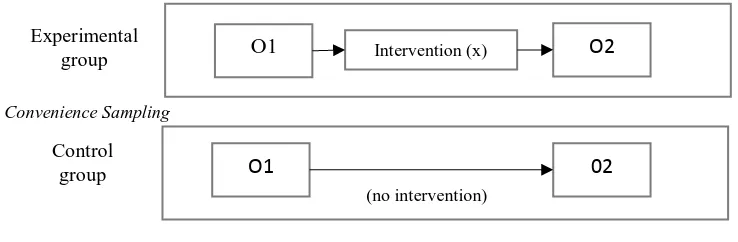
[image:18.595.79.448.522.643.2]attitude and behavioral intention. The study entailed a quasi-experimental pretest posttest control group design using questionnaires at two points in time as presented in Figure 3.
Figure 3. Model quasi-experimental research design.
*note: O1 is the pre-test measurement, O2 is the post-test measurement. O1
O1
O2
02 Intervention (x)
(no intervention) Experimental
group
19 Wegerif, E. Master Educational Science and Technology
The quasi-experimental design is often used for inquiry at school level, in which two groups are compared (Furtak, Seidel, Iverson & Briggs, 2012). Based on willingness to participate in the physical training sessions, teachers were assigned to either one of two conditions; (1) experimental group, participating in the professional development program or (2) control condition, not participating in the professional development program.
Procedure
Boards of primary schools that participated in this study were approached individually by the
researcher by e-mail and informed with the purpose of this study. Schools were provided with options
to sign-up for (1) participation in a training and (2) participation in control group. Teachers participating in the training, signed-up voluntarily. During the two-day professional development intervention, teachers were trained in teaching HOTS at their school location. The second training sessions took place within approximately two weeks after the first training session.
Respondents from the experimental group filled out the pretest individually, at the start of the first training session and the posttest individually, at the start of the second training session. In both cases, the trainer was present. The training was offered to two separate experimental groups. The first training sessions of one experimental group was filmed for research and promotional purposes.
20 Wegerif, E. Master Educational Science and Technology
Ethical considerations
The research protocol was checked and approved by the BMS Ethics Committee of the University of Twente. Boards of primary schools participating in the study were approached by e-mail and informed of the content and ethical considerations of the study. Respondents in both experimental and control group were informed beforehand about the details of the study and were asked to confirm participation by signing a consent form. Respondents participating in the experiment were briefed on the filming during the training. Options for both approval and disapproval for use of video was included in the consent form. The consent form noted that it was possible to quit at any given moment, without consequences, should the respondent feel uncomfortable during the study. Data derived during the
study was analyzed anonymously.
Measurement Instruments
The instruments in this study consisted of questionnaires conducted at two points in time. The
quantitative data derived from questionnaires gained insight in primary school teachers’ a) knowledge, b) attitude and c) behavioral intentions towards teaching higher-order thinking skills as data derived from questionnaires are easily generalizable to the population (Endedijk & Bronckhorst, 2014).
21 Wegerif, E. Master Educational Science and Technology
knowledge. In the following section, questionnaire items on knowledge, attitude and behavioral intention are described in more detail.
Knowledge
Knowledge of teaching higher-order thinking skills was assessed by seven questions about teachers’ knowledge on teaching higher-order thinking skills (see Appendix V). In the questionnaire,
two questions regarded factual knowledge (e.g. “What are the six levels of Bloom’s Taxonomy?”), two questions regarded conceptual knowledge (e.g. “Why do you think it is relevant to teach higher-order thinking?”) and three questions regarded procedural knowledge (e.g. “Rewrite the following traditional student assignments”). The knowledge-test was validated consulting experts and piloting
several versions of the test with primary school teachers. Responses were assessed using a rubric (Appendix VI), developed by the researchers consulting experts. The maximum score on the knowledge test was 25; points were distributed over the factual (max. score = 9), conceptual (max. score = 8) and procedural (max. score 8) knowledge dimensions (see Appendix VI).
Metacognitive knowledge on teaching higher-order thinking skills was assessed using a self-reporting measurement instrument (see Appendix VII) including six questions on metacognitive strategies (1) evaluating, (2) monitoring and (3) planning. Respondents from the experimental group, reflected on development of metacognitive knowledge by reporting positive or negative attitude towards development of cognition. In the questionnaire, respondents were provided with opportunities to explain any possible self-reflection on metacognitive strategies (e.g. “I discovered my weaknesses in teaching HOTS, namely…”). The questionnaire was assessed by indicating percentages of
22 Wegerif, E. Master Educational Science and Technology
Attitude
Attitude towards teaching higher-order thinking skills was assessed using a questionnaire with a 5-point Likert scale on agreement. Respondents were asked to score twenty statements on attitude ranging from 1 (strongly disagree) to 5 (strongly agree) (see Appendix VIII). The questionnaire contained four statements on perceived relevance (e.g. “I think it is crucial for students’ learning to
stimulate higher-order thinking.”), six statements on low achieving students (e.g. “I think we can expect little higher-order thinking from ‘weak’ students.”), four statements on self-efficacy (e.g. “I am able to ask questions to students which stimulate higher-order thinking.”) and six statements on context-dependency (e.g. “To me, the size of the class determines whether I will stimulate students’
higher-order thinking.”) The validated instrument is developed by Wijnen et al. (in progress) in which factor-analyses were conducted. The twenty items are presented unstructured to prevent bias. A detailed overview of questions organized by factors is presented in Appendix IX.
Behavioral intention
Intention to teach higher-order thinking skills in class was assessed using a questionnaire with a 5-point Likert scale on agreement. Statements as ‘I ask my students questions to stimulate higher-order thinking’ are presented. Respondents were asked to score eight statements on agreement ranging
23 Wegerif, E. Master Educational Science and Technology
The intervention
TPD-programs are proven to be effective for improvement in instructional practices and enhanced knowledge on new teaching strategies and tend to have a positive effect on student outcomes (Borko, 2004; Desimone, Smith & Phillips, 2013). The aim of the professional development training was to improve primary school teachers’ knowledge, attitude and behavioral intention towards
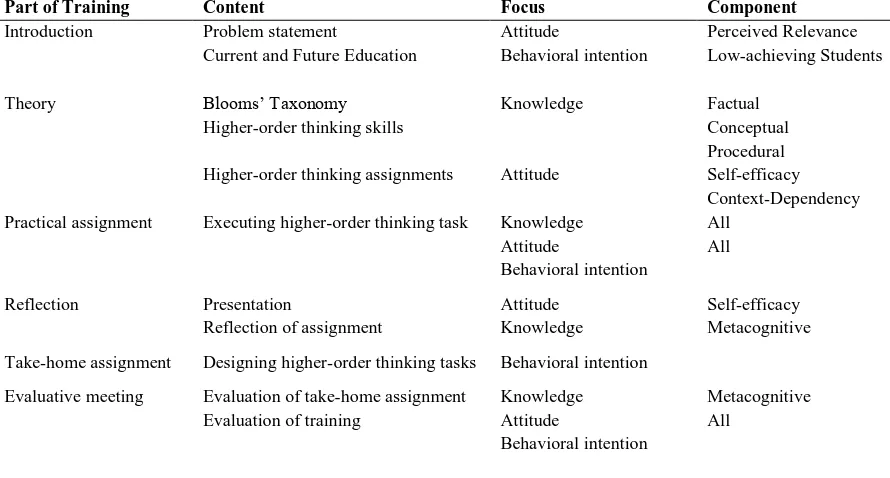
teaching HOTS. The focus of each intervention part is presented in Table 2.
The intervention in this study was developed based on existing literature on professional development (Timperley, 2008; Borko, 2004) acknowledging the importance of the training to be short to overrule practical limitations (Thijs et al., 2014) and fit within the current timespan. After
24 Wegerif, E. Master Educational Science and Technology
Table 2
Overview of the training categorized by focus on 1) knowledge, 2) attitude and/or 3) behavioral intention.
Part of Training Content Focus Component
Introduction Problem statement
Current and Future Education
Attitude
Behavioral intention
Perceived Relevance Low-achieving Students
Theory Blooms’ Taxonomy
Higher-order thinking skills
Higher-order thinking assignments
Knowledge Attitude Factual Conceptual Procedural Self-efficacy Context-Dependency Practical assignment Executing higher-order thinking task Knowledge
Attitude
Behavioral intention
All All
Reflection Presentation
Reflection of assignment
Attitude Knowledge
Self-efficacy Metacognitive
Take-home assignment Designing higher-order thinking tasks Behavioral intention
Evaluative meeting Evaluation of take-home assignment Evaluation of training
Knowledge Attitude
Behavioral intention
Metacognitive All
Key Elements in the training
The training included the key elements (1) theoretical information and (2) practical information on teaching higher order thinking, to stimulate teachers’ knowledge, attitude and behavioral intention.
The interactive nature of the training, including group assignments and group discussions, encouraged teachers’ desire to learn. Additionally, the training contained an (3) evaluation-part in which a plenary
25 Wegerif, E. Master Educational Science and Technology
Detailed description of the training
Results from theoretical framework were used to develop the intervention, the two-day professional development training on teachers’ knowledge, attitude and behavioral intention towards
teaching higher-order thinking.
The training consisted of two sessions (see Figure 2 for videotaped training) of approximately two hours. During the first
session, after approving participation by signing the consent form, respondents began by filling out questionnaires on knowledge, attitude and behavioral intention. During the first part of the initial
session, teachers were provided with the problem statement and theoretical information on teaching HOTS to broaden knowledge and strengthen attitude. Respondents were presented with definition statements on higher-order thinking along with practical examples on how to stimulate HOTS during different teaching activities in classroom environments.
In the second part of the first session, respondents were actively involved in a training activity about executing a higher-order thinking task including cognitive skills analyzing, evaluating and creating. The task (Appendix II) entailed the development of a sports complex suitable for five alternative sports such as underwater hockey and quidditch. After analysis of these sports and
evaluation of options, respondents created a future sports complex in groups of approximately five. To highlight the importance of critical and creative thinking as part of the design process, respondents were asked to present both design and design process at the end of the training.
Ending the first training session, respondents were asked to design similar higher-order thinking tasks before the next training session. The take-home assignment was handed out in clear
26 Wegerif, E. Master Educational Science and Technology
formats (see Appendix III) and focusses on behavioral intention. Working in duos, respondents were able to choose between 1) redesigning existing materials or 2) designing new materials and asked to bring the designs to the second training session.
After two weeks, the second training session started with filling out questionnaires on knowledge, attitude, behavioral intention and metacognitive knowledge accordingly. During this session, we focused on respondents’ metacognitive knowledge and behavioral intention as we
conducted group discussion on difficulties and successes when designing and executing higher-order thinking assignments in classroom environments. The assignments designed after the first training session are presented plenary as the power of the community improves learning when related issues
are discussed collectively to empower professional growth (Zohar, 2006). At the end of the training, respondents were thanked for participation and informed on further developments of the study.
Result of the intervention
During the first meeting of the professional development training, teachers were provided with the take-home assignment on designing higher-order thinking assignments. Some of the assignments are presented to show transfer of training and effects of the training on practical implementation.
Two teachers choose to redesign an existing assignment for geography on creating a farm in groups of four students. A complete assignment description can be found in Appendix X. Teachers guided the students in HOTS: analyzing, evaluating and creating. As students were enthusiast and creatively working on the assignment, both teachers valued the assignment as successful.
27 Wegerif, E. Master Educational Science and Technology
ultimately create a new feast day. A complete description of the assignment can be found in Appendix X. Although students needed encouragement for creative thinking, the assignment was a success.
Data Analysis
The effectiveness of the professional development training on primary school teachers’ knowledge,
attitude and behavioral attention towards teaching higher order thinking was analyzed using univariate repeated measures ANOVA’s for each component with statistical significance at p < 0.05. For each
repeated measures ANOVA, the between-subject variable was condition and the within-subject variable was time. We investigated the interaction effects between time and condition to determine differences
28 Wegerif, E. Master Educational Science and Technology
Results
Preliminary analysis
Results from preliminary analysis showed that the assumption of homogeneity of variance was
satisfied on each component of knowledge, attitude and behavioral intention. Homogeneity of variance was tested using independent-sample t-tests in pretest measurement, including assessment of Levene’s tests effect at a significance level of p = 0.05.
Results from tests on normality showed non-normal distributions for some components of knowledge, attitude and behavioral intention. As the sample was small, we accepted the limitation of the non-normality in this study. Since the assumption of homogeneity was satisfied, we assume that data from the experimental and control group showed large similarities and were valuable for further data analysis.
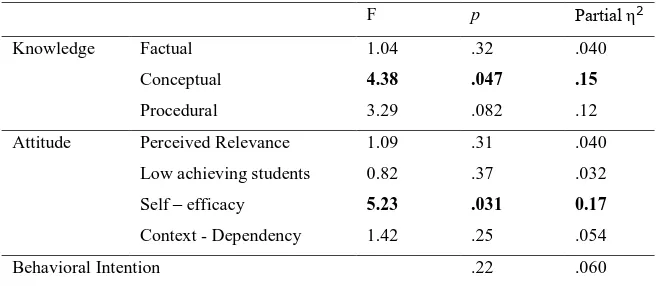
Results of the multiple ANOVA’s are presented in Table 3 (descriptive statistics) and Table 4 (interaction effects). Analyses of the univariate analyses for each component is described in more detail, reporting on the interaction effects between condition (experimental and control) and time (pre- and posttest) to show the effect of the professional development training for each component. Post-hoc paired t-test were reported to indicate differences between pre- and posttest within each group
29 Wegerif, E. Master Educational Science and Technology
Table 3
Descriptive statistics pre- and post-measurement organized by component Experimental group
(N = 13)
Control group
(N = 14)
Pre Post Pre Post
M SD M SD M SD M SD
Knowledge Factual 2.92 2.33 5.23 2.68 2.21 2.58 3.57 3.63
Conceptual 5.23 1.24 5.69 1.03 5.07 1.00 4.86 1.03
Procedural 3.38 1.98 4.92 1.44 2.50 2.10 2.57 1.40
Attitude Perceived Relevance 4.54 0.50 4.73 0.35 4.20 0.78 4.18 0.63
Low achieving students 2.63 0.50 2.36 0.53 2.65 0.92 2.67 0.76
Self-efficacy 2.73 0.62 3.38 0.60 2.86 0.73 3.02 0.63
Context- dependency 2.91 0.54 2.79 0.51 2.82 0.59 3.00 0.63
Behavioral intention 4.30 0.56 4.46 0.47 3.90 0.66 3.90 0.75
* Mean score range for each knowledge dimension: factual 0 – 9; conceptual 0 – 8; and procedural 0 – 8. ** Mean scores range for attitude components: 1 (totally disagree) to 5 (totally agree).
Table 4
Interaction effects (time of measures * condition) organized by component
F p Partial η2
Knowledge Factual 1.04 .32 .040
Conceptual 4.38 .047 .15
Procedural 3.29 .082 .12
Attitude Perceived Relevance 1.09 .31 .040
Low achieving students 0.82 .37 .032
Self – efficacy 5.23 .031 0.17
Context - Dependency 1.42 .25 .054
Behavioral Intention .22 .060
[image:29.595.70.400.474.617.2]30 Wegerif, E. Master Educational Science and Technology
Knowledge
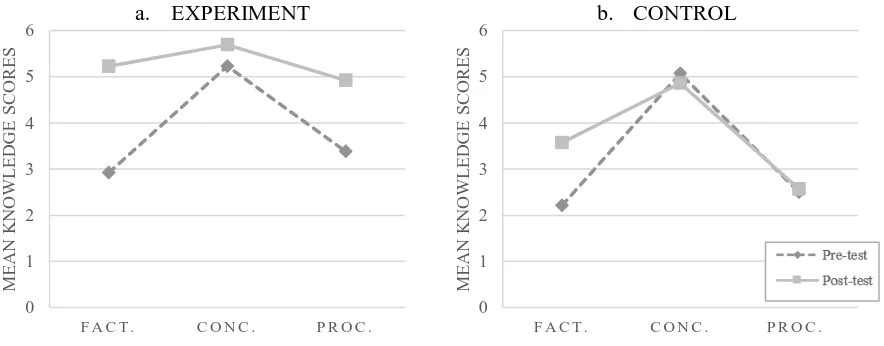
[image:30.595.84.526.351.524.2]The result of the study on the component of knowledge are presented in Table 3 and corresponding Figure 4. Table 3 shows descriptive statistics on each knowledge dimension (factual, conceptual and procedural) for both experimental and control condition. Figure 4 shows the graphical presentation of the mean pre- and posttest score of the experimental condition (Fig. 4a) and the control condition (Fig. 4b). The effects of the training are investigated using univariate repeated measurement ANOVA for each knowledge dimension, reporting the interaction effect (see Table 4) between time (pre- and posttest) and condition (experimental and control).
Figure 4. Mean scores pre- and posttest measurement on each knowledge dimension: factual (fact.), conceptual (conc.) and procedural (proc.).
The univariate analyses did not show a significant interaction effect of time and condition for factual knowledge dimension, F(1, 25) = 1.04, p = 0.32. When exploring data extensively by using paired t -tests, both experimental, t(12) = -2.62, p = 0.022 and control group, t(13) = -3.66, p = 0.003, showed
0 1 2 3 4 5 6
F A C T . C O N C . P R O C .
ME A N K N O W L E D G E SCO RE S 0 1 2 3 4 5 6
F A C T . C O N C . P R O C .
ME A N K N O W L E D G E SCO RE S
31 Wegerif, E. Master Educational Science and Technology
significant increase in factual knowledge. This means that both groups developed their factual knowledge over time.
The univariate analysis for the component of conceptual knowledge showed a statistically
significant interaction effect of time and condition, F(1, 25) = 4.38, p = 0.047, η2 = .15. The effect
size is high (Cohen, 1988) with partial η2 of .15, meaning that 15% of the variance in score for
conceptual knowledge was accounted for by the training. However, consulted paired t-tests did not show significant change within pre- and posttest score for experimental group t(12) = -1.59, p = 0.14, nor for the control group t(13) = 1.39, p = 0.19 on conceptual knowledge. This means that there was no effect of the professional training on conceptual knowledge as both experimental and control group did not develop conceptual knowledge over time.
There was no statistically significant interaction effect between time and condition on the procedural knowledge dimension, F(1, 25) = 3.29, p = 0.082. Additional paired t-tests showed a significant increase in procedural knowledge for respondents in the experimental group from pre- to posttest, t(12) = -2.49, p = 0.028, while the change for the control group was not significant t(13) = -0.14, p = 0.90. In other words, a trend was found for development of procedural knowledge for teachers participating in the experimental group.
Metacognitive knowledge was measured using a self-reporting measurement tool in which teachers of the experimental group reflect individually on the development of metacognitive
32 Wegerif, E. Master Educational Science and Technology
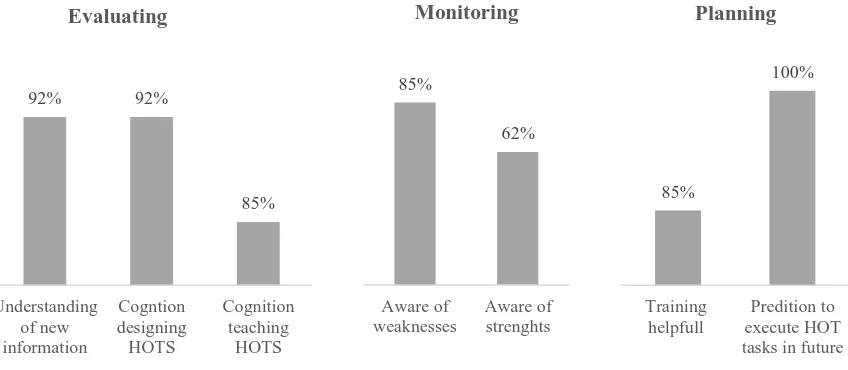
Figure 5. Percentages of teachers in the experimental group reporting positive development of
metacognitive knowledge dimension categorized by evaluating, monitoring and planning components (N = 13).
As evaluation indicated the transfer of the training, 92% percent of teachers reported positive development of cognition on designing and understanding HOTS, supported by examples of
comments of teachers as “Bloom’s Taxonomy Scheme helped me designing tasks” and “Practical tips and examples helped me understand teaching HOTS”. Additionally, 85% of the teachers self-reported
positive development of cognition on teaching HOTS in practice.
At monitoring-level, teachers reported on control of own’s cognitive systems. 85% of the teachers reported positively on the discovery of weakness with examples as “difficulties remembering theories” and “requiring more practice”. Strengths on metacognitive development for teaching HOTS are positively valuated by 62% of the teachers with examples as “creative thinking” and “curiosity”.
The metacognitive strategy planning is valued to indicate teachers’ cognitive awareness for adaptation of behavior. As 85% of the teachers acknowledged the training to be helpful for future classroom practice, each teacher that engaged in the professional development training plans to teach HOTS in future classroom practice (100%). Comments on planned adaptation of behavior were:
33 Wegerif, E. Master Educational Science and Technology
“being aware of importance teaching HOTS”, “acknowledging the value of exchanging experience
with colleagues” and “important to teach HOTS for students’ future private and professional life”. Thus, based on self-reported measurement, teachers engaging in the professional development training valued the development of their metacognitive knowledge positively.
To summarize, teachers who engaged in the professional development training did not develop more factual, conceptual and procedural knowledge, compared to teachers from the control group. Although procedural knowledge dimension did show a trend for improvement for the experimental group, the training had no significant effect. Nonetheless, the majority of the teachers in the experimental group
self-reported positive development of metacognition as result of the professional development training.
Attitude
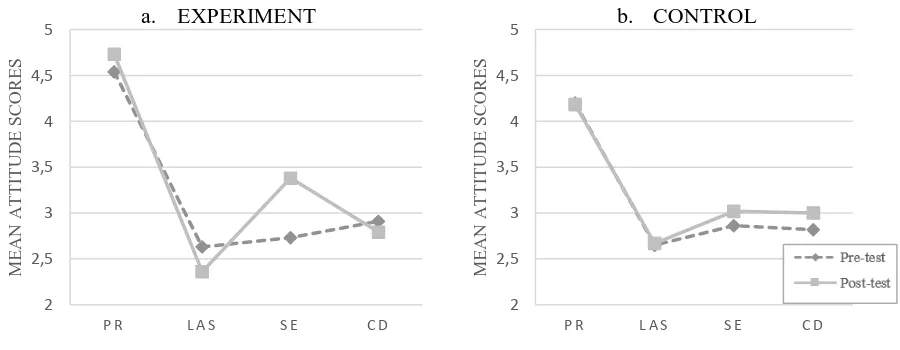
Regarding attitude toward teaching HOTS, we measured teachers’ cognitive beliefs and perceptions of behavioral control. The results of the study on the component of attitude are presented in Table 3 and corresponding Figure 6. Table 3 shows descriptive statistics on each attitude component (i.e.,
perceived relevance, beliefs about low achieving students, self-efficacy and context-dependency) for both the experimental and control condition. Figure 6 shows the graphical presentation of the mean pre- and posttest score of the experimental condition (Fig. 6a) and the control condition (Fig. 6b). The effects of the training were investigated using univariate repeated measurement ANOVA for each attitude component, reporting the interaction effect (see Table 4) between time (pre- and posttest) and condition (experimental and control).
34 Wegerif, E. Master Educational Science and Technology
Figure 6. Mean scores pre- and posttest measurement on each attitude component: perceived relevance (PR), beliefs about low-achieving students (LAS), self -efficacy (SE) and context-dependency (CD).
The univariate analysis for the component perceived relevance did not show a statistically significant interaction effect between time and condition, F(1, 25) = 1.09, p = 0.31. By exploring data using paired t-tests, a trend for development of perceived relevance is found for the experimental group, t(12) = -2.54, p = 0.026. This trend was absent in the control group for pre- and posttest, t(13) = 0.099, p = 0.92. This means that, as a result of the training, teacher’s believes towards perceived relevance for teaching HOTS positively changed for experimental group.
There was no statistically interaction effect of time and condition for the beliefs about low achieving students, F(1,25) = 0.82, p = 0.37. Additional paired t-tests showed no significant difference in attitude towards low achieving students from pre- and posttest for both experimental group, t(12) = 1.40, p = 0.19, and control group t(13) = -0.05, p = 0.96. Meaning that teachers from both groups did not change their belief towards student-ability of low-achieving students.
The univariate analysis showed a statistically significant interaction effect of the training on
self-efficacy, F(1, 25) = 5.23, p = 0.031, η2 = .17 for the experimental group. The effect size is large 2 2,5 3 3,5 4 4,5 5
P R L A S S E C D
ME A N A T T IT U D E SCO RE S 2 2,5 3 3,5 4 4,5 5
P R L A S S E C D
ME A N A T T IT U D E SCO RE S
35 Wegerif, E. Master Educational Science and Technology
(Cohen, 1988) as 17% of the variance was accounted for by the professional development training. The effect of the training was supported by paired t-tests showing a significant change in self-efficacy for the experimental group, t(12) = - 3.13, p = 0.009, while the statistically significant effect was absent for the control group, t(13) = -1.53, p = 0.15. This means that only the teachers from the experimental group showed increased self-efficacy as a result of the training.
The univariate analysis for the component context-dependency did not show a statistically significant interaction effect, F (1, 25) = 1.42, p = 0.25. Although a trend, i.e., a decrease within valued context-dependency for the experimental group was found, the change showed no significant
difference, t(12) = 0.92, p = 0.38. Teachers’ context- dependency in the control group increased,
though non-significant t(13) = -0.86, p = 0.40. Meaning that the professional development training did not affect teachers’ context-dependency towards teaching HOTS.
36 Wegerif, E. Master Educational Science and Technology
Behavioral Intention
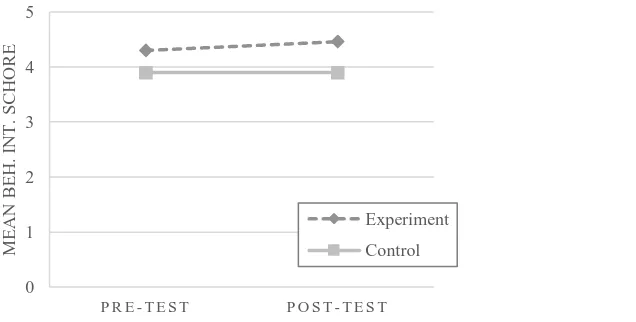
[image:36.595.84.402.335.496.2]The result of the study on behavioral intention are presented in Table 3 and corresponding Figure 7. Table 3 shows descriptive statistics on behavioral intention for both experimental and control condition. Figure 7 shows the graphical presentation of the mean pre- and posttest score of the experimental condition and the control condition. The effects of the training are investigated using univariate repeated measurement ANOVA, reporting the interaction effect (see Table 4) between time (pre- and posttest) and condition (experimental and control). Results of the interaction effect are presented in Table 4.
Figure 7. Mean scores pre- and posttest measurement on behavioral intention for experimental and control group.
The univariate analysis of the interaction between time and condition for the component behavioral
intention did not show a significant effect, F(1, 25) = 1.61, p = 0.22, η2 = .060. Additional paired t
-tests showed no significant difference in behavioral intention from pre- and posttest for both
experimental group, t(12) = -1.57, p = 0.14, and control group t(13) < 0.00, p = 1.00. Meaning that,
0 1 2 3 4 5
P R E - T E S T P O S T - T E S T
37 Wegerif, E. Master Educational Science and Technology
conflicting with the hypothesis, the professional development training had no effect on teacher’s behavioral intention to teach higher-order thinking.
In conclusion, we found no effect of the professional development training on primary school
teachers’ factual, conceptual and procedural knowledge. Although the interaction effect for conceptual
knowledge is significant, additional post-hoc tests showed that this interaction effect is neglected as both groups did not significantly change their conceptual knowledge over time. The seeming interaction effect for conceptual knowledge can be explained by the opposite effect for both groups over time as score for experimental group increased while score for control group decreased. This conflicts with our hypotheses since the experimental group was expected to increase knowledge compared to unvaried control group.
Nevertheless, we did find an effect for teachers’ self-efficacy as a result of the training.
Meaning that teachers in the experimental group felt more confidence and able to teach higher-order thinking skills after participation in the professional development training. Evaluating teachers’ metacognitive knowledge, teaches reported to be more capable of teaching HOTS once provided with
examples and materials. This explains the small, though non-significant, increase for primary school teachers’ behavioral intention to teach higher-order thinking as teachers felt more capable to teach
higher-order thinking.
38 Wegerif, E. Master Educational Science and Technology
Discussion
In this study, we evaluated the impact of a newly-developed two-day professional development training designed to improve primary school teachers’ knowledge, attitude and behavioral intention
towards teaching HOTS. As we did not include Bonferroni correction, we must be careful when interpreting results. Nevertheless, the results of the study partially support our hypotheses, indicating that the training has a positive effect on teachers’ metacognitive knowledge and attitude toward
self-efficacy for teaching higher-order thinking in primary schools.
The results of the post-hoc paired-t-tests showed significant changes for the factual knowledge dimension, the attitude toward perceived-relevance, and the attitude toward self-efficacy for the experimental group. However, most of the univariate ANOVA tests showed no interaction effect between time and condition. The small sample in both experimental (N = 13) and control (N = 14) condition is assumed to be causing the lack of interaction effect for the components. Nonetheless, we did find a significant interaction effect for self-efficacy as a result of the training.
Knowledge
We hypothesized increased knowledge at all knowledge-dimensions (Bloom, 1965) as a result of the training. Although factual, conceptual and procedural knowledge increased in experimental group, the results of the univariate analyses did not show statistically significant interaction effect for those
knowledge dimension, combining effect of time and condition.
39 Wegerif, E. Master Educational Science and Technology
support previous findings of Retnawati et al. (2018) showing that teachers find it difficult to give a clear definition of the term higher-order thinking. As the low score on pre-test left room for
improvement, an increased score for each knowledge dimension was expected and accordingly found for respondents from the experimental group.
Voluntary participation in the intervention seems to have effect on the development of knowledge dimensions. Previous studies on teacher professional development indicated that teachers who do not voluntarily participate in interventions tend to lack content knowledge (Desimone, Smith, & Ueno, 2006) as they do not connect with the subject-matter. It is expected that teachers in the experimental group signed up for the intervention because they already connect with the
subject-matter and possess basic knowledge of HOT. This is supported by higher mean score on pre-test for all knowledge dimensions of experimental group. Moreover, teachers participating in the intervention are expected to be motivated learners (Borko, 2004) as the majority is eager to explore new ideas when volunteering for professional development (Fishman, Marx, Best & Tal, 2003). Accordingly, results show indeed a greater (non-significant) improvement for experimental group on knowledge.
On the contrary, respondents of the control group also increased their score, though minimally, on post-test (M = 3.57) compared to pre-test (M = 2.21) for the factual knowledge dimension. This effect can be explained by raised awareness in the control group, commonly referred to as the Hawthorne-effect (Mayo, 1933), suggesting modified behavior as a result of the awareness of being studied. Nevertheless, in the current study we agree with previous studies, assuming that the impact of social desirability is minimal when questionnaires are anonymous (Armitage & Conner, 1999).
40 Wegerif, E. Master Educational Science and Technology
the lack of transferred of knowledge as time for practice and implementation are important for effective professional development (Timperley, 2008). Nevertheless, the few take-home assignments that were completed individually were of high quality (see Appendix X). Furthermore, some of the teachers were able to teach the HOTS-assignments in classroom environments with their students. Those teachers noted that the assignments were successful in classroom practice as students became more critical and creative during these assignments. These findings support statements from
introduction, concluding that teacher professional develop has a large effect on the quality of
education and learners’ achievement (Whitworth & Chiu, 2015). Hence, the effect of the assignments
is considered to stimulate teachers’ continuous future development of knowledge in teaching HOTS.
Another important discussion point is the instrument used for measuring knowledge. As the questionnaires entail self-reported measurement, we do not measure actual classroom practices. Although group discussion attributes to the skill of self-reflection (Civitillo, Juang, Badra, &
Schachner, 2019), results from self-reporting measurements could differ from actual implications. Due to limited assessment time in this study, the practical implementations were not studied.
To conclude, although, except for metacognitive knowledge, the results did not support our hypotheses on increased knowledge, based on teachers’ statements in the evaluative session of the training, we value the results as promising. Future research should extend training duration and include measurement of actual behavior as a result of the TPD-program to investigate effectiveness.
Attitude
41 Wegerif, E. Master Educational Science and Technology
developments in future labor market. As we provide respondents with practical information and opportunities to share professional development in a learning community, we expect teachers to increase self-efficacy as a result of the training. Accordingly, we hypothesized decreased values for attitude components beliefs about low-achieving student ability and context-dependency. Teachers in the professional development training are provided with examples on HOTS-assignments focusing on all students, hence decreased attitude towards ability from low-achieving students towards higher-order thinking is expected. Finally, we believed teachers’ context-dependence decreases as a result of the training since the training focusses on teacher’s ability to design HOTS-assignments individually by providing teachers with theoretical and practical information.
Since teachers acquire beliefs through professional development experiences (Gaines et al., 2019), the findings on attitude are promising. Respondents of the experimental group valued the effects of the training based on their experience. Though not show significant, teachers in the experimental group did decrease their value toward the attitude components: beliefs about
low-achieving students (M = - 0.27), context-dependence (M = - 0.12), and increased the value towards the attitude component: perceived relevance (M = + 0.12) and self-efficacy (M =+0.65).
The latest was found significant, meaning that teachers’ self-efficacy (i.e. perceived control and self-confidence) in teaching HOTS increased as a result of the training. As previous studies indicated that most teachers’ feel insufficiently competent to teach HOTS (Ivie, 1998; Zohar &
self-42 Wegerif, E. Master Educational Science and Technology
efficacy due to practical tips and materials. These results support previous studies suggesting that provided teaching materials and strategies support teaching HOTS (Collins, 2004).
Previous studies on the attitude component perceived relevance indicated that primary school teacher’s believes on perceived relevance towards teaching HOTS is improvable (Zohar et al., 2001; Ivie, 1998). Nevertheless, in this study, respondents’ attitude towards perceived relevance was already valued relatively high at pre-test for both experimental and control group. Moreover, respondents in the experimental group increased their value toward perceived-relevance to M = 4.73 at post-test measurement. Statements from teachers in the experimental group as “These skills are necessary in the 21st century” support teachers’ positive attitude towards perceived relevance. Based on these findings,
conflicting with previous studies on perceived-relevance for teaching HOTS, we assume that teachers’ attitude towards perceived-relevance is generally high.
43 Wegerif, E. Master Educational Science and Technology
On the contrary, we considered well-being of respondents when designing the professional development training as we established a culture of trust to increase effectiveness of the training (Van Geel, Keuning, Visscher, Fox, 2016). In this study, teachers formed a learning community while trained in stimulating higher-order thinking at their own school locations with colleagues, thus in a familiar environment. Teachers from the experimental group acknowledge the value of collaborative interactions when examining and improving their practice (Borko, 2004). We believe we established a positive social learning community in a familiar environment since teachers commented on the community with statements such as “I appreciate the brainstorming on assignments with colleagues” and “Sharing thoughts helps me designing tasks” during the evaluative session.
To conclude, as the training was developed to train teachers on designing and executing HOT-assignments, we are pleased by the statistically significant effect of the training on teachers’
self-efficacy. The development of a more positive attitude towards self-efficacy is supported by teachers in the evaluative session of the training with statements as “The practical examples helped me teaching HOTS in my class”. Though non-significant, results on perceived-relevance, beliefs about low-achieving students and context-dependency are promising as trends in development are found and should be studied in future research.
Behavioral Intention
44 Wegerif, E. Master Educational Science and Technology
However, despite room for improvement, the trend in developing behavioral intention was absent in the control group. In other words, respondents in the experimental group increased their behavioral intention while behavioral intention from respondents in the control group remained the same.
The relatively high score on behavioral intention can be explained by supporting literature on behavioral intention. Namely, behavioral intention is studied as the motivation required to behave particularly (Armitage & Christian, 2003). Results from pre-tests show that teachers already were motivated to teach HOTS. Motivation for particular subject could explain voluntary participation in the current study (Van Aalderen-Smeets & Walma van der Molen, 2015). During the evaluative session, teachers support this finding as they wanted to stimulate HOTS but experienced practical
limitations as lack of time or lack of perceived control before attending the training. So, behavioral intention does not always lead to actual behavior (Fishbein & Ajzen, 1975). As the current study did not include measurements on actual behavior, future research should investigate effects of professional development programs on actual behavior.
Thus, although the improvement on behavioral intention is minimal we do assume that
teachers from experimental group are likely to transform behavioral intention into behavior as some of the teachers already did. During the evaluative session, this transfer is supported by teachers’
statements such as “I acknowledge the importance of teaching HOTS” and “These assignments
stimulate students’ enthusiasm and involvement”. Based on these finding, we expect that behavioral intention is predicative for behavior, as we eliminate limitations such as lack of knowledge.
45 Wegerif, E. Master Educational Science and Technology
components for the control group was absent, teachers’ behavioral intention did not change. Likewise, though non-significant, the positive development of knowledge and change of attitude in the
experimental group synchronizes with the positive development of behavioral intention. In other words, results suggest that development of knowledge as a result from professional development trainings, synchronize with an effect in attitude and an effect in behavioral intention can be expected.
Conclusion
The aim of this study was to evaluate the effects of a newly developed two-day professional
development training on primary school teachers’ knowledge, attitude and behavioral intention toward
teaching higher-order thinking skills to contribute to scientific research base on professional
development trainings. As we conclude, a few limitations for this study must considered accordingly. One of the limitations is having a small sample size at N = 27, representing six primary
schools in the Netherlands. Due to small sample size, the result limit the transferability to other teacher populations. We must be careful when generalizing the effects of professional development training on teaching HOTS, as effects are less likely to transfer to larger populations. Due to limited time span and relatively low application of voluntary participation, we were unable to include more respondents.
46 Wegerif, E. Master Educational Science and Technology
Therefore, voluntary participation in the experimental group is considered to be a limitation of this study as teachers participating in such experiments, are likely to be motivated learners (Borko, 2004). Although other studies argued respondents in control group behaving socially desirable in research correspondingly (Mayo, 1933), in this study, we agree with Armitage and Conner (1999) acknowledging that the impact of social desirability in anonymous questionnaires on models as planned behavior is minimal.
Lastly, the timespan of the study tends to have a negative effect on the results. Although the trainings were deliberately designed to be short to overcome practical limitations as lack of time (Thijs et al., 2014), we experienced that it takes time for teachers to learn and change (Desimone, 2002).
These findings are in line with previous studies on TPD, stressing the importance of transfer time in professional development (Borko, 2004; Timperley, 2008). Both limited time and practical
implications as holidays reduced transfer of knowledge, as the timespan was only two weeks.
Nonetheless, this study provide evidence on teachers’ intention to teach higher-order thinking in primary schools as scores on behavioral intention are relatively high. Similar to literature on teachers’ willingness to teach HOTS (Thijs et al, 2014; Ivie, 1998; Zohar & Schwartzer, 2005),
findings of this study showed positive development of attitudes as predictor for increased behavioral intention (Ajzen & Fishbein, 2000). In fact, answering the research question, we can conclude that teachers’ self-efficacy on teaching HOTS are positively developed as a result of the newly developed short TPD-program.
47 Wegerif, E. Master Educational Science and Technology
for self-efficacy development within a relatively short time span. Future research is necessary to further investigate actual practical implications and student achievements as a result of professional development programs on higher-order thinking skills.
In practice, teachers in primary education benefit from practical tips and tricks provided in the intervention such as overviews of useful questions and assignments on stimulating higher-order thinking in classroom practice. The main practical contribution of this study is the videotaped training, as a useful tool in creating awareness and understanding for the importance of teaching higher-order thinking skills in primary schools. This tool stimulates acknowledgement on including higher-order thinking skills in primary school curricula, which is needed to prepare young individuals for