UNIVERSITEIT TWENTE.
Visual attention and motor learning in
dyslexics and controls
Masterthesis Psychology
Cognition & media
20-08-2010
Author
J. Askamp
Supervisors
Dr. R.H.J. Van der Lubbe
Dr. E. De Kleine
1
A
BSTRACT
3
I
NTRODUCTION
Developmental dyslexia is characterized by an unexpected difficulty in learning to read, despite conventional instruction, adequate intelligence, and socio-cultural opportunity. Prevalence rates of dyslexia range from 5-17.5% (Shaywitz & Shaywitz, 2005). Besides linguistic problems, nonlinguistic disabilities have been found in dyslexics too, including auditory, visual and motor impairments (Ramus, 2003; Stoodley, Harrison & Stein, 2005).
Several theories have been formulated to explain which mechanisms underlie the variety of symptoms found in dyslexics. The most accepted theory is the phonological deficit theory, which states that the reading problems of dyslexics originate from a specific impairment in the representation, storage and/or retrieval of speech sounds (Ramus, 2003). Support for this theory comes from findings of dyslexics performing particularly poorly on tasks that require phonological awareness, such as segmentation of speech sounds and reading nonsense words. A weakness of this theory in explaining symptoms in dyslexia is, however, that impairments seem not to be limited to phonological skills (Nicolson & Fawcett, 1999).
Besides the phonological theory, two other theories have been dominating the field: the magnocellular theory and the cerebellar deficit hypothesis. Both theories suggest that dyslexia is a general sensori-motor syndrome, rather than a specific reading disability. Because of contradictory findings regarding auditory, visual and motor impairments in dyslexics, researchers do not agree on which theory provides the most likely explanation for these symptoms or whether these impairments have a common origin (Ramus , 2003).
T
HE MAGNOCELLULAR HYPOTHESIS4 consists of magnocellular and parvocellular processing streams. Magnocellular layers in the Lateral Geniculate Nucleus (LGN) transmit information from the rods, which is necessary to perceive (fast) movements, low contrast and depth, whereas the parvocellular layers transmit information from the cones necessary for the perception of color and fine detail. Via the magnocellular layers in the LGN, magnocells project to the posterior parietal cortex (PPC) and the primary visual cortex in the occipital lobe. The posterior parietal cortex is believed to manipulate mental images, integrate sensory and motor portions of the brain, and is involved in the formation of plans. The PPC is also important in the guidance of visual spatial attention (Kinsey, Rose, Hansen, Richardson & Stein, 2004) and the ‘attentional spotlight’ (Vidyasagar & Pammer, 1999). Cells in the primary visual cortex project further to the cerebellum and superior colliculus, which are important for visuo-motor control.
5 attention and fast and precise control of visual orienting (Facoetti, Turatto, Lorusso & Mascetti, 2001). Some found that word analysis is slowed in dyslexics, because of crowding effects, which limit letter-identification in multi-letter arrays (Martelli, Di Filippo, Spinelli & Zoccolotti, 2009). Facoetti and colleagues (2002) found dyslexic children to have both auditory and visual deficits in the automatic orienting of spatial attention. Another study found that a target captures attentional resources for longer time in dyslexics than in controls, i.e., attentional dwell time was prolonged by 30% in dyslexics, meaning that, for (some) dyslexics, it takes longer to disengage attention from a previous target, in series of targets (Hari, Valti & Uutela, 1999). A similar impairment in visual attentional engagement and disengagement was also found in dyslexic children by Facoetti and colleagues (Facoetti, Ruffino, Peru, Paganoni, & Chelazzi, 2007). It thus seems plausible that a magnocellular impairment may underlie problems in dyslexics in focusing attention on separate letters in words, eventually leading to problems with reading.
6 search, whereas the other groups did not. In another study, the speed of attention-shifting was tested in high-functioning adults during visual search; here, dyslexics were well able to perform pop-out single feature searches, whereas their accuracy decreased as set-size increased during conjunction searches (Buchholz & McKone, 2004).
T
HE CEREBELLAR DEFICIT HYPOTHESISA somewhat more recent theory of developmental dyslexia is the cerebellar deficit hypothesis. This theory came from the idea that the diversity of problems found in dyslexia is caused by a general deficit in the automatization of skill, whether or not the skill is in the literacy domain (Nicolson & Fawcett, 1999).
The cerebellum is responsible for integration of sensory perception, coordination and motor control. It is traditionally believed to be a motor area, responsible for the execution of acquired skills and building up new skills. The cerebellum has also been shown to be involved in language-related skills (Nicolson et al., 1999).
7 become automatic and fluent (Stoodley, Harrison & Stein, 2005). Nicolson and colleagues (1999) found dyslexics to make more errors than controls in sequencing of finger movements, even after a sequence was overlearned. De Kleine and Verwey (2009) found dyslexics to be slower and to produce more errors than controls in learning six-key finger sequences. An automatization deficit could account for these and other impairments found in dyslexics, possibly caused by cerebellar dysfunctioning.
Motor learning is best studied by simple motor learning tasks, such as discrete sequence production (DSP) tasks. In a DSP task, discrete sequences with a maximum of about eight elements are typically practiced on a keyboard by responding to key-specific stimuli (Rhodes, Bullock, Verwey, Averbeck & Page, 2004). During a classical DSP task, motor execution and motor preparation occur in parallel, because a new element in the sequence is presented immediately after the response to a previous element. However, in order to get a clear view on preparation processes underlying sequencing, a classical DSP task is not suitable; we need to separate the motor execution from the motor preparation phase. Therefore, a modified DSP task was designed (Rosenbaum, 1980), in which a precue was used, giving information about defining values of movements (arm, direction, or distance) before a reaction signal was presented.
8 processor is believed to organize movement itself, by means of the information received from the cognitive processor (Shaffer, 1991). Together, these processors are involved in the whole process known as motor programming. It was suggested that the duration of motor programming processes increases with the length of the sequence that is being learned (Schröter & Leuthold, 2009).
9
R
ESEARCH QUESTIONSIn the present study, we were interested in visual attention and motor learning performance in dyslexics as compared to controls, in order to assess the magnocellular theory and the cerebellar deficit hypothesis. We examined whether dyslexics were worse than controls on conjunction and feature searches, in target-absent and target-present trials, while there were four different numbers of distracters in the field. Further, we examined whether dyslexics were slower and made more errors on a DSP task, when learning three-key as well as six-key sequences. Moreover, we were interested in whether differences in motor learning in dyslexics compared to controls are already present when preparing movements, as reflected in the CNV amplitude. Not surprisingly, we expect that, in a DSP task, larger sequences require more effort to learn than shorter sequences, resulting in larger RTs and more errors, because more elements have to be held in working memory and more motor programming is required. The CNV was suggested to reflect activity of a cognitive processor. In line with this, Schröter and Leuthold (2009) found CNV amplitudes to be larger for three-key responses than for one-key responses. We expect the amplitude of the late CNV to be larger during preparation of large sequences, than during preparation of short sequences, in both dyslexics and controls.
10 The cerebellar deficit theory hypothesizes dyslexics to be worse at tasks that require skill automatization, such as a DSP task. As was found in the study of De Kleine & Verwey (1999), dyslexics might perform poorly compared to controls during sequence learning, resulting in larger RTs and more errors. Poorer performance on sequence learning would indicate an automatization deficit in agreement with the cerebellar deficit hypothesis. If dyslexics are worse, differences might already be present during preparation, which would then be reflected in smaller CNV amplitudes.
11
M
ETHOD
PARTICIPANTS
Participants were 25 students from the University of Twente, of which 13 were dyslexic (six female and seven male) and 12 were nondyslexic (nine female and three male). Their age ranged from 18 to 25 years (mean: 20.8 ± 2.1 years). Dyslexics were paid €18 for their participation whereas controls received course credits. All participants were right-handed as assessed with Annett’s Handedness Inventory (Annett, 1970) and had normal or corrected-to-normal vision. All nondyslexics were native speakers of Dutch, whereas one of the dyslexics was not a native speaker of Dutch. All participants signed informed consent before the start of the experiment and the study was approved by the ethics committee of the University of Twente.
VISUAL SEARCH - STIMULI AND TASK
The visual search experiment consisted of eight blocks, of which four conjunction search and four feature search blocks were randomly presented. Each block consisted of 48 trials and started with the presentation of a target. In each trial 20, 40, 60 or 80 randomly positioned distracter items were presented, which included the target in 50% of all trials. The items were thick stripes positioned in one of two orientations (horizontal and vertical) and filled with one of two colors (red and blue). In feature blocks, the target differed from the elements only in orientation and not in color (participants searched for a blue horizontal rectangle among blue vertical rectangles). In conjunction blocks, the target differed in both orientation and color (participants searched for a blue horizontal rectangle among blue vertical and red horizontal rectangles). An example showing the start of a conjunction and feature block including one trial is shown in Figure 1.
12 computer keyboard respectively. When the target was present, participants had to respond with their right index finger, whereas when it was not, participants had to respond with their left. Participants were instructed to respond as quickly but as accurately as possible. A new trial began as soon as the response to the previous one had been given. Between blocks, participants were encouraged to take a short break and then start a new block.
DSP- STIMULI AND TASK
The DSP experiment consisted of six blocks. Each block consisted of 56 trials (of which 48 were to be followed by a response (go trials) and 8 were not (nogo trials)), yielding a total of 336 trials. Participants placed both hands on eight keys of a normal computer keyboard: the little, ring, middle and index finger of their left hand on the ‘a’, ‘s’, ‘d’, and ‘f’, and the same fingers of their right hand on the ‘;’, ‘l’, ‘k’ and ‘j’ key respectively.
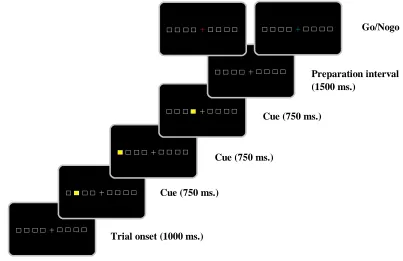
A fixation cross was presented at the centre of the screen (see Figure 2). On both sides, four horizontally aligned squares functioned as placeholders for the stimuli, having the same alignment as the corresponding response keys. All squares were presented as silver lines on a black background. After 1000 ms, a sequence started when one of the four squares (either on the
Figure1. Example of the start of a block in which participants searched for a blue horizontal target among blue vertical in feature blocks and blue vertical and red horizontal items in conjunction blocks.
Conjunction
In this block, the target is:
14
Figure 2. Example of a three-key sequence showing duration of each step from trial onset to the presentation of the go/nogo signal
equally produced by both controls and dyslexics. An example of the presentation of a three-key sequence (103) is shown in Figure 2.
PROCEDURE
Participants were seated in a dimly lit room in front of a 17 inch computer screen with a viewing distance of approximately 60 cm. All participants were first presented the Dutch version of the Dyslexic Screening Test (DST; Nicolson and Fawcett, 1969). The DST consists of separate paper-and-pencil tests, of which participants performed the picture and letter naming, single word reading, spoonerism, spelling, working memory, nonsense reading and writing test. After completion of the DST, the visual search task was performed, which took about fifteen minutes. Next, EEG preparation was done by the experimenters, after which participants performed the DSP task, which took about 50 minutes. Before each task, written instructions were given and
Trial onset (1000 ms.)
Preparation interval (1500 ms.)
Cue (750 ms.)
Cue (750 ms.)
Cue (750 ms.)
15 participants practiced a few trials until the task was understood. Altogether, the experiment lasted about three hours.
RECORDING AND DATA PROCESSING
During both experiments, stimulus presentation and response registration were controlled by E-prime version 2.0 on a 2.8GHz Pentium 4 PC running under Windows XP. EEG was recorded using 64 active electrodes located at standard electrode positions of the 10/20 system. EOG was recorded bipolarly, horizontally (on the outer side of both eyes) as well as vertically (above and below the left eye). EMG was recorded bipolarly at the musculus flexor digitorum superficialis of both forearms, in order to check whether participants did not execute movements during the preparation phase. EEG, EOG and EMG signals were amplified with a Quick-Amp amplifier (70 channels) and recorded with Brain Vision Recorder version 1.05. Impedance was kept below 20 kΩ. All data were sampled at a rate of 500 Hz and filtered online (low-pass 140 Hz).
DATA-ANALYSIS
16 block and all trials on which an error was made. By this procedure, we removed 6.4% of all trials, 13.1% of the conjunction trials and 1.1% of the feature trials.
We evaluated RTs and PC in the DSP task. T1-T6 indicate the time between two key presses, starting with the time between the go/nogo signal and the first key press. All first two trials of each block and all sequences in which one or more errors were made were removed. RTs on sequences were calculated by summating T1-T3 for three-key sequences and T1-T6 for six-key sequences. We eliminated from analysis those sequences in which the total RT on that sequence exceeded the mean sequence execution time across participants for each group and within each block and length, plus three standard deviations. RTs and PC were analyzed using repeated measures ANOVA with group as between-subjects variable and key (1-3 or 1-6) and block (1-6) as within-subjects factors, for short (three-key) and long (six-key) sequences separately.
18
R
ESULTS
D
YSLEXICS
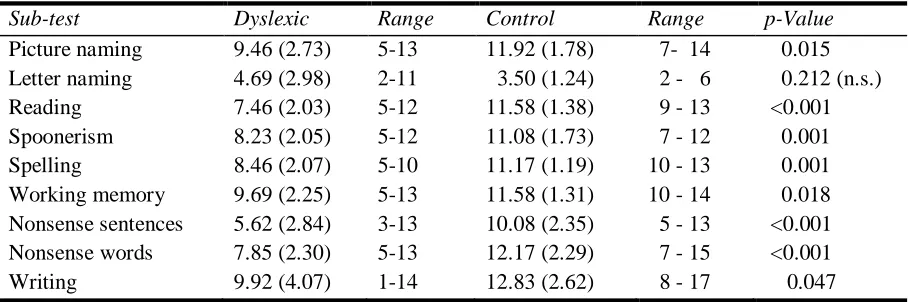
CREENING TESTScores on the dyslexia tests were analyzed using a multivariate analysis of variance (MANOVA). An overall significant difference between the two groups (dyslexics versus controls) was found on DST performance, F(8,16)= 7.4, p<0.001. Results of univariate tests comparing group scores on several dyslexia tests are shown in Table 1. Dyslexics scored worse on picture naming, reading, spoonerism, spelling, working memory, reading of nonsense words and sentences, and writing, whereas there was no significant difference in performance on the letter naming test. These results indicate that our dyslexic participants were correctly classified.
Sub-test Dyslexic Range Control Range p-Value
[image:20.612.73.527.386.537.2]Picture naming 9.46 (2.73) 5-13 11.92 (1.78) 7- 14 0.015 Letter naming 4.69 (2.98) 2-11 3.50 (1.24) 2 - 6 0.212 (n.s.) Reading 7.46 (2.03) 5-12 11.58 (1.38) 9 - 13 <0.001 Spoonerism 8.23 (2.05) 5-12 11.08 (1.73) 7 - 12 0.001 Spelling 8.46 (2.07) 5-10 11.17 (1.19) 10 - 13 0.001 Working memory 9.69 (2.25) 5-13 11.58 (1.31) 10 - 14 0.018 Nonsense sentences 5.62 (2.84) 3-13 10.08 (2.35) 5 - 13 <0.001 Nonsense words 7.85 (2.30) 5-13 12.17 (2.29) 7 - 15 <0.001 Writing 9.92 (4.07) 1-14 12.83 (2.62) 8 - 17 0.047
19
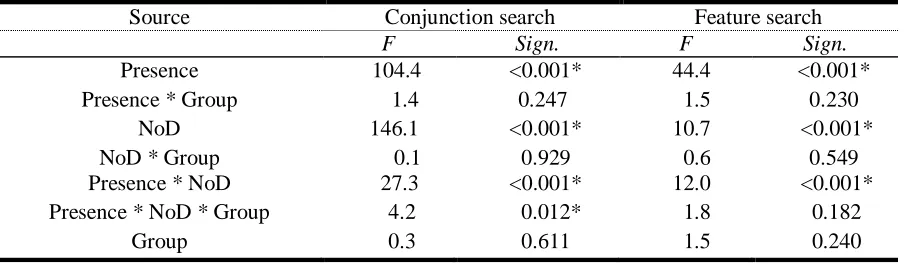
Table 2: Results of within-subjects and between-subjects comparisons on RTs in visual search
V
ISUALS
EARCHThe aim of the first experiment was to investigate visual search performance in dyslexics as compared to nondyslexics. Repeated measures ANOVA with group as between-subjects factor and presence of target (present vs. absent) and number of distracters (NoD; 20, 40, 60, or 80) as within-subjects factors was used to evaluate performance. Results of the repeated measures ANOVA for conjunction and feature trials are shown in Table 2.
Source Conjunction search Feature search
F Sign. F Sign.
Presence 104.4 <0.001* 44.4 <0.001* Presence * Group 1.4 0.247 1.5 0.230
NoD 146.1 <0.001* 10.7 <0.001* NoD * Group 0.1 0.929 0.6 0.549 Presence * NoD 27.3 <0.001* 12.0 <0.001* Presence * NoD * Group 4.2 0.012* 1.8 0.182
Group 0.3 0.611 1.5 0.240
Overall, groups did not differ significantly in visual search performance on conjunction, F(1,23) = 0.3, p=0.611, or feature search, F(1,23) = 1.5, p=0.240. Reaction times were larger for target-absent trials in both groups, as indicated by the significant main effect of presence. For conjunction trials, reaction times increased with the number of distracters, F(3,69) = 146.1,
20 There was a three-way interaction between presence, NoD and group in conjunction trials only,
F(1,23) = 4.2, p=0.012.More specifically, during conjunction search, RTs on target-absent trials compared to target-present trials increased more in dyslexics than in controls from 40 to 60 distracters, F(1,23) = 13.679, p=0.001.
Because Figure 3 suggests that there might be some differences on target-absent trials and not on target-present trials, we tested target-absent trials separately. There were no differences in RTs between dyslexics and controls however, for conjunction or feature trials,
F(1,23) = 0.630, p=0.435, and F(1,23) = 1.527, p=0.229, respectively, even though all means were higher for dyslexics.
A Repeated measures ANOVA on PC in conjunction searches and features searches showed no significant effect of group, or any significant interaction between group and presence or NoD.
Figure 3: Mean RTs (+/- SE) as a function of the number of distracters on target-present (pres.) and target-absent trials in dyslexic and nondyslexic participants, for conjunction (left) and feature searches.
21
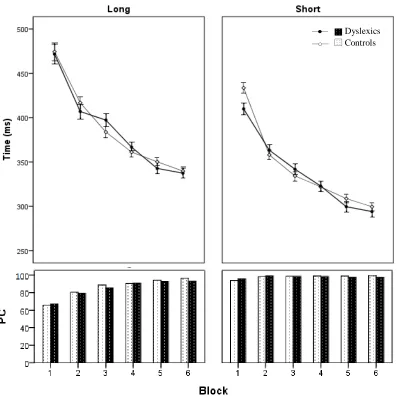
Figure 4: Mean RT (+/- SE) and percentage correct (lower panel) for dyslexics and controls when learning six-key (left) and three-six-key sequences over six blocks.
D
ISCRETES
EQUENCEP
RODUCTIONBEHAVIORAL MEASURES
The aim of the second experiment was to investigate sequence learning in dyslexics as compared to nondyslexics. Specifically, we analyzed RTs and PC in participants learning three-key and six-key sequences during six blocks of trials. Repeated measures ANOVA was performed with group as between-subjects factor and block (1-6) and key (1-3 or 1-6) as within-subjects factors, separately for short and long sequences. Figure 4 shows the mean RTs and PC across all keys, per block, for long (left) and short sequences.
22 There was no overall difference in RT between dyslexics and controls, on short F(1,23) = 0.2,
p=0.647, or long sequences, F(1,23) = 0.6, p=0.466. Participants became faster over blocks,
F(5,115)=56.6, p<0.001 and F(5,115)=39.0, p<0.001 for three-key and six-key sequences respectively. There was no significant interaction between group and blocks for short, F(5,115) = 0.8, p=0.450, or long sequences, F(5,115) = 0.2, p=0.902. Across groups, RTs became shorter in each subsequent block except in the fifth compared to the fourth and the sixth compared to the fifth in the execution of long sequences, and in the last block for short sequences.
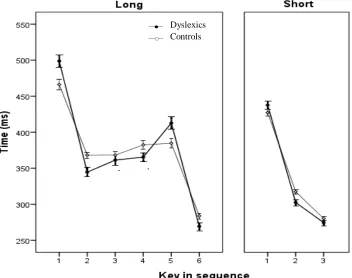
Further, it seemed valuable to check whether there are differences between dyslexics and controls in chunking during sequence production, because slower chunk execution might suggest differences in automatization (De Kleine & Verwey, 2009). RTs across blocks per key for long and short sequences, for dyslexics and controls are shown in Figure 5.
Figure 5: Mean RTs (+/- SE) per key for dyslexics and controls during the execution of long (left) and short sequences.
[image:24.612.113.465.396.674.2]23 Figure 5 suggests that, in executing long sequences, participants tended to make two chunks, one consisting of the first four and one consisting of the last two key presses of a sequence, or three chunks, each consisting of two key presses. Repeated measures ANOVA on long sequences with key (1-6) and block (1-6) as within-subjects and group as between-subjects factor revealed that, overall, participants’ 2nd key press was significantly faster than their 1st, and their 6th was significantly faster than their 5th, for both dyslexics and controls. We found no significant interaction between block, key and group, F(25,575) = 0.5, p=0.932. The chunking pattern of dyslexics seems to be similar to that of the controls.
Percentage Correct (PC) was evaluated using repeated measures ANOVA with group as between-subjects variable and block as within-subjects variable. Dyslexics did not differ significantly from controls on long, F(1,23) = 0.1, p=0.755 or short sequences, F(1,23) = 0.1,
p=0.809. The amount of errors decreased significantly over blocks, F(5,115) = 75.8, p<0.001, and, F(5,115) = 6.4, p=0.002, for six-key and three-key sequences respectively. Less errors were made on three-key as compared to six-key sequences, F(1,23) = 49.4, p<0.001. There were no significant interactions between block and group.
EVENT RELATED POTENTIALS
24 dyslexics and one nondyslexic) was omitted because more than 40% of the data was noisy.
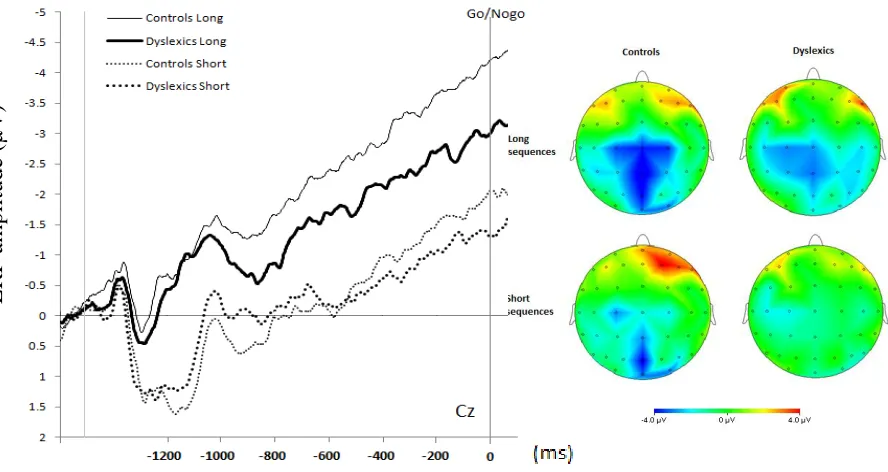
Averaged ERP activity during motor preparation is shown in Figure 6 for dyslexics and controls, for long and short sequences, including topographic maps for averaged activity across the 200-0 ms interval before the go/nogo signal. There was no overall difference in CNV amplitude between dyslexics and controls, F(20) = 0.2, p=0.699. Amplitudes increased significantly over time, F(5,100) = 15.2, p<0.001. Inspection of the topographic maps at 200- 0 ms before the go/nogo signal reveals a centroparietal negative maximum and smaller maxima preceding short sequences, especially in dyslexics.
We checked whether CNV amplitudes were significantly different between dyslexics and controls at 200-0 ms before the go/nogo signal. Moreover, we were interested in whether the CNV amplitude at 200-0 ms changed while participants became faster in the production of sequences. Therefore, we determined averaged brain potentials at Cz in three ‘blocks’, in which
Figure 6: Left: CNV at Cz as a function of group and sequence length, from the offset of the last stimulus (left vertical line) to the go/nogo signal. Right: topographic maps of the 200 ms interval before the go/nogo signal.
[image:26.612.88.532.135.371.2]25 the first consisted of the first two blocks, the second of the third and fourth block, and the third of the last two actual blocks of the DSP experiment. We examined amplitudes using repeated measures ANOVA with block (1-3) and length (short versus long) as within-subjects and group as between-subjects factors. There was no significant difference in CNV amplitude between dyslexics and controls, F(1,20) = 0.3, p=0.574. Amplitudes were significantly larger during six-key compared to three-six-key preparation, F(1,20) = 24.2, p<0.001. There was no significant interaction between length and group, F(1,20) = 0.5, p=0.481, indicating that the amplitudes were larger during six-key preparation in both dyslexics and controls. Amplitudes did not change significantly over blocks, F(2,40) = 0.6, p=0.541.
26
D
ISCUSSION
In this study, we investigated visual search and sequence learning in dyslexics as compared to controls, in order to assess the magnocellular and cerebellar deficit hypothesis in explaining the origin of problems in dyslexia. A dyslexic screening test revealed that our dyslexics were worse than our controls on picture naming, reading, spoonerism, spelling, working memory, nonsense sentences/words reading and writing, indicating that they were correctly classified.
First, we examined whether dyslexics were worse on conjunction and feature searches, with different numbers of distracter items (20, 40, 60 or 80). The magnocellular pathway seems vitally important in the serial deployment of visual attention (Cheng, Eysel & Vidyasagar, 2004), which is required when searching for a conjunction of two features, but not during feature or pop-out search. Worse performance on conjunction search in dyslexics could therefore indicate the presence of a magnocellular deficit. Vidyasagar and Pammer (1999) reported the presence of such a deficit in dyslexic children, especially when set size was large.
In the present study, dyslexics were not worse than controls on either conjunction or feature search. These findings suggest that there is no general visual attention deficit in our dyslexics as compared to controls, by which we did not find support for the magnocellular theory. In contrast to the participants in the study of Vidyasagar and Pammer (1999), our participants were highly-functioning young adults. Our inability to replicate earlier findings may indicate that deficits in visual attention as found by Vidyasagar and Pammer may disappear as children develop further. However, visual attention problems have been found in highly-functioning adults before (Bucholz & McKone, 2004).
27 controls, which shows up only when dyslexics search for a target that is not present. Dyslexics might be more insecure about deciding whether the target is not present, even in the pop-out condition. We suggest that problems in dyslexics therefore do not originate early in the visual system, but later, when higher-level processes take place such as decision-making.
In the DSP experiment, we examined whether dyslexics were worse than controls in learning three-key and six-key sequences over six blocks. Moreover, we analyzed whether there were differences during motor preparation. It was suggested that difficulties in learning finger sequences supports the view of a cerebellar deficit in dyslexics. Our results showed that, overall, dyslexics were not slower than controls during sequence learning and did not make more errors. Further, De Kleine and Verwey (2009) found dyslexics to have problems with chunk execution when learning sequences, which could be the cause of slowed performance in dyslexics and was thought to reflect difficulties with skill automatization. In the present study, however, the chunking pattern in dyslexics seemed to be similar to that of controls and chunking was not slowed in dyslexics. Our findings suggest that there is no general deficit in motor learning in our dyslexic participants, by which we did not find support for the cerebellar deficit hypothesis.
29
R
EFERENCES
Annett, M. (1970). A classification of hand preference by association analysis. British Journal of Psychology, 61, 303-321.
Buchholz, J., & McKone, E. (2004). Adults with dyslexia show deficits on spatial frequency doubling and visual attention tasks.
Cheng, A., Eysel, U.T., & Vidyasagar, T.R. (2004). The role of the magnocellular pathway in serial deployment of visual attention. European Journal of Neuroscience, 20, 2188-2192. Cui, R.Q., Egkher, A., Huter, D., Lan, W., Lindinger, G., & Deecke, L. (2000). High resolution spatiotemporal analysis of the contingent negative variation in simple or complex motor tasks and a non-motor task. Clinical Neurophysiology, 111, 1847-1859.
De Kleine, E., & Van der Lubbe, R.H.J. (2008). Preparation of familiar and unfamiliar movement sequences reflected in the EEG. In preparation –a .
De Kleine, E. & Van der Lubbe, R.H.J. Preparing mirrored motor sequences. In preparation - b.
De Kleine, E. & Verwey, W.B. (2009). Motor learning and chunking in dyslexia. Journal of Motor Behavior, 41, 331-337.
Facoetti, A., Larusso, M.L., Paganoni, P., Cattaneo, C., Galli, R., Umilta, C., & Mascetti, G.G. (2002). Auditory and visual automatic attention deficits in developmental dyslexia. Cognitive Brain Research, 16, 185-191.
Facoetti, A., Paganoni, P., & Lorusso, M.L., (1999). The spatial distribution of visual attention in developmental dyslexia. Exp. Brain Res., 132, 531-538.
30 Galaburda, A.M. and Livingstone, M. (1993) Evidence for a magnocellular defect in developmental dyslexia, pp. 65–73. In P. Tallal, A.M. Galaburda, R.R. Llinas and C. von Euler (Eds), Temporal Information Processing in the Nervous System. Annals of the New York Academy of Science, 682, 70–82.
Hari, R., Valta, M., Uutela, K. (1999). Prolonged attentional dwell time in dyslexic adults. Neuroscience Letters, 271, 202-204.
Iles, J., Walsch, V., & Anderson, A. (2000). Visual Search performance in dyslexia. Dyslexia, 6, 163-177.
Kinsey, K., Rose, M., Hansen, P., Richardson, A., & Stein, J.F. (2004). Magnocellular mediated visual-spatial attention and reading ability. NeuroReport, 15.
Livingstone, M.S., Rosen, G.D., Drislane, F.W., & Galaburda, A.M. (1991). Physiological and anatomical evidence for a magnocellular deficit in developmental dyslexia. Proceedings of the national academy of science USA, 88, 7943-7947.
Leuthold, H., Sommer, W. & Ulrich, R. (2005). Preparing for action: inferences from CNV and LRP. Journal of Psychophysiology, 18, 77-88.
Lovegroove, W.J., Bowling, A., Badcock, D., & Blackwood, M. (1980). Specific reading disability: differences in contrast sensitivity as a function of spatial frequency. Science, 210, 439-440.
Martelli, M., Di Fillipo, G., Spinelli, D., & Zoccolotti, P. (2009). Crowding, reading, and developmental Dyslexia. Journal of Vision, 9, 1-18.
31 Nicolson, R.I., Fawcett A.J., Berry, E.L., Jenkins, H., Dean, P., & Brooks, D.J. (1999). Association of abnormal cerebellar activation with motor learning difficulties in dyslexic adults. The Lancet, 353, 1662-1667.
Rae, C., Harasty, J.A., Dzendrowskyj, T.E., Talcott, J.B., Simpson, J.M., Blamire, A.M., Dixon, R.M., Lee, M.A., Thompson, C.H., Styles, P., Richardson, A.J., & Stein, J.F. (2001). Cerebellar morphology in developmental dyslexia. Neuropsychologia, 40, 1285-1292. Ramus, F (2003). Developmental dyslexia: specific phonological deficit or general sensorimotor dysfunction? Current Opinion in Neurobiology, 13, 212-218.
Rhodes, B.J., Bullock, D., Verwey, W.B., Averbeck, B.B., & Page, M.P.A. (2004). Learning and production of movement sequences: behavioral, neurophysiological and modeling perspectives. Human Movement Science, 23, 699-746.
Rosenbaum, D.A. (1980). Human movement initiation: Specification of arm, direction and extent. Journal of Experimental Psychology: General, 109, 444-474.
Schröter, H. & Leuthold, H. (2009). Motor programming of rapid finger sequences: inferences form movement-related brain potentials. Psychophysiology, 46, 388-401.
Shaffer, L.H. (1991). Cognition and motor programming. In J. Requin, & G.E. Stelmach, Tutorials in motor neuroscience (pp. 371-383). Dordrecht: Kluwer.
Shaywitz, S.E. & Shaywitz, B.A. (2005). Dyslexia (Specific Reading Disability). Biological Psychiatry, 57, 1301-1309.
32 Stoodley, C.J., Harrison, E.P.D., & Stein, J.F. (2005). Implicit motor learning in dyslexic adults. Neuropsychologia, 44, 795-798.
Talcott, J.B., Hansen, P.C., Willis-Owen, C., McKinnell, I.W., Richardson, A.J., Stein, J.F. (1998). Visual magnocellular impairment in adult developmental dyslexics. Neuroophthalmology, 20, 187-201.
Treisman, A. (1982). Perceptual grouping and attention in visual search for features and for objects. Journal of Experimental Psychology: Human Perception and Performance, 8, 194-214.
Vicari, S., Finzi, A., Menghini, D., Marotta, L., Baldi, S., & Petrosini, L. (2005). Do children with developmental dyslexia have an implicit learning deficit? Journal of Neural Neurosurgery and Psychiatry, 76, 1392-1397.