- -
-Quick Reference
Borland
"
Turbo
Quick Reference
Borland®
Turbo Assembler®
Borland may have patents and/or pending patent applications covering subject matter in this document The furnishing of this document does not give you any license to these patents. Copyright © 1988, 1995 by Borland International. All rights reserved. All Borland products are trademarks or registered trademarks of Borland International, Inc. Other brand and product names are trademarks or registered trademarks of their respective holders.
The material in Chapter 3 and Chapter 4 is reprinted with permission of Intel Corporation, copyright © Intel Corporation 1987, 1995.
Printed in the U.S.A
Contents
Chapter 1
Predefined symbols
1
$ . . . 1
@32Bit . . . 1
@code . . . 1
@CodeSize . . . . 1
@CPU . . . 1
@curseg . . . 1
@data . . . 1
@DataSize. . . . 2
??date . . . 2
@fardata . . . 2
@fardata? . . . 2
@FileName . . . . 2
??filename . . . 2
@Interface. . . . 2
@Model . . . 2
@Objed . . . 2
@ffi&k . . . 2
@Startup . . . 2
@Table_<objectname>.. . . 2
@TableAddr_<objectname> . .·3 ??time . . . 3
??version . . . . 3
@WordSize . . . . 3
Chapter 2
Operators
5
Ideal mode operator
precedence . . .
5
MASM mode operator
precedence . . .
5
Operators . . . 6
() . . . 6
* . . .
6+ (binary) . . . . 6
+ (unary) . . . 6
- (binary) . . . . 6
- (unary) . . . 6
. . . 7
/ . . . 7
: . . . 7
? . . . 7
[j . . .
7AND . . . 7
BYTE . . . 7
BYTEPTR ., . . . 7
CODEPTR. . . 7
DATAPTR . . . 8
DUP . . . 8
DWORD . . . 8
DWORDPTR . . . 8
EQ . . . 8
FAR . . . 8
FARPTR . . . 8
FWORD . . . 8
FWORDPTR . . . 8
GE . . . 9
GT . . . '" . . . 9
HIGH . . . 9
HIGH . . . 9
LARGE . . . 9
LE . . . 9
LENGTH . . . 9
LOW . . . 9
LOW . . . 9
LT . . . 10
MASK . . . 10
MOD . . . 10
NE . . . 10
NEAR . . . 10
NEARPTR . . . 10
NOT . . . 10
OFFSET . . . 10
OR . . . 10
PROC . . . 11
PROCPTR . . . 11
PTR . . . 11
PWORD . . . 11
PWORD PTR . . . 11
QWORD . . . 11
QWORD PTR . . . 11
SEG . . . 11
SHL . . . 11
SHORT . . . 12
SHR . . . , . . . 12
SIZE . . . 12
SMALL . . . 12
SYMTYPE . . . 12
TBYTE . . . 12
TBYTE PTR . . . 12
THIS . . . 12
.TYPE . . . 13
TYPE . . . 13
TYPE . . . 13
UNKNOWN . . . , . . . 13
WIDTH . . . 13
WORDPTR . . . 13
XOR . . . • . . . . 13
Macro operators . . . .
& . . . . <> . . . . 1. . . . . 0/0 . . . • . .14
14 14 14 14 14Run-time operators . . . 14
-- . . . 14
!= . . . 14
> . . . 14
>= . . . 15
< . . . 15
<= . . . 15
I I . . . 15
&& . . . l . • • . 15 & . . . 15
! . . . , . . . 15
CARRY? . . . 15
OVERFLOW? '" . . . 15
PARITY? . . . 15
SIGN? . . . 16
ZERO? . . . 16
Chapter 3
Directives
17
.186 . . . 17.286 . . . 17
.286C . . . 17
.286P . . . 17
.287 . . . 17
.386 . . . 17
.386C . . . 18
.386P . . . 18
.387 . . . 18
.486 . . . 18
.486C . . . 18
.486P . . . 18
.487 . . . 18
.586 . . . 18
.586C . . . 19
.586P . . . 19
.587 . . . 19
,.8086 . . . 19
.8087 . . . 19
ALIGN . . . . .ALPHA . . . . ALIAS . . . . 19 19 19 19 20 ASSUME . . . 20
%BIN . . . 20
.BREAK . . . . " . . . 20
BYTE . . . 21
CALL' . . . 21
CATSTR . . . 21
.CODE . . . 21
CODESEG . . . 21
COMM . . . 21
COMMENT . . . 22
%CONDS . . . I . • • • • 22 .CONST . . . 22
CONST . . . 22
.CONTINUE . . . 22
.CREF . . . 22
%CREF . . . 22
%CREFALL . . . 22
%CREFREF . . . 23
%CREFUREF . . . 23
%CTLS . . . 23
.DATA . . . 23
DATASEG . . . 23
.DATA? . . . 23
DB . . . ' . . . 23
DD . . . 24
%DEPTH . . . 24
DF . . . 24
DISPLAY . . . 24
DOSSEG . . . 24
DP . . . 24
DQ . . . '" . . . 25
DT . . . 25
DW . . . 25
DWORD . . . , . . . . 25
ECHO . . . 25
ELSE . . . 25
.ELSE . . . 26
ELSEIF . . . 26
EMUL . . . 26
END . . . 26
ENDIF . . . 26
.ENDIF . . . 27
ENDM . . . 27
ENDP . . . 27
ENDS . . . 27
.ENDW . . . 27
ENUM . . . 27
EQU . . . 27
.ERR . . . 28
ERR . . . 28
.ERRB . . . 28
.ERRDEF . . . 28
.ERRDIF . . . 28
.ERRDIFI . . . .28
.ERRE . . . 29
.ERRIDN . . . 29
.ERRIDNI. . . .29
ERRIF . . . 29
ERRIF1 . . . 29
ERRIF2 . . . .29
ERRIFB . . . 29
ERRIFDEF . . . .29
ERRIFDIF. . . .30
ERRIFDIFI . . . .30
ERRIFE . . . 30
ERRIFIDN . . . .30
ERRIFIDNI . . . 30
ERRIFNB . . . 30
ERRIFNDEF . . . .30
.ERRNB . . . 30
.ERRNDEF . . . 31
.ERRNZ . . . 31
EVEN . . . 31
EVENDATA . . . 31
.EXIT . . . 31
EXITCODE . . . 31
EXITM . . . 31
EXTERN . . . 31
EXTERNDEF . . . 31
EXTRN . . . 32
.FARDATA . . . 32
FARDATA . . . 32
.FARDATA? . . . 32
FASTIMUL . . . .32
FLIPFLAG . . . .32
FOR . . . 33
FORC . . . 33
FWORD . . . 33
GETFIELD . . . .33
GLOBAL . . . 33
GOTO . . . .34
GROUP . . . 34
IDEAL . . . .34
IF . . . 34
.IF . . . 34
IF1 . . . 35
IF2 . . . 35
IFB . . . 35
IFDEF . . . 35
IFDIF . . . 35
IFDIFI . . . 36
IFE . . . 36
IFIDN . . . 36
iii IFIDNI . . . 36
IFNB . . . 37
IFNDEF . . . 37
%INCL . . . 38
INCLUDE . . . 38
INCLUDELIB . . . 38
INSTR . . . 38
INVOKE . . . 38
IRP . . . 39
IRPC . . . 39
JMP . . . 39
JUMPS . . . 39
LABEL . . . 39
.LALL . . . 39
LARGESTACK. . . 39
.LFCOND . . . 40
%LINUM . . . 40
%LIST . . . 40
.LIST . . . 40
.LISTALL . . . 40
.LISTIF . . . 40
.LISTMACRO . . . 40
.LISTMACROALL . . . 40
LOCAL . . . 41
LOCALS . . . 41
MACRO . . . 41
%MACS . . . 41
MASKFLAG . . . 41
MASM . . . 41
MASM51 . . . 41
MODEL . . . 41
.MODEL . . . :'.. . 42
MULTERRS . . . 42
NAME . . . 42
%NEWP AGE. . . 42
%NOCONDS . . . 42
%NOCREF . . . 42
%NOCTLS . . . 42
NOEMUL . . . 43
%NOINCL . . . 43
NOJUMPS . . . 43
%NOLIST . . . 43
.NOLIST . . . 43
.NOLISTIF . . . 43
.NOLISTMACRO . . . 43
NOLOCALS . . . 43
%NOMACS . . . 44
NOMASM51 . . . 44
NOMULTERRS . . . 44
NOSMART . . . 44
%NOSYMS . . . 44
%NOTRUNC. . . 44
OPTION . . . 44
ORG . . . 45
%OUT . . . 45
P186 . . . 45
P286 . . . 45
P286N . . . 45
P286P . . . 45
P287 . . . 45
P386 . . . 45
P386N . . . 45
P386P . . . 46
P387 . . . : . . . 46
P486 . . . 46
P486N . . . 46
P487 . . . 46
P586 . '.' . . . 46
P586N . . . 46
P587 . . . 46
P8086 . . . 47
P8087 . . . 47
PAGE . . . 47
%PAGESIZE . . . 47
%PCNT . . . 47
PN087 . . . 47
%POPLCTL . . . 47
POPSTATE . . . 47
PROC . . . 48
PROCDESC . . . 48
PROCTYPE. . . 48
PROTO . . . 49
PUBLic . . . 49
PUBLICDLL . . . 49
PURGE . . . 49
%PUSHLCTL . . . 49
PUSHSTATE . . . 49
QUIRKS . . . 50
QWORD . . . 50
.RADIX . . . 50
RADIX . . . ' . . . 50
REAL4 . . . : . . . 50
REAL8 . . . 50
REAL10 . . . 50
RECORD . . . 50
REPEAT . . . 51
.REPEAT . . . 51
REPT . . . 51
RETCODE . . . 51
RETF . . . 51
RETN . . . 51
.sALL . . . 52
SBYTE . . . 52
SDWORD . . . 52
SEGMENT . . . 52
.SEQ . . . 52
SETFIELD . . . 53
SETFLAG . . . 53
.sFCOND . . . 53
SIZESTR . . . 53
SMALLSTACK . . . 53
SMART . . . 53
.sTACK . . . : .. 53
STACK . . . 53
.STARTUP . . . 54
STARTUPCODE . . . 54
STRUC . . . '.' . 54
STRUCT . . . 54
SUBSTR . . . 54
SUBTITLE . . . 54
SUBTTL . . . 55
%SUBTTL . . . 55
SWORD . . . 55
%SYMS . . . 55
TABLE . . . 55
% TABSIZE . . . 55
TBLINIT . . . 55
TBLINST . . . 55
TBLPTR . . . 56
TBYTE . . . 56
TESTFLAG . . . 56
%TEXT . . . 56
TEXTEQU . . . 56
.TFCOND . . . -. . . 56 .
TITLE . . . 56
%TITLE . . . 56
%TRUNC . . . 56
TYPEDEF . . . , .. 57
UDATASEG . . . 57
UFARDATA . . . 57
UNION . . . 57
.UNTIL . . . 57
.UNTILCXZ . . . 57
USES . . . 58
VERSION . . . 58
WARN . . . 58
WHILE . . . 58
.WHILE . . . 58
WORD . . . 58
.xALL . . . 58
.XCREF . . . 59
[image:7.389.32.352.14.590.2]Chapter 4
Processor instructions
61
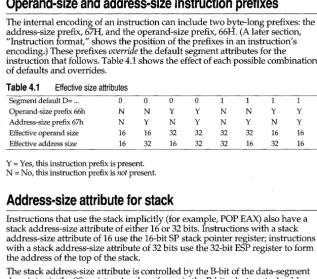
Operand-size and address-size
attributes . . . 61
Default segment attribute . . . 61
Operand-size and address-size Instruction prefixes . . . .62
Address-size attribute for stack . . . 62
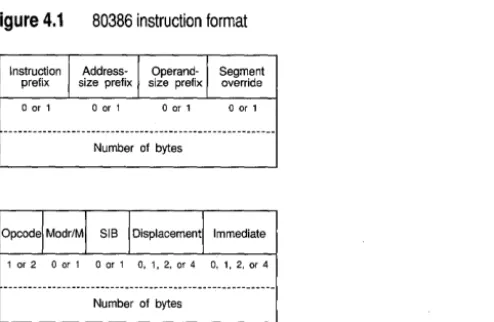
Instruction format . . . . 62
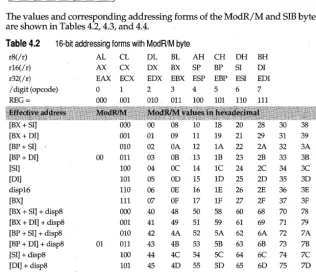
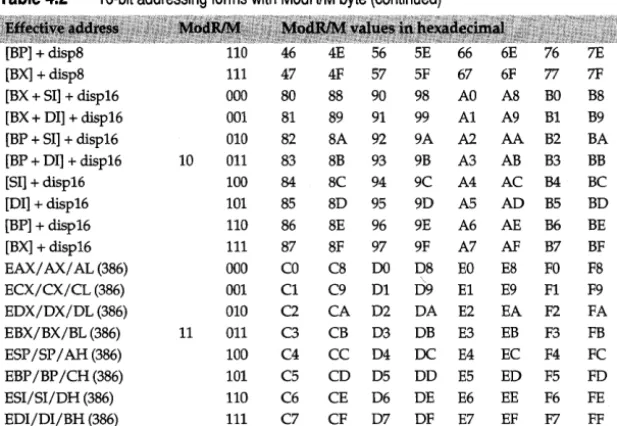
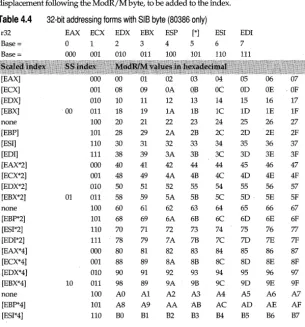
ModR/M and SIB bytes . . . .63
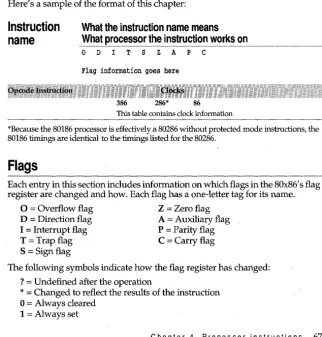
How to read the instruction set pages . . . .67
Instruction name . . . .67
Flags . . . 67
Opcode . . . -.68
Instruction . . . .68
Clocks . . . 70
AAA . . . 71
AAD . . . 71
AAM . . . 71
AAS . . . 72
ADC . . . 72
ADD . . . 73
AND . . . 73
ARPL . . . 74
BOUND . . . 75
BSF . . . 75
BSR . . . 75
BSWAP . . . 76
BT . . . ' . . . 76
BTC . . . 76
BTR . . . 77
BTS . . . 77
CALL . . . 77
CBW . . . 79
CDQ . . . 80
CLC .. '.' . . . 80
CLD . . . 80
CLI . . . 80
CLTS . . . 81
CMC . . . 81
CMP . . . 81
CMPS,CMPSB, CMPSW, CMPSD . . . 82
CMPXCHG . . . 83
CHPXCHG8B . . . 84
CPUID . . . 85
CWD '.' . . . 85
v CWDE . . . 86
DAA . . . 86
DAS . . . 86
DEC . . . 86
DIV . . . 87
ENTER . . . 87
HLT . . . 88
IDIV . . . 88
IMUL . . . 89
IN . . . 90
INC . . . 90
INS, INSB, INSW, INSD . . . 91
INT,INTO . . . 91
INVD . . . 92
INVLPG . . . 93
IRET, IRETD, IRETW . . . 93
Jcc . . . 94
JMP . . . 97
LAHF . . . 98
LAR . . . 98
LEA . . . 99
LEAVE . . . 99
LGDT /LIDT . . . . 100
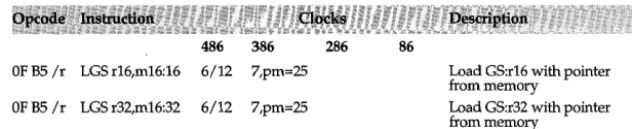
LGS, LSS, LFS, LDS, LES . . . . . 100
LLDT . . . 101
LMSW . . . 101
LOCK . . . 102
LODS, LODSB, LODSW, LODSD . . . 103
LOOP, LOOPcond . . . 103
LSL . . . 104
LTR . . . 104
MOV . . . 105
MOV . ~ . . . 106
MOVS, MOVSB, MOVSW, MOVSD . . . 107
MOVSX . . . 107
MOVZX . . . 108
MUL . . . 108
NEG . . . 108
NOP . . . 109
NOT . . . 109
OR . . . 109
OUT . . . 110
OUTS, OUTSB, OUTSW, OUTSD . . . 110
POP . . . 111
POP A, POP AD, POP AW . . . 112
PUSH . . . 113 FCLEX, FNCLEX . . . . 139
PUSHA, PUSHAD, FCOM . . . 139
PUSHAW . . . 114 FCOMP . . . 139
PUSHF, PUSHFD, PUSHFW . . 114 FCOMPP . . . 140
RCL, RCR, ROL, ROR . . . 115 FCOS . . . 140
RDMSR . . . 117 FDECSTP . . . 140
RDTSC . . . 118 FDISI, FNDISI . . . 140
REP, REPE, REPZ, REPNE, FDN . . . 140
REPNZ . . . 118 FDNP . . . 141
RET . . . 120 FDNR . . . 141
RSM . . . 121 FDNRP . . . 141
SAHF . . . 122 FENI, FNENI . . . 141
SAL, SAR, SHL, SHR . . . . 122 FFREE . . . 142
SBB . . . 124 FIAD}) . . . 142
SCAS, SCASB, SCASW, FICOM . . . 142
SCASD . . . 125 FICOMP . . . 142
SETcc . . . 125 FIDIV . . . 143
SGDT, SIDT . . . . 126 FIDIVR . . . 143
SHLD . . . 127 FILD . . . 143
SHRD . . . 127 FIMUL . . . 143
SLDT . . . 128 FINCSTP . . . 144
SMSW . . . 128
STC . . . 128 FINIT, FNINIT. . . . 144 FIST . . . 144
STD . . . 128 FISTP . . . 144
STI . . . , . . . 129 FISUB . . . 145
STOS, STOSB, STOSW, . STOSD . . . 129
STR . . . '.' . . . 130
SUB . . . 130
TEST . . . 131
VERR, VERW . . . . 131
WAIT . . . 132
WBINVD . . . 132
WRMSR . . . 132
XADD . . . 133
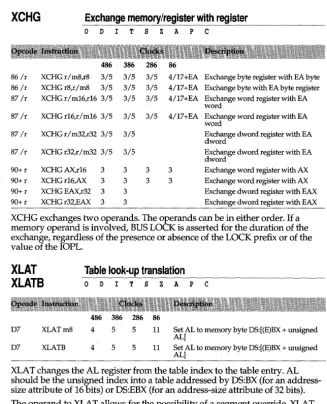
XCHG . . . 134
XLAT, XLATB . . . 134
XOR . . . 135
FISUBR . . . 145
FLD . . . 145
FLDCW . . . 145
FLDENV . . . 146
FLDLG2 . . . 146
FLDLN2 . . . 146
FLDL2E . . . 146
FLDL2T . . . 146
FLDPI . . . 147
FLDZ . . . 147
FLD1 . . . 147
FMUL . . . 147
FMULP . . . 148
ChapterS
Coprocessor instructions 137
FNOP . . . 148FPATAN . . . 148
FPREM . . . 148
F2XM1 . . . 138 FPREM1 . . . 148
FABS . . . ; . . . 138 FPTAN . . . 149
FADD . . . 138 FRNDINT . . . . 149
FADDP . . . 138 FRSTOR . . . 149
FBLD . . . 138 FSA VE, FNSA VE . . . . 149
FSIN . . . 150 FSUBRP . . . 152
FSINCOS . . . . 150 ' FTST . . . 153
FSQRT . . . 150 FUCOM . . . 153
FST . . . 151 FUCOMP . . . 153
FSTCW, FNSTCW . . . 151 FUCOMPP . . . .153
FSTENV, FNSTENV . . . . 151 FWAIT . . . 153
FSTP . . . 151 FXAM . . . 154
FSTSW, FNSTSW . . . 151 FXCH . . . 154
FSTSW AX, FNSTSW AX . . . . 152 FXTRACT .. . . . . 154
FSUB . . . 152 FYL2X . . . 154
FSUBP . . . 152 FYL2XP1 . . . . 154
FSUBR . . . 152 F2XM1 . . . 155
Predefined symbols
All the predefined symbols can be used in both MASM and Ideal mode.
$
Represents the current location counter within the current segment.
@32Bit
Numeric equate indicating whether segments in the current model are declared as 16 bit or 32 bit.
@code
Alias equate for .CODE segment name.
@CodeSize
Numeric equate that indicates code memory model (O=near, l=fi.u).
@CPU
Numeric equate that returns information about current processor directive.
@curseg
Alias equate for current segment.
@data
Alias equate for near data group name.
@DataSize
Numeric equate that indicates the data memory model (O=near, l=far, 2=huge).
??date
String equate for today's date.
@fardata
Alias equate for initialized far data segment name.
@fardata?
Alias equate for uninitialized far data segment name.
@FileName
Alias equate for current assembly file name.
??filename
String equate for current assembly file name.
@Interface
Numeric equate indicating the language and operating system selected by MODEL.
@Model
Numeric equate representing the model currently
In
effect.@Object
Text macro containing the name of the current object. = Alias equate for stack segment.
@Stack
Alias equate for stack segment.
@Startup
Label that marks the beginning of startup code.
@Table_<objectname>
@TableAddr_<objectname>
Label describing the address of the instance of the object's virtual method table.
??time
String equate for the current time.
??version
Numeric equate for current Turbo Assembler version number.
@WordSize
Numeric equate that indicates 16- or 32-bit segments (2=16-bit, 4=32-bit).
Operators
This chapter covers the operators Turbo Assembler provides and their precedence. The two tables that follow detail operator precedence for Ideal and MASMmodes.
Ideal mode operator precedence
The following table lists the operators in order of priority (highest is first, lowest is last):
• 0, [],
LENGTH, MASK, OFFSET, SEG, SIZE, WIDTH • HIGH, LOW• +, - (unary)
• *,
I, MOD, SHL, SHR• +, - (binary)
• EQ, GE, GT, LE, L T, NE • NOT
• AND • OR,XOR
• : (segment override) • . (structure member selector)
• HIGH (before pointer), LARGE, LOW (before pointer), PTR, SHORT, SMALL, SYMTYPE
MASM mode operator precedence
• <,
0, [],
LENGTH, MASK, SIZE, WIDTH • . (structure member selector)• HIGH,LOW
• +, - (unary) • : (segment override)
• OFFSET, PTR, SEG, THIS, TYPE • *,/, MOD, SHL, SHR
• +, - (binary)
• EQ, GE, GT, LE, LT, NE
• NOT • AND • OR,XOR
• LARGE, SHORT, SMALL, .TYPE
Operators
()
Ideal,MASM( expression)
Marks expression for priority evaluation.
*
Ideal,MASMexpression 1 * expression2
Multiplies two integer expressions. Also used with 80386 addressing modes where one expression is a register .
. +
(binary)
expression 1 + expression2 Adds two expressions.
+
(unary)
+ expression
Indicates that expression is positive.
- (binary)
expression 1 - expression2
Subtracts two expressions.
- (unary)
- expression
Changes the sign of expression.
Ideal,MASM
Ideal,MASM
Ideal, MASM
Ideal,MASM
memptr. fieldname
Selects a structure member.
Ideal,MASM
expression1 / expression2
Divides two integer expressions.
Ideal, MASM
segorgroup : expression
Generates segment or group override.
?
Ideal, MASMOx?
Initializes with indeterminate data (where Dx is DB, DD, DF, OP, DQ, DT, or DW).
[]
expression 1[ expression2j [expression 1][ expression2j
Ideal,MASM
MASM mode: The [ ] operator can be used to specify addition or register indirect memory operands. Ideal mode: The [ ] operator specifies a memory reference.
AND
Ideal, MASMexpression1 AND expression2
Performs a bit-by-bit logical AND of two expressions.
BYTE
IdealBYTE expression
Forces address expression to be byte size.
BYTE PTR
Ideal,MASMBYTE PTR expression
Forces address expression to be byte size.
CODEPTR
Ideal,MASMCODEPTR expression
Returns the default procedure address size.
DATAPTR
IdealDATAPTR expression
Forces address expression tomodel-dependent size.
DUP
Ideal, MASMcount DUP (expression [,expression] ... )
Repeats a data allocation operation count times.
DWORD
IdealDWORD expression
Forces address expression to be doubleword size.
DWORDPTR
Ideal,MASMDWORD PTR expression
,Forces address expression to be doubleword size.
EQ
Ideal,MASMexpression1 EO expression2
Returns true if expressions are equal.
FAR
IdealFAR expression
Forces an address expression to be a far code pointer.
FARPTR
Ideal,MASMFAR PTR expression
Forces an address expression to be a far code pointer.
FWORD
IdealFWORD expression
Forces address expression to be 32-bit far pointer size.
FWORDPTR
Ideal,MASMFWORD PTR expression
GE
Ideal, MASMexpression 1 G E expression2
Returns true if one expression is greater than or equal to the other.
GT
Ideal, MASMexpression 1 GT expression2
Returns true if one expression is greater than the other.
HIGH
Ideal,MASMHIGH expression
Returns the high part (8 bits or
type
size) ofexpression.
HIGH
Idealtype HIGH expression
Returns the high part (8 bits or
type
size) ofexpression.
LARGE
Ideal,MASMLARGE expression
Sets
expression's
offset size to 32 bits. In Ideal mode, this operation is legal only if 386 code generation is enabled.LE
Ideal, MASMexpression 1 LE expression2
Returns true if one expression is less than or equal to the other.
LENGTH
Ideal, MASMLENGTH name
Returns number of data elements allocated as part of
name.
LOW
Ideal,MASMLOW expression
Returns the low part (8 bits or
type
size) ofexpression.
LOW
Idealtype LOW expression
Returns the low part (8 bits or
type
size) ofexpression.
LT
expression 1 L T expression2
Returns true if one expression is less than the other.
MASK
MASK recordfieldname
MASK record
Returns a bit mask for a record field or an entire record.
MOD
expression 1 MOD expression2
Returns remainder (modulus) from dividing two expressions.
~
NE
expression 1 N E expression2
Returns true if expressions are not equal.
NEAR
NEAR expression
Forces an address expression to be a near code pointer.
NEARPTR
NEAR PTR expression
Forces an address expression to be a near code pointer.
NOT
NOT expression
Performs a bit-by-bit complement (invert) of expression.
OFFSET
OFFSET expression
Ideal,MASM
Ideal,MASM
Ideal,MASM
Ideal,MASM
Ideal
Ideal,MASM
Ideal,MASM
Ideal,MASM
Returns the offset of expression within the current segment (or the group that the segment belongs to, if using simplified segmentation directives or Ideal mode).
OR
Ideal,MASMexpression 1 OR expression2
PRoe
IdealPROC expression
Forces an address expression to be a near or far code pointer.
PRoe PTR
Ideal,MASMPROC PTR expression
Forces an address expression to be a near or far code pointer.
PTR
Ideal, MASMtype PTR expression
Forces address expression to have type size.
PWORD
IdealPWORD expression
Forces address expression to be 32-bit far pointer size.
PWORDPTR
Ideal,MASMPWORD PTR expression
Forces address expression to be 32-bit far pointer size.
aWORD
IdealaWORD expression
Forces address expression to be quadword size.
aWORDPTR
Ideal, MASMaWORD PTR expression
Forces address expression to be quadword size.
SEG
Ideal, MASMSEG expression
Returns the segment address of an expression that references memory.
SHL
Ideal, MASMexpressioQ SHL count
Shifts the value of expression to the left count bits. A negative count causes the data to be shifted the opposite way.
SHORT
Ideal,MASMSHORT expression
Forces
expression
to be a short code pointer (within -128 to +127 bytes of the current code location).SHR
Ideal,MASMexpression SHR count
Shifts the value of
expression
to the rightcount
bits. A negative count causes the data to be shifted the opposite way.SIZE
Ideal,MASMSIZE name
Returns size of data item allocated with
name.
In MASM mode, SIZE returns the value of LENGTHname
multiplied by TYPEname.
In Ideal mode, SIZE returns the byte count withinname's
DUP.SMALL
Ideal,MASMSMALL expression
Sets
expression's
offset size to 16 bits. In Ideal mode, this operation is legal only if 386 code generation is enabled. .SYMTYPE
IdealSYMTYPE
Returns a byte describing
expression.
TBVTE
IdealTBYTE expression
Forces address expression to be lO-byte size.
TBVTE PTR
Ideal,MASMTBYTE PTR expression
Forces address expression to be 10-byte size.
THIS
Ideal,MASMTHIS type
Creates an operand whose address is the current segment and location counter.
.TYPE
MASM.TYPE expression
Returns a byte describing the mode and scope of expression.
TYPE
IDEALTYPE name1 name2
Applies the type of an existing variable or structure member to another variable or structure member.
TYPE
TYPE expression
Returns a number indicating the size or type of expression.
UNKNOWN
UNKNOWN expression
Removes type information from address expression.
WIDTH
WIDTH recordfieldname
WI DTH record
Returns the width in bits of a field in a record, or of an entire record.
WORD
WORD expression
Forces address expression to be word size.
WORDPTR
WORD PTR expression
Forces address expression to be word size.
XOR
expression1 XOR expression2
MASM
Ideal
Ideal, MASM
Ideal
Ideal,MASM
Ideal, MASM
Performs bit-by-bit logical exclusive OR of two expressions. Unconditional page break inserted for print formatting
Macro operators
&
Ideal,MASM&name
Substitutes actual value of macro parameter name.
<>
Ideal, MASMTreats text literally, regardless of any special characters it might contain.
Ideal,MASM
!character
Treats character literally, regardless of any special meaning it might otherwise have.
%
Ideal,MASM%text
Treats text as an expression, computes its value and replaces text with the result.
text may be either a numeric expression or a text equate.
"
Ideal, MASM;;comment
Suppresses storage of a comment in a macro definition.
Run-time operators
The following operators are evaluated at run time, and can only be used inside .IF, .REPEAT, and .WHILE loops. These operators are valid only in MASM mode.
MASM
expressionl == expression2
Returns true when expressionl is equal to expression2.
!=
MASMexpressionl != expression2
Returns true when expressionl is not equal to expression2.
>=
MASM
expressionl >= expression2
Returns true when expressionl is greater than or equal to expression2.
<
MASM
expressionl < expression2
Returns true when expressionl is less than expression2.
<=
MASM
expressionl <= expression2
Returns true when expressionl is less than or equal to expression2.
II
MASM
expressionl I I expression2
Returns the logical ORed value of expressionl and expression2.
&&
MASM
expressionl && expression2
Returns the logical ANDed value of expressionl and expression2.
&
MASM
express ion 1 & expression2
Returns the bitwise ANDed value of expressionl and expression2.
MASM
!expression
Returns the logical negation of expression.
CARRY?
MASM
Returns the status of the carry flag.
OVERFLOW?
MASM
Returns the status of the overflow flag.
PARITY?
MASM
Returns the status of the parity flag.
SIGN?
MASMReturns the status of the sign flag.
ZERO?
MASMDirectives
.186
MASM
.186
Enables assembly of 80186 processor instructions .
. 286
MASM
.286
Enables assembly of non-privileged (real mode) 80286 processor instructions and 80287 numeric coprocessor instructions .
. 286C
MASM
.286c
Enables assembly of non-privileged (real mode) 80286 processor instructions and 80287 numeric coprocessor instructions .
. 286P
.286P
Enables assembly of a1180286 (including protected mode) processor instructions and 80287 numeric coprocessor instructions .
. 287
.287
Enables assembly of 80287 numeric coprocessor instructions.
MASM
MASM
.386
MASM
.386
Enables assembly of non-privileged (real mode) 80386 processor ins:tructions and 80387 numeric coprocessor instructions .
. 386C
MASM
.386C
Enables assembly of non-privileged (real mode) 80386 processor instructions and 80387 numeric coprocessor instructions .
. 386P
.386P
Enables assembly of all 80386 (including protected mode) processor instructions and 80387 numeric coprocessor instructions .
. 387
.387
Enables assembly of 80387 numeric coprocessor instructions .
. 486
.486
Enables assembly of non-privileged (real mode) instructions for the i486 processor .
. 486C
.486C
Enables assembly of non-privileged (real mode) instructions for the i486 processor .
. 486P
.486P
Enables assembly of protected mode instructions for the i486 processor .
. 487
.487
Enables assembly of 80487 numeric processor instructions.
MASM
MASM
MASM
MASM
MASM
·586
.586
Enables assembly of non-privileged (real mode) instructions for the Pentium processor .
. 586e
.586e
Enables assembly of non-privileged (real mode) instructions for the Pentium processor .
. 586P
.586P
MASM
MASM
MASM
Enables assembly of protected mode instructions for the Pentium processor .
. 587
MASM.587
Enables assembly of Pentium numeric processor instructions .
. . 8086
MASM.8086
Enables assembly of 8086 processor instructions only. This is the default processor instruction mode used by Turbo Assembler .
. 8087
MASM.8087
Enables assembly of 8087 numeric coprocessor instructions only. This is the default coprocessor instruction mode used by Turbo Assembler.
Ideal,MASM
name:
Defines a near code label called name.
=
Ideal,MASMname
=
expressionDefin~s or redefines a numeric equate.
ALIGN
Ideal,MASMALIGN boundary
Rounds up the location counter to a power-of-two address boundary (2,4,8, ... ).
.ALPHA
MASM.ALPHA
Sets alphanumeric segment-ordering. The fa command-line option performs the same function.
ALIAS
Ideal,MASMALIAS <alias _ name>=<targeL name>
Allows the association of an alias name with a particular target name. When the linker encounters an alias name, it resolves the alias by referring to the target name.
Note: The syntax for ALIAS is identical in both Ideal and MASM modes.
ARG
Ideal,MASMARG argument [,argumen~ ... [=symbo~
[RETURNS argument [,argumenm
Sets up arguments on the stack for procedures.'Each argument is assigned a positive offset from the BP register, presuming that both the return address of the procedure call and the caller's BP have been pushed onto the stack already. Each argument has the following syntax (boldface items are literal):
argname [[cauntt]] [:[debug_size] [type] [:caunt2]]
The optional debug_size has this syntax:
[type] PTR
ASSUME
ASSUME segmentreg:name [,segmentreg:name) ... ASSUME segmentreg:NOTHING
ASSUME NOTHING
Ideal,MASM
Specifies the segment register (segmentreg) that will be used to calculate the
effective addresses for all labels and variables defined under a given segment or group name (name). The NOTHING keyword cancels the association between
the designated segment register and segment or group name. The ASSUME NOTHING statement removes all associations between segment registers and segment or group names.
In addition, MASM mode supports the following syntax, which uses ASSUME to assign a data type to a data register:
ASSUME datareg:type [,datareg:type)
%BIN
Ideal,MASM%BIN size
.BREAK
MASM.BREAK [.IF expression]
This directive generates code that terminates a . WHILE or .REPEAT block if the
expression evaluates true.
BYTE
MASM[name] BYTE expression [,expression] ...
Allocates and initializes a byte of storage. Synonymous with DB.
CALL
Ideal,MASMCALL<instance ytr>M ETHOD{ objeclname>:}
< method_ name>{USES{ segreg: }offsreg}{ <extended _ caILParameters>}
Calls a method procedure.
CATSTR
Ideal, MASM51name CATSTR string [,string] ...
Concatenates several strings to form a single string name .
. CODE
MASM.CODE [nameJ
Synonymous with CODESEG. MASM mode only.
CODESEG
Ideal, MASMCODESEG [name]
Defines the start of a code segment when used with the .MODEL directive. If you have specified the medium or large memory model, you can follow the .CODE (or CODESEG) directive with an optional name that indicates the name of the segment.
COMM
Ideal,MASMCOMM definition [,definition] ...
Defines a communal variable. Each definition describes a symbol and has the following format (boldface items are literal):
[distance] [language] symbolname[ [ cauntt] ]:type [:count2J
distance can be either NEAR or FAR and defaults to the size of the default data memory model if not specified. language is either C, PASCAL, BASIC,
FORTRAN, PROLOG, or NOLANGUAGE and defines any language-specific conventions to be applied to symbolname. symbolname is the communal symbol (or symbols, separated by commas). If distance is NEAR, the linker uses countl
to calculate the total size of the array. If distance is FAR, the linker uses count2 to indicate how many elements there are of size countl times the basic element size
(determined by type). type can be one of the following: BYTE, WORD,
DATAPTR, CODEPTR, DWORD, FWORD, PWORD, QWORD, TBYTE, or a structure name. count2 specifies how many items this communal symbol defines. Both countl and count2 default to 1.
COMMENT
COMMENT delimiter [tex~
[tex~
[tex~ delimiter [tex~
MASM
Starts a multiline comment. delimiter is the first non-blank character following COMMENT.
%CONDS
Ideal,MASM%CONDS
Shows all statements in conditional blocks in the listing .
. CONST
MASM.CONST
Defines the start of the constant data segment. Synonymous with CONST. MASM mode only.
CONST
Ideal,MASMCaNST
Defines the start of the constant data segment.
.CONTINUE
MASM.CONTINUE [.IF expression]
This directive generates code that jumps to the top of a .WHILE or .REPEAT block if the expression evaluates true .
. CREF
MASM.CREF
Synonymous with %CREF. MASM mode only.
%CREF
Ideal,MASM%CREF
Allows cross-reference information to be accumulated for all symbols
%CREFALL
Ideal,MASM%CREFALL
Causes all subsequent symbols in the source file to appear in the cross-reference listing. This is the default mode for Turbo Assembler. %CREF ALL reverses the effect of any previous %CREFREF or %CREFUREF directives that disabled the listing of unreferenced or referenced symbols.
%CREFREF
Ideal,MASM%CREFREF
Disables listing of unreferenced symbols in cross-reference.
%CREFUREF
Ideal,MASM%CREFUREF
Lists only the unreferenced symbols in cross-reference.
%CTLS
Ideal, MASM%CTLS
Causes listing control directives (such as %LIST, %INCL, and so on) to be placed in the listing file .
. DATA
MASM. DATA
Synonymous with DATASE6: MASM mode only.
DATASEG
IdealDATASEG
Defines the start of the initialized data segment in your module. You must first have used the .MODEL directive to specify a memory model. The data segment is put in a group called DGROUP, which also contains the segments defined with the .STACK, .CONST, and .DATA? directives .
. DATA?
MASM. DATA?
Defines the start of the uninitialized data segment in your module. You must first have used the .MODEL directive to specify a memory model. The data segment is put in a group called DGROUP, which also contains the segments defined with the .STACK, .CONST, and .DATA directives.
DB
Ideal,MASM[name]
DB
expression [,expression] ...Allocates and initializes a byte of storage.
name
is the symbol you'llsubsequently use to refer to the data.
expression
can be a constant expression, a question mark, a character string, or a DUPlicated expression.DD
Ideal, MASM[name] DO [type PTR] expression [,expression] ...
Allocates and initializes 4 bytes (a doubleword) of storage.
name
is the symbol you'll subsequently use to refer to the data.type
followed by PTR adds debug information to the symbol being defined, so that Turbo Debugger can display its contents properly.type
is one of the following: BYTE, WORD, DATAPTR, CODEPTR, DWORD, FWORD, PWORD, QWORD, TBYTE, SHORT, NEAR, FAR or a structure name.expression
can be a constant expression, a 32-bit floating-point number, a question mark, an address expression, or a DUPlicated expression.%DEPTH
Ideal, MASM%DEPTH width
Sets size of depth field in listing file to
width
columns. The default is 1 column.DF
Ideal,MASM[name] OF [type PTR] expression [,expression] ...
Allocates and initializes 6 bytes (a far 48-bit pointer) of storage.
name
is the symbol you'll subsequently use to refer to the data.type
followed by PTR adds debug information to the symbol being defined, so that Turbo Debugger can display its contents properly.type
is one of the following: BYTE, WORD, DATAPTR, CODEPTR, DWORD, FWORD, PWORD, QWORD, TBYTE, SHORT, NEAR, FAR or a structure name.exprespion
can be a constant expression, a question mark, an address expression, or a DUPlicated expression.DISPLAY
Ideal,MASMDISPLAY "text'
Outputs a quoted string
(text)
to the screen.DOSSEG
Ideal,MASMDOSSEG
OP
Ideal,MASM[name] DP [type PTR] expression [,expression] ...
Allocates and initializes 6 bytes (a far 48-bit pointer) of storage.
name
is the symbol you'll subsequently use to refer to the data.type
followed by PTR adds debug information to the symbol being defined, so that Turbo Debugger can display its contents properly.type
is one of the following: BYTE, WORD, DATAPTR, CODEPTR, DWORD, FWORD, PWORD, QWORD, TBYTE, SHORT, NEAR, FAR or a structure name.expression
can be a constant expression, a question mark, an address expression, or a DUPlicated expression.OQ
Ideal,MASM[name] DO expression [,expression] ...
Allocates and initializes 8 bytes (a quadword) of storage.
name
is the symbol you'll subsequently use to refer to the data.expression
can be a constant expression, a 64-bit floating-point number, a question mark, or a DUPlicated expression.OT
Ideal,MASM[name] DT expression [,expression] ...
Allocates and initializes 10 bytes of storage.
name
is the symbol you'llsubsequently use to refer to the data.
expression
can be a constant expression, a packed decimal constant expression, a question mark, an 80-bit floating-point number, or a DUPlicated expression.ow
Ideal,MASM[name] DW [type PTR] expression [,expression] ...
Allocates and initializes 2 bytes (a word) of storage.
name
is the symbol you'll subsequently use to refer to the data.type
followed by PTR adds debug information to the symbol being defined, so that Turbo Debugger can display its contents properly.type
is one of the following: BYTE, WORD, DATAPTR, CODEPTR, DWORD, FWORD, PWORD, QWORD, TBYTE, SHORT, NEAR, FAR or a structure name. expression can be a constant expression, a question mark, an address expression, or a DUPlicated expression.OWORO
MASM[name] DWORD [type PTR] expression [,expression] ...
Allocates and initializes a doubleword (4 bytes) of storage. Synonymous with DD.
ECHO
MASMECHO text
Displays the message
text
to the standard output device (the screen, by default). Synonymous with %OUT and DISPLAY.ELSE
IF condition
statements 1
[ELSE
statements2j
ENDIF
Ideal,MASM
Starts an alternative IF conditional assembly block. The statements introduced by ELSE (statements2) are assembled if condition evaluates to false .
. ELSE
.1 F condition statements 1
[.ELSE
statements2j
.ENDIF
MASM
Starts an alternative .IF conditional assembly block. The statements introduced by .ELSE (statements2) are executed if condition evaluates to false.
ELSEIF
IF condition1
statements 1
[ELSEIF condition2
statements2j
ENDIF
Ideal,MASM
Starts nested conditional assembly block if condition2 is true. Several other forms of ELSEIF are supported: ELSEIF1, ELSEIF2, ELSEIFB, ELSEIFDEF, ELSEIFDIF, ELSEIFDIFI, ELSEIFE, ELSEIFIDN, ELSEIFIDNI, ELSEIFNB, and ELSEIFNDEF.
EMUL
Ideal,MASMEMUL
Causes all subsequent numeric coprocessor instructions to be generated as emulated instructions, instead of real instructions. When your program is executed, you must have a software floating-point emulation package installed or these instructions will not work properly.
END
Ideal,MASMEND [stat1address]
ENDIF
IFx condition statements
ENDIF
Ideal, MASM
Marks the end of a conditional assembly block started with one of the IF directives .
. ENDIF
.IF condition statements
.ENDIF
MASM
Marks the end of a conditional assembly block started with the .IF directive.
ENDM
Ideal,MASMENDM
Marks the end of a repeat block or a macro definition.
ENDP
ENDP [procname] [procname] ENDP
Ideal, MASM
Marks the end of a procedure. If procname is supplied, it must match the procedure name specified with the PROC directive that started the procedure definition.
ENDS
ENDS [segmentname
I
strucname] [segmentnameI
strucname] ENDSIdeal, MASM
Marks end of current segment, structure or union. If you supply the optional name, it must match the name specified with the corresponding SEGMENT, STRUC, or UNION directive .
. ENDW
.WHILE expression statements
.ENDW
Marks the end of a conditional assembly block started with the .WHILE directive.
MASM
ENUM
Ideal,MASMENUM name[enum_va~,enum_var ... ]] name ENUM [enum_va~,enum_var ... ]]
Declares an enumerated data type.
EQU
Ideal,MASMname EQU expression
Defines
name
to be a string, alias, or numeric equate containing the result of evaluatingexpression .
. ERR
MASM.ERR <string>
Synonymous with ERR. MASM mode only.
ERR
Ideal, MASMERR <string>
Forces an error to occur at the line that this directive is encountered on in the source file. The optional string will display as part of the error message .
. ERR1
MASM.ERR1 <string>
Forces an error to occur on pass 1 of assembly. The optional string will display as part of the error message .
. ERR2
MASM.ERR2 <string>
Forces an error to occur on pass 2 of assembly if multiple-pass mode (controlled by 1m command-line option) is enabled. The optional string will display as part of the error message .
. ERRS
MASM.ERRS argument <string>
Forces an error to occur if
argument
is blank (empty). The optional string will appear as part of the error message .. ERRDEF
MASM.ERRDEF symbol <string>
.ERRDIF
MASM.ERRDIF argument1,argument2 <string>
Forces an error to occur if arguments are different. The comparison is case sensitive. The optional string will appear as part of the error message .
. ERRDIFI
MASM.ERRDIFI argument1,argument2 <string>
Forces an error to occur if arguments are different. The comparison is not case sensitive. The optional string will appear as part of the error message .
. ERRE
MASM.ERRE expression <string>
Forces an error to occur if
expression
is false (0). The optional string will appear as part of the error message .. ERRIDN
MASM.ERRIDN argument1,argument2 <string>
Forces an error to occur if arguments are identical. The comparison is case sensitive. The optional string will appear as part of the error message .
. ERRIDNI
MASM.ERRIDNI argument1,argument2 <string>
Forces an error to occur if arguments are identical. The comparison is not case sensitive. The optional string will appear as part of the error message.
ERRIF
Ideal, MASMERRIF expression <string>
Forces an error to occur if
expression
is true (nonzero). The optional string will appear as part of the error message.ERRIF1
Ideal, MASMERRIF1 <string>
Forces an error to oCcur on pass 1 of assembly. The optional string will appear as part of the error message.
ERRIF2
Ideal,MASMERRIF2 <string>
Forces an error to occur on pass 2 of assembly if multiple-pass mode (controlled by 1m command-line option) is enabled. The optional string will appear as part of the error message.
ERRIFB
Ideal, MASMERRIFB argument <string>
Forces an error to occur if argument is blank (empty). The optional string will appear as part of the error message.
ERRIFDEF
Ideal,MASMERRIFDEF symbol <string>
Forces an error if symbol is defined. The optional string will appear as part of the error message.
ERRIFDIF
Ideal,MASMERRIFDIF argumentt,argument2 <string>
Forces an error to occur if arguments are different. The comparison is case sensitive. The optional string will appear as part of the error message.
ERRIFDIFI
Ideal,MASMERRIFDIFI argument1,argument2 <string>
Forces an error to occur if arguments are different. The comparison is not case sensitive. The optional string will appear as part of the error message.
ERRIFE
Ideal,MASMERRIFE expression <string>
Forces an error if expression is false (0). The optional string will appear as part of the error message.
ERRIFIDN
Ideal,MASMERRIFIDN argumentt,argument2 <string>
Forces an error to occur if arguments are identical. The comparison is case sensitive. The optional string will appear as part of the error message.
ERRIFIDNI
Ideal,MASMERRIFIDNI argument1,argument2 <string>
Forces an error to occur if arguments are identical. The comparison is not case sensitive. The optional string will appear as part of the error message.
ERRIFNB
Ideal,MASMERRIFNB argument <string>
ERRIFNDEF
Ideal, MASMERRIFNDEF symbol <string>
Forces an error to occur if
symbol
is not defined. The optional string will appear as part of the error message .. ERRNB
MASM.ERRNB argument <string>
Forces an error to occur if
argument
is not blank. The optional string will appear as part of the error message .. ERRNDEF
MASM.ERRNDEF symbol <string>
Forces an error to occur if
symbol
is not defined. The optional string will appear as part of the error message .. ERRNZ
MASM.ERRNZ expression <string>
Forces an error to occur if
expression
is true (nonzero). The optional string will appear as part of the error message.EVEN
Ideal, MASMEVEN
Rounds up the location counter to the next even address.
EVEN DATA
Ideal, MASMEVENDATA
Rounds up the location counter to the next even address in a data segment.
.EXIT
MASM.EXIT [return_value_exp~
Produces termination code. MASM mode only. Synonymous with EXITCODE.
EXITCODE
Ideal,MASMEXITCODE [return_value_exp~
Produces termination code. You can use it for each desired exit point.
return_value_expr
is a number to be returned to the operating system. If you don't specifyreturn_value_expr,
the value in AX is returned.EXITM
Ideal,MASMEXITM
TeI1l1lnates macro- or block-repeat expansion and returns control to the next statement following the macro or repeat-block call. .
EXTERN
MASMEXTREN definition [,definition] ...
Synonymous with EXTRN. MASM mode only.
EXTERNDEF
MASMEXTERNDEF [language] name:type [,[Ianguage] name: type] ...
This directive defines one or more external variables, labels, or symbols called
name, of type type. name is treated as PUBLIC if it is defined in the current module; it is treated as EXTERN if it is referenced in the module. name is ignored if it is not referenced in the module. If type is ABS, name can be imported as a constant. This directive is normally used in include files.
EXTRN
Ideal, MASMEXTRN definition [,definition] ...
Indicates that a symbol is defined in another module. definition describes a symbol and has the following format:
[language] name[count1]:type [:count2]
language specifies that the naming conventions of C, PASCAL, BASIC, FORTRAN, ASSEMBLER, or PROLOG are to be applied to symbol name. name i$ the symbol that is defined in another module and can optionally be followed by countl, an array element multiplier that defaults to 1. type must match the type of the symbol where it's defined and must be one of the following: NEAR, FAR, PROC, BYTE, WORD, DWORD, DATAPTR, , CODEPTR, FWORD, PWORD, QWORD, TBYTE, ABS, or a structure name.
count2 specifies how many items this external symbol defines and defaults to 1 if not specified .
. FARDATA
.FARDATA [segmentname]
Synonymous with FARDATA. MASM mode only.
FARDATA
FARDATA [segmentname]
Defines the start of a far initialized data segment. segmentname, if present, overrides the default segment name.
MASM
• FAR DATA?
MASM .FARDATA? [segmentname]Defines the start of a far uninitialized data segment.
segmentname,
if present, overrides the default segment name.FASTIMUL
Ideal,MASMFASTIMUL<deslreg>,<source_rlm>,<value>
Generates code that multiplies source register or memory address by value, and puts it into destination register.
FLiPFLAG
Ideal, MASMf1agreg FLIPFLAG f1agreg]
Optimized form of XOR that complements bits with shortest possible instruction. Use only if the resulting contents of the flags registers are unimportant.
FOR
FOR parameter, arg 1[, arg2] ... statements
ENDM
Synonymous with IRP. MASM mode only.
FORe
FORe parameter,string statements
ENDM
Synonymous with IRPC. MASM mode only.
FWORD
[name] FWORD [type PTR] expression [,expression] ...
MASM
MASM
MASM
Allocates and initializes a 6 bytes (a far 48-bit pointer) of storage. Synonymous with DF. MASM mode only.
GETFIELD
Ideal,MASMGETFI ELD<field _ name><destination Jeg>, <source_rim>
Generates code that retrieves the value of a field found in the same source register or memory address, and sets the destination to that value.
GLOBAL
Ideal,M~SM GLOBAL definition [,definition] ...Acts as a combination of the EXTRN and PUBLIC directives to define a global symbol. definition describes the symbol and has the following format (boldface items are literal):
[language] name [[ countt ]] :type [:count2]
language specifies that the naming conventions of C, PASCAL, BASIC, FORTRAN, NOLANGUAGE, or PROLOG are to be applied to symbol name.
If name is defined in the current source file, it is made public exactly as if used in a PUBLIC directive. If not, it is declared as an external symbol of type type, as if the EXTRN directive had been used. name can be followed by an optional array count multiplier, countl, which defaults to 1. type must match the type of the symbol in the module where it is defined and must be one of the following: NEAR, FAR, PROC, BYTE, WORD, DATAPTR, CODEPTR, DWORD, FWORD, PWORD, QWORD, TBYTE, ABS, or a structure name. count2
specifies how many items this symbol defines (1 is the default).
GOTO
Ideal,MASMGOTO tag_symbol
Tells Turbo Assembler to resume execution at the specified macro tag
(tag_symbol). GOTO terminates any conditional block that it is found in.
GROUP
Ideal,MASMGROUP groupname segmentname [,segmentname] .. . groupname GROUP segmentname [,segmentname] .. .
Associates groupname with one or'more segments, so that all labels and variables defined in those segments have their offsets computed relative to the beginning of group groupname. segmentname can be either a segment name defined previously with SEGMENT or an expression starting with SEG. In MASM mode, you must use a group override whenever you access a symbol in a segment that is part of a group. In Ideal mode, Turbo Assembler
automatically generates group overrides for such symbols.
IDEAL
Ideal,MASMIDEAL
Enters Ideal assembly mode. Ideal mode will stay in effect until it is overridden by a MASM or QUIRKS directive.
IF
I F expression statements 1
[ELSE
statements2J
ENDIF
Initiates a conditional block, causing the assembly of
statements1
up to the optional ELSE directive, provided thatexpression
is true (nonzero). Ifexpression
is falso (zero),
statements2
are assembled ..IF
.1 F
expression
statements
1[.ELSE
statements2J
.ENDIF
MASM
This directive generates code that executes
statements1
if theexpression
evaluates true. If an .ELSE follows the .IF,statements2
are executed if theexpression
evaluates false. Because the
expression
is evaluated at run time, it can incorporate the run-time relational operators. MASM mode only.IF1
IF1
statements
1[ELSE
statements2J
ENDIF
Ideal, MASM
Initiates a conditional block, causing the assembly of
statements1
up to the optional ELSE directive, provided directive, provided that multiple-pass mode (controlled by the 1m command-line option) is enabled and that the current assembly pass is pass one.IF2
IF2
statements
1[ELSE
statements2J
ENDIF
Ideal, MASM
Initiates a conditional block, causing the assembly of statements 1 up to the optional ELSE directive, provided that multiple-pass mode (controlled by the 1m command-line option) is enabled and the current assembly pass is pass two.
IFB
IFB
argument
statements 1
[ELSE
Ideal, MASM
statements2J
ENDIF
Initiates a conditional block, causing the assembly of
statementsl
up to the optional ELSE directive, provided thatargument
is blank (empty). Ifargument
is is not blank,statements2
are assembled.IFDEF
IFDEF symbol statements 1
[ELSE
statements2J
ENDIF
Ideal,MASM
Initiates a conditional block, causing the assembly of
statementsl
up to the optional ELSE directive, provided thatsymbol
is defined. Ifsymbol
is undefined,statements2
are assembled.IFDIF
IFDIF argument1,argument2 statements 1
[ELSE
statements2J
ENDIF
Ideal,MASM
Initiates a conditional block, causing the as'sembly of
statementsl
up to the optional ELSE directive, provided that the arguments are different. If the arguments are the same,statements2
are assembled. The comparison is casesensitive. .
IFDIFI
IFDIFI argument1,argument2 statements 1
[ELSE
statements2]
ENDIF
Ideal,MASM
Initiates a conditional block, causing the assembly of
truestatements
up to the optional ELSE directive, provided that the arguments are different. If the arguments are the same,statements2
are assembled. The comparison is not case sensitive.IFE
IFE expression statements 1 [ELSE
statements2J
ENDIF
Initiates a conditional block, causing the assembly of
statementsl
up to the optional ELSE directive, provided thatexpression
is false. Ifexpression
is true,statements2
are assembled.IFIDN
IFIDN argument 1 ,argument2 statements 1
[ELSE
statements2J
ENDIF
Ideal,MASM
Initiates a conditional block, causing the assembly of
statementsl
up to the optional ELSE directive, provided that the arguments are identical. If the arguments are not identical,statements2
are assembled. The comparison is case sensitive.IFIDNI
IFIDNI argument1,argument2 statements 1
[ELSE
statements2J
ENDIF
Ideal,MASM
Initiates a conditional block, causing the assembly of
statements
1 up to the optional ELSE directive, provided that the arguments are identical. If the arguments are not identical,statements2
are assembled. The comparison is not case sensitive.IFNB
IFNB argument statements 1
[ELSE
statements2J
ENDIF
Ideal,MASM
Initiates a conditional block, causing the assembly of
statementsl
up to the optional ELSE directive, provided thatargument
is nonblank. Ifargument
is blank,statements2
are assembled.IFNDEF
IFNDEF symbol statements 1
[ELSE
Ideal, MASM
statements2J
ENDIF
Initiates a conditional block, causing the assembly of statementsl up to the optional ELSE directive, provided that symbol is not defined. If symbol is not defined, statements2 are assembled.
%INCL
Ideal,MASM%INCL
Enables listing of include files. This is the default INCLUDE file listing mode.
INCLUDE
MASM, IdealINCLUDE filename or INCLUDE "filename"
Includes source code from file filename at the current position in the module being assembled. If no extension is specified, .ASM is assumed.
INCLUDELIB
MASM, IdealINCLUDELIB filename or INCLUDELIB "filename"
Causes the linker to include library filename at link time. If no extension is specified, .LIB is assumed.
INSTR
Ideal,MASMname INSTR [start,]string1,string2
name is assigned the position of the first instance of string2 in stringl. Searching begins at position start (position one if start not specified). If string2 does not appear anywhere-within stringl, name is set to zero.
IRP
IRP parameter,arg1[,arg2] ... statements
ENDM
Ideal,MASM
IRPC
IRPC parameter,string statements
EN OM
Ideal,MASM
Repeats a block of statements with character substitution.
statements
are assembled once for each character instring.
Each time the block is assembled, the next character in the string is substituted for any instances ofparameter
instatements.
JMP
Ideal, MASMJM P <instance ytr>METHOO{ <objecl name>:} <method _ name>{USES{ segreg:} offsreg}
Functions exactly like CALL..METHOD except that it generates a
IMP
instead of a CALL and it cleans up the stack if there are LOCAL or USES variables on the stack. Use primarily for tail recursion.JUMPS
Ideal,MASMJUMPS
Causes Turbo Assembler to look at the destination address of a conditional jump instruction, and if it is too far away to reach with the short displacement that these instructions use, it generates a conditional jump of the opposite sense around an ordinary jump instruction to the desired target address. This directive has the same effect as using the IJJUMPS command-line option.
LABEL
name LABEL type
LABEL name type
MASM,ldeal
Defines a symbol
name
to be of typetype. name
must not have been defined previously in the source file.type
must be one of the following: NEAR, FAR, PROC, BYTE, WORD, DATAPTR, CODEPTR, DWORD, FWORD, PWORD, QWORD, TBYTE, or a structure name .. LALL
MASM.LALL
Enables listing of macro expansions.
LARGESTACK
Ideal,MASMLARGESTACK
Indicates that the stack is 32-bit.
.LFCOND
MASM
.LFCOND
Shows all statements in conditional blocks in the listing.
%LlNUM
Ideal,MASM
%L1NUM size
Sets the width of the line-number field in listing file to size columns. The default is four columns.
%LlST
Ideal,MASM
%L1ST
Shows source ooes in the listing. This is the default listing mode .
. LIST
MASM
.L1ST
Synonymous with %LIST. MASM mode only .
. LlSTALL
MASM
.L1STALL
Begins the listing of all statements. Combines the directives .LIST, .LISTIF, and .LISTMACROALL.
.LlSTIF
MASM
.L1STIF
Lists all statements in conditional blocks, whether true or false. Synonymous with .LFCOND. MASM mode only .
. LlSTMACRO
.L1STMACRO
Enables the listing of macro expansions that generate code or data. Synonymous with .XALL. MASM mode only .
. LlSTMACROALL
.L1STMACROALL
MASM
MASM
LOCAL
In macros:LOCAL symbol [,symbo~ ...
In procedures:
LOCAL element [,elemen~ ... [=symbo~
Ideal, MASM
Defines local variables for macros and procedures. Within a macro definition, LOCAL defines temporary symbol names that are replaced by new unique symbol names each time the macro is expanded. LOCAL must appear before any other statements in the macro definition.
Within
![TABLE name [table_member [,table_member ... ]]](https://thumb-us.123doks.com/thumbv2/123dok_us/962058.609401/67.381.30.355.233.589/table-name-table-member-table-member.webp)