Did Social Networks Shape Language Evolution?
A Multi-Agent Cognitive Simulation
David Reitter Department of Psychology Carnegie Mellon University
Pittsburgh, PA, USA [email protected]
Christian Lebiere Department of Psychology Carnegie Mellon University
Pittsburgh, PA, USA [email protected]
Abstract
Natural language as well as other commu-nication forms are constrained by cogni-tive function and evolved through a social process. Here, we examine whether hu-man memory may be uniquely adapted to the social structures prevalent in groups, specifically small-world networks. The emergence of domain languages is simu-lated using an empirically evaluated ACT-R-based cognitive model of agents in a naming game played within communi-ties. Several community structures are ex-amined (grids, trees, random graphs and small-world networks). We present pre-liminary results from small-scale simula-tions, showing relative robustness of cog-nitive models to network structure.
1 Introduction
A language, even if shared among the members of a community, is hardly static. It is constantly evolving and adapting to the needs of its speak-ers. Adaptivity in natural language has been found at various linguistic levels. Models of dialogue
describe how interlocutors develop representation systems in order to communicate; such systems can, for instance, be observed using referring ex-pressions such asthe wall straight aheadthat iden-tify locations in a maze. Experiments have shown that communities converge on a common standard for such expressions (Garrod and Doherty, 1994).
Models of the horizontal transmission of cul-tural information within generations show on a much larger scale how beliefs or communicative standards spread within a single generation of hu-mans. Recently, language change has accelerated through the use of communication technologies, achieving changes that used to take generations in years or even months or weeks. However, the
structure of electronic networks mimics that of more traditional social networks, and even com-munication via mass media follows a power-law-driven network topology.
The individual agents that are effecting the lan-guage change depend on their cognitive abilities such as memory retrieval and language processing to control and accept novel communication stan-dards. Do the local, cognitive constraints at the individual level interact with the structure of large-scale networks? Both social structure and individ-ual cognitive systems have evolved over a long pe-riod of time, leading to the hypothesis that certain network structures are more suitable than others to convergence, given the specific human cognitive apparatus. Some properties of human cognition are well established, e.g., in cognitive frameworks (Anderson et al., 2004). Was human cognition shaped by social networks? Why are memory pa-rameters the way they are? Social network struc-tures may hold an answer to this question. If so, we should find that naturally occurring networks structures are uniquely suited to human learning, while others will perform less well when human learners are present.
The environment may have been influenced by individual cognition as well. Why are social net-works structured the way they are? Human mem-ory and possibly human learning strategies are the result of an evolutionary process. Social net-work structures can be explained by models such asPreferential Attachment (Barabasi and Albert, 1999), yet, even that is tied to evolved distribu-tions of preferences in human agents. Dall’Asta et al. (2006) argue that the dynamic of agreement in small-world networks shows, at times, proper-ties that ease the (cognitive) memory burden on the individuals. It is possible that the human mem-ory apparatus and social preferences governing network structures have co-evolved. Such a the-ory would, again, suggest the hypothesis
ing this study: that network structure and human memory are co-dependent.
2 Modeling Language Change
Network structure, on a small scale, does influ-ence the evolving patterns of communication. The dichotomy between individual and community-based learning motivated experiments by Garrod et al. (2007) and Fay et al. (2010), where partic-ipants played the Pictionary game. In each trial of this naming game, each participant is paired up with another participant. One of them is then to make a drawing to convey a given concept out of a small set of known concepts; the other one is to select the concept from that list without engaging in verbal communication. Over time, participants develop common standards codifying those con-cepts: they develop a system of meaning-symbol pairs, or, signs. We take this system as the lex-ical core of the shared language. The conver-gence rate and the actual language developed dif-fered as a function of the structure of the small participant communities: Fay (2010) either asked the same pairs of participants to engage in the activity repeatedly, or matched up different pairs of participants over time. Fay and Garrod’s Pic-tionary experiments served as the empirical basis for a cognitive process model developed by (Reit-ter and Lebiere, 2009). Our model has agents pro-pose signs by combining more elementary signs from their divergent knowledge bases, and also adopt other agent’s proposals of signs for later re-use. The model, designed to match Fay’s com-munities, was studied in a condition involving groups of eight agents, with two network struc-tures: maximally disjoint with the same pairs of agents throughout the simulation, and maximally connected, with interactions between all possible pairs of agents.
Reitter and Lebiere’s (2009) cognitive model re-flects the Pictionary game. The model explains the convergence as a result of basic learning and memory retrieval processes, which have been well understood and made available for simulation in a cognitive modeling framework, ACT-R Anderson et al. (2004). Thus, properties of human memory and of the agent’s learning strategies dictate how quickly they adopt signs or establish new signs: processes such as learning, forgetting and noise to-gether with their fundamental parameters that are within well-established ranges provide strong
con-straints on the behavior of each agent and in turn the evolution of their communication within the network. This approach acknowledges that cul-tural evolution is constrained by individual learn-ing; each agent learns according to their cognitive faculty (cf., Christiansen and Chater, 2008). With non-cognitive models, language change has been simulated on a larger scale as well (e.g., Kirby and Hurford, 2002; Brighton et al., 2005).
It is because adaptation according to experi-ence is determined by human learning behav-ior that simulation in validated learning frame-works is crucial. Griffiths and Kalish (2007) for instance model language evolution through iteration among rational learners in a Bayesian framework; the purpose of the present project is to tie the simulation of language evolution to a concrete experiment and a more process-oriented cognitive architecture than the Bayesian frame-work. ACT-R’s learning mechanisms extend the Bayesian view with at least a notion of recency. Work on language processing has pointed out its relationship to memory retrieval from within the ACT-R framework, both for language comprehen-sion (Budiu and Anderson, 2002; Lewis and Va-sishth, 2005; Crescentini and Stocco, 2005; Ball et al., 2007) and for language production (Reitter, 2008). The individual language faculty as a result of biological evolution and adaptation to cultural language has been the focus of psycholinguis-tic models proposing specialized mechanisms (the Chomskian viewpoint); our model does not pro-pose a specialized mechanism but rather declara-tive memory as store for lexical information, and procedural cognitive processes as regulators of certain communicative functions. Our multi-agent model sees part of the linguistic process as an in-stantiation of general cognition: the composition and retrieval of signs follows general cognitive mechanisms and can be formulated within cogni-tive frameworks such as ACT-R (Anderson et al., 2004) or SOAR (Laird and Rosenbloom, 1987).
3 Network structures
Differences in naturally occurring social networks are hardly as extreme as in Fay’s experiment. Some agents will be connected to a large number of other ones, while many agents will have just a few connections each. Concretely, the number of interaction partners of a randomly chosen commu-nity member is not normally distributed and cen-tered around a mean. It shows a (Zipfian) power law distribution, with a number of hubs attracting many network neighbors, and a long tail of sub-jects interacting with just a few other ones each. Social networks aresmall worldnetworks: the av-erage distance between any two nodes in the net-works is low, since many of them are connected to hubs. Non-organically connected communication and command networks follow other normals–tree graphs for instance. However, natural communica-tion standards develop in networks that have very specific properties that can be observed in most or-ganically developed networks.
Realistic social networks commonly show very specific properties. Social networks, in which links symbolize communication pathways or some form of social acquaintance, frequently exhibit the
small world property. The mean minimum dis-tance between any two nodes is relatively low, and the clustering coefficient is high (Watts and Stro-gatz, 1998).
Other forms of networks include tree hierar-chies with a constant or variable branching factor (directed acyclic graphs). Such networks ressem-ble communication and command hierarchies in military or business organizations. N-dimensional grid networks have nodes with constant degrees, which are connected to each of their two neigh-bors along each dimension in a lattice.
Much work on information or belief propaga-tion, or decision-making in networks has used large artificial networks modeled after social ones; nodes in such networks are commonly simple agents that make decisions based on input fed to them by their neighbor nodes and pass on infor-mation. These often state-less agents do not nec-essarily employ learning or adaptivity, and when they do, learning does not reflect known cognitive properties of human memory. The mechanisms governing learning and retrieval in human mem-ory have been studied in detail, leading to formal models of process that detail the units that may be stored in and retrieved from memory, the retrieval
time and accuracy depending on the frequency and recency of prior rehearsals, on contextual cues that may facilitate retrieval, and on individual differ-ences. Cognitive agents can serve as a more real-istic basis for network simulations (Sun, 2001).
Frequency, recency, contextual cues and chunk-ing of the stored information determine retrieval probability, which is crucial when novel idioms are required to express meaning in communica-tion. The process leads to the choice of one of several available synonyms. Our model sees this decision-making process as a matter of memory retrieval: given the desired meaning, which sign (word or drawing, compound noun or drawings) can be used to express it. This process is implicit (not consciously controlled), and it follows re-cent suggestions from cognitive psychology: Pick-ering and Garrod’s (2004) Interactive Alignment Model proposes that explicit negotiation and sepa-rate models of the interlocutor’s mental state aren’t necessary, as long as each speaker is coherent and adapts to their interlocutors, as speakers are known to do on even simple, linguistic levels (lexical, syntactic). This shifts the weight of the task from a sophisticated reasoning device to the simpler, more constrained implicit learning mechanism of the individual.
The social network controls the interactions that the agents can experience. Each interaction is an opportunity to develop new signs and adapt the ex-isting communication systems. It can be shown that even separate pairs of agents develop spe-cialized communication systems, both empirically (Garrod and Doherty, 1994; Reitter and Moore, 2007; Kirby and Hurford, 2002) and in the specific model used here.When communication partners change, convergence towards a common system and the final transmission accuracy is slower (Fay et al., 2008). At this point it is unclear how the structure of the communication network and the learning process interact. Given that some types of networks show a wide distribution of degrees, where some nodes communicate much more often and with a wide variety of neighbors, while others communicate less often, recency and frequency of memory access will vary substantially. Other com-munication networks may reflect command hier-archies in organizations, which are constructed to ensure, among other things, more predictable in-formation propagation.
ap-paratus and preferred social network structures have co-evolved to be uniquely suited to create a macro-organism that adapts its communication structures and reasoning mechanisms to novel sit-uations. There is limited opportunity to test such a hypothesis under controlled conditions with a suf-ficiently large human network; however, cognitive models that have been developed to explain and predict human performance in isolated cognitive situations can be leveraged to study the develop-ment of sign systems.
In a simulated network with cognitive mod-els representing agents at the network nodes, and communication between agents along network links, we expect that the social network structures lead to better, if not optimal, adaptivity during the establishment of a communication system. We ex-pect that scale-free small world networks do best, outperforming tree hierarchies, random networks and regular grids (lattices).
3.1 Architecture
ACT-R’s memory associates symbolic chunks of information (sets of feature-value pairs) with sub-symbolic, activation values. Learning occurs through the creation of such a chunk, which is then reinforced through repeated presentation, and forgotten through decay over time. The symbolic information stored in chunks is available for ex-plicit reasoning, while the subsymbolic informa-tion moderates retrieval, both in speed and in re-trieval probability. The assumption of rationality in ACT-R implies that retrievability is governed by the expectation to make use of a piece of in-formation at a later point. Important to our ap-plication, retrieval is further aided by contextual cues. When other chunks are in use (e.g., parlia-ment), they support the retrieval of related chunks (building).
The properties of memory retrieval in terms of time and of retrieval success are governed by the
activationof a chunk that is to be retrieved. Three components of activation are crucial in the context of this model:base-level activation,spreading ac-tivationandtransient noise(). Base-level activa-tion is predictive of retrieval probability indepen-dent of the concurrent context. It is determined by the frequency and recency of use of the particular chunk, with tj indicating the time elapsed since
usekof the chunk. dindicates a base-level decay parameter, usually0.5):
HOSPITAL
PARAMEDIC
[image:4.595.310.519.64.247.2]FIRE STATION
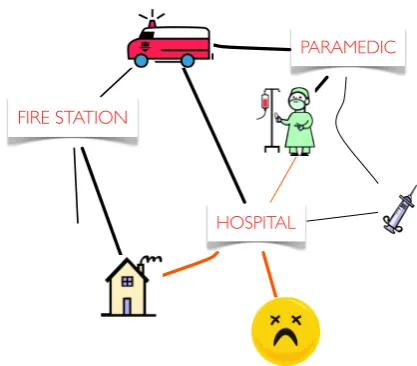
Figure 1: Example of a small ontology with ab-stract concepts (spelled-out words) and concrete ones (drawings).
Ai= log pres
X
k=1
t−kd+
cues X
j
wjSji+
Retrieval is contextualized by cues available through spreading activation. It is proportional to the strengths of association (Sji) of all of the
cues with the target chunk. While the base-level term (first term of the sum) can be seen as a prior, spreading activation models the conditional proba-bility of retrieval given the available cues. Finally,
is sampled from a logistic distribution shaped by canonical parameters.Aimust surpass a minimum
retrieval threshold.
The model is implemented using the ACT-UP toolbox, which makes the components of the ACT-R theory are directly accessible. The cognitive model does not specify other model components (perceptual, manual, procedural), as they are nei-ther subject to evaluation nor considered to make a significant contribution to learning or convergence effects.
3.2 Communication model
We assume that the communication system, or
experiments uses drawings as symbols–the princi-ple stays the same. Agents start out with a knowl-edge base containing signs for concrete concepts that are immediately representable as drawings or nouns; the target concepts to be conveyed by the participants, however, are more abstract and re-quire the combination of such concrete concepts. A concept such ashospital, for instance, could in-volve the drawings for house, ambulance, and a
sad face. A participant could choose among many ways to expresshospital.
The goal of our cognitive models is to com-municate meaning from one agent to another one. Put in natural language-oriented terminology, the
director role is the speaker, a role that involves selecting the right concrete concepts that can ex-press a given target concepts; thematcherrole ( lis-tener) involves decoding the concrete drawings (or words) to retrieve the target.
A single ACT-R model implements thedirector
and matcher roles. As a director, the model es-tablishes new combinations of drawings for given target concepts. As a matcher, the model makes guesses. In each role, the model revises its internal mappings between drawings and target concepts. The model is copied to instantiate a community of agents, one for each node in the network.
The simplest form of representing a communi-cation system in ACT-R memorychunksis as a set of signs. Each sign pairs a concept with a set of drawings. Competing signs can be used to assign multiple drawings for one conceptTo reflect se-mantic relationships, we need to introduce a sub-symbolic notion of relatedness. We use ACT-R’s spreading activation mechanism and weights be-tween concepts to reflect relatedness. Spreading activation facilitates retrieval of a chunk if the cur-rent context offers cues related to the chunk. Re-latedness is expressed as a value in log-odds space (Sjivalues).
When the model is faced with the task to draw a given concept such asRussell Crowe(one of the concepts in the experiment) orHospital(as in Fig-ure 1) that has no canonical form as a drawing, a related but concrete concept is retrieved from declarative memory (such as Syringe in the exam-ple). In drawing-based communication, this would be a concept that can be drawn, while in natural-language based communication, this is an existing drawing expressing a similar, partial or otherwise related concept. We request two other such
con-cepts, reflecting the desire of the communicator to come up with a distinctive rather than just fit-ting depiction of the target concept. The case of a model recognizing a novel combination of draw-ings is similar; we retrieve the concept using the drawings as cues that spread activation, making the target concept the one that is the most related one to the drawings.
After drawings have been produced or recog-nized and mapped to a target, the target or guessed concept, along with the component drawings, is stored symbolically in memory as a chunk for later reuse (domain sign). These signs differ from the pre-existing concepts in the network, although they also allow for the retrieval of suitable draw-ings given a concept, and for a concept given some drawings. When drawing or recognizing at a later stage, the memorized domain signs are strictly preferred as a strategy over the retrieval of related concepts. The system of domain signs encodes what is agreed upon as a language system between two communicators; they will be reused readily during drawing when interacting with a new part-ner, but they will be of only limited use when at-tempting to recognize a drawing combination that adheres to somebody else’s independently devel-oped communication system.
Thus, the model has two avenues to express and recognize an abstract concept: by associative re-trieval and by idiomatic domain concept. A mes-sage constructed by domain concept retrieval is often decoded by the matcher by association, and vice versa.
The identification accuracy of the model shows characteristics observed in empirical work (Fay et al. 2008). See Reitter and Lebiere (subm) for a de-tailed description of the model and its evaluation.
3.3 Knowledge
Agents start out with shared world knowledge. This is expressed as a network of concepts, con-nected by weighted links (Sji). The distribution
of link strengths is important in this context, as it determines how easily we can find drawing combi-nations that reliably express target concepts. Thus, the Sji were sampled randomly from an
ex-ID accuracy (empirical)
42 Games over 7 rounds Identification accuracy 0.75
0.80 0.85 0.90 0.95
0 10 20 30 40
Communities
Isolated Pairs
42 Games over 7 rounds Identification accuracy 0.65
0.70 0.75 0.80 0.85
10 20 30 40
Communities
[image:6.595.78.285.62.265.2]Isolated Pairs
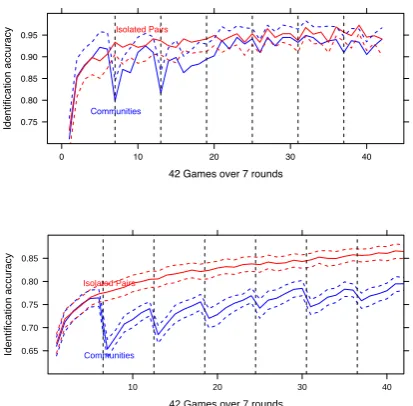
Figure 2: Identification accuracy for isolated pairs and communities: (a) human data as pro-vided by Fay (p.c.), (b) simulation. One-tailed standard-error based 95% confidence intervals (upper bounds for communities, lower bounds for pairs) for human data; two-tailed 95% via boot-strapping for simulations. As in the human data, both community pairs and isolated pairs converge most in the early rounds, but community pairs lose much accuracy when switching partners.
pected, the frequencies of such collocations are distributed according to a power law.
Such knowledge is, however, not fully shared between agents. Each agent has their own knowl-edge network resulting from life experience. This difference is essential to the difficulty of the task: if all agents came to the same conclusions about the strongest representation of target concepts, there would be little need to establish the domain language. We control the noise applied to the link strengths between conceptsj andifor agent
M (SjiM) by combining the common ground Sji
(shared between all agents) with a random sample
NjiM in a mixture model: SjiM = (1−n)Sji +
nNjiM; sign identification accuracy was found to be stable fornup to about0.4; we set it to0.3for Simulation 1.
4 Simulation 1
Networks of individual cognitive agents were cre-ated to differentiate performance between four dif-ferent network structures. Random networks
contain N nodes with randomly assigned links
between them, on average d links for each node (Erd˝os and R´enyi, 1959). n-dimensional Grids
contain N nodes with a constant numer of links
d per node, with links between neighbors along each dimension. The width w is kept the same along each dimension, i.e. there arewnodes per row. We use 6-dimensional lattices. Treesare di-rected acyclic graphs with1link leading up, and
d−1 links (branching factor) leading down the hierarchy of a total ofN nodes. Scale-free
net-works are constructed using the preferential
at-tachmentmethod as follows (Barabasi and Albert, 1999).N nodes are created and each is connected to one randomly selected other node. Then, two links< a, b >and< a0, b0 >are chosen randomly out of the existing set of links, and a new link
< a, b0 >is added, until the mean degreed(links per node) is reached. Preferential attachment en-sures that nodes with a high number of links ac-quire further links more quickly than other nodes (the rich get richer). This yields a power-law tribution of degrees. Our scale-free networks dis-play small world properties.
For the first Simulation, we controlN at85and
dat51. 35 iterations were simulated in each trial; 20 trials were run. During each round, each agent (network node) plays one game (16 concepts) with one of its neighbors. The order of neighbors is shuffled initially, but constant across the rounds. A variableRoundcoded iterations from1to35.
Results Figure 3 shows the learning curve for
agent pairs in the four networks. Agents in all net-works converge. Confidence intervals obtained via bootstrapping indicated no apparent differences at any specific iteration. A linear model was fit-ted estimating the effects of network type over-all (as a baseline) for each of the four types. It also fitted interactions of iteration (1–35) with the network types, which indicate significant learn-ing effects as follows. For each network type, we found a significant learning effect (effect of
Round) (β0.002, p <0.001).
Planned comparisons of the learning rate in Small World networks revealed no difference with either of the other three network types (p >0.3).
1We found that networks need to be sufficiently large to
iteration
Identification accur
acy
0.6 0.7 0.8
0 10 20 30
grid
smallworld
tree
[image:7.595.75.283.71.274.2]random
Figure 3: Identification accuracy between con-nected agents for communities of different net-work structures.
5 Simulation 2
The success of a community is not only deter-mined by how successfully individuals communi-cate in their local environment, that is, with their network neighbors. Communities require commu-nicative success outside of well-acquainted agents. Agents’ languages would ideally converge on a global scale. One way to test this is to have ran-domly paired agents play the Pictionary game at regular intervals throughout the game and thus measure identification accuracy outside of the net-work that defines the social structure.
This simulation was identical to Simulation 1, except that we scaled up the simulation to examine whether the lack of effect was possibly due to size or density of the nodes (N = 512, d = 6, noise level: 0.2, repetitions: 20). In this simulation, we measured ID accuracy between pairs of randomly chosen agents after each round. For three network types, Grid, Small World andRandomwe found significant interactions withround, i.e. significant convergence, (allβ >0.016, z > 2.1, p < 0.05). For the network typeTreewe found no significant interaction (β= 0.012, z= 1.55, p= 0.12).2
2
All regressions in this simulation where (generalized) mixed-effects models, with ID accuracy as response via logit link,Roundas predictor, andConditionas factor for four net-work types. A random intercept was fitted, grouped by repeti-tion (1−20), to account for repeated measures. The predictor was centered; no substantial collinearity remained. The anal-ysis of Simulation 1 was a simple linear model; ID accuracy
iteration
ID accur
acy of r
andomly paired agents
0.60 0.65 0.70
0 10 20 30
grid
smallworld
tree
random
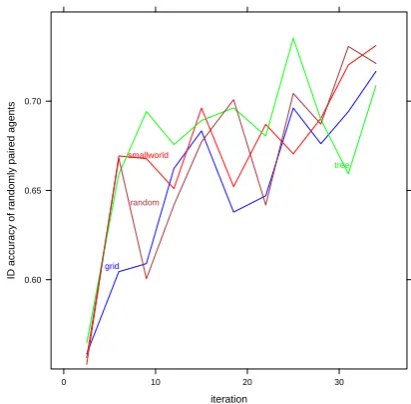
Figure 4: (Aggregate) Identification accuracy be-tween random agent pairs for communities of dif-ferent network structures.
To test the initial hypothesis, we re-coded the conditions with a SmallWorld factor, contrasting the small world networks with all other conditions. We found an effect of Round (β = 0.017, z = 3.66, p < 0.001), indicating convergence, but no interaction withSmallWorld(β =−0.00027, z = −0.03, p= 0.98).3
Results Figure 4 shows network-global
conver-gence. Again, a linear model was fitted to estimate the learning rate in different network types (inter-action of network type and iteration) (baseline in-tercepts were fitted for each network type). We found significant interactions with iteration for the following network types: Grid (β = 0.004, p <
0.001),Small World (β = 0.003, p < 0.01), and
Random(β = 0.003, p < 0.005), but not forTree
(p= 0.991).
Planned comparisons revealed an interaction of network type and iteration for Tree compared to
Small World (β = −0.003, p < 0.05), but not for Grid nor Random compared to Small World
(p > 0.35). This indicates slower across-network convergence for trees than for small worlds. It also suggests that convergence across the network does not differ much between grids, random networks and small worlds.
was, for all levels, not near either extreme (µ= 0.77).
3Further, unreported, experiments, showed a similar
[image:7.595.309.515.72.274.2]6 Discussion
We find that convergence is relatively stable across the four network types. Analyzing the differences between the networks, we find that the average de-gree, which was controlled for grids, random net-works and small worlds, was substantially lower for trees (d = 1.9) due to the large number of leaves with degree 1. This (or the correlated al-gebraic connectivity of the network) may prove to be a deciding correlate with cross-network conver-gence. Other metrics, such as the clustering coef-ficient (Watts and Strogatz, 1998), which gives an indication of the degree of neighborhood cohesion We see these results still as preliminary. More work needs to be done to investigate how well learning scales with network growth, and how net-work analytics such as clustering coefficients af-fect the dispersion of information.
Further work will explore range of networks and the possibly unique suitability of human learn-ing mechanisms to succeed in such networks. We will explore the (subsymbolic) parameters govern-ing adaptation, and to what extend the quantitative parameters we find universal to humans are sub-stantially optimized to deal with the small-world networks and pareto degree-distributions found in human communities.
7 Conclusion
Cognition may appear to be adapted to the so-cial structures prevalent in communities of flocks, packs and human teams. There are many reasons why such social structures themselves could have evolved; if cognitive constraints play a role, we ex-pect it to be only a small factor among many. The present simulation results certainly do not support this view: they are much more compatible with ahumans-as-generaliststheory that proposes that humans have evolved to handle a variety of net-work structures well, or that their recency- and frequency-based learning mechanism is not spe-cialized.
Learning, if adapted to social structure in any way, may go beyond the current, mechanistic and implicit mechanisms implemented in ACT-R and comparable theories: learning may rely on more explicit strategies, analyzing one’s interac-tion partners and their current knowledge, and it needs to judge information according to its sources (trust). Meta-cognition could also play a role in determining when a set of signs is substantially
novel and better than the current system, and thus worth enduring the cost of switching from a settled set of language conventions.
We have evaluated only a small, initial part of a co-evolution theory we proposed. Also, the prob-lem we describe may be best operationalized at a higher abstraction level: Consensus problems
and information spread have been intensively stud-ied (e.g., Latora and Marchiori, 2001; Wu et al., 2004). Comparing community convergence in a number of differently-structured networks, so far we see little evidence supporting our hypothesis, namely that cognition (memory) has specialized to accommodate social structures as defined by con-temporary network science, and that those struc-tures accommodate cognitive properties. Instead, we find that the simulated cognitive agents con-verge in their communication systems quite well regardless of the network structures, at least as long as those networks are relatively small and of similar average degrees.
Acknowledgments
This work was funded by the Air Force Office of Scientific Research (MURI grant FA95500810356).
References
Anderson, J. R., Bothell, D., Byrne, M. D., Dou-glass, S., Lebiere, C., and Quin, Y. (2004). An integrated theory of mind. Psychological Re-view, 111:1036–1060.
Ball, J., Heiberg, A., and Silber, R. (2007). Toward a large-scale model of language comprehension in act-r 6. In Proceedings of the 8th Interna-tional Conference on Cognitive Modeling, Ann Arbor, MI.
Barabasi, A. L. and Albert, R. (1999). Emer-gence of scaling in random networks. Science, 286(5439):509–512.
Brighton, H., Smith, K., and Kirby, S. (2005). Language as an evolutionary system. Physics of Life Reviews, 2(3):177–226.
Budiu, R. and Anderson, J. R. (2002). Compre-hending anaphoric metaphors.Memory & Cog-nition, 30:158–165.
Crescentini, C. and Stocco, A. (2005). Agramma-tism as a failure in the lexical activation process. InProceedings of the 27th Annual Conference of the Cognitive Science Society.
Dall’Asta, L., Baronchelli, A., Barrat, A., and Loreto, V. (2006). Agreement dynamics on small-world networks. EPL (Europhysics Let-ters), 73(6):969.
Erd˝os, P. and R´enyi, A. (1959). On random graphs. I. Publ. Math. Debrecen, 6:290–297.
Fay, N., Garrod, S., and Roberts, L. (2008). The fitness and functionality of culturally evolved communication systems. Philosophical Trans-actions of the Royal Society B: Biological Sci-ences, 363(1509):3553–3561.
Fay, N., Garrod, S., Roberts, L., and Swoboda, N. (2010). The interactive evolution of hu-man communication systems. Cognitive Sci-ence, 34(3):351–386.
Garrod, S. and Doherty, G. M. (1994). Conversa-tion, co-ordination and convention: An empir-ical investigation of how groups establish lin-guistic conventions. Cognition, 53:181–215.
Garrod, S., Fay, N., Lee, J., Oberlander, J., and Macleod, T. (2007). Foundations of represen-tation: Where might graphical symbol systems come from? Cognitive Science, 31(6):961–987.
Griffiths, T. L. and Kalish, M. L. (2007). Language evolution by iterated learning with Bayesian agents.Cognitive Science, 31(3):441– 480.
Kirby, S. and Hurford, J. (2002). The emergence of linguistic structure: An overview of the it-erated learning model. In Cangelosi, A. and Parisi, D., editors, Simulating the Evolution of Language, chapter 6, pages 121–148. Springer Verlag, London.
Laird, J. E. and Rosenbloom, P. S. (1987). Soar: An architecture for general intelligence. Artifi-cial Intelligence, 33(1):1–64.
Latora, V. and Marchiori, M. (2001). Efficient behavior of small-world networks. Phys. Rev. Lett., 87(19):198701.
Lewis, R. L. and Vasishth, S. (2005). An activation-based model of sentence processing as skilled memory retrieval. Cognitive Science, 29:1–45.
Pickering, M. J. and Garrod, S. (2004). Toward a mechanistic psychology of dialogue. Behav-ioral and Brain Sciences, 27:169–225.
Reitter, D. (2008). Context Effects in Language Production: Models of Syntactic Priming in Di-alogue Corpora. PhD thesis, University of Ed-inburgh.
Reitter, D. and Lebiere, C. (2009). Towards ex-plaining the evolution of domain languages with cognitive simulation. InProceedings of the 9th International Conference on Cognitive Model-ing (ICCM), Manchester, UK.
Reitter, D. and Lebiere, C. (subm.). Towards ex-plaining the evolution of domain languages with cognitive simulation. Cognitive Systems Re-search.
Reitter, D. and Moore, J. D. (2007). Predict-ing success in dialogue. InProceedings of the 45th Annual Meeting of the Association of Com-putational Linguistics (ACL), pages 808–815, Prague, Czech Republic.
Steedman, M. (2000).The Syntactic Process. MIT Press, Cambridge, MA.
Sun, R. (2001). Cognitive science meets multi-agent systems: A prolegomenon.Philosophical Psychology, 14(1):5–28.
Watts, D. J. and Strogatz, S. H. (1998). Collective dynamics of /‘small-world/’ networks. Nature, 393(6684):440–442.