Reduced Energy Consumption in Cloud Computing
Environment
Patel Apeksha
PG Student Marwadi University
Rajkot
Ashish Revar
Senior Assistant Professor Marwadi University
Rajkot
ABSTRACT
Development in Information Technology led to the increasing necessity of computing and storage. Cloud services is one of the technologies with huge demand and hence involves more computing resources and storage. Consequently, the energy consumption by the cloud is also increasing. Cloud data centers consume large amount of energy and there by discharging carbon dioxide to the atmosphere. Dynamic efforts are put in to this research to minimize the energy consumption of data centers. This work recommends a technique for energy efficient resource management. Prior techniques do not emphasis on the variations of workloads and deficient in probing the effect of algorithms on performance. Virtual machine configuration also plays a crucial role for reducing energy consumption and resource wastage but is not given much importance. To address these weaknesses, this work recommends a novel method to map groups of tasks to customized virtual machine types. Virtual machine migration is done to stabilize the load by manipulating the load using MIPS, RAM and Bandwidth.
General Terms
General term is mainly to classify the overloaded host and by that migrate the VM based on load. We mention generally 4 algorithms based on that concept.
Keywords
Cloud computing, datacenters, energy consumption, Virtual machine migration, Bandwidth utilization
1.
INTRODUCTION
Cloud computing can be defined as a mode of using computational resources such as operating systems, storages etc. which are situated distantly and are provided as a service over internet. A huge change in the IT sector and IT marketing has been estimated by the researchers and academicians. The main advantages of cloud computing include low costs, high availability, scalability and elasticity. Now a days, cloud computing refers to the many diverse types of services and applications being delivered in the internet cloud, and the fact that, in many situations, the devices used to access these services and applications do not require any special applications. Some examples of companies that deliver services form cloud are as follows:
Google —It has a private cloud that it uses for providing many divergent services to its consumers, including email access, maps, document applications, text translations, web analytics, and much more [1].
Microsoft —it has Microsoft SharePoint online service that allows for content and business intelligence tools to be moved into the cloud, and Microsoft currently making its office applications available in a cloud [1].
Salesforce.com it runs its application set for its customers in a cloud, and its force.com and vmforce.com products provide developers with platforms to build customized cloud services [1].
2.
SERVICE MODELS
[image:1.595.327.524.278.450.2]The Service model of cloud is shown in Figure1
Figure 1: Cloud Service Models [1]
Software as a Service
This layer offers different applications as a service to the end user over the web on a pay-per use model. A SaaS provider deploys software to the user on demand, usually through a licensing model [1]. Salesforce is a pioneer example of this service model.
Platform as a Service
This layer offers development environment which can be used to develop different business applications [1]. This layer differs from SaaS solution in that they offer a cloud hosted virtual development platform, accessible via a web browser. The computing platform and solution pile are provided by this layer. It offers toolkits configure for the virtual development environment. In short, it provides an integrated environment for building, testing and deploying application. Microsoft Azure, Google App Engine, Amazon Map Reduce service etc. are examples of PaaS.
Infrastructure as a Service
30
3.
LITERATURE SURVEY
Aslam et al have proposed algorithm which utilizes resources properly [2]. It is achieved by dynamically triggering VM migration to balance the load of VM. Aslam et al have considered VMs, CPU state, Storage, Memory, Network resources and Disk spaces. The limitation of the algorithm is that Framework and algorithms modelled and simulated in cloudsim.
Elrotub et al proposed a method to allocate task to VMs and achieve high level of Quality of Services [3]. The algorithm uses CPU, memory and RAM utilization as parameters. The limitation of the algorithm is that it considered priority task in order to satisfy the user. It needs to include more parameters in order to achieve better result.
Kumar et al proposed Power and Data Aware Best Fit Algorithm (PDABFA) [4]. This algorithm provides better resource utilization and energy optimization. The parameters considered for this algorithm are CPU, size of data, RAM and Network. It can use more parameters for improvement in the existing approach.Kepi Zhang, Tong Wu and all have proposed algorithm which focus on the energy saving issue for virtual machine (VM) selections on an overloaded host in a cloud computing environment [5]. They analyze the energy influencing factors during a VM migration, then design energy efficient VM selection algorithms based on greedy algorithm and dynamic programming method. It reduces energy consumption using proposed method.
LI Hongyou, WANG Jiangyong and all have proposed two algorithms called the Energy-aware Scheduling algorithm using Workload-aware Consolidation Technique (ESWCT) and the Energy- aware Live Migration algorithm using Workload-aware Consolidation Technique (ELMWCT) [6]. They focus on multiple resources for scheduling like RAM, CPU and network bandwidth and result show reduced energy consumption than one dimensional resource.
Adrian et al have proposed K-Mean Clustering Algorithms and FIFO Algorithms in their paper [7]. This paper suggests that virtual machine CPU utilization can increase with K-means algorithm method during simulation. For this, CPU utilization is only parameter considered. The drawback of this algorithm is that virtual machine allocation using k-means algorithm becomes unbalanced.
Chavan et al proposed a formation of VM cluster and flow diagram of VM cluster in their paper [8]. In this paper author suggested that scalability and availability can be consider for better outcomes for users. This not only saves time, but also improves cost utilization. The parameters considered are
RAM, storage, CPU utilization and Bandwidth utilization. The drawback of this method is that in private cloud in terms of resources utilization is due to improper migration, and improper placement of virtual machines in data centers. Singh et al discussed techniques and challenges in live virtual machine migration [9]. The paper suggests that migration of virtual machine is gaining more importance today to improve utilization of resources and to rise the efficiency of physical server. The parameters considered in their paper are CPU, RAM, memory and Network. The paper discussed few challenges in the improvement of post copy virtual machine migration technique.
Liyanage et al have proposed a VM scheduler algorithms [10]. This algorithm optimizes Virtual Machines’ (VMs’) allocation and consolidation to improve resource utilization of running servers and the shutdown of idle servers. CPU, memory and Network bandwidth are considered for VM scheduler algorithms in this paper. The only limitation of this paper is that it did not evaluate the algorithm in large Distributed Computing and access its performance in terms of SLAs. Somayeh Soltan Baghshahi et al have proposed a method is for virtual machine migration from one data center to another [11]. The proposed method uses the greedy algorithm for virtual machine selection. Virtual machines within a cluster are given priority, which reduces the total migration time of a cluster. They have shown that the bandwidth parameter has the important role in the virtual machine migration.
4.
PROPOSED FRAMEWORK
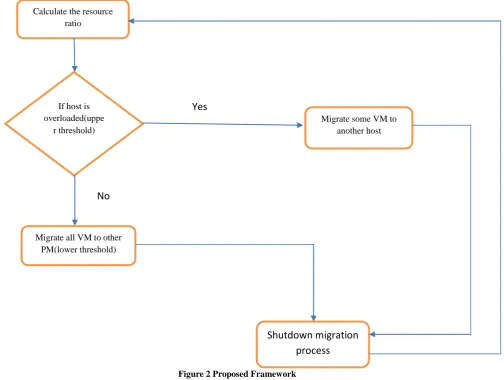
Figure 2 Proposed Framework
5.
PROPOSED ALGORITHM
Algorithm 1: Selecting Overloaded PM
n=thresholdOverloaded_PM<-null For each Host p in Hostlist
ramUtilization totalrequestedRam / totalRam mipsUtilization totalrequestedMips / totalMips bwUtilization totalrequestedBw / totalBw totalUtilization ← (ramUtilization * mipsUtilization * bwUtilization) / 3
If (totalUtilization > n) then Overloaded_PM p End If
End For
Algorithm 2: Selecting VM for Migration
(u[ram] define utilization of Ram, u[mips]
define utilization of mips and u[bw] define
utilization of bandwidth)
VMtoMigrate NULL Vmid NULL
Max 0
If (ramUtilization > mipsUtilization) If (ramUtilization >bwUtilization) For each VM vi in overloaded PM If (Max < u[ram])
Max u[ram] vm vi End If End For
VMtoMigrate vm End If
End If
Else If (mipsUtilization>bwUtilization) For each VM vi in overloaded PM If (Max < u[mips])
Max u[mips] vm vi End If Calculate the resource
ratio
If host is overloaded(uppe
r threshold)
Migrate some VM to another host
Migrate all VM to other PM(lower threshold)
Yes
No
32 End For
VMtoMigrate v End Else if Else
For each VM vi in overloaded PM If (Max < u[bw])
Max u[bw] vm vi End If End For
VMtoMigrate vm End Else
Algorithm 3: Selecting Physical Machine for
VM Placement
(issuitablehost (p,vm) return true if it has
enough resource to create vm on p)
Selected_PM NULL For each PM p in PMList If (issuitablehost (p,vm))
AllocateVM (p,vm) //vm is created on pm If (isoverloaded (pm))
Deallocate (p,vm)
// if host is overload then deallocate vm End If
Else Break End If
Algorithm : 4 Task Submission Algorithm
SortedTasklist <- nullSort task in increasing order of deadline and stored in SortedTasklist
For each task t in SortedTasklist For each vm in vm list
If t.deadline>(t.length/vm.getavailabelmips) Submit task t on vm
End If End For End For
The proposed algorithm is shown above. Algorithm-1
describes to find overloaded PM and to select the host which is overloaded. Algorithm-2 is to select VM for Migration and we select the VM which one is to be migrated.
Algorithm-3 is for finding suitable host for VM ,where we
decide to migrate VM and place VM to that target host. So here we will find a target host which have lower utilization of that parameter and create VM on that host. If host has enough
resources , then place VM on that host, otherwise check for another host. Likewise the cycle continues until and unless the suitable host must be found. Algorithm-4 is for Task submission to submit the task to VM based on deadline and it must be greater than cloudlet length. Here host will be overloaded by anyone of this over utilized resource it can be memory, MIPS or bandwidth.
6.
RESULT ANALYSIS
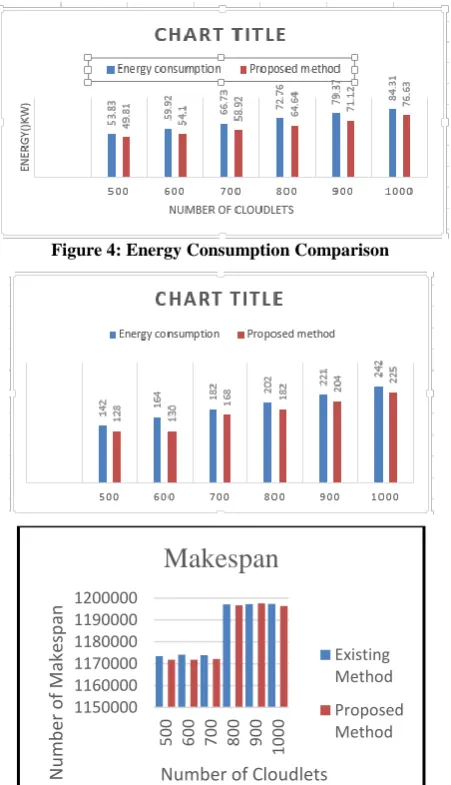
[image:4.595.318.544.221.614.2]Existing method and proposed method have been implemented in cloudsim simulator for the result analysis. Energy consumptions for various numbers of cloudlets like 500 cloudlets to 1000 cloudlets and result is as figure 4, figure 5 and figure 6.
Figure 4: Energy Consumption Comparison
Figure 5: VM Migration Comparison
Figure 6: Makespan comparison values of Makespan 1150000
1160000 1170000 1180000 1190000 1200000
500 600 700 800 900 1000
N
u
m
b
er
o
f M
ak
es
p
an
Number of Cloudlets
Makespan
Existing Method
7.
CONCLUSION AND FUTURE WORK
Cloud is a widely used technology in many organizations. Optimizing its performance is a major challenge now-a-day. One such issue is energy consumption. The need to decrease the energy consumption is necessary for the current environment. Cloud emits large amount of Carbon dioxide to the environment. Decrease in energy consumption also decreases the cost of the cloud. Hence green is critical to overcome this issue.This work proposed an end-to-end architecture of cloud for optimal energy consumption. Incoming tasks are clustered together based on their usage patterns. These clusters of tasks are then allocated on to customized virtual machines. Further, virtual machine migration techniques are used to migrate the virtual machines whenever the hosts are overloaded and under loaded.
This work utilizes newly designed algorithms for calculating the load, task allocation and for virtual machine migrations. The simulation results show that the overall performance of the cloud has improved, compared to the earlier works, in terms of energy consumption, number of virtual machine migrations without any increase in the completion time of the tasks.
The scope of improving any algorithm is always feasible. Future work contains use of other classification algorithms for task classification and implementation of this work to real cloud environment.
8.
REFERENCES
[1] R. uyya . ro erg and . o ci ski, Cloud computing. Hoboken, N.J.: Wiley, 2011.
[2] S. Aslam and M. Shah, "Load balancing algorithms in cloud computing: A survey of modern techniques",National Software Engineering Conference (NSEC), 2015, Rawalpindi, Pakistan.
[3] M. Elrotub and A. Gherbi, "Virtual Machine Classification-based Approach to Enhanced Workload Balancing for Cloud Computing Applications", Procedia Computer Science, vol. 130, pp. 683-688, 2018.
[4] Kumar, P., D. Singh and A. Kaushik. "Power and Data Aware Best Fit Algorithm for Energy Saving in Cloud
Computing." International Journal of Computer Science and Information Technologies vol. 5(5) pp. 6712-671,2014.
[5] K. Zhang, T. Wu, S. Chen, L. Cai and C. Peng, "A New Energy Efficient VM Scheduling Algorithm for Cloud Computing Based on Dynamic Programming", IEEE 4th International Conference on Cyber Security and Cloud Computing (CSCloud), 2017, New York, NY, USA. [6] L. Hongyou, W. Jiangyong, P. Jian, W. Junfeng and L.
Tang, "Energy-aware scheduling scheme using workload-aware consolidation technique in cloud data centres", China Communications, vol.10(12), pp. 114-124, 2013.
[7] B. Adrian and L. Heryawan, "Analysis of K-means algorithm for VM allocation in cloud computing”
International Conference on Data and Software Engineering (ICoDSE), 2015, Yogyakarta, DIY, Indonesia.
[8] Chavan and P. Kaveri, "Clustered virtual machines for higher availability of resources with improved scalability in cloud computing",First International Conference on Networks & Soft Computing (ICNSC),Guntur, 2014. [9] G. Singh and P. Gupta, "A review on migration
techniques and challenges in live virtual machine migration",5th International Conference on Reliability, Infocom Technologies and Optimization (Trends and Future Directions) (ICRITO), Noida,2016.
[10] S. Liyanage, S. Khaddaj and J. Francik, "Virtual Machine Migration Strategy in Cloud Computing",14th International Symposium on Distributed Computing and Applications for Business Engineering and Science (DCABES), Guiyang,2015.
![Figure 1: Cloud Service Models [1]](https://thumb-us.123doks.com/thumbv2/123dok_us/9300367.428690/1.595.327.524.278.450/figure-cloud-service-models.webp)