PREPARATION AND APPLICATION OF Β
PHENOL-FORMALDEHYDE AS AN
1
Krishnan, N. P.,
2Ilayaraja,
1
Department of Chemistry, K.L.N College of Engineering, Pottapalayam
2
Department of Chemistry, SBM College of Engineering &
3
Department of Chemistry, Faculty of Engineering, Karpagam University, Coimbatore
*4
PG & Research Department of Chemistry, Thiagarajar college, Madurai
ARTICLE INFO ABSTRACT
The Phenol
structure showed superior adsorption properties for Hg (II) and Pb
before and after Hg(II) and Pb(II) adsorption represented that the functional groups responsible for Hg(II) and Pb(II) adsorption. Thermodynamic studies revealed that Hg (II) and Pb (II) adsorption on the PFCR adsorbent
force between Hg (II) and Pb (II) ions and functional groups has been strengthened at high temperatures, which made the adsorption more favorable at high temperatures. The adso
fitted well by the Temkin isotherm for Pb(II) ion and both the metal ions fitted well with Jovanoic isotherm models.
and provide a base for the scientific and e
Copyright © 2015 Krishnan et al. This is an open access article distributed under the Creative Commons Att distribution, and reproduction in any medium, provided the original work is properly cited.
INTRODUCTION
Most of the metals are known to be toxic and half of these, including cadmium, chromium, copper, lead, mercury, nickel, selenium, silver and zinc, are released into the environment in quantities that pose a risk to human health (Ireland
et al., 1991). Heavy metal contamination exists in aqueous
waste streams from diverse industries such as metal plating, manufacturing, batteries, as well as agricultural sources where fertilizers and fungicidal sprays are intensively used. Cu, Zn, Hg, and Cd are harmful wastes produced by industry that pose a risk of contamination groundwater and other water resources. Heavy metals are not biodegradable and tend to accumulate in living organisms, causing various diseases and disorders (Guo
et al., 2002; Albert et al., 1995; Nuhoglu et
et al., 2002). Lead is an important compound used as an
intermediate in processing industries such as plating, paint and dyes, glass operations, and lead batteries (Aroua
*Corresponding author: Sayee Kannan, R.
PG & Research Department of Chemistry, Thiagarajar college, Madurai-625009, India
ISSN: 0975-833X
Article History:
Received 28th April, 2015 Received in revised form 06th May, 2015 Accepted 03rd June, 2015 Published online 28th July,2015
Key words:
Adsorption, Lead, Mercury,
Functionalized β-cyclodextrin, Thermodynamics.
Citation: Krishnan, N. P., Ilayaraja, M., Muthukrishnan, P. and
polymerized with phenol-formaldehyde as an adsorbent for the removal of PB(ii) and HG(ii) from aqueous media
Current Research, 7, (7), 17829-17838.
RESEARCH ARTICLE
PREPARATION AND APPLICATION OF Β-CYCLODEXTRIN POLYMERIZED
FORMALDEHYDE AS AN ADSORBENT FOR THE REMOVAL OF PB(II)
AQUEOUS MEDIA
Ilayaraja, M.,
3Muthukrishnan, P. and
4,*Sayee Kannan
Department of Chemistry, K.L.N College of Engineering,
Pottapalayam-Department of Chemistry, SBM College of Engineering & Technology, Dindigul
Department of Chemistry, Faculty of Engineering, Karpagam University, Coimbatore
Research Department of Chemistry, Thiagarajar college, Madurai
ABSTRACT
The Phenol-Formaldehyde/β-cyclodextrin (β-CD) resin (PFCR) adsorbent with macro cycle network structure showed superior adsorption properties for Hg (II) and Pb
before and after Hg(II) and Pb(II) adsorption represented that the functional groups responsible for Hg(II) and Pb(II) adsorption. Thermodynamic studies revealed that Hg (II) and Pb (II) adsorption on the PFCR adsorbent is a favorable, spontaneous, and endothermic chemisorption process. The binding force between Hg (II) and Pb (II) ions and functional groups has been strengthened at high temperatures, which made the adsorption more favorable at high temperatures. The adso
fitted well by the Temkin isotherm for Pb(II) ion and both the metal ions fitted well with Jovanoic isotherm models. This study will contribute to an in-depth understanding of adsorption phenomena, and provide a base for the scientific and engineering practical applications of the PFCR adsorbent.
is an open access article distributed under the Creative Commons Attribution License, which distribution, and reproduction in any medium, provided the original work is properly cited.
toxic and half of these, including cadmium, chromium, copper, lead, mercury, nickel, selenium, silver and zinc, are released into the environment in
quantities that pose a risk to human health (Ireland ontamination exists in aqueous
waste streams from diverse industries such as metal plating, manufacturing, batteries, as well as agricultural sources where fertilizers and fungicidal sprays are intensively used. Cu, Zn, ed by industry that pose a risk of contamination groundwater and other water resources. Heavy metals are not biodegradable and tend to accumulate in living organisms, causing various diseases and disorders (Guo
et al., 2002; Ngah Lead is an important compound used as an intermediate in processing industries such as plating, paint and Aroua et al., 2008).
Research Department of Chemistry, Thiagarajar college,
However, the presence of lead in water even at a very low level would be harmful to aquatic life and human health in terms of its toxicological, potential carcinogenic a neurotoxical effects (Martins
limits of lead in drinking water and surface water intended for drinking, as set by EU, USEPA and WHO, are 0.010, 0.015 and 0.010 mg l-1, respectively (
has a high tendency of binding with proteins and it mainly affects the renal and nervous systems
Therefore, reliable methods are necessary for the removal of heavy metals from aquatic environment.
A great deal of effort has been devoted to
of heavy metal ions from environmental matrices. Various treatment techniques available for the removal of toxic metals are adsorption, chemical precipitation, ion exchange, coagulation, reverse osmosis, electrolysis and membrane process, etc. (Merzouka et al.,
Mohamed et al., 2008). However, among all these methods, adsorption is considered an effective, efficient and economic method for the removal of pollutants from wastewater (Feng
et al., 2010; Gupta et al., 2012; Mittal
International Journal of Current Research
Vol. 7, Issue, 07, pp.17829-17838, July, 2015
Muthukrishnan, P. and Sayee Kannan, R. 2015. “Preparation and application of β formaldehyde as an adsorbent for the removal of PB(ii) and HG(ii) from aqueous media
CYCLODEXTRIN POLYMERIZED WITH
ADSORBENT FOR THE REMOVAL OF PB(II) AND HG(II) FROM
Sayee Kannan, R.
-630612, India
Technology, Dindigul-624005, India
Department of Chemistry, Faculty of Engineering, Karpagam University, Coimbatore-64102, Tamilnadu, India
Research Department of Chemistry, Thiagarajar college, Madurai-625009, India
CD) resin (PFCR) adsorbent with macro cycle network structure showed superior adsorption properties for Hg (II) and Pb (II) ions. FT-IR spectral analysis before and after Hg(II) and Pb(II) adsorption represented that the functional groups responsible for Hg(II) and Pb(II) adsorption. Thermodynamic studies revealed that Hg (II) and Pb (II) adsorption on is a favorable, spontaneous, and endothermic chemisorption process. The binding force between Hg (II) and Pb (II) ions and functional groups has been strengthened at high temperatures, which made the adsorption more favorable at high temperatures. The adsorption process fitted well by the Temkin isotherm for Pb(II) ion and both the metal ions fitted well with Jovanoic depth understanding of adsorption phenomena, ngineering practical applications of the PFCR adsorbent.
ribution License, which permits unrestricted use,
However, the presence of lead in water even at a very low level would be harmful to aquatic life and human health in terms of its toxicological, potential carcinogenic and Martins et al., 2006). The permissible limits of lead in drinking water and surface water intended for drinking, as set by EU, USEPA and WHO, are 0.010, 0.015 , respectively (Balaria et al., 2008). Mercury h tendency of binding with proteins and it mainly affects the renal and nervous systems (Denizli et al., 2003). Therefore, reliable methods are necessary for the removal of heavy metals from aquatic environment.
A great deal of effort has been devoted to the effective removal of heavy metal ions from environmental matrices. Various treatment techniques available for the removal of toxic metals are adsorption, chemical precipitation, ion exchange, coagulation, reverse osmosis, electrolysis and membrane
et al., 2008; Meunier et al., 2006; However, among all these methods, adsorption is considered an effective, efficient and economic method for the removal of pollutants from wastewater (Feng
2012; Mittal et al., 2008). This
OF CURRENT RESEARCH
technique can be applied frequently on large scale, as it can handle fairly large flow rates, producing a high quality of water without producing notorious sludge, residual contaminants, etc (Gupta et al., 2007). Moreover, adsorption is universal and fast in nature and applicable for the removal of organic and inorganic pollutants even at low concentration. Recent research has focused on adsorbents such as activated carbons, zeolites, clays, biomass and polymeric materials for the removal of heavy metals (Crini, 2005).
In wastewater treatment, especially in the removal of heavy metals, natural polymers, mainly polysaccharides such as chitosan, starch and its derivatives, cyclodextrins, have attracted particular attentions, due to their physico-chemical characteristics, low cost, availability and the presence of various reactive groups on the backbone chain. Recently, we have synthesized carboxymethylated β-cyclodextrin modified magnetic nanoparticles which could remove Cu2+ ions effectively from water based on complexation reactions between metal ions and carboxyl group (Badruddoza et al.,
2011).
Cyclodextrins (CDs) are cyclic oligosaccharides consisting of 6 (α), 7 (β), 8 (ɤ) glucopyranose units linked together via α (1– 4) linkages. They form a torus-shaped ring structure which contain an a polar cavity with primary hydroxyl groups lying on the outside and secondary hydroxyl groups inside (Szejtli, 1998). This renewable and biodegradable compound has the ability to complex various metal ions and this complexation ability can be improved by modifying CDs with suitable functional groups through esterification, oxidation reactions and cross-linking of hydroxyls outside the interior cavity (Norkus, 2009). Though β-CD/metal complexation has been used in water decontamination technique, particularly in the removal of heavy metals (Crini, 2006; Mahlambi et al., 2010), very little attention has been paid to the adsorption selectivity of heavy metal ions on these cyclodextrin based adsorbents. In this work, for improved effect the metal complexing ability and selectivity, β-cyclodextrin polymer was synthesized and used to graft on the phenol-formaldehyde surface. The aim of this work is to study the utility of PFCR, low cost as well as non-hazardous material, as an adsorbent for Pb (II) and Hg (II) removal from aqueous solution by batch experiments. The effect of experimental parameters such as initial concentration, contact time and temperature was investigated. Furthermore, equilibrium, kinetic and thermodynamic studies on the adsorption of Pb(II) and Hg(II) onto the PFCR were also carried out for the design of adsorption process.
MATERIALS AND METHODS
Materials
The chemicals used in the present study were con. sulfuric acid (Specific gravity =1.82), formaldehyde (37-40% solution) and phenol (Density =1.057gm-1). β-cyclodextrin (molecular weight, 79.87) was purchased from SRL chemicals, Mumbai, India. The Mercuric chloride (HgCl2, M.W. 271.50) and Lead
nitrate (Pb(NO3)2, M.W. 331.21) were obtained from
RANKEM chemicals New Delhi, India. All the chemicals used were analytical grade. The double distilled (DD) water was used throughout the investigation.
Preparation of PFCR composites
Phenol and con. sulfuric acid (1:1) and 0.5 mg of β-cyclodextrin were mixed slowly with constant stirring in an ice bath. The mixture was then heated to 70oC for three hours, and was kept overnight for cooling. The product was polymerized with formaldehyde solution (12 ml) in an ice bath, and then heated to 70oC for three hours. The product was cured, and was then ground washed with DD water to remove the free acid. Then the sample was dried at 70oC for 16 h. Finally the composite resin was sieved and preserved for characterization and further studies.
Adsorption experiments
Batch mode adsorption studies were carried out by adding certain amount of adsorbent and 40 ml of metal ion solutions of certain concentrations, dose, contact time and temperatures in a thermo stated water bath shaker with a shaking of 200 rpm. The samples were withdrawn from the shaker at predetermined time intervals, and solutions were separated from the adsorbent by centrifugations at 4000 rpm for 5 min. To determine the residual metal ion concentration, the absorbance of the supernatant solution was measured before and after treatment using atomic absorption (Elico SL-173) spectrometry at wavelength of 283.3 253.7 nm for Pb(II) and Hg(II) respectively. Experiments were carried out twice and the concentrations given were average values. The initial metal ion concentration in the test solution and the contact time were varied to investigate their effect on the adsorption kinetics. The pH of the metal ion solution was adjusted by using NaOH or HCl solution and a pH meter. The adsorption studies were carried out at different temperatures (308K, 318K and 328K).This was used to determine the effect of temperature on the thermodynamic parameters. The amount of adsorption in batch experiments and adsorption efficiency were calculated as follows:
q= (Co - Ce) V / m ….……… (1)
Efficiency (%) = (Co - Ce) / Co × 100 ...……… (2)
Where Co is the initial concentration (mg/L), Ce is the
equilibrium concentration (mg/L), V is the volume of solution (mL), m is the mass of adsorbent (g) and q is the amount of adsorbed (mg/g).
Surface characteristic of the adsorbent
Surface area and porous size distribution of PFCR sample were measured by nitrogen adsorption analysis (Quantachrome V5.02). Crystal structure of sample was determined by performing ray diffraction (XRD) on SHIMADZU 6000 X-ray diffraction spectrometer. Surface morphologies were examined by a scanning electron microscope (SEM, JEOL (JSM 6390) with the working distance of 9.9 mm and an accelerating voltage of 30 keV. The SEM was equipped with an energy dispersion spectrometer (EDS) and it was used to perform the analysis of chemical constituents of the adsorbent. Infrared absorption spectroscopy (IR) spectra were measured at room temperature on a Fourier transform infrared (FTIR) spectroscopy (8400s SHIMADZU spectrometer) using the KBr pellet technique. Thermo gravimetric analysis (TGA) was
carried out using a Shimadzu TGA Q50, with a heating rate of 20 ˚C min-1, under nitrogen flow at rate of 60 mL min-1.
RESULTS AND DISCUSSION
BET
The specific surface area was determined using the BET equation applied to the adsorption data. The surface area of PFCR was found to be 18.06 m2/g. Total pore volume is 7.25 cm3/gand pore size is 248.7 A° in Fig.1. PFCR has a relatively promising surface area although it was obtained from β-cyclodextrin.
Fig.1. Adsorption-desorption isotherms of nitrogen at 77 K on PFCR
FTIR
FTIR spectra of the β-CD, PFCR, Hg(II) and PFCR-Pb(II) are shown in Fig.2. The main bands are observed in the IR spectra of β-CD, in Fig.2a. FTIR data of β-CD shows that characteristic bands at 3246.2, 1640.8 1412.0, 892 cm-1 and 1172.1cm-1 correspond to the free OH, C=O, CH2, C=CH2and
C-O-C stretching vibrations respectively. Fig.2b shows the FTIR spectrum of PFCR. The absorption peak at 3150.3 cm-1 indicates the presence of OH groups on the surface of PFCR. The characteristic bands at 1637.1 cm-1 and 1462.5 cm-1 correspond to the C=O and C-CH2 stretching vibrations. The
band at 1025.4 cm-1 is attributed to the C-O-C.
FTIR data of PFCR-Hg(II) showed that characteristic bands at 3013.5, 1739.0 and 1439.0 cm-1 corresponding to OH, C=O and C-CH2 stretching vibrations respectively in Fig.2c. The
three new peaks were observed at 2141.8, 1366.6 and 891.4 cm-1 corresponding to C=C, C-CH3 and C=CH2 which revealed
the adsorption of Hg(II) onto PFCR. FTIR data of PFCR-Pb (II) showed that characteristic band at 3190.1, 1593.0, 1459.7 and 1023.0 cm-1 correspond to the OH, C=O, C-CH2 and
C-O-C stretching vibrations respectively. Fig.2d. indicated that mostly the bonded OH groups, C=O stretching, C-CH2
bending vibrations and C-O-C vibrations were involved in Pb(II) ion adsorption. There were clear band shifts and intensity increases in Fig.2d. These findings suggest that there is attachment of Pb(II) on the PFCR.
Fig.2. FTIR spectra of (a) β-CD (b) PFCR (c) PFCR- Hg(II) (d) PFCR- Pb(II)
XRD
The XRD patterns as shown in Fig.3 were performed to analyze the crystalline nature. The characteristic 20˚- 25˚ peaks of PFCR were discernible, the diffraction spectrum of PFCR did not show any obvious crystalline peak at the scan range 10-90˚ thereby indicating the amorphous phase of PFCR.
Fig.3. XRD pattern of PFCR
SEM
Fig.4. The SEM images of (a) PFCR (b) Hg (II) (c) PFCR-Pb (II)
EDX
Further confirmation of the adsorption of Hg(II) and Pb(II) on PFCR was done by energy dispersive X-ray analysis (EDX). Fig.5a for the unloaded PFCR, did not show any characteristic signal for metal ions, but only showed for the four major constituents, i.e., C, O, Mg and S. Whereas for Hg(II) and Pb(II) loaded PFCR (Fig.5b and Fig.5c) signals of presence of Hg(II) and Pb(II) were observed. This showed the diffusion or accumulation of metal ions onto the surface of PFCR.
Fig.5. Energy dispersive spectra of (a) PFCR (b) PFCR-Hg (II) (c) PFCR-Pb (II)
TGA
The TGA thermogram for the PFCR sample is shown in Fig.6. The thermogravimetric profile revealed that the mass loss occurs in three stages. The first weight loss about 17.43% in the temperature range 50 - 124 ˚C, which may be the combined water that existed in PFCR composite. The second weight loss occurred in the temperature range 124 - 415 ˚C, a typically high enough temperature to induce thermal degradation of ordinary carbon polymers for about 30.01%. The final weight loss was found above 415 - 700 ˚C, which is about 18.87%.
Finally, no mass loss was detected when the temperature was increased above 700 ˚C. This result indicated that the PFCR are stable at higher temperature. The char residue of PFCR content was 35.6%.The characterization results confirmed that the formation of the adsorbent PFCR occurred successfully.
Fig.6. TGA curve of PFCR
Effect of initial concentration
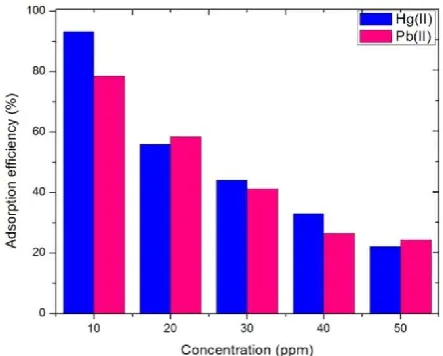
[image:5.595.329.537.132.300.2]Effect of initial Hg(II) and Pb(II) ion concentration was studied at different initial metal ion concentrations in the range of 10 - 50 mg/L at 298 K with 0.080 g PFCR at 120 min. The percentage of Hg(II) and Pb(II) ions adsorption at different metal concentrations using PFCR decreased with increase in metal ion concentration. This may be due to saturation of available adsorption sites onto PFCR. The effect of initial concentration on the removal of Hg(II) and Pb(II) by the adsorbent was indicated in Table.1 and Fig.7.
Fig.7. Effect of initial concentrations of Hg (II) and Pb (II)
Effect of contact time
The effect of contact time on the adsorption of Hg(II) and Pb(II) was at 10 mg/L. The Hg(II) and Pb(II) adsorption increased with increasing the contact time, the maximum removal of both Pb(II) and Hg(II) ions occurred at 120 min, after which there were no significant changes. The equilibrium was reached at 150 min for both the metal ions. Following this, the adsorption rate was uniform as there was no significant
change in adsorption with the increasing time. The initial fast adsorption is due to the availability of more active sites and more functional groups which participate in the lead and mercury uptake till equilibrium is attained and thereafter, there was no further adsorption. All the results are presented in Table 2 and Fig.8.
Fig.8. Effect of contact time
Effect of adsorbent mass
[image:5.595.53.275.447.625.2]The effect of adsorbent dosage on lead and mercury removal was studied by varying the amount PFCR between 0.020 - 0.100 g. It is evident from Table 3 and Fig.9, that the removal of Hg(II) and Pb(II) was increased with increase in PFCR dose until a constant value was achieved. That is, the percentage removal that was increased from 26.1% to 93.6% for Hg(II) and Pb(II) was increased from 18.5% to 79.2 % as the PFCR adsorbent. This can be associated with higher available surface area and more available sorption sites at higher sorbent doses. The optimum adsorbent dosage was found to be 0.080 g for both metal ions. The adsorption efficiency of Hg(II) and Pb(II) was observed at 93.6% and 79.2% respectively.
Fig.9. Effect of adsorbent dose
Adsorption isotherms
[image:5.595.331.535.489.661.2]Adsorption isotherms are critical in optimizing the use of adsorbents, and the analysis of the isotherm data by fitting them to different isotherm models is an important step to find the suitable model that can be used for design purposes. In the current study, a comparison of Langmuir, Freundlich, Temkin, D-R and Jovanoic isotherm models were fitted to analyze the equilibrium data. The linear form of Langmuir isotherm was represented by the following equation:
m e
m L e e
q C + q K = q C
×
1 ………... (3)
Where qm is monolayer (maximum) adsorption capacity (mg/g)
and KL is Langmuir constant related to energy of adsorption
(1/mg) obtained from the slope and intercept values of the plot Ce/qe against Ce respectively.
According to Hall et al. (1996), the essential characteristics of Langmuir isotherm can be explained in terms of dimensionless constant separation factor (RL), which is defined by the
following equation:
RL = 1/1+ KL Co ………... (4)
Where, KL (L/mg) is the Langmuir constant related to the
energy of adsorption and Co (mg/L) is the initial concentration
of metal ions. The RL value indicates the type of the isotherm
to be either unfavorable (RL>1), linear (RL=1), favorable
(0<RL<1), irreversible (RL=0).
The linear form of Freundlich isotherm equation was employed for the adsorption of Hg(II) and Pb(II) onto the PFCR adsorbents was represented by
log qe = log KF + 1/n log Ce ………... (5)
Where qe is amount of Hg(II) and Pb(II) adsorbed at
equilibrium (mg/g), Ce is the equilibrium concentration of
metal ion in solution (mg/l). A plot of log qe against log Ce
gives a straight line, KF and n are constant incorporating
factors affecting the adsorption capacity and intensity of adsorption calculated from the intercept and slope of the plot respectively.
The Dubinin–Radushkevich (Dubininand Radushkevich, 1947) isotherm has been used to describe the sorption of metal ions; the equation has the form:
ln qe = ln qm – βε2 ………(6)
Where qe is the amount of Hg(II) and Pb(II) adsorbed per unit
weight of adsorbent (mg/g), qm is the maximum sorption
capacity, β is the activity coefficient related to mean sorption energy, and ε is the Polanyi potential, which is equal to
ε = RT ln (1+1/Ce) ……… (7)
Where R is the gas constant (kJ/mol K) and T is the temperature (K). The saturation limit qm may represent the
total specific microspore volume of the sorbent. The sorption potential is independent of the temperature but varies according to the nature of sorbent and sorbate.
The biosorption type based on the D-R model can be predicted by the mean free energy (kJ/mol) employing Eq.8 (Foo and Hameed, 2010):
E = 1/ (2β) 1/2 ……….. (8)
The magnitude of E may characterize the type of the adsorption as chemical ion exchange (E=8-16 kJ/mol), or physical adsorption (E<8 kJ/mol).
The Temkin isotherm (Temkin and Pyzhev, 1940) is given as
qe = B1 ln KT + B1 ln Ce ……….. (9)
Where KT (1/g) is the equilibrium binding constant,
corresponding to the maximum binding energy and constant B1
is related to heat of adsorption calculated from the intercept and slope of the plot qe against ln Ce respectively Fig.10. The
Jovanoic isotherm (Jovanoic,1969), which is based on the same assumptions of the Langmuir isotherm, also considers the possibility of some mechanical contacts between the adsorbing and desorbing molecules on the homogeneous surface and can be represented in a linear form as follows:
ln qe = ln qm + KJ Ce ………. (10)
Table 1. Effect of initial concentration of Hg (II) and Pb (II)
Concentrations (ppm) Adsorption efficiency (%) Amount of adsorbed (q) (mg/g)
10 20 30 40 50 10 20 30 40 50
Hg (II) 93.2 56 44.2 33.1 22.2 117.5 85.5 69.5 54 41 Pb (II) 78.6 58.5 41.2 26.5 24.4 142 107 76.5 51 48.5
Table 2. Effect of contact time
Contact time (min) Adsorption efficiency (%) Amount of adsorbed (q) (mg/g)
30 60 90 120 150 30 60 90 120 150
Hg (II) 23.0 38.4 50.0 92.4 92.4 29.0 48.5 63.0 116.5 116.5 Pb (II) 11.6 20.7 68.1 79.5 79.5 21.0 37.5 123 143.5 143.5
Table 3. Effect of adsorbent dose
Dose (g) Adsorption efficiency (%) Amount of adsorbed (q) (mg/g) 0.020 0.040 0.060 0.080 0.100 0.020 0.040 0.060 0.080 0.100 Hg (II) 26.1 43.6 70.6 93.6 93.6 132 110 118.6 118 94.4 Pb (II) 18.5 34.9 48.1 79.2 79.2 134 126 116 143 114.4
Where, qm is the maximum amount adsorbed (in mg/g) and KJ
(in L/mg) is the constant related to the energy of adsorption. The qm and KJ can be calculated from the intercept and slope
of the linear plot of ln qe against Ce (Fig.11). As seen from
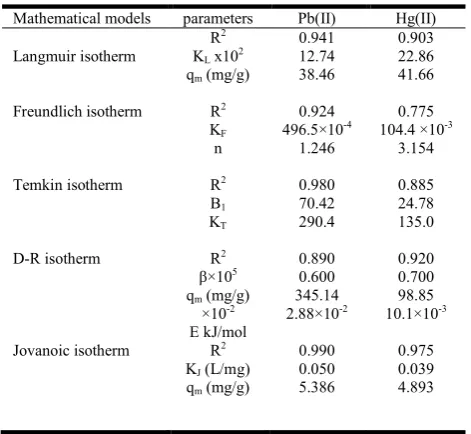
[image:7.595.62.270.181.351.2]Table 4, the correlation coefficients showed that the Temkin and Jovanoic model was the best fitted in five isotherm models. Langmuir, Freundlich and Dubinin–Radushkevich models were not very good. The Jovanoic isotherm model was well described in Pb(II) onto PFCR. The maximum amount adsorbed was 5.386 mg/g for Pb(II).
Fig.10.Temkin isotherm plots for the adsorption the of Hg(II) and Pb(II) onto PFCR
Fig.11. Jovanoic isotherm plots for adsorption of Hg(II) and Pb(II) onto PFCR
Kinetic Studies
Designing of adsorption treatment systems requires knowledge of kinetic processes due to the many varied chemical systems, the nature of different adsorbents, and the different designs of contacting systems. For that reason, three liquid-phase adsorption kinetic models are available, namely the Lagergren pseudo-first order, pseudo-second order model and intraparticle diffusion models.
Pseudo-first order model
The Lagergren rate equation is one of the most widely used adsorption rate equations for the adsorption of solute from a
liquid solution. The pseudo-first order kinetic model can be expressed by the following equation (Lagergren, 1898).
ln (qe-qt) = ln qe – k1t ……… (11)
Where qe and qt refer to the amount of metals adsorbed (mg/g)
at equilibrium and at any time, t (min), respectively, and k1 is
[image:7.595.316.552.185.402.2]the equilibrium rate constant of pseudo-first order sorption (1/min).
Table 4. Different adsorption isotherm model parameters for the adsorption of Pb(II) and Hg(II) on PFCR
Mathematical models parameters Pb(II) Hg(II)
Langmuir isotherm
R2 KL x102 qm (mg/g)
0.941 12.74 38.46
0.903 22.86 41.66
Freundlich isotherm R2 KF
n
0.924 496.5×10⁻⁴
1.246
0.775 104.4 ×10⁻³
3.154
Temkin isotherm R2 B1 KT
0.980 70.42 290.4
0.885 24.78 135.0
D-R isotherm R2
β×105 qm (mg/g)
×10-2 E kJ/mol
0.890 0.600 345.14 2.88×10⁻²
0.920 0.700 98.85 10.1×10⁻³
Jovanoic isotherm R2 KJ (L/mg) qm (mg/g)
0.990 0.050 5.386
0.975 0.039 4.893
The slope and intercept of the plot of log (qe − qt) versus t are
used to determine the first order rate constant, k1. It was found
that the correlation coefficient (R2) had low value (<97%). The pseudo-first order model is inapplicable to describe the kinetics of Hg(II) and Pb(II) by adsorption using PFCR adsorbents.
Fig.12. Pseudo-second order kinetic plots for adsorption of Pb (II) and Hg (II) onto PFCR
Pseudo-second order model
The pseudo-second order model is expressed as (Ho and Mckay, 1999):
e e
t q
t + q K = q
t
2 2
1
[image:7.595.63.267.388.557.2] [image:7.595.329.534.486.649.2]
Where, k2 (g/mg/min) is the second order rate constant of
adsorption. The plot of t/qt versus t shows a linear relationship.
Values of k2 and equilibrium adsorption capacity qe were
calculated from the intercept and slope of the plot shown in Fig.12. The values of R2 were greater than 0.983 for Hg (II) ion concentrations.
Intraparticle diffusion model
The intraparticle diffusion model (Mckay et al., 1983) was used to identify the diffusion mechanism during adsorption process. It is described using the following equation
qt = kidt 0.5
+ C ………...(13)
Where, kid (mg g-1min-0.5) is the rate constant of the
intraparticle diffusion model and C (mg/ g) reflects the boundary layer effect. The kid and C can be determined from
the slope and intercept of the linear plot of qt against t0.5. The
pseudo-first order, pseudo-second order and intraparticle diffusion models were used to understand the kinetic nature of Pb(II) and Hg(II) onto PFCR adsorption system. All the values are presented in Table 5. All the experimental data showed better agreement with pseudo-second order model in terms of higher correlation coefficient value (R2 >0.983), which suggested the adsorption rate of Hg(II) onto PFCR might be controlled by chemisorptions mechanism. The rate controlling step consisted valence forces through sharing or exchange of electrons between the adsorbent surface and adsorbate ions and no involvement of mass transfer in solution. The value of pseudo-second order rate constant, k2, was 3.150 g/mg/min for
[image:8.595.301.565.198.594.2]Pb (II) was and 6.875 g/mg/min for Hg (II).
Table 5. Kinetic parameters for the adsorption of Pb(II) and Hg(II) on PFCR
Mathematical models parameters Pb(II) Hg(II) First order kinetics R2
k1 (min-1) qe (mg/g)
0.019 0.002 889.2
0.392 0.190 2.238 Second order kinetics
R2 k2 g/mg/min×10-3
qe (mg/g)
0.416 3.150 200
0.983 6.875 30.30 Intra particle diffusion R2
kid g/mg/min1/2 C (mg/g)
0.887 21.10 100.1
0.903 14.27 56.34
Effect of temperature and thermodynamic data
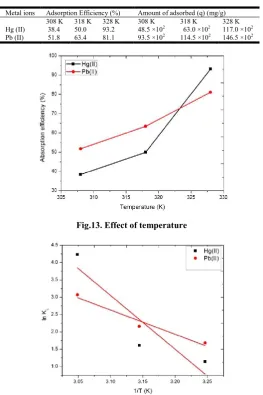
The adsorption tests were performed by batch technique in single system at 308 K, 318 K, and 328 K, respectively. For kinetic studies, a series of 250 ml flasks were used and each flask was filled with PFCR at mass loadings 0.080 g for both Pb(II) and Hg(II) solution at 10 ppm metal solutions. The percentage removal of Pb(II) and Hg(II) are presented in Table 6 and Fig.13. The frequently used thermodynamic parameters assessed in this study are: change in Gibbs free energy (ΔGo), isosteric heat of adsorption (ΔHo) and the change in entropy (ΔSo) using VantHoff plot (Fig.14). The parameters are assessed using the equations (Biswas et al., 2007).
e e L
C q = K
……… (14)
ΔG˚ = -RT ln KL ……… (15)
RT ΔH R ΔS = KL
0 0
ln ……… (16)
Where, KL is the Langmuir constants; Ce is the concentration
of solute adsorbed on the resin at equilibrium, mg/ L. where R (8.314 J/mol K) is the gas constant, T (K) is the absolute temperature. The correlation coefficient for the linear plot for Pb (II) and Hg (II) was R2 = 0.962 and R2 = 0.848 respectively. Values of the standard Gibbs free energy change for the adsorption process obtained from Eq. (15) were listed in Table 7.
Table 6. Effect of temperature
Metal ions Adsorption Efficiency (%) Amount of adsorbed (q) (mg/g)
308 K 318 K 328 K 308 K 318 K 328 K
Hg (II) 38.4 50.0 93.2 48.5 ×10² 63.0 ×10² 117.0 ×10² Pb (II) 51.8 63.4 81.1 93.5 ×10² 114.5 ×10² 146.5 ×10²
Fig.13. Effect of temperature
Fig.14. Van’t Hoff plots of ln KL versus 1/T for the adsorption of Hg(II) and Pb(II) onto PFCR
It is well known that these parameters can evaluate the orientation and feasibility of the physicochemical adsorptive reaction. The negative adsorption standard free energy changes
Table 7. Thermodynamic parameters for the adsorption of Pb(II) and Hg(II) on PFCR
Dyes
Thermodynamics parameters
R2 ΔH˚ J/mol ΔS˚ J/mol K -ΔG˚(kJ/mol)
Hg(II) 0.848 128.7 424.5
308K 318K 328K
2920.9 4254.9 11538.8
Pb(II) 0.962 58.09 201.9 4305.5 5711.4 8371.8
[image:8.595.48.279.444.550.2](ΔG˚) at all temperatures indicated that the adsorption of Pb(II) and Hg(II) on PFCR was a general spontaneous process. In addition, the positive enthalpy change (ΔH˚) values indicated that the Pb(II) and Hg(II) adsorption on PFCR was an endothermic process. The positive value of the (ΔS˚) implies the increment of an orderliness between the adsorbate and the adsorbent molecules.
Conclusion
In this study, PFCR composite was prepared, characterized and used as a bioadsorbent. PFCR has higher adsorption capacity for Hg(II) and Pb(II) due to the introduction of β-cyclodextrin. The adsorption of Hg(II) and Pb(II) onto PFCR followed Jovanoic isotherm and was spontaneous and endothermic in nature. Batch adsorption experiments showed that the adsorption process followed the pseudo-second-order kinetic model. The novel PFCR can be utilized as an environment-friendly bioadsorbent for the removal of metals from aqueous solution due to the efficient and fast adsorption process, as well as simple and convenient separation.
REFERENCES
Albert, M., Demesmay, C., and Rocca, J.L., 1995.Analysis of organic and nonorganic arsenious or selenious compound by capillary electrophoresis, Fresenius. J.Anal.
Chem., 351: 126-432
Aroua, M.K., Leong, S.P.P., Teo, L.Y., Yin, C.Y., and Daud, W.M.A.W., 2008. Real-time determination of kinetics of adsorption of lead(II) onto palm shell-based activated carbon using ion selective electrode, Bioresour.
Technol., 99(13): 5786-5792
Badruddoza, A. Z. M., Tay, A. S. H., Tan, P. Y., Hidajat, K., and Uddin, M. S., 2011.Carboxymethyl-β-cyclodextrin conjugated magnetic nanoparticles as nano-adsorbents for removal of copper ions: synthesis and adsorption studies. J.Hazard.Mater.,185(2- 3): 1177-1186. Balaria, A., Schiewer, S., and Schiewer, S.2008. Assessment
of biosorption mechanisms for Pb binding by citrus pectin, Sep. Purif. Technol., 63: 577-581
Biswas, K., Saha, S.K., and Ghosh, V.C.,2007. Adsorption of Fluoride from Aqueous Solution by a Synthetic Iron(III)−Aluminum(III) Mixed Oxide, Ind. Eng. Chem.
Res., 46(16): 5346- 5356
Crini, G.,2005. Recent developments in polysaccharide-based materials used as adsorbents in wastewater treatment,
Progress in Polymer Science. 30(1): 38-70
Crini, G., and Peindy, H. N.2006. Adsorption of C.I. Basic Blue 9 on cyclodextrin-based material containing carboxylic groups, Dyes and Pigments., 70(3): 204-211 Denizli, A., Senal, S., Alsancak, G., Tuzmen, N.,and Say, R.
2003.Mercury removal from synthetic solutions using poly(2-hydroxyethylmethacrylate) gel beads modified with poly(ethyleneimine), React. Funct. Polym., 55(2): 121-130. Dubinin, M.M., and Radushkevich, L.V.1947.Equation of the Characteristic Curve of Activated Charcoal, Proc. Acad.
Sci, USSR., 55: 331-333
Feng, Y., Gong, J. L., Zeng, G. M., Niu, Q. Y., Zhang, H. Y., and Niu, C. G., 2010.Adsorption of Cd (II) and Zn (II) from aqueous solutions using magnetic hydroxyapatite nanoparticles as adsorbents,Chem. Eng. J.,162:487-494
Foo, K.Y., and Hameed, B.H., 2010.Insights into the modeling of adsorption isotherm systems, Chem. Eng. J., 156(1):2-10
Guo, Y., Qi, J., Yang, S., Yu, K., Wang, Z., and Xu, H.2002. Adsorption of Cr (VI) on micro-and mesoporous rice husk-based activated carbon, Mat. Chem. Phys., 78: 132-137
Gupta, N ., Kushwaha, A.K.,and Chattopadhyaya, M.C. 2012. Adsorptive removal of Pb2+, Co2+ and Ni2+ by hydroxyapatite/chitosan composite fro m aqueous solution, J.Taiwan. Instit. Chem.Eng., 43(1): 125-131
Gupta, V.K., Jain, R., Mittal, A., Mathur, M., and Sikarwar, S., 2007. Photochemical degradation of the hazardous dye Safranin-T using TiO2 catalyst, J.Colloid and Interface
Sci,. 309(2): 464-469.
Hall, K.R., Eagleton, L.C., Acrivos, A., and Vermilion, T., 1966. Pore- and Solid-Diffusion Kinetics in Fixed-Bed Adsorption under Constant-Pattern Conditions,
Ind.Eng.Chem.Fund., 5(2): 212-223.
Ho, Y.S., and Mckay, G., 1999. Pseudo-second order model for sorption processes, Process Biochem., 34: 451-465 Ireland, M.P., 1991. Biological Monitoring of Heavy Metals,
Wiley, New York.
Jovanoic, D.S., 1969. Physical adsorption of gases, Colloid.
Polym. Sci.,235(1): 1203-1213.
Lagergren, S., 1898. Zur theorie der sogenannten adsorption gelöster stoffe,
Kungliga Svenska Vetenskaps-Akademiens Handlingar, 24
(4):1-39
Mahlambi, M. M., Malefetse, T. J, Mamba, B. B., and Krause, R.W., 2010. β-Cyclodextrin-ionic liquid polyurethanes for the removal of organic pollutants and heavy metals from water: synthesis and characterization,
J.Poly.Resear., 17: 589-600.
Martins, B.L., Cruz, C.C.V., Luna, A.S., and Henriques C.A.2006. Sorption and desorption of Pb2+ ions by dead Sargassum sp. Biomass, Biomass.Biochem. Eng.J., 27(3): 310-314
Mckay, G., Blair, H.S., and Gardner, J.1983. The adsorption of dyes in chitin. III. Intraparticle diffusion processes, J.
Appl. Polym. Sci., 28(5): 1767-1778
Merzouka, B., Gourich, B., Sekki, A., Madani, K., and Chibane, M.2008. Removal turbidity and separation of heavy metals using electrocoagulation-electroflotation technique A case study,
J. Hazard. Mater. 164(1):215-220.
Meunier, N., Drogui, P., Montan´e, C., Hausler, R., Mercier, G., and Blais J.F., 2006. Comparison between electrocoagulation and chemical precipitation for metals removalfrom acidic soil leachate. J.Hazard. Mater.B
137: 581-590
Mittal, A, Gupta, V, Malviya, A., and Mittal, J.2008. Process development for the batch and bulk removal and recovery of a hazardous, water-soluble azo dye (Metanil Yellow) by adsorption over waste materials (Bottom Ash and De-Oiled Soya). J. Hazard. Mater.151(2–3): 821-832.
Ngah, W.S. W., Endud, C.S. and Mayanar, R.2002. Removal of copper(II) ions from aqueous solution onto chitosan and cross-linked chitosan beads, React. Funct. Polymer.
50: 181-190
Norkus, E., 2009. Metal ion complexes with native cyclodextrins. An overview, J. Inclu. Phenomena and
Macro. Chem., 65(3-4): 237-248.
Nuhoglu, Y., Malkoc, E., Guurses, A., and Canpolat, N. 2002. The removal of Cu(II) from aqueous solutions by
Ulothrix zonata, Bioresour. Technol., 85(3): 331-333
Szejtli, J. 1998. Introduction and General Overview of Cyclodextrin Chemistry. Chemical Reviews., 98(5): 1743-1754
Temkin, M.J., and Pyzhev, V. 1940. Kinetics of Ammonia Synthesis on Promoted Iron Catalysts. Acta Physicochim Acta. Physiochim URSS., 12: 217-222