EFFECT OF LIME AND PALM KERNEL SHELL ASH ON THE STABILIZATION OF
*Ikeagwuani, Chijioke Christopher
Department of Civil Engineering, University of Nigeria, Nsukka, Enugu State, Nigeria
ARTICLE INFO ABSTRACT
The need to stabilize expansive soils such as black cotton soil in deleterious property of swelling and
effectively utilized as subgrade it has to be stabilize So to attempt stabilizing the
study the potential of stabilizing with the l and 20% of palm
percentage at 4% for all mix ratios. Experimental tests Atterberg’s limits, specific
(CBR). The result obtained after the experiment showed that there was a the value obtained for the CBR value while
density obt
Copyright © 2015 Ikeagwuani et al. This is an open access article distributed under the Creative Commons Att distribution, and reproduction in any medium, provided the original work is properly cited.
INTRODUCTION
Due to the increasing high cost of additives such as
lime and bitumen in the stabilization of soils the world over, researchers are now constantly seeking to evolve new additive which are readily and easily available for the stabilization of soil especially soils that are expansive. Examples of such expansive soils are the black cotton soil. Black cotton soil is expansive clay with the deleterious property of shrinking and swelling depending on the variability of the moisture content present in the soil. With an increase in the available moisture content, the soil could expand excessively and contract when the soil begins to lose the moisture content present in it. This is because the black cotton soil contains inorganic clay of medium to high compressibility and this adversely affects the strength of the black cotton soil. Black cotton soils are known to be rich in montmorillonite which enables them to absorb
large volume of water (Shamrani et al., 2010;
causing the excessive swelling and shrinking with respect to changes in the moisture content. They are black in colour and are found in clays exist in North-East Nigeria, India, USA and
other parts of the world (Oyekan and Meshida, 2013
black cotton soil to be used as a subgrade material in highway construction, the soil has to be stabilized so as not to result in
heavy distress to engineering construction (Ameta
*Corresponding author: Ikeagwuani,
Department of Civil Engineering, University of Nigeria, Nsukka, Enugu State, Nigeria.
ISSN: 0975-833X
Vol.
Article History:
Received 09th August, 2015
Received in revised form 23ed September, 2015
Accepted 10th October, 2015
Published online 30th November,2015
Key words:
Black cotton soil, Lime, Stabilization, Palm kernel shell ash,
California bearing ratio.
Citation:Ikeagwuani, Chijioke Christopher, Nwoji Ugochukwu Clifford and Ekwuilo Kingsley Ikechukwu
kernel shell ash on the stabilization of black cotton soil”,
RESEARCH ARTICLE
EFFECT OF LIME AND PALM KERNEL SHELL ASH ON THE STABILIZATION OF
BLACK COTTON SOIL
Ikeagwuani, Chijioke Christopher, Nwoji Ugochukwu Clifford and Ekwuilo Kingsley Ikechukwu
Department of Civil Engineering, University of Nigeria, Nsukka, Enugu State, Nigeria
ABSTRACT
The need to stabilize expansive soils such as black cotton soil in
deleterious property of swelling and shrinking cannot be fully overemphasized. For the soil to be effectively utilized as subgrade it has to be stabilized and more importantly
to attempt stabilizing the black cotton soil, this research uses palm kernel
study the potential of stabilizing with the locally available material. For this investigation and 20% of palm kernel shell ash was added by weight of the black cotton soil while keeping percentage at 4% for all mix ratios. Experimental tests conducted in
Atterberg’s limits, specific gravity, differential free swell, compaction and California bearing (CBR). The result obtained after the experiment showed that there was a
the value obtained for the CBR value while there was a significant dropped in the maximum dry density obtained from the result of the compaction test carried out.
is an open access article distributed under the Creative Commons Attribution License, which distribution, and reproduction in any medium, provided the original work is properly cited.
Due to the increasing high cost of additives such as cement, lime and bitumen in the stabilization of soils the world over, researchers are now constantly seeking to evolve new additive which are readily and easily available for the stabilization of soil especially soils that are expansive. Examples of such expansive soils are the black cotton soil. Black cotton soil is expansive clay with the deleterious property of shrinking and swelling depending on the variability of the moisture content present in the soil. With an increase in the available moisture ent, the soil could expand excessively and contract when the soil begins to lose the moisture content present in it. This is because the black cotton soil contains inorganic clay of medium to high compressibility and this adversely affects the Black cotton soils are known to be rich in montmorillonite which enables them to absorb
., 2010; Osinubi, 2006) causing the excessive swelling and shrinking with respect to changes in the moisture content. They are black in colour and East Nigeria, India, USA and
Oyekan and Meshida, 2013) For the
to be used as a subgrade material in highway construction, the soil has to be stabilized so as not to result in
Ameta et al., 2007).
Department of Civil Engineering, University of Nigeria, Nsukka,
Different types of additive have long been used towards stabilizing the problematic black cotton soil. The most recent method in the stabilization of black cotton soil i
the additive known as Envirobase. Pramod
showed from their work that the California bearing ratio of the black cotton soil improved significantly when the envirobase was added to the soil.
Other additives that have been used in
the engineering properties of black cotton soil include the use
of fly-ash (Erdal, 2001; Pandian
Radhey, 2004; Pankaj et al., 2012 Nagakumar, 2014; Osinubi et al
Groundnut shell ash (Oriola and Moses, 2010
regarded as waste and are therefore relatively inexpensive to obtain. In the results obtained from the additive used for the stabilization of black cotton soil, fly
significant improvement in the stabilization of black cotton soil while the baggase ash did not improve the engineering properties of the black cotton soil. However, with a longer curing period, the baggase ash was found to show progressive strength development of the black cotton soil
Moses, 2010).
To further advance the course of using inexpensive and locally available material to stabilize black cotton soil; this research explored the use of palm kernel shell mixed with lime for t stabilization of black soil.
International Journal of Current Research
Vol. 7, Issue, 11, pp.22528-22532, November, 2015
INTERNATIONAL
Christopher, Nwoji Ugochukwu Clifford and Ekwuilo Kingsley Ikechukwu kernel shell ash on the stabilization of black cotton soil”, International Journal of Current Research, 7, (11),
EFFECT OF LIME AND PALM KERNEL SHELL ASH ON THE STABILIZATION OF
and Ekwuilo Kingsley Ikechukwu
Department of Civil Engineering, University of Nigeria, Nsukka, Enugu State, Nigeria
The need to stabilize expansive soils such as black cotton soil in order to mitigate the inherent shrinking cannot be fully overemphasized. For the soil to be importantly at a relatively cheap cost. this research uses palm kernel shell ash and lime to material. For this investigation, 0, 4, 12, 16 shell ash was added by weight of the black cotton soil while keeping the lime conducted in this research includes: free swell, compaction and California bearing ratio (CBR). The result obtained after the experiment showed that there was a marginal improvement in there was a significant dropped in the maximum dry from the result of the compaction test carried out.
ribution License, which permits unrestricted use,
Different types of additive have long been used towards stabilizing the problematic black cotton soil. The most recent method in the stabilization of black cotton soil is the used of
Envirobase. Pramod et al. (2015)
showed from their work that the California bearing ratio of the black cotton soil improved significantly when the envirobase
Other additives that have been used in recent past to improve the engineering properties of black cotton soil include the use
Erdal, 2001; Pandian et al., 2002; Phanikumar and ., 2012) Baggase ash (Prakash and
et al., 2009; Kiran and Kiran, 2013)
Oriola and Moses, 2010) which are all
regarded as waste and are therefore relatively inexpensive to obtain. In the results obtained from the additive used for the stabilization of black cotton soil, fly-ash and baggase ash show significant improvement in the stabilization of black cotton soil while the baggase ash did not improve the engineering properties of the black cotton soil. However, with a longer curing period, the baggase ash was found to show progressive
ngth development of the black cotton soil (Oriola and
To further advance the course of using inexpensive and locally available material to stabilize black cotton soil; this research explored the use of palm kernel shell mixed with lime for the
INTERNATIONAL JOURNAL OF CURRENT RESEARCH
Palm Kernel shell
Palm kernel shell is the by-product of the combustion of palm kernel shells under a controlled temperature of between 600
and 800oC (Adetoro and Adekanmi, 2015). The palm kernel
shells are derived from the oil palm tree (Elaeis Guineensis) known for its economic value and it is native to western Africa but it has also spread to most equatorial tropics of south-east
Asia and America (Hartley, 1988; Luangkiattikhun et al., 2008)
In Nigeria, the oil palm tree generally grows in the rain forest region close to the coastal areas and adjacent to some inland waterways. The palm kernel shell is deposited in large quantities as wastes on production sites which cause not only environmental hazard but disposal problems. The most cultivated oil palm trees are the Dura and the Pisifera
(Okoroigwe and Saffron, 2012). According to Okoroigwe and
Saffron (2012) the Dura species has thick shell with thin
mesocarp while the pisifera species has thin shell but with thicker mesocarp. Palm kernel shell consists of 60-90% of
particles in the range of 5 – 12mm (Okafor, 1988). Figure 1
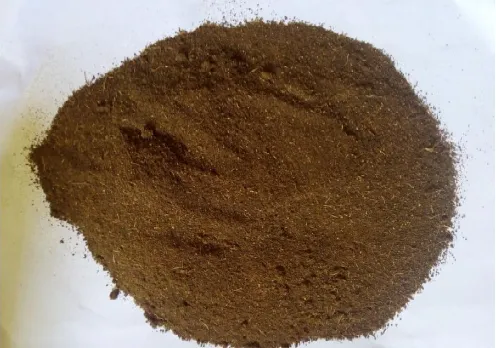
[image:2.595.41.289.307.481.2]shows the sample palm kernel shell used for the experiment.
Fig. 1. Palm kernel shell ash
MATERIALS AND METHODS
Materials
Black cotton soil
The black cotton soil was obtained from Numan in Adamawa
state, Nigeria. Numan is located at latitude 9o29’10’’N and
longitude 12o 02’36’’E of the Nigerian geographical map. The
collection of the sample was done through disturbed sampling method using the hand carved sample method. It was collected at a depth of between 0.4 to about 1.0m. This was done to avoid picking up any vegetative matter or debris. The sample was then placed in air-tight bags and taken to the geotechnical engineering section, Civil Engineering Laboratory, University of Nigeria.
At the laboratory the sample was pulverized using a hammer and index classification of the soil was made on the sample. The properties of the soil show that the soil can be classified as A-7-6 using the AASHTO classification system. Also the oxide composition of the soil was also carried on the soil as shown in the Table 1.
Palm kernel Shell ash
Palm Kernel shells (PKS) used in this investigation were obtained from Nsukka local government area, Nigeria where
the mean annual rainfall of 1,981mm (Anyadike, 1992) favours
commercial oil palm production in the area as is common within Southern Nigeria. The sample used was a mixture of palm kernel shells from Dura and Pisifera species since the varieties are not usually sorted during palm oil processing
(Okoroigwe and Saffron, 2012). Prior to experimentation, the
PKS were washed, sun dried in open air at ambient temperature
of 31oC. They were transferred into cellophane bags, sealed
and then taken to a milling machine where it was crushed mechanically. The crushed particles were later burnt using open air burning and the resulting ash was passed through sieve 75μm.
Lime
The lime used for this investigation is calcium oxide commonly called quick lime. It is colourless, odourless, white or gray cubic crystalline solid produced by heating limestone, coral or
chalk at a temperature of about 500 – 600oC to drive of
carbondioxide. There are basically five types of lime but the quick lime is more effective as a stabilizer. The amount of lime required for stabilization varies between 2 to 10% and lime normally react chemically with available silica and alumina in soils (Arora, 2003).
Methods
The various test carried out in this investigation for the determination of geotechnical properties of soils were Atterberg’s limit, specific gravity, compaction and California bearing ratio which were all in accordance with the method described by B, 1377. The palm kernel shell ash was added by weight of the soil sample while keeping the lime at 4 percent for all mix ratios.
Atterberg Limit
The Atterberg’s limits comprises liquid limit test, plastic limit test and shrinkage limit. The Atterberg’s limits of the natural Black cotton soil were carried out in this investigation. It enables us to determine the consistency of a soil whether it is soft, firm or hard. The consistency of fine-grained soil is the
physical state in which the soil exists (Arora, 2003). The Liquid
and plastic limits obtained from Atterberg’s limits test is used for the determination of the plasticity index of the soil sample. The plasticity index is obtained by subtracting the plastic limit from the liquid limit.
Table 1. Oxide composition Black cotton soil
Oxides SiO2 Al2O3 SO3 P2O5 Na2O K2O CaO MgO TiO2 Fe2O3 MnO L.O.I
[image:2.595.75.518.712.787.2]Chemical composition (%) 56.70 11.00 <0.001 <0.001 2.12 1.52 3.83 1.70 2.59 17.02 0.23 3.18
Table 2. Oxide composition of palm kernel shell ash
Oxides SiO2 Al2O3 P2O5 SO3 Na2O K2O CaO MgO TiO2 MnO Fe2O3 L.O.I
Both the liquid limit and the plasticity index are used for the classification of fine-grained soil. Based on the plasticity index, Atterberg classified soil as shown in Table 3.
Table 3. Atterberg classification of soil based on plasticity index
Plasticity index Plasticity
0 Non-plastic
<7 Low plastic 7-17 Medium plastic >17 Highly Plastic Source: Ramamurthy and Sitharam (2010)
Differential free swell
Differential free swell (DFS) test was carried out for the determination of the expansiveness of the soil. IS 2911 (Part 3)-1980 method for the determination of the differential free swell of the sample was used in this study. DFS of the natural BCS and that of optimum mix for BCS + PKSA + lime were conducted.
Compaction characteristics
Compaction is usually carried out to improve the engineering properties of the soil by expelling air from the void spaces in the soil sample and this helps to lower compressibility and reduces the permeability of the soil.
The compaction experiment in this investigation is carried out
in accordance with (B. 1377). The compaction test of the
natural black cotton soil was first carried and that of the various mix ratios was later done. All compaction experiment was done using the British standard light compaction.
California bearing ratio
The California bearing ratio (CBR) test was carried out in accordance with BS 1377 with slight modification to conform
to the Nigeria general specification works (FWW, 1997) which
states that soaked CBR sample has to be cured for four days before testing. The soaked and Unsoaked CBR for the natural black cotton soil was carried and that of the various mix ratios was also done.
RESULTS AND DISCUSSION
Preliminary test result for the natural black cotton soil
The results of the preliminary tests carried out on the natural black cotton are shown in table 4. Classification of the black cotton soil was done using both the American Association of Highway and Testing Organization (AASHTO) and Unified Soil Classification System (USCS). Specific gravity of the natural black cotton soil was found to be 2.75. The soil also has a high plasticity index of 26.1 and free swell index of 70% indicating clearly that the soil is weak with poor engineering properties and thus not suitable as subgrade material.
COMPACTION CHARACTERISTICS
a. Variation of the maximum dry density with mix ratios
Figure 2 shows that there was a gradual reduction in the
maximum dry density from 1.73 g/cm3 to1.45g/cm3 upon the
increase in the quantity of the palm kernel shell ash added to the BCS. The natural black cotton soil has indicated in Table 1
has a higher maximum dry density of 1.81 g/cm3.
[image:3.595.310.557.184.470.2]The progressive reduction in the maximum dry density is as a result of the increase in the fine particles which led to an increase in void ratio thereby forming a weak bond between the black cotton soil and the palm kernel shell ash. This ultimately led to a reduction in the maximum dry density of the mix ratio.
Fig. 2. Relationship between the maximum dry density and mix ratios
b. Variation of the optimum moisture content with mix ratio
Figure 3 shows the relationship that exists between the palm kernel shell ash and the mix ratio. From figure 3 it can seen that there was an increase in the optimum moisture content
Fig. 3. Relationship between optimum moisture content and mix ratio
Table 4. Characteristics of black cotton soil
S.No. Characteristics Value 1 Bulk Density 2.0g/cm3
2 Maximum Dry Density (MDD) 1.8g/cm3
3 Liquid limit 52%
4 Plastic limit 25.9%
5 Plasticity Index 26.1 6 Specific Gravity 2.75 7 Optimum Moisture Content 11.2%
8 CBR (soaked) 1.5
9 CBR (Unsoaked) 3.2
9 AASHTO Classification A-7-5 10 USCS Classification CH 11 Natural Moisture Content 5.64% 12 Free Swell index 70%
[image:3.595.313.555.186.475.2] [image:3.595.308.559.587.732.2]CALIFORNIA BEARING RATIO
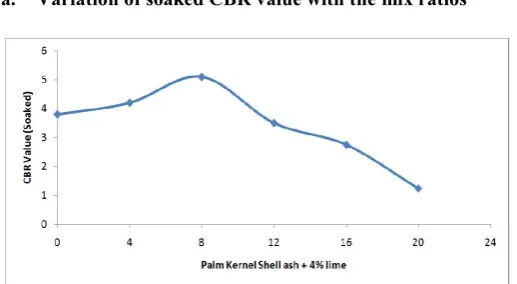
Figures 4 and 5 show the variation of the both the soaked and Unsoaked CBR respectively. The result obtained for both soaked and unsoaked CBR indicates that there was an initial increase in the CBR value till it got to 8%PKSA+ 4%lime before the progressive reduction in the CBR value. The initial increase could be attributed to the slight but quick pozzolanic reaction that took place between the lime and the soil and not the palm kernel shell ash but as the palm kernel shell content increases the cementitious relationship that was hitherto built up initially began to fade away which does affected the CBR value leading to the drop noticeable in the CBR value for both soaked and unsoaked CBR.
[image:4.595.35.294.233.375.2]a. Variation of soaked CBR value with the mix ratios
Fig. 4. Relationship between the Soaked CBR value and mix ratios
b. Variation of the unsoaked CBR value with the mix
[image:4.595.38.289.406.579.2]ratios
Fig. 5. Relationship unsoaked CBR and mix ratios
Conclusion
From the foregoing the following conclusions can be drawn
1. The introduction of lime and palm kernel shell ash in the
natural soil will cause a reduction in maximum dry density and increasing the optimum moisture content of the composite mixture.
2. The maximum value of CBR value 10.2% (unsoaked) and
5.1% (soaked) was gotten when the natural soil (black cotton soil) was mix 4%lime and 8%pksa by weight.
It is recommended that it should be stabilized with a more portend stabilizer for effective result
REFERENCES
Adetoro A. E. and S. J. Adekanmi, "Potentials Of Palm Kernel Shell And Sawdust Ashes For Stabilization Of Gbonyin Local Government Area Soil, Nigeria," Journal of
Multidisciplinary Engineering Science and Technology,
vol. 2, no. 8, pp. 2315-2319, August 2015.
Ameta N. K., D. G. M. Purohit and A. S. Wayal, "Characteristics, Problems and Remedies of Expansive Soil of Rathastan, India," EGJE, 2007.
Anyadike, R. N. "Regional Variations in Fluctuation of seasional rainfall over Nigeria," Theor. Appl. Climatol., vol. 45, pp. 285-292, 1992.
Arora, K. R. Soil Mechanics and Founation Engineering, 6th ed., Nai Sarak, Delhi: Standard Publishers Distributors, 2003.
B. 1377, "Methods of testing soils for Civil Engineering Purposes," British Standard Institute, London, 1990. Erdal, C. "Use Of Class C Fly Ashes for the Stabilization – of
an Expansive Soil," Journal of Geotechnical and
Geoenvironmental Engineering, vol. 127, pp. 568-573, July
2001.
Hartley, C. W. S. The Oil Pal, 3rd edition ed., New york: Longman Scientic & Technical, 1988.
Kiran R. G. and L. Kiran, "Analysis Of Strength Characteristics Of Black Cotton Soil Using Bagasse Ash," International Journal of Engineering Research &
Technology, vol. 7, no. 2, pp. 2240-2246, July 2013.
Luangkiattikhun P., C. Tangsathitkulchai and M.
Tangsathitkulchai, "Non-isothermal Thermo-gravimetric
Analysis of Oil-palm solid wastes," Bioresource
Technology, vol. 99, pp. 986-997, 2008.
O. K. J., "Influence of compactive efforts on lime-slag treated tropical black clay," American Society of Engineers. J.
Mater. Civil Eng., pp. 175-181, 2006.
Okafor, F. O. "Palm Kernel Shell as a lightweight Aggregate for Concrete," Cement and Concrete Research, vol. 18, no. 6, pp. 901-910, 1988.
Okoroigwe E. C. and C. M. Saffron, "Determination of Bio-Energy Potential of Palm Kernel Shell by Physicochemical Characterization," Nigeria Journal of Technology, vol. 31, no. 3, pp. 329-335, 2012.
Oriola F. and G. Moses, "Groundnut Shell Ash Stabilization of Black Cotton Soil," EGJE, vol. 15, no. Bund E, pp. 415-428, 2010.
Osinubi K. J., T. S. Ijimdiya and I. Nmadu, "Lime Stabilization of Black Cotton Soil Using Bagasse Ash as Admixture,"
Advanced Materials Research, Vols. 62-64, pp. 3-10, Feb.
2009.
Oyekan G. L. and E. A. &. O. A. O. Meshida, "Effect of ground polyvinyl waste on the strength characteristics of black cotton clay soil," Journal of Engineering and
Manufacturing Technology, pp. 1-10, 2013.
Pandian N. S., K. C. Krishna and B. Leelavathamma, "Effect of Fly Ash on the CBR Behaviour of Soils," in Indian Geotechnical Conference, Allahabad, 2002.
Admixtures," International Journal of Engineering and
Innovative Technology, vol. 1, no. 5, pp. 1-5, May 2012.
Phanikumar B. R. and S. S. Radhey, "Effect of flyash on Engg properties of Expansive Soil," Journal of Geotechnical and
Geoenvironmental Engineering, vol. 130, no. 7, pp.
764-767, 2004.
Prakash C. and M. S. Nagakumar, "Studies on Soil Stabilization by using bagasse ash," in Conference Proceeding, 30-31 August, 2014, India, 2014.
Pramod K., A. Tanveer, B. Dorothy, K. Nitesh and S. Yasaswini, "Stabilization Of Black Cotton Soil Using Envirobase And Sodium Silicate With Lime," International
Journal of Scientific & Technology Research, vol. IV, no.
06, pp. 344-348, June 2015.
Ramamurthy T. N. and T. G. Sitharam, Geotechnical Engineering (Soil NMechanics), 3rd revised ed., New Delhi: S. Chand & Company Ltd, 2010.
Shamrani M. A., E. Mutaz and A. J. &. D. M. A. Puppala, "Characterization of problematic expansive soils from mineralogical and swell characterization studies.," in ASCE Conf. Proc. 365, 78., 2010.