RESEARCH ARTICLE
PERFORMANCE ANALYSIS OF IMAGE SUPER RESOLUTION USING WAVELETS TRANSFORM
BASED ON SAMPLING
*Vasavi Sai Prasanna, L., Balaji, V. and Srinivasa Reddy, E.
Department of Computer Science & Engineering, College of Engineering and Technology, Acharya Nagarjuna
University, Guntur, AP, India
ARTICLE INFO ABSTRACT
Super resolution is astoundingly significant and captivating zone of examination for image planning applications in light of wavelet change. Stationary Wavelet Transform (SWT) and Discrete Wavelet change (DWT) are utilizing as a part of our proposed work for actualizing the Super Resolution of the specific picture. In for the most part Single frame super resolution can be refined by utilization of various extension strategies like interpolation in any case this technique doesn't give precise result at edges, means here edges are getting with blur. Consequently this paper we are taking the samples from the pictures after that we are applying Discrete wavelet change (DWT) and Stationary wavelet Transform (SWT), then we are applying the wavelet filters on that super resolved image. For purpose of value part of the recently remade picture, for example, mean, variance, median, mode furthermore finding the MSE and PSNR.
Copyright©2016, Vasavi Sai Prasanna et al. This is an open access article distributed under the Creative Commons Attribution License, which permits unrestricted use, distribution, and reproduction in any medium, provided the original work is properly cited.
INTRODUCTION
The Method to remake a high resolution images assumes essential part in various, electronic applications as high resolution images are craved and frequently required. pixel density is high in high resolution images as it gives more subtle elements of data which is required in basic application, for example, medical diagnosis, satellite observation and mammography images. From 1970 onwards pictures were procured by a charge coupled device (CCD) or by CMOS innovation picture sensor which are financially savvy as contrast with various algorithms. So such a resolution upgrade of picture gets to be intriguing examination zone to specialists and researchers and it called super determination picture recreation. As of several previous new calculations have been suggested. one noteworthy methodology for single edge super determination in interjection in which high recurrence data is removed from low determination picture and predication is accomplished for detailed information in the HR image. They are some understood existing methodologies for the super resolution which relies on upon the standard presentation
*Corresponding author: Vasavi Sai Prasanna, L.
Department of Computer Science & Engineering, College of Engineering and Technology, Acharya Nagarjuna University, Guntur, AP, India.
techniques (pixel replication, bilinear, bicubic, linear interjection) that builds the pixel number without including the details. However, addition based super determination systems presented the obscure impact in edges. So there are diverse super resolution systems in context of different images to maintain a strategic distance from obscure in images. Generally, super resolution strategy can be isolated into three types: spatial area reconstruction, Frequency domain, and probability based methods, Tasi and Huang are the primary who made thought of super resolution utilizing frequency domain. Further work has proposed by Keren et al. who develophed a spatialdomain procedure to perform image registration using using a global translation and rotation model. The approach by Irani and peleg in remaking a high resolution images handles dynamic pictures of an object, and more mind boggling motions than unadulterated translational motion in the image plan. Their algorithm depends on creating an arrangement of reproduced low resolution images. The image contrasts between this arrangement of pictures and the genuine watched low-resolution images are back-projected utilizing a back-projected kernel, onto an initial estimation of the high-resolution image. Cohen, Arvin and Dinstein have implemented algorithm for remaking a high-resolution image. They have augmented Irani and Peleg's work, in which high resolution images is gotten by utilization of projection of every
ISSN: 0975-833X
International Journal of Current Research
Vol. 8, Issue, 08, pp.37084-37088, August, 2016
INTERNATIONAL JOURNAL OF CURRENT RESEARCH
Article History: Received 22ndMay, 2016 Received in revised form 28thJune, 2016 Accepted 15thJuly, 2016 Published online 31stAugust, 2016
Key words:
Super resolution, DWT and SWT, Interpolation, High Frequency (HF), Low Frequency (LF).
Citation: Vasavi Sai Prasanna, L., Balaji, V. and Srinivasa Reddy, E. 2016.“Performance analysis of image super resolution using wavelets transform based on sampling”,International Journal of Current Research, 8, (08), 37084-37088.
RESEARCH ARTICLE
PERFORMANCE ANALYSIS OF IMAGE SUPER RESOLUTION USING WAVELETS TRANSFORM
BASED ON SAMPLING
*Vasavi Sai Prasanna, L., Balaji, V. and Srinivasa Reddy, E.
Department of Computer Science & Engineering, College of Engineering and Technology, Acharya Nagarjuna
University, Guntur, AP, India
ARTICLE INFO ABSTRACT
Super resolution is astoundingly significant and captivating zone of examination for image planning applications in light of wavelet change. Stationary Wavelet Transform (SWT) and Discrete Wavelet change (DWT) are utilizing as a part of our proposed work for actualizing the Super Resolution of the specific picture. In for the most part Single frame super resolution can be refined by utilization of various extension strategies like interpolation in any case this technique doesn't give precise result at edges, means here edges are getting with blur. Consequently this paper we are taking the samples from the pictures after that we are applying Discrete wavelet change (DWT) and Stationary wavelet Transform (SWT), then we are applying the wavelet filters on that super resolved image. For purpose of value part of the recently remade picture, for example, mean, variance, median, mode furthermore finding the MSE and PSNR.
Copyright©2016, Vasavi Sai Prasanna et al. This is an open access article distributed under the Creative Commons Attribution License, which permits unrestricted use, distribution, and reproduction in any medium, provided the original work is properly cited.
INTRODUCTION
The Method to remake a high resolution images assumes essential part in various, electronic applications as high resolution images are craved and frequently required. pixel density is high in high resolution images as it gives more subtle elements of data which is required in basic application, for example, medical diagnosis, satellite observation and mammography images. From 1970 onwards pictures were procured by a charge coupled device (CCD) or by CMOS innovation picture sensor which are financially savvy as contrast with various algorithms. So such a resolution upgrade of picture gets to be intriguing examination zone to specialists and researchers and it called super determination picture recreation. As of several previous new calculations have been suggested. one noteworthy methodology for single edge super determination in interjection in which high recurrence data is removed from low determination picture and predication is accomplished for detailed information in the HR image. They are some understood existing methodologies for the super resolution which relies on upon the standard presentation
*Corresponding author: Vasavi Sai Prasanna, L.
Department of Computer Science & Engineering, College of Engineering and Technology, Acharya Nagarjuna University, Guntur, AP, India.
techniques (pixel replication, bilinear, bicubic, linear interjection) that builds the pixel number without including the details. However, addition based super determination systems presented the obscure impact in edges. So there are diverse super resolution systems in context of different images to maintain a strategic distance from obscure in images. Generally, super resolution strategy can be isolated into three types: spatial area reconstruction, Frequency domain, and probability based methods, Tasi and Huang are the primary who made thought of super resolution utilizing frequency domain. Further work has proposed by Keren et al. who develophed a spatialdomain procedure to perform image registration using using a global translation and rotation model. The approach by Irani and peleg in remaking a high resolution images handles dynamic pictures of an object, and more mind boggling motions than unadulterated translational motion in the image plan. Their algorithm depends on creating an arrangement of reproduced low resolution images. The image contrasts between this arrangement of pictures and the genuine watched low-resolution images are back-projected utilizing a back-projected kernel, onto an initial estimation of the high-resolution image. Cohen, Arvin and Dinstein have implemented algorithm for remaking a high-resolution image. They have augmented Irani and Peleg's work, in which high resolution images is gotten by utilization of projection of every
ISSN: 0975-833X
International Journal of Current Research
Vol. 8, Issue, 08, pp.37084-37088, August, 2016
INTERNATIONAL JOURNAL OF CURRENT RESEARCH
Article History: Received 22ndMay, 2016 Received in revised form 28thJune, 2016 Accepted 15thJuly, 2016 Published online 31stAugust, 2016
Key words:
Super resolution, DWT and SWT, Interpolation, High Frequency (HF), Low Frequency (LF).
Citation: Vasavi Sai Prasanna, L., Balaji, V. and Srinivasa Reddy, E. 2016.“Performance analysis of image super resolution using wavelets transform based on sampling”,International Journal of Current Research, 8, (08), 37084-37088.
RESEARCH ARTICLE
PERFORMANCE ANALYSIS OF IMAGE SUPER RESOLUTION USING WAVELETS TRANSFORM
BASED ON SAMPLING
*Vasavi Sai Prasanna, L., Balaji, V. and Srinivasa Reddy, E.
Department of Computer Science & Engineering, College of Engineering and Technology, Acharya Nagarjuna
University, Guntur, AP, India
ARTICLE INFO ABSTRACT
Super resolution is astoundingly significant and captivating zone of examination for image planning applications in light of wavelet change. Stationary Wavelet Transform (SWT) and Discrete Wavelet change (DWT) are utilizing as a part of our proposed work for actualizing the Super Resolution of the specific picture. In for the most part Single frame super resolution can be refined by utilization of various extension strategies like interpolation in any case this technique doesn't give precise result at edges, means here edges are getting with blur. Consequently this paper we are taking the samples from the pictures after that we are applying Discrete wavelet change (DWT) and Stationary wavelet Transform (SWT), then we are applying the wavelet filters on that super resolved image. For purpose of value part of the recently remade picture, for example, mean, variance, median, mode furthermore finding the MSE and PSNR.
Copyright©2016, Vasavi Sai Prasanna et al. This is an open access article distributed under the Creative Commons Attribution License, which permits unrestricted use, distribution, and reproduction in any medium, provided the original work is properly cited.
INTRODUCTION
The Method to remake a high resolution images assumes essential part in various, electronic applications as high resolution images are craved and frequently required. pixel density is high in high resolution images as it gives more subtle elements of data which is required in basic application, for example, medical diagnosis, satellite observation and mammography images. From 1970 onwards pictures were procured by a charge coupled device (CCD) or by CMOS innovation picture sensor which are financially savvy as contrast with various algorithms. So such a resolution upgrade of picture gets to be intriguing examination zone to specialists and researchers and it called super determination picture recreation. As of several previous new calculations have been suggested. one noteworthy methodology for single edge super determination in interjection in which high recurrence data is removed from low determination picture and predication is accomplished for detailed information in the HR image. They are some understood existing methodologies for the super resolution which relies on upon the standard presentation
*Corresponding author: Vasavi Sai Prasanna, L.
Department of Computer Science & Engineering, College of Engineering and Technology, Acharya Nagarjuna University, Guntur, AP, India.
techniques (pixel replication, bilinear, bicubic, linear interjection) that builds the pixel number without including the details. However, addition based super determination systems presented the obscure impact in edges. So there are diverse super resolution systems in context of different images to maintain a strategic distance from obscure in images. Generally, super resolution strategy can be isolated into three types: spatial area reconstruction, Frequency domain, and probability based methods, Tasi and Huang are the primary who made thought of super resolution utilizing frequency domain. Further work has proposed by Keren et al. who develophed a spatialdomain procedure to perform image registration using using a global translation and rotation model. The approach by Irani and peleg in remaking a high resolution images handles dynamic pictures of an object, and more mind boggling motions than unadulterated translational motion in the image plan. Their algorithm depends on creating an arrangement of reproduced low resolution images. The image contrasts between this arrangement of pictures and the genuine watched low-resolution images are back-projected utilizing a back-projected kernel, onto an initial estimation of the high-resolution image. Cohen, Arvin and Dinstein have implemented algorithm for remaking a high-resolution image. They have augmented Irani and Peleg's work, in which high resolution images is gotten by utilization of projection of every
ISSN: 0975-833X
International Journal of Current Research
Vol. 8, Issue, 08, pp.37084-37088, August, 2016
INTERNATIONAL JOURNAL OF CURRENT RESEARCH
Article History: Received 22ndMay, 2016 Received in revised form 28thJune, 2016 Accepted 15thJuly, 2016 Published online 31stAugust, 2016
Key words:
Super resolution, DWT and SWT, Interpolation, High Frequency (HF), Low Frequency (LF).
single pixel. However, their methodology is confined to input images that are simple translation of the original image to obtained super resolved image. In Many super resolution images, the problem is always associated with edges of image. These outliers may include noise, motion blur. Moving objects and motion errors. They work by Zomet, Rav-Acha, and peleg tries to improve these issuesof outliers of image GAjjar and joshi proposed learning-based approach for super resolving an image by utilizing single observation, in this learning-based approach HF sub bands derived from DWT. They have utilized orthogonal wavelet filter bank (db4) to extract the High frequency components from low resolution image .ji and Femullat proposed super-resolution algorithm in which image restoration based on standard bi-orthogonal wavelet channel bank (cdf-9/7). Jiji et al. proposed single edge image super resolution Methodology in which wavelet coefficient are utilized to decide high frequency segments then pixel values in various frequency sub-bands. This proposed method concentrates more on localized frequency analysis than global filtering utilizing Fourier transform. Hguyen and Milanfar proposed wavelet-based introduction reclamation strategy for super-resolution. Anbarjafari and Demirel grew new approach for super resolution in light of interjection of high recurrence segments which is acquired after the transformation of info picture utilizing DWT (9/7FB) The same authors enhanced this super resolution scheme by utilization of DWT and SWT to transfer the input image to various high frequency sub bands. These sub bands and info image is consolidated subsequent to applying interpolation on both. Here they attempt have utilized same filter bank for this super resolution scheme. Chappali and Bose applied the idea of edge level on reconstructed image quality in lifting scheme based wavelet super –resolution. in there algorithm they attempt tp evacuate however much of the corrupted noise as could reasonably be expected without influencing the reconstructed image quality because of obscure presented in the super resolution process.
Previous work
There are different algorithms and techniques for the super resolution in various domain like frequency domain and spatial domain. In this section we discussed different super resolution technique based on wavelet domain. Gholamreza Anbarjafari and Hassan Demirel developed interpolation based a super resolution technique by using Discrete Wavelet Transform. In their Paper low resolution image is transformed to different subbands frequencies using discrete wavelet transform. These high frequency subbands are interpolated using various interpolation method (nearest, bilinear and bicubic interpolation). Super resolved image is obtained by inverse transformed of combination of interpolated high frequency subbands and input image they have proved that quality of image is enhanced using this wavelet based technique as compared to super resolved image obtained by different interpolation method. The block diagram of method proposed by demirel and Anbarjafari in show in Figure1.
An another super resolution technique is introduced by Gholamrez Anbarjafari Hassan Demirel which is the extension of the existing works. The simulation technique of super resolution with a new concept as interpolation utilizing with
[image:2.595.313.555.109.259.2]wavelet transformation techniques. In this technique the decimated values of DWT HF subbands are predicted by SWT HF sub bands through interpolation technique.
Figure 1. Block Diagram for method proposed by Gholamreza Anbarjafari
[image:2.595.313.553.458.674.2]Here high frequency sub bands acquired from DWT are introduced and added to sub bands got structure SWT. At long last super resolution image is acquired by combination of sub groups and interpolated input image. This technique proposed by Demirel et al. gives improvement in quality measure of image. The block diagram of proposed strategy is appeared in Figure 2. Off-the-shelf wavelet premise i.e. orthogonal wavelet bases (Daubechies family), bi orthogonal wavelet bases, and haar basis. In any case, there are numerous issues opportunity still open in field bank. The performance of wavelet based framework is exceptionally needy upon the decision of wavelet filter bank.
Figure 2. The block diagram of proposed method of Demirel et al.
Proposed work
the usually utilized strategies for image resolution enhancement is Interpolation. Interpolation has been generally utilized as a part of numerous image processing applications, for example, facial reconstruction, multiple coding, and super resolution. There are three surely understood interpolation techniques, to be specific nearest neighbor interpolation, bilinear interpolation, and bicubic interpolation. Our proposed algorithm identified with the super resolution system implemented in view of modified Demiral et al. along with sampling theorem. This algorithm used to enhance the resolution for the specific low resolution immage, by taking the samples from the low resolution image then build the high resolution image based sampling pixels.
Figure 3(a). Block diagram for proposed method
Algorithm
Step 1: In this first step read the low resolution image, this images related to the general images (lenna image), medical images, satellite images, real time objects. Step 2: In second step apply quincunx sampling on the
original image. In quincunx sampling obtained only even and odd indices pixel values only
Step 3: After that apply super resolution algorithm which is proposed by Demiral et al. by using this algorithm obtained high resolved image.
Step 4: After obtained high-resolution image apply dyadic filter analysis, for removing noise and blur.
Modified demiral et al algorithm
This modified Demiral et al. algorrithm actualized same as proposed algorithm of demiral, the fundamental adjustment done at wavelet transform, here in this altered algorithm we are
expanding the level of DWT and SWT. Really in this proposed calculation we take 3-level DWT and SWT. DWT works under decimation process implies factor 2, we are applying the DWT on any image, we get four sub bands decimated by factor2. It implies the size of sub bands lessened by half of the original image. In this decimation procedure we misfortune some data at sub bands. You need to anticipate those data by utilizing different interpolation techniques and Stationary Wavelet transform. The remaining procedure done same as Demiral et al. calculation.
Quincunx sampling Theorem
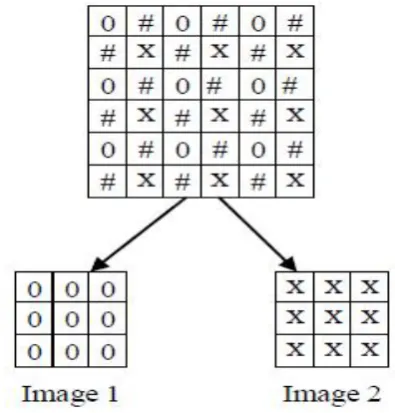
There exist several sampling theorems in digital Image processing. In our proposed method we are using quincunx sampling theorem for taking the samples from the image. Actually quincunx sampling take the alternative pixels form the image, this sampling technique divide the original image in to two images which are having the only even indices and odd indices.
Figure 3(b). Representation of quincunx sampling theorem
Figure 3(c). Example for quincunx sampling
Which is based on half-pixel shift done at both directions (rows and columns). Though this process the image is decomposed into two images as I1 andI2 shows in following
[image:3.595.68.274.215.506.2] [image:3.595.318.547.302.420.2] [image:3.595.323.521.468.675.2]indicate odd indices pixel and the cross indicates the even indices pixel. After completion of the sampling process, then applying the Demiral et al. algorithm on both the images individually. So we got two high resolution image. After getting this two resolution images, add both the images into single image. After getting the single high resolution image applying the Dyadic Filter Analysis, this filter is used to remove the noise and blur at the edges. This filter analysis having both low pass filter and high pass filter are down sampled by factor 2. For, quality assessment between the original image and reconstructed image find the mean, variance, mode, median and find the noise ratio between two images find MSE and PSNR values.
Mean: The mean is the average of the all pixels intensities in the image. It is easy to calculate. add up all the intensities, then divide by size matrix . In other words it is the sum divided by the count.
Mean(µ)=
n
m
j
i
f
n mj i
*
)
,
(
,
,
(1)
Variance: Variance is used to find out, how the pixels spread over the image plan. Low variance means the pixel values in the image clustered close together. Higher variance means the pixel values are more spread out.
Variance(σ2)=
n
*
m
)
j)
f(i,
-µ
(
,
,
mnj i
(2)
Standard deviation: is a measure that is used to quantify the amount of variation or dispersion of pixel values in image.
Standard deviation=
2
(3)Median: The median of a finite list of pixels can be found by arranging all the observations from lowest value to highest value and picking the middle one.
If n(m*n) is odd then Median (M) = value of ((n + 1)/2)th item term.
If n(m*n) is even then Median (M) = value of [((n)/2)th item term + ((n)/2 + 1)th item term ]/2
Mean Square Error:
MSE=
2
1 1
))
,
(
)
,
(
'
(
1
mi n
j
j
i
g
j
i
g
mn
(4)Peak Signal to Noise Ratio:
PSNR= 10log10( ) (5)
RESULTS AND DISCUSSION
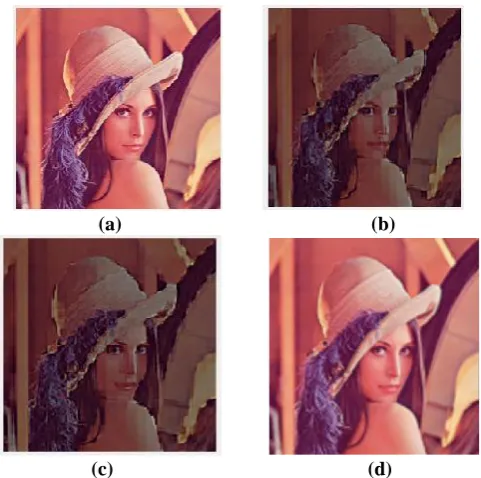
Proposed super resolution algorithm is implemented based on take the samples from the original image and then reconstruct the original image with maximizing resolution of the image. If the input of size of the image is 256×256 then it will increase the resolution nearly 2048×2048. Proposed algorithm gives at most possible reconstruction of the increased the resolution of image. For the performance analysis for the finding the level of reconstruction finds the mean, variance, mode, median. And finding the error ration between these two images find the MSE and PSNR value between original and reconstructed image.
(a) (b)
(c) (d)
Figure 4. (a) Original Image (b) Image which contains only even indexed intensity value (c) Image which contains only odd indexed intensity values (d) Super resolved Image
Performance Analysis for Reconstruction Image
Conclusion
[image:4.595.313.554.215.454.2]REFERENCES
Anbarjafari, Gholamreza, and Hasan Demirel, 2010. "Image super resolution based on interpolation of wavelet domain high frequency subbands and the spatial domain input image."ETRI Journal, 32.3; 390-394.
Bagawade Ramdas, P., S. Bhagawat Keshav, and M. Patil Pradeep. 2012. "Wavelet transform techniques for image resolution enhancement: a study."International Journal of Emerging Technology and Advanced Engineering, 2.4. 167-172.
Bagawade Ramdas, P., S. Bhagawat Keshav, and M. Patil Pradeep. 2012. "Wavelet transform techniques for image resolution enhancement: a study." International Journal of Emerging Technology and Advanced Engineering, 2.4; 167-172.
Demirel, Hasan, and Gholamreza Anbarjafari. 2011. "Image resolution enhancement by using discrete and stationary wavelet decomposition."IEEE transactions on image processing 20.5; 1458-1460.
Gajjar, Prakash P., and Manjunath V. Joshi. 2010. "New learning based super-resolution: use of DWT and IGMRF prior."IEEE Transactions on Image Processing 19.5; 1201-1213.
Iqbal, Muhammad Zafar, Abdul Ghafoor, and Adil Masood Siddiqui. 2013. "Satellite image resolution enhancement
using dual-tree complex wavelet transform and nonlocal means."IEEE geoscience and remote sensing letters 10.3; 451-455.
Irani, Michal, and Shmuel Peleg. 1993. "Motion analysis for image enhancement: Resolution, occlusion, and transparency."Journal of Visual Communication and Image Representation 4.4; 324-335.
Ji, Hui, and Cornelia Fermuller. 2009. "Robust wavelet-based super-resolution reconstruction: theory and algorithm."IEEE Transactions on Pattern Analysis and Machine Intelligence 31.4; 649-660.
Jiji, C. V., Manjunath V. Joshi, and Subhasis Chaudhuri. 2004. "Single frame image super resolution using learned wavelet coefficients."International Journal of Imaging systems and
Technology, 14.3; 105-112.
Naik, Sapan, and Nikunj Patel. 2013. "Single image super resolution in spatial and wavelet domain." arXiv preprint arXiv:1309.2057.
Nguyen, Nhat, and Peyman Milanfar. 2000. "A wavelet-based interpolation-restoration method for superresolution (wavelet superresolution).”Circuits, Systems and Signal Processing 19.4: 321-338.
Tsai, R. Y., and Thomas S. Huang. 1984. "Multiframe image restoration and registration."Advances in computer vision and Image Processing 1.2: 317-339.