Proceedings of NAACL-HLT 2019: Demonstrations, pages 110–115 110
Multilingual Entity, Relation, Event and Human Value Extraction
Manling Li1, Ying Lin1, Joseph Hoover3, Spencer Whitehead1,
Clare R. Voss2,Morteza Dehghani3, Heng Ji1 1 Rensselaer Polytechnic Institute, Troy, NY, USA
{lim22,liny9,whites5,jih}@rpi.edu
2US Army Research Laboratory, Adelphi, MD, USA
3 University of Southern California, Los Angeles, CA, USA {jehoover,mdehghan}@usc.edu
Abstract
This paper demonstrates a state-of-the-art end-to-end multilingual (English, Russian, and Ukrainian) knowledge extraction system that can perform entity discovery and linking, re-lation extraction, event extraction, and coref-erence. It extracts and aggregates knowledge elements across multiple languages and doc-uments as well as provides visualizations of the results along three dimensions: temporal (as displayed in an event timeline), spatial (as displayed in an event heatmap), and relational (as displayed in entity-relation networks). For our system to further support users’ analyses of causal sequences of events in complex sit-uations, we also integrate a wide range of hu-man moral value measures, independently de-rived from region-based survey, into the event heatmap. This system is publicly available as a docker container and a live demo,1,2 with a video demonstrating the system3.
1 Introduction
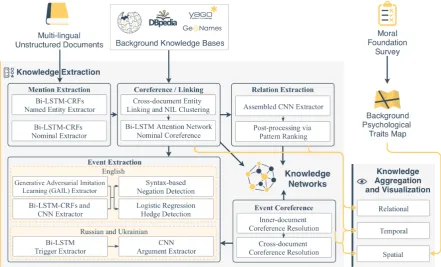
Knowledge extraction aims to convert unstruc-tured texts into strucunstruc-tured entities, relations and events. Recently, we have developed a state-of-the-art multilingual knowledge extraction system for three languages including English, Russian, and Ukrainian (Zhang et al., 2018). However, individual extraction components lack the ability to aggregate knowledge from multiple languages and documents. For example, complementary salient information about the Ukraine crisismay be extracted from English, Ukrainian, and Russian news documents. We develop a novel framework, as illustrated in Figure1, to aggregate knowledge elements from multiple documents in multiple lan-guages and visualize these knowledge elements
1
System: http://nlp.cs.rpi.edu/demo/aida_
pipeline-master.zip 2
Demo:http://nlp.cs.rpi.edu/software/
3Video:https://youtu.be/cQPHaxGLn8k
in three interfaces (temporal, spatial, and entity-relation networks) which support effective multi-dimensional search and filtering. The system is publicly available as a series of docker containers and it can be easily run via a single script. We also provide a live demo of the system that efficiently extracts knowledge elements from user input text. The system improves the ease and speed with which users may discover inter-connections among knowledge elements from multiple lan-guages and documents, so users can isolate sub-sets of activity that warrant further attention. The complementary dimensions of the three visualiza-tion interfaces provide distinct yet comprehensive views of the entities, relations, and events as well as, most notably, their implicit connections.
For example, in theUkraine crisis, a Transport-Person event in an airport inKramatorsk is part of theAttackevent inSloviansk. A causal relation between these two events may be discovered both in the event heat-map interface, where the former event inKramatorskis located near the latter event in Sloviansk, and in the event timeline interface, where these two events both occur inApril 2014. Furthermore, the entity-relation network interface enables users to retrieve and relate entities of terest while reasoning about such events. The in-terface displays each retrieved entity with its one-hop relations to other entities, which then allows the user to retrieve one-hop relations for any of those entities, thereby traversing the network and discovering information. We see this in travers-ing the network followtravers-ing theLeadershiprelation fromDonbass People’s militiatoPro-Russian sep-aratists and then the Sponsorship relation from
Pro-Russian separatiststoRussia, suggesting the
Figure 1: System overview.
a major role in social functioning and motiva-tion (Rai and Fiske, 2011; Haidt, 2012; Graham et al., 2013; Schwartz, 2017). Numerous stud-ies suggest that human values are often central motivating factors for protests, conflicts, and vi-olence (Ginges and Atran, 2009; Fiske et al.,
2014;Mooijman and Van Dijk,2015;Skitka et al.,
2017). Therefore, we integrate region-specific es-timates of dominant psychological characteristics into the spatial event heat-map, which provides an additional layer of information that can be used to understand geo-spatial event patterns.
2 Multilingual Knowledge Extraction
The overall architecture of our multilingual knowledge extraction system is illustrated in Fig-ure1. The system performs entity discovery and linking (Pan et al., 2017; Lin et al., 2018), time expression extraction and normalization (Manning et al.,2014), relation extraction (Shi et al.,2018), event extraction (Zhang et al., 2017, 2019), and event coreference (Zhang et al.,2015). The system supports the extraction of 7 entity types, 23 rela-tions, and 47 event types, as defined in the DARPA AIDA ontology.4Table1shows the main types.
For Russian and Ukrainian text input, we did
4https://www.darpa.mil/program/
active-interpretation-of-disparate-alternatives
Entity Person, Organization, Geopolitical En-tity, Facility, Location, Weapon, Vehicle
RelationPhysical, Part-Whole, Personal-Social, Measurement, Organization-Affiliation, General-Affiliation
Event Life, Movement, Business, Conflict,
[image:2.595.79.521.65.332.2]Contact, Manufacture, Personnel, Jus-tice, Transaction, Government, Inspec-tion, Existence
Table 1: Main types of knowledge elements
not adopt the alternative approach of translating the source documents into English and then apply-ing English knowledge extraction system due to the low-quality of state-of-the-art machine transla-tion and word alignment for these two languages.
Components Ours State-of-the-art
Name Tagging 91.8% 91.4%
(Liu et al.,2018)
Relation Extraction 66.4% 65.2%
(Fu et al.,2017) Event
72.9% 69.6%
Trigger Labeling (Sha et al.,2018) Event
59.0% 57.2%
[image:3.595.72.290.62.205.2]Argument Labeling (Sha et al.,2018)
Table 2: F1 score comparisons of our approach vs. state-of-the-art for English knowledge extraction.
3 Knowledge Aggregation and Visualization
To demonstrate the capabilities of our afore-mentioned system, we process 10,984 documents about the Ukraine-Russia conflict scenario from the DARPA AIDA program, including 7,415 in English, 2,307 in Russian, and 929 in Ukrainian.
We organize the extracted events in our inter-faces, as described below, along the temporal and spatial dimensions in order to assist users both in gaining a comprehensive view of the evolving sit-uations in this scenario and in detecting shared patterns of occurrence and possible connections among events of interest over time and space.
3.1 Event Timeline
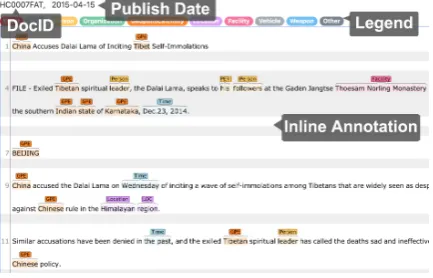
We extract and normalize time arguments to con-struct an event timeline in Figure 2 using Time-lineJS for visualization.5 There are three zones in the web-enabled timeline interface. By click-ing on an event in the timeline (i.e., the gray area at the bottom of the screen), the pertinent con-text sentence for that event is displayed in the middle of the screen with the trigger and argu-ments highlighted in color, along with a link to the sentence’s source document (Figure3). Click-ing on the source document link retrieves the doc-ument with full inline annotations and its publi-cation date, to support inference of the absolute date(s) from relative time expressions in the text (e.g., “two days ago”). Additionally, at the top of the interface, users may search and filter with mul-tiple criteria (entity name, event type, event sub-type, argument role, and time period) to narrow down the results to a particular query of interest.
[image:3.595.307.524.66.215.2]5https://timeline.knightlab.com/
Figure 2: Example of the event timeline interface.
Figure 3: Example source document with inline anno-tation retrieved from the link in the event timeline in-terface.
3.2 Event and Human Value Heatmap
We link event locations to the GeoNames database (Vatant and Wick, 2012) via the entity linking component and visualize involved events on a world map using Mapbox for visualization, as Figure4illustrates.6 Each event is displayed as a dot or, when zooming in, an icon on the map. The color of a dot indicates the language of the source sentence, while the icon denotes the event type. Users can apply filters to the map to view the events of a certain type or language.
In addition to events, we also integrate regional estimates of human values into the heatmap. Specifically, the system encodes the geographic variations of 10 distinct dimensions of the hu-man values in Table3. These values are proposed in the Schwartz Basic Theory of Human Values (Schwartz, 2012) as a culturally universal taxon-omy of human values.
The human values estimates are derived from the European Social Survey (ESS) (Round, 5, 6,
[image:3.595.309.526.252.391.2]Figure 4: Example event heatmap with events and hu-man values by region.
Human Achievement, Benevolence,
Values Conformity, Hedonism, Power,
Security, Self-direction, Simula-tion, TradiSimula-tion, Universalism
Age Filter 15-29, 30-44, 45-59, 60+
[image:4.595.73.290.61.204.2]Gender Filter Female, Male
Table 3: Human values. In the heatmap, the estimates for these values are displayed by region.
7), a nationally representative survey administered throughout the European Union. While the ESS data is sufficient for directly estimating national
human values, it cannot be used to directly derive Oblast-level estimates because it is not representa-tive at the Oblast-level.7 To resolve this issue, we employ a state-of-the-art approach to survey ad-justment and small-area estimation called Multi-level Regression and Synthetic Post-stratification with Spatial Smoothing (MrsP-SM) (Park et al.,
2004; Selb and Munzert, 2011; Leemann and Wasserfallen,2017;Hoover and Dehghani,2018). This involves a model-based approach to post-stratification in which a hierarchical regression model is used to model person-level responses to a survey item as a function of demographic charac-teristics, region-level factors, and geographic indi-cators. Then, the model is used to generate predic-tions for each combination of demographic vari-ables and geographic region. Finally, the predic-tions are weighted by the demographic population proportions within each region, yielding a set of regularized regional estimates that are adjusted for representativeness. To obtain regional human val-ues estimates in the event heatmap, we estimate
7Our regional unit of analysis is the Oblast, of which there
are 24 in Ukraine.
MrsP-SM models for each of the 10 Schwartz Hu-man Values domains.
Human values have close ties to the intentions underlying events. ADemonstrationevent may re-sult in violence, property destruction and involve-ment of extremist groups. The values of Benevo-lence,Hedonism, andConformityamong authority figures may impact their response to a protest. Ad-ditionally, people in areas where Conflict events are common may have higher values forSecurity
and lower values forAchievement.
3.3 Entity-relation Networks
Figure 5: Entity-relation network.
A critical task for users gaining an understand-ing of complex scenarios is to explore implicit en-tity relations beyond the scope of traditional in-line document annotation. Our interface provides interactive knowledge graph exploration, using Neo4j8(Figure5), where entities can be searched by name and a sub-graph for each entity with its one-hop neighbors and their relations is returned, with entity properties displayed at the bottom of the interface. Users may either explore each re-trieved neighbour by double clicking on it for its subgraph, or reduce their search graph by deleting entities no longer of interest. Thus, users can con-struct a multi-hop entity-relation graph, discover-ing variable length paths between entities. Each entity is labeled with its canonical name mention, while the entities without name mentions are re-moved from the network.
4 Conclusions and Future Work
In this paper, we demonstrate a comprehensive multi-lingual knowledge extraction, aggregation
[image:4.595.307.526.253.404.2]and visualization system which can effectively discover and synthesize knowledge elements from multiple data sources, and present them to users in multiple dimensions. In the future, we plan to conduct utility experiments with users to compare and evaluate the quality and speed of generating summary reports with and without using our inter-faces.
Acknowledgments
This work was supported by the U.S. ARL NS-CTA No. W911NF-09-2-0053 and DARPA AIDA Program No. FA8750-18-2-0014. The views and conclusions contained in this document are those of the authors and should not be interpreted as rep-resenting the official policies, either expressed or implied, of the U.S. Government. The U.S. Gov-ernment is authorized to reproduce and distribute reprints for Government purposes notwithstanding any copyright notation here on.
References
A P Fiske, T S Rai, and S Pinker. 2014. Virtuous Vio-lence: Hurting and Killing to Create, Sustain, End,
and Honor Social Relationships. Cambridge
Uni-versity Press.
Lisheng Fu, Thien Huu Nguyen, Bonan Min, and Ralph Grishman. 2017. Domain adaptation for re-lation extraction with domain adversarial neural net-work. In Proceedings of the Eighth International Joint Conference on Natural Language Processing
(Volume 2: Short Papers), volume 2, pages 425–429.
Jeremy Ginges and Scott Atran. 2009. What motivates participation in violent political action. Annals of
the New York Academy of Sciences, 1167(1):115–
123.
Jesse Graham, Jonathan Haidt, Sena Koleva, Matt Motyl, Ravi Iyer, Sean P Wojcik, and Peter H Ditto. 2013. Moral foundations theory: The pragmatic va-lidity of moral pluralism. InAdvances in
experimen-tal social psychology, volume 47, pages 55–130.
El-sevier.
Jonathan Haidt. 2012. The righteous mind: Why good
people are divided by politics and religion. Vintage.
J Hoover and M Dehghani. 2018. The big, the bad, and the ugly: Geographic estimation with flawed psy-chological data.PsyArXiv. October.
Lucas Leemann and Fabio Wasserfallen. 2017. Ex-tending the use and prediction precision of sub-national public opinion estimation: EXTENDING USE AND PRECISION OF MrP. American
jour-nal of political science, 61(4):1003–1022.
Ying Lin, Shengqi Yang, Veselin Stoyanov, and Heng Ji. 2018. A multi-lingual multi-task architecture for low-resource sequence labeling. In Proceed-ings of the 56th Annual Meeting of the Association for Computational Linguistics (Volume 1: Long
Pa-pers), volume 1, pages 799–809.
Liyuan Liu, Jingbo Shang, Xiang Ren,
Frank Fangzheng Xu, Huan Gui, Jian Peng, and Jiawei Han. 2018. Empower sequence la-beling with task-aware neural language model.
In Thirty-Second AAAI Conference on Artificial
Intelligence.
Christopher Manning, Mihai Surdeanu, John Bauer, Jenny Finkel, Steven Bethard, and David McClosky. 2014. The stanford corenlp natural language pro-cessing toolkit. In Proceedings of 52nd annual meeting of the association for computational
lin-guistics: system demonstrations, pages 55–60.
Marlon Mooijman and Wilco W Van Dijk. 2015. The self in moral judgement: How self-affirmation affects the moral condemnation of harmless sex-ual taboo violations. Cognition and Emotion, 29(7):1326–1334.
Xiaoman Pan, Boliang Zhang, Jonathan May, Joel Nothman, Kevin Knight, and Heng Ji. 2017. Cross-lingual name tagging and linking for 282 languages.
In Proceedings of the 55th Annual Meeting of the
Association for Computational Linguistics (Volume
1: Long Papers), volume 1, pages 1946–1958.
David K Park, Andrew Gelman, and Joseph Bafumi. 2004. Bayesian multilevel estimation with post-stratification: State-Level estimates from national polls. Political analysis: an annual publication of the Methodology Section of the American Political
Science Association, 12(4):375–385.
Tage Shakti Rai and Alan Page Fiske. 2011. Moral psy-chology is relationship regulation: moral motives for unity, hierarchy, equality, and proportionality.
Psy-chological review, 118(1):57–75.
ESS Round. 5. 5: European social survey round 4 data (2010).Data file edition, 5.
ESS Round. 6. 6: European social survey round 6 data (2012).Data file edition, 6.
ESS Round. 7. 7: European social survey round 7 data (2014).Data file edition, 7.
Shalom H Schwartz. 2012. An overview of the schwartz theory of basic values. Online Readings
in Psychology and Culture, 2(1):11.
Shalom H Schwartz. 2017. The refined theory of basic values. In Sonia Roccas and Lilach Sagiv, editors,
Values and Behavior: Taking a Cross Cultural
Per-spective, pages 51–72. Springer International
P Selb and S Munzert. 2011. Estimating constituency preferences from sparse survey data using auxiliary geographic information. Political analysis: an an-nual publication of the Methodology Section of the
American Political Science Association.
Lei Sha, Feng Qian, Baobao Chang, and Zhifang Sui. 2018. Jointly extracting event triggers and argu-ments by dependency-bridge rnn and tensor-based argument interaction. InThirty-Second AAAI
Con-ference on Artificial Intelligence.
Ge Shi, Chong Feng, Lifu Huang, Boliang Zhang, Heng Ji, Lejian Liao, and Heyan Huang. 2018. Genre separation network with adversarial training for cross-genre relation extraction. InProceedings of the 2018 Conference on Empirical Methods in
Natural Language Processing, pages 1018–1023.
Linda J Skitka, Brittany E Hanson, and Daniel C Wis-neski. 2017. Utopian hopes or dystopian fears? ex-ploring the motivational underpinnings of moralized political engagement. Personality & social
psychol-ogy bulletin, 43(2):177–190.
Bernard Vatant and Marc Wick. 2012. Geonames on-tology. Dostupn´e online:¡ http://www. geonames.
org/ontology/ontology v3, 1.
Boliang Zhang, Di Lu, Xiaoman Pan, Ying Lin, Hal-idanmu Abudukelimu, Heng Ji, and Kevin Knight. 2017. Embracing non-traditional linguistic re-sources for low-resource language name tagging. In
Proceedings of the Eighth International Joint Con-ference on Natural Language Processing (Volume 1:
Long Papers), volume 1, pages 362–372.
Tongtao Zhang, Heng Ji, and Avirup Sil. 2019. Joint entity and event extraction with generative adversar-ial imitation learning. Data Intelligence.
Tongtao Zhang, Hongzhi Li, Heng Ji, and Shih-Fu Chang. 2015. Cross-document event coreference resolution based on cross-media features. In Pro-ceedings of the 2015 Conference on Empirical
Meth-ods in Natural Language Processing, pages 201–
206.
Tongtao Zhang, Ananya Subburathinam, Ge Shi, Lifu Huang, Di Lu, Xiaoman Pan, Manling Li, Bo-liang Zhang, Qingyun Wang, Spencer Whitehead, Heng Ji, Alireza Zareian, Hassan Akbari, Brian Chen, Ruiqi Zhong, Steven Shao, Emily All-away, Shih-Fu Chang, Kathleen McKeown, Dongyu Li, Xin Huang, Kexuan Sun, Xujun Peng, Ryan Gabbard, Marjorie Freedman, Mayank Kejriwal, Ram Nevatia, Pedro Szekely, T.K. Satish Kumar, Ali Sadeghian, Giacomo Bergami, Sourav Dutta, Miguel Rodriguez, and Daisy Zhe Wang. 2018. Gaia - a multi-media multi-lingual knowledge ex-traction and hypothesis generation system. In Pro-ceedings of TAC KBP 2018, the 25th International Conference on Computational Linguistics: