Bilingual Word Embeddings from Parallel and Non-parallel Corpora for
Cross-Language Text Classification
Aditya Mogadala
Institute AIFB
Karlsruhe Institute of Technology Karlsruhe, Germany
Achim Rettinger
Institute AIFB
Karlsruhe Institute of Technology Karlsruhe, Germany [email protected]
Abstract
In many languages, sparse availability of re-sources causes numerous challenges for tex-tual analysis tasks. Text classification is one of such standard tasks that is hindered due to lim-ited availability of label information in low-resource languages. Transferring knowledge (i.e. label information) from high-resource to low-resource languages might improve text classification as compared to the other ap-proaches like machine translation. We intro-duce BRAVE (Bilingual paRAgraph VEctors), a model to learn bilingual distributed repre-sentations (i.e. embeddings) of words with-out word alignments either from sentence-aligned parallel or label-sentence-aligned non-parallel document corpora to support cross-language text classification. Empirical analysis shows that classification models trained with our bilingual embeddings outperforms other state-of-the-art systems on three different cross-language text classification tasks.
1 Introduction
The availability of language-specific annotated re-sources is crucial for the efficiency of natural lan-guage processing tasks. Still, many lanlan-guages lack rich annotated resources that support various tasks such as part-of-speech tagging, dependency parsing and text classification. While the growth of multi-lingual information on the web has provided an op-portunity to build these missing annotated resources, but still lots of manual effort is required to achieve high quality resources for every language separately. Another possibility is to utilize the unlabeled data present in those languages or transfer
knowl-edge from annotation-rich languages. For the first alternative, recent advancements made in learning monolingual distributed representations of words (Mikolov et al., 2013a; Pennington et al., 2014; Levy and Goldberg, 2014) (i.e. monolin-gual word embeddings) capturing syntactic and se-mantic information in an unsupervised manner was useful in numerous NLP tasks (Collobert et al., 2011). However, this may not be sufficient for several other tasks such as cross-language informa-tion retrieval (Grefenstette, 2012), cross-language word semantic similarity (Vuli´c and Moens, 2014), cross-language text classification (CLTC, hence-forth) (Klementiev et al., 2012; Xiao and Guo, 2013; Prettenhofer and Stein, 2010; Tang and Wan, 2014) and machine translation (Zhao et al., 2015) due to irregularities across languages. In these kind of sce-narios, transfer of knowledge can be useful.
Several approaches (Hermann and Blunsom, 2014; Sarath Chandar et al., 2014; Gouws et al., 2015; Coulmance et al., 2015) tried to induce monolingual distributed representations into a lan-guage independent space (i.e. bilingual or multilin-gual word embeddings) by jointly training on pair of languages. Although the overall goal of these approaches is to capture linguistic regularities in words that share same semantic and syntactic space across languages, they differ in their implementa-tion. One set of methods either perform offline alignment of trained monolingual embeddings or jointly-train both monolingual and cross-lingual ob-jectives, while the other set uses only cross-lingual objective. Jointly-trained or offline alignment meth-ods can be further divided based on the type of
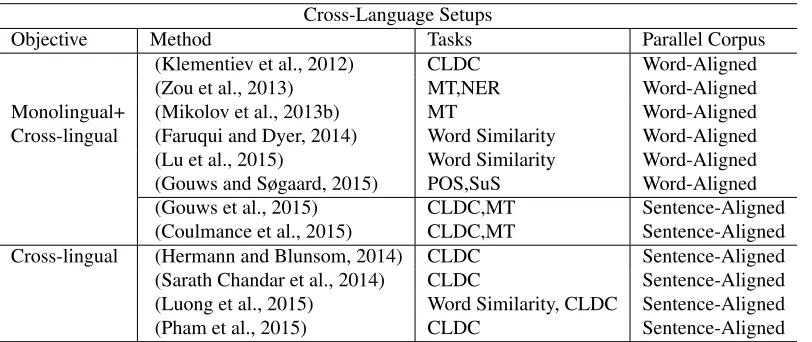
Cross-Language Setups
Objective Method Tasks Parallel Corpus
[image:2.612.107.513.59.230.2](Klementiev et al., 2012) CLDC Word-Aligned (Zou et al., 2013) MT,NER Word-Aligned Monolingual+ (Mikolov et al., 2013b) MT Word-Aligned Cross-lingual (Faruqui and Dyer, 2014) Word Similarity Word-Aligned (Lu et al., 2015) Word Similarity Word-Aligned (Gouws and Søgaard, 2015) POS,SuS Word-Aligned (Gouws et al., 2015) CLDC,MT Sentence-Aligned (Coulmance et al., 2015) CLDC,MT Sentence-Aligned Cross-lingual (Hermann and Blunsom, 2014) CLDC Sentence-Aligned (Sarath Chandar et al., 2014) CLDC Sentence-Aligned (Luong et al., 2015) Word Similarity, CLDC Sentence-Aligned (Pham et al., 2015) CLDC Sentence-Aligned
Table 1: Summary of bilingual or multilingual embedding methods that support Cross-language Document Classification (CLDC), Machine Trans-lation (MT), Named Entity Recognition (NER), Part-of-Speech Tagging (POS), Super Sense Tagging (SuS).
allel corpus (e.g. word-aligned, sentence-aligned) they use for learning the cross-lingual objective. Ta-ble 1 summarizes different setups to learn bilingual or multilingual embeddings for the various tasks.
Methods in the Table 1 that use word-aligned parallel corpus as offline alignment (Mikolov et al., 2013b; Faruqui and Dyer, 2014) assume sin-gle correspondence between the words across lan-guages and ignore polysemy. While, the jointly-train methods (Klementiev et al., 2012) that use word-alignment parallel corpus and consider poly-semy perform computationally expensive operation of considering all possible interactions between the pairs of words in vocabulary of two different lan-guages. Methods (Hermann and Blunsom, 2014; Sarath Chandar et al., 2014) that overcame the complexity issues of word-aligned models by us-ing sentence-aligned parallel corpora limits them-selves to only cross-lingual objective, thus mak-ing these approaches unable to explore monolin-gual corpora. Jointly-trained models (Gouws et al., 2015; Coulmance et al., 2015) overcame the issues of both word-aligned and purely cross-lingual ob-jective models by using monolingual and sentence-aligned parallel corpora. Nonetheless, these ap-proaches still have certain drawbacks such as us-age of only bag-of-words from the parallel sen-tences ignoring order of words. Thus, they are missing to capture the non-compositional meaning of entire sentence. Also, learned bilingual em-beddings were heavily biased towards the sampled sentence-aligned parallel corpora. It is also
some-times hard to acquire sentence-level parallel corpora for every language pair. To subdue this concern, few approaches (Rajendran et al., 2015) used pivot languages like English or comparable document-aligned corpora (Vuli´c and Moens, 2015) to learn bilingual embeddings specific to only one task.
lan-guages to learn multilingual text sequences. The main contributions of this paper are:
• We jointly train monolingual part of parallel corpora with the improved cross-lingual align-ment function that extends beyond bag-of-word models.
• Introduced a novel approach to leverage non-parallel data sets such as label or class aligned documents in different languages for learning bilingual cues.
• Experimental evaluation on three different CLTC tasks, namely cross-language docu-ment classification, multi-label classification and cross-language sentiment classification us-ing learned bilus-ingual word embeddus-ings. 2 Related Work
Most of the related work can be associated to the approaches that aim to learn latent topics across lan-guages or distributed representations of the words and larger pieces of text for supporting various cross-lingual tasks.
2.1 Cross-Language Latent Topics
Various approaches have been proposed to identify latent topics in monolingual (Blei, 2012; Rus et al., 2013) and multilingual (Mimno et al., 2009; Fuku-masu et al., 2012) scenarios for cross-language se-mantic word similarity and document comparison. Extraction of cross-language latent topics or con-cepts use context-insensitive (Zhang et al., 2010) and context-sensitive methods (Vuli´c and Moens, 2014) to build word co-occurrence statistics for doc-ument representations.
2.2 Distributed Representations
Continuous word representations (Bengio et al., 2003; Mikolov et al., 2013a; Pennington et al., 2014) was further extended to multilingual (Hermann and Blunsom, 2014; Koˇcisk´y et al., 2014; Coulmance et al., 2015), bilingual (Gouws et al., 2015; Vuli´c and Moens, 2015; Luong et al., 2015) and polylin-gual (Al-Rfou et al., 2013) settings by projecting multiple or pair of languages into the shared seman-tic space. Also, word representations were extended to meet larger textual units like phrases, sentences
and documents either monolingual (Socher et al., 2012; Le and Mikolov, 2014) or bilingual (Pham et al., 2015). Some approaches fine tuned the embed-dings for specific tasks such as cross-lingual senti-ment analysis (Zhou et al., 2015b), cross-language POS tagging (Gouws and Søgaard, 2015), machine translation (Cho et al., 2014) etc.
3 BRAVE Model
In this section, we present the BRAVE model along with its variations whose aim is to learn bilingual embeddings that can generalize across different lan-guages.
3.1 Bilingual Paragraph Vectors (BRAVE)
Most of the NLP tasks require fixed-length vectors. Tasks like CLTC also require fixed-length vectors to incorporate inherent semantics of sentences or doc-uments. Distributed representation of sentences and documents i.e. paragraph vectors (Le and Mikolov, 2014) are designed to out-perform certain text clas-sification tasks by overcoming constraints posed by the bag-of-words models.
Here, we leverage paragraph vectors distributed memory model (PV-DM) as the monolingual objec-tive M(·) and jointly optimize with bilingual reg-ularization functionϕ(·) for learning bilingual em-beddings similar to the earlier approaches (Gouws et al., 2015; Coulmance et al., 2015). Equation 1 shows the formulation of the overall objective func-tion that is minimized.
L= min
θl1,θl2
X
l{l1,l2}
X
Cl
Ml(w
t, h;θl) +λϕ(θ l1, θl2)
2
(1) Here, Cl represent the corpus of individual
lan-guages (i.e. l1orl2). Given any sequence of words
(wl
1, wl2...wlT) in Cl, wt is the predicted word in a
contexthconstrained on paragraph p(i.e. sentence or document) and sequence of words.
Formally, the first term (i.e. M(·)) in the Equa-tion 1 maximizes the average log probability based on word vector matrixWl and a unique paragraph
vector matrixPl. Equation 2 represents the average
log probability.
Ml(w
t, h;θl) = Σ T−k
t=kywlt −log(
P
iey
l i)
where eachyl
iis log-probability of predicted word
iand is given by Equation 3.
yl=b+Uh(wl
t−k....wlt+k;Wl, Pl) (3)
To optimize for efficiency, hierarchical soft-max (Mnih and Hinton, 2009) is used in training withU andbas parameters. Binary Huffmann tree is utilized to represent hierarchial softmax (Mikolov et al., 2013a). Analogous to Pham et al., (2015), we also derive h by concatenating paragraph vec-tor fromPlwith the average of word vectors inWl.
This helps to fine tune both word and paragraph vec-tors independently.
Now, to capture the bilingual cues, the regulariza-tion funcregulariza-tion (ϕ(·)) is learned in two different ways. In the first approach a sentence-aligned parallel cor-pora is used, while in the second approach a label-aligned document corpora.
3.2 BRAVE with Sentence-Aligned Parallel corpora (BRAVE-S)
To compute the bilingual regularization func-tion ϕ(·), we slightly deviate from earlier ap-proaches (Gouws et al., 2015). Instead of simply performing L2-loss between the mean of word
vec-tors in each sentence pair (sl1j,sl2j ) of the sentence-aligned parallel corpus (PC) at each training step. We use the concept of elastic net regularization (Zou and Hastie, 2005) and employ linear combination of L2-loss between sentence paragraph vectors SPjl1
and SPjl2 ∈ Rd precomputed from the
monolin-gual termM(·) with L2-loss between the mean of
word vectors observed in sentences. This induces a constraint on the usage of monolingual part of parallel training data to learn M(·). At the same time, it has an advantage of using combination of paragraph and word vectors which combines com-positional and non-comcom-positional meanings of sen-tences.
Also, it eliminates the need for word-alignment and makes an assumption that each word observed in the sentence of languagel1can potentially find its
alignment in the sentence of languagel2.
Theoret-ically, low value ofϕ(·) ensures that words across languages which are similar are embedded closer to each other. Equation 4 shows the regularization
term.
α||SPl1
j −SPjl2||2+(1−α)||m1 m X
wislj1
Wl1 i −1n
n X
wkslj2
Wl2 k ||2
(4) WhereWil1 andWkl2 represent word embeddings obtained for the wordswi andwk in each sentence
(sj) of lengthmandnin languagesl1andl2
respec-tively.
3.3 BRAVE with Non-Parallel Document Corpora (BRAVE-D)
Sometimes it is hard to acquire sentence-aligned parallel corpora for many languages. Availability of non-parallel corpora such as topic-aligned (e.g. Wikipedia) or label/class-aligned document corpora (e.g. sentiment analysis and multi-class classifica-tion data sets) in different languages can be lever-aged to learn bilingual embeddings for perform-ing CLTC. Earlier approaches like CL-LSI (Du-mais et al., 1997) and CL-KCCA (Vinokourov et al., 2003) were used to learn bilingual document spaces for the tasks comparable to CLTC. Although these approaches provide decent results, they face serious scalability issues and are mostly limited to Wikipedia. Cross-lingual latent topic extraction models (Vuli´c and Moens, 2014) showed promising results for the tasks like word-level or phrase-level translations, but have certain drawbacks for CLTC tasks.
Here, we propose a two step approach to build bilingual embeddings with label/class-aligned doc-ument corpora.
• In the first step, we perform manifold align-ment using Procrustes analysis (Wang and Ma-hadevan, 2008) between sets of documents be-longing to same class/label in different lan-guages. This will help to identify the closest alignment of a document in languagel1 with a
document in another languagel2.
• In the second step, we use the pair of partially aligned documents belonging to same class or label in different languages to extract bilin-gual cues similar to the approach mentioned in
Step-1:
LetSl1 andSl2 be the sets containing languagesl
1
and l2 training documents associated to label or a
class. Below, we provide the three step procedure to attain partial alignment between the documents present in these sets.
• Learning low-dimensional embeddings of the sets (Sl1, Sl2) is key for alignment. We
use document paragraph vectors (Le and Mikolov, 2014) to learn low-dimensional em-beddings of the documents in each language. LetXl1 andXl2 be the low-dimensional
em-beddings ofSl1 andSl2 respectively.
• To find the optimal values of transformation, Procrustes superimposition is done by translat-ing, rotating and scaling the objects (i.e. rows ofXl2 is transformed to make it similar to the
rows ofXl1). Transformation is achieved by – Translation: Taking mean of all the
members of set to make centroids (P|iS=1l1| Xl1
|Sl1|,
P|Sl2|
i=1 X
l2
|Sl2|) lie at origin.
– Scaling and Rotation: The rotation and scaling that maximizes the alignment is given by orthogonal matrix (Q) and scal-ing factor (k). They are obtained by minimizing orthogonal Procrustes prob-lem (Sch¨onemann, 1966) and is provided by Equation 5.
arg min k,Q ||X
l1 −Xl2
∗ ||F (5)
where Xl2
∗ a matrix of transformed Xl2
values given by kXl2Q and ||.||
F is the
Frobenius norm constrained overQTQ=
I.
• IfSl2
∗ represents the new document set obtained
after identifying the close alignment among documents inSl1andSl2with cosine similarity
betweenXl1andXl2
∗ , then the partially aligned
corpora {Sl1, Sl2
∗ } contains one-to-one
corre-spondence between the two languages docu-ments that are used to learn bilingual cues in the second step.
From perturbation theory of spectral spaces (Kostrykin et al., 2003) it can be under-stood that the difference between low-dimensional
embedding subspaces (i.e. Xl1 andXl2
∗ ) is always
bounded, thus the new alignment obtained between document sets{Sl1, Sl2
∗ } is insensitive to
perturba-tions. Which also means that Procrustes analysis has provided best possible document alignments.
Step-2:
Now, document pairs (dl1j ,dl2j ) of the partially-aligned corpus (PAC) is used to compute bilingual regularization function ϕ(·). At each training step, L2-loss of precomputeddocument paragraph
vectors DPl1
j and DPjl2 ∈ Rd obtained from
the monolingual term M(·) is combined with the L2-loss between vector of words weighted by
the probability of their occurrence in a particular label/class of entire PAC. Consideration of word probabilities will help to induce label/class specific information. Equation 6 provides the regularization term.
α||DPl1
j −DPjl2||2
+ (1−α)|| Xm widlj1
pwiWil1
P mpwi
− Xn wkdlj2
qwkWkl2 P
nqwk
||2 (6)
Where wi,wk are words and their embeddings
Wil1,Wkl2 observed in each document (dj) of length
mandnin languagesl1andl2 respectively. While, pwi andqwk represents probability of occurrence of
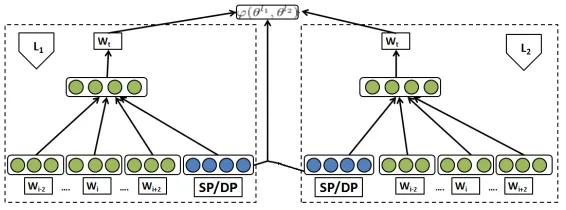
wordswi andwk in a specific label/class of entire PAC. Figure- 1 shows overall goal of both the ap-proaches.
4 Experiments
In this section, we report results on three differ-ent CLTC tasks to comprehend whether our learned bilingual embeddings are semantically useful across languages. First, cross-language document classi-fication (CLDC) task proposed by Klementiev et al. (2012) using the subset of Reuters RCV1/RCV2 corpora (Lewis et al., 2004). Second, a multi-label CLDC task with more languages using TED corpus1
of Hermann et al. (2014) . Subsequently, a cross-language sentiment classification (CLSC) proposed by Prettenhofer et al., (2010) on a multi-domain sen-timent dataset.
Figure 1: Bilingual word embeddings learned using sentence or document paragraph vectors (SP/DP) along with word vectors.
4.1 Parallel and Non-Parallel Corpora
For sentence-aligned parallel corpora, Europarl-v7 2(EP) is used as both monolingual and parallel
training data. While for label-aligned non-parallel document corpora, only training and testing collec-tions of the cross-language multi-domain Amazon product reviews(CL-APR) (Prettenhofer and Stein, 2010) corpus with sentiment labels is used.
4.2 Implementation
Our implementation launches monolingual para-graph vector (Le and Mikolov, 2014) threads for each language along with bilingual regularization thread. Word and paragraph embeddings matrices are initialized with normal distribution (µ = 0 and
σ2 = 0.1) for each language and all threads access
them asynchronously. Following Pham et al. (2015) suggested combination (P=5*W) of paragraph and word embeddings, we chose paragraph embeddings with dimensionality of 200 and 640 when word em-beddings are of 40 and 128 dimensions respectively. Asynchronous stochastic gradient descent (ASGD) is used to update parameters (i.e. Pl,Wl,U andb)
and train the model.
For each training pair in parallel or non-parallel corpora, initially monolingual threads sample con-text h with window size of 8 from a random para-graph (i.e. sentence or document) in each lan-guage. Then the bilingual regularization thread along with monolingual threads make update to pa-rameters asynchronously. Learning rate is set to 0.001 which decrease with the increase of epochs, whileαis chosen to be 0.6 (can be fine tuned based on empirical analysis) to give more weight to para-graph vectors. All models are trained for 50 epochs.
2http://www.statmt.org/europarl/
4.3 Document Representation
Documents are represented with tf-idf weighted sum of embedding vectors of the words that are present in them.
4.4 Results
The experimental results for each of the CLTC tasks are presented separately.
4.4.1 Cross-language Document Classification (CLDC) - RCV1/RCV2
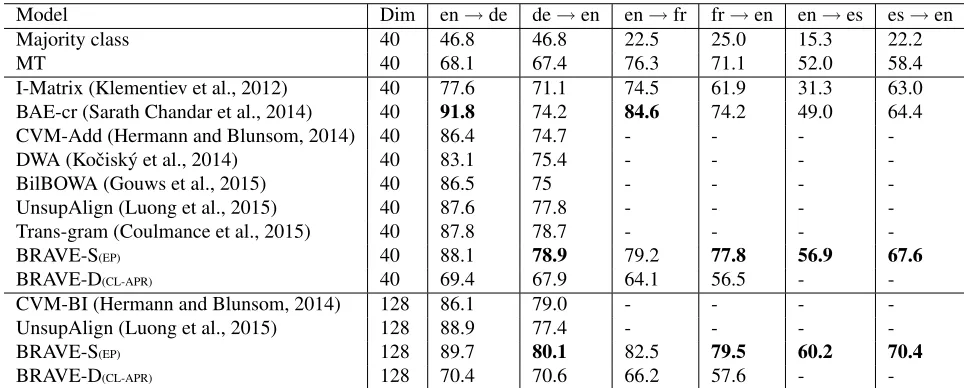
Goal of this task is to classify target language doc-uments with the labeled examples from the source language. To achieve it, we used the subset of Reuters RCV1/RCV2 corpora as the training and evaluation sets and replicated the experimental set-ting of Klementiev et al. (2012). From the En-glish, German, French and Spanish collection of the dataset, only those documents are selected which was labeled with a single topic (i.e. CCAT, ECAT, GCAT and MCAT). For the classification experi-ments, 1000 labeled documents from source lan-guage are selected to train a multi-class classifier using averaged perceptron (Freund and Schapire, 1999; Collins, 2002) and 5000 documents were used as the testing data.
German, French and English-Spanish portion of EP corpora (i.e. each with around 1.9M sentence-pairs) is used both as mono-lingual and parallel training data with BRAVE-S
Model Dim en→de de→en en→fr fr→en en→es es→en
Majority class 40 46.8 46.8 22.5 25.0 15.3 22.2
MT 40 68.1 67.4 76.3 71.1 52.0 58.4
I-Matrix (Klementiev et al., 2012) 40 77.6 71.1 74.5 61.9 31.3 63.0 BAE-cr (Sarath Chandar et al., 2014) 40 91.8 74.2 84.6 74.2 49.0 64.4 CVM-Add (Hermann and Blunsom, 2014) 40 86.4 74.7 - - - -DWA (Koˇcisk´y et al., 2014) 40 83.1 75.4 - - - -BilBOWA (Gouws et al., 2015) 40 86.5 75 - - - -UnsupAlign (Luong et al., 2015) 40 87.6 77.8 - - - -Trans-gram (Coulmance et al., 2015) 40 87.8 78.7 - - -
-BRAVE-S(EP) 40 88.1 78.9 79.2 77.8 56.9 67.6
BRAVE-D(CL-APR) 40 69.4 67.9 64.1 56.5 -
-CVM-BI (Hermann and Blunsom, 2014) 128 86.1 79.0 - - - -UnsupAlign (Luong et al., 2015) 128 88.9 77.4 - - -
-BRAVE-S(EP) 128 89.7 80.1 82.5 79.5 60.2 70.4
BRAVE-D(CL-APR) 128 70.4 70.6 66.2 57.6 -
-Table 2: CLDC Accuracy with 1000 labeled examples on RCV1/RCV2 Corpus. en/de, en/fr and en/es results of Majority class, MT, I-Matrix and BAE-cr are adopted from Sarath Chandar et al., (2014)
18k French. Further, documents in the training and testing data of RCV1/RCV2 corpora are represented as described in§4.3 with the vocabulary built. Ta-ble 2 shows the comparison of our approaches with the existing systems.
4.4.2 Multi-label CLDC - TED Corpus
To understand the applicability of our approaches to wider range of languages3 and class labels, we
perform experiments with the subset of TED cor-pus (Hermann and Blunsom, 2014). Aim of this task is same as § 4.4.1, but experiments were con-ducted with larger variety of languages and class la-bels. TED Corpus contains English transcriptions and their sentence-aligned translations for 12 lan-guages from the TED conference. Entire corpus is further classified into 15 topics (i.e. class labels) based on the most frequent keywords appearing in them.
To conduct our experiments, we follow thesingle
mode setting of Hermann et al. (2014) (i.e. embed-dings are learned only from a single language pair). Entire language pair (i.e. en→L2) training data of the TED corpus is used both as monolingual and parallel training data to learn bilingual word embed-dings with dimensionality of 128 using BRAVE-S
approach. Bilingual word embeddings of 128 di-mensions learned with EP and CL-APR are also 3Our goal is not to evaluate shared multilingual semantic representation.
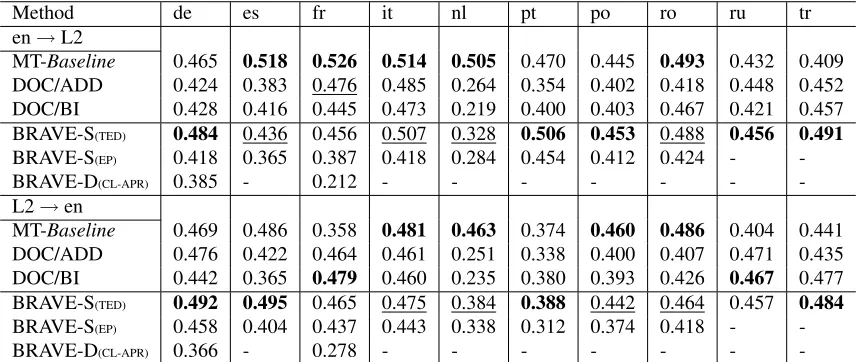
used for comparison. Documents in the training and testing data of TED corpus are represented as de-scribed in § 4.3 using each of these embeddings. A multi-class classifier using averaged perceptron is built using training documents in source language to be applied on target language testing data for pre-dicting the class labels. Table 3 shows the cumula-tive F1-scores.
4.4.3 Cross-language Sentiment Classification (CLSC)
The objective of the third CLTC task is to iden-tify sentiment polarity (e.g. positive or negative) of the data in target language by exploiting the labeled data in source language. We chose sub-set of publicly available Amazon product reviews (CL-APR) (Prettenhofer and Stein, 2010) dataset mainly English(E), German(G) and French(F) lan-guages belonging to three different product cate-gories (books(B), dvds(D) and music(M)) to con-duct our experiments. For each language-category pair, corpus consists of training, testing sets com-prising 1000 positive and 1000 negative reviews each with an additional unlabeled reviews varying from 9,000 to 170,000.
[image:7.612.70.552.59.253.2]Method de es fr it nl pt po ro ru tr en→L2
MT-Baseline 0.465 0.518 0.526 0.514 0.505 0.470 0.445 0.493 0.432 0.409 DOC/ADD 0.424 0.383 0.476 0.485 0.264 0.354 0.402 0.418 0.448 0.452 DOC/BI 0.428 0.416 0.445 0.473 0.219 0.400 0.403 0.467 0.421 0.457 BRAVE-S(TED) 0.484 0.436 0.456 0.507 0.328 0.506 0.453 0.488 0.456 0.491 BRAVE-S(EP) 0.418 0.365 0.387 0.418 0.284 0.454 0.412 0.424 - -BRAVE-D(CL-APR) 0.385 - 0.212 - - - -L2→en
MT-Baseline 0.469 0.486 0.358 0.481 0.463 0.374 0.460 0.486 0.404 0.441 DOC/ADD 0.476 0.422 0.464 0.461 0.251 0.338 0.400 0.407 0.471 0.435 DOC/BI 0.442 0.365 0.479 0.460 0.235 0.380 0.393 0.426 0.467 0.477 BRAVE-S(TED) 0.492 0.495 0.465 0.475 0.384 0.388 0.442 0.464 0.457 0.484 BRAVE-S(EP) 0.458 0.404 0.437 0.443 0.338 0.312 0.374 0.418 - -BRAVE-D(CL-APR) 0.366 - 0.278 - - -
-Table 3: Cumulative F1-scores on TED Corpus using training data in English language and evaluation on other languages (i.e. German (de), Spanish (es), French (fr), Italian (it), Dutch (nl), Portugese (pt), Polish (po), Romanian (ro), Russian (ru) and Turkish (tr)) and vice versa. MT-Baseline, DOC/ADD, DOC/BI represents single language pair of Hermann et al., (2014) as document features. Underline shows the best results amongst embedding models.
Cross-Language Sentiment Classification (en→L2 and Vice versa)
Task CL-SCL CL-SSMC CL-SLF CL-DCI100 BSE BRAVE-S BRAVE-D
(EP) (CL-APR) EFB 79.86±0.22 83.05±0.26 82.61±0.25 82.30 - 72.24±0.31 82.57±0.33 EFD 78.80±0.25 82.70±0.20 82.70±0.45 82.40 - 74.95±0.25 82.90±0.35
EFM 75.95±0.31 80.46±0.20 80.19±0.40 81.05 - 72.80±0.20 80.70±0.45
FEB 77.26±0.22 80.05±0.26 80.48±0.33 - - 75.45±0.38 80.28±0.21 FED 76.57±0.20 79.40±0.28 78.76±0.38 - - 73.75±0.26 79.80±0.15
FEM 76.76±0.25 78.82±0.17 79.18±0.33 - - 73.66±0.17 78.56±0.33 EGB 77.77±0.28 81.88±0.42 79.91±0.47 81.40 80.27±0.50 75.95±0.16 81.75±0.45
EGD 79.93±0.23 82.25±0.20 81.86±0.31 79.95 77.16±0.30 78.30±0.42 81.56±0.26 EGM 73.95±0.30 81.30±0.20 79.59±0.42 83.30 77.98±0.51 75.95±0.33 81.20±0.17 GEB 77.85±0.27 79.06±0.23 78.61±0.34 - - 72.25±0.20 80.23±0.17
GED 77.83±0.33 80.89±0.16 80.27±0.35 - - 73.28±0.23 80.78±0.20
[image:8.612.92.520.60.241.2]GEM 77.37±0.34 79.85±0.17 79.80±0.26 - - 74.41±0.22 79.77±0.36 Table 4: Average classification accuracies and standard deviations for 12 CLSC tasks. Results of other baselines are adopted from CL-SCL (Pret-tenhofer and Stein, 2010), CL-SSMC (Xiao and Guo, 2002), CL-SLF (Zhou et al., 2015a), CL-DCI100(Esuli and Fernandez, 2015) and BSE (Tang
and Wan, 2014)
BRAVE-SandBRAVE-Dare used to represent each review as described in§ 4.3. To have fair compari-son with earlier approaches, sentiment classification model is then trained with libsvm4 default
parame-ter settings using source language training reviews5
to classify target language test reviews. Table 4 shows the accuracy and standard deviation results after we randomly chose subset of target language testing documents and repeated the experiment for
4https://www.csie.ntu.edu.tw/ cjlin/libsvm/
5We do not use 100 labeled target language reviews in model training, as it was shown by earlier approaches that 100 labeled target language reviews does not have much impact.
10 times for all CLSC tasks.
5 Discussion
First CLTC task (i.e. CLDC) results presented in Ta-ble 2 shows that BRAVE-S was aTa-ble to outperform most of the existing systems. Success of BRAVE-S can be attributed to its ability to incorporate both non-compositional and compositional meaning ob-served in entire sentence and the individual words respectively. Thus making it different from other models which use only bag-of-words (Gouws et al., 2015) or bi-grams (Hermann and Blunsom, 2014).
[image:8.612.85.531.295.476.2]Top-3 Nearest Neighbors (Euclidean Distance) English Words Models German French great wachstum ´eminent
BRAVE-S super maintenus spielen m’efforcerai sch¨arfe festival BRAVE-D m¨ogen interressante
kraftvolle attachant bored boykottiert ennuy´e
BRAVE-S leere pr´ec´edera ausgehen compromettent ableben r´eserve BRAVE-D lichtblick intensit´e
[image:9.612.177.434.58.230.2]traurigen constern´e
Table 5: Nearest Neighbors for English Words in German and French.
CLDC) results presented in Table 3 shows that BRAVE-S learned with the training data of TED cor-pus outperformed single mode DOC/* embedding models (Hermann and Blunsom, 2014), BRAVE-S learned with EP and D. The BRAVE-S(TED) was able to capture better linguistic regu-larities across languages that is more specific to the corpus, than the general purpose bilingual embed-dings learned with EP. Though in some cases, all our embedding models could not outperform ma-chine translation baseline. This can be due to the asymmetry between languages induced by the lan-guage specific words which could not find its equiv-alents in English.
Also, it can be apprehended from the Table 2 and Table 3 that BRAVE-D results are not as expected. Though being a general approach like BRAVE-S which can capture both non-compositional and com-positional meaning from larger pieces of texts, min-imal overlap of vocabulary learned with BRAVE-D using cross-language sentiment label-aligned cor-pora with other domains (i.e. Reuters and TED) pro-duce unfavorable results. Thus, we understand that the choice of label/class-aligned corpora is crucial.
Final CLTC task (i.e. CLSC) results presented in Table 4 shows that BRAVE-D outperforms other baseline approaches in most of the cases. As BRAVE-D learns bilingual word embeddings us-ing CL-APR, it was able to inherently encom-pass sentiment label information effectively like ear-lier approaches (Tang and Wan, 2014; Zhou et al., 2015b) than the general purpose embeddings learned using BRAVE-S with EP and similar
ap-proaches (Meng et al., 2012). Thus making it more suitable for sentiment classification task. Also unlike SSMC (Xiao and Guo, 2002) and CL-SLF (Zhou et al., 2015a), BRAVE-D is not highly parameter dependent where the results of the for-mer approaches show big variance based on the pa-rameter settings. To visualize the difference in em-beddings learned with BRAVE-S and BRAVE-D, we selected sentiment words and identified cross-language nearest neighbors in Table 5. It can be observed that BRAVE-D was able to identify better sentiment (either positive or negative) word neigh-bors than BRAVE-S.
6 Conclusion and Future Work
In this paper, we presented an approach that lever-ages paragraph vectors to learn bilingual word em-beddings with sentence-aligned parallel and label-aligned non-parallel corpora. Empirical analysis ex-hibited that embeddings learned from both of these types of corpora have shown good impact on CLTC tasks. In future, we aim to extend the approach to learn multilingual semantic spaces with more la-bels/classes.
Acknowledgments
References
R. Al-Rfou, B. Perozzi, and S. Skiena. 2013. Polyglot: Distributed word representations for multilingual nlp. InCoNLL.
Y. Bengio, R. Ducharme, P. Vincent, and C. Janvin. 2003. A neural probabilistic language model. The Journal of Machine Learning Research., 3:1137–1155.
D. M. Blei. 2012. Probabilistic topic models. Communi-cations of the ACM., 55(4):77–84.
K. Cho, B. van Merrienboer, C. Gulcehre, F. Bougares, H. Schwenk, and Y. Bengio. 2014. Learning phrase representations using rnn encoder-decoder for statisti-cal machine translation. InEMNLP.
M. Collins. 2002. Discriminative training methods for hidden markov models: Theory and experiments with perceptron algorithms. InACL-EMNLP., pages 1–8. R. Collobert, J. Weston, L. Bottou, M. Karlen,
K. Kavukcuoglu, and P. Kuksa. 2011. Natural lan-guage processing (almost) from scratch. The Journal of Machine Learning Research., 12:2493–2537. J. Coulmance, J. M. Marty, G. Wenzek, and A.
Benhal-loum. 2015. Trans-gram, fast cross-lingual word-embeddings reyes- mannde= reginait- femmefr. In EMNLP.
S. T. Dumais, Todd A. Letsche, Michael L. Littman, and Thomas K. Landauer. 1997. Automatic cross-language retrieval using latent semantic indexing. In AAAI spring symposium on cross-language text and speech retrieval.
A. Esuli and A. M. Fernandez. 2015. Distributional cor-respondence indexing for cross-language text catego-rization. InAdvances in Information Retrieval., pages 104–109.
M. Faruqui and C. Dyer. 2014. Improving vector space word representations using multilingual correlation. InACL.
Y. Freund and R. E. Schapire. 1999. Large margin clas-sification using the perceptron algorithm. The Journal of Machine Learning Research., 37(3):277–296. K. Fukumasu, Koji Eguchi, and Eric P. Xing. 2012.
Symmetric correspondence topic models for multilin-gual text analysis. InNIPS, pages 1295–1303. S. Gouws and A. Søgaard. 2015. Simple task-specific
bilingual word embeddings. In NAACL-HLT., pages 1386–1390.
S. Gouws, Y. Bengio, and G. Corrado. 2015. Bilbowa: Fast bilingual distributed representations without word alignments. InICML.
G. Grefenstette. 2012. Cross-language information re-trieval. Springer Science and Business Media, 2. K. M. Hermann and P. Blunsom. 2014. Multilingual
models for compositional distributed semantics. In ACL.
A. Klementiev, I. Titov, and B. Bhattarai. 2012. Inducing crosslingual distributed representations of words. In COLING.
T. Koˇcisk´y, K. M. Hermann, and P. Blunsom. 2014. Learning bilingual word representations by marginal-izing alignments. InACL, pages 224–229.
V. Kostrykin, K. Makarov, and A. Motovilov. 2003. On a subspace perturbation problem. American Mathemat-ical Society., pages 3469–3476.
Q. Le and T. Mikolov. 2014. Distributed representations of sentences and documents. InICML, pages 1188– 1196.
O. Levy and Y. Goldberg. 2014. Dependency based word embeddings. InACL., pages 302–308.
D. D. Lewis, Y. Yang, T. G. Rose, and F. Li. 2004. Rcv1: A new benchmark collection for text categorization re-search. The Journal of Machine Learning Research., 5:361–397.
A. Lu, W. Wang, M. Bansal, K. Gimpel, and K. Livescu. 2015. Deep multilingual correlation for improved word embeddings. InNAACL-HLT.
T. Luong, H. Pham, and C. D. Manning. 2015. Bilin-gual word representations with monolinBilin-gual quality in mind. InFirst Workshop on Vector Space Modeling for Natural Language Processing., pages 151–159. X. Meng, F. Wei, X. Liu, M. Zhou, G. Xu, and H. Wang.
2012. Cross-lingual mixture model for sentiment clas-sification. InACL., pages 572–581.
T. Mikolov, K. Chen, G. Corrado, and J. Dean. 2013a. Efficient estimation of word representations in vector space. InarXiv preprint arXiv:1301.3781.
T. Mikolov, Q. V. Le, and I. Sutskever. 2013b. Exploiting similarities among languages for machine translation. InarXiv preprint arXiv:1309.4168.
D. Mimno, Hanna M. Wallach, Jason Naradowsky, David A. Smith, and Andrew McCallum. 2009. Polylingual topic models. InEMNLP, pages 880–889. A. Mnih and G. E. Hinton. 2009. A scalable hierarchical distributed language model. In NIPS., pages 1081– 1088.
J. Pennington, R. Socher, and C. D. Manning. 2014. Glove: Global vectors for word representation. In EMNLP.
H. Pham, M. T. Luong, and C. D. Manning. 2015. Learn-ing distributed representations for multilLearn-ingual text se-quences. InNAACL-HLT, pages 88–94.
P. Prettenhofer and B. Stein. 2010. Cross-language text classification using structural correspondence learn-ing. InACL., pages 1118–1127.
V. Rus, M. C. Lintean, R. Banjade, N. B. Niraula, and D. Stefanescu. 2013. Semilar: The semantic simi-larity toolkit. InACL(Conference System Demonstra-tions), pages 163–168.
A. P. Sarath Chandar, S. Lauly, H. Larochelle, M. Khapra, B. Ravindran, V. C. Raykar, and A. Saha. 2014. An autoencoder approach to learning bilingual word rep-resentations. InNIPS., pages 1853–1861.
P. H. Sch¨onemann. 1966. A generalized solution of the orthogonal procrustes problem. The Journal of Psy-chometrika., 31(1):1–10.
R. Socher, B. Huval, C. D. Manning, and A. Y. Ng. 2012. Semantic compositionality through recursive matrix-vector spaces. InEMNLP, pages 1201–1211.
X. Tang and X. Wan. 2014. Learning bilingual em-bedding model for cross-language sentiment classi-fication. In Web Intelligence (WI) and Intelligent Agent Technologies (IAT), 2014 IEEE/WIC/ACM In-ternational Joint Conferences., volume 2, pages 134– 141.
A. Vinokourov, J. Shawe-Taylor, and N. Cristianini. 2003. Inferring a semantic representation of text via cross-language correlation analysis. InNIPS., pages 1497–1504.
I. Vuli´c and M. F. Moens. 2014. Probabilistic models of cross-lingual semantic similarity in context based on latent cross-lingual concepts induced from comparable data. InEMNLP.
I. Vuli´c and M. F. Moens. 2015. Bilingual word em-beddings from non-parallel document-aligned data ap-plied to bilingual lexicon induction. InACL.
C. Wang and S. Mahadevan. 2008. Manifold alignment using procrustes analysis. In ICML., pages 1120– 1127.
M. Xiao and Y. Guo. 2002. Semi-supervised matrix completion for cross-lingual text classification. In AAAI.
M. Xiao and Y. Guo. 2013. Semi-supervised represen-tation learning for cross-lingual text classification. In EMNLP., pages 1465–1475.
D. Zhang, Qiaozhu Mei, and ChengXiang Zhai. 2010. Cross-lingual latent topic extraction. In ACL, pages 1128–1137.
K. Zhao, H. Hassan, and M. Auli. 2015. Learning trans-lation models from monolingual continuous represen-tations. InNAACL-HLT.
G. Zhou, T. He, J. Zhao, and W. Wu. 2015a. A sub-space learning framework for cross-lingual sentiment classification with partial parallel data. InIJCAI. H. Zhou, L. Chen, F. Shi, and D. Huang. 2015b.
Learn-ing bilLearn-ingual sentiment word embeddLearn-ings for cross-language sentiment classification. InACL, pages 430– 440.
H. Zou and T. Hastie. 2005. Regularization and vari-able selection via the elastic net. The Journal of the Royal Statistical Society: Series B (Statistical Method-ology)., 67(2):301–320.