INTRODUCTION
Our society – we mean especially the CR – is also en-tering the New Economy. When analysing this evolution, it seems important to achieve a better understanding and to use new Information and Communication Technology (ICT).
Considering agriculture, entering the New Economy means examining how an important classical sector of the “Old Economy” may benefit from the New Economy, i.e. may increase its productivity and efficiency (e.g. spend-ing less on inputs, bespend-ing more environmentally-friendly). Many examples of advantages provided by ICT for rural areas and agriculture have been presented (Waksman 2001):
– rural areas benefiting from the same services (e.g. lei-sure) as urban areas, with no “electronic gap” between rural and urban people
– new market opportunities for agricultural products with the development of electronic auctions and market plac-es
– direct sale of agricultural products and services (tradi-tional products, wine, organic farming products, self catering facilities) to final consumer
– direct purchase of goods and services for farm and home – new services for rural people facilitating relationships
with administrations.
METHODOLOGY
First, it is necessary to compare different technologies that are used for creating a web site.
We will try below to focus attention only on actual impacts of the www technology for farmers.
THEORETICAL BACKGROUNDS
An English physicist Tim Berners-Lee defined the con-cept of WWW – World Wide Web, in September 1989. His original idea of improving arrangement of scientific documents in the CERN International Research Institute became the basis for an unprecedented use of hypertext on a world scale. Any document in www can contain ref-erences to other documents (or relevant services), which can be located anywhere within the Internet. As a result of this property of www, the Internet has become one huge hyperdocument. The document does not have to contain just text, it can also contain other digitalised media, such as images, sounds, videos, etc.
WWW fully utilises the client/server computer archi-tecture. The user’s computer must have a viewing pro-gram (i.e. browser), which makes it possible to navigate within the Internet, and to display information obtained from servers.
Three pillars support this technology: – http communication protocol
– html programming language – address system
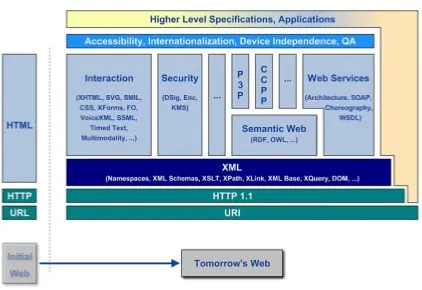
The evolution of Internet technology is very fast. W3C is transforming the architecture of the initial Web (essen-tially HTML, URIs, and HTTP) into the architecture of tomorrow’s Web (Figure 1), built on the solid foundation provided by XML.
Web technology and farmers
Webové technologie a farmá
ř
i
Z. H
AVLÍČEKCzech University of Agriculture, Prague, Czech Republic
Abstract: Web technology is a major element of the Internet. The various and inexpensive possibilities to use this technology allow for the minimisation of differences between rural and urban areas. This article focuses on the use of www technology for creating web sites. It outlines theoretical starting points for planning web sites, as well as practical methods, which are utilised for setting up the web presentation of a farm.
Key words: web site, www evolution, extranet
Abstrakt: Webové technologie jsou hlavním prvkem Internetu. Rozmanité a nenákladné možnosti použití této technologie umožňuje minimalizaci rozdílů mezi venkovskými a městskými oblastmi. Článek je zaměřen na využívání www technologií pro tvorbu web site. Zdůrazňuje jak několik teoretických východisek pro plánování web site, tak i praktické metody, které se používají při vytváření webových prezentací pro zemědělskou farmu.
WEB SITE AND WEB DESIGN
A web site represents a multitude of web files dedicat-ed to a certain type of activities (a specific area) and it also contains an introductory file called Home Page. The majority of large companies and organisations have their own web sites, each with their own specific address. For example, the home address www.czu.cz allows access to the web pages – web site – of the Czech University of Agriculture in Prague. In this case, we may use the term web server, since all web pages are physically download-ed within a single computer.
On the other hand, the use of the term web server is somewhat inaccurate, since web pages of large compa-nies, such as IBM or Microsoft, are scattered over a num-ber of servers at different geographical locations. There also exists an alternative in which some ISP’s (Internet Service Provider) offer a proportion of their hard disks space for downloading web pages of a variety of clients. Thus, for example, the Society of the Hovawart dog breeders can advertise their activities on the Internet without having their own server.
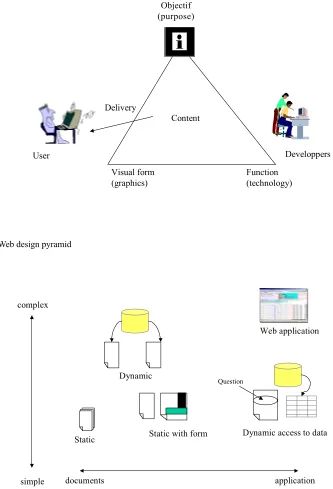
There are five areas that cover the major facets of Web design (Figure 2):
– Purpose
The reason the site exists, often related to an economic issue, is arguably the most important part of Web de-sign.
– Content
This includes the form and organisation of a site’s
con-tent. This can range from the way text is written to how it is organised, presented, and structured.
– Visuals form
This refers to the screen layout used in a site. The lay-out is usually created using HTML and CSS and may include graphic elements.
– Technology
Technology refers to the various interactive elements of a site, particularly those built using programming tech-niques. Such elements range from client-side scripting languages.
– Delivery
The speed and reliability of a site’s delivery over the Internet.
TYPOLOGY OF WEB SITES
The growing importance of usability in web sites is directly related to a movement from the Internet. In the early days, most sites were just an electronic form of print product, similar to a brochure or catalogue. Today’s Web sites are increasingly complex. The range of web sites is presented by (Powell 2000) – Figure 3.
A web site represents a multitude of web files dedicat-ed to a certain group of activities (a specific area). The majority of large companies and organisations have their own web sites, each with its own specific address.
[image:2.595.80.502.54.344.2]On the other hand, an alternative exists in which some ISP’s (Internet Service Provider) offer a proportion of
their hard disk space for downloading the web pages of a variety of clients.
Development of the web site involves e.g. the struc-ture of www pages, the method of graphic expression, and linkages to other pages. This leads to a computer ap-plication that utilises the principles of information sys-tems and a project developed in the following stages: – Design
– Creation and implementation – Operation
Within each of these stages, specific practical ques-tions must be resolved. Thus, in the design stage, we ask: – What is to be published?
– Who is the Web Site aimed at?
– What is the communication strategy of a given farmer? – Is suitable material, such as photographs, available?
RESULTS
Connecting to the Internet
Farmers have Internet access and theoretically are ready to buy or sell on-line.
[image:3.595.109.442.63.552.2]Research shows that, for example in Great Britain, 69% of arable farmers are online and that 90% of all farmers on line are ready to purchase inputs over the Internet .
Figure 3. The types of web sites Figure 2. The Web design pyramid
complex
simple documents application
Static
Dynamic
Static with form
Web application
Dynamic access to data Question
Visual form (graphics)
Content
Function (technology)
Developpers User
Delivery
[image:3.595.141.443.65.257.2]In the Czech Republic, connecting to the Internet also rapidly increases. More than 90% of large farm are con-nected.
Use of the Internet has developed as a result of demand within the agricultural industry, but also following antic-ipation of that demand by various providers of Internet-based services.
In the Czech Republic, only, 1.6 % of farmers have a www presentation (Jarolímek, Vaněk 2001), 5% of farmers (own-er research July 2002 – FEM CUA Prague) have a web site. For improving this situation, it is proposed to prepare web site by:
• To use a prepared common solution – e.g. “A-web” (of-fered by FEM CUA Prague – see: www.agris.cz), Actu-ally more than 10 farmers use these services.
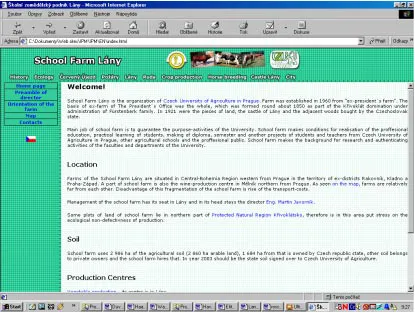
• Specific individual solution for a farmer. To prepare not only web sites for the farm presentation, but also to pro-pose a dynamic web site, the type Extranet, that allows a farmer better communication with partners and others. An essential requirement for a web site success is suit-able co-operation between a farmer and an IT specialist. In the course unit Informatics for the Managers, this new approach is used to develop a web site for agricul-tural farms. At present, it is considered necessary for the students to acquaint themselves with the methodology of creating web pages and to understand the needs of farmers. Groups of students are given tasks in accor-dance with specific requirements of farmers, and they then create the web sites. An example of a new web site
is found in Figure 4. The web site (files HTML, scripts) will be placed in an ISP.
CONCLUSION
The impact of the Internet on farm management is very important. The conclusion of our survey is that, through the Internet, the farmer’s office is/will be connected to those of his advisers, of his commercial partners, etc. Through the web sites, e.g. offices of co-operatives are becoming neighbours to those of all farmers.
WWW technology is expanding rapidly and touches almost all areas of human activity. It is therefore essen-tial that farmers can participate in the creation of web sites for their farms.
Agricultural universities must prepare not only stu-dents to use new IT, but must also help farmers in better use of the web by different means, eg, extension servic-es, and creating new specific web sites.
REFERENCES
Powell T.A. (2000): Web Design. The complete reference. Osborne.
[image:4.595.88.503.56.369.2]Vaněk J., Havlíček Z., Jarolímek J., Šilerová E. (2001): Portá-lové řešení informačních služeb v agrárním sektoru. Confe-rence System Integration, Prague.
Waksman G. (2001): ICT farm management: impact of the Internet. 3rd EFITA Conference, Montpellier, France. Havlíček Z. (2000): Web design a jeho vliv na
konkurence-schopnost, Sborník odborné konference Využití IT při bu-dování konkurenční výhody II, PEF ČZU, Praha.
Jarolímek J., Vaněk J. (2001): Využití Internetu v českém ze-mědělství. Konference Informační systémy v zemědělství a lesnictví, Seč: 86–93; ISBN 80-238-6472-6.
www.w3c.org
Arrived on 6th November 2003
Contact address:
Doc. Ing. Zdeněk Havlíček, CSc., Česká zemědělská univerzita v Praze, Kamýcká 129, 165 21 Praha 6-Suchdol,
Česká republika