Proceedings of the Institute of Acoustics Volume 22, Part 5, 2000
pages 61- 68
THE 75 dB(A) THRESHOLD LEVEL OF
THE PHYSICAL AGENTS DIRECTIVE:
A FLAWED EVOLUTION
B W Lawton Institute of Sound and Vibration Research, University of Southampton, SO17 1BJ
1. INTRODUCTION
In 1993, the Council of the European Communities proposed a Directive dealing with the exposure of workers to physical agents, one of which is noise (CEC, 1993; amended by CEU, 1994). This draft Physical Agents Directive is intended to repeal the current noise-at-work regulations (CEC, 1986) and to introduce measures which are more protective. As a matter of social and employment policy, the risks arising from noise exposure must be reduced to the lowest achievable level, ultimately to below a Threshold Level, “the exposure value below which continuous and/or repetitive exposure has no adverse effect on the health and safety of workers”. In respect of noise-induced hearing loss, the proposed Threshold Level is set at an LEX,8h value of 75 dB(A).
In the light of the definitions above, the various Articles of the proposed Directive require certain general and specific actions on the part of the employer.
1. Taking account of the availability of measures to control noise at its source, the risks arising from noise exposure must be reduced to the lowest achievable level; the aim is to get workers’ daily noise exposure below 75 dB(A).
2. If noise exposure exceeds the Threshold Level, then exposed workers must be informed of the potential risk of noise-induced hearing loss.
Obviously, the Threshold Level will assume considerable importance for industry, becoming the target for any noise control programme. If that ideal cannot be achieved, then exposed workers must be informed that their hearing may be at risk from noise at work.
The draft Physical Agents Directive was accompanied by an Explanatory Memorandum which gave background on the aim of the proposal and the need for action, relying upon a draft International Standard (International Organization for Standardization, 1982 and 1985). The Memorandum stated that, during the period leading up to the 1986 Council Directive on noise at work, “scientific and technical knowledge was already sufficiently advanced to make it possible to ascertain precisely the harmful effect of noise on hearing capacity. The scientific community had already established that, from 75 dB(A) on, the risks run by workers were far from negligible.” These statements may be challenged on several counts.
The 75 dB(A) noise exposure Threshold Level - B W Lawton
showed no hearing loss except that expected for their age. Where noise exceeded an LAeq,8h of
85 dB(A), a risk of noise-induced hearing loss emerged. As workplace noise increased to higher levels, the risk of hearing damage became plain.
This paper examines the background of the 75 dB(A) exposure threshold of ISO 1999, which is the foundation of the Threshold Level of the proposed Physical Agents Directive. However, it will be shown that ISO 1999 is flawed. There is considerable uncertainty in the predicted magnitude of noise-induced threshold shift, particularly for low noise exposure levels; this uncertainty persists in the Threshold Level of the draft Directive.
2.
THE ISO STANDARD
The various editions (1982, 1985, 1990) of the standard ISO 1999 enable the prediction of Hearing Threshold Levels resulting from noise exposure and natural ageing. Formulae are given for the calculation of noise-induced permanent threshold shift (NIPTS) for the frequencies 500 Hz to 6 kHz. The noise is deemed to last 8 hours per day, over a period ranging from 0 to 40 years, with daily exposure LEX,8h ranging from 75 dB(A) to 100 dB(A).
The lower limit of applicability of the standard, an LEX,8h of 75 dB(A), is implicit in the calculation
method. For exposure levels above 75 dB(A), and durations ranging from 10 to 40 years, the median NIPTS values, N0.50 in dB, for both sexes are given by the equation:
N0.50 = [u + v log q ] [ LEX,8h – L0 ] 2
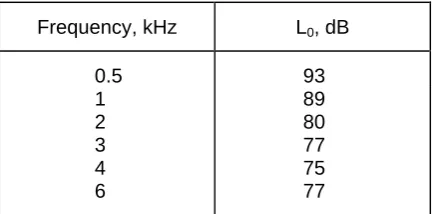
where L0 is a cut-off sound pressure level defined as a function of audiometric frequency,
q is the exposure time in years, and
u and v are parameters tabulated as a function of frequency.
[image:2.595.190.409.541.648.2]The values of u and v (appropriate to the different frequencies) are of no interest for present purposes; the values of L0 are reproduced below in Table 1.
Table 1: Values of L0 for each audiometric frequency
Frequency, kHz L0, dB
0.5 93 1 89 2 80 3 77 4 75 6 77
Note that L0 assumes a minimum value at 4 kHz, the audiometric frequency at which noise-induced
hearing loss usually appears first. For an LEX,8h of 75 dB(A), the squared term in the equation above
equals zero, therefore the median NIPTS is zero. For LEX,8h less than 75 dB(A), NIPTS is defined as
zero. Other fractiles of the NIPTS distribution are also calculated using the term [ LEX,8h – L0 ] 2
. Therefore, NIPTS at 4 kHz is zero for all members of the population exposed to 75 dB(A) or less. In fact, a non-zero value of NIPTS at 4 kHz is not predicted until the exposure reaches 78 dB(A). To show the influence of the quantity L0 upon NIPTS, predicted threshold shifts are given in Table 2
The 75 dB(A) noise exposure Threshold Level - B W Lawton
noise-exposed population and also the most noise-susceptible decile. An LEX,8h of 75 dB(A) yields
NIPTS values of zero. Exposures of 76 and 77 dB(A) give non-zero NIPTS values for 4 kHz but rounding to the nearest integer decibel still gives entries of zero.
For an LEX,8h of 78 dB(A), a non-zero value of NIPTS at 4 kHz emerges for the 'tender-ear' decile
[image:3.595.84.515.317.676.2]after 10 years of exposure. After 20 years of exposure, the threshold shift at the median reaches 1 dB. Further exposure duration up to 40 years does not enlarge the 1 dB of NIPTS at 4 kHz, and does not produce NIPTS at any other frequency. A threshold shift of 1 dB is virtually undetectable, and is imperceptible to the person with such a loss. Even if the predicted values of NIPTS are accepted as true, the Threshold Level of the proposed Directive should not be 75 dB(A), but closer to 80 dB(A).
Table 2. Noise-induced permanent threshold shift, in dB, by ISO 1999 calculations.
Exposure duration 10 yr 20 yr 30 yr 40 yr
Fractile 50% 10% 50% 10% 50% 10% 50% 10% LEX,8h Freq.
dB(A) kHz
78 1 0 0 0 0 0 0 0 0
2 0 0 0 0 0 0 0 0
3 0 0 0 0 0 0 0 0
4 0 1 1 1 1 1 1 1
6 0 0 0 0 0 0 0 0
80 1 0 0 0 0 0 0 0 0
2 0 0 0 0 0 0 0 0
3 0 1 1 1 1 1 1 1
4 1 2 1 2 2 2 2 2
6 0 1 0 1 0 1 1 1
85 1 0 0 0 0 0 0 0 0
2 1 1 1 2 1 2 2 2
3 3 5 4 6 4 7 5 7
4 5 7 6 8 6 9 7 9
6 3 4 3 5 3 6 4 6
90 1 0 0 0 0 0 0 0 0
2 2 6 4 8 5 9 6 10
3 8 13 10 16 11 18 12 19
4 11 15 13 18 14 19 15 20
6 7 12 8 14 9 15 10 15
Still referring to Table 2, it may be seen that an LEX,8h of 80 dB(A) is another landmark: non-zero
The 75 dB(A) noise exposure Threshold Level - B W Lawton
The behaviour of NIPTS across frequencies, exposure levels and exposure durations is determined by the workings of the equation for N0.50 as seen above. Its derivation is based upon work
undertaken for the ISO committee by Johnson (1978), forcing a synthesis of two incompatible data sets.
2.1 UK
Data
Hearing surveys of noise-exposed British workers were conducted during the 1960s by the Medical Research Council working with the National Physical Laboratory. The findings of this work were condensed into a set of convenient tables (Robinson and Shipton, 1977) giving a form of NIPTS for a normal population with noise exposure every working day for a given number of years. Provision is made for various fractiles of the population, frequency (0.5–6 kHz), and sex. Adding a standard age correction gives overall Hearing Threshold Level (HTL). This NPL data formed one half of the input to Johnson's 1978 synthesis
To allow convenient use of the NPL tables, the statistical variation of both age and noise effects is loaded on to the noise component alone and cannot be partitioned between the two components. Johnson, nevertheless, attempted just such a separation in order to force the British data into a format compatible with other information available at the time.
2.2 Dutch
Data
Johnson's other input data were contained in a report by Passchier-Vermeer (1977). The hearing loss model was given in the form which Johnson desired, as separate distributions (90%, 50% and 10%) of NIPTS and age components, with overall HTLs being obtained by summing at corresponding fractiles.
Although being in the desired format, the data were far from satisfactory. For the frequency 4 kHz, expected to show the first sign of damage by noise, the NIPTS component actually decreased with increasing years of exposure for the ‘tender-ear’ decile. Such a notion is, of course, false: longer noise exposure is not beneficial to the hearing. A related fault indicated that, for some durations, the ‘tender-ear’ decile had a smaller NIPTS component than the ‘tough-ear’ end of the distribution. Despite such obvious shortcomings, the Dutch data was included in the ISO 1999 model for noise-induced hearing loss.
2.3
The ISO Model
The data derived from the two sources described above were not in close agreement; in some cases, the corresponding values differ by over 20 dB. However discordant, the values were simply averaged to provide a data field which was then modelled mathematically. The curve-fitting procedure introduced two arbitrary assumptions regarding the noise exposure threshold.
1. Noise exposures of 75 dB(A), no matter for how long, produce no hearing loss. This threshold value has its origin elsewhere, as will be shown in following sections.
2. NIPTS is proportional to the excess of actual exposure over the 75 dB(A) threshold. This model for the growth of NIPTS has no foundation in experiment.
The 75 dB(A) noise exposure Threshold Level - B W Lawton
3.
THE WORLD HEALTH ORGANIZATION
The World Health Organization (1980) criteria on noise gave information on the estimation of hearing impairment risk, and might be thought of as an authoritative source for the ISO 75 dB(A) noise exposure threshold. A summary statement was given: “For the working environment, there is no identifiable risk of hearing damage in noise levels of less than 75 dB(A) Leq (8-h). For higher
levels, there is an increasing predictable risk and this must be taken into account when setting occupational noise standards.” On the specific subject of noise-induced permanent threshold shift, the important text was: “... the percentage of people who suffer an NIPTS of 5 dB (the smallest amount measurable) at the most sensitive frequency (4000 kHz) may be defined as a function of an equivalent 8-h level. [Here, the WHO document refers to a diagram attributed to US Environmental Protection Agency, 1974.] From this diagram, an 8-h equivalent level of 75 dB(A) can be identified as the limit for protection against significant NIPTS.” Whilst adding support to the ISO exposure threshold, it is clear that the WHO recommendation is a simple restatement of information from the US Environmental Protection Agency.
4.
THE EPA “LEVELS DOCUMENT”
[image:5.595.155.442.568.672.2]The 75 dB(A) noise exposure value featured in an important social policy document from the US Environmental Protection Agency (1974), to establish sound levels which would not adversely affect public health. Any measurable loss of hearing sensitivity, at any audiometric frequency, was deemed unacceptable. A noise-induced permanent threshold shift of 0 dB was thought ideal, but not entirely appropriate: there was no evidence to suggest that a NIPTS of 5 dB or less would be perceptible by an individual with such a hearing loss. Therefore, an imperceptibly small threshold shift at the most noise-sensitive frequency 4 kHz was thought to be of no practical significance. The EPA recommendation was based upon a synthesis (earlier work by Johnson, 1973) of results from three occupational hearing loss surveys, one Dutch, one British, and the last American. These survey results were summarized to give the predicted maximum NIPTS for the better-hearing decile, median, and worse-hearing decile of a noise-exposed population after a 40 year working lifetime in a range of average noise levels.
Table 3. NIPTS (dB) at 4 kHz
LAeq,8h Fractile
dB(A) 90% 50% 10%
75 0 1 6
80 2 4 11
85 5 9 19
90 11 15 28
The 75 dB(A) noise exposure Threshold Level - B W Lawton
A further step involved the seemingly reasonable limiting condition that one’s hearing cannot be damaged by a sound not loud enough to be audible. The worse-hearing extreme of the distribution of 4 kHz HTLs in 60 year old women was used (wrongly) to estimate what sound levels would be inaudible to younger workers. This information is superimposed on the 5 dB NIPTS line of Figure 1 by the simple expedient of equating the A-weighted exposure level of a broadband noise in free air to the magnitude of a pure tone, presented by earphone and measured in terms of dB above ‘audiometric zero’. If one accepts this numerical operation, then a conclusion may be drawn from the Figure: If occupational noise exposure is limited to 75 dB(A) or less, then no US worker will suffer a NIPTS greater than 5 dB at 4 kHz.
Despite the uncertainties of this line of reasoning, the EPA recommended that an LAeq,8h of 75 dB(A)
would protect the hearing of the American public “with an adequate margin of safety”. In fact, the recommended occupational noise threshold value was intentionally conservative to protect the
entire American working population from an imperceptible hearing loss due to noise, even after a working lifetime of 40 years.
5. CONCLUSIONS
There are a number of issues embedded in the noise exposure Threshold Level of the European Union draft Physical Agents Directive. The Threshold Level was set at LEX,8h = 75 dB(A),
administratively marking “the exposure value below which continuous and/or repetitive exposure has no adverse effect on the health and safety of workers”. This is a statement by the Commission of the European Union of a new goal of social and employment policy, in respect of hearing damage by occupational noise.
It appears that the value 75 dB(A) originates with the International Organization for Standardization, but consideration of the contemporary literature indicates otherwise. The US Environmental Protection Agency judged that an LAeq,8h of 75 dB(A) would protect the hearing of the American
public “with an adequate margin of safety”. In fact, this recommended occupational noise threshold value was intentionally conservative to protect the entire working population from even minimal hearing injury at the most noise-susceptible audiometric frequency. The WHO endorsed this goal of social policy.
Since the EPA, WHO and ISO documents were published, there have been a number of occupational hearing loss studies involving low-level noise exposures. The results suggest a region of transition between no noise effect and a clear effect. Below an LEX,8h value of 80 dB(A), the daily
occupational noise seems to have little if any effect upon the 4 kHz threshold of even the most susceptible workers; male workers exposed to a daily average noise level of 80 dB(A) or less showed no hearing loss except that typically expected for their age. As workplace noise becomes greater, the risk of hearing damage becomes evident. Where noise exceeds an LAeq,8h of 85 dB(A),
there is a chance of acquiring noise-induced hearing loss. Above 90 dB(A), the risk of hearing damage becomes plain and progressively more severe for populations with higher noise exposures. The concept of an noise exposure Threshold Level is worthwhile, indeed necessary, but the LEX,8h
value 75 dB(A) is unnecessarily restrictive. The scientific evidence suggests that the Threshold Level could be higher without sacrificing the aim of no noise-induced hearing loss, even in the most noise-susceptible portion of the population exposed for a working lifetime.
6. REFERENCES
The 75 dB(A) noise exposure Threshold Level - B W Lawton
Commission of the European Union. Amended proposal for a Council Directive on the minimum health and safety requirements regarding the exposure of workers to the risks arising from physical agents. Official Journal of the European Communities, 19 August 1994, No C 230/3-12.
Council of the European Communities. Council Directive on the protection of workers from the risks related to exposure to noise at work. Official Journal of the European Communities, 5 May 1986, No L 137/28-34.
Environmental Protection Agency. Information on levels of environmental noise requisite to protect public health and welfare with an adequate margin of safety. Report 550/9-74-004, 1974, US Environmental Protection Agency, Washington DC.
Flottorp G. Ten year test of the Norwegian regulations relating to noise at the workplace. Proceedings 15th International Congress on Acoustics, Trondheim, 1995; III: 225-228.
International Organization for Standardization. Acoustics - Determination of occupational noise exposure and estimation of noise-induced hearing impairment. ISO 1999:1990 second edition. (Preceded by two draft international standards ISO/DIS 1999 of 1982 and ISO/DIS 1999.2 of 1985.) Johnson DL. Prediction of NIPTS due to continuous noise exposure. Issued jointly as: Report EPA-550/9-73-001-B, 1973, US Environmental Protection Agency, Washington DC; Report AMRL-TR-73-91, 1973, Aerospace Medical Research Laboratory, Wright-Patterson Air Force Base, Ohio.
Johnson DL. Derivation of presbycusis and noise induced permanent threshold shift (NIPTS) to be used for the basis of a standard on the effects of noise on hearing. AMRL-TR-78-128, 1978, Aerospace Medical Research Laboratory, Wright-Patterson Air Force Base, Ohio.
Passshier-Vermeer W. Hearing levels of non-noise exposed subjects and of subjects exposed to constant noise during working hours. Report B 367, 1977, Research Institute for Environmental Hygiene, Delft.
Passchier-Vermeer W. Occupational noise exposure and hearing: An analysis of recent publications on age-related hearing threshold levels and on hearing threshold levels of occupational noise-exposed populations. Report 88056, 1988, TNO Institute of Preventive Health Care, Leiden. Robinson DW, Shipton MS. Tables for the estimation of noise-induced hearing loss. Acoustics Report Ac 61 (second edition), 1977, National Physical Laboratory, Teddington.
The 75 dB(A) noise exposure Threshold Level - B W Lawton