University of Southampton Research Repository
ePrints Soton
Copyright © and Moral Rights for this thesis are retained by the author and/or other
copyright owners. A copy can be downloaded for personal non-commercial
research or study, without prior permission or charge. This thesis cannot be
reproduced or quoted extensively from without first obtaining permission in writing
from the copyright holder/s. The content must not be changed in any way or sold
commercially in any format or medium without the formal permission of the
copyright holders.
When referring to this work, full bibliographic details including the author, title,
awarding institution and date of the thesis must be given e.g.
AUTHOR (year of submission) "Full thesis title", University of Southampton, name
of the University School or Department, PhD Thesis, pagination
Video Database Management System
A Mini thesis submitted for transfer of registration from M-Phil
to PhD.
May 1999,
3
Contents
1.0 INTRODUCTION ... 5
2.0 INITIAL WORK CARRIED OUT ... 5
2.1 LITERATURE REVIEW ... 5
2.1.1 Data Modelling ... 6
2.1.2 Query Processing ... 7
2.1.3 Compression Techniques ... 7
2.2 INITIAL EXPERIMENTATION ... 7
3.0 THE CURRENT STATE OF PROGRESS ... 8
3.1VIDEO DATA ... 8
3.2 VIDEO DATA MODEL ... 11
3.2.1 Object Entities ... 13
3.2.2 Thematic Indexing ... 15
3.2.3 Common Video Tree Model ... 17
3.2.4 Objects in Video Clips: ... 18
3.3 DATA QUERY &RETRIEVAL ... 21
3.3.1 Query types ... 21
3.3.2 Query Certainty ... 21
3.3.3 Query Processing ... 22 4.0 EXPERIMENTATION ... 22
5.0 SUMMARY & FUTURE TASKS ... 24
APPENDIX 1 ... 26
A1 VIDEO DATA MODELLING ... 26
A1.1 ANNOTATION DEPENDENT MODELS... 26
A1.1.1 VidIO ... 27
A1.1.2 Vane ... 30
A1.1.3 A. Caetano & N. Guimaraes (1998) ... 31
A1.2 OBJECT ORIENTED DATA MODELS... 32
A1.2.1 S. Gibbs & C. Breiteneder (1995) ... 33
A1.2.2 L. Huang & W. Xiong (1995) ... 34
A1.2.3 MPIL ... 35
A1.3 VIDEO ALGEBRA ... 36
A1.4 THE VISIONDIGITAL VIDEO LIBRARY ... 37
4
APPENDIX 2 ... 39
A2.1 MPEG OVERVIEW ... 39
A2.2 MPEG-4... 40
A2.2.1 Functionality of MPEG-4 ... 41
A2.2.2 Scene Description in MPEG-4 System ... 42
A2.2.3 Representations of AV objects ... 42
A2.2.4 System Layer Model ... 43
A2.2.5 Scene Description Unit ... 44
A2.2.6 MPEG-4 File Format: ... 46
A.2.3 MPEG-7... 47
5
1.0 Introduction
Advances in multimedia computing technologies have offered new opportunities to store,
manage, and present video data in databases. Object oriented technology on the other hand
provides novel ways to organise the multimedia items, by supporting both the temporal as
well as spatial properties. Many researchers come up with data models by implementing
object oriented concepts into multimedia technology. The aim of this work is to make a video
data model, called VDbMS (Video Data Base Management System) by incorporating and
integrating the above mentioned technologies.
This report summarises the current progress of this research in the development of VDbMS.
The intention of this database system is to provide an effective way for storing video data,
optimal query parsing and an ideal interface for user interactivity.
This report is separated into six sections. Section 2 briefly reviews the previous twelve
months. Section 3 depicts the work carried out in the next six months in developing the video
model. Section 4 tells us about the experiments on the video data. Section 5 is about the
conclusions and the line of action for future work and finally section 6 is the appendixes for
some video models and MPEG4
2.0 Initial work carried out
Following is the summary of the initial six months, which can be termed as the foundation of
my research work:
2.1 Literature Review
A lot of work is going on in the field of video data modelling and its applications, due to its
high commercial value. Since video itself is a very complex object with both spatial and
temporal properties, researchers are still unable to get a proper and comprehensive data
model. A summary of literature review covering various video data models (annotation
dependent, hierarchical, object-oriented, algebraic, etc.), video content-based understanding,
indexing, segmentation of scenes and objects, visual learning, query processing and different
6 2.1.1 Data Modelling
The functionality of a database is measured by data manipulation and query processing. A
query for video data is very complex in nature. It is also possible that a database user can
make a content based query (objects inside the video), as well as feature based (technical
specifications of the video i.e. frame rate, segment change etc.). Various models have been
suggested by different researchers, based on relational, hierarchical and object oriented
concepts. The two major modelling schemas are:
Annotation Dependent Models:
These models heavily depend on hierarchical or relational databases. In these type of
models, some textual data (also known as signatures or metadata) about the contents
of video are embedded into the video data. Usually an annotator is required to write
the captions, but in some models dynamic text can be generated from the audio.
VidIO[1], VANE[2], Video-STAR[3] and Media Object [4]are the models of this
category.
Object Oriented Models:
Object Oriented Database Management Systems are considered to be good for
defining multimedia models, as they can entertain both spatial as well as temporal
features of any media. Another property of a media object is that it can define its own
data rate, abstraction and other attributes. Again an AV (audio video) object can be
accessed concurrently. OVID[5], Video Widgets[6], MPIL[7] are examples of object
oriented video modelling.
Apart from the above stated models, researchers have also tried to solve the problem of video
modelling by using complex algebraic methods[8], frame based techniques[9], or making a
hybrid system[10], comprising all or some of the above stated models. These models are
7 2.1.2 Query Processing
A browser enables a user to access all information related to a specific piece of video,
querying makes it possible to formulate some conditions and then retrieve only the video
material that have desired properties. In VDbMS, a query can give the output defined as exact
match, in-exact match or similar match, where the major data indexing is based on
annotations, video technical data such as frame rate, colour histogram, etc and audio
data[11].
2.1.3 Compression Techniques
Compression is the key to low data rate for digital video and a number of studies have
undertaken to devices suitable compression algorithms and techniques. These methods can be
categorised into lossy or loss-less compression methods. Some of the industry compression
standards are DVI (Digital Video Interface), MPEG (Moving Pictures Expert Group),
M-JPEG (Motion Joint Pictures Enhanced Group), Apple QuickTime, and Microsoft AVI
(Audio Video Interleaved). It was found that MPEG-4 is the best for multimedia applications,
at the moment as it provides content based interactivity, improved compression techniques
and support for working at a very low bit rate (< 1Mbits/sec)[12,13]. Keeping the advanced
functionality of MPEG-4 in view, VDbMS is designed to be totally compatible to this
standard. MPEG-4 is discussed in detail in Appendix B.
2.2 Initial Experimentation
Trial experimentation was started by making a video database of some videos from the Lord
Mountbatten archives. It was decided that the research direction would be in the area of
digital video archives and their databases.
The major task for next six months was to design and develop a comprehensive video data
model, called VDbMS (Video Database Management System), which can incorporate
temporal as well as spatial entities of a digital video.
8
3.0 The current state of Progress
During the last twelve months, I have carried out the task of understanding the video data
formats and then designing an object oriented video model for VDbMS. At the same time trial
experimentation was continued on the Lord Mountbatten documentaries. First, using a basic
scene detection algorithm, the video was broken into different scenes. These scenes were then
given some captions and stored in a simple database. Still no impressive results were found.
Then it was decided that a comprehensive data model should be developed to support all the
video-related functions.
Section 3.1 discusses the basic types of information available in the video data, 3.2 describes
the VDbMS model, the object entities used in the model and a note on thematic indexing,
3.2.3 discusses video object tree and finally section 3.3 describes data query and retrieval.
3.1 Video Data
A video database will store different types of information, which is divided into streams,
sequences, scenes, shots and frames. A video database can be defined as a collection of sets
where the elements of each set are elements of the same type. Here the object – oriented
approached is used in VDbMS, so that each element is identified by a unique object identity.
Objects may be complex with attribute that are objects on their own.
Following is a short description of the different object types, which are relevant for the data
model of VDbMS:
• Stored Media Segments: Audio & Video data which are generated during recording.
• Video Streams: Video documents are composed from pieces of stored media segments.
A video document represents a logical stream of video data that may be explicitly stored.
• Media Streams: Media streams are a generalisation of stored media segments and video
streams.
• Stream Interval: A stream interval represents a contiguous sequence from a media
9
• Video Content Indexes / Annotations: For browsing and querying purposes there is a need to relate entities from a real-world model to pieces of video. This relation is made
by annotating an video object that identifies the stream interval of interest and that is
linked to an element of a real-world model.
• Video Document Structure: Video documents can have a certain structure. This
structure can be represented by a set of structural components where each component
identifies a stream interval.
Video data is stored as contiguous groups of frames called stored video segments. A video
document is represented by a video stream which is mapped to one or more stored video
segments. An important and flexible video information unit is frame sequence which is an
interval of subsequent frames from a video document. One single frame sequence can
represent any sequence of video frames ranging from one single video frame to an entire
video document. The frame sequence is also responsible for connecting structural units and
thematic annotations to the video material. A frame sequence can also be defined as a ‘part
of’ relationship to a video stream, as shown in fig (1).
The structure of a video document is represented by a hierarchy of structural components.
Each structural component identifies a frame sequence which consists of the frames that
belong to the component. The entire video document or a single frame can also become a
structural component, but a whole document is too coarse as a level of abstraction and a
single frame is rarely a unit of interest[9].
From experiments, it has been learnt that abstractions such as scenes or events make it easier
for a user to make references to video information and easier to comprehend its contents.
Therefore more emphasis in VDbMS is given to metadata which are categorised as Event,
Location, Person, Object_of_Interest metadata.
Since a huge metadata is created while annotating different video scenes, it is very important
that some standards for metadata should also be followed. While doing literature review, it
was found that WWW consortium (W3C) is coming up with Resource Description
Framework (RDF), which provides a more general treatment of metadata. RDF is a
declarative language and provides a standard way for using XML to represent metadata in the
form of properties and relationships of items on the Web. Such items, known as resources,
10
Along with ISO also introduced MPEG-7 standard, which will specify a standard set of
descriptors that can be used to describe various types of multimedia information. MPEG-7 is
discussed further in Appendix 2.
Fig (1) A common data model for video information sharing using an ER-notation, suggested by Hjesvold[27]. Here the video document is catogorised into Frame Sequence, which is further divided into different types of annotations
Video Document ComponentStructured Compound Unit
Shot Scene Sequence Event Annotation Location Annotation Object_of_Interest Annotation Annotation Frame Sequence Stored Video Segment Video Stream D D Id Title Description
[image:10.595.72.526.149.606.2]11
3.2 Video Data Model
The work started with the idea that a large or long video should be divided into very small
fragments or clips of a few seconds, depending only on simple scene detection algorithm.
Soon it was found out that this technique is useless due to the following drawbacks:
• It was impossible to track the main story of the video, as one small video clip was unable to show the main theme.
• Query search was not possible, as a query can be of a concept, story or an event, whereas our division was based on a simple scene change technique, which was just the histogram
difference of the two shots.
• This technique might be suitable for videos such as news clips or a catalogue of commercials, but when a full hour documentary programme is processed (as in our case),
event sequence, frame sequence and hierarchy of scenes cannot be established.
It was also found that in documentary movies, like that of Lord Mountbatten, video
modelling was heavily dependent on annotations or metadata of a video. Since algorithms of
computer vision are still not able to get the whole data of a scene or a sequence, especially
concepts, themes and ideas, so special importance to the metadata is given in VDbMS model.
Audio data is the other domain providing a lot of information about the video. Applying any
speech-to-text converter, one can generate streams of data which can be used to extract
metadata.
Apart from metadata, data regarding frame size, frame rate, colour, texture and other features
are also of important value. To create a comprehensive data model, all the above mentioned
entities should be modelled to such a way that issues such as data storage, query processing
and data indexing should be optimally resolved.
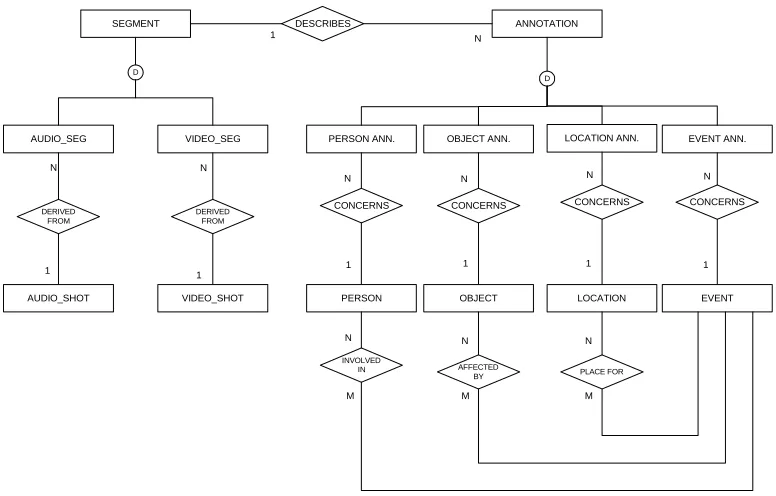
During the literature review phase, it was found that Hjesvold [14] had developed a very
precise model for annotating a segment. Metadata is generated from audio components as
well as video components. Textual information about an event, person, location or an object
is also inserted, as shown in figure (2). Hjesvold’s idea appeared very relevant and was made
the part of VDbMS model, with slight modifications such as adding an entity of concept in
12
Figure (2) Data components of a generalised video segment
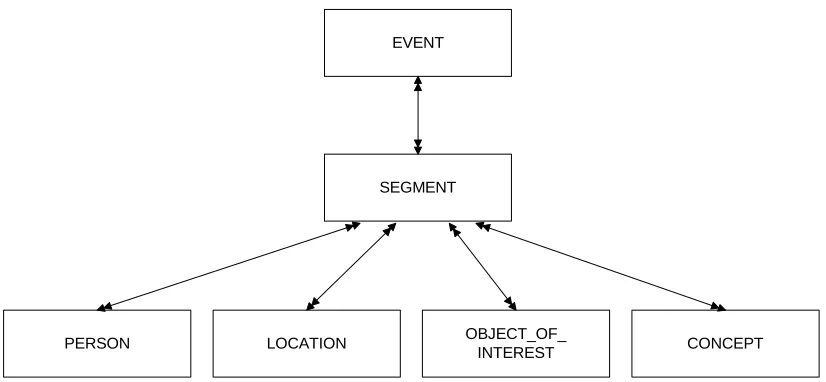
For VDbMS, considerable modifications are made in the data model shown in figure (2).
Since in VDbMS model the entity is considered as event, and a segment is a subset of an
event, so the event has been made the pivotal item, which comprise of segments, as shown is
figure (3). Further the segment describes the annotations for the objects inside the scene, such
as person, location, etc. Each object has its own metadata, which creates a many-many
relationship with the segment metadata. This is then normalised to create a relational database
for accessing any object present in the video scene.
SEGMENT DESCRIBES PERSON ANN. VIDEO_SHOT AUDIO_SHOT VIDEO_SEG AUDIO_SEG ANNOTATION CONCERNS DERIVED FROM DERIVED FROM PERSON EVENT ANN. LOCATION ANN. OBJECT ANN. INVOLVED IN CONCERNS CONCERNS CONCERNS EVENT LOCATION OBJECT PLACE FOR AFFECTED BY D D 1 N N N 1 1 N 1 N 1 N N 1 1
N N N
[image:12.595.100.488.70.318.2]13
Figure (3) Suggested Annotation model for VDbMS. Here 'event' entity is added
and been assigned a top level in hierarchy, as opposed of Hjesvold's model[27].
3.2.1 Object Entities
In this section, all the operations and attributes applicable to a composite entity are discussed.
The attributes of a composite entity are:
Object Identity: The unique identity of the component
Symbolic Name: The text string that the author may optionally assign to the
component to have a user generated name for identifying the
component.
Synopsis: Textual description of the component.
EVENT
DESCRIBED BY
PERSON ANN.
ANNOTATIONS
CONCERNS
PERSON
LOCATION ANN. OBJECT ANN.
INVOLVED IN
CONCERNS CONCERNS
LOCATION OBJECT
PLACE FOR AFFECTED
BY D
N
1
N
1
N
1
N N N
M M M
SEGMENT COMPRISED
OF 1
[image:13.595.129.434.124.501.2]14
Architecture Operations: This group includes operations for creating, modifying or
deleting components in the component architecture and for
manipulating the synchronisation of components in a
narrative presentation.
An event is defined as the set of scenes, constituting a part of a story. In the VDbMS data
model the major object entity is an event. It should be noted that even humans’ memory
circle around events. When people recall something, they often say “I played a movie of that
event in my mind”. It tells us that an event plays a very important role in our memory [2,6].
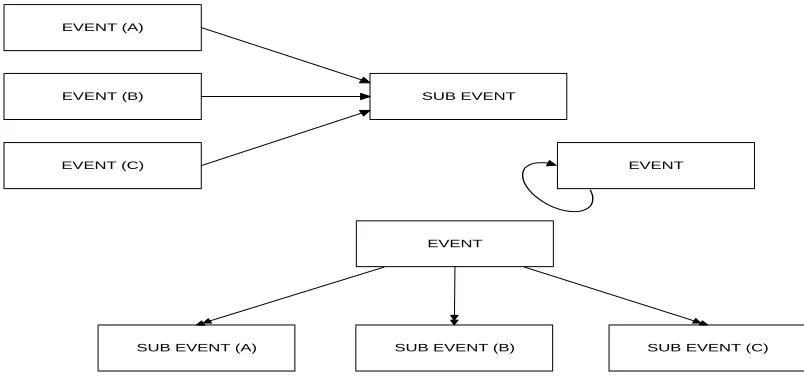
An event comprising of one or more segments, can be generated by another event or can
generate many sub events, and many events can generate a single sub event, as shown in
figure (4).
Figure (4) Inheritance properties of an Event
Hence the event entity is proposed over segment entity, as shown in figure (4), as compared
to Hjesvold’s generalised video model in figure (2). The main objective in this modification is
to maintain the sense of a story. Again the other entities, such as person, location,
object_of_interest, etc. are the sub group of the segment. This ER diagram shown in figure (4)
can be normalised accordingly and can be adjusted in the main data model.
EVENT
SUB EVENT (C) SUB EVENT (B)
SUB EVENT (A)
SUB EVENT
EVENT (C) EVENT (B) EVENT (A)
[image:14.595.100.502.402.592.2]15
Figure (5) ER Diagram of Annotation Model
It should be noted in figure(5) that another entity of concept is introduced in the model.
While watching the Lord Mountbatten documentary, it was found that some scenes require
additional information. Again some scenes were found which were impossible to define using
physical objects only. So another entity of ‘concept’ is introduced in the data model, where a
user can provide some textual information about the scene. The idea of concept as a textual
study is also used in Vane [2], where the entities are classified as tangible and conceptual
entities.
3.2.2 Thematic Indexing
A theme is defined as a topic of discourse or discussion [38]. While watching a movie, one
can find that many themes are interwoven with in and around a story. For the documentary of
Lord Mountbatten, it was realised that two main themes substantially form the whole story.
One theme is of Lord Mountbatten himself, his life, his career as a commander in the armed
forces and as a dignitary in Burma and India. The second theme is about the war between the
Allied Forces and the Japanese. Since a war is fought between nations, soldiers are involved,
weapons are used and injuries and fatalities occur. Here the two themes combine as Lord
Mountbatten himself is a soldier and a soldier fights a war.
EVENT
SEGMENT
CONCEPT OBJECT_OF_
INTEREST LOCATION
[image:15.595.93.506.83.274.2]16
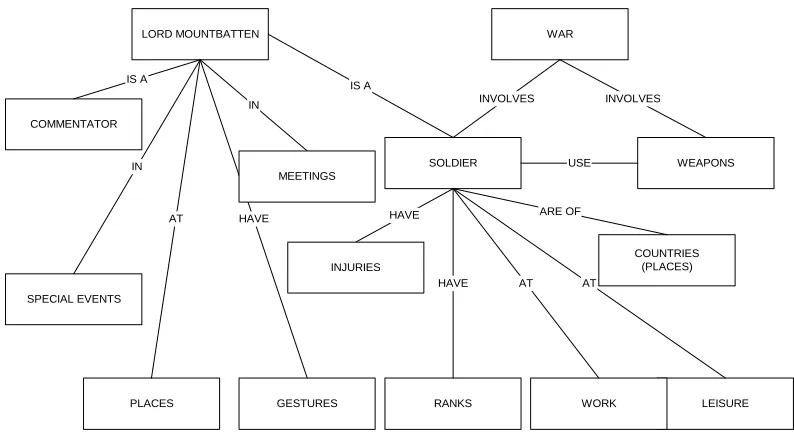
Figure (6) shows the object model of the above mentioned themes. This model can be very
useful in indexing and cataloguing the data, as the sense of the story is not broken and
structured data is obtained as well. Since this model is object oriented, real time modification
is also possible.
Figure (6) Thematic Indexing of Lord Mountbatten’s documentary
It should be noted that both the themes are implicitly related to each other, so indexing and
query processing can easily be done at various levels in the hierarchy of entities. For example
if a user is querying about Air Bombing, this will come under weapons entity, which is a
sub-part of the war entity. Another benefit of hierarchical modelling is that, at a certain level, if
the search engine is unable to obtain some match, it can always go back to the parent level
and fetch some related data.
LORD MOUNTBATTEN
LEISURE WORK
COUNTRIES (PLACES)
WEAPONS SOLDIER
RANKS SPECIAL EVENTS
GESTURES PLACES
COMMENTATOR
WAR
AT AT HAVE HAVE
INVOLVES INVOLVES
ARE OF IS A
IN
AT HAVE
IN
MEETINGS
INJURIES IS A
[image:16.595.99.496.171.387.2]17 3.2.3 Common Video Tree Model
Li, Goralwala, Ozsu and Szafron [39,40], gave the idea of a Common Video Object Tree
(CVOT), where objects contained in a video frame can be accessed. To understand this tree
model, following axioms should be determined:
Let a video clip "C" be associated with a time interval [ts, tf ]
Where ts starting time of clip
tf ending time of clip
Here ts and tf are relative (discrete) time instants and ts≤ tf
Since all clips have a start and finish time, a partial order could be defined over clips,
i.e. Ci = [tsi, tfi]
Then the following axioms hold true in a digital video,
Partial Ordered Clips:
Let Ci = [tsi, tfi]
Cj = [tsj, tfj]
Then is defined as the partial order over clips with Ci Cj iff:
Tsi≤ tsj and
Tfi≤ tfj
Ordered Clips
Ci is said to be ordered iff C is finite i.e. C = {C1, C2,..……,Cm} and there exists a time order,
such that C1≤ C2≤ C3 ….…. ≤ Cm
Perfectly Ordered Clips
A set of clips C = { C1, C2, …., Cm} is said to be perfectly ordered iff C is ordered and for
some two neighbouring clips i.e. Ci = [tsi, tfi] and Ci+1 = [tsi+1, tfi+1], we have tsi+1 = tfi+1
Strongly Ordered Clips
A set of clips C = {C1, C2, ….,Cm} is said to be strongly ordered iff C1 < C2 < C3 ..< Cm
Weakly Ordered Clips
A set of Clips C = {C1, C2,….,Cm} is said to be weakly ordered iff C is ordered for two
18
Hjelsvold and Midtstraum [3] also define some temporal operations on video clips. These
operations are annotation dependent and can be expressed in a traditional query language.
Some of these operations are
Ci EQUALS Cj: Returns true if Ci and Cj are identical
Ci BEFORE Cj: Returns true if Ci happens before Cj
Ci MEETS Cj: Returns true if Cj starts with the next frame after Ci has ended.
Ci OVERLAPS Cj: Returns true if Cj starts while Ci is still active
Ci CONTAINS Cj: Returns true if Cj starts after Ci and ends before Ci
Ci STARTS Cj: Returns true if Ci and Cj start with the same frame and Ci ends before Cj
Ci FINISHES Cj: Returns true if Cj starts before Ci and Ci and Cj end with the same frame.
If we look closely to these operations, they are more likely same, however quite important for
the foundation of VBDMS thematic indexing model. Further these axioms provide all the
operations required to query a video.
3.2.4 Objects in Video Clips:
A video frame has many noticeable real finite number of objects like persons, house, cars, etc.
Its assumed that there is always a finite set of objects, for a given video. Let "O" be the
collection of all the objects and "C" be the collection of all the video shots. Then the common
objects for a given set of video shots are the objects which appear in every clip within the set.
Then the intersection of m video shots can be defined as
(C1,C2,…..,Cm) = { ϒϒϒϒ(C1) ∩∩∩∩ϒϒϒϒ(C2) ∩∩∩∩ …..∩∩∩∩ϒϒϒϒ(Cm)}
19
Figure (7) Noticeable objects in different video scenes
For Example in Figure (7), we have six video shots, from Lord Mountbatten's video. Clip 1
contains a flag, Clip 2 contains titles, a tower and Burmese lions statues in the background.
The other clips contain Lord Mountbatten, a palace in Burma. If the video is segmented, then
C = {C1,C2,C3,C4,C5,C6,C7}
Furthermore,
C1 = Flag
C2 = Tower, Burmese lions statues
C3 = Burmese lions statues
C4 = Mountbatten, palace
C5 = Mountbatten, palace
C6 = palace
With the object point of view
ϒ(Flag) = C1 ϒ(Tower) = C2
[image:19.595.93.505.83.317.2]20
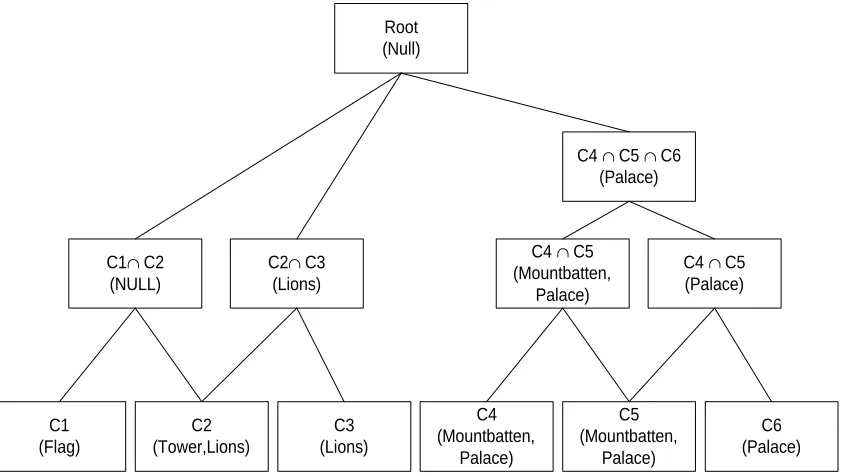
Hence now a relational tree can be developed by using any of the axioms stated above. For
example if we use the intersection axiom, then we have,
C1∩C2 = Null
C2∩C3 = lion statues
C4∩C5 = Mountbatten, palace
C5∩C6 = palace
Similarly we can build a hierarchical affinity like
C4∩C5∩C6 = palace
In this way we construct an object tree, shown in figure (8).
Figure (8). A Video Object Tree
Once the tree is established, a query can be created, by using any of the axioms. It should be
noted that this sort of tree can be developed at the frame, segment or scene level. Once this
tree is ready, the next step is to create generic links between these objects. For example
Mountbatten is a Soldier. Here "is a" relationship has been created between two objects
Mountbatten and Soldier. These generic relationship links will also provide themes of the
story. In this way one can also follow the story line of the video with thematic indexing.
C1 (Flag) C3 (Lions) C4 (Mountbatten, Palace) C5 (Mountbatten, Palace) C6 (Palace) C1∩ C2
(NULL)
C2∩ C3 (Lions)
C4 ∩ C5 (Mountbatten,
Palace)
C4 ∩ C5 (Palace) C4 ∩ C5 ∩ C6
(Palace) Root
(Null)
[image:20.595.91.513.325.563.2]21
3.3 Data Query & Retrieval
The efficiency of a database is evaluated by the nature and complexities of the queries, that
will be made about data. In terms of video the query and retrieval process becomes more
complicated by the numerous demands placed on the system. Elmagarmid [11] describes the
video data retrieval system in the following simple steps. First, the user specifies a query
using a facility provided by the user interface. The query is then processed and evaluated. The
value or feature obtained is used to match and retrieve the video data stored in the database.
At the end, the resulting video data is displayed on the user interface in suitable form.
3.3.1 Query types
Since the video data is spatial and temporal, the queries are heavily dependant on their data
content. Along with the architecture of the video data model and intended applications are
also many other factors that modify a query. A query can be divided into:
Query by Content: These queries are further categorised as semantic information query
(content information in the scene) , meta information query (scene
description information) and audio-visual query (audio and visual
feature of a scene)
Query by Nature: These queries depend on the nature of the video content and can be
further categorised in spatial or temporal aspects of the video
3.3.2 Query Certainty
The certainty of a query can be specified in terms of the type of matching operator used to
satisfy the query. A query can fall into Exact match, Inexact match, or similarity matched
queries.
Hjelsvold [15], in his Video-STAR data model, defined a video query algebra, that allows the
user to define complex queries based on temporal relationships between video stream
intervals. These operations include normal Boolean set operations (AND, OR), temporal set
22
B, A starts B and A finishes B), annotations operations that are used to retrieve all annotations
of a given type and have non empty intersections with a given input set and mapping
operations that map the elements in a given set onto different contexts that can be basic,
primary or video stream.
3.3.3 Query Processing
This process usually involves query parsing, query evaluation, database index search and the
returning of results. In the query parsing phase, the query condition or assertion is usually
decomposed into the basic unit and then evaluated. Along with text based search for
annotations, feature based search is also applied to extract spatial contents like colour,
motion, texture of the video data. Here thematic indexing will also aid to retrieve data for a
query. Now the index structure of database is searched and checked. The video data are
retrieved, if the assertion is satisfied or if the similarity measured is maximum and finally the
resulting a video data are usually displayed by a GUI, developed by the user.
4.0 Experimentation
The major requirement for our experiments was a need of a video player, which allow us to
annotate, insert metadata and overall allow us to insert a link into a digital video. While
having a look on the current experimental and commercial video players, we decided to
develop our own video player, which can allow us to do the above mentioned task, as well as
to match the following considerations:
• It should be capable enough to run any sort of video format, e.g. avi, mpeg, etc
• It allows to connect the video file with a database, which can provide metadata for the video
• Once starting and ending frames are selected, the player should be able to run the selected part of video
Soon a player was developed in the Microsoft windows environment, which was capable to
fulfil the above mentioned requirements. Then a database of annotations, based on the
methods stated in section 3 was developed in Microsoft Access 97, and was then connected to
23
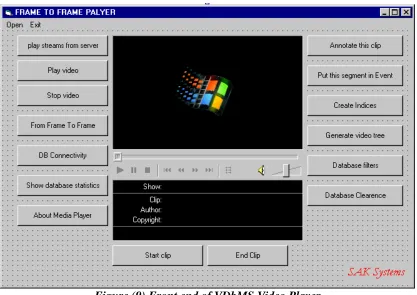
Figure (9) Front end of VDbMS Video Player
A number of options have been incorporated into this video player. On the left hand side of
the video player, video options and on the right hand side database options are provided. For
example this player is directly connected to the "Godzilla" machine, which is currently
working as the temporary video server for the MMRG group. Along with pressing the "Frame
to Frame" button, the user can run a video for a desired no of frames. The "DB-Connectivity"
button connects the player with the VDbMS database. On the other side, options for
annotating a video segment, attributing a video segment to an event, creating and
re-establishing indices, database filters and database garbage control buttons are also provided.
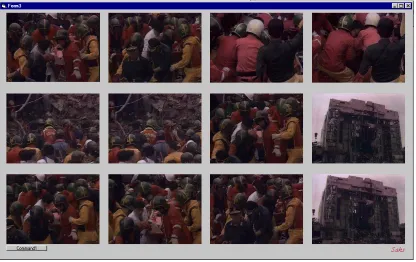
The second task was to construct a query output window, so that the user can see up to 12
nearest selected portions of video for his/her query. Figure (10) shows the output for a query
[image:23.595.90.507.69.364.2]24
Fig (10) Query output box for VDbMS
5.0 Summary & Future Tasks
The next task is to increase the efficiency of the VDbMS query module, by inserting more
data to thematic indexing modules and video object trees. It should be noted that that the
model will be modified throughout the research work, so the development of the model will
be altered accordingly. At the moment the following tasks are suggested for further research:
• Designing and developing new techniques to incorporate thematic indexing model
• MPEG-4 standard incorporation with VDbMS
• Query complexity
• Incorporating the technical video specifications in the data model
• Working of complex issues such as sharing and re-using digital video
There are many projects that deal with video databases, developed in recent years, with
special properties, ranging from editing, segmentation, indexing, searching, browsing, sharing
and re-using and synchronising video presentation. VDbMS on the other hand is novel in such
a way that it demonstrates functionality for supporting thematic indexing and query parsing.
Again the model also entertains a wide range of metadata, providing a wide range of
attributes for a user to perform query. Still a lot of work is required to make this model
[image:24.595.91.507.72.334.2]25
Proposed Timetable for research work up to October 2000
July 1999 -
September 1999
Exhaustive experimentation on Lord Mountbatten archives, by
providing metadata to the long videos and using VDbMS data
model and thematic indexing.
October 1999 -
December 1999
Further research on query processing and query complexity.
Along with, some improvements in VDbMS browsers will also
be done to provide further accessibility to the VDbMS users.
January 2000-
February 2000
Implementation of MPEG -4 and -7 protocols in VDbMS.
March 2000 Evaluation of my work and comparing it with other available
models
Some research on video content based searching, sharing and the
re-use of digital video. Tracking of the state of the art technology
at that time.
April 2000 Evaluation of my work and comparing it with other available
models
Submission of one research paper in some international
conference / research journal.
May 2000 -
August 2000
Writing up of PhD thesis and final touches to the experimental
work.
September 2000 -
October 2000
26
APPENDIX 1
A1
Video Data Modelling
Data modelling is essentially required to present video data based on its characters,
information extent and the applications it is intended for. It plays a very important role in the
system since all the functions, procedures and classes are dependent on it. Again all the
features, outputs, storage spaces, processes are also described at this stage.
Looking at the complexity of a video stream, the contents attribution and semantic structure
of the video need to be described in a data model. A generic video model should also support
the following features:
• Multi-level video structure abstraction
• Spatial and temporal relationship support
• Video annotation support
The conventional relational database model suggested by Codd [35] in the early 70’s was not
able to represent multidimensional video data as all sort of rich-information-file-format data
are considered as simple binary large object files (blob), which is very insufficient to
incorporate temporal and spatial features. In the past few years, a lot of data models based on
different techniques have been proposed, which can be categorised as annotation dependent,
annotation oriented, object oriented, and others. Following is a discussion on some of these
models:
A1.1 Annotation Dependent Models
In these type of models, some textual data (also known as signatures or metadata) about the
contents of video are embedded into the video data. For example the annotations for a typical
television news clip will be news date and time, news headlines text, news captions, scene
captions etc. Usually an annotator is required to write the captions, but in some models
dynamic text is also generated, depending on scene detection algorithms and other semantics,
generated from the spatial characteristics of the video. Examples include histogram colours,
basic shapes, textures and other information generated from audio contents. Following are
27 A1.1.1 VidIO
In the Multimedia Research Group, at the University of Southampton, work on video
databases was started by Salam and Hall [3]. They developed the system, VidIO (Video
Information Organiser), that takes account of the importance of different perspectives of
different users in video retrieval.
The main feature of this system was the provision of support for the creation and maintenance
of personalised video materials (i.e. personal collections, video segments, video documents).
Other features support the user for easy access to personalised video material. This is
achieved by maintaining both, the original and the personalised video.
.
To provide more user access, tools such as Query Result Window (made for displaying user
query results and other related information), Video Pad (used in creation, maintenance and
re-indexing of personalised video segment, also supports segment browsing, file append and
segment addition / deletion) and Document Creation tools (supports construction and
maintenance of original video database, and aids in organising personalised video segments)
were also added to the system, as shown in figure A1. [3]
VidIO’s data model is hierarchical and revolves around the three data elements, i.e. structural
components, contents in text form and the data catalogue. The video segment is divided into
four main components, which are frames, shots, scenes and program. The hierarchy for a
particular video is also resolved with these components [4]. The software’s front end was
developed in Visual C++(16 bit) and the back end database is Microsoft Access ver 2.0. The
Main Video Doc Personalized Doc
Storage relatedoperations
Woring Document
Video Doc
[image:27.595.108.466.293.486.2]Creation Video Retrieval Query ResultWindow Video Pad
28
videos are stored in AVI format (frame size =240x180, frame rate/sec = 15.0, kilobits/sec
data rate =190, compression mode = Microsoft Indeo32). The data used for testing this
model was the recorded news clips of CNN International.
During the creation of personalised documents, users are required to add their own
descriptions, which are stored in the hierarchical manner, as shown in fig 1 above,
maintaining linear story structures of original video materials, as they have contextual
information that should be preserved to help users to interpret the data during video retrieval.
This can be seen for a part of news clip data, stored in hierarchical form, in figure 2. At level
1 is the main review section. Then at level 2 are the sub-sections like Arts & Culture,
Political, Crime, etc. Further in level 3 are the subsections of Arts & Culture column like
WW2 paintings, Ballet Dispute, Movies of the week, etc. In this way each frame of the news
video is captioned with its inheritance and can be very easily retrieved from the main video
file. Hence according to figure 2, the link for the councillor’s speech part in the main video
document will be :
news_reviews . arts&culture . ww2_booty_paintings . councillor’s_speech
The major problem with VidIO is about its video description input. No tools were developed
or incorporated for auto indexing of contents. Again no provision is provided for the
recognition of a particular object in a video scene or frame. Thirdly major attention was given
only to the video part of the data and no consideration was given to the audio support, which
was emphasised by Merlino [5], who suggests that audio information can play a major part
for content indexing especially in videos such as news bulletins, archives or documentaries,
where there is always an anchor person giving some important information in the
background. The author further suggests that some textual footings and the presenter’s voice
29
Along with this project, the MMRG at Southampton is actively involved in MAVIS. The
MAVIS project is a programme of research to develop Multimedia Architectures for Video,
Image and Sound. Modular approach is used and different modules are responsible for all the
processing associated with a particular media-based feature type and, as new feature types are
introduced, associated matching techniques are developed and added to the main engine. For
example, to make use of the added richness which digital video presents, modules are being
developed which understand the temporal nature of the video and which can extract combined
spatial and temporal features. This will be further used in multimedia thesaurus (MMT) and
intelligent agent support for content-based retrieval and navigation. The earlier MAVIS 1
project was concerned with enhanced handling of images and digital video sequences in
multimedia information systems. The project will extend the Microcosm architecture to
support the MMT, in which representations of objects in different media are maintained
together with their inter-relationships. Intelligent agents will be developed to classify and
cluster information from the MMT, as well as additional knowledge extracted during
information authoring and indexing, to seek out discriminators between object classes and
also naturally-occurring groupings of media-based features and to accelerate media-based
[image:29.595.103.515.75.273.2]navigation. [6]
Fig 2. VidIO hierarchical description structure for an original video document
Hierarchy level 1 Hierarchy level 2 Hierarchy level 3 Hierarchy level 4 Hierarchy level 5
Political
stage, official ceremony 1 WW2 booty
paintings unvieled Arts & Culture
Intl News
Ballet Dispute
Business Disasters
Crime Couciller's
speech stage, official
Movies of the week Literature
Review Roxette in
30 A1.1.2 Vane
The Multimedia Group at University of Boston has developed video database Vane [7] with
the property to encompass multiple applications or video document domains. Using SGML1
and TCL/TK2 they developed a semi-automatic annotation process which extracts the content
and semantic value of a raw video stream. However this system still require a human
annotator who expedites the canonical information as metadata within the application domain.
The data model for Vane supports three types of indexing structural, content based , and
bibliographic. The structural metadata is again divided into media specific data and
cinematography data. The media specific data indexes information about recording rate,
compression format and resolution of frame, whereas the cinematic index is about the
creation of video, specific information, title, date and camera motion. The other end the
content based information is again divided into two main categories i.e. information about
tangible (physical shapes appearing in video) objects and information about conceptual
(events, concepts, actions etc.) entities.
The developers of Vane are of the view that three levels of hierarchy i.e. sequences, scenes
and shots are enough for most straight forward generic decomposition. Additional layers will
yield excessive fragmentation and excessive computation but do not provide significant
knowledge [7,8].
In the model the user can also have multiple annotations of the same video segment, by going
a step ahead in hierarchy but the implementation of this idea makes the model very complex
and it is not clearly stated that how these multiple annotations are stored in the data model.
In order to compensate for this problem they have provided additional dynamic metadata
definitions, as attributes to the unique identifier DTD (data type definition). These are
category definitions, attribute order and attribute definitions.
Overall this tool is designed to construct large and useful video documents and was tested on
some news archives and was found to be quite successful. Still this tool is in its evolution
stage and its usability on complex videos like documentaries or commercial programmes is
not known. Secondly an annotator with prior domain knowledge is also required to identify
the start and end of a segment, which is quite cumbersome. Regarding its model the
additional metadata definitions seem useless if human annotator does all the segmentation.
1 Standard General Mark up Language
31 A1.1.3 A. Caetano & N. Guimaraes (1998)
Arthur Caetano and Nuno Guimaraes defines shot as a sequence of one or more frames that
were contiguously recorded and if sequenced represent a continuous action in space and time.
They presented a modelling language for video, which enables the automatic segmentation,
labelling and clustering of video data. These clusters of data generate a hierarchy of groups
that can represent scenes as well as other types of semantic or logic groups to felicitate
browsing and navigation in the contents of the video. N-dimensional vectors represent low
level features of the video shots. These vectors contain data of frame rate, frame size, frame
priority (for frames), colour, texture, shape (for image / shot) and other related camera
operations like tilting, zooming and panning. These vectors (data sets) are stored in R-tree and
its variants (R*-tree, -tree) for adequate indexing.
The scenes, frames and shots are stored as multimedia objects (MO) which is in fact the basic
unit of information in their data model. Again the media object is defined as
MO= (Oid, Otype F, R)
where Oid is the unique object identifier,
Otype shows the type of object and
F is the feature set associated with the ojbect i.e F= {fi} and fi = {ri1, ……., rin} ⊃ R.
Each feature fi is composed of one or more representation, for example, the colors in an
object can be representated by histogram, moments, color vectors etc. These features aids in
creating hierarchies of data at different levels. The Query is then processed by retrieving the
k-most similar ojbects to a set of feature vectors that designate the query’s content. Work is
also in progress on developing tools for creating algorithms on MPEG and MJPEG
32
A1.2 Object Oriented Data Models
Since multimedia objects possess both temporal and spatial features, OODBMS (Object
Oriented Data Base Management System) are considered to be the best option for defining
multimedia models [10,11].
Gibbs defines an AV (audio-video ) object as
“An AV value, v is a finite sequence, vi, of digital audio or digital video data
elements” [12].
Further he suggests that,
“Each AV value has a media data type governing the encoding and interpretation of
its elements. The type of v determines rv, the data rate of v.”
These definitions clearly state that the media objects define themselves, their own data rate
and other attributes, which is a likely behaviour of objects defined in object-oriented
environments. Oomato and Tanaka [22] have also worked on this idea. They developed the
Object Oriented Video Information Database (OVID), and introduced the term ‘video
object’. Traditional databases are unable to support video data models using multimedia
objects for the following three reasons. First, AV values often have a very long duration (i.e.
of minutes or hours). Secondly, it may not be possible to allow concurrent use of AV objects
(as is the case of relational models) and finally system resources (buffers, processor cycles,
bus bandwidth etc ) can only be allotted in a limited quantity to a process to handle a tuple.
Another major problem with conventional databases is the concurrent access to AV data, as it
requires explicit scheduling of different processes in the system, by different clients. Since
AV sequences are also temporal in nature, the database system should also be responsible for
co-ordinating the presentation of these sources to different clients at different time.
Traditional databases usually solve this problem by providing a temporary copy of the
particular tuple to each client and then save the last modified copy to the master database. As
the AV object is of a very large size (in our case, a single object can be greater than 500 Mega
bytes !!), the idea of providing individual copy to all the clients becomes impossible.
The above points convinced the researchers about the usefulness of object-oriented data
models, particularly for AV data models. A lot of work has been done in this regard, which
33 A1.2.1 S. Gibbs & C. Breiteneder (1995)
Gibbs and Breiteneder define several abstractions that provide higher-level descriptions of
AV values. The first is Quality factor, which takes care of compression ratio and frame size.
Second abstraction is of Temporal Entity Type, which is specified in the form of N[T, {Q},
{D}] , where N is the name of entity type, T is underlying data type, Q shows the quality
factor (additional) and D is its discrete time co-ordinate system[13]. For example in the
expression
Video Entity[JPEG video Type, 480*640*8, D30]
JPEG shows the compression format, 480*640 is for frame rate, 8 is for 8 bits per pixel, and
D30 shows the data rate of 30 frames per second.
Further a number of relationships can be derived and instantiated with the above mentioned
entity, solving the problem of concurrency. Useful derivation relations can be of the type like
Translation (the start times of a value are uniformly displaced), Concatenation (a value is
added to the end of another value), Selection (a sub-value is extracted) and Conversion (a
value is re-sampled and used at some other location).
The Object-oriented approach is also useful in request scheduling. For instance, read and
write requests are scheduled by the concurrency control subsystem and disk accesses are
scheduled by the storage subsystem. With videos, these areas are particularly important and
should be visible at the database interface and under application control of the user. For
example, it should be possible to request ‘play video X now’ or ‘play video X after Y
seconds’ [14]. This facility will not only aid in attractive features but will also help is
scheduling resources and thedatabase itself, thus providing concurrent access to media data.
Gibbs provides a class for categorising video objects as,
class VideoValue subclasssubclasssubclass----of subclassof of Media Value of
{ int width
int height int depth int numFrame
34
}
class AudioValue subclasssubclasssubclasssubclass----ofofofof Media Value
{ int numChannel
int depth
int numSample
int sample[numChannel][numSample] }
The above classes provide very little information about the media objects. i.e. image is
considered as a binary object, however more information about image is required. Further
annotation and signatures for images, scenes and sequences are also missing. Since these
classes provide the basic structure of a video and were produced in early 90’s, a lot of
improvements in these classes were made by other researchers in later years.
A1.2.2 L. Huang & W. Xiong (1995)
Xiong and Huang divide AV databases into two categories, depending on their functionality.
The first category consists of those databases which concentrate on retrieving an image/frame
according to one or more specific features. The second category of systems work mainly on
retrieving requested information from a single image. In some systems, these two
functionalities are combined together [15].
They further state that the main problems with the conventional OODB modelling is that a
class has to be defined statically and objects of a class must be homogeneous in nature, which
cannot be applied to AV objects which are inter-related, adhoc, tentative and evolving [16].
A Conceptual Clustering Mechanism (CCM) is defined as Ct = <A,M,X>, where A is a set of
cluster attributes, M is a set of cluster methods and X is the set of role-player associates. X is
. . . . . . . . . . . . . . . .. .. ... Role tree
Play frames
Goals frames
frames
scene 1
seg 1
seg 2
seg 3
seg 1i
seg 1j
seg 4
seg 3i seg 3j
[image:34.595.100.478.534.672.2]Cluster tree
35
also the set of roles and objects that play the role within the cluster. Coming the properties of
CCM, they are dynamically created and deleted and can manage adhoc dynamics, but cannot
create or delete objects [16].
In the indexing mode, video classification decomposes the data into semantically meaningful
segments and CCMs, as shown in fig 3. It should be noted that it is not necessary for segXi to
inherit all the properties of segX, but do inherits some of the basic properties to remain in
hierarchy. In this way a cluster tree is formed , which in fact is a binary tree and can be easily
used for indexing any video scene.
There are many issues which are not addressed in this model for example storage problems
are not discussed and parsing of arbitrary arguments (messages) from one object to another is
not very flexible. Again this model is still in its infancy and has not been tested on real
applications.
A1.2.3 MPIL
Jain and Gupta [17] came up with their model “Multiple Perspective Interactive Video
(MPIL)” which can generate three dimensional voxels (information vectors) data sets from
multiple streams of video data, which is manipulated to be refined and configured.. The
schema designer then chooses a set of primitives to model this data which in fact is now a
specific class definition. Subsequent objects similar to this data will become the instances of
this class. A set of additional features are also assigned to this object which aids in indexing
the class and its instances to use later in query operations.
The special attributes of AV objects introduced in this model are name (a string composed of
two vectors, the first is the identification and the second vector defines the geometric
properties of the primitive i.e. it can be of the shape square.mesh.cylinder or
simplex.mesh.cylinder), parameters (define the external values set by the user at the time of
data definition), create, delete and display. Along with, other attributes like cut, copy, paste,
deform, compare are also added for user facilities.
The most common operations for a query in any AV model are union, difference and
set-membership of point sets in feature space. More specific operations applicable in MPIL are
Find Boundary (returning hyperpolyhyderal boundary of the points in image), Select by
36
Jain further states that all these classes, functions and operations merge to form a Video Data
Modelling Language (VDML) which is destined to support description and manipulation for
AV data. In addition they are also developing an implementation of a set of shape
representations, stepping ahead beyond the current paradigm of query-by-visual-example,
describing the new research prototype of image-space visualisation environment [19].
A1.3 Video Algebra
Weiss and Duda proposed an algebraic data model that defines a video stream by recursively
applying a set of algebraic operations on the raw video segment[20]. The basic object of a
video algebra model is presentation. A presentation is a multi-window spatial, temporal and
content combination of video segments. Presentations are described by video expressions,
which are constructed from raw video segments using video algebraic operations. These
operations are Creation(create, delay), Composition (concatenation, union, intersection, etc.),
Output (window) and description (content attributes that can be attached to video
expressions).
Segments are specified using the name of the raw video and a range within the raw video. The
recursive nature of the video structure is supported by creating compound video expressions
from simpler ones using video algebra operations. The model also allows nested stratification,
i.e. overlapping logical video segments are used to provide multiple coexisting views and
annotations for the same raw video data. Users can search video collections with queries by
specifying the desired attributes of video expressions. The result of the query is a set of video
expressions that can be played back, reused, or manipulated by a user. In addition to the
content-based access, algebraic video also allows video browsing.
This model was tested on a collection of a pre-indexed TV broadcast news, commercials and
movie trailers. Along with indexing, closed captioned text (signatures) were also provided to
the Video Algebra System. The video and file server was run on Sun Sparc Station, the model
was run on a Silicon Graphics machine and a third different machine with HTTP server was
also connected to them via Ethernet [21]. Users were then logged on through the network and
edited and composed the algebraic video nodes , the performance was found quite good. This
system is still under construction and tools like database support, auto indexing etc. are in the
37
A1.4 The VISION Digital Video Library
The VISION (Video Indexing for Searching over Networks) digital video library prototype
was developed at the Telecommunications an Information Sciences Laboratory of University
of Kansas as a test bed for evaluating automatic and comprehensive mechanisms for library
creation and content-based search and retrieval of video across networks with a wide range of
bandwidths.
Gauch and Li [36] came up with the idea of an on-line digital video library, which provide
content-based search. The major feature of this project is an integrated application, which
provide video processing, information retrieval, speech extraction and word-spotting feature
in real time.
First the full-motion video is captured in AVI format with JPEG compression, then
segmented by using two-step algorithm based on video and audio contents. Then a closed
caption decoder is used to extract textual information to index video clips. Finally all the
information is stored textually for content-based exploration of the video library over the
network.
A novel algorithm is used to segment the video. First the video is broken into different shots
by the traditional image-based segmentation methods. These shots are then post-processed to
merge some contiguous segments back together. This is done by analysing audio features
extracted from speech signals such as endpoint detection and speaker identification.
The endpoint detection algorithm is based on measurement of the audio signal short-time
energy and zero-crossing rate and end of an utterance. The short-time energy function of
speech is computed by splitting the speech signal into 'N' samples and computing the total
squared value of the signal in each sample. Further the energy of the speech is generally
greater than that of silence or background noise. A speech threshold is then determined by
taking into account the silence energy and the peak energy. Zero-crossing rate is the measure
of the number of times in a given time interval that the speech signal amplitude passes
through a value of zero [37].
CNN news clips (headline news footage) were used to test this prototype and a successful
result was achieved, but some major problems were also incurred. The major problem was
that the contiguous clips which were separated by video techniques such as zoom-in/out,
38
was no sound between two successive clips, as there is no way to detect a change on the
short-time energy of the audio signal.
This system is still in its prototype level and work is still carried on to modify this project.
A1.5 Others
Hjesvold [23] has introduced an architecture to support video information sharing and reuse,
specially when running video presentations, annotating video materials and video information
extraction. To identify video shots, audio recordings, presentations and annotations, he
incorporated two models. First a content model for basic components in a video and secondly
a structure model for composite components.
The content model is responsible for scene composition. It also defines attributes, operations
and content descriptions for the video basic components. The structure model is used for
scene editing. It also defines attributes, operations and semantics for the composite
components. The attributes include Object-Identity, Type, Object Architecture and a Textual
Signature. VCR type operations such as playing, pausing, stopping, enhanced operations like
creating and modifying components, and administrative operations like reading and changing
the values of the attributes symbolic name, type, coding rate, quality factor, synopsis, etc. are
also provided [24]. Semantics for modelling a narrative presentation are supported by five
story entities: scene, sequence, descriptive story, interlaced story and concurrent story.
This model is heavily dependent on metadata i.e. data about data at every semantic node and
an experienced annotator is required to provide this data, but is a very good example to share
and re-use the same video among different video applications and users.
Smoliar and Zhang [25] proposed a frame based (knowledge base) model that represent a
hierarchical organisation of video nodes. A frame contains textual information for classes and
instances. A class frame holds important information for maintaining the hierarchy such as
super class, sub class and instance, while the instance frame holds a pointer to its upper level
39
APPENDIX 2
A2.1 MPEG Overview
The Moving Picture Coding Experts Group (MPEG) is a working group of ISO/IEC, in
charge of the development of international standards for compression, decompression,
processing and coded representation of moving pictures, audio and their combination.
The purpose of MPEG is to produce standards. The first two standards produced by MPEG
were:
MPEG-1, as standard for storage and retrieval of moving pictures and audio on storage media
(officially designated as ISO/IEC 111172, in 5 parts)
MPEG-2, a standard for digital television (officially designated as ISO/IEC 13818, in 9 parts).
MPEG-4 Version 1, a standard for multimedia applications, that has officially reach the status
of International Standard in February 1999, with the ISO number 14496.
Since July 1993 MPEG is working on its third standard, called MPEG-4. MPEG considers of
vital importance to define and maintain, without slippage, a work plan. This is the MPEG-4
Version 1 work plan:
Part Title Working
Draft
Committee Draft
Final Committee Draft
Draft for Intl. Standard
Internat- ional Standard
1 Systems 11/97 03/98 10/98 02/99
2 Visual 11/97 03/98 10/98 02/99
3 Audio 11/97 03/98 10/98 02/99
4 Conformance Testing 10/97 12/98 03/98 03/99 05/99
5 Reference Software 11/97 03/98 03/99 05/99
6 Delivery MM Integration
Framework
![Fig (1) A common data model for video information sharing using an ER-notation, suggested by Hjesvold[27]](https://thumb-us.123doks.com/thumbv2/123dok_us/1048351.620680/10.595.72.526.149.606/common-model-video-information-sharing-notation-suggested-hjesvold.webp)
![Figure (3) Suggested Annotation model for VDbMS. Here 'event' entity is added and been assigned a top level in hierarchy, as opposed of Hjesvold's model[27]](https://thumb-us.123doks.com/thumbv2/123dok_us/1048351.620680/13.595.129.434.124.501/figure-suggested-annotation-vdbms-assigned-hierarchy-opposed-hjesvold.webp)