© 2019, IRJET | Impact Factor value: 7.211 | ISO 9001:2008 Certified Journal | Page 3772
FACE RECOGNITION USING MACHINE LEARNING
Ishan Ratn Pandey, Mayank Raj, Kundan Kumar Sah
, Tojo Mathew, M. S. Padmini
123
B.E., Department of Computer Science and Engineering, The National Institute of Engineering, Mysuru, India
45Assistant Professor, Computer Science & Engineering, The National Institute of Engineering, Mysuru, India
---***---Abstract -
For real world applications like videosurveillance, human machine interaction, and security
systems, face recognition is of great importance.Deep learning
based methods have shown better performance in terms of accuracy and speed of processing in image recognition
compared to traditional machine learning methods. This
paper presents a modified architecture of the Convolution Neural Network (CNN) by adding two operations of
normalization to two of the layers. The operation of
normalization that is normalization of the batch provided acceleration of the network. CNN architecture was used to extract distinctive facial characteristics and Softmax classifier was used to classify faces within CNN's fully connected layer. Our Face Database has shown in the experiment part that the proposed approach has improved the performance of face recognition with better results of recognition.
Key Words: face recognition, convolutional neural network,
softmax classifier, deep learning
1.INTRODUCTION
Face recognition is the process of recognizing a person's face through a vision system.Because of its use in security systems, video surveillance, commercial areas, it has been an important human - computer interaction tool and is also used in social networks like Facebook. After the fast development of artificial intelligence, face recognition has attracted attention due to its meddlesome nature and since it is the main method of human identification when compared with other types of biometric methods.Face recognition can be easily checked in an uncontrolled environment without the knowledge of the subject person.
As the history of face recognition is viewed, it is seen that it has been present in many research papers e.g. [1]–[6 ]. Traditional methods based on shallow learning have faced challenges such as pose variation, scene lighting and facial expression changes as in references [7]-[17]. Shallow learning methods use only some basic image characteristics and trust on artificial experience to extract sample characteristics. Deep learning methods can extract more complicated facial characteristics [18]-[27].Deep learning is making crucial progress in solving issues that have for many years restricted the artificial intelligence community's best attempts.It has proved outstanding in disclosing complex structures in high-dimensional data and is therefore applicable to many science, business and government domains.It addresses the problem of learning hierarchical representations with a single algorithm or some algorithms
and has mainly defeated records in image recognition, natural language processing, semantic segmentation and many other real world scenarios [28]-[35]. There are various deep learning approaches like Convolution Neural Network (CNN), Deep Belief Network (DBN) [36], [37], Stacked Autoencoder [38]. In image and face recognition, CNN is frequently used as an algorithm. CNN is a kind of artificial neural networks that use convolution approach to extract characteristics from input data to increase the number of characteristics.CNN was first proposed by LeCun and was first used in the recognition of handwriting [39]. His network was the source of many of the recent architectures and an inspiration for many scientists. By publishing their work in the ImageNet Competition, Krizhevsky, Sutskever and Hinton achieved good results [40].It is regarded as one of computer vision's most dominant publications and has shown that CNNs outperform recognition performance in comparison with handmade methods. CNN has achieved cutting - edge over a number of areas with computational power from Graphical Processing Units (GPUs), including image recognition, scene recognition and edge detection.
This paper's main contribution is to obtain a powerful high accuracy recognition algorithm. In this paper, by adding Batch Normalization process after two different layers, we developed a new CNN architecture.
In this paper, the general structure of the process of face recognition consists of three stages. It starts with the pre - processing stage: the conversion of color space and the resize of images, continuing with the extraction of facial features and then the classification of extracted feature set. Softmax Classifier is to realize the final stage in our system, which is classification based on the facial characteristics extracted from CNN.
The rest of this paper is as follows organized. The architecture of CNN is introduced in section 2. The proposed algorithm will be discussed in section 3. Section 4 presents the face database used in this paper.Section 5 presents the experimental results. Finally, in section 6, we discuss conclusions.
2. METHODOLOGY
© 2019, IRJET | Impact Factor value: 7.211 | ISO 9001:2008 Certified Journal | Page 3773
Fig.1, a typical CNN architecture is shown. CNN's structurecontains layers of Convolution, pooling, Rectified Linear Unit (ReLU), and Fully Connected.
Fig 1: Layers of CNN
2.1 Convolution Layer
Convolution layer performs the core building block of a Convolutionary Network that performs most of the heavy lifting computations. Convolution layer's main purpose is to extract features from the image-based input data.By learning image features using small squares of input image, Convolution preserves the spatial relationship between pixels. Using a set of learnable neurons, the input image is compressed. This creates a feature map in the output image and then feeds the feature maps to the next convolution layer as input data.
2.2 Pooling Layer
Pooling layer reduces each activation map's dimensionality but still has the most important information. The images input are divided into a set of rectangles that are not overlapping.A non-linear operation such as average is used to down-sample each region.This layer achieves better generalization, faster convergence, robust translation and distortion, and is usually placed between layers of convolution.
2.3 ReLU Layer
ReLU is a non-linear operation that involves units that use the rectifier. It is an element-wise operation which means that it is applied per pixel, reconstituting all the negative values by zero in the feature map.To understand how ReLU operates, we assume that in the literature for neural networks there is a neuron input given as x and from that the rectifier is defined as f(x)= max(0,x).
2.4 Fully Connected Layer
The term Fully Connected Layer (FCL) refers to each filter connected in the next layer in the previous layer.The output from the layers of convolution, pooling, and ReLU are incarnation of the input image's high-level features.The aim of using the FCL is to use these features to classify the input image into different classes based on the training dataset. FCL is considered to be the final layer of pooling feeding the features to a classifier using the activation function of Softmax. The sum of Fully Connected Layer's output probabilities is 1. Using the Softmax as the activation function ensures this. The Softmax function takes an arbitrary real-evaluated scores vector and transforms it into a value vector between 0 and 1 that sums up to 1.
3. THE PROPOSED ALGORITHM
The block scheme of the proposed algorithm for CNN recognition is shown in Fig. 2. The algorithm is performed in the following three steps:
1) Resize the input images as 16x16x1, 16x16x3, 32x32x1, 32x32x3, 64x64x1, and 64x64x1. 2) Make a CNN structure with eight layers made up of
convolutional, max pooling, convolutional, max pooling, convolutional, max pooling, convolutional, and convolutional layers respectively.
3) Use Softmax classifier for classification after extracting all the features.
Fig 2: CNN Block Diagram
In picture. 3, The structure of the proposed CNN extraction block feature is shown.
4. DATABASE
© 2019, IRJET | Impact Factor value: 7.211 | ISO 9001:2008 Certified Journal | Page 3774
5. EXPERIMENTAL RESULTS
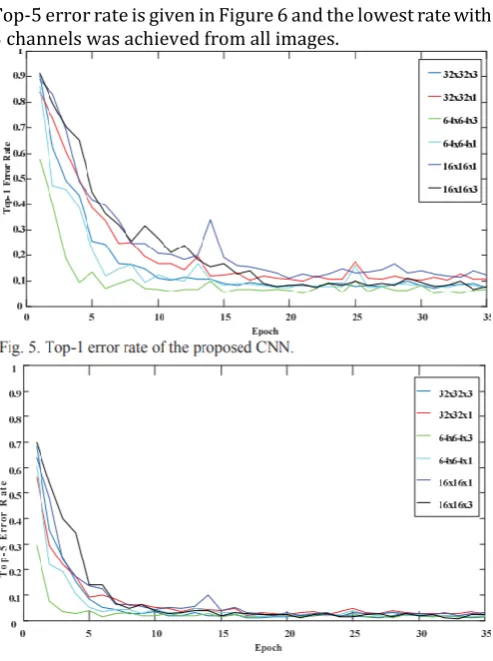
[image:3.595.313.560.98.429.2]We designed our CNN with the MatConvNet software tool Beta23 version. The size of each image was changed after the pre-processing stage as 16x16x1, 16x16x3, 32x32x1, 32x32x3, 64x64x1, and 64x64x3. 70% of the pictures were assigned to the training set, 30% to the test set.By making changes in image size, learning rate, batch size, and so on, we implemented various tests. For 35 epochs, CNN was trained.The performance of the proposed CNN was assessed based on top-1 and top-5 errors.Top-1 error rate checks whether the top class is identical to the target label and top-5 error rate checks whether the target label is one of your top five predictions. Table 1 shows a brief structure of the proposed algorithm. The results in the literature are better than those using shallow learning techniques like in references [43-45].
Figure 5 shows the performance of the proposed CNN architecture with respect to the top-1 error rate. As seen from Figure 5, from the image size 64x64x3, the lowest top-1 error rate was obtained.This result matters when it is intended to find any subject's target label in the database.
Top-5 error rate is given in Figure 6 and the lowest rate with 3 channels was achieved from all images.
6. CONCLUSION
This paper presents an empirical assessment of the CNN architecture-based face recognition system. The prominent features of the proposed algorithm is that it uses batch normalization for the outputs of the first and final convolution layers and higher accuracy rates are achieved by the network.Softmax Classifier is used to classify the faces in a fully connected layer step. Our Face Database tested the performance of the proposed algorithm.The results showed satisfactory rates of recognition according to literature studies.
REFERENCES
[1] S. G. Bhele and V. H. Mankar, “A Review Paper on Face Recognition Techniques,” Int. J. Adv. Res. Comput. Eng. Technol., vol. 1, no. 8, pp. 2278–1323, 2012.
[2] V. Bruce and A. Young, “Understanding face recognition,” Br. J. Psychol., vol. 77, no. 3, pp. 305–327, 1986.
[3] D. N. Parmar and B. B. Mehta, “Face Recognition Methods & Applications,” Int. J. Comput. Technol. Appl., vol. 4, no. 1, pp. 84–86, 2013.
© 2019, IRJET | Impact Factor value: 7.211 | ISO 9001:2008 Certified Journal | Page 3775
[5] K. Delac, Recent Advances in Face Recognition. 2008.[6] A. S. Tolba, A. H. El-baz, and A. A. El-Harby, “Face Recognition : A Literature Review,” Int. J. Signal Process., vol. 2, no. 2, pp. 88–103, 2006.
[7] C. Geng and X. Jiang, “Face recognition using sift features,” in Proceedings - International Conference on Image Processing, ICIP, pp. 3313–3316, 2009.
[8] S. J. Wang, J. Yang, N. Zhang, and C. G. Zhou, “Tensor Discriminant Color Space for Face Recognition,” IEEE Trans. Image Process., vol. 20, no. 9, pp. 2490–501, 2011.
[9] S. N. Borade, R. R. Deshmukh, and S. Ramu, “Face recognition using fusion of PCA and LDA: Borda count approach,” in 24th Mediterranean Conference on Control and Automation, MED 2016, pp. 1164–1167, 2016.
[10] M. A. Turk and A. P. Pentland, “Face Recognition Using Eigenfaces,” Journal of Cognitive Neuroscience, vol. 3, no. 1. pp. 72–86, 1991.
[11] M. O. Simón, “Improved RGB-D-T based face recognition,” IET Biometrics, vol. 5, no. 4, pp. 297–303, Dec. 2016.
[12] O. Dniz, G. Bueno, J. Salido, and F. De La Torre, “Face recognition using Histograms of Oriented Gradients,” Pattern Recognit. Lett., vol. 32, no. 12, pp. 1598–1603, 2011.
[13] J. Wright, A. Y. Yang, A. Ganesh, S. S. Sastry, and Y. Ma, “Robust face recognition via sparse representation,” IEEE Trans. Pattern Anal. Mach. Intell., vol. 31, no. 2, pp. 210–227, 2009.
[14] C. Zhou, L. Wang, Q. Zhang, and X. Wei, “Face recognition based on PCA image reconstruction and LDA,” Opt. - Int. J. Light Electron Opt., vol. 124, no. 22, pp. 5599–5603, 2013.
[15] Z. Lei, D. Yi and S. Z. Li, “Learning Stacked Image Descriptor for Face Recognition,” IEEE Trans. Circuits Syst. Video Technol., vol. 26, no. 9, pp. 1685–1696, Sep. 2016.
[16] P. Sukhija, S. Behal, and P. Singh, “Face Recognition System Using Genetic Algorithm,” in Procedia Computer Science, vol. 85, 2016.
[17] S. Liao, A. K. Jain, and S. Z. Li, “Partial face recognition: Alignmentfree approach,” IEEE Trans. Pattern Anal. Mach. Intell., vol. 35, no. 5, pp. 1193–1205, 2013.
[18] Z. Zhang, P. Luo, C. C. Loy, and X. Tang, “Learning Deep Representation for Face Alignment with Auxiliary Attributes,” IEEE Trans. Pattern Anal. Mach. Intell., vol. 38, no. 5, pp. 918–930, 2016.
[19] G. B. Huang, H. Lee, and E. Learned-Miller, “Learning hierarchical representations for face verification with convolutional deep belief networks,” in Proceedings of the IEEE Computer Society Conference on Computer Vision and Pattern Recognition, pp. 2518–2525, 2012.
[20] S. Lawrence, C. L. Giles, Ah Chung Tsoi, and A. D. Back, “Face recognition: a convolutional neural-network approach,” IEEE Trans. Neural Networks, vol. 8, no. 1, pp. 98–113, 1997.
[21] O. M. Parkhi, A. Vedaldi, and A. Zisserman, “Deep Face Recognition,” in Procedings of the British Machine Vision Conference 2015, pp. 41.1- 41.12, 2015.
[22] Z. P. Fu, Y. N. ZhANG, and H. Y. Hou, “Survey of deep learning in face recognition,” in IEEE International Conference on Orange Technologies, ICOT 2014, pp. 5–8, 2014.
[23] X. Chen, B. Xiao, C. Wang, X. Cai, Z. Lv, and Y. Shi, “Modular hierarchical feature learning with deep neural networks for face verification,” Image Processing (ICIP), 2013 20th IEEE International Conference on. pp. 3690–3694, 2013.
[24] Y. Sun, D. Liang, X. Wang, and X. Tang, “DeepID3: Face Recognition with Very Deep Neural Networks,” Cvpr, pp. 2–6, 2015.
[25] G. Hu, “When Face Recognition Meets with Deep Learning: An Evaluation of Convolutional Neural Networks for Face Recognition,” 2015 IEEE Int. Conf. Comput. Vis. Work., pp. 384–392, 2015.
[26] C. Ding and D. Tao, “Robust Face Recognition via Multimodal Deep Face Representation,” IEEE Trans. Multimed., vol. 17, no. 11, pp. 2049– 2058, 2015.
[27] A. Bharati, R. Singh, M. Vatsa, and K. W. Bowyer, “Detecting Facial Retouching Using Supervised Deep Learning,” IEEE Trans. Inf. Forensics Secur., vol. 11, no. 9, pp. 1903–1913, 2016.
[28] M. Liang and X. Hu, “Recurrent convolutional neural network for object recognition,” 2015 IEEE Conference on Computer Vision and Pattern Recognition (CVPR). pp. 3367– 3375, 2015.
[29] P. Pinheiro and R. Collobert, “Recurrent convolutional neural networks for scene labeling,” Proc. 31st Int. Conf., vol. 32, no. June, pp. 82–90, 2014.
© 2019, IRJET | Impact Factor value: 7.211 | ISO 9001:2008 Certified Journal | Page 3776
Vision and Pattern Recognition, vol. 07–12, pp. 3982–3991,June 2015.
[31] M. A. K. Mohamed, A. El-Sayed Yarub, and A. Estaitia, “Automated Edge Detection Using Convolutional Neural Network,” Int. J. Adv. Comput. Sci. Appl., vol. 4, no. 10, pp. 11– 17, 2013.
[32] Dan Cireúan, “Deep Neural Networks for Pattern Recognition.”
[33] R. Collobert, J. Weston, L. Bottou, M. Karlen, K. Kavukcuoglu, and P. Kuksa, “Natural Language Processing (Almost) from Scratch,” J. Mach. Learn. Res., vol. 12, pp. 2493–2537, 2011.
[34] R. Collobert and J. Weston, “A unified architecture for natural language processing: Deep neural networks with multitask learning,” Proc. 25th Int. Conf. Mach. Learn., pp. 160–167, 2008.
[35] E. Shelhamer, J. Long, and T. Darrell, “Fully Convolutional Networks for Semantic Segmentation,” IEEE Trans. Pattern Anal. Mach. Intell., vol. 39, no. 4, pp. 640–651, 2017.
[36] R. Xia, J. Deng, B. Schuller, and Y. Liu, “Modeling gender information for emotion recognition using Denoising autoencoder,” in ICASSP, IEEE International Conference on Acoustics, Speech and Signal Processing – Proceedings, pp. 990–994, 2014.
[37] G. E. Hinton, S. Osindero, and Y. W. Teh, “A fast learning algorithm for deep belief nets,” Neural Comput., vol. 18, no. 7, pp. 1527–1554, 2006.
[38] Y. Bengio, “Learning Deep Architectures for AI,” vol. 2, no. 1, 2009.
[39] Y. LeCun, “Backpropagation Applied to Handwritten Zip Code Recognition,” Neural Comput., vol. 1, no. 4, pp. 541– 551, Dec. 1989.
[40] A. Krizhevsky, I. Sutskever, and H. E. Geoffrey, “ImageNet Classification with Deep Convolutional Neural Networks,” Adv. Neural Inf. Process. Syst. 25, pp. 1–9, 2012.
[41] A. Uçar, Y. Demir, and C. Guzelis, “Object Recognition and Detection with Deep Learning for Autonomous Driving Applications,” Simulation, pp. 1-11, 2017.
[42] “Georgia Tech face database,” 10-Jan-2017 [Online]. Available: http:/www.anefian.com/research/face reco.htm. [43] Nischal K N, Praveen Nayak M, K Manikantan, and S Ramachandran, “Face Recognition using Entropy-augmented face isolation and Image folding as pre-processing
techniques,” 2013 Annual IEEE India Conference (INDICON), 2013.
[44] Katia Estabridis, “Face Recognition and Learning via Adaptive Dictionaries,” IEEE Conference on Technologies for Homeland Security (HST), 2012.