Proceedings of the 2019 Conference on Empirical Methods in Natural Language Processing 1527
Enhancing Context Modeling with a Query-Guided
Capsule Network for Document-level Translation
Zhengxin Yang123, Jinchao Zhang3, Fandong Meng3 Shuhao Gu12, Yang Feng12?, Jie Zhou3
1 University of Chinese Academy of Sciences 2 Key Laboratory of Intelligent Information Processing
Institute of Computing Technology, Chinese Academy of Sciences (ICT/CAS) 3 Pattern Recognition Center, WeChat AI, Tencent Inc, China
{yangzhengxin17z,gushuhao17g,fengyang}@ict.ac.cn {dayerzhang,fandongmeng,withtomzhou}@tencent.com
Abstract
Context modeling is essential to gener-ate coherent and consistent translation for Document-level Neural Machine Translations. The widely used method for document-level translation usually compresses the context in-formation into a representation via hierarchi-cal attention networks. However, this method neither considers the relationship between context words nor distinguishes the roles of context words. To address this problem, we propose a query-guided capsule networks to cluster context information into different perspectives from which the target transla-tion may concern. Experiment results show that our method can significantly outperform strong baselines on multiple data sets of dif-ferent domains.
1 Introduction
The encoder-decoder based Neural machine trans-lation (NMT) models (Sutskever et al.,2014; Bah-danau et al.,2014;Wu et al.,2016;Vaswani et al., 2017; Zhang et al., 2019) have made great pro-gresses and drawn much attention in recent years. In practical applications, NMT systems are often fed with a document-level input which requires reference resolution, the consistency of tenses and noun expressions and so on. Many researchers have proven that contextual information is essen-tial to generate coherent and consistent translation for document-level translation (Hardmeier,2012; Meyer and Webber,2013;Sim Smith,2017;Jean et al.,2017;Maruf and Haffari,2018;Miculicich et al.,2018;Zhang et al.,2018a;Voita et al.,2018; Wang et al., 2017;Tu et al., 2018;Maruf et al., 2019). Despite the great success of the above mod-els, they are designed for sentence-level
transla-Joint work with Pattern Recognition Center, WeChat AI, Tencent Inc, China.
?Corresponding Author
tion tasks and exclude contextual information in the model architecture.
On these grounds, the widely used hierarchi-cal attention networks (HAN) was proposed to in-tegrate contextual information in document-level translation (Miculicich et al., 2018). In this method, the context sentences are considered in the form of hierarchical attentions retrieved by the current generation. That is, it utilizes a word-level attention to represent a sentence and then a sentence-level attention to represent all the in-volved context. In this way, the final attention representation has to encode all the information needed for coherent and consistent translation, in-cluding reference information, tenses, expressions and so on. To get the multi-perspective informa-tion, it is necessary to distinguish the role of each context word and model their relationship espe-cially when one context word could take on mul-tiple roles (Zhang et al.,2018b). However, this is difficult to realize for the HAN model as its final representation for the context is produced with an isolated relevance with the query word which ig-nores relations with other context words.
To address the problem, we introduce Capsule Networks into document-level translation which have proven good at modelling the parts-wholes
low-level capsules and high-low-level capsules are both explored. In order to make sure high-level cap-sules indeed cluster information needed by the tar-get translation, we apply capsule networks to both sides of the current sentence and add a regulariza-tion layer using Pearson Correlaregulariza-tion Coefficients to force the high-level capsules on the two sides to approach to each other. In addition, we still need to ensure the final output of capsule networks is relevant to the current sentence. Therefore we pro-pose a Query-guided Capsule Network (QCN) to have the current source sentence to take part in the routing process so that high-level capsules can re-tain information related to the current source sen-tence.
To the best of our knowledge, this is the first work which applies capsule networks to document-level translation tasks and QCN is also the first attempt to customize attention for cap-sule networks in translation tasks. We conducted experiments on three English-German translation data sets in different domains and the results demonstrate that our method can significantly im-prove the performance of document-level transla-tion compared with strong baselines.
2 Background
2.1 Sentence-level NMT and Transformer Model
Sentence-level NMTs are generally based on an encoder-decoder framework (Sutskever et al., 2014; Bahdanau et al., 2014; Wu et al., 2016; Vaswani et al.,2017;Zhang et al.,2019;Meng and Zhang,2019). In this framework, the encoder en-codes the source sentencex={x1, x2,· · ·, xM}
into a sequence of continuous representationsz =
{z1, z2,· · · , zM}. Given z, the decoder predicts
target words in order and returns the target trans-lationy={y1, y2,· · · , yN}. The objective
func-tion of NMT is to maximize the log-likelihood of a set of source-target language sentence pairs as
L(Θ;x,y) = 1
|S| X
(x,y)∈S
logP(y|x; Θ) (1)
whereSis the training set.
As we implement our approaches based on the Transformer architecture (Vaswani et al., 2017), which is a strong sentence-level NMT baseline, we give a brief description of the Transformer model. The encoder and decoder are composed of simi-lar layers which consists of two general types of
sub-layers: multi-head attention mechanism and point-wise fully connected feed-forward network (FFN).
Encoder: The encoder of the Transformer is composed of N identical layers. Each of these layers includes a multi-head self-attention mecha-nism that allows each position of the output of pre-vious encoder layer to attend to all other positions, as well as a position-wise FFN, which is stacked on top of the multi-head self-attention, composed of two linear transformations and a ReLU activa-tion funcactiva-tion.
Decoder: The architecture of the decoder is similar to the encoder, however, it employs an ad-ditional multi-head attention sub-layer over the en-coder output between the multi-head self-attention sub-layer and position-wise FFN sub-layer. The multi-head self-attention sub-layer needs to mask the input target tokens in the future.
2.2 Document-level NMT
The document-level translation task is to trans-late each source sentence with consideration of the previous context in the document. Formally, the translation of a documentD containing|D|=J
sentence pairs can be defined as given the source documentX in order and the translation system generates each translationyj ∈ Y in order. The document translation probability can be defined as:
P(Y|X; Θ) =
J Y
j=1
P(yj|xj,D<j; Θ) (2)
wherexj,yj denote thejthsource and target
sen-tence respectively, andD<jdenotes all of the
pre-vious sentence pairs in document. For each sen-tencexj, each target word is generated according to the source representation and the generated tar-get hypothesis, therefore the Eq. (2) can be formu-lated as:
P(Y|X; Θ) =
J Y
j=1 Ij Y
i=1
P(yij|,yj<i,xj,D<j; Θ)
(3) whereyij denotes theith word of the jth
transla-tionyj with the length asIj andyj
<i denotes the
generated target hypothesis.
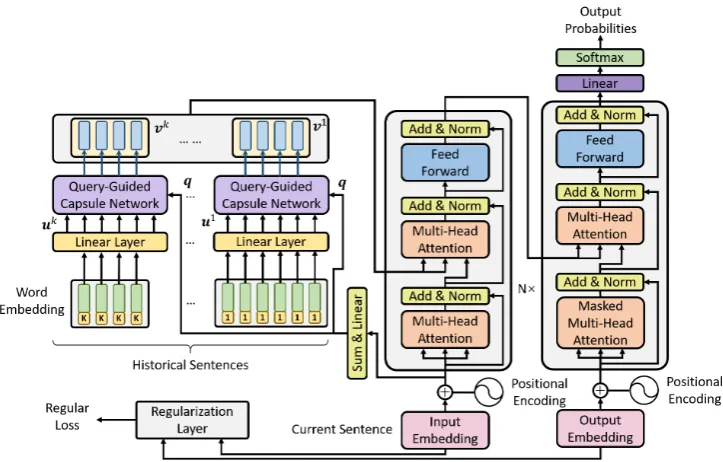
Figure 1: The overall architecture consists of three modules: theQuery-guided Capsule Networkin the upper left of this figure, theRegularization Layerin the lower left of this figure and theSub-layer-expanded Transformerin the right of this figure.
document context as following:
L(Θ;X,Y) = 1
|D| X
(X,Y)∈D
logP(Y|X; Θ)
(4) whereDis the training set of the DocNMT.
Compared with the sentence-level NMTs, the critical part of document-level NMTs is to effec-tively capture and utilize the related contextual information when translating the to-be-translated source sentence.
3 Our Approach
In this section, we introduce the proposed Query-guided Capsule Network (QCN) for enhancing the document-level NMT. First, we present the overall architecture of the network, and then we describe the QCN in detail.
3.1 Overall Architecture
We aim to enhance the document-level NMT per-formance through effectively capturing and em-ploying the contextual features in each histor-ical sentence that related to the current sen-tence. We integrating a novel Query-guided Cap-sule Network into the sentence-level Transformer-based NMT (Vaswani et al., 2017) to capture the document-level contextual information for trans-lating the current source sentence.
As shown in Figure1, the overall architecture of our translation model is composed of three mod-ules:
• The Query-guided Capsule Networktakes the to-be-translated source sentence as the query to guide the procedure of retrieving related and helpful contextual features from historical sentences with a novel dynamic routing algorithm.
• Sub-layer-expanded Transformercontains a new sub-layer that attending the contex-tual features extracted from the QCN to ef-fectively utilize them for translation.
• Regularization Layercontains two conven-tional Capsule Networks to unify the source sentence and the target sentence into an iden-tical semantic space through computing an extra PCCs loss item at the training stage.
3.2 Query-guided Capsule Network
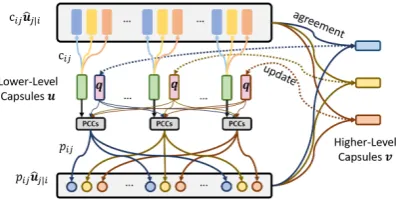
Figure 2: Query-guided Capsule Network, the green blocks in the middle of the figure are lower-level cap-sules ui, right-side blocks indicate the higher-level
capsulesvj and the query vectorq is initially tiled to
length|v|and updated with corresponding higher-level capsules. Here shows a Query-guided Capsule Net-work with 3 high-level (feature) capsules. In each iter-ation, the PPCs is computed according to the input vec-toruiand the query vectorqj, thenpijuˆj|iandcijuˆj|i
are added to obtain the higher-level capsules which will be used to update corresponding query later.
coupling coefficients. However, there exists an ob-vious drawback of directly applying the Capsule Network into the document-level NMT for cap-turing contextual features. The reason is that the CapsNet can only extract internal features without considering whether features are related to the to-be-translated source sentence.
To address this issue, we proposed the Query-guided Capsule Network (QCN), which employ the representation of the to-be-translated source sentence as the query to guide the feature ex-traction procedure of the Capsule Network. In this way, contextual features that generated from the QCN are based on the internal semantic rela-tions among each historical sentence and the ex-ternal semantic relations between historical sen-tences and the to-be-translated source sentence. The QCN is based on an improved dynamic rout-ing algorithm which will be detailed introduced in the next section.
Improved Dynamic Routing of QCN
Given a query vectorqand a set of input capsules
u={u1,u2,· · · ,un}, the dynamic routing
algo-rithm iteratively calculates the correlation between the query vector and each input capsule and up-dates output capsules. Specifically, query vector
q is the representation of source to-be-translated sentence and input capsules u are all word em-beddings in previous sentences, which can be
for-Algorithm 1Improved Dynamic Routing
Input: r,qandu={u1,u2,· · ·,un}
Output: v={v1,v2,· · ·,vm}
1: // Initialization
2: for each output capsulevjin higher-layer do
3: for each input capsuleuiin lower-layer do
4: uˆj|i←Wijui
5: αij←0
6: qj←q
7: pij←tanh(PCCs(ui,qj))
8: .PCCscomputes Eq7
9: end for 10: end for 11:
12: // Iteration 13: itr←0
14: repeat
15: for each input capsuleuiin lower-layerdo
16: ci←softmax(αi)
17: end for 18:
19: for each output capsulevjin higher-layerdo
20: sj←Pni=1(cij+pij) ˆuj|i
21: vj←squash(sj)
22: .squashcomputes Eq8
23: end for 24:
25: for each output capsulevjin higher-layer do
26: for each input capsuleuiin lower-layer do
27: αij←αij+pijuˆj|ivj
28: end for 29: qj←
qj+vj 2
30: for each input capsuleuiin lower-layer do
31: pij←tanh(PCCs(ui,qj))
32: end for 33: end for 34: itr←itr+ 1
35: until itr=r
mulated as:
q= g(X
x∈x
embedding(x)) (5)
u−i k= f([embedding(x−i k); onehot(k)]) (6)
where f and g are both linear transformation functions and k indicates the distance of histor-ical sentence from the to-be-translated sentence. Each word embedding in historical sentences is concatenated with a distance-determined one-hot
vector to provide positional markers.
Com-pared to the dynamic routing method proposed by (Sabour et al.,2017), our improved dynamic rout-ing method of QCN can model information that related to the query among input capsules.
Algorithm1shows details of the algorithm and Figure 2 illustrates the interaction of the vari-ous components in the QCN. Initially, the im-proved dynamic routing algorithm of QCN re-cieves a sequence of lower-level capsules u =
[image:4.595.82.281.63.163.2] [image:4.595.306.529.67.518.2]then calculates a Pearson Correlation Coefficients (PCCs) betweenqand each input capsuleui(line
7). The PCCs is a measure of the linear correla-tion between two variables. When PCCs is close to +1, it means they have very strong positive lin-ear correlation, and close to -1 means total nega-tive correlation. Given a pair of variables(A,B), the formula for computing PPCs is
PCCs(A,B) = Cov(A,B)
σAσB
= (A−
1 n
Pn
i=1ai)T(B− 1n Pn
i=1bi) kAk · kBk (7)
where A and B are both n-dimension vectors,
Covis the covariance andσA, σB is the standard
deviation ofAandBrespectively.
The routing iteration process then computes coupling coefficients, denoted asci(line 16), with
regard to a input capsule ui and all the
higher-level capsules v. In the original dynamic rout-ing algorithm (Sabour et al., 2017), coupling co-efficients are only determined by the cumulative “agreement”, which are the prior probabilities that capsuleuishould be coupled to capsulevj.
How-ever, in DocNMT situation, it is far from enough to cluster the high-level information from the cap-sules in lower-level that related to query vector ac-cording to a naive “agreement”. To address this is-sue, we reduce the “agreement”, when PCCs show a negative linear correlation between the query vectorq and the input vectorui. Instead, we
in-crease the “agreement”, when PCCs are positive (line 27). The query vector q is initially tiled to length|v|and updated with the corresponding higher-level capsulesvjin each iteration (line 29).
Our routing iteration updates higher-level cap-sules by addingPn
i=1pijuˆj|i tosj. This step can
add more information related to the query vector and cut off the unrelated features (line 20). It is necessary to get different length of output cap-sules shrunk into the 0 to 1 interval using “squash” function (line 21) proposed bySabour et al.(2017) which is shown in Eq.(8).
squash(t) = ||t||
2
1 +||t||2 t
||t|| (8)
wheretcan be the initial input capsuleui or the
vectorsj for predicting the output capsule.
3.3 Sub-layer-expanded Transformer
To effectively utilize contextual features extracted from each historical sentence by QCN, we
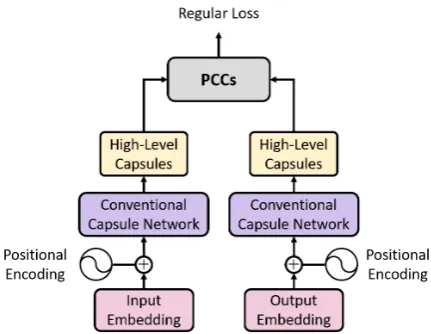
intro-Figure 3: Regularization Layer. In the training stage, this layer takes the inputs of the encoder (left part of the figure) and decoder (right part of the figure) as the input capsules of two capsule networks separately, and computes the PCCs between the high-level capsules of two networks.
duce an additional context-aware multi-head at-tention sub-layer in each layer of the Transformer encoder. The multi-head attention can attend to all the positions of the contextual features with out-puts of the previous sub-layer as a query. Then the output of the context-aware multi-head attention sub-layer is fed into the point-wise feed-forward sub-layer in each layer of the encoder. The right part in Figure 1 shows details of the Sub-layer-expanded Transformer. Specifically, the equation of multi-head attention computing procedure is as following:
MultiHead(Q,K,V) = Concat(H1,· · ·, Hh)WO Hi= Attention(QWiQ, KWiK, V WiV) (9)
whereWiQ,WiK andWiV are the parameter
ma-trices, Q, K andV indicates the query, key and value representations. The computation of the at-tention function is as following:
Attention(Q, K, V) = softmax(QK
T √
dk
)V (10)
wheredkindicates the dimension of queriesQand
keysK.
3.4 Regularization Layer
[image:5.595.311.527.64.231.2]of encoder and decoder into two capsule networks
CapsencandCapsdec, and computes the PCCs be-tween the outputs of two networks. We regard the PCCs as an extra regularization term in the final objective at the training stage. The loss function of our model can be formulated as:
L(Θ;X,Y) = 1
|D|
× J X
j=1 Ij X
i=1
{logP(yij|,yj<i,xj,D<j; Θ)
+ PCCs(Capsenc(xj),Capsdec(yj))}
(11)
where Θ are parameters of the model, D<j are
historical sentences of the to-be-translated source sentence, xj is the to-be-translated sentence and
yj<idenotes the generated target hypothesis.
4 Experiments
4.1 Settings
Datasets and Evaluation Metrics
We carry out experiments on English-German translation tasks in three different domains: talks, news, and speeches. The corpora statistics are shown in Table1.
• TED. This corpus is a Machine
Transla-tion part of the IWSLT 2017 (Cettolo et al., 2012) evaluation compaigns1, each TED talk is considered to be a document. we take the
tst2016-207 as the test set, and other as our development set.
• News. We take the sentence-aligned document-delimited News Commentary v11 corpus2 as our training set. The WMT’16
news-test2015 and news-test2016 are used for development and testing respectively.
• Europarl. The corpus are extracted from the Europarl v7 (Koehn, 2005) according to the method mentioned inMaruf and Haffari (2018). The training, development and test sets are obtained through randomly splitting the corpus.
We download all of above extracted corpora3 from Maruf et al. (2019). The tokenization and
1
https://wit3.fbk.eu/ 2
http://www.casmacat.eu/corpus/news-commentary.html 3
https://github.com/sameenmaruf/selective-attn/tree/master/data
truecase pre-processing are implemented on all datasets using the scripts of the Moses Toolkit4 (Koehn et al.,2007). We also apply segmentation into BPE subword units5 (Sennrich et al., 2016) with 30K merge operations.
We use two metrics: BLEU (Papineni et al., 2002) and Meteor (Lavie and Agarwal, 2007) to evaluate the translation quality.
Models and Baselines
We use the Transformer architecture as our agnostic baseline and adopt three context-aware baselines (Zhang et al., 2018a;Miculicich et al.,2018;Maruf and Haffari,2018).
We performed the same configuration on our models according to the settings of theMaruf and Haffari(2018). Specifically, for the Transformer, we set the hidden size and point-wise FFN size as 512 and 2048 respectively. We use 4 layers and 8 attention heads in both encoder and decoder. All dropout rates are set to 0.1 for context-agnostic model and 0.2 for context-aware model.
In the training phase, we use the default Adam optimizer (Kingma and Ba, 2014) with a fixed learning rate of 0.0001. The batch size is 1500 on TED dataset and 900 on both News and Europarl datasets.
4.2 Results and Analysis
Main Results
Table 2 shows that our model surpasses all
the context-agnostic(Vaswani et al., 2017) and context-aware(Zhang et al., 2018a; Miculicich et al., 2018; Maruf and Haffari, 2018) baselines on TED and Europarl datasets. For TED dataset, the performance of our model greatly exceeds that of all other baselines, and is better thanMiculicich et al.(2018) with a gain of +0.59 BLEU and +0.61 Meteor. For Europarl dataset, our model got im-provements with a gain of +0.07 on BLEU metric, but the Meteor score is +0.64 higher thanMaruf et al.(2019) which utilize the whole document as the contextual information, whereas we only using 3 previous sentences.
Results on the sequence-level Transformer and our DocNMTs show that the captured contex-tual features provide helpful semantic information for enhancing the translation quality. The regu-larization term that we proposed can effectively
4
https://github.com/moses-smt/mosesdecoder/tree/master/scripts
TED News Europarl
Sent No. Doc len avg Sent No. Doc len avg Sent No. Doc len avg
Training 206,126 121.39 236,287 38.93 1,666,904 14.14
Development 8,967 96.42 2,169 26.78 3,587 14.95
[image:7.595.89.512.61.133.2]Test 2,271 98.74 2,999 19.35 5,134 14.26
Table 1: The statistics of the training/development/test corpora in number of sentence pairs and the average document length (in sentences).
TED News Europarl
Model BLEU Meteor BLEU Meteor BLEU Meteor
Transformer-DocNMT (Zhang et al.,2018a) 24.00 44.69 23.08 42.40 29.32 46.72 HAN-DocNMT (Miculicich et al.,2018) 24.58 45.48 25.03 44.02 28.60 46.09 SAN-DocNMT (Maruf et al.,2019) 24.42 45.38 24.84 44.27 29.75 47.22
Transformer 23.28 44.17 21.67 41.11 28.72 46.22
Transformer + Regularization Term 24.55 45.57 22.09 41.77 29.42 47.59
Transformer + QCN 24.41 46.09 22.22 41.90 29.48 47.49
[image:7.595.78.522.178.298.2]Transformer + QCN + Regularization Term 25.19 45.91 22.37 41.88 29.82 47.86
Table 2: BLEU and Meteor scores of models. There exists three aware baseline models and a context-agnostic model. “Regularization Term” denotes integrating the regularization layer into the Transformer model and “QCN” denotes incorporating Query-guided Capsule Network in the Transformer model.
Figure 4: Effect of Contextual Information Scope. It is not that the more historical sentences we utilize, the better translation performance is. Effect of scope on BLEU and Meteor scores are inconsistent to some de-gree.
further improve the model performance on TED and Europarl datasets. For the restriction of the GPU memory, we have to filter long sentences to keep our model running. Although, it hurts the model performance on the “News” dataset (con-tains many long sentences), the QCN module and regularization term still bring improvements.
Effect of Contextual Information Scope
[image:7.595.321.513.370.490.2]To investigate the effect of contextual information scope, we carry on the number of historical sen-tences hyper-parameter experiments on the TED talk dataset. We fix the hyper-parameters of the QCN by setting both the number of higher-level
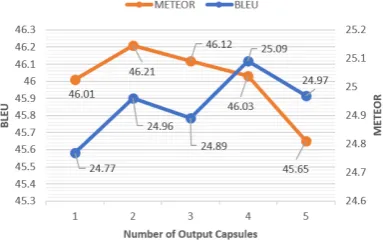
Figure 5: Effect of Feature Capsule Number. Appro-priate capsule number is important for model perfor-mance.
[image:7.595.86.280.371.481.2]Figure 6: Agreement distribution of a sentence (26 words) as inputs of the QCN and 4 contextual features as output. Blue color means higher agreement and the red means lower. From top to bottom are four heat maps in0thto3thiterations.
Effect of Feature Capsule Number
QCN is the crucial part of our overall architec-ture and the positive and negative impact depends on the configuration of the QCN. Therefore, We also investigate the effect of the hyper-parameter of QCN: the number of feature capsules.
We set the number of historical sentence as 3 ac-cording to the previously experimental results, and the number of routing iteration is set to 4. Figure 5 shows that Meteor score become highest when the number of higher-level capsules is set as 2, but BLEU score can obtain best score at 4. We finally choose 4 as the final setting because both BLEU and Meteor can obtain relatively good results.
Visualization of Agreement and PCCs
Coupling Coefficients (CCs) can indirectly reflect the variation of the “agreement”, so we visual-ize the coefficients in each routing iteration at the stage of decoding as shown in Figure6. In the first iteration, all coupling coefficients are initialized in a uniform distribution, all higher-level capsules are voted by lower-level capsules equally. Then, lower-level capsules are iteratively trained to send more information to the proper higher-level cap-sule. Figure6 shows that most of input capsules are tend to vote the2ed feature capsule finally.
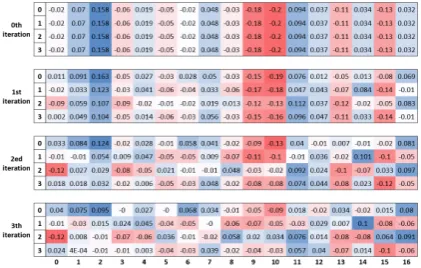
[image:8.595.312.523.62.196.2]Different from the CCs, PCCs show the linear correlation between query and inputs. Initially, the query vector is tiled with the number of feature capsules and is used to calculate the PCCs with each input capsules, as the Figure7shows that the color of every column is identical. As the iterative routing begins, each query is updated according to the higher-level capsules. The function of the PPCs is to increase or decrease the coupling coef-ficients value according to the positive or negative
Figure 7: PCCs distribution of a sentence has 17 words as inputs of the QCN and 4 duplicated query. Blue color denotes positive correlation and red means neg-ative. From top to bottom are four heat maps in0thto
3thiterations.
value. See Figure7, we can find that PCCs varies as iteration changes.
5 Related Work
Document-level Machine Translation
Document-level machine translation became a hot research direction in the later stage of statistical machine translation era. Hardmeier and Federico (2010) represented the links between word pairs in the context using a word dependency model for SMT to improve the translation of anaphoric pro-nouns. Hardmeier et al. (2012, 2013) first pro-posed a new document-level SMT paradigm that translates whole documents as units. However, in this period, most of the work has not achieved too many compelling results or has been only focused on a part of difficulties.
With the coming of the era of Neural Ma-chine Translation, many works began to focus on Document-level NMT tasks. Xiong et al. (2019) trained a reward teacher to refine the transla-tion quality from a document perspective. Tiede-mann and Scherrer (2017) simply concatenated sentences in one document as models’ input or output. Jean et al. (2017) used additional con-text encoder to capture larger-concon-text information. Kuang et al.(2017);Tu et al.(2018) used a cache to memorize most relevant words or features in previous sentences or translations.
memory-networks, andWang et al.(2017) and Mi-culicich et al.(2018) integrated hierarchical atten-tion network in RNN-based NMT or Transformer to model the document-level information. Maruf et al.(2019) used the whole document as the con-textual information and firslty divided document-level translation tasks into two types: offline and online.
Capsule Networks
Hinton et al.(2011) proposed the capsule concep-tion to use vector for describing the pose of an object. The dynamic routing algorithm was pro-posed by Sabour et al. (2017) to build the part-whole relationship through the iterative routing procedure. Hinton et al. (2018) designed a new routing style based on the EM algorithm. Some researchers investigated to apply the capsule net-work for various tasks.Wang et al.(2018) investi-gated a novel capsule network with dynamic rout-ing for linear time NMT. Yang et al. (2018) ex-plored capsule networks for text classification with strategies to stabilize the dynamic routing process. Gu and Feng (2019) introduces capsule networks into Transformer to model the relations between different heads in multi-head attention. We specif-ically investigated dynamic routing algorithms for the document-level NMT.
6 Conclusion
We have proposed a novel Query-guided Cap-sule Network with an improved dynamic rout-ing algorithm for enhancrout-ing context modelrout-ing for the document-level Neural Machine Translation Model. Experiments on English-German in differ-ent domains showed our model significantly out-performs sentence-level NMTs and achieved state-of-the-art performance on two of three datasets, which proved the effectiveness of our approaches.
Acknowledgments
We thank the anonymous reviewers for their in-sightful comments. This work was supported by the National Natural Science Foundation of China (NO.61662077, NO.61876174) and National Key R&D Program of China (NO.2017YFE9132900).
References
Dzmitry Bahdanau, Kyunghyun Cho, and Yoshua Ben-gio. 2014. Neural machine translation by jointly
learning to align and translate. arXiv preprint arXiv:1409.0473.
Mauro Cettolo, Christian Girardi, and Marcello Fed-erico. 2012. Wit3: Web inventory of transcribed and
translated talks. In Proceedings of the 16th Con-ference of the European Association for Machine Translation (EAMT), pages 261–268, Trento, Italy.
Shuhao Gu and Yang Feng. 2019. Improving multi-head attention with capsule networks. In Proceed-ings of the 8th CCF International Conference on Natural Language Processing and Chinese Comput-ing.
Christian Hardmeier. 2012. Discourse in statistical ma-chine translation. a survey and a case study. Dis-cours. Revue de linguistique, psycholinguistique et informatique. A journal of linguistics, psycholin-guistics and computational linpsycholin-guistics, (11).
Christian Hardmeier and Marcello Federico. 2010. Modelling pronominal anaphora in statistical ma-chine translation. In IWSLT (International Work-shop on Spoken Language Translation); Paris, France; December 2nd and 3rd, 2010., pages 283– 289.
Christian Hardmeier, Joakim Nivre, and J¨org Tiede-mann. 2012. Document-wide decoding for phrase-based statistical machine translation. In Proceed-ings of the 2012 Joint Conference on Empiri-cal Methods in Natural Language Processing and Computational Natural Language Learning, pages 1179–1190, Jeju Island, Korea. Association for Computational Linguistics.
Christian Hardmeier, Sara Stymne, J¨org Tiedemann, and Joakim Nivre. 2013. Docent: A document-level decoder for phrase-based statistical machine trans-lation. InProceedings of the 51st Annual Meeting of the Association for Computational Linguistics: System Demonstrations, pages 193–198, Sofia, Bul-garia. Association for Computational Linguistics.
Geoffrey E Hinton, Alex Krizhevsky, and Sida D Wang. 2011. Transforming auto-encoders. In Inter-national Conference on Artificial Neural Networks, pages 44–51. Springer.
Geoffrey E Hinton, Sara Sabour, and Nicholas Frosst. 2018.Matrix capsules with EM routing. In Interna-tional Conference on Learning Representations.
S´ebastien Jean, Stanislas Lauly, Orhan Firat, and Kyunghyun Cho. 2017. Does neural machine translation benefit from larger context? CoRR, abs/1704.05135.
Diederik P Kingma and Jimmy Ba. 2014. Adam: A method for stochastic optimization. arXiv preprint arXiv:1412.6980.
Philipp Koehn, Hieu Hoang, Alexandra Birch, Chris Callison-Burch, Marcello Federico, Nicola Bertoldi, Brooke Cowan, Wade Shen, Christine Moran, Richard Zens, et al. 2007. Moses: Open source toolkit for statistical machine translation. In Pro-ceedings of the 45th annual meeting of the associ-ation for computassoci-ational linguistics companion vol-ume proceedings of the demo and poster sessions, pages 177–180.
Shaohui Kuang, Deyi Xiong, Weihua Luo, and Guodong Zhou. 2017. Cache-based document-level neural machine translation. arXiv preprint arXiv:1711.11221.
Alon Lavie and Abhaya Agarwal. 2007. Meteor: An automatic metric for mt evaluation with high levels of correlation with human judgments. In Proceed-ings of the Second Workshop on Statistical Machine Translation, pages 228–231. Association for Com-putational Linguistics.
Sameen Maruf and Gholamreza Haffari. 2018. Docu-ment context neural machine translation with mem-ory networks. In Proceedings of the 56th Annual Meeting of the Association for Computational Lin-guistics (Volume 1: Long Papers), pages 1275– 1284, Melbourne, Australia. Association for Com-putational Linguistics.
Sameen Maruf, Andr´e FT Martins, and Gholamreza Haffari. 2019. Selective attention for context-aware neural machine translation. In Proceedings of the 2019 Conference of the North American Chapter of the Association for Computational Linguistics: Human Language Technologies, Minneapolis, Min-nesota. Association for Computational Linguistics.
Fandong Meng and Jinchao Zhang. 2019. Dtmt: A novel deep transition architecture for neural machine translation. InProceedings of the AAAI Conference on Artificial Intelligence, volume 33, pages 224– 231.
Thomas Meyer and Bonnie Webber. 2013. Implicita-tion of discourse connectives in (machine) transla-tion. InProceedings of the Workshop on Discourse in Machine Translation, pages 19–26.
Lesly Miculicich, Dhananjay Ram, Nikolaos Pappas, and James Henderson. 2018. Document-level neural machine translation with hierarchical attention net-works. InProceedings of the 2018 Conference on Empirical Methods in Natural Language Process-ing, pages 2947–2954, Brussels, Belgium. Associ-ation for ComputAssoci-ational Linguistics.
Kishore Papineni, Salim Roukos, Todd Ward, and Wei-Jing Zhu. 2002. Bleu: a method for automatic eval-uation of machine translation. In Proceedings of the 40th annual meeting on association for compu-tational linguistics, pages 311–318. Association for Computational Linguistics.
Sara Sabour, Nicholas Frosst, and Geoffrey E Hin-ton. 2017. Dynamic routing between capsules. In Advances in neural information processing systems, pages 3856–3866.
Rico Sennrich, Barry Haddow, and Alexandra Birch. 2016. Neural machine translation of rare words with subword units. InProceedings of the 54th An-nual Meeting of the Association for Computational Linguistics (Volume 1: Long Papers), pages 1715– 1725, Berlin, Germany. Association for Computa-tional Linguistics.
Karin Sim Smith. 2017. On integrating discourse in machine translation. In Proceedings of the Third Workshop on Discourse in Machine Translation, pages 110–121, Copenhagen, Denmark. Association for Computational Linguistics.
Ilya Sutskever, Oriol Vinyals, and Quoc V Le. 2014. Sequence to sequence learning with neural net-works. In Z. Ghahramani, M. Welling, C. Cortes, N. D. Lawrence, and K. Q. Weinberger, editors, Ad-vances in Neural Information Processing Systems 27, pages 3104–3112. Curran Associates, Inc.
J¨org Tiedemann and Yves Scherrer. 2017. Neural ma-chine translation with extended context. In Proceed-ings of the Third Workshop on Discourse in Machine Translation, pages 82–92, Copenhagen, Denmark. Association for Computational Linguistics.
Zhaopeng Tu, Yang Liu, Shuming Shi, and Tong Zhang. 2018. Learning to remember translation his-tory with a continuous cache. Transactions of the Association for Computational Linguistics, 6:407– 420.
Ashish Vaswani, Noam Shazeer, Niki Parmar, Jakob Uszkoreit, Llion Jones, Aidan N Gomez, Łukasz Kaiser, and Illia Polosukhin. 2017. Attention is all you need. InAdvances in neural information pro-cessing systems, pages 5998–6008.
Elena Voita, Pavel Serdyukov, Rico Sennrich, and Ivan Titov. 2018. Context-aware neural machine transla-tion learns anaphora resolutransla-tion. InACL.
Longyue Wang, Zhaopeng Tu, Andy Way, and Qun Liu. 2017. Exploiting cross-sentence context for neural machine translation. InProceedings of the 2017 Conference on Empirical Methods in Natu-ral Language Processing, pages 2826–2831, Copen-hagen, Denmark. Association for Computational Linguistics.
Mingxuan Wang, Jun Xie, Zhixing Tan, Jinsong Su, Deyi Xiong, and Chao Bian. 2018. Towards lin-ear time neural machine translation with capsule net-works.CoRR, abs/1811.00287.
human and machine translation. arXiv preprint arXiv:1609.08144.
Liqiang Xiao, Honglun Zhang, Wenqing Chen, Yongkun Wang, and Yaohui Jin. 2018. Mcapsnet: Capsule network for text with multi-task learning. In Proceedings of the 2018 Conference on Empiri-cal Methods in Natural Language Processing, pages 4565–4574.
Hao Xiong, Zhongjun He, Hua Wu, and Haifeng Wang. 2019. Modeling coherence for discourse neural ma-chine translation. CoRR, abs/1811.05683.
Min Yang, Wei Zhao, Jianbo Ye, Zeyang Lei, Zhou Zhao, and Soufei Zhang. 2018. Investigating cap-sule networks with dynamic routing for text classifi-cation. InProceedings of the 2018 Conference on Empirical Methods in Natural Language Process-ing, pages 3110–3119, Brussels, Belgium. Associ-ation for ComputAssoci-ational Linguistics.
Jiacheng Zhang, Huanbo Luan, Maosong Sun, Feifei Zhai, Jingfang Xu, Min Zhang, and Yang Liu. 2018a. Improving the transformer translation model with document-level context. InProceedings of the 2018 Conference on Empirical Methods in Natu-ral Language Processing, pages 533–542, Brussels, Belgium. Association for Computational Linguis-tics.
Wen Zhang, Yang Feng, Fandong Meng, Di You, and Qun Liu. 2019. Bridging the gap between train-ing and inference for neural machine translation. In Proceedings of the 57th Annual Meeting of the Asso-ciation for Computational Linguistics, pages 4334– 4343. Association for Computational Linguistics.