A n a n n o t a t i o n scheme for discourse-level a r g u m e n t a t i o n
in research articles
S i m o n e T e u f e l t a n d J e a n C a r l e t t a f a n d M a r c M o e n s ~ t H C R C L a n g u a g e T e c h n o l o g y G r o u p a n d
t H u m a n C o m m u n i c a t i o n R e s e a r c h C e n t r e D i v i s i o n o f I n f o r m a t i c s
U n i v e r s i t y o f E d i n b u r g h
S. T e u f e l @ e d . ac. uk, J. C a r l e t t a @ e d . ac. uk, M. M o e n s @ e d . ac. u k
A b s t r a c t
In order to build robust automatic ab- stracting systems, there is a need for bet- ter training resources than are currently available. In this paper, we introduce an annotation scheme for scientific ar- ticles which can be used to build such a resource in a consistent way. The seven categories of the scheme are based on rhetorical moves of argumentation. Our experimental results show that the scheme is stable, reproducible and intu- itive to use.
1 I n t r o d u c t i o n
Current approaches to automatic summariza- tion cannot create coherent, flexible automatic summaries. Sentence selection techniques (e.g. Brandow et al., 1995; Kupiec et al. 1995) pro- duce extracts which can be incoherent and which, because of the generality of the methodology, can give under-informative results; fact extrac- tion techniques (e.g. Rau et al., 1989, Young and Hayes, 1985) are tailored to particular domains, but have not really scaled up from restricted texts and restricted domains to larger domains and un- restricted text. Sp~irck Jones (1998) argues that taking into account the structure of a text will help when summarizing the text.
The problem with sentence selection is that it relies on extracting sentences out of context, but the meaning of extracted material tends to depend on where in the text the extracted sentence was found. However, sentence selection still has the distinct advantage of robustness.
We think sentence selection could be improved substantially if the global rhetorical context of the extracted material was taken into account more. Marcu (1997) makes a similar point based on rhetorical relations as defined by Rhetorical Struc- ture Theory (RST, (Mann and Thompson, 1987)).
In contrast to this approach, we stress the impor- tance of rhetorical moves which are global to t h e argumentation of the paper, as opposed to local R S T - t y p e moves. For example, sentences which describe weaknesses of previous approaches can provide a good characterization of the scientific articles in which they occur, since they are likely to also be a description of the problem that pa- per is intending to solve. Take a sentence like "Un]ortunately, this work does not solve problem X": if X is a shortcoming in someone else's work, this usually means t h a t the current paper will t r y to solve X. Sentence extraction methods can lo- cate sentences like these, e.g. using a cue phrase method (Paice, 1990).
But a very similar-looking sentence can play a completely different argumentative role in a sci- entific text: when it occurs in the section "Future Work", it might refer to a minor weakness in the work presented in the source paper (i.e. of the au- thor's own solution). In that case, the sentence is not a good characterization of the paper.
Our approach to automatic text summarization is to find important sentences in a source text by determining their most likely argumentative role. In order to create an automatic process to do so, either by symbolic or machine learning techniques, we need training material: a collection of texts (in this case, scientific articles) where each sentence is annotated with information about the argumen- tative role that sentence plays in the paper. Cur- rently, no such resource is available. We developed an annotation scheme as a starting point for build- ing up such a resource, which we will describe in section 2. In section 3, we use content analysis techniques to test the annotation scheme's relia- bility.
2 T h e a n n o t a t i o n s c h e m e
we can use it for text summarization in a range of fields. This means we cannot rely on similarities in external presentation, e.g. section structure and typical linguistic formulaic expressions.
Previous discourse-level annotation schemes (e.g. Liddy, 1991; Kircz, 1991) show that infor- mation retrieval can profit from added rhetorical information in scientific texts. However, the def- initions of the categories in these schemes relies on domain dependent knowledge like typical re- search methodology, and are thus too specific for our purposes.
General frameworks of text structure and argu- mentation, like Cohen's (1984) theoretical frame- work for general argumentation and Rhetorical Structure Theory (Mann and Thompson, 1987), are theoretically applicable to many different kinds of text types. However, we believe that re- stricting ourselves to the text type of research ar- ticles will give us an advantage over such general schemes, because it will allow us to rely on com- municative goals typically occurring within that text type.
STales' (1990) CARS (Creating a Research Space) model provides a description at the right level for our purposes. STales claims t h a t the regularities in the argumentative structure of re- search article introductions follow from the au- thors' primary communicative goal: namely to convince their audience that they have provided a contribution to science. From this goal follow highly predictable subgoals which he calls argu- mentative moves ("recurring and regularized com- municative events"). An example for such a move is "Indication of a gap", where the author argues that there is a weakness in an earlier approach which needs to be solved.
STales' model has been used extensively by dis- course analysts and researchers in the field of En- glish for Specific Purposes, for tasks as varied as teaching English as a foreign language, human translation and citation analysis (Myers, 1992; Thompson and Ye, 1991; Duszak, 1994), but al- ways for manual analysis by a single person. Our annotation scheme is based on STales' model but we needed to modify it. Firstly, the CARS model only applies to introductions of research articles, so we needed new moves to cover the other paper sections; secondly, we needed more precise guide- lines to make the scheme applicable to reliable an- notation for several non-discourse analysts (and for potential automatic annotation).
For the development of our scheme, we used computational linguistics articles. The papers in our collection cover a challenging range of sub-
ject matters due to the interdisciplinarity of the field, such as logic programming, statistical lan- guage modelling, theoretical semantics and com- putational psycholinguistics. Because the research methodology and tradition of presentation is so different in these fields, we would expect the scheme to be equally applicable in a range of dis- ciplines other than those named.
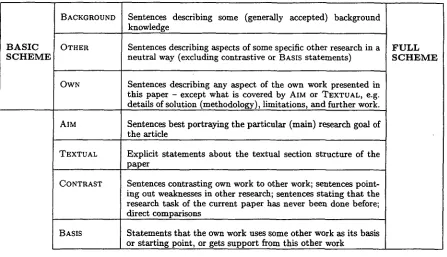
Our annotation scheme consists of the seven categories shown in Figure 1. T h e r e are two ver- sions of the annotation scheme. T h e basic scheme provides a distinction between three textual seg- ments which we think is a necessary precondi- tion for argumentatively-justified summarization. This distinction is concerned with the attribution of authorship to scientific ideas and solutions de- scribed in the text. Authors need to make clear, and readers need to understand:
• which sections describe generally accepted
statements (BACKGROUND);
• which ideas are attributed to some other, spe- cific piece of research outside the given paper, including own previous work
(OTHER);
• and which statements are the authors' own new contributions (OWN).
T h e / u l l annotation scheme consists of the ba- sic scheme plus four other categories, which are based on STales' moves. The most important of these is AIM (STales' move "Explicit statements of research goal"), as these moves are good char- acterizations of the entire paper. We are inter- ested in how far humans can be trained to con- sistently annotate these sentences; similar experi- ments where subjects selected one or several 'most relevant' sentences from a paper have traditionally reported low agreement (Rath et al., 1961). There is also the category TEXTUAL
(
STales' move "In- dicate structure"), which provides helpful infor- mation about section structure, and two moves having to do with attitude towards previous re- search, namelyBASIS and CONTRAST.
The relative simplicity of the scheme was a com- promise between two demands: we wanted the scheme to contain enough information for auto- matic summarization, but still be practicable for hand coding.
B A S I C S C H E M E
BACKGROUND
OTHER
Sentences describing some (generally accepted) background knowledge
Sentences describing aspects of some specific other research in a neutral way (excluding contrastive or BASIS statements) OWN Sentences describing any aspect of the own work presented in
this paper - except what is covered by AIM or TEXTUAL, e.g. details of solution (methodology), limitations, and further work. AIM Sentences best portraying the particular (main) research goal of
the article
TEXTUAL Explicit statements about the textual section structure of the paper
CONTRAST Sentences contrasting o w n work to other work; sentences point-
ing out weaknesses in other research; sentences stating that the research task of the current paper has never been done before; direct comparisons
BASIS Statements that the own work uses some other work as its basis
[image:3.596.73.520.81.338.2]or starting point, or gets support from this other work
Figure 1: Overview of the annotation s c h e m e
F U L L S C H E M E
1997; Alexandersson et al., 1995; Jurafsky et al., 1997), but our task is more difficult since it re- quires more subjective interpretation.
3 A n n o t a t i o n e x p e r i m e n t
Our annotation scheme is based on the intuition that its categories provide an adequate and in- tuitive description of scientific texts. But this intuition alone is not enough of a justification: we believe t h a t our claims, like claims about any other descriptive account of textual interpreta- tion, should be substantiated by demonstrating that other humans can apply this interpretation consistently to actual texts.
We did three studies. S t u d y I and II were de- signed to find out if the two versions of the an- notation scheme (basic vs. full) can be learned by human coders with a significant amount of train- ing. We are interested in two formal properties of the annotation scheme: stability and reproducibil- ity (Krippendorff, 1980). Stability, the extent to which one annotator will produce the same classi- fications at different times, is important because an instable annotation scheme can never be re- producible. Reproducibility, the extent to which different annotators will produce the same clas- sifications, is important because it measures the consistency of shared understandings (or mean- ing) held between annotators.
We use the K a p p a coefficient K (Siegel and Castellan, 1988) to measure stability and repro-
ducibility among k annotators on N items: In our experiment, the items are sentences. K a p p a is a better measurement of agreement t h a n raw percentage agreement (Carletta, 1996) because it factors out the level of agreement which would be reached by r a n d o m annotators using the same distribution of categories as the real coders. No m a t t e r how many items or annotators, or how the categories are distributed, K--0 when there is no agreement other t h a n what would be expected by chance, and K = I when agreement is perfect. We expect high r a n d o m agreement for our annotation scheme because so many sentences fall into the OWN category.
Studies I and II will determine how far we can t r u s t in the h u m a n - a n n o t a t e d training material for both learning and evaluation of the automatic method. The outcome of Study II (full annota- tion scheme) is crucial to the task, as some of the categories specific to the full annotation scheme (particularly AIM) add considerable value to the information contained in the training material.
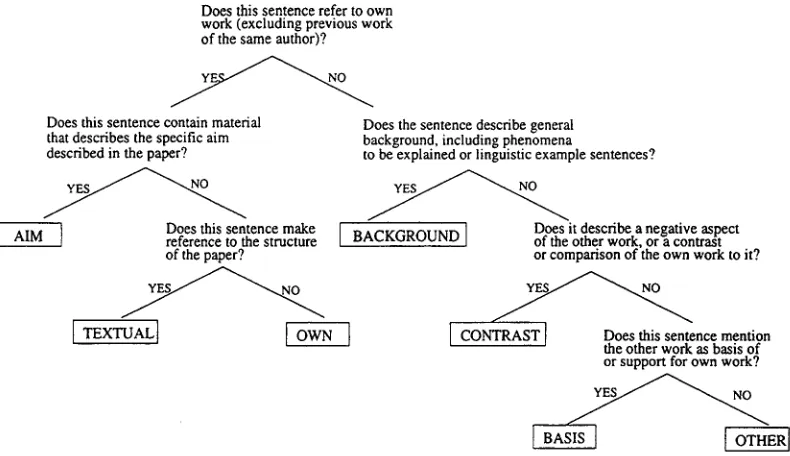
Does this sentence refer to own work (excluding previous work of the same author)?
Does this sentence contain material that describes the specific aim described in the paper?
Does this sentence make reference to the structure of the paper?
I TEXTUAL ]
Does the sentence describe general background, including phenomena
to be explained or linguistic example sentences?
t[ BACKGROUND 1 Does it describe a negative aspect J of the other work, or a contrast
or comparison of the own work to it?
Y ~ N O
[ CONTRAST I Does this sentence mention the other work as basis of or support for own work?
Figure 2: Decision tree for annotation
Our materials consist of 48 computational lin- guistics papers (22 for Study I, 26 for Study II), taken from the Computation and Language E- Print Archive ( h t t p : / / x x x . l a n l . gov/cmp-lg/). We chose papers that had been presented at COL- ING, ANLP or A C L conferences (including stu- dent sessions), or ACL-sponsored workshops, and been put onto the archive between April 1994 and April 1995.
3.1 S t u d i e s I a n d II
For Studies I and II, we used three highly trained annotators. The annotators (two graduate stu- dents and the first author) can be considered skilled at extracting information from scientific papers but they were not experts in all of the sub- domains of the papers they annotated. The anno- tators went through a substantial amount of train- ing, including the reading of coding instructions for the two versions of the scheme (6 pages for the basic scheme and 17 pages for the full scheme), four training papers and weekly discussions, in which previous annotations were discussed. How- ever, annotators were not allowed to change any previous decisions. For the stability figures (intra- annotator agreement), annotators re-coded 6 ran- domly chosen papers 6 weeks after the end of the annotation experiment. Skim-reading and anno- tation of an average length paper (3800 words) typically took the annotators 20-30 minutes.
During the annotation phase, one of the pa- pers turned out to be a review paper. This paper
caused the annotators difficulty as the scheme was not intended to cover reviews. Thus, we discarded this paper from the analysis.
The results show t h a t the basic annotation scheme is stable (K=.83, .79, .81; N=1248; k=2 for all three annotators) and reproducible (K=.78, N=4031, k=3). This reconfirms that trained an- notators are capable of making the basic dis- tinction between own work, specific other work, and general background. The full annotation scheme is stable (K=.82, .81, .76; N--1220; k=2 for all three annotators) and reproducible (K=.71, N=4261, k=3). Because of the increased cogni- tive difficulty of the task, the decrease in stability and reproducibility in comparison to Study I is acceptable. Leaving the coding developer out of the coder pool for Study II did not change the re- sults (K=.71, N=4261, k=2), suggesting that the training conveyed her intentions fairly well.
[image:4.596.73.468.82.310.2]0.8
0.7
0.6
0,5
K 0.4
0.3
0.2
0.1
0
,;
i::!i,i!ii
: . : : : . :I ~:~:i;it i i::~i:!::}i
Iz!!~;is!l :::.;.i:~:!
C O N T R A S T AIM BASIS TEXTUAL
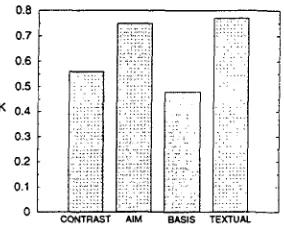
Figure 3: Reproducibility diagnostics: non-basic categories (Study II)
.,o4
~-3
r ~
~2
~° 1
0
0.3 0.4 0.5 0.6 0.7 0.8 0.9 1 K
Figure 4: Distribution by reproducibility (Study
II)
TUAL. This is an i m p o r t a n t result: as AIM sen- tences constitute the best characterization of the research p a p e r for the summarization task we are particularly interested in having them annotated consistently in our training material. T h e anno- tators were less good at determining BASIS and CONTRAST. This might have to do with the loca- tion of those types of sentences in the paper: AIM
a n d TEXTUAL are usually found at the beginning or end of the introduction section, whereas CON- TRAST, and even more so BASIS, are usually in- terspersed within longer stretches of OWN. As a result, these categories are more exposed to lapses of attention during annotation.
If we blur the less i m p o r t a n t distinctions be- tween CONTRAST, OTHER, and BACKGROUND, the reproducibility of the scheme increases to
K=.75. Structuring our training set in this way
seems to be a good compromise for our task, be- cause with high reliability, it would still give us the crucial distinctions contained in the basic an- notation scheme, plus the highly i m p o r t a n t AIM sentences, plus the useful TEXTUAL and BASIS sentences.
The variation in reproducibility across papers is large, b o t h in Study I and Study II (cf. the quasi- bimodal distribution shown in Figure 4). Some hypotheses for why this might be so are the fol-
0.9
0.8
K 0.7
0.6
0.5
none low high
Figure 5: Effect of self-citation ratio on repro- ducibility (Study I)
lowing:
• One problem our annotators reported was a difficulty in distinguishing OTHEa work f r o m OWN work, due to the fact t h a t some a u t h o r s did not express a clear distinction between
previous own work (which, according to our
instructions, h a d to be coded as OTHEa) a n d
current, new work. This was particularly the
case where authors had published several pa- pers a b o u t different aspects of one piece of research. We found a correlation with self ci- tation ratio (ratio of self citations to all cita- tions in running text): papers with m a n y self citations are m o r e difficult to a n n o t a t e t h a n papers t h a t have few or no self citations (cf. Figure 5).
• Another persistent problematic distinction for our a n n o t a t o r s was t h a t between OWN and BACKGROUND. This could be a sign t h a t some authors aimed their papers at an e x p e r t audience, and thus thought it unnecessary to signal clearly which s t a t e m e n t s are c o m m o n l y agreed in the field, as opposed to their own new claims. If a p a p e r is written in such a way, it can indeed only be understood with a considerable a m o u n t of domain knowledge, which our a n n o t a t o r s did not have.
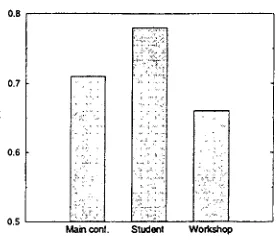
• There is also a difference in reproducibil- ity between papers from different conference
types, as Figure 6 suggests. O u t of our 25 pa-
[image:5.596.344.485.75.195.2] [image:5.596.114.256.79.194.2] [image:5.596.73.293.238.342.2]0.8
0.7
0,5
:!!i~?:
• i :;. :L:
Mai~ conf. S t u d e n t Wad(shop
Figure 6: Effect of conference type on repro- ducibility (Study II)
criticising other people's work than student or workshop papers (on average about one fourth of the paper). They seem to be care- fully prepared (and thus easy to annotate); conference authors must express themselves more clearly than workshop authors because they are reporting finished work to a wider audience.
3 . 2 S t u d y I I I
For Study III, we used a different subject pool: 18 subjects with no prior annotation training. All of them had a graduate degree in Cognitive Sci- ence, with two exceptions: one was a graduate student in Sociology of Science; and one was a sec- retary. Subjects were given only minimal instruc- tions (1 page A4), and the decision tree in Fig- ure 2. Each annotator was randomly assigned to a group of six, all of whom independently annotated the same single paper. These three papers were randomly chosen from the set of papers for which our trained annotators had previously achieved good reproducibility in Study II (K=.65,N=205, k=3; K=.85,N=192,k=3; K=.87,N=144,k=3, re- spectively).
Reproducibility varied considerably between groups (K=.35, N=205, k=6; K=.49, N=192, k=6; K=.72, N=144, k=6). K a p p a is designed to abstract over the number of coders. Lower reli- ablity for Study III as compared to Studies I and II is not an artefact of how K was calculated.
Some subjects in Group 1 and 2 did not un- derstand the instructions as intended - we must conclude that our very short instructions did not provide enough information for consistent anno- tation. This is not surprising, given that human indexers (whose task is very similar to the task introduced here) are highly skilled professionals. However, part of this result can be attributed to the papers: Group 3, which annotated the pa- per found to be most reproducible in Study II,
performed almost as well as trained annotators; Group 1, which performed worst, also happened to have the paper with the lowest reproducibil- ity. In Groups 1 and 2, the most similar three annotators reached a respectable reproducibility (K=.5, N=205, k=3; K=.63, N=192, k=3). T h a t , together with the good performance of Group 3, seems to show that the instructions did at least convey some of the meaning of the categories.
It is remarkable that the two subjects who had no training in computational linguistics performed reasonably well: they were not part of the circle of the three most similar subjects in their groups, but they were also not performing worse than the other two annotators.
4 D i s c u s s i o n
It is an interesting question how far shallow (hu- man and automatic) information extraction meth- ods, i.e. those using no domain knowledge, can be successful in a task such as ours. We believe t h a t argumentative structure has so many reliable lin- guistic or non-linguistic correlates on the surface - physical layout being one of these correlates, others are linguistic indicators like "to our knowl-
edge" and the relative order of the individual ar-
gumentative moves - that it should be possible to detect the line of argumentation of a text without much world knowledge. The two non-experts in the subject pool of Study III, who must have used some other information besides computational lin- guistics knowledge, performed satisfactorily - a fact that seems to confirm the promise of shallow methods.
Overall, reproducibility and stability for trained annotators does not quite reach the levels found for, for instance, the best dialogue act coding schemes (around K=.80). Our annotation re- quires more subjective judgments and is possi- bly more cognitively complex. Our reproducibility and stability results are in the range which Krip- pendorff (1980) describes as giving marginally sig- nificant results for reasonable size d a t a sets when correlating two coded variables which would show a clear correlation if there were prefectly agree- ment. T h a t is, the coding contains enough signal to be found among the noise of disagreement.
[image:6.596.113.252.78.198.2]cation.
T h e single most surprising result of the experi- ments is the large variation in reproducibility be- tween papers. Intuitively, the reason for this are qualitative differences in individual writing style - annotators reported that some papers are bet- ter structured and b e t t e r written than others, and t h a t some authors tend to write more clearly t h a n others. It would be interesting to compare our re- producibility results to independent quality judge- ments of the papers, in order to determine if our experiments can indeed measure the clarity of sci- entific argumentation.
Most of the problems we identified in our stud- ies have to do with a lack of distinction between own and other people's work (or own previous work). Because our scheme discriminates based on these properties, as well as being useful for summarizing research papers, it might be used for automatically detecting whether a p a p e r is a re- view, a position paper, an evaluation p a p e r or a ' p u r e ' research article by looking at the relative frequencies of automatically a n n o t a t e d categories.
5
C o n c l u s i o n s
We have introduced an annotation scheme for re- search articles which marks t h e aims of the pa- per in relation to p a s t literature. We have ar- gued t h a t this scheme is useful for building b e t t e r abstracts, a n d have conducted some experiments which show t h a t the annotation scheme can be learned by trained a n n o t a t o r s and subsequently applied in a consistent way. Because the scheme is reliable, h a n d - a n n o t a t e d d a t a can be used to train a system which applies the scheme a u t o m a t - ically to unseen text.
T h e novel aspects of our scheme are t h a t it ap- plies to different kinds of scientific research arti- cles, because it relies on the form and meaning of argumentative aspects found in the text t y p e r a t h e r t h a n on contents or physical format. As such, it should be independent of article length and article discipline. In the future, we plan to show this by applying our scheme to journal and conference articles from a range of disciplines. Practical reasons have kept us from using journal articles as d a t a so far (namely the difficulty of cor- pus collection and the increased length and subse- quent time effort of h u m a n experiments), b u t we are particularly interested in t h e m as they can be expected to be of higher quality. As the basic ar- g u m e n t a t i o n is the same as in conference articles, our scheme should be applicable to journal arti- cles at least as consistently as to the papers in our current collection.
6 Acknowledgements
We wish to t h a n k our annotators, Vasilis Karaiskos and Ann Wilson, for their patience and diligence in this work, and for their insightful, crit- ical, and very useful observations.
T h e first a u t h o r is supported by an E P S R C stu- dentship.
R e f e r e n c e s
Jan Alexandersson, Elisabeth Mater, and Norbert Re- ithinger. 1995. A robust and efficient three-layered dialogue component for a speech-to-speech transla- tion system. In Proceedings of the Seventh Euro- pean Meeting of the ACL, pages 188-193.
Ronald Brandow, Karl Mitze, and Lisa F. Rau. 1995. Automatic condensation of electronic publications by sentence selection. Information Processing and Management, 31(5):675-685.
Jean Carletta, Amy Isard, Stephen Isard, Jacque- line C. Kowtko, Gwyneth Doherty-Sneddon, and Anne H. Anderson. 1997. The reliability of a dia- logue structure coding scheme. Computational Lin- guistics, 23(1):13-31.
Jean Carletta. 1996. Assessing agreement on classi- fication tasks: the kappa statistic. Computational Linguistics, 22(2):249-254.
Robin Cohen. 1984. A computational theory of the function of clue words in argument understanding. In Proceedings of COLING-8~, pages 251-255. Anna Duszak. 1994. Academic discourse and intellec-
tual styles. Journal of Pragmatics, 21:291-313. Daniel Jurafsky, Elizabeth Shriberg, and Debra Bi-
asca, 1997. Switchboard SWBD-DAMSL Shallow- Discourse-Function Annotation Coders Manual. University of Colorado, Institute of Cognitive Sci- ence. TR-97-02.
Joost G. Kircz. 1991. The rhetorical structure of sci- entific articles: the case for argumentational analy- sis in information retrieval. Journal of Documenta- tion, 47(4):354-372.
Klaus Krippendorff. 1980. Content analysis: an in- troduction to its methodology. Sage Commtext se- ries; 5. Sage, Beverly Hills London.
Julian Kupiec, Jan O. Pedersen, and Francine Chen. 1995. A trainable document summarizer. In Pro- ceedings of the 18th ACM-SIGIR Conference, Asso- ciation for Computing Machinery, Special Interest Group Information Retrieval, pages 68-73.
William C. Mann and Sandra A. Thompson. 1987. Rhetorical structure theory: description and con- struction of text structures. In G. Kempen, edi- tor, Natural Language Generation: New Results in Artificial Intelligence, Psychology and Linguistics, pages 85-95, Dordrecht. Nijhoff.
Daniel Marcu. 1997. From discourse structures to text summaries. In Inderjeet Mani and Mark T. Maybury, editors, Proceedings of the workshop on Intelligent Scalable Text Summarization, in associ- ation with A CL//BA CL- 97.
Greg Myers. 1992. In this paper we report... - speech acts and scientific facts. Journal of Pragmatics, 17(4):295-313.
Chris D. Paice. 1990. Constructing literature ab- stracts by computer: techniques and prospects. Information Processing and Management, 26:171- 186.
G.J Rath, A. Resnick, and T. R. Savage. 1961. The formation of abstracts by the selection of sentences. American Documentation, 12(2):139-143.
Lisa F. Rau, Paul S. Jacobs, and Uri Zernik. 1989. Information extraction and text processing using linguistic knowledge acquisition. Information Pro- cessing and Management, 25(4):419-428.
Sidney Siegel and N.J. Jr. Castellan. 1988. Non- parametric statistics for the Behavioral Sciences. McGraw-Hill, second edition edition.
Karen Sp~ixck Jones. 1998. Automatic summarising: factors and directions. In ACL/EACL-97 Work- shop 'Intelligent Scalable Text Summarization'. John Swales. 1990. Genre analysis: English in aca-
demic and research settings. Cambridge University Press.
Geoff Thompson and Yiyun Ye. 1991. Evaluation in the reporting verbs used in academic papers. Ap- plied Linguistics, 12(4):365-382.