2555
Text Generation with Exemplar-based Adaptive Decoding
Hao Peng⇤ Ankur P. Parikh} Manaal Faruqui} Bhuwan Dhingra|⇤ Dipanjan Das} Paul G. Allen School of Computer Science & Engineering, University of Washington, Seattle, WA
}Google AI Language, New York, NY
|School of Computer Science, Carnegie Mellon University, Pittsburgh, PA
[email protected], {aparikh,mfaruqui,dipanjand}@google.com, [email protected]
Abstract
We propose a novel conditioned text gener-ation model. It draws inspirgener-ation from tra-ditional template-based text generation tech-niques, where the source provides the con-tent (i.e.,what to say), and the template influ-enceshow to say it. Building on the success-ful encoder-decoder paradigm, it first encodes the content representation from the given in-put text; to produce the outin-put, it retrieves exemplar text from the training data as “soft templates,” which are then used to construct an exemplar-specific decoder. We evaluate the proposed model on abstractive text sum-marization and data-to-text generation. Em-pirical results show that this model achieves strong performance and outperforms compara-ble baselines.
1 Introduction
Conditioned text generation is the essence of many natural language processing (NLP) tasks, e.g., text summarization (Mani, 1999), machine translation (Koehn,2009), and data-to-text gener-ation (Kukich,1983;McKeown,1992;Reiter and Dale, 1997). In its common neural sequence-to-sequence formulation (Sutskever et al.,2014;Cho et al., 2014), an encoder-decoder architecture is used. The decoder generates the text autoregres-sively, token-by-token, conditioning on the feature representations encoded from the source, typically with attention (Bahdanau et al., 2015) and copy mechanisms (Gu et al., 2016; See et al., 2017). This paradigm is capable of generating fluent ab-stractive text, but in an uncontrolled and some-times unreliable way, often producing degenerate outputs and favoring generic utterances (Vinyals and Le,2015;Li et al.,2016).
The encoder-decoder approach differs con-siderably from earlier template-based
meth-⇤Work done during internship at Google.
ods (Becker, 2002; Foster and White, 2004; Re-iter et al.,2005;Gatt and Reiter,2009,inter alia), where the source content is filled into the slots of a handcrafted template. These solutions of-fer higher generation precision compared to neu-ral approaches (Wiseman et al., 2017), but tend to lack the naturalness of neural systems, and are less scalable to open domain settings, where the number of required templates can be prohibitively large.
To sidestep the scalability problems with hand-crafted templates, it has been proposed to use simi-lar training samples asexemplars, to guide the de-coding process (Gu et al.,2018;Guu et al.,2018;
Weston et al.,2018;Pandey et al.,2018;Cao et al.,
2018a, inter alia).1 In general, existing methods
accomplish this by (a) using traditional informa-tion retrieval (IR) techniques for exemplar extrac-tion (e.g., TF-IDF), and then (b) concatenating the exemplar to the source as additional inputs, allow-ing the decoder to attend over and copy from both. We propose a different strategy for using exem-plars. For motivation, Figure 1 shows a source-target pair together with its exemplar from the Gi-gaword dataset (Graff et al.,2003). The target is a summary of the source sentence, and the exemplar is retrieved from the training set (§3.2).2 There is word overlap between the exemplar and the de-sired output, which would be easily captured by an attention/copy mechanism (e.g. Norwayandaid). Despite this, ideally, the model should also exploit the structural and stylistic aspects to produce an output with a similar sentence structure, even if the words are different.
Indeed, in traditional templates, the source
1The termexemplarindicates a training instance used to
help generation. We aim to distinguish from “templates,” since here no explicit slot-filling procedure is involved.
2We use thetraining targetas the exemplar, whose source
Source: Norway said Friday it would give Zimbabwe 40 million kroner (7.02 million dollars, 4.86 million euros) in aid to help the country deal with a lack of food and clean drinking water and a cholera outbreak.
Exemplar: Norway boosts earthquake
aid to Pakistan.
Target: Norway grants aid of 4.86
million euros to Zimbabwe.
Figure 1: A source-target pair from Gigaword training set, along with its exemplar.
is supposed to determine “what to say,” while the templates aim to address “how to say it,” reminiscent of the classical content selection and surface realization pipeline (Reiter and Dale,
1997). For instance, an ideal template for this example might look as follows:
grants aid of to
In the neural formulation, the “how to say it” aspect is primarily controlled by the decoder.
Inspired by the above intuition, we propose exemplar-based adaptive decoding, where a cus-tomized decoder is constructed for each exem-plar. This is achieved by letting the exemplars to directly influence decoder parameters through a reparameterization step (§3.1). The adaptive de-coder can be used as a drop-in replacement in the encoder-decoder architecture. It offers the poten-tial to better incorporate the exemplars’ structural and stylistic aspects into decoding, without exces-sive increase in the amount of parameters or com-putational overhead.
We empirically evaluate our approach on ab-stractive text summarization and data-to-text gen-eration (§4), on which most of the recent efforts on exemplar-guided text generation have been stud-ied. On three benchmark datasets, our approach outperforms comparable baselines, and achieves performance competitive with the state of the art. The proposed method can be applicable in many other conditioned text generation tasks. Our im-plementation is available at https://homes. cs.washington.edu/˜hapeng.
2 Background
This section lays out the necessary background and notations for further technical discussion. We begin with conditioned text generation and the encoder-decoder framework (Sutskever et al.,
2014;Cho et al.,2014). In the interest of the
no-tation clarity, §3 will use an Elman network ( El-man,1990) as a running example for the decoder, which is briefly reviewed in §3. The proposed technique generalizes to other neural network ar-chitectures (§3.3).
Conditioned text generation and the encoder-decoder architecture. Our discussion centers around conditioned text generation, i.e., the model aims to output the target y = y1y2. . . yT given the source inputx = x1x2. . . xS, both of which are sequences of tokens. Each tokenxi,yi takes one value from a vocabulary V. x andy could vary depending on the tasks, e.g., they will respec-tively be articles and summaries for text summa-rization; and for data-to-text generation, xwould be structured data, which can sometimes be lin-earized (Lebret et al.,2016;Wiseman et al.,2018,
inter alia), and y is the output text. We aim to learn a (parameterized) conditional distribution of the target textygiven the sourcex,
p y|x = T
Y
t=1
p yt|y<t,x , (1)
wherey<t = y1. . . yt 1 is the prefix of y up to
the(t 1)thtoken (inclusive).
The probability of each target token is usually estimated with asoftmaxfunction:
p(yt|y<t,x) =
exph>t 1wyt
P
yexph>t 1wy
. (2)
wydenotes a learned vector for tokeny 2V.ht 1
depends ony<tandx, and is computed by a func-tion which we will describe soon.
A typical implementation choice for computing ht is the encoder-decoder architecture (Sutskever
et al., 2014). More specifically, an encoder g✓
first gathers the feature representations from the source x; then a decoder f is used to compute thehtfeature vectors:
ht=f
⇣
yt,ht 1,g✓(x) ⌘
. (3)
✓ and are, respectively, the collections of pa-rameters for the encoder and the decoder, both of which can be implemented as recurrent neu-ral networks (RNNs) such as LSTMs ( Hochre-iter and Schmidhuber,1997) or GRUs (Cho et al.,
2014), or the transformer (Vaswani et al., 2017). In Sutskever et al. (2014), the dependence of f ong✓is made by using the last hidden state of the
at-tention (Bahdanau et al., 2015) and copy mecha-nisms (Gu et al., 2016; See et al., 2017), as we will do in this work.
§3introduces how we use exemplars to inform decoding, by dynamically constructing the de-coder’s parameters . For the notation clarity, we will use the Elman network as a running example, reviewed below.
Elman networks. Given input sequence x, an Elman network (Elman,1990) computes the hid-den state at time steptfrom the previous one and the current input token by
ht= tanh Pht 1+Qvt , (4)
wherePandQare learnedd⇥dparameter ma-trices (withdbeing the hidden dimension), andvt is the embedding vector for tokenxt. We omit the bias term for clarity.
3 Method
This section introduces the proposed method in detail. Our aim is to use exemplars to inform the decoding procedure (i.e., how to say it). To ac-complish this, we reparameterize the decoder’s pa-rameters with weighted linear sums, where the co-efficients are determined by an exemplar. The de-coder isadaptive, in the sense that its parameters vary according to the exemplars. The adaptive de-coder can be used as a drop-in replacement in the encoder-decoder architecture. Before going into details, let us first overview the high-level genera-tion procedure of our model. Given source textx, the model generates an output as follows:
1. Run a standard encoder to gather the content representationsg✓(x)from the source.
2. Retrieve its exemplar zx, and compute exemplar-specific coefficients (§3.2).
3. Construct the adaptive decoder parameters (§3.1), using the coefficients computed at step 2. Then the output is generated by applying the adaptive decoder followed by a softmax, just as in any other encoder-decoder architecture.
Aiming for a smoother transition, we will first de-scribe step 3 in§3.1, and then go back to discuss step 2 in§3.2. For clarity, we shall assume that the decoder is implemented as an Elman network ( El-man,1990; Equation4). The proposed technique generalizes to other neural network architectures, as we will discuss later in§3.3.
3.1 Reparameterizing the RNN Decoder At its core, the exemplar-specific adaptive decoder involves a reparameterization step, which we now describe. We focus on the parameters of the Elman network decoder, i.e.,PandQin Equation4.
Parameter construction with linear sums. We aim to reparameterize the pair of matrices(P,Q), in a way that they are influenced by the exemplars. Let us first consider an extreme case, where one assigns a different pair of parameter matrices to each exemplar, without any sharing. This leads to an unreasonably large amount of parameters, which are difficult to estimate reliably.3
We instead constructPandQfrom a set of pre-defined parameters matrices. TakePfor example, it is computed as the weighted sum ofPimatrices:
P= r
X
i=1
iPi, (5)
where Pi 2 Rd⇥d, with dbeing the size of the hidden states. ris a hyperparameter, determining the number of Pi matrices to use.4 The summa-tion is weighted by the coefficients i, which are computed from the exemplar zx. For clarity, the dependence of bothPand i onzxis suppressed when the context is clear.
Equation 5 constructs the decoder’s parameter matrixPusing a linear combination of {Pi}ri=1.
The exemplar informs this procedure through the coefficients i’s, the detailed computation of which is deferred to§3.2. The other matrixQcan be similarly constructed byQ=Pi iQi.
Rank-1 constraints. In the above formulation, the number of parameters is stillrtimes more than a standard Elman network, which can lead to over-fitting with a limited amount of training data. Be-sides, it would be more interesting to compare the adaptive decoder to a standard RNN under a com-parable parameter budget. Therefore we want to further limit the amount of parameters. This can be achieved by forcing the ranks ofPi andQi to be 1, since it then takes2dparameters to form each of them, instead ofd2. More formally, we
upper-3The amount of parameters grows linearly with the
num-ber of possible exemplars, which, as we will soon discuss in §3.2, can be as large as the training set.
4Instead of choosingr empirically, we set it equal tod
bound their ranks by construction:
Pi =u(ip) ⌦ v
(p)
i . (6)
a⌦b = ab> denotes the outer product of two vectors; u(ip) and v(ip) are learnedd-dimensional vectors. EachQi can be similarly constructed by a separate set of vectorsQi =u(iq)⌦vi(q).
Let Up,Vp 2 Rd⇥r denote the stack of u(ip), v(ip)vectors, i.e.,
Up=
h
u(1p), . . . ,u(rp)i, (7a)
Vp=
h
v1(p), . . . ,v(rp)i. (7b)
Equations5and6can be compactly written as P=Up⇤Vp>. (8)
where⇤ is the diagonal matrix built from the
r-dimensional coefficient vector = [ 1, . . . , r]>:
⇤= diag( ) =
2 6 4
1
... r
3 7
5. (9)
The construction ofQis similar, but with a differ-ent set of parameters matricesUqandVq:5
Q=Uq⇤V>q. (10)
Note that, despite their similarities to SVD at a first glance, Equations8and10 are not perform-ing matrix factorization. Rather, we are learn-ing{Up,Vp,Uq,Vq}directly;P, Q,{Pi}, and {Qi}are never explicitly instantiated (Peng et al.,
2017,2018c).
To summarize, we reparameterize PandQ as interpolations of rank-1 matrices. By the fact that rank(A +B) rank(A) + rank(B), the ranks of P and Q are upper-bounded by r. As pointed out byKrueger and Memisevic(2017), the parameter matrices of a trained RNN tend to have full rank. Therefore, in the experiments, we set r equal to the hidden size d, aiming to allow the adaptive decoder to use full-rank matrices in the recurrent computation. Yet, if one holds a priori
beliefs that the matrices should have lower ranks, usingr < dcould be desirable. Whenr =d, an adaptive RNN constructed by the above approach has 4d2 parameters, which is comparable to the
2d2parameters in a standard Elman network.6
5The bias term in the Elman networkbcan be constructed
asb=B , withBbeing a learnedd⇥rmatrix.
6This does not include the bias term, which contributes
additionald2parameters to the former, anddto the latter.
3.2 Incorporating Exemplars
We now discuss the computation of coefficients , through which the exemplars inform the decoder construction (Equations8and10). Before detail-ing the neural network architecture, we begin by describing the exemplar retrieval procedure. Retrieving exemplars zx. Intuitively, similar source texts should hold similar targets. There-fore, given source input x, we use the training target as its exemplar zx, whose source is most similar tox.7 To compute the similarities between
source texts, we use bag-of-words (BOW) features and cosine similarity. We extract the top-1 exem-plar for each instance. This step is part of the pre-processing, and we do not change the exemplars as the training proceeds.
There are, of course, many other strategies to get the exemplars, e.g., using handcrafted or heuristically created hard templates (Reiter et al.,
2005;Becker, 2002;Foster and White,2004, in-ter alia), randomly samplingmultipletraining in-stances (Guu et al., 2018), or learning a neural reranker (Cao et al.,2018a). Using more sophisti-cally extracted exemplars is definitelly interesting to explore, which we defer to future work.
Computing coefficients. Next we describe the computation of , the r-dimensional coefficient vector, which is used to construct the adaptive de-coder (Equations8and10).
Intuitively, the rank-1 matrices (Pi’s and Qi’s in Equation6and thereafter) can be seen as cap-turing different aspects of the generated text. And determines how much each of them contributes to the adaptive decoder construction. A natural choice to calculate is to use the similarities be-tween the exemplar and each of the aspects.
To accomplish this, we run a RNN encoder over zx, and use the last hidden state as its vector rep-resentationa.8We further associate each(P
i,Qi) pair with a learned vectorci; and then i is com-puted as the similarity betweenaandci, using an inner product i =a>ci. More compactly,
=Ca, (11)
withC= [c1, . . . ,cr]>.
7The source of an exemplar is only used in the retrieval
and never fed into the encoder-decoder model. For a training instance, we additionally disallow using its own target as the exemplar.
8For clarity, the dependence ofaon the exemplarz xis
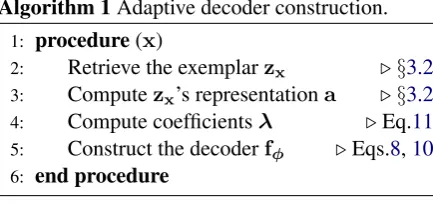
Algorithm 1Adaptive decoder construction. 1: procedure(x)
2: Retrieve the exemplarzx .§3.2 3: Computezx’s representationa .§3.2 4: Compute coefficients .Eq.11 5: Construct the decoderf .Eqs.8,10 6: end procedure
Closing this section, Algorithm 1 summarizes the procedure to construct an adaptive decoder.
3.3 Discussion.
Although we’ve based our discussion on Elman networks so far, it is straightforward to apply this method to its gated variants (Hochreiter and Schmidhuber, 1997;Cho et al.,2014,inter alia), and other quasi-/non-recurrent neural architec-tures (Bradbury et al.,2017;Vaswani et al.,2017;
Peng et al.,2018a,inter alia). Throughout the ex-periments, we will be using an adaptive LSTM decoder (§4). As a drop-in replacement in the encoder-decoder architecture, it introduces a rea-sonable amount of additional parameters and com-putational overhead, especially when one uses a small encoder for the exemplar (i.e., the sizes of the ci vectors in Equation 11 are small). It can benefit from the highly-optimized GPU imple-mentations, e.g., CuDNN, since it uses the same recurrent computation as a standard nonadaptive RNN.
In addition to the neural networks, the adap-tive decoder requires access to the full training set due to the retrieval step. In this sense it is
semi-parametric.9 The idea to dynamically
con-struct the parameters is inspired by Hypernet-works (Ha et al.,2017) and earlier works therein. It proves successful in tasks such as classifica-tion (Jia et al.,2016;Liu et al.,2017) and machine translation (Platanios et al., 2018). Many recent template-based generation models include the ex-emplars ascontent in addition to the source, and allow the decoder to attend over and copy from both (Gu et al., 2018; Guu et al., 2018; Weston et al.,2018;Pandey et al.,2018;Cao et al.,2018a,
inter alia). We compare to this approach in the experiments, and show that our model offers
fa-9Nothing prohibits adaptively constructing other
compo-nents of the model, e.g., the encoderg✓. Yet, our motivation is to use exemplars to informhow to say it, which is primar-ily determined by the decoder (in contrast, the encoder relates more to selecting the content).
NYT Giga Wikibio
# inst. TrainDev. 92K9K 190K3.8M 583K73K Test 9,706 1,951 73K
[image:5.595.73.290.66.174.2]Avg. len. Src.Tgt. 939.048.6 31.48.2 26.0N/A
Table 1: Number of instances and average text lengths for the datasets used in the experiments. The lengths are averaged over training instances.
vorable performance, and that they can potentially be combined to achieve further improvements.
4 Experiments
This section empirically evaluates the proposed model on two sets of text generation tasks: ab-stractive summarization (§4.2) and data-to-text generation (§4.3). Before heading into the exper-imental details, we first describe the architectures of the compared models in§4.1.
4.1 Compared Models
In addition to previous works, we compare to the following baselines, aiming to control for con-founding factors due to detailed implementation choices.
• SEQ2SEQ. The encoder-decoder architec-ture enhanced with attention and copy mech-anisms. The encoder is implemented with a bi-directional LSTM (BiLSTM;Hochreiter and Schmidhuber, 1997; Schuster and Pali-wal,1997;Graves,2012), and the decoder a uni-directional one. We tie the input embed-dings of both the encoder and the decoder, as well as thesoftmaxweights (Press and Wolf,
2017). We use beam search during evalua-tion, with length penalty (Wu et al.,2016). • ATTEXP. It is based on SEQ2SEQ. It
4.2 Text Summarization
Datasets. We empirically evaluate our model on two benchmark text summarization datasets:
• Annotated Gigaword corpus (Gigaword;
Graff et al.,2003;Napoles et al.,2012). Gi-gaword contains news articles sourced from various news services over the last two decades. To produce the dataset, we follow the split and preprocessing by Rush et al.
(2015), and pair the first sentences and the headlines in the news articles. It results in a 3.8M/190K/1,951 train/dev./test split. The average lengths of the source and target texts are 31.4 and 8.2, respectively.
• New York Times Annotated Corpus (NYT; Sandaus, 2008). It contains news articles published between 1996 and 2007 by New York Times. We use the split and preprocessing by Durrett et al. (2016).10
Following their effort, we evaluate on a smaller portion of the test set, where the gold summaries are longer than 50 tokens. We further randomly sample 9,000 instances from the training data for validation, result-ing in a 91,834/9,000/3,452 train/dev./test split. Compared to Gigaword, the inputs and targets in NYT are much longer (averaging 939.0 and 48.6, respectively).
Table1summarizes some statistics of the datasets. We note that some recent works use a differ-ent split of the NYT corpus (Paulus et al., 2018;
Gehrmann et al.,2018), and thus are not compara-ble to the models in Tacompara-ble3. We decide to use the one byDurrett et al.(2016) because their prepro-cessing script is publicly available.
For both datasets, we apply byte-paired encod-ing (BPE;Sennrich et al.,2016), which proves to improve the generation of proper nouns (Fan et al.,
2018).
Empirical results. Table2compares the models on Gigaword test set in ROUGEF1(Lin,2004).11
By using adaptive decoders, our model (ADADEC) improves over SEQ2SEQ by more than 1.1 ROUGE scores. Cao et al. (2018b) and the FULL model by Cao et al. (2018a) hold the best published results. The former uses extensive handcrafted features and relies on external infor-mation extraction and syntactic parsing systems;
10https://github.com/gregdurrett/ berkeley-doc-summarizer.
11Version 1.5.5 of the official script.
Model RG-1 RG-2 RG-L
Open-NMT 35.0 16.6 32.4
†Cao et al.,2018a(BASIC) 36.0 17.1 33.2 †Cao et al.,2018a(FULL) 37.0 19.0 34.5
?Cao et al.(2018b) 37.3 17.6 34.2
This work (SEQ2SEQ) 35.8 17.5 33.5 †This work (ATTEXP) 36.0 17.7 33.1
†This work (ADADEC) 37.3 18.5 34.7
Table 2: Text summarization performance in ROUGE F1 scores (dubbed as RG-X) on Gigaword test set (§4.2). † denotes the models using retrieved exemplars, while ? uses handcrafted features. Bold font indicates best performance. Open-NMT numbers are taken fromCao et al.(2018a).
while the latter uses additional encoding, atten-tion and copy mechanisms over the exemplars extracted using a novel neural reranker. ADADEC achieves better or comparable performance to the state-of-the-art models, without using any handcrafted features or reranking techniques. The BASIC model by Cao et al. (2018a) ablates the reranking component from their FULLmodel, and uses the top exemplar retrieved by the IR system. Therefore it is a more comparable baseline to ours. ADADECoutperforms it by more than 1.3 ROUGE scores. Surprisingly, we do not observe interesting improvements by ATTEXP over the sequence-to-sequence baseline. We believe that our model can benefit from better extracted exemplars by, e.g., applying a reranking system. Such exploration is deferred to future work.
The NYT experimental results are summarized in Table 3. We follow previous works and re-port limited-length ROUGErecallvalues.12 Dur-rett et al.(2016) is an extractive model, andPaulus et al.(2018) an abstractive approach based on rein-forcement learning. Our ADADECmodel outper-forms both. We observe similar trends when com-paring ADADEC to the SEQ2SEQ and ATTEXP baselines, with the exception that ATTEXP does
improve over SEQ2SEQ.
4.3 Data-to-text Generation
Data-to-text generation aims to generate textual descriptions of structured data, which can be
12FollowingDurrett et al.(2016) andPaulus et al.(2018),
Model ROUGE-1 ROUGE-2
Durrett et al.(2016) 42.2 24.9
Paulus et al.(2018) 42.9 26.0
This work (SEQ2SEQ) 41.9 25.1 †This work (ATTEXP) 42.5 25.7
[image:7.595.315.516.64.255.2]†This work (ADADEC) 43.2 26.4
Table 3: NYT text summarization test performance in ROUGE recall values. This is a smaller portion of the original test data, after filtering out instances with summaries shorter than 50 tokens (§4.2;Durrett et al.,
2016).†denotes the models using retrieved exemplars, and bold font indicates best performance.
seen as a table consisting of a collection of records (Liang et al., 2009). For a given entity, each record is an(attribute, value)tuple. Figure2
shows an example for entityJacques-Louis David. The table specifies the entity’s properties with tu-ples(born, 30 August 1748),(nationality, French), and so forth. The table is paired with a description, which the model is supposed to generate using the table as input. We refer the readers toLebret et al.
(2016) for more details about the task.
Dataset and implementation details. We use the Wikibio dataset (Lebret et al.,2016). It is au-tomatically constructed by pairing the tables and the opening sentences of biography articles from English Wikipedia. We follow the split and pre-processing provided along with the dataset, with around 583K/73K/73K train/dev./test instances. Following Lebret et al. (2016), we linearize the tables, such that we can conveniently train the sequence-to-sequence style models described in §4.1. Table 1 summarizes some statistics of the dataset.
In contrast to the text summarization experi-ment (§4.2), we do not apply BPE here. Fur-ther, the word embeddings are initialized with
GloVe (Pennington et al., 2014; fixed during training), andnottied with the softmaxweights. In addition to the models introduced in§4.1, we additionally compare to ADADEC+ATTEXP, aim-ing to study whether the adaptive decoder can fur-ther benefit from attention and copy mechanisms over the exemplars.
Empirical results. FollowingLiu et al.(2018) we report ROUGE-4 and BLEU scores (Papineni
[image:7.595.79.283.65.167.2]Jacques-Louis David (30 August 1748 – 29 December 1825) was a French painter in the Neoclassical style.
Figure 2: A training instance from the Wikibio dataset. It consists of a collections of records for Jacques-Louis David (top), and a piece of textual description (bottom).
et al., 2002).13 Table 4 summarizes the
data-to-text generation results on the Wikibio test set. Overall, we observe similar trends to those in the summarization experiment (§4.2): by attend-ing over and copyattend-ing from the exemplars, AT-TEXP improves upon the SEQ2SEQ baseline by around 0.6 absolute scores. Also utilizing ex-emplar information, our ADADEC model out-performs SEQ2SEQ by a larger margin: 1.3 for ROUGE-4 and 1.1 for BLEU. We further study whether we can get further improvements by com-bining both. ADADEC+ATTEXPachieves around 0.5 absolute improvements over ADADEC, less than those by ATTEXPover SEQ2SEQ. This pro-vides evidence that, to some extend, the ways AT-TEXP and ADADEC incorporate exemplar infor-mation might be complementary. Wiseman et al.
(2018) is a template-motivated model based on a semi-Markov model. Liu et al. (2018) hold the current state-of-the-art results. They encode the table structures by using (a) position and filed em-beddings, and (b) structure-aware attention and gating techniques. These techniques are beyond the scope of this work, which focuses mainly on the decoding end.
13We use the script by Lin (2004) to calculate the
Model RG-4 BLEU
Wiseman et al.(2018) 38.6 34.8
Liu et al.(2018) 41.7 44.7
This work (SEQ2SEQ) 39.3 42.5 †This work (ATTEXP) 40.0 43.1
†This work (ADADEC) 40.6 43.6 †This work (ADADEC+ATTEXP) 41.1 44.1
Table 4: Data-to-text generation performance in ROUGE-4 and BLEUon the Wikibio test set (§4.3). †
indicates the models using retrieved exemplars.
5 Analysis
We now qualitatively evaluate our model, by studying how its outputs are affected by using different exemplars. Figure 3 shows two ran-domly sampled Gigaword development instances. It compares the outputs by ADADEC(i.e., without attention/copy over exemplars;§4.1) when receiv-ing different exemplars, controllreceiv-ing for the same source inputs. In each example, Exemplar 1
is retrieved by the system (i.e., a training target; §3.2); while the remaining ones are produced by the authors, by modifying the first one in styles and sometimes introducing distractions in the con-tent.
In the top example, the model includes peo-pleinto the subject (Threevs. Three people) un-der the influence by Exemplar 2; Exemplar 3 changes the tense and adds some distraction by changing the place from Britain to Canada. The model follows the tense switch, but gets con-fused by the distraction, and decides to let a train in southern Europe collide into North America, which it should not. Looking at the bottom exam-ple, the model in general follows the exemplar in using noun adjuncts or prepositional phrases (e.g.,
new home sales vs. sales of new homes), except the first one. Perhaps confused by the distraction inExemplar 3, the model makes a judgment on the specific amount of growth, but gets it wrong.
6 Related Work
Exemplar-based generation. Partly inspired by traditional template-based generation (Kukich,
1983;Reiter and Dale,1997,inter alia), many re-cent efforts have been devoted to augmenting text generation models with retrieved exemplars ( Ho-dosh et al., 2013; Mason and Charniak, 2014;
Song et al., 2016; Lin et al., 2017, inter alia).
Source: A Portuguese train derailed
in the northern region of Oporto on Wednesday, killing three people...
Exemplar 1: Two die in a Britain
train collision.
Output 1: Three killed in Portuguese
train derailment.
Exemplar 2: Two people were
killed in Britain train collision.
Output 2: Three people killed in
Portuguese train derailment.
Exemplar 3: A train collision in
Canada killed two people.
Output 3: Portuguese train derails
in northern Mexico killing three.
Source: Sales of new homes in the
U.S. increased by 11.8 percent in May, the biggest gain in 26 years...
Exemplar 1: U.S. sales of new homes
up strongly in March.
Output 1: US new home sales rise
11.8 percent in May.
Exemplar 2: The sales of new homes
in the U.S. grow strongly.
Output 2: Sales of new homes in US
rise in May.
Exemplar 3: U.S. economic
statis-tics: new home sales grow by 2.5 percent.
Output 3: US new home sales grow 26
percent in May.
Figure 3: Two randomly sampled Gigaword devel-opment instances used for qualitative evaluation (§5).
Exemplar 1’s are retrieved by the system (§3.2),
while the remaining ones are produced by the authors. Notable exemplars changes are highlighted in bold purple, and output changes initalic yellow.
Without committing to an explicit slot-filling pro-cess, a typical method is to include exemplars as additional inputs to the sequence-to-sequence models (Gu et al.,2018;Pandey et al.,2018;Guu et al., 2018, inter alia). Wiseman et al. (2018) took a different approach and used a semi-Markov model to learn templates.
Dynamic parameter construction. The idea of using a smaller network to generate weights for a larger one dues back toStanley et al. (2009) and
classifica-tion (Jia et al.,2016;Liu et al.,2017) and machine translation (Platanios et al.,2018). It also relates to the meta-learning set-up (Thrun and Pratt,1998).
7 Conclusion
We presented a text generation model using exemplar-informed adaptive decoding. It repa-rameterizes the decoder using the information gathered from retrieved exemplars. We experi-mented with text summarization and data-to-text generation, and showed that the proposed model achieves strong performance and outperforms comparable baselines on both. The proposed model can be applicable in other conditioned text generation tasks. We release our implementa-tion at https://homes.cs.washington. edu/˜hapeng.
Acknowledgments
We thank Antonios Anastasopoulos, Ming-Wei Chang, Michael Collins, Jacob Devlin, Yichen Gong, Luheng He, Kenton Lee, Dianqi Li, Zhouhan Lin, Slav Petrov, Oscar T¨ackstr¨om, Kristina Toutanova, and other members of the Google AI language team for the helpful discus-sion, and the anonymous reviewers for their valu-able feedback.
References
Maruan Al-Shedivat, Avinava Dubey, and Eric P. Xing. 2017. Contextual explanation networks.
arXiv:1705.10301.
Dzmitry Bahdanau, Kyunghyun Cho, and Yoshua Ben-gio. 2015. Neural machine translation by jointly learning to align and translate. InProc. of ICLR.
Tilman Becker. 2002. Practical, template–based natu-ral language generation with tag. InProceedings of the Sixth International Workshop on Tree Adjoining Grammar and Related Frameworks.
James Bradbury, Stephen Merity, Caiming Xiong, and Richard Socher. 2017. Quasi-Recurrent Neural Net-work. InProc. of ICLR.
Ziqiang Cao, Wenjie Li, Sujian Li, and Furu Wei. 2018a. Retrieve, rerank and rewrite: Soft template based neural summarization. InProc. of ACL.
Ziqiang Cao, Furu Wei, Wenjie Li, and Sujian Li. 2018b. Faithful to the original: Fact aware neural abstractive summarization. InProc. of AAAI.
Kyunghyun Cho, Bart Van Merri¨enboer, Caglar Gul-cehre, Dzmitry Bahdanau, Fethi Bougares, Holger
Schwenk, and Yoshua Bengio. 2014. Learning phrase representations using RNN encoder-decoder for statistical machine translation. In Proc. of EMNLP.
Greg Durrett, Taylor Berg-Kirkpatrick, and Dan Klein. 2016. Learning-based single-document summariza-tion with compression and anaphoricity constraints. InProc. of ACL.
Jeffrey L. Elman. 1990. Finding structure in time.
Cognitive science, 14(2):179–211.
Angela Fan, David Grangier, and Michael Auli. 2018. Controllable abstractive summarization. In Pro-ceedings of the 2nd Workshop on Neural Machine Translation and Generation.
Chrisantha Fernando, Dylan Banarse, Malcolm Reynolds, Frederic Besse, David Pfau, Max Jader-berg, Marc Lanctot, and Daan Wierstra. 2016. Convolution by evolution: Differentiable pattern producing networks. InProceedings of the Genetic and Evolutionary Computation Conference 2016.
Mary Ellen Foster and Michael White. 2004. Tech-niques for text planning with xslt. InProceeedings of the Workshop on NLP and XML: RDF/RDFS and OWL in Language Technology.
Albert Gatt and Ehud Reiter. 2009. SimpleNLG: A re-alisation engine for practical applications. In Pro-ceedings of the 12th European Workshop on Natural Language Generation.
Sebastian Gehrmann, Yuntian Deng, and Alexander M Rush. 2018. Bottom-up abstractive summarization. InProc. of EMNLP.
David Graff, Junbo Kong, Ke Chen, and Kazuaki Maeda. 2003. English Gigaword Second Edition.
Alex Graves. 2012. Supervised Sequence Labelling with Recurrent Neural Networks, volume 385 of
Studies in Computational Intelligence. Springer.
Jiatao Gu, Zhengdong Lu, Hang Li, and Victor OK Li. 2016. Incorporating copying mechanism in sequence-to-sequence learning. InProc. of ACL.
Jiatao Gu, Yong Wang, Kyunghyun Cho, and Vic-tor OK Li. 2018. Search engine guided non-parametric neural machine translation. InProc. of AAAI.
Kelvin Guu, Tatsunori B Hashimoto, Yonatan Oren, and Percy Liang. 2018. Generating sentences by editing prototypes. TACL, 6:437–450.
David Ha, Andrew Dai, and Quoc V Le. 2017. Hyper-networks. InProc. of ICLR.
Sepp Hochreiter and J¨urgen Schmidhuber. 1997. Long short-term memory. Neural computation, 9(8):1735–1780.
Micah Hodosh, Peter Young, and Julia Hockenmaier. 2013. Framing image description as a ranking task: Data, models and evaluation metrics. JAIR, 47(1):853–899.
Xu Jia, Bert De Brabandere, Tinne Tuytelaars, and Luc V Gool. 2016. Dynamic filter networks. In
Proc. of NeuralIPS.
Diederik Kingma and Jimmy Ba. 2015. Adam: A method for stochastic optimization. In Proc. of ICLR.
Durk P Kingma, Tim Salimans, and Max Welling. 2015. Variational dropout and the local reparame-terization trick. InProc. of NeuralIPS.
Philipp Koehn. 2009. Statistical machine translation. Cambridge University Press.
Jan Koutnik, Faustino Gomez, and J¨urgen Schmidhu-ber. 2010. Evolving neural networks in compressed weight space. InProceedings of the Annual Confer-ence on Genetic and Evolutionary Computation.
David Krueger and Roland Memisevic. 2017. Regu-larizing rnns by stabilizing activations. In Proc. of ICLR.
Karen Kukich. 1983. Design of a knowledge-based re-port generator. InProc. of ACL.
R´emi Lebret, David Grangier, and Michael Auli. 2016. Neural text generation from structured data with application to the biography domain. In Proc. of EMNLP.
Jiwei Li, Michel Galley, Chris Brockett, Jianfeng Gao, and Bill Dolan. 2016. A diversity-promoting ob-jective function for neural conversation models. In
Proc. of NAACL.
Percy Liang, Michael I. Jordan, and Dan Klein. 2009. Learning semantic correspondences with less super-vision. InProc. of ACL.
Chin-Yew Lin. 2004. Rouge: A package for automatic evaluation of summaries. In Text Summarization Branches Out: Proceedings of the ACL-04 Work-shop.
Kevin Lin, Dianqi Li, Xiaodong He, Zhengyou Zhang, and Ming-ting Sun. 2017. Adversarial ranking for language generation. InProc. of NeuralIPS.
Pengfei Liu, Xipeng Qiu, and Xuanjing Huang. 2017. Dynamic compositional neural networks over tree structure. InProc. of IJCAI.
Tianyu Liu, Kexiang Wang, Lei Sha, Baobao Chang, and Zhifang Sui. 2018. Table-to-text generation by structure-aware seq2seq learning. InProc. of AAAI.
Minh-Thang Luong, Hieu Pham, and Christopher D. Manning. 2015. Effective approaches to attention-based neural machine translation. In Proc. of EMNLP.
Inderjeet Mani. 1999.Advances in automatic text sum-marization. MIT press.
Rebecca Mason and Eugene Charniak. 2014. Domain-specific image captioning. InProc. of CoNLL. Kathleen McKeown. 1992. Text generation.
Cam-bridge University Press.
Marcin Moczulski, Misha Denil, Jeremy Appleyard, and Nando de Freitas. 2015. ACDC: A structured efficient linear layer. arXiv:1511.05946.
Courtney Napoles, Matthew Gormley, and Benjamin Van Durme. 2012. Annotated gigaword. In Pro-ceedings of the Joint Workshop on Automatic Knowl-edge Base Construction and Web-scale KnowlKnowl-edge Extraction.
Gaurav Pandey, Danish Contractor, Vineet Kumar, and Sachindra Joshi. 2018. Exemplar encoder-decoder for neural conversation generation. InProc. of ACL. Kishore Papineni, Salim Roukos, Todd Ward, and Wei jing Zhu. 2002. Bleu: a method for automatic eval-uation of machine translation. InProc. of ACL. Romain Paulus, Caiming Xiong, and Richard Socher.
2018. A deep reinforced model for abstractive sum-marization. InProc. of ICLR.
Hao Peng, Roy Schwartz, Sam Thomson, and Noah A. Smith. 2018a. Rational recurrences. InIn Proc. of EMNLP.
Hao Peng, Sam Thomson, and Noah A. Smith. 2017. Deep multitask learning for semantic dependency parsing. InProc. of ACL.
Hao Peng, Sam Thomson, and Noah A. Smith. 2018b. Backpropagating through structured argmax using a spigot. InProc. of ACL.
Hao Peng, Sam Thomson, Swabha Swayamdipta, and Noah A. Smith. 2018c. Learning joint semantic parsers from disjoint data. InProc. of NAACL. Jeffrey Pennington, Richard Socher, and
Christo-pher D. Manning. 2014. GloVe: Global vectors for word representation. InProc. of EMNLP.
Emmanouil Antonios Platanios, Mrinmaya Sachan, Graham Neubig, and Tom Mitchell. 2018. Contex-tual parameter generation for universal neural ma-chine translation. InProc. of EMNLP.
Ofir Press and Lior Wolf. 2017. Using the output em-bedding to improve language models. In Proc. of EACL.
Ehud Reiter, Somayajulu Sripada, Jim Hunter, Jin Yu, and Ian Davy. 2005. Choosing words in computer-generated weather forecasts. Artificial Intelligence, 167(1-2):137–169.
Alexander M. Rush, Sumit Chopra, and Jason Weston. 2015. A neural attention model for abstractive sen-tence summarization. InProc. of EMNLP.
Evan Sandaus. 2008. The New York Times Annotated Corpus. LDC corpora. Linguistic Data Consortium.
M. Schuster and K.K. Paliwal. 1997. Bidirectional recurrent neural networks. Transactions on Signal Proccesing, 45(11):2673–2681.
Abigail See, Peter J. Liu, and Christopher D. Manning. 2017. Get to the point: Summarization with pointer-generator networks. InProc. of ACL.
Rico Sennrich, Barry Haddow, and Alexandra Birch. 2016. Neural machine translation of rare words with subword units. InProc. of ACL.
Yiping Song, Rui Yan, Xiang Li, Dongyan Zhao, and Ming Zhang. 2016. Two are better than one: An ensemble of retrieval- and generation-based dialog systems. arXiv:1610.07149.
Nitish Srivastava, Geoffrey Hinton, Alex Krizhevsky, Ilya Sutskever, and Ruslan Salakhutdinov. 2014. Dropout: A simple way to prevent neural networks from overfitting. JMLR, 15(1):1929–1958.
K. O. Stanley, D. B. D’Ambrosio, and J. Gauci. 2009. A hypercube-based encoding for evolving large-scale neural networks. Artificial Life, 15(2):185– 212.
Ilya Sutskever, Oriol Vinyals, and Quoc V Le. 2014. Sequence to sequence learning with neural net-works. InProc. of NeuralIPS.
Sebastian Thrun and Lorien Pratt, editors. 1998.
Learning to Learn. Kluwer Academic Publishers.
Ashish Vaswani, Noam Shazeer, Niki Parmar, Jakob Uszkoreit, Llion Jones, Aidan N Gomez, Ł ukasz Kaiser, and Illia Polosukhin. 2017. Attention is all you need. InProc. of NeuralIPS.
Oriol Vinyals and Quoc Le. 2015. A neural conversa-tional model. InProc. of ICML.
Jason Weston, Emily Dinan, and Alexander Miller. 2018. Retrieve and refine: Improved sequence gen-eration models for dialogue. InProceedings of the International Workshop on Search-Oriented Con-versational AI.
Sam Wiseman, Stuart Shieber, and Alexander Rush. 2017. Challenges in data-to-document generation. InProc. of EMNLP.
Sam Wiseman, Stuart M Shieber, and Alexander M Rush. 2018. Learning neural templates for text gen-eration. InProc. of EMNLP.
Yonghui Wu, Mike Schuster, Zhifeng Chen, Quoc V. Le, Mohammad Norouzi, Wolfgang Macherey, Maxim Krikun, Yuan Cao, Qin Gao, Klaus Macherey, Jeff Klingner, Apurva Shah, Melvin Johnson, Xiaobing Liu, ukasz Kaiser, Stephan Gouws, Yoshikiyo Kato, Taku Kudo, Hideto Kazawa, Keith Stevens, George Kurian, Nishant Patil, Wei Wang, Cliff Young, Jason Smith, Ja-son Riesa, Alex Rudnick, Oriol Vinyals, Greg Cor-rado, Macduff Hughes, and Jeffrey Dean. 2016. Google’s neural machine translation system: Bridg-ing the gap between human and machine translation.