Stacking Dependency Parsers
Andr´e F. T. Martins∗† Dipanjan Das∗ Noah A. Smith∗ Eric P. Xing∗ ∗
School of Computer Science, Carnegie Mellon University, Pittsburgh, PA 15213, USA †
Instituto de Telecomunicac¸˜oes, Instituto Superior T´ecnico, Lisboa, Portugal {afm,dipanjan,nasmith,epxing}@cs.cmu.edu
Abstract
We explore a stacked framework for learn-ing to predict dependency structures for natu-ral language sentences. A typical approach in graph-based dependency parsing has been to assume a factorized model, where local fea-tures are used but a global function is opti-mized (McDonald et al., 2005b). Recently Nivre and McDonald (2008) used the output of one dependency parser to provide features for another. We show that this is an example of stacked learning, in which a second pre-dictor is trained to improve the performance of the first. Further, we argue that this tech-nique is a novel way of approximating rich non-local featuresin the second parser, with-out sacrificing efficient, model-optimal pre-diction. Experiments on twelve languages show that stacking transition-based and graph-based parsers improves performance over ex-isting state-of-the-art dependency parsers.
1 Introduction
In this paper we address a representation-efficiency tradeoff in statistical natural language processing through the use of stacked learning (Wolpert, 1992). This tradeoff is exemplified independency parsing, illustrated in Fig. 1, on which we focus in this paper:
• Exact algorithms for dependency parsing (Eis-ner and Satta, 1999; McDonald et al., 2005b) are tractable only when the model makes very strong, linguistically unsupportable independence
assumptions, such as “arc factorization” for non-projective dependency parsing (McDonald and Satta, 2007).
• Feature-rich parsers must resort to search or greediness, (Ratnaparkhi et al., 1994; Sagae and Lavie, 2005; Hall et al., 2006), so that parsing solutions are inexact and learned models may be subject to certain kinds of bias (Lafferty et al., 2001).
A solution that leverages the complementary strengths of these two approaches—described in de-tail by McDonald and Nivre (2007)—was recently and successfully explored by Nivre and McDonald (2008). Our contribution begins by reinterpreting and generalizing their parser combination scheme as astacking of parsers.
We give a new theoretical motivation for stacking parsers, in terms of extending a parsing model’s fea-ture space. Specifically, we view stacked learning as a way of approximating non-local features in a lin-ear model, rather than making empirically dubious independence (McDonald et al., 2005b) or structural assumptions (e.g., projectivity, Eisner, 1996), using search approximations (Sagae and Lavie, 2005; Hall et al., 2006; McDonald and Pereira, 2006), solving a (generally NP-hard) integer linear program (Riedel and Clarke, 2006), or adding latent variables (Titov and Henderson, 2007). Notably, we introduce the use of very rich non-localapproximate features in one parser, through the output of another parser. Related approaches are the belief propagation algo-rithm of Smith and Eisner (2008), and the “trading of structure for features” explored by Liang et al.
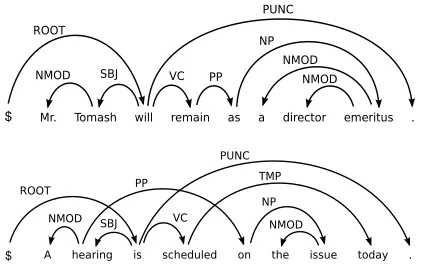
Figure 1: A projective dependency graph.
Figure 2: Non-projective dependency graph.
those that assume each dependency decision is in-dependent modulo the global structural constraint that dependency graphs must be trees. Such mod-els are commonly referred to asedge-factoredsince their parameters factor relative to individual edges of the graph (Paskin, 2001; McDonald et al., 2005a). Edge-factored models have many computa-tional benefits, most notably that inference for non-projective dependency graphs can be achieved in polynomial time (McDonald et al., 2005b). The pri-mary problem in treating each dependency as in-dependent is that it is not a realistic assumption. Non-local information, such as arity (or valency) and neighbouring dependencies, can be crucial to obtaining high parsing accuracies (Klein and Man-ning, 2002; McDonald and Pereira, 2006). How-ever, in the data-driven parsing setting this can be partially adverted by incorporating rich feature rep-resentations over the input (McDonald et al., 2005a). The goal of this work is to further our current understanding of the computational nature of non-projective parsing algorithms for both learning and inference within the data-driven setting. We start by investigating and extending the edge-factored model of McDonald et al. (2005b). In particular, we ap-peal to the Matrix Tree Theorem for multi-digraphs to design polynomial-time algorithms for calculat-ing both the partition function and edge expecta-tions over all possible dependency graphs for a given sentence. To motivate these algorithms, we show that they can be used in many important learning and inference problems including min-risk decod-ing, training globally normalized log-linear mod-els, syntactic language modeling, and unsupervised
learning via the EM algorithm – none of which have previously been known to have exact non-projective implementations.
We then switch focus to models that account for non-local information, in particular arity and neigh-bouring parse decisions. For systems that model ar-ity constraints we give a reduction from the Hamilto-nian graph problem suggesting that the parsing prob-lem is intractable in this case. For neighbouring parse decisions, we extend the work of McDonald and Pereira (2006) and show that modeling vertical neighbourhoods makes parsing intractable in addi-tion to modeling horizontal neighbourhoods. A con-sequence of these results is that it is unlikely that exact non-projective dependency parsing is tractable for any model assumptions weaker than those made by the edge-factored models.
1.1 Related Work
There has been extensive work on data-driven de-pendency parsing for both projective parsing (Eis-ner, 1996; Paskin, 2001; Yamada and Matsumoto, 2003; Nivre and Scholz, 2004; McDonald et al., 2005a) and non-projective parsing systems (Nivre and Nilsson, 2005; Hall and N´ov´ak, 2005; McDon-ald et al., 2005b). These approaches can often be classified into two broad categories. In the first cat-egory are those methods that employ approximate inference, typically through the use of linear time shift-reduce parsing algorithms (Yamada and Mat-sumoto, 2003; Nivre and Scholz, 2004; Nivre and Nilsson, 2005). In the second category are those that employ exhaustive inference algorithms, usu-ally by making strong independence assumptions, as is the case for edge-factored models (Paskin, 2001; McDonald et al., 2005a; McDonald et al., 2005b). Recently there have also been proposals for exhaus-tive methods that weaken the edge-factored assump-tion, including both approximate methods (McDon-ald and Pereira, 2006) and exact methods through in-teger linear programming (Riedel and Clarke, 2006) or branch-and-bound algorithms (Hirakawa, 2006).
For grammar based models there has been limited work on empirical systems for non-projective pars-ing systems, notable exceptions include the work of Wang and Harper (2004). Theoretical studies of note include the work of Neuhaus and B¨oker (1997) showing that the recognition problem for a
mini-$ Figure 1: A projective dependency graph.
Figure 2: Non-projective dependency graph.
those that assume each dependency decision is in-dependent modulo the global structural constraint that dependency graphs must be trees. Such mod-els are commonly referred to asedge-factoredsince their parameters factor relative to individual edges of the graph (Paskin, 2001; McDonald et al., 2005a). Edge-factored models have many computa-tional benefits, most notably that inference for non-projective dependency graphs can be achieved in polynomial time (McDonald et al., 2005b). The pri-mary problem in treating each dependency as in-dependent is that it is not a realistic assumption. Non-local information, such as arity (or valency) and neighbouring dependencies, can be crucial to obtaining high parsing accuracies (Klein and Man-ning, 2002; McDonald and Pereira, 2006). How-ever, in the data-driven parsing setting this can be partially adverted by incorporating rich feature rep-resentations over the input (McDonald et al., 2005a). The goal of this work is to further our current understanding of the computational nature of non-projective parsing algorithms for both learning and inference within the data-driven setting. We start by investigating and extending the edge-factored model of McDonald et al. (2005b). In particular, we ap-peal to the Matrix Tree Theorem for multi-digraphs to design polynomial-time algorithms for calculat-ing both the partition function and edge expecta-tions over all possible dependency graphs for a given sentence. To motivate these algorithms, we show that they can be used in many important learning and inference problems including min-risk decod-ing, training globally normalized log-linear mod-els, syntactic language modeling, and unsupervised
learning via the EM algorithm – none of which have previously been known to have exact non-projective implementations.
We then switch focus to models that account for non-local information, in particular arity and neigh-bouring parse decisions. For systems that model ar-ity constraints we give a reduction from the Hamilto-nian graph problem suggesting that the parsing prob-lem is intractable in this case. For neighbouring parse decisions, we extend the work of McDonald and Pereira (2006) and show that modeling vertical neighbourhoods makes parsing intractable in addi-tion to modeling horizontal neighbourhoods. A con-sequence of these results is that it is unlikely that exact non-projective dependency parsing is tractable for any model assumptions weaker than those made by the edge-factored models.
1.1 Related Work
There has been extensive work on data-driven de-pendency parsing for both projective parsing (Eis-ner, 1996; Paskin, 2001; Yamada and Matsumoto, 2003; Nivre and Scholz, 2004; McDonald et al., 2005a) and non-projective parsing systems (Nivre and Nilsson, 2005; Hall and N´ov´ak, 2005; McDon-ald et al., 2005b). These approaches can often be classified into two broad categories. In the first cat-egory are those methods that employ approximate inference, typically through the use of linear time shift-reduce parsing algorithms (Yamada and Mat-sumoto, 2003; Nivre and Scholz, 2004; Nivre and Nilsson, 2005). In the second category are those that employ exhaustive inference algorithms, usu-ally by making strong independence assumptions, as is the case for edge-factored models (Paskin, 2001; McDonald et al., 2005a; McDonald et al., 2005b). Recently there have also been proposals for exhaus-tive methods that weaken the edge-factored assump-tion, including both approximate methods (McDon-ald and Pereira, 2006) and exact methods through in-teger linear programming (Riedel and Clarke, 2006) or branch-and-bound algorithms (Hirakawa, 2006).
For grammar based models there has been limited work on empirical systems for non-projective pars-ing systems, notable exceptions include the work of Wang and Harper (2004). Theoretical studies of note include the work of Neuhaus and B¨oker (1997) showing that the recognition problem for a mini-$
Figure 1: A projective dependency parse (top), and a non-projective dependency parse (bottom) for two English sentences; examples from McDonald and Satta (2007).
(2008).
This paper focuses on dependency parsing, which has become widely used in relation extraction (Cu-lotta and Sorensen, 2004), machine translation (Ding and Palmer, 2005), question answering (Wang et al., 2007), and many other NLP applications. We show that stacking methods outperform the ap-proximate “second-order” parser of McDonald and Pereira (2006) on twelve languages and can be used within that approximation to achieve even better re-sults. These results are similar in spirit to (Nivre and McDonald, 2008), but with the following novel con-tributions:
• a stacking interpretation,
• a richer feature set that includes non-local features (shown here to improve performance), and
• a variety of stacking architectures.
Using stacking with rich features, we obtain results competitive with Nivre and McDonald (2008) while preserving the fast quadratic parsing time of arc-factored spanning tree algorithms.
The paper is organized as follows. We discuss re-lated prior work on dependency parsing and stacking in§2. Our model is given in§3. A novel analysis of stacking in linear models is given in§4. Experiments are presented in§5.
2 Background and Related Work
We briefly review work on the NLP task of depen-dency parsingand the machine learning framework known asstacked learning.
2.1 Dependency Parsing
Dependency syntax is a lightweight syntactic rep-resentation that models a sentence as a graph where the words are vertices and syntactic relationships are directed edges (arcs) connecting heads to their argu-ments and modifiers.
Dependency parsing is often viewed computa-tionally as a structured prediction problem: for each input sentencex, withnwords, exponentially many candidate dependency treesy∈ Y(x)are possible in principle. We denote each tree by its set of vertices and directed arcs, y = (Vy, Ay). A legal
depen-dency tree hasn+ 1vertices, each corresponding to one word plus a “wall” symbol, $, assumed to be the hidden root of the sentence. In a valid dependency tree, each vertex except the root has exactly one par-ent. In theprojectivecase, arcs cannot cross when depicted on one side of the sentence; in the non-projectivecase, this constraint is not imposed (see Fig. 1).
2.1.1 Graph-basedvs.transition-based models
Most recent work on dependency parsing can be categorized asgraph-based ortransition-based. In graph-based parsing, dependency trees are scored by factoring the tree into its arcs, and parsing is performed by searching for the highest scoring tree (Eisner, 1996; McDonald et al., 2005b). Transition-based parsers model the sequence of decisions of a shift-reduce parser, given previous decisions and current state, and parsing is performed by greedily choosing the highest scoring transition out of each successive parsing state or by searching for the best sequence of transitions (Ratnaparkhi et al., 1994; Yamada and Matsumoto, 2003; Nivre et al., 2004; Sagae and Lavie, 2005; Hall et al., 2006).
Both approaches most commonly use linear mod-els to assign scores to arcs or decisions, so that a score is a dot-product of a feature vector f and a learned weight vectorw.
§2.1.2). Recently, Nivre and McDonald (2008) pro-posed combining a graph-based and a transition-based parser and have shown a significant improve-ment for several languages by letting one of the parsers “guide” the other. Our stacked formalism (to be described in§3) generalizes this approach.
2.1.2 Arc factorization
In the successful graph-based method of McDon-ald et al. (2005b), anarc factorizationindependence assumption is used to ensure tractability. This as-sumption forbids any feature that depends on two or more arcs, permitting only “arc-factored” features (i.e. features that depend only on a single candidate arca ∈ Ay and on the input sequencex). This
in-duces a decomposition of the feature vectorf(x, y)
as:
f(x, y) = X
a∈Ay
fa(x).
Parsing amounts to solving arg maxy∈Y(x)
w>f(x, y), where w is a weight vector. With a projectivity constraint and arc factorization, the parsing problem can be solved in cubic time by dynamic programming (Eisner, 1996), and with a weaker “tree” constraint (permitting nonprojective parses) and arc factorization, a quadratic-time algorithm exists (Chu and Liu, 1965; Edmonds, 1967), as shown by McDonald et al. (2005b). In the projective case, the arc-factored assumption can be weakened in certain ways while maintaining polynomial parser runtime (Eisner and Satta, 1999), but not in the nonprojective case (McDonald and Satta, 2007), where finding the highest-scoring tree becomes NP-hard.
McDonald and Pereira (2006) adopted an approx-imation based onO(n3)projective parsing followed by rearrangement to permit crossing arcs, achieving higher performance. In §3 we adopt a framework that maintains O(n2) runtime (still exploiting the Chu-Liu-Edmonds algorithm) while approximating non arc-factored features.
2.2 Stacked Learning
Stacked generalization was first proposed by Wolpert (1992) and Breiman (1996) for regression. The idea is to include two “levels” of predictors. The first level, “level 0,” includes one or more predictors
g1, . . . , gK : Rd → R; each receives inputx ∈ Rd
and outputs a prediction gk(x). The second level,
“level 1,” consists of a single functionh:Rd+K → Rthat takes as inputhx, g1(x), . . . gK(x)iand
out-puts a final predictionyˆ = h(x, g1(x), . . . gK(x)).
The predictor, then, combines an ensemble (thegk)
with a meta-predictor (h).
Training is done as follows: the training data are split intoL partitions, and Linstances of the level 0 predictor are trained in a “leave-one-out” basis. Then, an augmented dataset is formed by letting each instance output predictions for the partition that was left out. Finally, each level 0 predictor is trained using the original dataset, and the level 1 predictor is trained on the augmented dataset, simulating the test-time setting whenhis applied to a new instance
xconcatenated withhgk(x)ik.
This framework has also been applied to classifi-cation, for example with structured data. Some ap-plications (including here) use only one classifier at level 0; recent work includes sequence labeling (Co-hen and de Carvalho, 2005) and inference in condi-tional random fields (Kou and Cohen, 2007). Stack-ing is also intuitively related to transformation-based learning (Brill, 1993).
3 Stacked Dependency Parsing
We next describe how to use stacked learning for efficient, rich-featured dependency parsing.
3.1 Architecture
The architecture consists of two levels. At level 0 we include a single dependency parser. At runtime, this “level 0 parser”gprocesses an input sentencex
and outputs the set of predicted edges that make up its estimation of the dependency tree,yˆ0 =g(x). At
level 1, we apply a dependency parser—in this work, always a graph-based dependency parser—that uses basic factored featuresplusnew ones from the edges predictedby the level 0 parser. The final parser pre-dicts parse trees ash(x, g(x)), so that the total run-time is additive in calculatingh(·)andg(·).
The stacking framework is agnostic about the form ofgandhand the methods used to learn them from data. In this work we use two well-known, publicly available dependency parsers, MSTParser (McDonald et al., 2005b),1 which implements
act first-order arc-factored nonprojective parsing (§2.1.2) and approximate second-order nonprojec-tive parsing, and MaltParser (Nivre et al., 2006), which is a state-of-the-art transition-based parser.2 We do not alter the training algorithms used in prior work for learning these two parsers from data. Us-ing the existUs-ing parsers as startUs-ing points, we will combine them in a variety of ways.
3.2 Training
Regardless of our choices for the specific parsers and learning algorithms at level 0 and level 1, training is done as sketched in§2.2. LetDbe a set of training examples{hxi, yii}i.
1. Split training data D into L partitions
D1, . . . ,DL.
2. TrainLinstances of the level 0 parser in the fol-lowing way: thel-th instance, gl, is trained on
D−l = D \ Dl. Then use gl to output
predic-tions for the (unseen) partitionDl. At the end,
an augmented datasetD˜ = SL
l=1D˜l is built, so
thatD˜ ={hxi, g(xi), yii}i.
3. Train the level 0 parsergon the original training dataD.
4. Train the level 1 parserhon the augmented train-ing dataD˜.
The runtime of this algorithm isO(LT0+T1), where
T0 and T1 are the individual runtimes required for
training level 0 and level 1 alone, respectively.
4 Two Views of Stacked Parsing
We next describe two motivations for stacking parsers: as a way of augmenting the features of a graph-based dependency parser or as a way to ap-proximate higher-order models.
4.1 Adding Input Features
Suppose that the level 1 classifier is an arc-factored graph-based parser. The feature vectors will take the form3
f(x, y) = f1(x, y)^f2(x,yˆ0, y)
= X
a∈Ay
f1,a(x)^f2,a(x, g(x)),
2
http://w3.msi.vxu.se/˜jha/maltparser
3
We use^to denote vector concatenation.
where f1(x, y) = Pa∈Ayf1,a(x) are
regu-lar arc-factored features, and f2(x,yˆ0, y) =
P
a∈Ayf2,a(x, g(x)) are the stacked features. An
example of a stacked feature is a binary feature
f2,a(x, g(x))that fires if and only if the arc awas
predicted byg, i.e., ifa∈Ag(x); such a feature was used by Nivre and McDonald (2008).
It is difficult in general to decide whether the in-clusion of such a feature yields a better parser, since features strongly correlate with each other. How-ever, a popular heuristic for feature selection con-sists of measuring theinformation gainprovided by each individual feature. In this case, we may obtain a closed-form expression for the information gain thatf2,a(x, g(x))provides about the existence or not
of the arcain the actual dependency treey. LetA
andA0 be binary random variables associated with the eventsa∈Ay anda0 ∈Ag(x), respectively. We
have:
I(A;A0) = X
a,a0∈{0,1}
p(a, a0) log2 p(a, a
0)
p(a)p(a0)
= H(A0)− X
a∈{0,1}
p(a)H(A0|A=a).
Assuming, for simplicity, that at level 0 the prob-ability of false positives equals the probprob-ability of false negatives (i.e., Perr , p(a0 = 0|a = 1) = p(a0 = 1|a = 0)), and that the probability of true positives equals the probability of true negatives (1−Perr = p(a0 = 0|a= 0) = p(a0 = 1|a= 1)),
the expression above reduces to:
I(A;A0) = H(A0) +Perrlog2Perr
+ (1−Perr) log2(1−Perr)
= H(A0)−Herr,
whereHerr denotes the entropy of the probability of
error on each arc’s prediction by the level 0 classi-fier. If Perr ≤ 0.5 (i.e. if the level 0 classifier is
better than random), then the information gain pro-vided by this simple stacked feature increases with (a) the accuracy of the level 0 classifier, and (b) the entropyH(A0)of the distribution associated with its arc predictions.
4.2 Approximating Non-factored Features
such as one that is not arc-factored, by using stacked features that make use of the predicted structure around a candidate arc. Consider a second-order model where the features decompose by arc and by arcpair:
f(x, y) = X
a1∈Ay
fa1(x)^ X
a2∈Ay
fa1,a2(x)
.
Exact parsing under such model, with arbitrary second-order features, is intractable (McDonald and Satta, 2007). Let us now consider a stacked model in which the level 0 predictor outputs a parseyˆ. At level 1, we use arc-factored features that may be written as
˜f(x, y) = X
a1∈Ay
fa1(x)^
X
a2∈Ayˆ
fa1,a2(x)
;
this model differs from the previous one only by re-placingAybyAyˆin the index set of the second
sum-mation. Sinceyˆis given, this makes the latter model arc-factored, and therefore, tractable. We can now view˜f(x, y)as an approximation off(x, y); indeed, we can bound thescore approximation error,
∆s(x, y) = w˜
>˜f(x, y)−w>f(x, y) ,
wherew˜ andwstand respectively for the parameters learned for the stacked model and those that would be learned for the (intractable) exact second order model. We can bound∆s(x, y) by spliting it into two terms:∆s(x, y) =
( ˜w−w)
>˜
f(x, y) +w>(˜f(x, y)−f(x, y))
≤
( ˜w−w)
>˜f(x, y)
| {z }
,∆str(x,y)
+
w
>(˜f(x, y)−f(x, y))
| {z }
,∆sdec(x,y)
;
where we introduced the terms∆strand∆sdecthat
reflect the portion of the score approximation error that are due totraining error(i.e., different parame-terizations of the exact and approximate models) and decoding error(same parameterizations, but differ-ent feature vectors). Using H¨older’s inequality, the former term can be bounded as:
∆str(x, y) =
( ˜w−w)
>˜f(x, y)
≤ kw˜ −wk1· k˜f(x, y)k∞
≤ kw˜ −wk1;
wherek.k1 andk.k∞ denote the `1-norm and
sup-norm, respectively, and the last inequality holds when the features are binary (so thatk˜f(x, y)k∞ ≤
1). The proper way to bound the term kw˜ −wk1
depends on the training algorithm. As for the de-coding error term, it can bounded for a given weight vectorw, sentence x, candidate tree y, and level 0 predictionyˆ. Decomposing the weighted vector as
w = w1 ^ w2, w2 being the sub-vector
associ-ated with the second-order features, we have respec-tively:∆sdec(x, y) =
w
>
(˜f(x, y)−f(x, y)) = X
a1∈Ay
w>2
X
a2∈Ayˆ
fa1,a2(x)−
X
a2∈Ay
fa1,a2(x)
≤ X
a1∈Ay X
a2∈Aˆy∆Ay
w
>
2fa1,a2(x)
≤ X
a1∈Ay
|Ayˆ∆Ay| · max a2∈Aˆy∆Ay
w
>
2fa1,a2(x)
= X
a1∈Ay
2L(y,yˆ)· max
a2∈Ayˆ∆Ay
w
>
2fa1,a2(x)
,
whereAˆy∆Ay , (Ayˆ−Ay)∪(Ay −Ayˆ)denotes
the symmetric difference of the sets Ayˆ and Ay,
which has cardinality2L(y,yˆ),i.e., twice the Ham-ming distance between the sequences of heads that characterize y and the predicted parse yˆ. Using H¨older’s inequality, we have both
w
>
2fa1,a2(x)
≤ kw2k1· kfa1,a2(x)k∞ and
w
>
2fa1,a2(x)
≤ kw2k∞· kfa1,a2(x)k1.
Assuming that all features are binary valued, we have thatkfa1,a2(x)k∞≤1and thatkfa1,a2(x)k1 ≤
Nf,2, whereNf,2 denotes the maximum number of
active second order features for any possible pair of arcs(a1, a2). Therefore:
∆sdec(x, y)≤2nL(y,yˆ) min{kw2k1, Nf,2·kw2k∞},
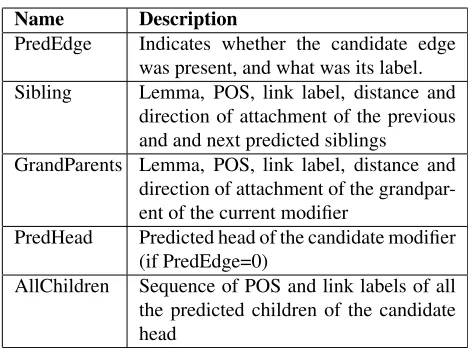
Name Description
PredEdge Indicates whether the candidate edge was present, and what was its label. Sibling Lemma, POS, link label, distance and
direction of attachment of the previous and and next predicted siblings
GrandParents Lemma, POS, link label, distance and direction of attachment of the grandpar-ent of the currgrandpar-ent modifier
PredHead Predicted head of the candidate modifier (if PredEdge=0)
[image:6.612.68.302.55.229.2]AllChildren Sequence of POS and link labels of all the predicted children of the candidate head
Table 1: Feature sets derived from the level 0 parser.
Subset Description
A PredEdge
B PredEdge+Sibling
C PredEdge+Sibling+GrandParents
D PredEdge+Sibling+GrandParents+PredHead E PredEdge+Sibling+GrandParents+PredHead+
AllChildren
Table 2: Combinations of features enumerated in Table 1 used for stacking. A is a replication of (Nivre and Mc-Donald, 2008), except for the modifications described in footnote 4.
which suggests that a separate regularization of the first-order and stacked features might be beneficial in a stacking framework.
As a side note, if we set each component of the weight vector to one, we obtain a bound on the `1-norm of the feature vector difference,
˜f(x, y)−f(x, y)
1 ≤2nL(y,yˆ)Nf,2.
5 Experiments
In the following experiments we demonstrate the ef-fectiveness of stacking parsers. As noted in§3.1, we make use of two component parsers, the graph-based MSTParser and the transition-based MaltParser.
5.1 Implementation and Experimental Details
The publicly available version of MSTParser per-forms parsing and labeling jointly. We adapted this system to first perform unlabeled parsing, then la-bel the arcs using a log-linear classifier with access to the full unlabeled parse (McDonald et al., 2005a;
McDonald et al., 2005b; McDonald and Pereira, 2006). In stacking experiments, the arc labels from the level 0 parser are also used as a feature.4
In the following subsections, we refer to our mod-ification of the MSTParser as MST1O (the
arc-factored version) and MST2O (the second-order
arc-pair-factored version). All our experiments use the non-projective version of this parser. We refer to the MaltParser asMalt.
We report experiments on twelve languages from the CoNLL-X shared task (Buchholz and Marsi, 2006).5 All experiments are evaluated using the labeled attachment score (LAS), using the default settings.6 Statistical significance is measured us-ing Dan Bikel’s randomized parsus-ing evaluation com-parator with 10,000 iterations.7 The additional fea-tures used in the level 1 parser are enumerated in Table 1 and their various subsets are depicted in Ta-ble 2. The PredEdge features are exactly the six fea-tures used by Nivre and McDonald (2008) in their
MSTMalt parser; therefore, feature set A is a
repli-cation of this parser except for modifirepli-cations noted in footnote 4. In all our experiments, the number of partitions used to createD˜ isL= 2.
5.2 Experiment: MST2O+MST2O
Our first experiment stacks the highly accurate MST2O parser with itself. At level 0, the parser
uses only the standard features (§5.1), and at level 1, these are augmented by various subsets of features ofxalong with the output of the level 0 parser,g(x)
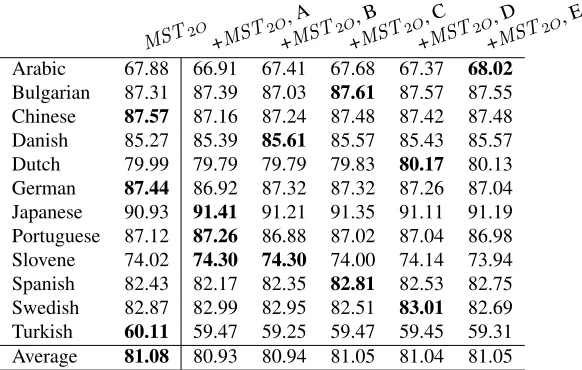
(Table 2). The results are shown in Table 3. While we see improvements over the single-parser baseline
4
We made other modifications to MSTParser, implement-ing many of the successes described by (McDonald et al., 2006). Our version of the code is publicly available athttp: //www.ark.cs.cmu.edu/MSTParserStacked. The modifications included an approximation to lemmas for datasets without lemmas (three-character prefixes), and replacing mor-phology/word and morphology/lemma features with morphol-ogy/POS features.
5
The CoNLL-X shared task actually involves thirteen lan-guages; our experiments do not include Czech (the largest dataset), due to time constraints. Therefore, the average results plotted in the last rows of Tables 3, 4, and 5 are not directly comparable with previously published averages over thirteen languages.
6
http://nextens.uvt.nl/˜conll/software.html
7
MST2O+MST
2O, A +MST
2O, B +MST
2O, C +MST
2O, D +MST
2O, E
[image:7.612.172.463.77.262.2]Arabic 67.88 66.91 67.41 67.68 67.37 68.02 Bulgarian 87.31 87.39 87.03 87.61 87.57 87.55 Chinese 87.57 87.16 87.24 87.48 87.42 87.48 Danish 85.27 85.39 85.61 85.57 85.43 85.57 Dutch 79.99 79.79 79.79 79.83 80.17 80.13 German 87.44 86.92 87.32 87.32 87.26 87.04 Japanese 90.93 91.41 91.21 91.35 91.11 91.19 Portuguese 87.12 87.26 86.88 87.02 87.04 86.98 Slovene 74.02 74.30 74.30 74.00 74.14 73.94 Spanish 82.43 82.17 82.35 82.81 82.53 82.75 Swedish 82.87 82.99 82.95 82.51 83.01 82.69 Turkish 60.11 59.47 59.25 59.47 59.45 59.31 Average 81.08 80.93 80.94 81.05 81.04 81.05
Table 3: Results of stackingMST2Owith itself at both level 0 and level 1. Column 2 enumerates LAS forMST2O.
Columns 3–6 enumerate results for four different stacked feature subsets. Bold indicates best results for a particular language.
for nine languages, the improvements are small (less than 0.5%). One of the biggest concerns about this model is the fact that it stacks two predictors that are very similar in nature: both are graph-based and share the featuresf1,a(x). It has been pointed out by
Breiman (1996), among others, that the success of ensemble methods like stacked learning strongly de-pends on how uncorrelated the individual decisions made by each predictor are from the others’ deci-sions.8 This experiment provides further evidence for the claim.
5.3 Experiment:Malt+MST2O
We next use MaltParser at level 0 and the second-order arc-pair-factored MST2O at level 1. This
extends the experiments of Nivre and McDonald (2008), replicated in our feature subset A.
Table 4 enumerates the results. Note that the best-performing stacked configuration for each and every language outperforms MST2O,
corroborat-ing results reported by Nivre and McDonald (2008). The best performing stacked configuration outper-formsMalt as well, except for Japanese and Turk-ish. Further, our non-arc-factored features largely outperform subset A, except on Bulgarian, Chinese,
8
This claim has a parallel in the cotraining method (Blum and Mitchell, 1998), whose performance is bounded by the de-gree of independence between the two feature sets.
and Japanese. On average, the best feature config-uration is E, which is statistically significant over Malt andMST2O withp < 0.0001, and over
fea-ture subset A withp <0.01.
5.4 Experiment: Malt+MST1O
Finally, we consider stacking MaltParser with the first-order, arc-factored MSTParser. We view this approach as perhaps the most promising, since it is an exact parsing method with the quadratic runtime complexity ofMST1O.
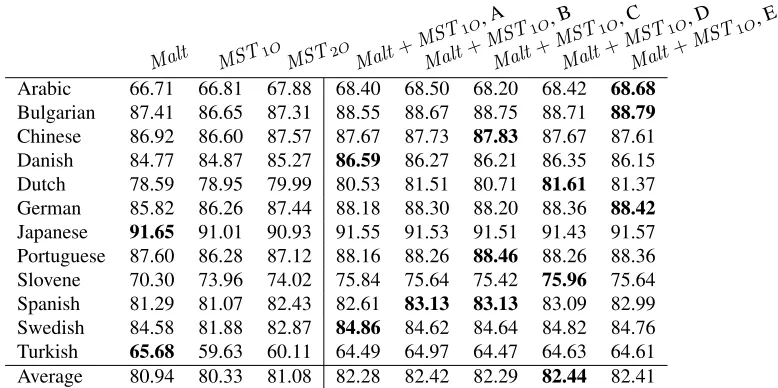
Table 5 enumerates the results. For all twelve languages, some stacked configuration outperforms MST1O and also, surprisingly, MST2O, the
sec-ond order model. This provides empirical evi-dence that using rich features from MaltParser at level 0, a stacked level 1 first-order MSTParser can outperform the second-order MSTParser.9 In only two cases (Japanese and Turkish), the MaltParser slightly outperforms the stacked parser.
On average, feature configuration D performs the best, and is statistically significant over Malt, MST1O, and MST2O with p < 0.0001, and over
feature subset A withp <0.05. Encouragingly, this configuration is barely outperformed by
configura-9Recall thatMST
2O uses approximatesearch, as opposed
Malt MST2OMalt+
MST2O , A
Malt+
MST2O , B
Malt+
MST2O , C
Malt+
MST2O , D
Malt+
MST2O , E
[image:8.612.155.506.66.262.2]Arabic 66.71 67.88 68.56 69.12 68.64 68.34 68.92 Bulgarian 87.41 87.31 88.99 88.89 88.89 88.93 88.91 Chinese 86.92 87.57 88.41 88.31 88.29 88.13 88.41 Danish 84.77 85.27 86.45 86.67 86.79 86.13 86.71 Dutch 78.59 79.99 80.75 81.47 81.47 81.51 81.29 German 85.82 87.44 88.16 88.50 88.56 88.68 88.38 Japanese 91.65 90.93 91.63 91.43 91.59 91.61 91.49 Portuguese 87.60 87.12 88.00 88.24 88.30 88.18 88.22 Slovene 70.30 74.02 76.62 76.00 76.60 76.18 76.72 Spanish 81.29 82.43 83.09 83.73 83.47 83.21 83.43 Swedish 84.58 82.87 84.92 84.60 84.80 85.16 84.88 Turkish 65.68 60.11 64.35 64.51 64.51 65.07 65.21 Average 80.94 81.08 82.52 82.58 82.65 82.59 82.71
Table 4: Results of stackingMalt andMST2Oat level 0 and level 1, respectively. Columns 2–4 enumerate LAS for Malt,MST2OandMalt+MST2Oas in Nivre and McDonald (2008). Columns 5–8 enumerate results for four other stacked feature configurations. Bold indicates best result for a language.
tion A of Malt +MST2O (see Table 4), the
dif-ference being statistically insignificant (p > 0.05). This shows that stackingM altwith the exact, arc-factoredMST1Obridges the difference between the
individualMST1OandMST2Omodels, by
approx-imating higher order features, but maintaining an
O(n2)runtime and finding the model-optimal parse.
5.5 Disagreement as a Confidence Measure
In pipelines or semisupervised settings, it is use-ful when a parser can provide aconfidencemeasure alongside its predicted parse tree. Because stacked predictors use ensembles with observable outputs, differences among those outputs may be used to es-timate confidence in the final output. In stacked de-pendency parsing, this can be done (for example) by measuring the Hamming distance between the out-puts of the level 0 and 1 parsers,L(g(x), h(x)). In-deed, the bound derived in §4.2 suggests that the second-order approximation degrades for candidate parsesythat are Hamming-far fromg(x); therefore, ifL(g(x), h(x))is large, the best score s(x, h(x))
may well be “biased” due to misleading neighbor-ing information provided by the level 0 parser.
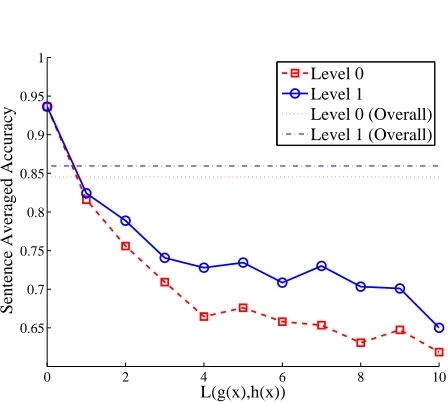
We illustrate this point with an empirical analysis of the level 0/1 disagreement for the set of exper-iments described in§5.3; namely, we compare the
0 2 4 6 8 10
0.65 0.7 0.75 0.8 0.85 0.9 0.95 1
L(g(x),h(x))
Sentence Averaged Accuracy
Level 0 Level 1
Level 0 (Overall) Level 1 (Overall)
[image:8.612.310.534.365.566.2]Malt MST1OMST2OMalt+
MST1O , A
Malt+
MST1O , B
Malt+ MST1O
, C
Malt+
MST1O , D
Malt+
MST1O , E
[image:9.612.135.524.67.261.2]Arabic 66.71 66.81 67.88 68.40 68.50 68.20 68.42 68.68 Bulgarian 87.41 86.65 87.31 88.55 88.67 88.75 88.71 88.79 Chinese 86.92 86.60 87.57 87.67 87.73 87.83 87.67 87.61 Danish 84.77 84.87 85.27 86.59 86.27 86.21 86.35 86.15 Dutch 78.59 78.95 79.99 80.53 81.51 80.71 81.61 81.37 German 85.82 86.26 87.44 88.18 88.30 88.20 88.36 88.42 Japanese 91.65 91.01 90.93 91.55 91.53 91.51 91.43 91.57 Portuguese 87.60 86.28 87.12 88.16 88.26 88.46 88.26 88.36 Slovene 70.30 73.96 74.02 75.84 75.64 75.42 75.96 75.64 Spanish 81.29 81.07 82.43 82.61 83.13 83.13 83.09 82.99 Swedish 84.58 81.88 82.87 84.86 84.62 84.64 84.82 84.76 Turkish 65.68 59.63 60.11 64.49 64.97 64.47 64.63 64.61 Average 80.94 80.33 81.08 82.28 82.42 82.29 82.44 82.41
Table 5: Results of stackingMalt andMST1Oat level 0 and level 1, respectively. Columns 2–4 enumerate LAS for Malt,MST1O andMST2O. Columns 5–9 enumerate results for five different stacked feature configurations. Bold
indicates the best result for a language.
level 0 and level 1 predictions under the best overall configuration (configuration E ofM alt+M ST2O).
Figure 2 depicts accuracy as a function of level 0-level 1 disagreement (in number of tokens), aver-aged over all datasets.
We can see that performance degrades steeply when the disagreement between levels 0 and 1 in-creases in the range 0–4, and then behaves more ir-regularly but keeping the same trend. This suggests that the Hamming distance L(g(x), h(x))is infor-mative about parser performance and may be used as a confidence measure.
6 Conclusion
In this work, we made use of stacked learning to im-prove dependency parsing. We considered an archi-tecture with two layers, where the output of a stan-dard parser in the first level provides new features for a parser in the subsequent level. During learning, the second parser learns to correct mistakes made by the first one. The novelty of our approach is in the exploitation of higher-order predicted edges to simu-late non-local features in the second parser. We pro-vided a novel interpretation of stacking as feature approximation, and our experimental results show rich-featured stacked parsers outperforming state-of-the-art single-layer and ensemble parsers.
No-tably, using a simple arc-factored parser at level 1, we obtain an exactO(n2)stacked parser that outper-forms earlier approximate methods (McDonald and Pereira, 2006).
Acknowledgments
The authors thank the anonymous reviewers for helpful comments, Vitor Carvalho, William Cohen, and David Smith for interesting discussions, and Ryan McDonald and Joakim Nivre for providing us their code and preprocessed datasets. A.M. was supported by a grant from FCT through the CMU-Portugal Program and the Information and Com-munications Technologies Institute (ICTI) at CMU. N.S. was supported by NSF IIS-0713265 and an IBM faculty award. E.X. was supported by NSF DBI-0546594, DBI-0640543, and IIS-0713379.
References
S. P. Abney, D. A. McAllester, and F. Pereira. 1999. Re-lating probabilistic grammars and automata. In Pro-ceedings of ACL.
A. Blum and T. Mitchell. 1998. Combining labeled and unlabeled data with co-training. In Proceedings of COLT.
E. Brill. 1993. A Corpus-Based Approach to Language Learning. Ph.D. thesis, University of Pennsylvania. S. Buchholz and E. Marsi. 2006. CoNLL-X shared task
on multilingual dependency parsing. InProceedings of CoNLL.
Y. J. Chu and T. H. Liu. 1965. On the shortest arbores-cence of a directed graph. Science Sinica, 14:1396– 1400.
W. W. Cohen and V. Rocha de Carvalho. 2005. Stacked sequential learning. InProceedings of IJCAI.
A. Culotta and J. Sorensen. 2004. Dependency tree ker-nels for relation extraction. InProceedings of ACL. Y. Ding and M. Palmer. 2005. Machine translation using
probabilistic synchronous dependency insertion gram-mar. InProceedings of ACL.
J. Edmonds. 1967. Optimum branchings.Journal of Re-search of the National Bureau of Standards, 71B:233– 240.
J. Eisner and G. Satta. 1999. Efficient parsing for bilex-ical context-free grammars and head automaton gram-mars. InProceedings of ACL.
J. Eisner. 1996. Three new probabilistic models for de-pendency parsing: An exploration. InProceedings of COLING.
J. Hall, J. Nivre, and J. Nilsson. 2006. Discriminative classifiers for deterministic dependency parsing. In Proceedings of ACL.
Z. Kou and W. W. Cohen. 2007. Stacked graphical mod-els for efficient inference in Markov random fields. In Proceedings of SDM.
J. Lafferty, A. McCallum, and F. Pereira. 2001. Con-ditional random fields: Probabilistic models for seg-menting and labeling sequence data. InProceedings of ICML.
P. Liang, H. Daum´e, and D. Klein. 2008. Structure com-pilation: trading structure for features. InProceedings of ICML.
R. McDonald and J. Nivre. 2007. Characterizing the errors of data-driven dependency parsing models. In Proceedings of EMNLP-CoNLL.
R. T. McDonald and F. C. N. Pereira. 2006. Online learn-ing of approximate dependency parslearn-ing algorithms. In Proceedings of EACL.
R. McDonald and G. Satta. 2007. On the complexity of non-projective data-driven dependency parsing. In Proceedings of IWPT.
R. McDonald, K. Crammer, and F. Pereira. 2005a. On-line large-margin training of dependency parsers. In Proceedings of ACL.
R. T. McDonald, F. Pereira, K. Ribarov, and J. Ha-jic. 2005b. Non-projective dependency parsing us-ing spannus-ing tree algorithms. InProceedings of HLT-EMNLP.
R. McDonald, K. Lerman, and F. Pereira. 2006. Multi-lingual dependency analysis with a two-stage discrim-inative parser. InProceedings CoNLL.
J. Nivre and R. McDonald. 2008. Integrating graph-based and transition-graph-based dependency parsers. In Proceedings of ACL-HLT.
J. Nivre, J. Hall, and J. Nilsson. 2004. Memory-based dependency parsing. InProceedings of CoNLL. J. Nivre, J. Hall, J. Nilsson, G. Eryiˇgit, and S. Marinov.
2006. Labeled pseudo-projective dependency pars-ing with support vector machines. InProceedings of CoNLL.
A. Ratnaparkhi, S. Roukos, and R. T. Ward. 1994. A maximum entropy model for parsing. InProceedings of ICSLP.
S. Riedel and J. Clarke. 2006. Incremental integer linear programming for non-projective dependency parsing. InProceedings of EMNLP.
K. Sagae and A. Lavie. 2005. A classifier-based parser with linear run-time complexity. In Proceedings of IWPT.
D. A. Smith and J. Eisner. 2008. Dependency parsing by belief propagation. InProceedings of EMNLP. I. Titov and J. Henderson. 2007. A latent variable model
for generative dependency parsing. InProceedings of IWPT.
M. Wang, N. A. Smith, and T. Mitamura. 2007. What is the Jeopardy model? A quasi-synchronous grammar for QA. InProceedings of EMNLP-CoNLL.
D. Wolpert. 1992. Stacked generalization. Neural Net-works, 5(2):241–260.