Original citation:
Reinecke, Juliane, Bommel, K. V. and Spicer, Andre (2017) When orders of worth clash : negotiating legitimacy in situations of moral multiplexity. In: Cloutier , Charlotte and Gond, Jean-Pascal and Leca , Bernard , (eds.) Justification, Evaluation and Critique in the Study of Organizations. Research in the Sociology of Organizations, 52. Emerald Group Publishing Ltd., pp. 33-72. ISBN 9781787143807
Permanent WRAP URL:
http://wrap.warwick.ac.uk/84000
Copyright and reuse:
The Warwick Research Archive Portal (WRAP) makes this work by researchers of the University of Warwick available open access under the following conditions. Copyright © and all moral rights to the version of the paper presented here belong to the individual author(s) and/or other copyright owners. To the extent reasonable and practicable the material made available in WRAP has been checked for eligibility before being made available.
Copies of full items can be used for personal research or study, educational, or not-for-profit purposes without prior permission or charge. Provided that the authors, title and full
bibliographic details are credited, a hyperlink and/or URL is given for the original metadata page and the content is not changed in any way.
Publisher’s statement:
'This article is © Emerald Group Publishing and permission has been granted for this version to appear here http://doi.org/10.1108/S0733-558X20170000052002 Emerald does not grant permission for this article to be further copied/distributed or hosted elsewhere without the express permission from Emerald Group Publishing Limited.'
A note on versions:
The version presented here may differ from the published version or, version of record, if you wish to cite this item you are advised to consult the publisher’s version. Please see the ‘permanent WRAP URL’ above for details on accessing the published version and note that access may require a subscription.
When Orders of Worth Clash: Negotiating Legitimacy in Situations of Moral
Multiplexity
Juliane Reinecke Warwick Business School
University of Warwick Coventry CV4 7AL
United Kingdom [email protected]
Koen van Bommel
Department of Management & Organization VU University
De Boelelaan 1105 1081 HV Amsterdam
The Netherlands [email protected]
André Spicer Cass Business School City University, London
106 Bunhill Row London EC1 8TZ
United Kingdom [email protected]
Forthcoming in the Special Issue of Sociology of Organizations (Accepted Nov 2016): Justification, Evaluation and Critique in the Study of Organizations: Contributions from
French Pragmatist Sociology
Editors:
Charlotte Cloutier, HEC Montreal Jean-Pascal Gond, Cass Business School
When Orders of Worth Clash: Negotiating Legitimacy in Situations of Moral
Multiplexity
Abstract
How is moral legitimacy established in pluralist contexts where multiple moral frameworks co-exist and compete? Situations of moral multiplexity complicate not only whether an organization or practice is legitimate but also which criteria should be used to establish moral legitimacy. We argue that moral legitimacy can be thought of as the property of a dynamic dialogical process in which relations between moral schemes are constantly (re-)negotiated through dynamic exchange with audiences. Drawing on Boltanski and Thévenot’s “orders of worth” framework, we propose a process model of how three types of truces may be negotiated: transcendence, compromise, antagonism. While each can create moral legitimacy in pluralistic contexts, legitimacy is not a binary variable but varying in degrees of scope and certainty.
Introduction
Legitimacy is key to institutions and organizations (Suchman, 1995), yet the moral dimension has become increasingly pressing (Scherer & Palazzo, 2007, 2011). Moral talk was once the preserve of various citizen and activist groups, such as the anti-sweatshop campaign against Nike (e.g. Klein, 1999). Now moral language has become a common practice among businesses. Google for instance started with the corporate slogan 'Don't be evil'.
Yet as companies face an environment with a greater range of moral schemes, this value pluralisation means that often conflicting society-wide moral schemes co-exist. This conundrum in turn means what is right can be fiercely contested. This begs the question, how is moral legitimacy established in pluralist contexts where multiple moral frameworks co-exist and compete? Moral legitimacy refers to judgments that “usually reflect beliefs about whether the activity effectively promotes societal welfare, as defined by the audience's socially constructed value system” (Suchman, 1995, p. 579), or simply to "the right thing to do"1. This widely-adopted definition clearly emphasizes the notion of audience evaluation and of conformity or ‘fit’. Audiences (e.g. media, regulators) assess conformity of an organization or a practice with well-established legitimate forms in order to make legitimacy judgements (Bitektine, 2011; Bitektine & Haack, 2015; Plunkett Tost, 2011). To be seen as morally legitimate by evaluating audiences, organizations need to create an alignment between their own activities and goals and those encoded in broader social life, such as wide-spread moral schemes (Friedland & Alford, 1991).
Yet when organizations face morally complex situations in which the moral criteria are unclear, which we call ‘moral multiplexity,’ gaining moral legitimacy is not simply a matter of creating fit between an organization's activity and a societal-level moral scheme. Scherer and Palazzo (2011, p. 915) argue that “value pluralization of modern society and the fact that multinational corporations operate within numerous and sometimes contradictory legal and moral contexts, makes a simple adaption to external expectations difficult”. In such contexts, moral legitimacy is socially and argumentatively constructed through a communicative process involving dialogue between an organization and its relevant audiences (Palazzo & Scherer, 2006; Scherer & Palazzo, 2011; Scherer, Palazzo, & Seidl, 2013). This prompts a rethinking of moral legitimacy as a property of organizations and entities achieved through passive normative compliance with audience expectations. Moral legitimation becomes a multi-actor process in which parties establish moral arguments: “Moral legitimacy is a result of a communicative process and finally rests on the ‘forceless force of the better argument” (Habermas, 1990, p. 185). As the property of the dynamic interchange between an organization and relevant audiences, “legitimacy is something entities and audiences do, not something entities merely have” (Barley, 2008, p. 506). Conceptualizing moral legitimacy as a process occurring between multiple actors, audiences can no longer be thought of as an external judge but need to be understood as part of the dialogue and constituents of legitimacy. This shifts attention towards the role of civil society actors, such as NGOs, social movements, consumer organizations but also government, media and industry associations
1To be sure, moral legitimacy is commonly considered as only one of three kinds of legitimacy
who form the broader public context in which dialogue takes place. But while this communicative approach provides a foundational understanding into moral legitimacy as a dialogical process, it remains less clear how participants give moral substance to their arguments.
In this paper, we explore in more depth how moral legitimacy is co-achieved in situations where there are multiple values through a process of dialogue. To better understand the process through which parties establish moral arguments, we draw on French pragmatist sociology and its typology of different orders or “economies of worth”2 (Boltanski & Thévenot, 2006). Scholars have suggested that orders of worth, which each provide a template of what is considered to be valuable and worthy, are mobilized by organizational actors to justify arrangements and (re-)establish moral legitimacy (Brandl, Daudigeos, Edwards, & Pernkopf-Konhäusner, 2014; Bullinger, 2014; Patriotta, Gond, & Schultz, 2011; Ramirez, 2013; Reinecke, 2010; van Bommel, 2014). We build on this work by developing a framework for understanding how organizations and their audiences build and maintain legitimacy in a context of moral multiplexity. While a communicative approach focuses on the idea that moral legitimacy is co-achieved through dialogue, the orders of worth framework allows us to identify the ways in which moral discourse is structured around orders of worth, which provide a sense of what is just.
To make our argument, we will proceed as follows. First, we examine existing conceptualizations of moral legitimacy and introduce a theoretical approach to moral legitimacy by drawing on the orders of worth perspective. We then develop a process model conceptualizing how legitimacy in situations of moral multiplexity is achieved through justifications in dialogue. Finally, we discuss the implications for the study of moral legitimacy and institutional complexity and chart out future lines of research.
Moral Legitimacy in Organization Theory: Conformity and Fit
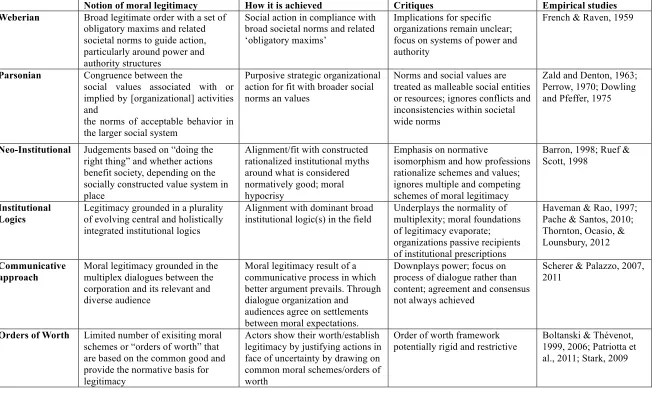
Table 1 provides a comparison of various theoretical understanding of moral legitimacy that will be discussed below. We take Ruef & Scott’s (1998) outline of legitimacy’s background as a starting point (Weber, Parsons, neo-institutional) yet at the same time extend these theoretical understandings and add more recent theoretical perspectives (institutional logics, communicative approach and orders of worth) that help us to construct our argument.
INSERT TABLE ONE HERE Weberian Approaches
The question of morality has been at the heart of debates about legitimacy since at least Max Weber (M. Weber, 1947, 1968). Weber argued social actors are typically guided by a legitimate order – which is made up by a set of 'obligatory maxims' of how people should act. These obligatory maxims are part of wider patterns of broad accepted societal norms which actors must appeal to make their forms of social action appear as legitimate. Weber’s study of the rise of bureaucracy is a well-known example where he sketches out how legitimacy is established through reference to moral claims. The increasing institutionalization of modern rationality as a dominant societal wide norm meant that exercises of authority no longer had to be grounded with reference to traditional norms, such as kinship (which was the case with
traditional authority), or inherent personal qualities (which is the case with personal charisma). Rather, authority could be gained with reference to increasing prevalent norms of rationalisation, and in particular bureaucratic rationalisation in society. Weber’s account of modern bureaucracy had a specific set of moral characteristics underpinning it, which gave the bureaucracy and its bureaucrats a degree of legitimacy. Additionally, Weber’s idea of value rationalization and the notion of ‘value spheres’ (see e.g. M. Weber, 1991) is helpful here for our later discussion of legitimacy. He argues that an action, position or decision “can be taken only from a standpoint, cultural beings must occupy a space from which they can understand the world and their place in it” (Oakes, 2003, p. 37). For Weber, several incommensurable value spheres (religion, the economy, politics, aesthetics, the erotic and intellectualism) are sufficiently abstract and generalizable that value positions are grounded on its principles. This resonates with the orders of worth perspective explained below, albeit that the latter explicitly discusses the combinatorial possibilities of a multiplicity of “orders of worth” (Friedland, 2014).
Parsonian Approaches
The classical Weberian account of legitimacy suggests that alignment with broad social norms, such as the norms of rationalization, is essential if broad forms of authority are to appear legitimate. Accounts of organizations influenced by Talcott Parsons have taken up the challenge of drawing out the implications for specific organizations. According to Parsons, legitimacy involved “the appraisal of action in terms of shared or common values” (Parsons, 1960, p. 175). Establishing legitimacy means ensuring that there is alignment between one’s actions and the subsystems of values in a society. Parsons (1956) argued that organizations typically seek to do this through their articulated goals or objects. Thus an organization would be seen as legitimate to the extent that it fitted with the broader values of a society (Dowling & Pfeffer, 1975). Documenting the fate of the YMCA in a secularizing America, Zald and Denton (1963) show how a misfit between the organization and broader social values occurred when the organization failed to keep pace with changes in the broader social values. In his study on the use of pigeons on a pharmaceutical production line, Perrow (1970) argued that an organization could respond to a misfit with established social values by either changing its own practices, transforming the social values themselves or creating a kind of symbolic-identification between an organization and these values (Dowling & Pfeffer, 1975). This Parsonian approach shares the assumption with Weber that legitimacy is established through reference to societal wide values. These are taken to be relatively unitary in nature and primarily expressed through communication. But this approach goes further in outlining how such norms might be a target for strategic action on the part of organizations.
Neo-Institutional Approaches
propagated by the professions. In their article, DiMaggio and Powell (1983) principally equate moral legitimacy with 'normative isomorphism' which is largely driven by the norms of professional groups3. In this sense, neo-institutionalists placed the quest for legitimacy at the heart of organizational activity. Following this approach, moral legitimacy largely refers to institutional myths which are produced by professional norms and values that are provided by accreditation bodies, rankings, industry standards, professional associations etc. However, professional groups would often compete for the most appropriate rational frameworks. For instance, Ruef and Scott (1998, p. 878) in their study on hospital survival in the San Francisco area trace out the struggle between different bodies of institutionalised myths propagated by two professional bodies – managers and medics. Although organizations are faced with “the application of generalized societal norms such as fair play”, they are still “particularly constrained by the existence of a variety of occupational and professional standards to which their participants subscribe”. Moral legitimacy is here seen as the alignment or fit with the “normative rules that introduce a prescriptive, evaluative, and obligatory dimension into social life” (Scott, 1995, p. 37).
Institutional logics
Studies of institutional logics have extended the sources of moral legitimacy beyond professional norms to a whole range of institutional logics, which are a function of wide-spread moral schemes (Friedland & Alford, 1991). The notion of institutional logics holistically integrates the coercive, normative, and cognitive aspects of institutions (Thornton & Ocasio, 1999). Fields are typically characterised by institutional logics, including the family, state, market, democracy and religion and the professions “which presume and performatively produce values” (Friedland, 2009, p. 907). Each of these logics makes different sets of practices, subjects and sets of values legitimate. This means that moral legitimacy is seen to result from an organization aligning itself with a dominant institutional logic in its field. For instance, the emergence of thrifts (a type of financial institutions targeting small savers and home-owners) was partly due to the widespread moral sentiment of progressivism embodied in this new organizational form (Haveman & Rao, 1997).
Neo-institutional scholars increasingly appreciate the complexity of institutional fields and the co-existence of multiple and often conflicting institutional logics (Greenwood, Diaz, Li, & Lorente, 2010; Greenwood, Raynard, Kodeih, Micelotta, & Lounsbury, 2011; Marquis & Lounsbury, 2007; Purdy & Gray, 2009; Zilber, 2002). Following Oliver’s (1991) typology of responses to institutional pressures, Pache and Santos (2010) have examined organizations’ repertoires for responding to conflicting institutional demands: Organizations can acquiesce to demands, compromise to achieve partial conformity, avoid conformity, defy these demands and engage in manipulation4. Hybrid organizational forms have been a popular site to study such responses (Battilana & Dorado, 2010; Tracey, Phillips, & Jarvis, 2011). For instance a multinational bank has to prove its market worth to compete on international financial
3 Some studies have used normative legitimacy rather than moral legitimacy (DiMaggio & Powell,
1991; Greenwood, Suddaby, & Hinings, 2002; Scott, 1995). We use moral legitimacy throughout this article.
4 The fifth response strategy, manipulation, “refers to the active attempt to alter the content of
markets, but adopt a moral scheme of community responsibility when dealing with local depositor communities (Peredo & Chrisman, 2006).
We argue that there are remaining challenges to viewing moral legitimacy as the outcome of conformity with (multiple) institutional logics. First, and most importantly, this approach leaves unexplained the role of audiences in legitimating organizational practices in the face of moral multiplexity. Moral legitimacy is typically seen as the product of audience assessment or a form of social judgment (e.g. Plunkett Tost, 2011), defined as “an evaluator’s decision or opinion about the social properties of an organization” (Bitektine, 2011, p. 152). This suggests a one-way relationship between organizations and their evaluating audiences who confer legitimacy. Second, while institutional approaches conceptualize legitimacy as a binary and dichotomous variable – organizations and practices are either legitimate or not – the role of audiences suggests that different audiences may apply different criteria for evaluating a practice, and legitimacy evaluations may be made on a continuum. Third, too often multiple logics/institutional demands are seen as a phenomenon that occurs in special conditions, such as fragmented fields (Pache & Santos, 2010). In the normal situation, each sphere is associated with a distinct logic (Friedland & Alford, 1991). Because each sphere is associated with a distinct logic, rather than a mixture of logics, it assumes that prescriptions of different logics are incompatible. This underplays, on the one hand, the normality of multiplexity and the resulting uncertainty (Gond & Leca, 2011), and on the other hand, the opportunities to exploit the frictions at the interplay of multiple orders of worth (Stark, 2009). Fourth, the specific moral foundations of legitimacy gets lost, namely the alignment with broad sets of values.
From Conformity to Dialogue: Communicative approach
As an alternative, Scherer and Palazzo’s communicative approach calls for rethinking processes of acquiring moral legitimacy based on the changing conditions of moral legitimacy, where ‘simple’ conformity with stable, pre-defined and wide-spread norms is no longer sufficient: “In the changing institutional context of global governance, this stable framework of law and moral custom is eroding and corporations have to find new ways of keeping their licences to operate” (Scherer & Palazzo, 2011, p. 907). While the notion of institutional logics collapses the normative, cognitive and regulative foundations into a single concept, Scherer and Palazzo point to the specifically moral foundations of legitimacy and their discursive basis. Moral legitimacy “is socially and argumentatively constructed by means of considering reasons to justify certain actions, practices, or institutions and is thus present in discourses between the corporation and its relevant publics” (Scherer & Palazzo, 2011, p. 915).
understand their role as political actors and become active participants in the direct democratic will formation of collective civil society actors. As Scherer & Palazzo (2007, p. 1109) put it “Some corporations do not simply follow powerful external expectations by complying with societal standards in legal and moral terms; they engage in discourses that aim at setting or redefining those standards and expectations in a changing, globalizing world and assume an enlarged political co-responsibility”.
To be sure, scholars have studied the discursive struggles of legitimation (Erkama & Vaara, 2010; Golant & Sillince, 2007) in which rhetorical strategies are not only used to frame conformity but also serve to manipulate meaning systems (Suddaby & Greenwood, 2005). The Habermasian approach, however, does not regard communication in terms of the more traditional “sender-receiver model” of communication. Instead it focuses on how legitimacy is negotiated between the organization and external actors in dialogue (Scherer et al., 2013) and the mechanisms by which actors can reach reasonable agreement over moral grounds (Reinecke & Ansari, 2015). This ascribes agency to both organizations and audiences in actively interpreting and influencing social acceptance and approval and, in some instances, transforming stakeholder pressures and institutional demands. Multi-stakeholder initiatives, such as the Forest Stewardship Council or Fairtrade, exemplify the deliberative approach that brings together a multitude of industry and civil society actors to jointly deliberate upon solutions to societal problems such as sustainable global forest management or fair trading (Reinecke & Ansari, 2015; Scherer & Palazzo, 2007).
becomes clear that justification and power interact (Boltanski, 2011; Gond, Barin Cruz, Raufflet, & Charron, 2016). In the regime of “justification” (‘dispute en justice’, Boltanski, 1990), in which disagreement in social interactions are subjected to the “imperative to justify,” domination may work to impose (or avoid) certain forms of justification (Boltanski, 2011). In the regime of “violence”, the “imperative to justify” may even be suspended through physical or symbolic violence. In the regime of “peace” stabilized by institutionalized and routinized situations (‘paix en justesse’, Boltanski, 1990), dominant justifications may prevail without being questioned. Yet, actors also have the reflexive competence and skill to question the moral justifications that underpin the allocation of worth (and domination). Third, the Habermasian model strongly rests on the idea of consensus and agreement among parties participating in the dialogue as the foundation of moral legitimacy. However, while the deliberative approach implies that dialogue always leads to consensus, in reality dialogue may result in different outcomes. The idea that the “force of the better argument wins” refers to the capability of rational actors to change their positions and preferences based on rational arguments presented. However, consensus may not always be possible. Positions among actors may be too antagonistic too arrive at agreement (Mouffe, 1993). Or, consensus may be weak, when agreements are tolerated but silently criticised. Or, agreement may only refer to smaller subsection of society, but practices may still not be accepted universally. Consensus may be limited in scope. This points to the fact that there may be different gradations on consensus reflecting different levels of agreements.
A Framework for Moral Justification: Orders of Worth
In order to better understand the process of communicative action and how moral legitimacy is co-achieved through dialogue, we draw on Luc Boltanski and Laurent Thévenot's (2006) orders of worth framework. At the heart of this framework is an analysis of how actors prove themselves legitimate in situations of moral uncertainty, where the criteria for judging moral legitimacy are unclear and contested. This provides an important complement to the communicative approach by offering a framework of different moral legitimacy criteria that actors draw upon through justification but also clues as to how disputes between multiple orders of worth may be resolved.
Orders of worth provide the normative basis for legitimacy as they determine the criteria for evaluating the worth of people, objects and practices, giving “direction to the ordinary sense of what is just” (Boltanski & Thévenot, 2006, p. 74). They are broad values-based ideal-type constructions that rest upon a particular conception of the common good. The orders of worth identified by Boltanski and Thévenot (2006) include inspired worth based on creativity and insight, domestic worth based on kinship and paternal authority, fame worth based on reputations, civic worth where the common good is constituted by the general will, market worth based on notions of reciprocal profit through trade, the industrial worth based on of efficiency and rational organization of society.
INSERT TABLE 2 HERE
Scholars have compared orders of worth with institutional logics (Brandl et al., 2014; Cloutier & Langley, 2013; Gond & Leca, 2011), which are similarly socially constructed, historical patterns comprised of cultural symbols, material practices, assumptions, values and beliefs. However, we suggest that the following aspects make orders of worth a particularly valuable framework for understanding moral legitimacy.
Focus on the moral: The orders of worth framework is based on a “conceptualization of justice that stresses and theorizes with depth the moral foundations of legitimacy” (Gond & Leca, 2011, p. 13). Actors need to justify that a certain practice promotes the ‘common good’ – being beneficial to all – rather than individual gain. Worthiness hence relates to a sense of justice so that the “notions of worth and of the common good are merged, combined in the higher common principle” (Boltanski & Thévenot, 2006, p. 77, emphasis original). The capability of reaching legitimate agreement through justifications thereby rests on the recognition of a shared, common humanity, which surpasses the particular interests of each participant in a dialogue. This places limits on what can be justified and called morally legitimate. Trade in human slaves, forced labour or the practice of eugenics are incompatible with the principle of common humanity and remain illegitimate states of worth.
Focus on agency and dialogical resources: The research programme of a pragmatist sociology of critique (Boltanski & Thévenot, 2006; Breviglieri, Lafaye, & Trom, 2009) has grown out of criticism of Bourdieu’s critical theory as a structuralist theory of domination, which treats actors as passive bearers of structures of domination (“social dopes”). It was concerned with the contradictions of Bourdieu’s critical sociology that wanted to be emancipatory, but saw the world as “constituted by ‘structures’, inhabited by the ‘laws of social fields’ and propelled by ‘forces’ that escape the consciousness of social actors” (Boltanski & Chiapello, 2005, p. x). The orders of worth framework aimed at elaborating a language that was capable of talking about people’s justifications and moral values “without reducing them to mere ideological masks of expressions of false consciousness” (Boltanski & Chiapello, 2005, p. xi). Because orders of worth are potentially always in conflict, in ongoing negotiations of moral legitimacy, actors become increasingly reflective about the assumptions and interpretive schema according to which situations are rendered legitimate (Boltanski & Thévenot, 2006, p. 134). This celebrates the critical competencies of reflective, skilled actors (e.g. ‘Love and Justice as Competences’, Boltanski, 1990), implying that actors learn to master a moral language game in which they draw on orders of worth as dialogical resources rather than internalise them as external socio-moral structures.
Higher common principle: Each order of worth involves a higher common principle which provides criteria for making comparisons and judging whether someone or something is worthy or not. For instance, market worth is associated with the higher common principle of competitiveness and price as a measure of worth.5 Encoded within each order of worth are situations where one is asked to demonstrate their worthiness in a particular peak moment which Boltanski and Thévenot call a Test. The test is hereby a theoretical instrument that encapsulates both relations of force and the exigency of legitimacy as justice. To assign worth, tests establish equivalencies according to general organising principles. For example, in a university exam, a payment (market worth) will not allow a student to pass as the exam
5 The example of the market world are taken from Boltanski and Thévenot's (2006, pp.193-203) own
tests for an alternative order of worth (civic worth). Yet, most situations are likely to involve a combination of several higher common principles, or moral criteria, at once.
Temporary truces: Moral legitimacy is a constant achievement that reflects provisional “ethical truces” (Reinecke & Ansari, 2015), between multiple orders of worth, with varying degrees of stability since the tension between multiple orders of worth is never completely resolved. The institutional world is not seen “as a functionally unified Gestalt but as a complex pattern governed by opposing forces and hence in continual flux” (Blau, 1974, p. 36). Rather than the exception, all organizational contexts are characterised by multiple orders of worth, creating uncertainty not only whether an actor or practice meets the criteria of worth, but creates uncertainty as to which order of worth should apply (Stark, 2009). Orders of worth are potentially always in conflict so that peaceful social order is a constant achievement of negotiating compromises and constructing agreement. For example, Stark (2009) stresses the heterarchy of the modern organization, where different organizational units are held accountable according to different principles of evaluation, yet the organization needs to function harmoniously as a whole. This creates an ongoing possibility to revoke compromises between orders of worth and create uncertainty.
Processual view of moral legitimacy: Moral legitimacy is not a binary either/or-type property but is a dynamic and evolving communicative process that is co-produced in dialogue with audiences. Organizations may have different degrees of worthiness according to different orders of worth, and thus different audiences valuing them differently. Using the translation from the French “grandeur” (=greatness), organizations can be ‘great’ or ‘small’ in each order of worth (Boltanski & Thévenot, 2006; Cloutier & Langley, 2013). For example, a successful mining company may have high market worth but low green worth. Organizations therefore need to draw on a range of different orders of worth at once and actively negotiate and re-negotiate the relations among them in order to construct moral legitimacy. The relationship between orders of worth becomes the focus for much activity on the part of various actors which seek to create, reinforce or disrupt what are seen as legitimate composite arrangements. Differential power and capability: Pragmatist sociology also offers a nuanced approach to power. Power depends on actors’ ability to effectively mobilise arguments from broader moral schemes. Yet, the ability to mobilize different orders of worth successfully is not equally distributed. Different orders of worth each provide a template for what is considered to be valuable and worthy, and who can be a legitimate spokesperson. Justifications are also justifications of power, which highlight the normative regulation of power and how moral justifications can alter power dynamics (Gond et al., 2016). By recourse to orders of worth justifications may infuse a social arrangement with worthiness, so that it does not appear like “the unjustifiable act of ‘domination’ that only serves the ‘personal interests’ of those who benefit from it” (Boltanski & Thévenot, 2006, p. 67). This explains why actors, even if endowed with reflective competence (Boltanski, 1990), will not always call moral legitimacy into question, but accept the dominance of particular orders of worth and their position within as ‘justified’ (Boltanski, 2011). For example, airline passengers in economy class typically do not question discrimination vis-à-vis passengers in business class. By paying less at the ‘test’ moment of purchasing a ticket, economy class passengers make a lesser investment into the market order of worth.
social movements (Benford & Snow, 2000). Instead, worthiness requires tangible investments if one wants to become a legitimate spokesperson on behalf of an order of worth, and effectively and credibly mobilize justifications (such as “investment” in a business class ticket). Through investing into objects and forms of relations that are deemed worthy within the order of worth in question, actors gain “grandeur” as alluded to in the French title “economies de la grandeur” (economies of worth/greatness). The type of investment is specified by an ‘investment formula’ that is specific to each order of worth (Boltanski & Thévenot, 2006). Investments can be costly since “self-centered pleasure […] has to be sacrificed to reach a higher state of worth” (Boltanski & Thévenot, 2006, p. 76).
In sum, the orders of worth framework provides a lens for addressing the question of how practices are justified under moral multiplexity that adds further nuance to the process of dialogue as in the communicative approach.
Towards a Process Model of Negotiation Moral Legitimacy
Building on the orders of worth perspective, we develop a process model of how moral legitimacy is co-achieved through justifications in dialogue with relevant audiences, which gives rise to different patterns of moral legitimacy (see Figure 1).
INSERT FIGURE ONE HERE
Uncertainty as a challenge to established worth: The “imperative to justify” emerges only in special ‘critical moments’ of dispute, when the legitimacy of an institutionalised ‘regime of peace’ (“paix en justesse”) is challenged and turns into a contested ‘regime of justification’ (“dispute en justice”), as Boltanski (2011)6 calls the different regimes of action. In most situations, actors are not called upon to engage in dialogue and give a moral account of themselves. This is because in the regime of peace qualifications of worth are temporarily stabilized as they are embedded within widely accepted organizational routines, objects or technologies. Conventions, often composed of compromises between orders of worth, thus create some temporary stability (Thévenot, 2001). But this “taken-for-granted” approach is maintained only so long as the question of justification is suspended” (Boltanski & Thévenot, 2006, pp. 136–7). The plurality of orders of worth creates a constant uncertainty that worthiness may be questioned from within alternative orders of worth. Taken-for-granted legitimacy in a “state of peace” is always only a temporary truce or “provisional settlement” (Kaplan & Murray, 2010). Below we outline situations which can trigger tension between multiple orders of worth.
Contentiousness due to social movements: The recent literature on social movements offers important clues about how moral legitimacy challenges are organized. Scholars have documented the ways in which social movements challenge existing moral orders “by encouraging innovation and by transforming what is seen as acceptable market practice” (King & Pearce, 2010). Social movement activists have been described as market rebels (Rao, 2009) or the engine of hegemonic struggle that offer resistance against hegemonic moral discourses (Spicer & Bohm, 2007). They also act as institutional entrepreneurs who mobilize alternative moral orders to devise, introduce and establish new practices (Helms, Oliver, &
6 “Justification” and “the state of peace” are part of Boltanski’s (1990) four quadrant schemata of
Webb, 2012; Levy & Scully, 2007; Maguire, Hardy, & Lawrence, 2004). For instance, social movements have championed new green industries and product markets (Lounsbury, Ventresca, & Hirsch, 2003; Weber, Heinze, & DeSoucey, 2008), created new lifestyles based on values of greenness and authenticity (Van Bommel & Spicer, 2011) or re-shaped the normative domain for what counts as a responsible company (Helms et al., 2012; Reinecke & Ansari, 2016). Common to all these works is the notion that social movements mobilize alternative moral schemes to challenge the moral legitimacy of existing arrangements and infuse new, potentially conflicting values.
Legitimacy crises triggered by external jolts: Taken-for-granted worthiness may also become attacked and other, competing orders of worth are evoked, in situations of ‘legitimacy crises’ (Kostova & Zaheer, 1999), such as when organizations are accused of illegitimate actions (Lamin & Zaheer, 2012; Lange & Washburn, 2012; Pfarrer, Decelles, Smith, & Taylor, 2008). For example, the 2011 Deepwater Horizon oil spill in the Gulf of Mexico revealed BP’s deficiency with regards to its green worth despite its green investment and re-branding as ‘Beyond Petroleum’. To regain moral legitimacy organizations need to engage in moral ‘repair work’. For instance, Patriotta and colleagues (2011) examined how an energy company involved in a nuclear incident tried to restore its moral legitimacy by engaging in public discourse, thereby using justifications from the market, civic, green and industrial orders of worth. Garud and colleagues (2010) explored how nuclear power had become represented as an ‘emission-free’, ‘clean’ and ‘sustainable’ technology to meet humanity’s energy demands as power companies increasingly mobilized the green order of worth. However, the 2011 nuclear disaster of Fukushima renewed the legitimacy crisis at global scale and turned nuclear power into a ‘dangerous’ and ultimately ‘destructive’ technology. The aftermath of the financial crisis led large parts of society, exemplified by the global Occupy movement, to question the taken-for-granted moral order underlying existing arrangements in financial markets. Private equity firms struggled to use market-based justifications to secure their moral legitimacy of (De Cock & Nyberg, 2016). These jolts destabilised the taken-for-grantedness of previous justifications.
Unique situations: A situation may also be relatively unique and unusual. Because of the lack of routines and technologies, actors are forced to make novel moral judgements with little prior guidance, including reflection on the moral criteria which they are using to make these judgements. For instance, Stark’s (2009) study of the change in the political system in Eastern Europe documents the moral uncertainty created due to competing sets of former socialist values versus the capitalist moral order. When new practices appear in established industries they also give rise to this moral uncertainty (Aldrich & Fiol, 1994). For instance, the rise of genetically engineered plants in the agricultural industry gave rise to a widespread debate about which moral criteria should be used to judge this practice (some using notions of efficiency, others appealing to notions such as the integrity of life).
Negotiating moral legitimacy through dialogue
When tensions between multiple orders of worth emerge, organizations can negotiate settlements between different moral expectations through dialogue with their audiences. Rather than passive normative compliance with stakeholder pressure, the need to engage in dialogue reflects a shift in “the modus of responsibility from the reactive model […] to a proactive concept of societal involvement” (Scherer & Palazzo, 2007, p. 1110). Dialogue prompts actors to be reflective about the moral assumptions they base their actions upon, and engages actors in acts of public justification by drawing on the 'moral grammar' of orders of worth (Boltanski & Thévenot, 2006). The opportunity to exploit the frictions at the interplay of multiple orders of worth (Stark, 2009) opens up multiple possibilities to reconcile conflict and reach a truce. Boltanski and Thévenot (2006) mainly focus on compromise as a way to bring multiple orders of worth together. Building on their work, we suggest that dialogical processes can result in transcendence or antagonism as alternative truces.
Negotiating a compromise
The first way to address conflicts arising from moral multiplexity is negotiating a compromise between two or more moral schemes. Compromise is created when “people agree to […] suspend a clash […] without settling it through recourse to a test in just one of the worlds” (Boltanski & Thévenot, 2006, p. 278). But agreement is reached without clarifying the principle of agreement itself. This can be achieved through the construction of moral hybrids which bring together different moral schemes on equal terms. For example, statements like “a faithful friend is a solvent client” indicates that arguments from the ‘market’ world are equated with ‘domestic’ world (Boltanski & Thévenot, 2006, p. 278). Or, consider the state bureaucracy that unites principles of ‘civic’ worth (collective justice, democracy) and principles of ‘industrial’ worth (hierarchy, division of labour, rule following).
How can corporations negotiate moral compromises with their audiences? Since it is often civil society actors “that map, filter, amplify, bundle, and transmit private problems, needs, and values” (Scherer & Palazzo, 2007, p. 1107), one way in which corporations increasingly seek to engage in direct dialogue with societal actors is through multi-stakeholder initiatives or platforms. For instance, Fairtrade Labelling is a multi-stakeholder umbrella organization that seeks to negotiate a “fair prices.” This combines market worth with civic and domestic worth as it uses market-based mechanisms to improve the livelihoods of producers and enable consumers to make more ethical choices (Reinecke, 2010). In studying the multi-stakeholder negotiation of fair prices, Reinecke and Ansari (2015) found that stakeholders may not be able to conclusively resolve conflicts, but can settle on “ethical truces” as a way to reach a reasonable agreement amidst conflicting parties.
the market for human genetic material (i.e. eggs and sperm) in the United States illustrates how compromise is possible without agreeing on the relevant order of worth. Whereas trading genetic material was unthinkable before, by now it has developed into a multi-billion dollar industry. Whereas the act of sperm donation has been legitimated in terms of market worth (i.e. making money from one’s body), for women egg donation has been framed as an altruistic act. It is the gift of life from one nurturing woman to the other (domestic worth). This gender division in the justification of donating eggs and sperm has allowed trade to become morally legitimate.
However, negotiating compromises may be an evolving process and result in different forms of agreement. In a study on the attempt to create of a market for weather derivatives, Huault & Rainelli-Weiss (2011) examine the struggle between industrial firms and market promoters to (unsuccessfully) negotiate a compromise. Market promoters tried to construct weather derivatives (market worth) as a solution to the threat of global warming (green worth). However, they failed to convey the legitimacy of their favoured solution – a market for financial weather derivatives – as serving a common interest. Unable to achieve commensuration, actors in the market for weather derivatives then suspended conflicting worldviews and adopted local solutions in the form of private arrangements and composite setups.
Organizations can also establish compromise by suspending the original conflict and reverting to a third scheme that does not solve the conflict but helps to bypass it. Anteby’s (2010) study of trade in human cadavers for medical education and research in the U.S. illustrates how the focus of moral assessment was shifted away from the question of categorical legitimacy of whether commerce in cadavers was morally legitimate toward the process of how trading should take place, hence evading more fundamental questions about the nature of the activity itself. This shift allowed professionals to define appropriate practices according to a scientific moral scheme and establish a morally legitimate market.
Negotiating Transcendence
The second, and more ambitious way to address conflicts arising from moral multiplexity aims at negotiating transcendent worth. Other than compromise, where conflict between orders of worth is temporarily stabilised but not conclusively resolved, transcendence involves the creation of a new moral reference point that aligns two or more existing schemes under a new, higher-level point of reference. Dialogue partners aim “at a common good that transcends the two different forms of worth in presence by including them both” (Boltanski & Thévenot, 2006, p. 278).
entirely new moral reference point for moral legitimacy: projective worth (Boltanski & Chiapello, 2005, p. 8, emphasis original).
The notion of sustainability or green worth (Lamont & Thévenot, 2000) is also a good example of how a new point of moral reference emerged through dialogue between various parties. Sustainability as an order of worth, in its ideal form, effectively moves the frame of judgment to an entirely new moral reference point, in this case that of sustainability and its consideration for “people, planet, profit” or the “triple bottom line” (Elkington, 1997). The way this new moral reference shapes corporate practice is illustrated in the emerging corporate practice of integrated reporting. Rather than keeping financial and sustainability reports separate, integrated reporting is a form of corporate disclosure that combines financial and non-financial reporting. As Van Bommel (2014) examined, the aim of integrated reporting is to ‘transcend’ the different logics of valuation and come to a novel holistic and integrated form of valuation of firms’ ‘worth’ where industrial, market, civic and green order of worth truly come together. But Van Bommel’s analysis also highlights the risk that integrated reporting gets captured by investors and accountants, leading to local private arrangements (see below) rather than transcendence, highlighting the difficulties in reaching the latter. As these examples show, over time, consensus around a higher common principle, agreement on forms of coordination and model tests can become established and institutionalized. Legitimate representations of worth emerge. However, reaching a more stable settlement on transcendence is an incremental process of change that cannot be negotiated by a single company but requires wider, societal-level changes. Negotiating parties are likely to operate within a grey area between hybridity and transcendence, making transcendence a regulative ideal rather than a reality of dialogue.
Negotiating Antagonism
The final way to settle conflicts arising from moral multiplexity is through antagonism. Rather than solving conflicts through what may be only fragile compromises, this entails strongly siding with one particular moral scheme and counter-posing it against another. In processes of dialogue this typically means adopting a moral position and instead of being willing to change, adjust and shift it as Habermasian accounts suggest ideally should happen (e.g. Scherer & Palazzo, 2007), the moral position becomes even more entrenched and clearly demarcated from other moral schemes. It is this process of sharpening up an order of worth through bringing it into direct conflict with another order that we call antagonism (Laclau & Mouffe, 1985). Antagonism does not allow a settlement which bridges across divides in a debate, but it does provide the ability to strengthen the commitment to a common order of worth amongst a narrower audience. This may overcome conflict between different schemes of worth by putting them into contrast with a third, commonly opposed scheme of worth such as targeting a “common enemy.”
movement could bring together a range of actors who were often committed to quite different schemes of worth. For instance, it was able to forge links between environmentalists (committed to a ‘green’ order of worth), small farmers (committed to a domestic order of worth), social justice campaigners (committed to a civic order of worth), and chefs (committed to an inspired order of worth) (Van Bommel & Spicer, 2011). By focusing on a commonly reviled order of worth associated with fast food (the industrial order), they were able to side-step many of the potential conflicts and forge a sense of commonality.
By forging strong unity, an antagonistic settlement avoids many of the problems associated with crafting reference to a higher order of worth or brokering a compromise between multiple orders of worth. But this also means that significant work goes into maintaining and reinforcing differences, rather than bridging differences between the groups who are involved and their moral schemes.
Legitimacy: Scope and certainty
In line with the orders of worth, we view legitimacy in continuous rather that in binary terms. This contrasts with the established notion of legitimacy (Deephouse & Suchman, 2008). This treats legitimacy as a dichotomous variable whereby “an organization’s form and behavior either fits or does not fit with the established social norms” (Bitektine, 2011, p. 161). Whereas regulative legitimacy (Scott, 1995) can be argued as being dichotomous (i.e. you are either in compliance or not) for moral legitimacy the verdict may be less clear. This is particularly true when considering the multiplicity of the evaluating audience and the more contentious nature of morality. Given multiple orders of worth each have their own criteria for worthiness, a practice may be regarded more or less worthy according to different orders of worth (Cloutier & Langley, 2013) – while different audiences privilege different orders of worth. With that in mind, we argue for a view of moral legitimacy as a continuous variable, and suggest that different dialogical settlements can create varying degrees of scope and certainty of moral legitimacy.
Scope
While legitimacy is often said to lie in the eye of the beholder, there are different “legitimating audiences” that may judge the same actions differently: “legitimacy is always assessed by multiple audiences and with respect to multiple activities” (Deephouse & Suchman, 2008, p. 62). Prior research has looked at how various stakeholder groups may favor different orders of worth and hence use different criteria to evaluate an organization or practice as legitimate or not (e.g. Lamin & Zaheer, 2012; Pontikes, 2012). Legitimacy is thus not a binary variable attributable to the organization but is contingent on the relationship with the evaluating audience. This points to the scope of moral legitimacy.
We define the scope of legitimacy as the degree to which dialogue seeks to appeal to the common good of a shared humanity, thus mobilizes an inclusive principle of justice so that efforts are made to try and accommodate the values of a plurality of legitimating audiences. Moral legitimacy is wide inscope if an organization or practice appeals to the common good of all. It is narrow in scope if justifications exclude those who do not already support the moral worth in question. An organization or practice with a narrow scope of moral legitimacy often appeals to one order of worth at the expense of other, and thus enjoys legitimacy only within the niche of those audiences who value this particular order of worth.
who benefit from it yet without laying claim to a common good at a wider societal level. It thus rests on shared interests and has no legitimacy beyond the parties involved or those outside the arrangement. Thus, parties to a “private arrangement” avoid drawing on a principle of justice that would be recognized outside the situation. What matters is whether the parties involved manage to establish equivalence among themselves: “[t] he concession that is made in a private arrangement consists precisely in avoiding recourse to a principle of justice: people come to terms among themselves—that is, locally” (Boltanski & Thévenot, 2006, p. 128). Thus, the “common” in common good is reduced to the parties involved in the private arrangement, rather than the parties’ membership of a shared humanity.
Contracts are a good example of private arrangements. Contracts are considered fair to parties if they were reached by voluntary agreement among consenting adults and are mutually beneficial, regardless of whether or not they also benefit outside parties. But even if private agreements have no adverse effects on outside audiences, their morality may remain highly questionable to a wider audience. Consider the controversial case of consensual cannibalism that has shocked the world and puzzled moral philosophers (e.g. Sandel, 2010). In 2004, a German cannibal found a voluntary victim on a website for people with cannibalism fetishes, and subsequently killed and ate the consenting victim while documenting the making of their agreement and subsequent deed on video.
In a “private arrangement,” parties may share a strong moral code but do not seek moral approval from others who may disagree. This resembles an “all or nothing” approach where parties who believe in the legitimacy of a practice are included while others are excluded. Other examples are religious sects, such as Scientology. Or the Sicilian Mafia, widely considered an illegal and immoral organization: It is built on a strong moral code that demarcates insiders from outsiders. The Mafia’s identity is “separate and distinct from that of the wider polis, which makes the mafioso ‘feel’ proudly different and foreign” from the social context in which they actually live (Di Maria & Falgares, 2013, p. 2). Yet, as an organization it excels at instilling strong values and world views in its members, establishing codes of conduct such as codes of honour, and strictly enforcing them.
To enjoy a broad scope of legitimacy, organizations need to appeal to the common good of multiple audiences. Mission-driven organizations such as charities, NGOs or intergovernmental organizations typically claim to promote the common good of wider society based on universal values. For instance, Oxfam, an international confederation of charitable organizations, focuses on the alleviation of global poverty. Its mission is justified based on the universality of human rights which, amongst others, includes the right to a sustainable livelihood or the right to life and security.
initiatives or platforms to address wider societal values. To be sure, business firms may be culpable to similar illegal and immoral acts as the Mafia, such as mining companies collaborating with corrupt regimes to profit from a country’s natural resources while violating the rights of indigenous people and polluting the environment (Banerjee, 2008; Gond, Palazzo, & Basu, 2009). However, the difference is that corporations justify their actions as contributing to the common good through CSR and job creation to legitimize their operations. Certainty
In addition to differences in scope, moral legitimacy can also be more or less certain. This is in line with Deephouse and Suchman (2008, p. 62) who argue that “legitimacy can vary in its certainty and security. Thus, a firm can become ‘more legitimate’ by becoming more clearly legitimate, more firmly legitimate, or both”. Certainty refers to the degree to which a practice is consistently and predictably judged as worthy within a particular order of worth. As table 2 showed earlier, the orders of worth framework consists of various factors that together help to establish the strength of worthiness/legitimacy. For instance, the states of worthiness have to be sufficiently present and states of deficiency avoided. The higher common principles need to be adhered to, both rhetorically as well as in actual practices. For instance, a high turnout and high percentage of the vote in a democratic election creates a strong democratic mandate for a particular party, or worthiness within the civic order of worth. Ultimately, “higher levels of worthiness can be achieved if one makes a significant, preferably irreversible, commitment to those beliefs, in the form of an investment, which is different from one world to the next. Those who make such an investment will be deemed to be particularly worthy (e.g. legitimate) in a given world and will be able to act as legitimate spokespersons on behalf of that world” (Cloutier & Langley, 2013, p. 367).
When multiple orders of worth are competing, certainty of the settlement increases when dialogue partners come to an agreement on either the order of worth that should apply to evaluate a practice, or can decide on the type of settlement. Certainty decreases however when actors retain conflicting views on either which order of worth to apply (as in fragile compromise situations) or when an investment in a particular order of worth is weak or conflicting. Audiences then have more reservations and conflicting judgements may increase doubts in the legitimacy of a practice.
Types of Moral Legitimacy emerging from Dialogue
Depending on the combination of scope and certainty, the kind of legitimacy that emerges from the dynamic interchange between a particular organization and its audiences varies. In what follows, we will argue that transcendence strategies give rise to strong legitimacy, compromise strategies create fragile legitimacy and antagonism creates niche legitimacy (See Figure 2).
INSERT FIGURE TWO ABOUT HERE ---Compromisecreates fragile legitimacy.
Compromise tends to create legitimacy which has a wide (inclusive) scope yet low levels of certainty. While compromises seek to make judgements based on objects stemming from different worlds compatible, they never fully resolve the tension between competing orders of worth. In a compromise, different parties stick to their preferred order of worth, but treat competing orders of worth as morally equivalent and compatible and “act as if they could rely upon a higher-level principle” (Boltanski & Thévenot, 1999, p. 375). Because the “as if” can easily be revoked, compromises tend to remain fragile and can easily be challenged.
This is illustrated in hybrid settlements, where organizations continue to struggle with competing external demands (Pache & Santos, 2010) and competing identities among internal constituencies (Kraatz & Block, 2008; Zilber, 2002). The literature on social-business hybrids highlights that tensions are never completely resolved in these settings, but organizations continue to navigate the tension between conflicting pressures (Battilana & Dorado, 2010; Jay, 2013). Today’s well-known Fairtrade label achieved greater alignment with the market order of worth. This increased sales but also renewed contestations among pioneers about the relevant order of worth to judge the worthiness of the label (Reinecke, 2010; VanderHoff Boersma, 2009). The Fairtrade example indicates that while compromises hold a potentially wide range of different schemes of justification and their attendant social worlds together, they are also inherently fragile or uncertain because they can always be potentially challenged from the perspective of one participating world. Even if stable agreement seems to have been reached, conflicts between deep seated assumptions held by market audiences and producer communities may be revealed in situations of change and crisis (Reinecke & Ansari, 2015). This means that the moral legitimacy which is produced by bringing these different worlds together is itself inherently fragile – it could be open to contestation at any potential moment. At times, dominant organizations may increase the certainty of their own legitimacy through compromises that keep critical voices at bay. Although CSR and its radical claims seemed at first to pose a threat to business and possible work as a Trojan horse, over time CSR has been absorbed by the ‘business case’ (Levy, Reinecke, & Manning, 2016). Environmental activists (committed to a ‘green’ order of worth), social justice activists (committed to a civic order of worth), and business organizations (committed to a market and/or industrial orders of worth) have often abandoned their oppositional stance in favour of cooperating for small gains. Corporations have used CSR practices such as social and environmental reporting “to reduce antagonism toward business from various social segments, obtaining consent for its actions and thereby (re)producing its ideological hegemony” (Spence, 2007, p. 856). However, CSR as a compromise is likely to remain fragile because corporations do not sincerely seek to align multiple orders of worth, but use it only instrumentally stabilize their own moral legitimacy vis-a-vis wider society.
of lower certainty, leading to a more fragile sense of moral legitimacy. Because legitimacy based on compromises requires actors to navigate tensions between multiple schemes, it remains relatively uncertain. Alignment between these different schemes may be called into question or unsettled, requiring renewed dialogue to maintain moral legitimacy. Thus the plurality of worlds is a constant source of potential disruption to the stability of a compromise.
Transcendence creates strong legitimacy
Transcendence leads to a stronger sense of moral legitimacy with wide scope and high levels of certainty. It enables a wide range of actors to transcend many previously established conflicts between different worlds, which are now seen as irrelevant. The legitimacy is broad in scope, i.e. inclusive. In contrast to compromises, transcendence not only establishes equivalences between orders of worth but creates principles that are firmly grounded in multiple orders of worth or even foundational for entirely new orders of worth. Thus, they are much stronger in certainty, i.e. at its core not constantly questioned and disrupted.
Consider how hybrid strategies may attempt to reach transcendence. Hybrid organizations, such as social enterprises, seek to bring notions of social welfare together with market-oriented behaviour (Tracey et al., 2011). As long as multiple moral schemes exist alongside one another without an attempt to integrate them the compromise may be revoked or questioned. Multiple moral schemes would need to become integrated in order for transcendence to be reached. For instance, new voluntary legal forms, such as the “benefit corporation” (B Corp) in the US or the community interest corporation (CIC) in the UK, seek to enable companies to include positive impact on society, workers, the community and the environment in addition to profit as their legally defined goals. By adopting these legal forms, corporations can pursue a mission to serve the common good of multiple stakeholders.
Because fewer disputes about orders of worth take place, a transcendent scheme creates greater certainty in moral legitimacy and increases the moral worth of an entity or practice. This reduces demands for justification, and by implication need for time consuming and costly dialogue in order to reconcile clashing moral positions.
Antagonism creates Niche Legitimacy
Antagonism contributes to a niche legitimacy which is narrow in scope yet can be high in certainty. Niche legitimacy is typically characterized by a strong sense of “us” against a “them”. The group of supporters for this antagonistic position can sometimes (but not exclusively) be relatively small in numbers, yet strong in force and conviction of their stance. This oppositional character of the antagonistic approach ignites a commitment. By developing justifications which are based on an opposition to other orders of worth, actors are able to establish a niche form of moral legitimacy which is accepted only by a relatively narrow group. In order to defend these schemes actors may seek to actively distance themselves from others who champion different orders of worth.
the sense of being alternative or resisting the dominant social order that “provides the energy and legitimacy for many civic movement organizations” (Spicer & Bohm, 2007, pp. 1681–2). This allows actors to develop and maintain a common antagonistic settlement. Proponents are unwilling to engage in meaningful dialogue with proponents of different orders of worth, as this could be seen as a sign of ‘selling out’. If proponents of Slow Food were to engage in dialogue with fast food operators they would run a significant risk of damaging the antagonistic agreement that holds together the different groups involved in Slow Food. For instance, in the case of US car brand Hummer, the scope of moral legitimacy may be low, yet the degree of certainty is high. For the enthusiastic and proud fans of this controversial car, moral legitimacy is certain as they are performing an act of patriotism and being truly and proudly American (Luedicke, Thompson, & Giesler, 2010). Yet, driving a Hummer enjoys only niche legitimacy since opponents may regard the driving of a Hummer as an environmentally degrading practice. Similar examples include radical activists, such as uncompromising veganarchists or members of the Animal Liberation Front who engage in direct action in the pursuit of animal rights alongside wider social revolution. While their values such as protecting animals, may in principle appeal to a wider group, radicals typically stand in opposition to mainstream society and are thus likely to alienate outsiders who are uncomfortable with the militant discourse and culture of the activists.
In other cases, certainty is achieved through a combination of moral values and violence. The Sicilian Mafia is a good example of this. Its legitimacy is extremely narrow in scope for it is based on separateness from its community and the state with its norms, laws and values. But it is high in certainty for its dogmatic culture demands obedience, loyalty and an extreme sense of belonging from its affiliates. Scholars have argued that this is achieved through the ideological framework of the family where father/son-type relationships create strong bonds based on loyalty, faith and protection that instil a strong emotional sense of belonging (Di Maria & Falgares, 2013). From within this moral and ideological framework of Mafia organization “even the most heinous crimes may be considered ‘right’ – from the sacrifice of their real family to the taking of their own lives” (Di Maria & Falgares, 2013, p. 3).
In sum, antagonistic settlements are exclusive, yet relatively stable as they may result in self-reinforcing processes whereby antagonism leads to enclaving that further sustains antagonism. The strong moral commitment that is needed to sustain antagonism may be driven either by strong moral enthusiasm, as often in the case of social movement activists, or by symbolic or actual violence, as in the case of the Mafia.
Discussion and Conclusion
In this paper, we have set out to explore how actors construct a sense of moral legitimacy around a practice when they are faced with multiple moral schemes. We have drawn on the orders of worth framework (Boltanski & Thévenot, 2006) to argue that creating moral legitimacy in the face of moral multiplexity involves engagement in a process of justification where actors aim to bring together different and often clashing orders of worth through a form of dialogue. We suggested that this dynamic dialogical process can yield a range of different moral truces. By providing a model which outlines how actors cope in contexts of moral multiplexity, we offer three contributions.
Contributions