warwick.ac.uk/lib-publications
Manuscript version: Submitted Version
The version presented here is the submitted version that may later be published elsewhere.
Persistent WRAP URL:
http://wrap.warwick.ac.uk/116107
How to cite:
Please refer to the repository item page, detailed above, for the most recent bibliographic citation information. If a published version is known of, the repository item page linked to above, will contain details on accessing it.
Copyright and reuse:
The Warwick Research Archive Portal (WRAP) makes this work by researchers of the University of Warwick available open access under the following conditions.
Copyright © and all moral rights to the version of the paper presented here belong to the individual author(s) and/or other copyright owners. To the extent reasonable and
practicable the material made available in WRAP has been checked for eligibility before being made available.
Copies of full items can be used for personal research or study, educational, or not-for-profit purposes without prior permission or charge. Provided that the authors, title and full
bibliographic details are credited, a hyperlink and/or URL is given for the original metadata page and the content is not changed in any way.
Publisher’s statement:
Please refer to the repository item page, publisher’s statement section, for further information.
Evaluation of the University of Warwick’s
outreach programme, UniTracks: The Warwick
Young Achievers' Programme:
Report 2:
The Big Deal Enterprise Challenge, 2016
Stephen M. Cullen
19th July, 2016
Centre for Educational Development, Appraisal and Researc h (CEDAR),
1
Contents
Executive Summary ... 4
1. Background ... 6
1.1 UniTracks and the Big Deal Enterprise Challenge competition ... 6
1.1.1. Details of the ten weeks of The Big Deal ... 7
2. The evaluation... 12
2.1 This evaluation report ... 12
2.1.1 Shooting the Past ... 13
3. The operation and impact of the Big Deal competition 2016 ... 15
3.1 Introduction ... 15
3.2 Business mentors’ views ... 15
3.2.1 Data collection ... 15
3.2.2 Business mentors – backgrounds and motivations ... 15
3.2.3 Induction and support... 17
3.2.4 The business mentors’ perceptions of the Big Deal Launch Days ... 19
3.2.5 Using the Brightside Blogs ... 25
3.2.6 Benefits for the Big Deal competitors ... 27
3.2.7 Business mentor suggestions for future Big Deal Competitions ... 29
3.3 Student mentors’ views ... 32
3.3.1 Student mentors – backgrounds and motivations... 32
3.3.2 Induction and support... 33
2
3.3.4 Using the Brightside Blogs ... 35
3.3.5 Benefits for the Big Deal competitors ... 36
3.3.6 Student mentor suggestions for future Big Deal Competitions ... 37
3.4 Teachers’ views ... 38
3.4.1 School staff views on the operation of the Big Deal competition ... 39
3.4.2 School staff view of the impact on school teams of taking part in the Big Deal ... 41
3.5 The Brightside Trust ... 42
3.5.1 The Brightside Trust’s mission and the Big Deal competition ... 43
3.5.2 Developing the Big Deal blogs... 44
3.5.3 Big Deal blogs site engagement and skills tracker ... 45
3.6 UniTracks’ school students’ views ... 48
3.6.1 The responses to the end of competition questionnaire ... 48
4. Summary and Recommendations ... 53
4.1 Overview ... 53
4.2 Recommendations ... 54
4.2.1 The role of schools and school staff ... 54
4.2.3 The workload commitment required from school students. ... 55
4.2.4 The role and engagement of student mentors ... 55
4.2.5 The Big Deal blogs ... 55
4.2.6 The Big Deal launch event (1) ... 56
4.2.7 The Big Deal launch event (2) ... 56
3
4.2.9 The Big Deal launch event (4) ... 57
4.2.10 The student mentor role ... 57
Appendix 1 ... 58
4
Executive Summary
The Big Deal competition is a core part of the University of Warwick’s UniTracks
programme, offering a ten week, supported, business and enterprise competition to UniTracks members in their first year of membership (Year 10 at school).
For 2016, 14 schools put forward teams, each of which had a maximum of five
UniTracks members. The competition was launched on 15/16th January, and was followed by nine weeks of weekly tasks, mentored via an online resource, before the Big Deal heats, held at the University of Warwick. The successful teams from the heats went through to the final, held on 18 April at the Shard in London.
The main elements of the competition were: the Launch event; the Brightside Blogs
focusing on a weekly schedule supported by the business and student mentors; the heats; the final.
The evaluation collected data from business mentors, student mentors, participating
young people, school staff, and the Brightside Trust. Findings are presented relating to each data source, with ten recommendations being made.
The recommendations relate to:
o The role of schools and school staff: the need for full commitment to support
their young people.
o The role of schools and school staff: the choice of which staff, from which
department, to support young people in a business and enterprise competition.
o The workload commitment required from school students. o The role and engagement of student mentors.
o The Big Deal blogs.
o The Big Deal launch event: communication between the Warwick Business
School and UniTracks’ teams and the business mentors, particularly prior to the event.
o The Big Deal launch event: a review of the timing and content of the
5 o The Big Deal launch event: school teams should come prepared with short
presentations covering their initial ideas of an entrepreneurial project. o The Big Deal launch event: it was suggested by some of the mentors that it
would be helpful if pre-launch contact between business and student mentor pairs could be arranged.
o The student mentor role: more rigorous recruiting to this important role, and
6
1. Background
1.1 UniTracks and the Big Deal Enterprise Challenge competition
UniTracks forms part of the University of Warwick’s widening participation programme. It engages between 440-520 school students from Years 10 – 13 (ages 14 – 18 years) in a programme of outreach and widening participation events aimed at talented/highly able
school students (top 10-5% nationally) from 23 schools. The participating school students all meet strict eligibility requirements relating, for example, to no parental history of higher education, residents of low participation neighbourhoods, and residents of areas of
significant socio-economic deprivation. The overriding aim of UniTracks is to support school student members to successfully apply to the UK’s most competitive, research intensive universities. The University has a background of being part of, and offering, widening participation programmes stretching back over a decade, and including the National Academy for Gifted and Talented Youth (NAGTY), and the International Gateway for Gifted Youth (IGGY)1.
Each of the UniTracks’ cohorts are offered differing interventions, events and support for each year of their membership. For the Year 10 members, 2015-2016, the three events offered in their first year of UniTracks membership were, the Launch Day at the University of Warwick (14th November, 2015), the Big Deal Enterprise Challenge (Big Deal)
Competition, and the ‘Shooting the Past’ Competition. In the event, although Shooting the Past was launched (23rd January, 2016), the competition was not run. Details of the small amount of evaluation data gathered, and the reasons behind the abandonment of Shooting the Past are contained in another, short, evaluation report.
7 The Big Deal competition was the main offer for the Year 10 UniTracks members in 2015-2016. It was described by the University’s ‘Widening Participation and Outreach Team’ as:
An enterprise challenge that forms a core part of Warwick’s UniTracks programme in the first year. It is a 10-week programme where school teams create and develop either a business or social enterprise idea with the assistance of a dedicated Business Mentor and Student Mentor. The Big Deal is organised by Warwick Business School (WBS), in conjunction with the educational charity the Brightside Trust2.
Fourteen schools put forward teams, each of which had a maximum of five UniTracks members. The competition was a ten week programme, with the launch on 15/16th January being followed by nine weeks of weekly tasks, mentored via an online resource, before the Big Deal heats, held at the University of Warwick. The successful teams from the heats went through to the final, held on 18 April at the Shard in London. The Big Deal was a combined UniTracks and Warwick Business School programme that also involved the Brightside Trust3, which provided the bespoke online mentoring system, ‘The Brightside Blogs’. The Big Deal competitors were supported by their schools, business mentors, and student mentors from the University of Warwick. Both business and student mentors had face-to-face contact with the school students over the two day launch event, in a single school-based meeting, and during the heats and, for the finalists, at the final.
1.1.1. Details of the ten weeks of The Big Deal
The main elements of the ten week competition were:
The Launch event.
8
The Brightside Blogs focusing on a weekly schedule supported by the business and
student mentors.
The heats.
The grand final.
Each is outlined here.
1.1.1.1The Launch Event
The Launch Event was held at the University over two days, Friday, 15th- Saturday, 16th January, 2016. The event started at 11:00 for the school teams. Friday was taken up with a series of presentations covering the competition: ‘Welcome to the Big Deal 2016’; ‘The Big Deal blogs’; ‘Top tips for becoming a successful team’; ‘Budgets’; ‘Presentation Skills’. The teams then went to their accommodation on the University campus, had dinner, and took part in evening events. During this period the teams were introduced to their
undergraduate student mentors, drawn from the University’s widening participation team, and their business mentors. The following day, Saturday, was taken up by an extended planning session, with each team beginning the process of developing a Big Deal business idea, led by their business mentor, supported by the student mentor.
1.1.1.2The Brightside Blogs
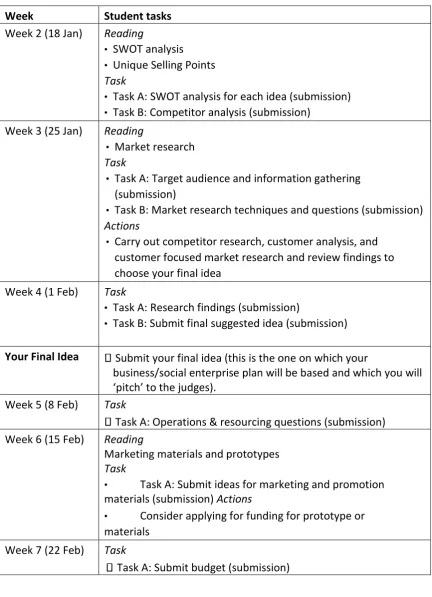
9 Table 1: Weekly Big Deal tasks
Week Student tasks
Week 2 (18 Jan) Reading
• SWOT analysis
• Unique Selling Points
Task
• Task A: SWOT analysis for each idea (submission)
• Task B: Competitor analysis (submission) Week 3 (25 Jan) Reading
• Market research
Task
• Task A: Target audience and information gathering (submission)
• Task B: Market research techniques and questions (submission)
Actions
• Carry out competitor research, customer analysis, and customer focused market research and review findings to choose your final idea
Week 4 (1 Feb) Task
• Task A: Research findings (submission)
• Task B: Submit final suggested idea (submission)
Your Final Idea Submit your final idea (this is the one on which your
business/social enterprise plan will be based and which you will ‘pitch’ to the judges).
Week 5 (8 Feb) Task
Task A: Operations & resourcing questions (submission) Week 6 (15 Feb)
Reading
Marketing materials and prototypes
Task
• Task A: Submit ideas for marketing and promotion materials (submission) Actions
• Consider applying for funding for prototype or materials
Week 7 (22 Feb) Task
10 Week 8 (29 Feb) Actions
• Prepare 1st draft of business or social enterprise plan
• Possible visit from mentors
Task
• 1st draft of business or social enterprise plan (submission) Week 9 (7 Mar) Task
• Update plan using feedback from mentor (submission)
Actions
• Think about presentation format Week 10 (14 Mar) Tasks
• Submit final plan using template (15 Mar - submission)
• Prepare, practice presentation and submit final version (18 Mar - submission) Submit feedback to mentors (18 Mar - submission)
Heat 1 (21/22 Mar)
Actions
• Round one of presentations
Tasks
• Submit learning outcomes (23 Mar - submission) Grand
Final (18 Apr)
• Travel to London
• Present presentation to judges
• Find out winners and all celebrate!
Afterwards • Complete online feedback form
Thank your mentors
• What will you do next?
1.1.1.3The Heats
The Big Deal heats were held at the University on Monday, 21st and Tuesday, 22nd March, with seven teams presenting on each day, following the same sequence of events. Each day started with teams having 50 minutes pre-event preparation with their business and
11
1.1.1.4The grand final
12
2. The evaluation
As part of its ongoing independent evaluation of the UniTracks programme, The Centre for Educational Development, Appraisal and Research (CEDAR) carried out an evaluation of the Big Deal competition, 2016. The evaluation of the UniTracks programme has three key aims:
To track attitudinal change among UniTracks members in relation to higher
education and post-higher education choices.
To assess the quality of UniTracks design at pupil, parent and teacher level.
To provide case studies of attainment at GCSE and A level.
The evaluation of the Big Deal competition focused on the second of the key evaluation aims, drawing upon the views of the Big Deal business mentors, the student mentors, and the student competitors.
2.1 This evaluation report
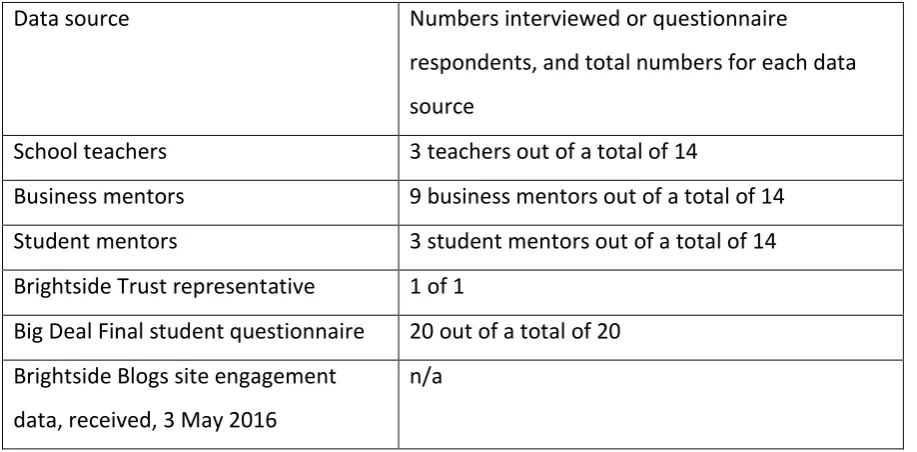
13 Table 2. Data Collection, Big Deal evaluation.
Data source Numbers interviewed or questionnaire
respondents, and total numbers for each data source
School teachers 3 teachers out of a total of 14
Business mentors 9 business mentors out of a total of 14 Student mentors 3 student mentors out of a total of 14
Brightside Trust representative 1 of 1
Big Deal Final student questionnaire 20 out of a total of 20
Brightside Blogs site engagement data, received, 3 May 2016
n/a
This report examines the Big Deal Competition 2016 from the perspective of mentors, teachers and school students. It also provides a summary of aspects of the operation of the Big Deal competition which may require additional attention in the future.
2.1.1 Shooting the Past
The UniTracks team decided prior to the start of the Big Deal competition that an additional offer would be made in 2016, for UniTracks members who wished to take part in a scheme that was not focused on business and entrepreneurship. Working with staff from the University’s Modern Records Centre (MRC) and the Department of Film and Television Studies, ‘Shooting the Past’ was developed. UniTracks members were told that Shooting the Past involved:
14 subject areas and related disciplines such as sociology and law! This is a great
opportunity for you to get hands-on experience in an internationally-renowned archive, experience a lecture and seminar by academics at the top of their field, and undertake an independent research project.’4
The theme of Shooting the Past was related to political protest in the UK in the late 20TH Century. Teams from five schools were recruited to Shooting the Past, and a launch day was held at the University on Saturday, 23rd January, which was to be followed by ten weeks of activities and a competition day on 8th April, 2016, when teams were expected to present a pitch for a film idea. CEDAR began to evaluate the programme, with 13 school students completing Shooting the Past Launch Day questionnaires, and two teachers being
interviewed in February. However, lack of interest resulted in the abandonment of Shooting the Past that month. Findings from the evaluation data that was collected are presented in a separate, short, evaluation report.
15
3. The operation and impact of the Big Deal competition 2016
3.1 Introduction
Part 3 of this report examines the data gathered from the business mentors, student mentors, teachers, the Brightside Trust, and the Big Deal competitors. The focus is on, firstly, the operation of the Big Deal competition, including features that were seen to have
worked well, and those that were seen to have worked less well. Secondly, the views of those involved regarding the impact on the school students of participation in the competition are presented.
3.2 Business mentors’ views
3.2.1 Data collection
The 14 business mentors were all invited to take part in the evaluation. Twelve of the business mentors agreed to be interviewed, with nine eventually being interviewed – eight by telephone and one face to face. Only one business mentor failed to respond to the requests for interview; the remaining business mentors were unable to arrange suitable times and dates for interview. The interviews were all recorded, with informed consent, fully transcribed and analysed. Interviews lasted between 20 and 40 minutes. The
interviewees were asked about their background and experience, how they came to take on the role of Big Deal mentor, induction and support for that role, their experience of contacts with their school team and teacher, the experience of e-mentoring, the benefits accruing to the UniTracks’ members resulting from being part of the Big Deal competition, and
suggestions for future developments of the role of Big Deal business mentor.
3.2.2 Business mentors – backgrounds and motivations
16 having experience of work with large, global businesses, start-up companies,
entrepreneurial initiatives, graduate recruitment, higher education, banking and finance, the healthcare sector and the European Commission. The majority of the business mentors were graduates of the University of Warwick, and some were current MBA students at WBS. There was, then, a very good fit between the experience and education backgrounds of the
interviewees and the role of business mentor for the Big Deal competition.
The business mentors were recruited to the Big Deal through LinkedIn contacts, direct contact from WBS, Warwick alumni information, and personal contacts through workplaces. They all gave very positive explanations regarding their decision to volunteer for the role (see Box 1).
Box 1: Illustrative explanations from business mentors of their motivations for the role.
I’m just really passionate about working with young people, and I just think it’s a great initiative to bring the practical application of business thinking and theory to life – so that’s what was driving my desire to be involved. (BM5)
I just really liked the idea of it, because I was the first person in my family to go to university, so to me it was a good fit, something that I could help with. (BM4)
I’ve always believed that education is the key to unlocking potential and t achieving things […] so when I heard about this Big Deal initiative it seemed interesting to me, and having worked last year with a group of students who were obviously coming from a
17 Explanations included, for example, having fulfilled the role before, and thought it
worthwhile; valuing university educational opportunities and wishing to support young people into university; wanting to put something back into society; and seeing the role as a useful and interesting break from work.
3.2.3 Induction and support
The business mentors were asked about the induction and support that was in place for their role. The interviewees discussed communications prior to the start of the Big Deal competition, the training available via the webinars, and general support from WBS for their role. The overall picture was positive, with the business mentors being satisfied with the pre-competition support and induction they received. A strongly positive account was, for example, given by one of the interviewees:
‘I’ve found the [Warwick] Business School people have been very efficient actually. They respond very quickly to anything, and they do keep you in touch very well. I e-mailed and said, “I’m interested” [in being a mentor], and then got a response saying, “this is what it is all about. Can we talk to you?”. And then I had a phone conversation with them and the next thing there was an online training session, which have been some time in November, which was pretty well organized.’ (BM1)
18 The webinars were well received, with some of the interviewees being strongly positive about them. For example, one business mentor commented: ‘it was really useful in the sense of understanding the online mentoring aspect, which was new to me, and I thought that Brightside did a brilliant job at bringing that to life,’ (BM5).
Despite the overall picture of good induction, a number of issues were raised in relation to communications, and the webinar sessions, by a minority of the business mentors. One interviewee was surprised by the length of time between expressing an interest in becoming a business mentor and being contacted; the interviewee remarked, ‘I think it was noticeable that the way it was handled was different from what I’d expect in a corporate environment’ (BM7). The same interviewee raised issues with the webinar induction:
‘There were some technical challenges, so they gave two different webinars, one which was an introduction, and then the second, which was more specifically about the [Brightside] blog. On the second one they had technical problems which meant you couldn’t continue, so in the end I just listened to a recording [later], and,
actually, it would have been much easier to have just done that in your own time. Of course, it wouldn’t have allowed for questions, but it was fairly clear, so I think that would have been a more practical way to do it really.’ (BM7)
19
3.2.4 The business mentors’ perceptions of the Big Deal Launch Days
The Big Deal competition was launched over two days, Friday, 15th- Saturday, 16th January, 2016, and was the first interaction between the business mentors, the student mentors and the Big Deal teams. The evaluation asked the business mentor interviewees about the preparation for the Launch Days, their role during the event, their experience of working with the young people, school staff, and the student mentors.
3.2.4.1 Preparing for the Launch Days
A number of issues were raised by the business mentor interviewees in relation to the preparatory information they received, and the roles of the school teachers and the student mentors. Of these three areas, the issue that was raised by the majority of the interviewees related to pre-event information and planning. The interviewees reported that they had not received sufficient information prior to the event, and that, as a result, last minute, on-site, preparation was needed on the Friday evening. A good, representative, account of this issue is presented in Box 2:
Box 2: Issues with information and preparation for the Launch Days
If I were to give a critique [of the Launch Days from the business mentors’ perspective] it would be around the [preparation], and, depending on how many of the mentors you are speaking to you might hear this again. A fair amount of us did discuss it. . It went fine, however, it was a bit of a surprise to a number of us that all day Saturday we were effectively in a room with our team, and we had a pretty high-level to-do list, and the show was ours. That could have been better explained to us, the expectations of us during the event. It ended up going fine, but myself and a couple of other people were a little bit scrabbling about on Friday night to put together some content […] It would improve the programme if, upfront, someone had said “you’re going to turn up, you’re
20 need to achieve the following things, and we are expecting you to make sure that
happens”, would have helped us to be better prepared. (BM2).
The need for good pre-event information was emphasized by another interviewee who noted that although the business mentors had wide experience relating to business, they did not, necessarily, have teaching experience, and planning was particularly important for a day’s contact with the young people.
3.2.4.2 Working with school staff on the Launch Days
A minority of the interviewees raised issues in relation to the role of the school staff who attended the Launch Days with the young people. The role of school staff was a wider issue, for some of the business mentors, beyond Launch Day, which is addressed below. The interviewees gave varying accounts of the contributions of different school staff at the Launch Days, with some being very pleased at the teacher contribution to making the Saturday contact successful, and other interviewees being less pleased. One business mentor described the input of a school teacher during the Saturday sessions:
‘They had a teacher with them when they were at Warwick who participated in the session we had. I thought that might be awkward, frankly, if you’ve got a
21 This positive experience can be contrasted with that of another business mentor who found that the team’s accompanying teacher found it difficult to give the young people full
freedom of interaction with the business mentor. The business mentor commented: ‘the teacher was often trying to come in and say what they should do, when I was trying to get them to say what they wanted to do,’ (BM1). Perhaps even more problematic was the case
raised by another business mentor, who said, ‘I have an issue with the teacher because the teacher is not available at all’ (BM3). The varying experience that the business mentors had of working with school staff on the Launch Days suggests that schools might be encouraged to consider carefully which staff they allocate to their school’s Big Deal teams. This issue was wider than school staff support for mentors on the Launch Days, and other aspects of school support for Big Deal teams are discussed later.
3.2.4.3 Working with student mentors on the Launch Days
The business mentor interviewees provided a range of accounts of working with the student mentors during the Launch Days. A third of the interviewees had no particular views on the role of their student mentors, with a third being positive, and a third, negative about the role and performance of the student mentor. The majority of the business mentors were, however, agreed that the student mentor role was an important one. One business mentor, for example, said:
22 The business mentors valued good communications, and an independent and pro-active approach to their role by student mentors. It was also seen to be important that the student mentors could quickly establish, and maintain, a good working relationship with the school students. One of the business mentors who was very pleased with their student mentor – ‘she’s been very proactive’ – talked about the good relationship that the student mentor
had built with the Big Deal school students, and the importance of the good communications she had with both the students and the business mentor (Box 3).
Box 3: Good communications between student mentor, business mentor, and a Big Deal team.
She [the student mentor] does interact quite well with the student team, and then I interact with her. Sometimes they will feed things to her, and I know she’s a little bit older than them (because they’re 15 and she’s 20, or something), and then she’ll come to me, and I say, “I’m talking to them about this and that – what do you think about it?”, and that actually seem to work quite well. And if I have to discuss things with them, there have been times when I’ve talked about
management models and stuff like that, I always make sure that she knows what I am doing, and I try and run it past her, and that sort of triangular thing seems to work quite well. (BM1).
The business mentor interviewees valued co-working with proactive, independent, student mentors who had good communication skills, and an ability to quickly establish, and
maintain, good links with the school students.
23 business mentor interviewees thought that their student mentors were not engaged
enough with the event, with the school students or the business mentor. The business mentors who raised these issue had expectations that student mentors would be active, engaged and able to contribute. One of the mentors described what they had hoped for, and expected, from their student mentor:
‘I would have thought the role of the student mentor was to be a little bit closer to the students [Big Deal competitors], to have obviously participated in the event the day before [Friday], so just perhaps bridge that process a little bit more from the Friday to the Saturday, and maybe they’d have a bit more of a rapport being that much younger […]. My expectation was that they would be involved on an equal level to me, but it seemed as if it was more like 90:10 [business mentor: student mentor], if that’ (BM6]
24 I’ve had from the students is that the student mentor hasn’t been that actively involved’ (BM6). There was, therefore, a suggestion that student mentors might need more support and training prior to the start of the Big Deal competition to ensure that they had a clearer idea of the importance of their role and were more equipped to fulfil that role.
3.2.4.4 Working with the UniTracks’ members on the Launch Days
All the business mentor interviewees enjoyed working with the UniTracks’ members on the Launch Days, while noting that the Saturday, in particular, represented a good deal of hard work – building a rapport with the young people, re-capping on the work that the teams had undertaken on the first day, working on the ideas that were generated, and beginning the process of getting the young people to think in business and entrepreneurial terms. Some parts of this process could, the business mentors found, be hard going. For example, one interviewee explained:
‘I’d kind of structured it around the agenda they’d been given and handled it with the materials (they’d given us some of the slides they’d used with the kids during the day [Friday]) and part of the brief was that they wanted us to re-cap on that. So, I did that first thing in the morning – that was a bit like pulling teeth, because you didn’t have the slides, because we only had the slides on paper…’ (BM7).
25 prepared with a number of initial business ideas – ‘they had lots of ideas, they were good on that. We did help them, but it was kind of a team effort, they were good on ideas and came up with a lot, which was positive’, (BM4). This, however, was the exception, and the lack of preparation, or thought, on the part of the Big Deal teams did impact upon the experience of the Saturday work: ‘My group really, really hadn’t come with any ideas at all, and it was a
big effort to get them even to come up with one idea, and they have come up with an idea, and since then they’ve had to come up with a few ideas’. (BM5). This evidence suggests that teams might be encouraged to undertake preparatory brain-storming around developing ideas they could take to the Launch Day work with their mentors.
3.2.5 Using the Brightside Blogs
The larger part of the Big Deal competition work was supported, and given structure, by the Brightside Big Deal blogs. This online platform provided a safe, moderated, forum for the school students to discuss their progress with the business and student mentors, and for the mentors to provide support for their teams as they carried out the weekly tasks (see Table 1 above). Overall, the business mentors’ experience of using the blogs was positive, and, with a few minor technical issues, the interviewees were pleased with the day-to-day use of the blogs by the teams, and the functionality of the platform. An example was given by one of the interviewees:
26 Some of the business mentors came to an agreed weekly timing for discussion and
preparation related to the tasks, with mentors being given input on fixed days, and, in turn, guaranteeing responses within a certain time frame. With an enthusiastic team, the blogs worked well, and, further, good interaction between the mentors and the teams could help
offset limited school support for teams. For example, one mentor said, ‘we contact each other almost every day […] I don’t want them to be disadvantaged because there’s not another adult [at the school] helping them’, (BM3). With the exception of one of the business mentor interviewees, they were very impressed by the levels of online
engagement shown by the Big Deal teams; and a representative example is given in Box 4.
Box 4: Working with a Big Deal team using the Brightside Blogs platform.
We agreed right at the beginning a timetable that if they let me have their stuff on a Thursday evening, I will get back to them on the Friday with my responses, and I’ve tried to stick to that. At the same time, I’ve said that if you need to raise something at other times, don’t feel you’ve got to be stuck to the Thursday schedule. I’ve actually been incredibly impressed, not only by their enthusiasm, but also with the ideas they’ve come up with, and also they’re taking on board that, when you ….OK, they’re 15 years old, they don’t understand all this business stuff, and what I’ve had to do (it’s quite hard for me) , so when I’m producing stuff for them I don’t use management speak […] but they’ve got ideas, and they’ve got concepts, and it seems to work quite well.
BM1
27 the weaknesses down in one case to the team’s lack of commitment, and, in the other case, to a lack of support from the school for their Big Deal students.
3.2.6 Benefits for the Big Deal competitors
The Big Deal competition aims to ensure that young people taking part in the competition
benefit in a number of ways. These include benefits relating, firstly, to the business and entrepreneurial focus of the competition; for example, creating a business or social enterprise, and learning about business and enterprise. In addition, it is intended that the young people will also benefit in relation to building their team skills, their confidence and thinking about their futures. The business mentor interviewees were asked what they thought had been the benefits, if any, that the young people had already, before the completion of the competition, enjoyed.
The interviewees identified a range of areas in which they felt that the Big Deal competitors were acquiring and enhancing their skill. These areas were: working to deadlines, delegating tasks, team working, organisation, planning and timing, and self-confidence. A good,
illustrative, account of the benefits accruing to one team is presented in Box 5.
Box 5: Learning and the Big Deal experience.
28 that this idea they’d got how it would be met, and I set them the task to go out and speak to as many people as possible and they came back having surveyed 75 people which surprised the hell out of me, I was expecting about 10, so really engaged and working as a team seems to be good considering they came into it not really knowing each other and they seem to be leveraging each other’s strengths as well; they’ve got one person who’s good at finance; one person who’s good at presentation; one person’s who’s more analytical.
(BM2)
The business mentors were also aware of the longer-term goal of UniTracks membership, that of increasing the number of gifted and talented school students, with non-university family backgrounds, applying for leading universities. The interviewees gave accounts of how they thought the Big Deal competition was contributing to the overall goal of the UniTracks programme. An example was:
‘The ten weeks is great but at the end of the day there is a wider aim to get them interested and engaged and wanting to go to these top universities so I was
29 In a similar vein, another interviewee stressed the importance of the student mentor role in this respect, with student mentors being, perhaps, more suited by age and recent
experience to talk to the school students about university choices, subject choices, and the transition from school to university.
3.2.7 Business mentor suggestions for future Big Deal Competitions
The business mentors provided a number of suggestions relating to future running of the Big Deal competition. These related to: preparation for the Launch Days, additional functions on the Brightside blogs platform, the role of student mentor, and the commitment required from participating schools and school staff.
The need for more information and time to prepare for the business mentors’ input into the Launch Days was covered above (3.2.4.1 Preparing for the Launch Days). This was a majority view on the part of the business mentor interviewees, who would have liked clearer
instructions regarding their role over the Launch Days, particularly the second day, which would then enable them to prepare more fully for their contact time with the Big Deal teams.
30 ‘I do think the blog is quite frustrating, in that you can’t forward, you can’t copy in, which means that … you can send a group message but you have to start it from scratch. So if, for example, the task has come to me from one of the students if I want to answer him and the others, or him and copy in the student mentor, I can’t
do that. So what I’ve ended up doing is if I do an individual response to one of the students then I copy it and send it to the student mentor because otherwise he doesn’t know what I’ve said and then I’ve been trying to encourage him to send me what’s he’s communicating to them because otherwise there’s a danger that we are saying different things and giving guidance that is not aligned, which then becomes very complicated when a student is trying to work out okay I’ve got two completely different points of view – what on earth do I do next? So that’s challenging and that would be easy for them to fix I’m sure. In moderation I understand why it’s
necessary but that then becomes kind of challenging in terms of flow.’
(BM7)
In addition, one interviewee made a specific request for a dedicated document storage area of the blogs, where all relevant documents relating to the running of the Big Deal
competition might be found.
31 That not all student mentors were pro-active, engaged, and willing to contribute throughout the competition was, the business mentors felt, an issue that needed some consideration.
There was a particular stress by some of the interviewees on the need to ensure more commitment from schools to support the young people. The importance of reliable contacts
with a named member of school staff who was fully committed to supporting the school Big Deal team was stressed, with one interviewee encapsulating the view (Box 6).
Box 6: The importance of school buy-in to Big Deal.
I think the school direction thing, I think that could be tighter in terms of perhaps in getting the schools from the very beginning to appoint someone to be the co-ordinator-type person would be good, and actually perhaps having one on the blog as well because one of the things is the blog’s got the student group on and it’s got the student mentor on and it’s got me on but I don’t know whether the person in the school sees any of that. They don’t necessarily need to get involved but it might be useful if they see what’s going on and I think that adds a connective link with the school, there being someone who is the key point of contact. There wouldn’t appear to me to be a hugely difficult thing at the beginning when the school decides to go in for this to say ‘right, this person is going to be the person who’s going to deal with it and they’re going to go to the launch, they’re going to go to the heats, they’re going to go to the final’ so they’ve got a commitment to be part of that process where at the moment it’s just something that’s going on, on the side lines. I’ve got the feeling that the student team is very committed, very active, running forward with this idea. I’m not totally convinced that there’s somebody in the school giving them the backing they need.
32 This view was also stressed by other interviewees, including, for example, one who noted that ‘I do think that it’s crucial having a teacher as an active stakeholder in this’ (BM5).
3.3 Student mentors’ views
All 14 student mentors were invited to be interviewed about their participation in the Big Deal competition. However, only three agreed to be interviewed. The three student mentor
interviewees provided interesting commentary on their experience of taking part in the Big Deal, covering their personal backgrounds and motivations for volunteering to take part in the Big Deal, the preparation they received to act as student mentors, the Launch Days and their work with the young people, the Brightside blogs, the benefits that they felt the young people were getting from the competition, and suggestions for future Big Deals. Although the data presented here represents the views of only three of the 14 student mentors, it does present a snapshot of the student mentor experience, and some interesting points were made by the interviewees.
3.3.1 Student mentors – backgrounds and motivations
33 ‘I’ve had the experience of benefiting from mentoring, so that’s why I was, like, OK, I had a good experience, and I recognized the importance, and how useful I found it, so I thought it seems like a good way I can help somebody else in a sphere where maybe I could use the good knowledge that I gained in my first year [of university].’ (SM2).
3.3.2 Induction and support
The interviewees all expressed satisfaction with the induction and preparation they were given prior to the start of the Big Deal competition. The only point that was raised was in relation to the Brightside blogs. The student mentors had no problems using the blogs site, - ‘the system was really easy to use’ (SM1) - but it was suggested that it might be useful if student mentors could have access to the platform prior to the training – ‘I think if I’d been able to log onto the site before that webinar [on the blogs] it would have made a lot more sense’ (SM3). The other interviewee said that they thought that the blogs ‘needed an update’ (SM2), as it looked dated.
3.3.3 Student mentors’ perceptions of the Big Deal Launch Days
34
3.3.3.1 Student mentors and their Big Deal teams at the Launch Days
The student mentor interviewees all saw a high level of value in the time that they spent with their Big Deal teams when they were showing them around the campus, talking to them about university, and eating lunch with them. It was during these interactions that the student mentors felt that they were helping to create a positive image of university life, and, particularly, the University of Warwick, for the young people. The student mentor
interviewees were ready to be pro-active with the young people, appreciating that they needed to take a lead in order to help the teams get the most out of the experience. For example, one student mentor explained:
‘They were quite quiet, but I prompted them, and asked them if they had any questions. It [looking around the campus] gave them more of a sense of what it is like, less of a mythical situation, and it makes it more of a reality, they can see themselves potentially being in a place like this, so I think it was a good experience for them.’ (SM2).
3.3.3.2 Student mentors working with business mentors
The three interviewees each had a different experience of working with their business mentor. Two of them felt that they had very good working relationships with their business mentors, and that they formed a good team to support the Big Deal teams. The third was not sure about the experience of the second day of the event, when the business mentor was leading on the day-long session with the team. Nonetheless, this student mentor still felt that they had a valuable role to play.
35 interviewees argued that they had a valuable role in this process, acting in an important supporting role for the business mentor:
‘They [the team] seemed to be a little uncomfortable with the business mentor when they first met, because he came from a more academic background maybe,
probably felt more like a teacher. They didn’t freely talk, they spoke to me, and I kind of fed back at times […] it was that they felt more comfortable speaking to the student mentor than the business mentor.’ (SM2)
There was a sense that the student mentors and the business mentors were having to develop their relationship, and their co-working in an ad-hoc fashion. This was, perhaps, inevitable, given the lack of time they had together prior to the start of the Launch events, and did not, in itself, lead to issues relating to the effectiveness of co-working to support the Big Deal teams. The effectiveness of that relationship was dependent on the approach of student and business mentors. For example, one student mentor commented: ‘the contact between us was quite easy to be honest, [the business mentor] and I got on really well, so we’d e-mail and communicate on the blog easily,’ (SM1).
3.3.4 Using the Brightside Blogs
36 A typical comment on the Brightside Blogs and the weekly tasks was:
‘I think it was good, it gave them small tasks, small deadlines, because they’ve never had … if you tell them to submit a business plan, that’s quite daunting, so I think it
was very good. It’s just that maybe some tasks should have been a bit longer, and others shorter. For example, my team needed an extension on their research, their market research, because they’d contacted a local business, and were going to meet them the following week, so the business mentor gave then a weekend and a day. Maybe that added a bit of flexibility, so someone could adjust it, but then still be on schedule for the end. Maybe that’s something that could be built in.’ (SM2).
The student mentor interviewees all said that they thought the weekly structure was ‘good in that it kept them working on it throughout’ (SM2), but some flexibility was necessary.
3.3.5 Benefits for the Big Deal competitors
37 Box 7: A student mentor’s view of benefits gained by a Big Deal team.
I know they really enjoyed it, being in the competition. I tried to make it a fun experience, and they all improved their confidence immediately from the moment I met them to the end of the project. The quietest member wouldn’t even talk to me at the start unless I asked him a direct question and by the end he was making jokes, just speaking up, so that definitely improved and they particularly were two members down right at the end, they were so determined to get it in, sort it out and re-distribute the work, so that aspect was so beneficial even though it was quite stressful for them, but I know they definitely enjoyed it and I know they found it a good experience.
(SM2)
3.3.6 Student mentor suggestions for future Big Deal Competitions
Each of the student mentor interviewees made suggestions for future offerings of the Big Deal competition. These suggestions related to school support, contact time between the teams and the student and business mentors, and the budgeting session during the Launch Day event. Two of the student mentor interviewees questioned whether the schools provided sufficient support for the young people. One team was only able to attend the Launch Days because of the support of parents, not the school. In this case, the school failed to send a teacher, or organize transport. Another school teacher merely dropped the young people off at the Launch Days, then picked up at the end of the event – ‘I’m pretty sure the teacher just dropped them off on the Friday night. I met him just to say “hi”, and then he left them in my hands’ (SM1). The third student mentor did, however, think that their team’s school was very supportive at all stages of the competition.
38 opportunity to show the young people around the campus, and answer their questions about the university. The same interviewee also wondered whether the heats event could be an overnight event, so that the teams would have longer to prepare their presentations with the help of business and student mentors.
Finally, all three of the student mentors raised the business planning session of the Launch Days event as being problematic. They reported that the young people found the
presentation difficult to follow, primarily because they had no prior understanding of the topic. As one student mentor explained:
‘I don’t think the budgeting session on the Launch was great, just because it was quite technical, and it was a lot of information, and they all looked a bit dazed (it kind of went over their heads). I think it needed to be simplified, especially at that point maybe that could have been a session that happened later on, maybe there could have been a recording that they released that they [the young people] could watch for more detail. But it was too complicated at that point, so they switched off, and didn’t really listen at all, because it was too complicated for them’ (SM2).
This was the view of the other interviewees, and suggests that some modifications might need to take place.
3.4 Teachers’ views
Teachers from all 14 schools were invited to be interviewed about their school’s
39 interviewed, but seven of these failed to keep telephone interview appointments, including additional appointments. In the end, only three teachers were interviewed. Although it is usually difficult to arrange telephone interviews with school staff, the fact that only three of 14 were eventually interviewed may have been a reflection of an issue that business
mentors and student mentors raised - that is a lack of commitment by some schools to the
Big Deal offer.
The three teacher interviews that were carried out provided data on the running and the impact of the Big Deal competition. Although the data is drawn from only three interviews, some interesting points were made by the teaching staff.
3.4.1 School staff views on the operation of the Big Deal competition
The three interviewees were very positive about the operation of the Big Deal competition. They expressed satisfaction about the Launch Days, the blogs, and the input of the business and student mentors. The only issues raised were in relation to time allowed for completing the weekly tasks, and concern over the budgeting session during the Launch Days.
3.4.1.1 School staff views on the Launch Days
40 of the Launch Days gave the opportunity for the young people to have time with the student mentors, who were valued by the school staff. One of the school staff, who had previous experience of the Big Deal competition when it did not have a residential element said: ‘This time I think it was much better in my opinion because it was spread over two days […] and there was a lot more opportunity for the students to meet their student mentors,’ (ST3).
The only issue raised in connection with the Launch Days related to the budgeting session. One school staff interviewee said: ‘The weakest point was the budgeting. The lecturer, I think because he’s used to speaking to adults and university students, it was a little bit over their heads, it didn’t reach them particularly well, and they did switch off a bit,’ (ST1). This issue was also raised by some of the student mentors.
4.4.1.2 School staff views on the Brightside blogs, and the weekly tasks
The school staff interviewees were positive in their views of the Brightside blogs, although there was some concern that the young people struggled to complete some tasks in the short time available, and a suggestion that there should be some increase in the time allowed.
The school staff interviewees all reported that they were happy with the functionality of the blogs platform – ‘we haven’t had any issues with it’ (ST1). One of the interviewees gave a good account of how they used a short weekly review session of the blog tasks to keep in touch with the young people’s progress:
41 time, they can come at lunchtime, after school – they just let me know when they need that extra time really.’
(ST2)
This is also a useful account of the way in which one school team was supported by school
staff. The issue of time was a prominent one, and while acknowledging that carrying out the weekly task successfully and to time was an important learning experience for the young people, there was still a sense that there could be a bit more flexibility in this area. One school staff member noted:
‘That is the only negative that we’ve found, the feedback I would like to give Big Deal is if it could be over a longer period of time, the weekly tasks. Some of them are massive, and to get them done in a week alongside their schoolwork is a tall order for them, because all of the team are doing extra GCSE work after school anyway, so it’s been a bit overwhelming in that respect.’ (ST1).
This issue was also raised by some of the student and business mentors, and the young people themselves.
3.4.2 School staff view of the impact on school teams of taking part in the Big Deal
42 making as part of the Big Deal competition. One of the interviewees said that ‘the skills these kids pick up during these challenges are absolutely priceless I think, not just the social aspect, but also the organisation, the communication between each other,’ (ST3). This was also the view of the other interviewees, while one of the school staff made a very clear link between their school teams’ aim of getting to university to the acquisition, as part of the Big
Deal, of university appropriate learning skills, and the experience of seeing and staying at a university; Box 8.
Box 8: The Big Deal experience and university – a school teacher’s view of the impact on school students.
It [Big Deal] gives them the opportunity of figuring out what university might be like. My point of view is that they’ve decided to go to university, where they’ll be left to their own devices, whereas at school we support them hugely – it’s just that learning curve isn’t it, to build up, and I think that the Big Deal helps them to realise what life would be like at university. […] I think the first thing is that they actually went to the university itself, and they could see what a lecture theatre looks like, and just the people milling about, the students themselves, and I think they got a little bit of a taster in the first place for that. (ST1)
3.5 The Brightside Trust
43 from the Brightside Trust’s viewpoint, of involvement with the Big Deal, and the
organisation and daily operation of the Big Deal blogs.
3.5.1 The Brightside Trust’s mission and the Big Deal competition
There was, of course, a notable commonality in the aims and goals of the Brightside Trust with that of UniTracks. As the interviewee put it:
‘In terms of helping young people make informed decision; helping them make confident decisions; giving them skills and networks to do that, that’s kind of the crux of our mission and vision, and I think that firs really well with this project [Big Deal]. Obviously a lot of this is about developing those skills, those team work skills, and being creative, but I think that being in contact with the business mentor, with the student mentor, is also giving them more information about university, giving them connections, and just more information to make those sort of decisions in the future.’ (BT1).
The interviewee further stressed the importance that Brightside attaches to the role of both business and student mentors in the competition, but also in the trust’s work in general (it runs 25-28 mentoring schemes aimed at school-age young people). The interviewee provided an account of the operation of the Big Deal blogs that stressed the willingness of both Brightside and Warwick Business School to develop the blogs as a platform to support the competition. It was this stress that provided the impetus to changes in the blogs
platform between 2014 and 2016. It is also the reason why the Brightside Trust wants mentors to be aware of the importance, but also the particular nature of, online mentoring. The interviewee gave an example of the difference between face-to-face and online
44 importance of being reliable, the difference between that communication online and if they were, for example, mentoring face-to-face, so the importance of active listening, and frequent replies to e-mails,’ (BT1).
3.5.2 Developing the Big Deal blogs
The Big Deal blogs have undergone change over the last two years, and further change is
planned for 2017. The interviewee explained that in previous years, the function of the blogs had been limited, largely acting as a platform from which the Big Deal teams could download weekly worksheets. However, it was recognized that this approach minimized the role of mentors, and failed to exploit the potential of an online mentoring programme. As a result, the Brightside Trust and WBS worked together to remove the barriers to the full use of the blogs platform:
‘The site wasn’t fully integrated into the project so teams could use the site to download worksheets but they didn’t have to interact with their mentor so not only is interacting with their mentor now part of their project, they have to do it in terms of winning the prize, but also they’re using the site right from the very beginning so they start using the site on that launch day and they use it throughout and I think they talk to their mentors a lot more. The mentors are a lot more involved in the idea generation now so that feels more natural for them to continue those conversations and I think also now that we’ve kind of moved along to activities, that’s helped.’ (BT1)
45 2016, which, in the opinion of the interviewee was a ‘real testament to adding that [new] structure, and the young people knowing what is expected of them,’ (BT1).
The process of review and improvement has been built into the Big Deal blogs, and further change is being planned for 2017:
‘We’re currently going through a whole technology overhaul at Brightside which is exciting for us and we’re getting a completely new site next year so if we’re running the Big Deal blogs again the site is going to look very different because it’s going to be amazing and the Big Deal will have been considered within that site planning so it means that things are going work much better, messaging within a group is going be a lot smoother.’ (BT1)
The aim is to continually seek ways of adding value to the Big Deal competition by
integrating the blogs as completely as possible with the daily operation of the competition, and ensuring that mentor-mentee contact is fully enabled.
3.5.3 Big Deal blogs site engagement and skills tracker
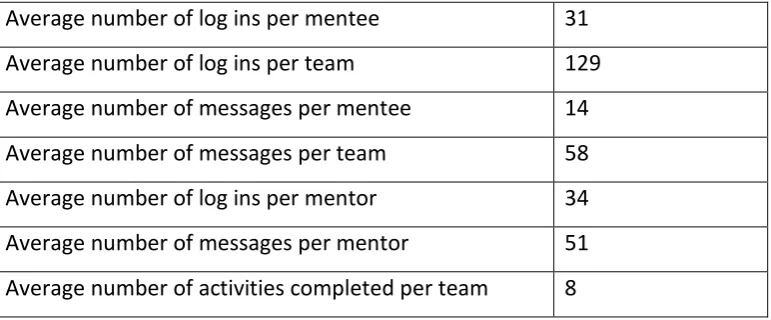
46 The teams were set 11 weekly activities to complete. Of the 14 teams, one team completed 10 activities, eight teams completed nine activities, three completed eight activities, one, seven activities, and one team completed only five activities, giving an average number of eight out of 11 activities completed by the teams. The Big Deal 2016 site engagement figures are presented in table 3.
Table 3: Big Deal Blogs 2016 Site Engagement
Average number of log ins per mentee 31
Average number of log ins per team 129 Average number of messages per mentee 14
Average number of messages per team 58
Average number of log ins per mentor 34
Average number of messages per mentor 51
Average number of activities completed per team 8
This level of engagement represented a notable increase in engagement with previous years, and was seen to reflect the changes introduced by the Brightside Trust5.
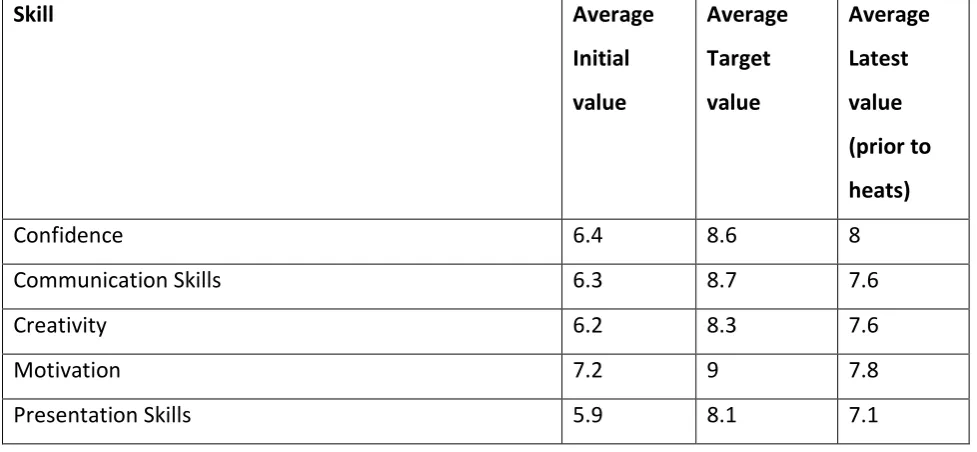
The young people who took part in the competition were also able to self-assess their perceptions of how participation in the Big Deal helped build key skills, relating to
confidence, communication skills, creativity, motivation and presentation skills. The data available to the evaluation related to the early period of the competition, prior to the heats, when all teams were still taking part. The data is presented in Table 4.
47 Table 4: Skills Tracker data. Self-assessed skills tracking by participating young people.
Skill Average
Initial
value
Average
Target
value
Average
Latest
value
(prior to
heats)
Confidence 6.4 8.6 8
Communication Skills 6.3 8.7 7.6
Creativity 6.2 8.3 7.6
Motivation 7.2 9 7.8
Presentation Skills 5.9 8.1 7.1
Data was also gathered in respect of the percentages of mentees who felt that they had improved their skills in key areas as a result of participating in the Big Deal competition. This data is presented in Table 5.
Table 5: Skills Tracker data relating to percentage of mentees (prior to the heats) who improved key skills.
% mentees who
improved skill
Confidence 88%
Communication Skills 74%
Creativity 73%
Motivation 54%
[image:50.595.72.461.582.743.2]48 Without further information it is difficult to interpret the skill tracker data, but it is
reasonable to assume that the comparatively low percentages of mentees who felt that they had improved their presentation skills, and boosted their confidence reflected their already high levels of confidence and presentation skills at the outset.
3.6 UniTracks’ school students’ views
Data gathering relating to the participant school students was limited to an end of competition questionnaire completed by the 20 Big Deal competitors at the competition final on 18th April, 2016. The questionnaire consisted of five point Likert scale response questions relating to: ‘Working in a Big Deal team’; ‘Working with the business mentor and the Bog Deal blog’; ‘Support from your school for your Big Deal team’; ‘The Big Deal
experience’; and ‘The Big Deal and your future’. In addition, there was an open question which invited respondents to add any additional comments. The questionnaire is
reproduced in Appendix 1. The findings presented here are an overview of the data,
presenting basic demographic details of the finalists, and a review of the key areas covered by the questionnaire. Respondents’ additional comments made in the open question section of the questionnaire (eight of the respondents completed that section) are also presented.
3.6.1 The responses to the end of competition questionnaire
3.6.1.1 Demographics
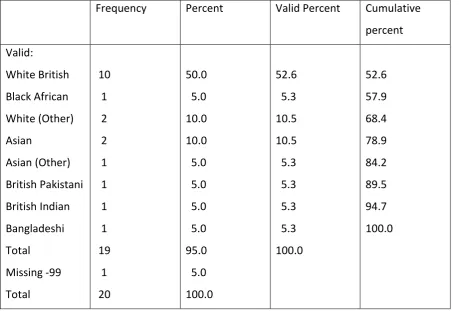
49 Table 6: Self-described ethnicity of Big Deal finalists.
Frequency Percent Valid Percent Cumulative percent Valid: White British Black African White (Other) Asian Asian (Other) British Pakistani British Indian Bangladeshi Total Missing -99 Total 10 1 2 2 1 1 1 1 19 1 20 50.0 5.0 10.0 10.0 5.0 5.0 5.0 5.0 95.0 5.0 100.0 52.6 5.3 10.5 10.5 5.3 5.3 5.3 5.3 100.0 52.6 57.9 68.4 78.9 84.2 89.5 94.7 100.0
3.6.1.2 Working in a Big Deal team
Team working skills represented one of the core skills that the Big Deal competition aims to build in participants. Seven discrete questions were asked in relation to team working with other young people. The questions related to: enjoyment from working together, the amount of effort respondents thought they had put into working with their team mates, whether they thought they had learnt new team working skills, new planning skills, new communications skills, new budgeting skills and new presentation skills from working together as a team. All the finalists responded to all questions.
50 with the statement regarding learning new presentation skills, and 100% ‘agree’ or ‘totally agree’ regarding ‘plenty of effort’ being put into the competition. Only two respondents returned a ‘disagree’ response, both for question 2f – ‘new budgeting skills’. Three of the respondents made open comment remarks relating to skills acquisition:
‘I have become a lot more confident in all aspects and have seen myself become a lot more professional.’
‘I feel that it has helped me to develop my skills and enhance my knowledge on how a business is run and how they work.’
‘This has been a great opportunity to try something new and learn new skills.’
These comments reflect the fact that there was overall response of 89% ‘agree’ or ‘totally agree’ with the key skills areas, indicating that the respondents were strongly positive in their perceptions of how much they had gained from team working in the Big Deal competition.
3.6.1.3 Working with the business mentor and the Big Deal blog.
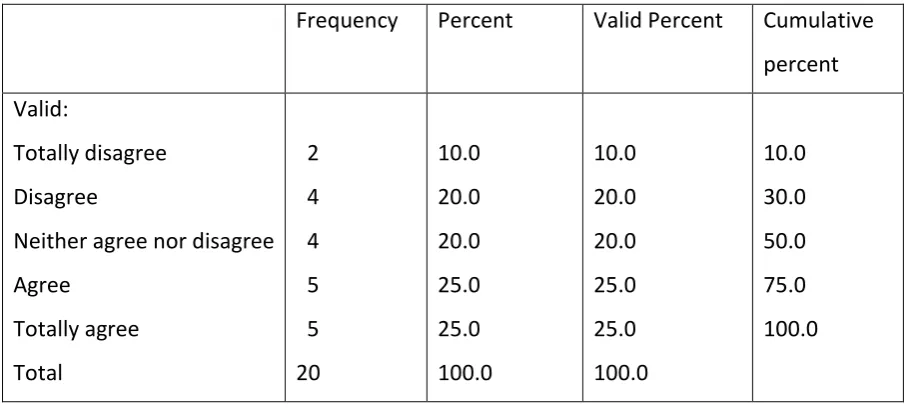
51 The responses to one question, 3e ‘your team had enough time to complete the weekly tasks’, stood out in that it had the lowest positive response, with only 50% of respondents agreeing or totally agreeing that there was enough time to complete the weekly tasks. This contrasted with the 85%-95% positive response rate to the other questions. The complete response rate is given in Table 7.
Table 7: Did your team have enough time to complete the weekly tasks?
Frequency Percent Valid Percent Cumulative percent
Valid:
Totally disagree Disagree
Neither agree nor disagree Agree Totally agree Total 2 4 4 5 5 20 10.0 20.0 20.0 25.0 25.0 100.0 10.0 20.0 20.0 25.0 25.0 100.0 10.0 30.0 50.0 75.0 100.0
Interestingly, of the eight respondents who made comments in response to the open question of the questionnaire, four of the finalists mentioned problems with timing. The comments were:
‘Need more time generally. Ten weeks is too short. A task to do every week is too hard for Y10 students.’
52 ‘One thing which I think they should be aware of is exams, as they clashed [with tasks].’
‘Timings of the events were wrong, which was not good especially if we have real or mock exams.’
Apart from the issue of time, the respondents were strongly positive about the value, responsiveness and advice of the business mentor using the Big Deal blog.
3.6.1.4 Support from school for Big Deal teams
The questionnaire asked four questions relating to school support for the Big Deal teams. These related to: good overall support, good individual teacher support, the interest of school peers in the competition, and how proud the school was of Big Deal team
achievements. The responses to all the questions were positive, ranging from 60% ‘agree’ and ‘strongly agree’ in relation to the questions of overall school support (which,
nevertheless also saw a 15% ‘disagree’, and 25% ‘neither agree nor disagree’ response), and peer interest, to 80% ‘agree’ and ‘disagree’ in relation to school pride in the team
achievement, and 70% for teacher support (which also saw a 20% ‘disagree’ response). The overall picture, then, was of satisfaction with school support.
3.6.1.5 The Big Deal experience
The questionnaire contained five questions relating to the Big Deal experience, skills development and future career choices. The responses suggest that taking part in the competition had a strongly positive effect on the in terms of skills development and
53 school, 95% ‘agreed’ or ‘totally agreed’, and only one respondent neither agreed nor
disagreed. Eighty-five percent of the respondents also ‘agreed’ or ‘totally agreed’ that the Big Deal had helped them develop skills that would be helpful in their post-school career. Interestingly, taking part in the competition had less of an effect on the young people’s ideas about their future (only 55% ‘agreed’ or ‘totally agreed’ with the statement), or on
being more interested in a business career, although 65% ‘agreed’ or ‘totally agreed’ with that statement.
3.6.1.6 The Big Deal and the young people’s perceptions of their future
As one might expect, the young people appear to have already had a good idea of which ‘A’ levels they want to study, and the experience of taking part in the Big Deal had a small impact, with only 4 of the respondents (n=19 for the question) ‘agreeing’ that taking part had ‘affected your views about what subjects you want to study at A level’. However, taking part in the competition did appear to have a strongly positive impact on the young people’s desire ‘to attend a top university’, with 90% (n=18, of 19) ‘agreeing’ or ‘totally agreeing’ with the statement. In terms of possible university degree choices, and, beyond university, career choices, the impact of taking part in the Big Deal was less pronounced. Only 35% (n=7, out of 19) thought that the competition had affected their views about degree choice, and 45% (n=9, of 19) ‘agreed’ or ‘totally agreed’ in relation to future career choices.
4. Summary and Recommendations
4.1 Overview